Five firewalls for intimacy, career privacy and an independent visit
Keep Long-Distance Dating Safe Around Two Careers
A two-career long-distance guide to call rhythms, work privacy, verification, visits, lodging, documents, money, consent, scripts and review points.
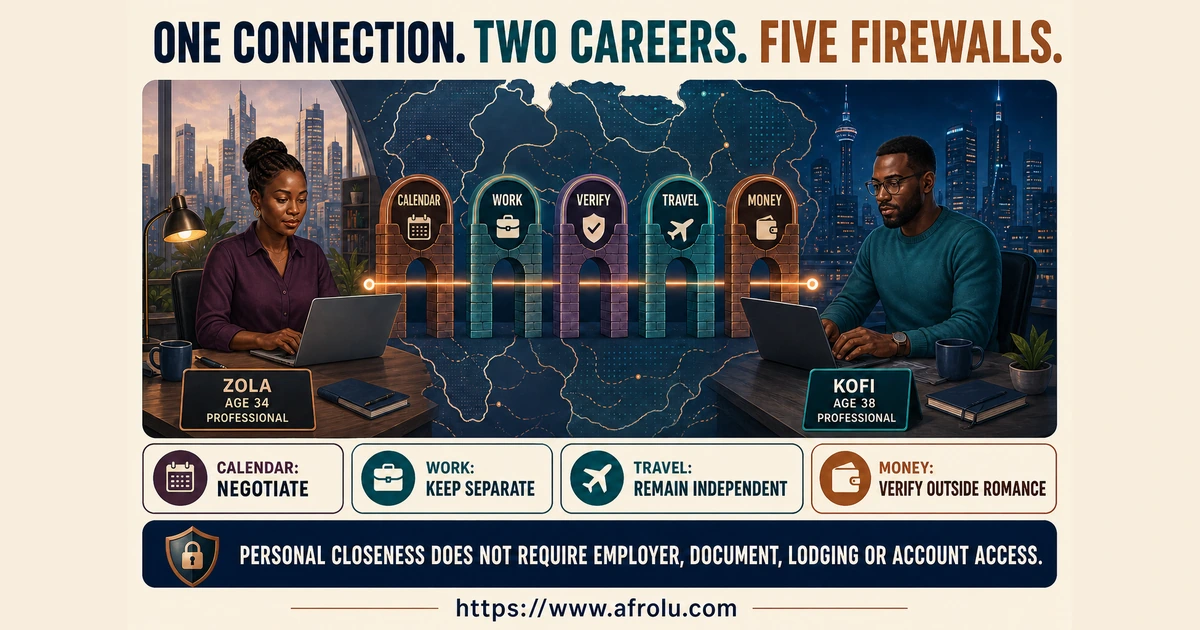
Connect deliberately across the map while keeping calendar, work systems, verification, travel and money independently protected.
Written and edited by Nia Kato · Profile Advice Editor
Build five firewalls. Negotiate a personal communication rhythm rather than monitoring calendars; keep employer devices, channels, colleagues and information outside romance; verify identity claims proportionately without exchanging documents; retain itinerary, lodging, local transport, check-in and return control; and keep transfers, investments and physical consent separate. Work friction may be repairable. Repeated one-sided availability, workplace intrusion, document pressure, financial urgency or punishment after no calls for reduced access and a different decision.
Distance and diaspora · Professionals
How can two professionals create intimacy across distance without turning availability, employer access, professional credibility, travel cost or shared plans into pressure?
A safe two-career long-distance relationship is a voluntary personal connection with a sustainable communication system, protected employer boundaries, proportionate verification, independently workable visits and separate control of documents, money and consent.
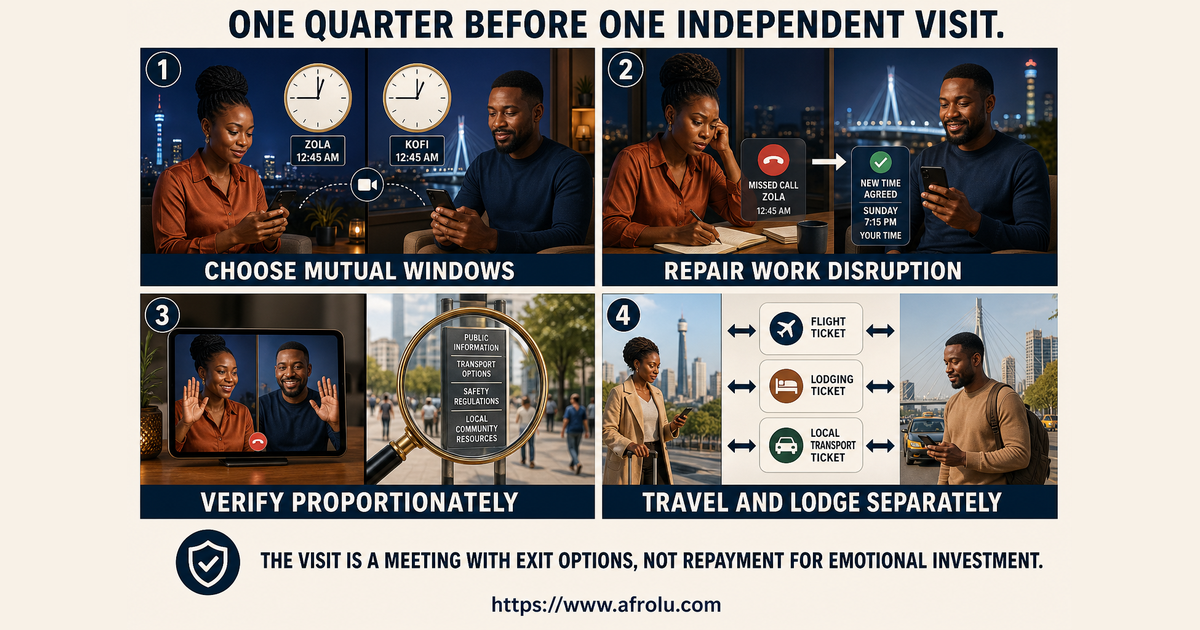
Zola and Kofi are fictional professionals, 34 and 38, in different cities. Across one quarter they negotiate two call windows, repair a work disruption and verify proportionately without employer access. Zola then makes a first visit with separate travel, lodging, money and transport. A changed physical answer is respected, and they review the next step only after she returns.
The two-career five-firewall plan
Let communication create closeness while access stays purpose-limited
Nia separates sustainable intimacy from calendar control, career intrusion, professional-status trust and travel dependence.
The plan installs five firewalls, follows a quarter of distance evidence and packs seven independent tickets for the first visit.
Calendar rhythm
Negotiate contact and repair around two working lives.
Career systems
Keep employer channels, people and records outside romance.
Verification and travel
Check proportionately and retain documents, lodging and return.
Money and consent
Let no transfer, trip or investment create access debt.
Keep intimacy personal and careers protected
Long-distance closeness does not require permanent access to either working life
Two professionals may build meaningful intimacy across cities, countries or time zones while each career continues to demand concentration, travel, confidentiality and rest. Long distance magnifies the temptation to treat availability as proof: instant replies, open calendars, live location or access to work systems can appear to reduce uncertainty. In practice, constant access may create fatigue and surveillance without verifying commitment. A safer relationship uses personal channels and agreed windows whose meaning both adults understand.
Career privacy includes more than a company password. Client names, internal documents, meeting links, employee directories, travel schedules, unpublished projects and colleague contact details may be confidential or simply inappropriate to share. A partner can know the broad shape of your work without entering its systems. Never send authentication codes or approve login prompts to reassure a romantic contact. Professional status also does not verify identity or relationship history by itself.
Distance requires deliberate communication, but frequency is not a universal measure of quality. Some pairs thrive with one deep scheduled call and asynchronous notes; others prefer brief daily contact. The important questions are whether the rhythm is mutual, sustainable and capable of supporting honest discussion and real plans. Work emergencies may disrupt it. A credible repair names the impact and proposes another complete window rather than using career prestige to make one adult permanently available on demand.
The relationship should remain voluntary when a visit is proposed. Each adult can verify travel details independently, retain documents and money, use separate lodging, control local transport and tell trusted support the itinerary. A first visit is not repayment for months of calls. Travel cost, visa effort, gifts or accommodation never supplies consent. If identity contradictions, financial urgency, workplace contact, threats or document pressure appears, prioritise access control and appropriate support over preserving the romantic narrative.
Install five practical firewalls
Separate connection from calendar control, work access, identity claims, travel and money
The calendar firewall replaces monitoring with negotiation. Share broad work constraints and choose personal call windows, response expectations and a cancellation method. Do not require screenshots of calendars, constant location or proof of every meeting. A professional can be honest without making their entire schedule inspectable. If time-zone arithmetic makes one person repeatedly lose sleep or work focus, rebalance the windows rather than calling the sacrifice commitment.
The work firewall keeps romance outside employer accounts, devices and networks. Use personal contact channels and never move a relationship argument into office email, collaboration software or colleague messages. Do not ask for client introductions, jobs, contracts or confidential records as proof of trust. If a partner contacts the workplace after a boundary, preserve records, alert appropriate internal support and restrict personal information that could enable further intrusion.
The verification firewall separates a plausible story from verified fact. Use live video, consistent history and independent public information in proportion to the next step. A corporate biography, uniform or conference badge can be copied or misrepresented. Do not exchange passport scans, visas, employment letters, bank statements or one-time codes to prove identity. Contradictions call for a pause and independent checks, not a reciprocal document contest.
Travel and money form the last two firewalls. Keep itinerary, lodging, local route, documents, return resources and a trusted check-in under your control. Book only what you can verify and afford to lose; avoid romantic investments, emergency transfers and joint ventures. During the visit, consent remains specific and can change. If either adult cannot leave without losing shelter, work access or essential funds, reduce dependence before the meeting.
Zola and Kofi build one quarter of evidence
A reliable distance system precedes a carefully bounded visit
Zola, 34, and Kofi, 38, were fictional professionals living in different African cities. They chose two scheduled calls each week and used asynchronous voice notes between them. Both kept employer email, calendars and devices outside the relationship. They shared broad work demands without sending screenshots or colleague details. A live video call and consistent public information supported continued conversation, while neither treated a job title as complete identity verification.
In the second month, Kofi missed a call during an unexpected client issue. He messaged when able, acknowledged that Zola had protected the time and proposed two new windows. They shifted one call so neither adult always carried the late hour. That repair mattered because it changed the system. Zola also made clear that contacting her office to find her would be unacceptable; Kofi accepted and kept all communication on their personal channel.
When they discussed a first visit, Zola booked her own flexible travel and staffed accommodation. She retained documents, return money and local transport, and a trusted person knew the itinerary. Kofi planned two public daytime meetings but did not add her to his work event or assume shared lodging. They agreed the visit was exploratory and that either adult could shorten it without debt, shame or an automatic end to respectful communication.
During the visit, Zola changed her answer about spending the evening together. Kofi accepted, helped identify a public transport option without controlling it and returned to his own accommodation. Afterward they reviewed the relationship rhythm and chose another quarter before discussing a longer visit. If either had demanded reimbursement, passport proof, workplace access or intimacy because of travel cost, the correct reading would have changed from relationship friction to access pressure.
Read what happens when work interrupts
Mutual flexibility differs from one-sided availability and career intrusion
Mutual flexibility means each career remains real. Call windows rotate when time zones create unequal cost, work peaks are communicated broadly and both adults can ask for rest. The relationship still receives dependable attention; flexibility is not a permanent exemption from planning. When closeness grows, each person can describe the rhythm and how disruptions are repaired without needing access to the other's calendar or workplace.
Work friction is an ordinary collision: a deadline runs late, travel changes or a shift moves. One incident may be disappointing and repairable. Look for early communication where possible, acknowledgement of impact and a concrete alternative. A recurring pattern can still be incompatible even without bad intent. If one person's role repeatedly prevents the relationship from meeting the other's needs, clarity may require resizing or closing rather than prosecuting the job.
One-sided availability occurs when only one adult sacrifices sleep, holidays or concentration, while the other chooses every window and calls the arrangement flexible. Ask for one observable rebalance. If the adult refuses or continually returns to convenience, the pattern shows how relationship labour is distributed. No job title makes another person's time less valuable, and no distance model succeeds when one career is expected to absorb all cost.
Career intrusion includes employer-channel contact, colleague outreach, login requests, confidential-document pressure, unapproved event attendance, client access and threats to professional reputation. It may also accompany financial grooming or surveillance. State a boundary where safe, secure personal and work systems, preserve relevant evidence and contact employer security, platform, legal or emergency support as appropriate. Severe threats do not need repetition before protection is justified.

Read who controls time and access when work interrupts the romantic plan.
Use language that protects two systems
A clear relationship request does not need a workplace back door
For rhythm, say: ‘I can offer Tuesday and Sunday calls; during work blocks I reply when I am free.’ Add a repair line: ‘If a call breaks, please send two replacement windows.’ This makes flexibility concrete. It also reveals whether the other adult can collaborate instead of demanding availability. You may choose more contact, but it should be an affirmative preference rather than a test backed by guilt or location monitoring.
For work, use: ‘My employer email, calendar, colleagues and systems are not dating channels.’ If contact crosses the line, state: ‘Do not contact my workplace again.’ You do not need to explain confidential details to prove that the boundary is legitimate. Where intrusion continues, stop engaging through the affected channel, preserve records and involve suitable workplace or legal support.
For verification and travel, say: ‘I verify independently and do not exchange passports, visas, employment letters or bank records.’ Then state visit scope: ‘I book my own travel and lodging, and this trip does not promise private time.’ A serious match can dislike the extra cost or feel disappointed, but they can still respect the arrangement. If the plan only works when one adult surrenders documents, shelter or return control, postpone it.
For money and consent, say: ‘I do not invest, lend or transfer funds through a new distance relationship,’ and ‘Travel and affection do not decide physical contact for me.’ Close with a review: ‘After the visit, let us assess rhythm, direction and the next practical step.’ A review should be able to produce continuation, revision or closure. It is not repayment for bookings already made.

Clarity reduces guesswork without turning either professional into an always-available employee of the relationship.
Own the visit's essential tickets
Independent logistics keep an in-person meeting voluntary
The verification ticket checks identity and itinerary in proportion to the visit without exposing sensitive documents. Confirm transport, accommodation and public meeting details through independent channels. Retain the physical and digital control of passports, visas, tickets and work devices. Share copies only with trusted support or authorities where genuinely required, not as romantic proof. A document request that arrives with urgency deserves a pause.
The lodging and local-route tickets protect shelter and movement. Separate accommodation lets either adult end private time without becoming homeless or stranded. Choose a staffed place you can verify, know the check-in and cancellation terms and retain a local return option. If you elect to stay together later, keep access to your documents, phone and funds and know how to leave without the host's permission.
The funds and check-in tickets keep the visit connected to independent support. Budget travel, food, communication, local transport and an emergency margin without borrowing essential work or household money. Tell a trusted person the itinerary, schedule check-ins and decide what they should do after a missed contact. Avoid public live-location posts that reveal an empty home or professional travel pattern.
The exit ticket is both practical and relational. Agree that either adult may shorten the meeting, decline sex or return to lodging without punishment. Keep a charged phone and the booking details accessible outside a work account. Afterward, review whether the in-person conduct matched the remote pattern. Travel cost may create disappointment; it cannot create a debt payable in access, exclusivity or another trip.

Own enough of the visit to change your mind without losing lodging, documents, work access or the route home.
Match medium to purpose
Communication quality comes from fit and conduct, not maximum immediacy
Asynchronous text or voice notes let adults answer around focus blocks and time zones, while tone may be misunderstood and difficult topics can stretch. Scheduled audio creates depth with lower visual demand. Video supplies richer cues and can reduce some identity uncertainty, but it still cannot verify every claim. Choose the medium for the conversation rather than making one channel a loyalty test.
Shared planning documents may help with visits, but use personal accounts and disclose only what the joint task needs. Remote co-working can create companionship without much conversation, yet it may blur career boundaries or expose screens. Never show confidential work material in the background. A low-contact week can protect a major deadline when both adults understand the reason and the next connection point.
Communication research suggests that how long-distance partners adapt media and disclosure can be associated with intimacy, and other research has found that long-distance relationships are not uniformly lower in reported quality than geographically close ones. These are population findings, not a forecast. A pair still needs truthful identity, compatible direction, mutual effort, safe access and repair. High intimacy can coexist with deception or financial pressure.
Run a rhythm review monthly or when work, time zone, health or travel changes. Ask whether both adults receive enough connection, whether one career carries unequal cost and whether the medium supports difficult honesty as well as affection. Continue when the system remains mutual. Revise frequency or channel when practical fit changes. Close when core needs conflict or when access, monitoring, threats or financial pressure replaces voluntary connection.
Eight two-career distance moments that need a firewall decision
A partner asks for screenshots of every meeting
The relationship needs an availability agreement, not an inspectable workday.
Share broad constraints and keep calendar access closed.A client issue breaks one planned window
The professional acknowledges the impact and offers two alternatives.
Assess the repair rather than treating one disruption as deception.Silence on personal chat triggers a work email
The boundary between relationship and employer systems has been bypassed.
State no workplace contact and preserve evidence.A senior role is offered as identity proof
Professional status can be misrepresented and does not verify private claims.
Check proportionately through independent sources.A scan is demanded before a visit
Sensitive documents are being framed as romantic trust.
Refuse and verify travel without document exchange.A joint venture is described as commitment
Distance and professional credibility are used to bypass due diligence.
Transfer nothing and seek independent advice.The visitor is expected to cancel separate lodging
Cost pressure would remove an independent place to stay.
Keep the booking or postpone the visit.Physical plans change during the visit
One adult no longer wants the anticipated private time.
Stop, use separate lodging and retain a respectful exit.Signs of mutual flexibility, work friction, imbalance and career intrusion
{'label': 'Rhythm', 'title': 'Call windows serve both careers', 'detail': 'Time-zone cost and focus blocks are distributed fairly.', 'reading': 'Mutual'}
{'label': 'Repair', 'title': 'Work disruption receives a complete alternative', 'detail': 'The next connection point becomes visible.', 'reading': 'Observable'}
{'label': 'Channels', 'title': 'Employer systems stay outside romance', 'detail': 'Personal contact never spills into workplace pressure.', 'reading': 'Firewalled'}
{'label': 'Verification', 'title': 'Claims are checked without document exchange', 'detail': 'Professional status is not treated as proof of everything.', 'reading': 'Proportionate'}
{'label': 'Privacy', 'title': 'Clients and colleagues remain protected', 'detail': 'The connection does not seek career leverage.', 'reading': 'Bounded'}
{'label': 'Travel', 'title': 'Itinerary and lodging remain independent', 'detail': 'Either adult can change or shorten the visit.', 'reading': 'Leaveable'}
{'label': 'Documents', 'title': 'Passports and work devices remain controlled', 'detail': 'No romantic proof requires sensitive access.', 'reading': 'Secure'}
{'label': 'Money', 'title': 'Transfers and ventures stay outside trust-building', 'detail': 'Future plans do not replace verification.', 'reading': 'Independent'}
{'label': 'Consent', 'title': 'Travel never creates physical debt', 'detail': 'A changed answer is accepted without punishment.', 'reading': 'Voluntary'}
{'label': 'Review', 'title': 'The system changes when careers change', 'detail': 'Both adults can continue, revise or close.', 'reading': 'Adaptive'}
Choose the next step from the five-firewall distance plan
| Situation | What it may mean | What to do next |
|---|---|---|
| Is the rhythm sustainable? | Fits: Both careers and rest retain workable space. Needs review: One window needs rebalancing. Stop: One adult is permanently on call. | Rotate cost and define reply expectations. |
| Did work friction receive repair? | Fits: Impact is named and alternatives are offered. Needs review: One follow-through remains pending. Stop: Career status excuses every broken plan. | Judge the next observable action. |
| Are work channels protected? | Fits: All romance stays on personal systems. Needs review: One accidental crossover is repaired. Stop: Employer or colleague contact bypasses a boundary. | Close access and alert suitable support. |
| Is verification proportionate? | Fits: Independent facts support the next modest step. Needs review: One contradiction needs checking. Stop: Documents, codes or confidential files are demanded. | Verify outside romance and disclose less. |
| Does the relationship seek career leverage? | Fits: Professional networks remain separate. Needs review: One request needs a limit. Stop: Jobs, clients or reputation are used as pressure. | Refuse and document intrusion. |
| Is the visit independently workable? | Fits: Travel, lodging and local return stand alone. Needs review: One booking needs completion. Stop: Shelter or return depends on the match. | Restore independence or postpone. |
| Are documents controlled? | Fits: Each adult retains identity and work records. Needs review: A copy request needs verification. Stop: Passports or devices are held as trust proof. | Refuse, secure records and seek help if withheld. |
| Is money outside the trust test? | Fits: Costs are transparent and independently affordable. Needs review: The plan needs a lower budget. Stop: Transfers, investments or emergencies create urgency. | Send nothing and verify separately. |
| Can consent change during travel? | Fits: A no changes the plan without punishment. Needs review: Disappointment needs respectful space. Stop: Cost or distance is used to demand access. | Use lodging and exit; seek support if pressured. |
| What does the system support? | Fits: One proportional connection or visit step. Needs review: Revise channel, frequency or logistics. Stop: Career, money or agency repeatedly shrinks. | Continue, redesign or close. |
Scripts for rhythm, work channels, verification, travel, money and consent
“I can offer Tuesday and Sunday calls; work blocks are offline time.”
“If a work issue breaks our call, please send two replacement windows.”
“My employer email, calendar, colleagues and systems are not dating channels.”
“I verify independently and do not exchange identity or employment documents.”
“I book my own itinerary and local route and keep my documents with me.”
“I am keeping separate accommodation for our first visit.”
“I do not lend, invest or transfer funds through a new distance relationship.”
“The visit does not promise private time, and I can change my answer.”
“We are planning two public meetings, not a complete shared weekend.”
“After the visit, let us assess rhythm, direction and one next step.”
Know the difference
The two-career long-distance rhythm console
Asynchronous updates and scheduled conversations can build closeness across two calendars without requiring continuous availability.
Employer systems, documents, travel, lodging and money remain independently protected, however serious the relationship feels.
Select a rhythm both careers can sustain; never use constant access or entry into a workplace system as proof of care.

Choose a rhythm that both careers can sustain, then review whether it still produces closeness and reliable plans.
Compare eight communication rhythms by intimacy and career load
| Type or dimension | What it describes | Best next question |
|---|---|---|
| Asynchronous text | ||
| Asynchronous voice notes | ||
| Scheduled audio call | ||
| Scheduled video | ||
| Personal shared plan | ||
| Remote co-working | ||
| Visit-planning rhythm | ||
| Planned low-contact week |
Build a two-career long-distance system in six moves
Negotiate the rhythm
Firewall both careers
Verify proportionately
Plan an independent visit
Protect money and consent
Review the system
Questions for rhythm, work firewalls, visits and review
Choose a few prompts that fit the moment. This is a reference library, not a list to complete.
Rhythm questions
Build connection around two real working lives.
- Which windows fit both?
- How fast are replies expected?
- What happens after a missed call?
- Does inconvenience rotate?
- When is work offline time?
Career-firewall questions
Keep personal intimacy outside employer systems.
- Which channels are personal?
- Which data is confidential?
- Are colleagues off limits?
- Can no office contact remain complete?
- Is career leverage appearing?
Visit questions
Own the essential tickets before travelling.
- What is verified independently?
- Where will I lodge?
- Who controls documents?
- How do I move locally?
- What is my exit plan?
Review questions
Compare intimacy, work load, money and agency.
- Is effort reciprocal?
- Does repair change conduct?
- Are finances separate?
- Can consent change?
- What is one next step?
What communication research and official career-safety guidance can support
Adapted media use can support intimacy across distance
Peer-reviewed communication research examined geographic separation, interpersonal media and intimacy in dating relationships. The practical lesson is to match channel and disclosure to purpose rather than demanding maximum contact.
Evidence limit: Association in a study cannot predict one couple's intimacy, honesty or safety.
Long-distance relationships are not uniformly lower quality
A peer-reviewed study reported similarities and differences in relationship quality, commitment and stability between long-distance and geographically close relationships. Distance alone is therefore not a verdict; conduct, fit and circumstances still matter.
Evidence limit: Group findings cannot establish the quality or future of an individual relationship.
Work schedules and work-life balance vary substantially
The International Labour Organization reviews working-time patterns and work-life balance around the world. A two-career relationship should negotiate rhythms around real working conditions instead of treating one schedule as universally flexible.
Evidence limit: Global labour evidence does not determine an individual's contract, rights or relationship capacity.
Basic security protects personal and professional accounts
CISA's Secure Our World guidance promotes strong passwords, multifactor authentication, software updates and phishing awareness. A partner should never need passwords, login approvals or employer access to prove trust.
Evidence limit: Security practices reduce exposure but cannot verify a romantic contact or guarantee an account is safe.
Distance and professional stories can precede money pressure
The U.S. Federal Trade Commission describes romance-scam patterns involving remote trust and later travel, medical or investment requests. Keep transfers, joint ventures and credentials outside a new or unverified connection.
Evidence limit: FTC reporting and remedies are U.S.-specific; use appropriate local financial, platform and legal channels.
Travel planning never fixes physical consent in advance
Healthdirect explains consent as knowingly and freely agreeing and says it can be withdrawn. Tickets, lodging, gifts, time invested or an earlier yes cannot supply permission during a visit.
Evidence limit: Healthdirect services and legal context are Australia-specific; use suitable local health, legal or emergency resources.
Six ways distance can turn professional credibility into unsafe access
Use a reviewed resource that matches the decision
This guide focuses on the relationship decision, so it does not rank dating apps. Check current prices, safety tools, and local availability before choosing a service.
Explore the guide library
Show more related guides
Continue with Afrolu
Show more Afrolu guides
Long-distance research and official work, cybersecurity, scam and consent sources
Afrolu reviewed these health, research, safety, or public guidance resources while editing this page. They support the behaviour and safety guidance; they do not diagnose any individual described by a reader.
Long-distance dating safety questions for professionals
How often should two busy professionals communicate long distance?
There is no universal frequency. Choose a rhythm that supplies enough connection while protecting both work schedules, sleep and rest. Define call windows, asynchronous contact, reply expectations and repair after disruption. Review whether the system remains mutual; maximum immediacy is not the same as intimacy or commitment.
Should partners share work calendars to build trust?
Not as a default. Share broad constraints and availability needed for relationship planning. Employer calendars may expose confidential people, meetings or locations, and inspectable schedules can become surveillance. Use personal systems and assess honesty through consistent conduct rather than continuous access.
Is a professional profile enough to verify a long-distance match?
No. A job title, corporate biography, badge or conference appearance can be incomplete or misrepresented and says little about private relationship claims. Use consistent live contact and proportionate independent public checks. Do not exchange passports, employment letters, bank records or one-time codes as proof.
What if work repeatedly interrupts our calls?
One disruption may be ordinary. Look for communication, acknowledgement and a concrete alternative. Rotate inconvenient time-zone windows. If one job permanently excuses every broken plan or only one adult adapts, the relationship may be incompatible or low effort even without intentional harm. Name the pattern and request one observable change.
Should a long-distance partner contact my workplace?
Only with clear permission and a legitimate reason. Romantic arguments, welfare checks without evidence or attempts to bypass personal silence do not justify employer contact. State the boundary, preserve records and involve appropriate workplace security, legal or emergency support if intrusion or threats continue.
Do first visits require separate lodging?
Separate staffed lodging is a strong way to preserve sleep, privacy and the ability to change plans, especially for a first meeting. No universal rule can guarantee safety, but relying entirely on a match for shelter increases dependence. Retain documents, return funds, local transport and a trusted check-in.
Should I send a passport scan before visiting?
Do not exchange sensitive identity documents as romantic proof. Verify bookings and any official travel requirements through the relevant provider or authority. Keep passport and visa control with the traveller. A match's urgency or reciprocal disclosure does not make unnecessary document sharing safe.
Can one partner pay for the entire visit?
It is possible, but financial dependence can reduce exit options and create hidden expectations. Discuss scope and refund terms, retain enough independent money for lodging and return, and remember that payment creates no physical or relationship obligation. Postpone if the visit cannot remain voluntary.
How do we protect consent after months of intimate calls?
Treat every in-person act as a new, current decision. Remote intimacy, explicit messages, travel, gifts and shared expectations do not fix consent in advance. Either adult may slow or stop. Separate lodging, independent transport and an agreed visit scope make a changed answer easier to carry out.
When should a professional long-distance relationship end?
Consider closing when core direction or communication needs conflict, the rhythm consistently damages one career, or deception, workplace intrusion, surveillance, document pressure, financial urgency, threats or disregard for consent appears. A concise ending is enough; secure systems and seek suitable support if contact persists.
One thing to do now
Let the relationship cross distance while both careers keep their firewalls
Apply five firewalls: calendar, work, verification, travel and money. Continue when communication is mutual, career limits hold, repairs change conduct and every visit remains leaveable. Revise channel or rhythm when practical fit changes. Close when core needs conflict or workplace intrusion, surveillance, document pressure, financial grooming, threats or disregard for consent reduces agency.