Five stations for a fresh connection that keeps Nairobi life intact
Begin Low-Pressure Long-Distance Dating from Nairobi
Start low-pressure long-distance dating from Nairobi with clear stages, privacy and money limits, a first-visit plan, consent scripts and review points.

A low-pressure distance line still needs named stops and independent exits.
Written and edited by Miriam Otieno · Senior Kenya Editor
Use five stations. Share present capacity without handing over a private past; choose a contact rhythm that protects work, sleep and local support; gather ordinary evidence through proportionate checks; keep documents, credentials, location and money separate; then plan a public Nairobi visit whose lodging, transport, funds and return the visitor controls. Long distance names geography and low pressure names pace—serious or casual direction and exclusivity need separate answers. Put the review in the calendar. A new beginning should expand choice, not demand constant availability, secret urgency, transfers, private arrival or relocation promises. Travel never creates consent or commitment.
Distance and diaspora · New Relationship Starters
How can a Nairobi adult build a low-pressure long-distance connection through clear stations while keeping a fresh start grounded and leaveable?
Low-pressure long-distance dating from Nairobi is adult connection across geography that expands through manageable, reviewable stages while local life, private history, data, money and city logistics remain protected. It is not low effort, constant contact or a promise that distance will close.
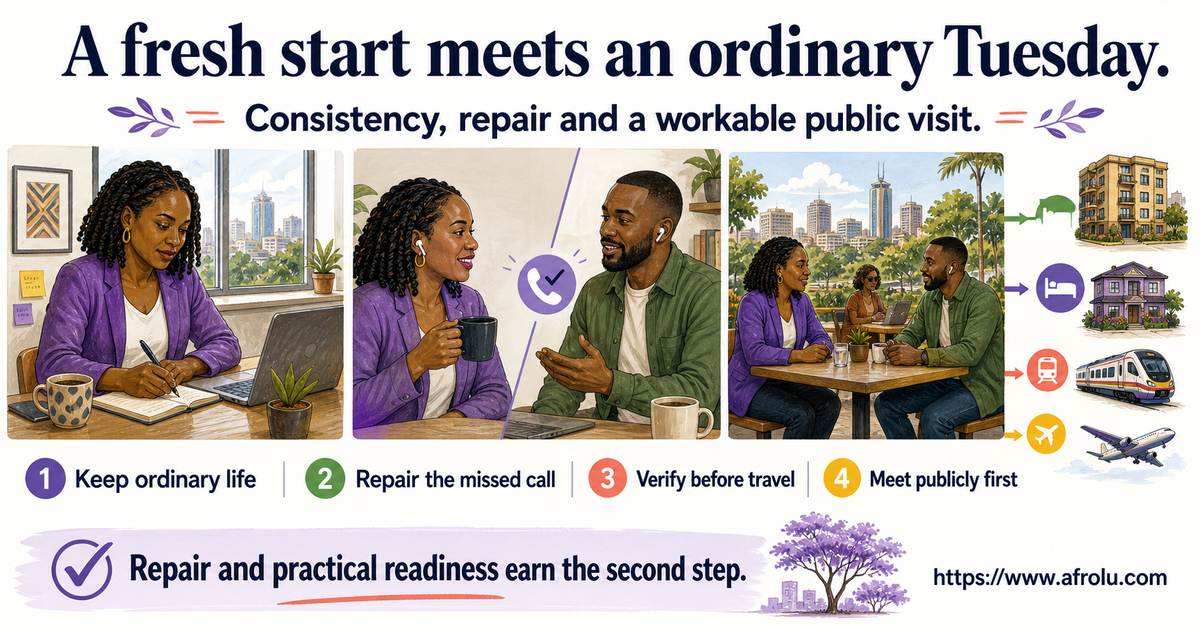
Wanjiku and Theo are fictional adults, 35 and 38. Wanjiku shares present capacity without disclosing the event behind her new chapter. They choose a light rhythm, repair an ordinary missed call and state serious direction without exclusivity. Theo later funds and controls his Nairobi lodging and return; their first meeting stays public and earns only one more date.
The five-station Nairobi distance line
Let a new chapter move without leaving its local life behind
Miriam separates present capacity, contact, evidence, city arrival and review so a distant connection never becomes the only route forward.
The line uses five stations, four behavioural platforms and a six-stop Nairobi arrival card without naming one district or venue as universally safe.
Start and rhythm
Share present capacity and choose contact that protects Nairobi life.
Ordinary evidence
Include repair, imperfect weeks and proportionate independent checks.
Nairobi arrival
Keep public place, lodging, movement, money and return independent.
Relationship review
Continue, revise, define or exit after ordinary reality.
Begin from present capacity
A new journey is context, not a reason to rush or disclose a private archive
A new journey may mean returning after heartbreak, divorce, bereavement, caregiving, relocation, illness, faith change, identity discovery or years outside dating. It can also mean trying long-distance dating for the first time. The phrase should not invite assumptions. State the present facts that affect the connection: available time, desired direction, important boundaries and any decision that needs qualified advice. Personal history can be shared voluntarily when trust and relevance grow.
Long-distance dating names geography. Low pressure names pace. Neither says whether the relationship is serious, casual, exclusive or safe. A new starter may prefer frequent calls or sparse messages, serious intent or genuine uncertainty. Write each choice on its own line. This prevents emotional novelty from turning a remote routine into a commitment that the adults have never defined.
Nairobi is the local life that must remain visible. Work, friends, family, community, rest and ordinary city movement should continue while a distant relationship develops. A connection that requires abandoning local support, hiding every question or remaining constantly online may feel intense without becoming more compatible. Healthy distance adds a relationship to a life; it does not ask hope to replace the systems that make choice possible.
This guide is for adults and is not therapy, travel, immigration, legal, financial or emergency advice. It cannot determine whether someone is ready after a difficult experience or whether a match is safe. Use qualified support where the past or present requires it. The narrower method here is practical: protect present capacity, build a sustainable rhythm, gather ordinary evidence, keep money and data separate, plan a public Nairobi visit and review the relationship at a named station.
Board the five-station distance line
Start, rhythm, evidence, visit and review should not arrive at once
At the start station, each adult names capacity. What does low pressure mean in hours, messages and dates? Which past context is relevant now? What relationship direction is being explored? Which permissions stay closed? Avoid using a fresh-beginning story to demand reassurance. The new starter can say, ‘I am ready for a small connection and not ready to discuss that part of my past.’ The other adult may accept or decline without cross-examination.
At the rhythm station, choose a baseline that protects sleep, work and Nairobi life: perhaps one planned call and lighter messages. Agree how changes are handled. Constant contact can temporarily soothe uncertainty while making every delay feel dangerous. A smaller rhythm creates room to observe whether attention returns reliably after ordinary interruptions. The goal is not distance endurance; it is a communication pattern both people can actually keep.
At the evidence station, include ordinary days, modest disagreements and proportionate identity checks. Use platform calls where helpful and verify material claims through sources you choose. Do not exchange identity documents, passwords, financial records or live location. Research on long-distance communication suggests that mediated interaction and idealisation can shape intimacy. The practical response is neither cynicism nor surveillance; it is more varied evidence and honest uncertainty.
The visit and review stations turn hope into practical decisions. A Nairobi meeting should begin publicly, with controlled time, lodging, transport, money, communication and return. Travel never creates consent or commitment. After the visit, pause before deciding. Compare ordinary fit, repair, boundaries and how each adult handled changed expectations. Continue, revise, define or close one layer at a time rather than using expense to justify a future neither person has freely chosen.
Wanjiku and Theo meet an ordinary Tuesday
A repaired interruption becomes stronger evidence than a perfect beginning
Wanjiku, 35, lives in Nairobi and is dating after a long personal reset. Theo, 38, lives elsewhere. They are fictional adults who meet online. Wanjiku says she is open to partnership but wants a low-pressure start. She does not describe the event that created her new chapter. Theo asks what pace works now rather than requesting the past as proof. They choose one Sunday call and occasional messages, keeping both workweeks intact.
On an ordinary Tuesday, Theo forgets a planned voice note after a difficult day. Wanjiku notices old uncertainty rising and sends one factual message instead of monitoring his status: ‘I did not hear from you; is Thursday still our plan?’ Theo apologises, names what he can offer and calls on Thursday. He does not demand that she minimise the impact, and she does not ask for continuous location. The repair provides specific evidence without making either adult perfect.
They discuss direction and structure after three weeks. Both are exploring serious partnership, but they remain non-exclusive and agree to revisit it after meeting. Wanjiku keeps her home, workplace and detailed movements private. Theo does not ask for fare or relocation support. They each verify material profile claims through ordinary independent routes. Where facts remain unknown, they name the limit instead of treating hope as confirmation.
Theo later plans a Nairobi visit he can fund and change independently. He controls lodging and return. Wanjiku identifies a staffed daytime venue directly, arranges her own transport and gives a trusted person the broad plan. Their first meeting has a clear end. When chemistry is good, they still keep private lodging separate. Two days later they review the visit and choose one more public meeting. A new journey remains new because no one forces it to become a destination.
Read four kinds of movement
Calm progress, an honest pause, low effort and an escape rush need different decisions
Calm progress completes small stations. The contact rhythm is sustainable, ordinary questions receive answers, a missed plan receives repair and local life remains intact. Direction and structure can be discussed without demanding certainty. The adults know what will be reviewed next. Low pressure comes from manageable exposure and reciprocal effort, not from pretending that a distant connection has no consequences.
An honest pause states what is happening and what remains available. A person may need time for grief, work, health, family or a changed travel plan. They do not owe private detail, but they can name whether the romantic connection continues and when they expect to know more. The other adult can decide whether waiting fits. A pause is not a promise that investment will be rewarded.
Low effort preserves attention without carrying a stage. Messages return when convenient, calls are repeatedly postponed and the same person asks every relationship question. The adult may be kind and still unavailable. Reduce investment, request one concrete action and observe. If no mutual next step appears, the pattern is the answer. A new starter need not accept indefinite distance to prove patience or healing.
An escape rush makes the relationship responsible for relief from a painful present. It may include instant future plans, pressure to relocate, secrecy from local support, private arrival, money requests or claims that only this person understands. Slow the bundle. Protect accounts, funds, home and travel. Seek independent support for the underlying life problem. Romance can accompany a new chapter, but it should not become the only exit door.

Read the pattern after a limit, not the excitement before it.
Announce only the current stop
Present-tense scripts keep a restart honest without making it public property
For context, say: ‘I am beginning a new chapter and am ready for a small dating connection. I will share more history when it becomes relevant and safe for me.’ The sentence is truthful without naming events. If the match needs more information to decide, they can ask a specific present question or decline. Pressure, amateur counselling or claims that disclosure proves trust are reasons to reduce access.
For rhythm and direction, try: ‘One planned call a week and light messages works now. I am open to a serious partnership, not promising an outcome.’ Add structure separately: ‘I am not assuming exclusivity before we discuss it.’ These sentences prevent remote intensity from doing several jobs at once. A changed rhythm should be discussed rather than tested through silence, repeated calling or monitoring.
For verification and money, say: ‘I will check important claims through sources I choose, and I do not exchange documents, passwords or money.’ Kenya's ODPC explains that personal data can include location, images and recordings; keep requests limited to what the present decision needs. If an urgent travel, medical, family, investment or account story appears, stop the transfer path before debating the relationship story.
For Nairobi arrival, say: ‘Our first meeting will be public and time-bounded. You will control your lodging and return, and I will arrange my own transport.’ Add consent explicitly: ‘Travel does not promise private space or physical intimacy.’ If either adult changes their answer, the meeting can end. The amount spent, the length of the journey and the emotional significance of a fresh start create no entitlement.

Tell the truth needed for today's stop and keep every later permission separate.
Build the city meeting from independent systems
Verification, public place, time, lodging, transport and support must work on their own
Verify only what matters before travel. Compare profile details with ordinary conversation, use calls and check material claims through sources you access independently. Do not send identity documents to a match or use an agent they recommend under urgency. A verification badge or video call reduces some uncertainty without proving character or future safety. Contradictions justify a pause; they do not authorise stalking, impersonation or public accusations.
Choose a staffed public venue that both adults can identify directly and set a clear duration. No Nairobi neighbourhood, venue category or daylight hour is safe in every situation. Each adult should retain phone, payment, transport and a route away. The visitor should control lodging and return. Sharing a broad plan with a trusted person can help, but do not broadcast live location or publish the other adult's private data.
Keep money and account systems separate. The FTC and Kenyan cyber reporting have described romance scams built around distant identities and emergencies. Do not send tickets, customs fees, visa money, deposits, medical funds, investments or credentials through a new match. If money or access was lost, contact providers promptly, update affected credentials and preserve useful records. Use reporting channels appropriate to the location and incident.
Consent remains current throughout the visit. Hosting, travel expense, serious direction, prior sexual conversation, gifts or exclusivity does not authorise touch, sex, images or recording. Either person may leave. For immediate danger in Kenya, use current official emergency information; the DCI reporting page reviewed here lists police emergency numbers and a hotline. Verify current channels at the time of need rather than relying on an article alone.

Nairobi can host the meeting; it cannot guarantee the person or outcome.
Name every relationship line
Geography, pace, direction and structure cannot substitute for one another
Long distance answers where the adults live. Low pressure answers how quickly contact, intimacy and access expand. Serious or casual answers future direction. Exclusive or non-exclusive answers present structure. One relationship may be long-distance, low-pressure, serious and non-exclusive at the same time. Another may be long-distance, fast, casual and exclusive by agreement. The labels are useful only when both adults can explain the actual conduct beneath them.
Online-only connection is another relevant state: the adults may not currently plan to meet. That can be freely chosen, but it leaves in-person compatibility untested. A first-visit stage tests geography without proving commitment. Closing-distance planning involves work, residence, money, community and sometimes legal systems that require independent advice. Do not use a romantic label as authority for decisions governed elsewhere.
Continue when the new start remains grounded, contact fits both lives, evidence grows and a Nairobi visit can be completed independently. Revise when the rhythm or plan is too heavy but the response to a boundary is respectful. Define structure only with two answers. Close when direction conflicts, no next station exists or money pressure, identity contradictions, surveillance, coercion, threats or isolation from local support makes practical choice smaller.
The final measure is not whether the distance story feels exceptional. Ask whether the connection can survive ordinary facts: a late reply, a declined transfer, an independently booked room, a public meeting, a changed physical answer and a review that might end the relationship. A low-pressure new journey should make truth easier to bear. If it needs fantasy, secrecy or dependency to continue, leaving the line may be the clearest next stop.
Eight distance moments where a fresh start needs a smaller station
A match asks for the whole restart story
The present date is made conditional on disclosing a private event.
Share current capacity and keep history voluntary.Daily contact begins harming Nairobi work
Excitement has become constant availability on one side.
Reset to a sustainable baseline.An ordinary interruption triggers old fear
The adult asks one factual question instead of monitoring the other person.
Judge the response and repair.Both want seriousness but not exclusivity yet
Future direction and present structure receive different answers.
Schedule a structure review after meeting.Live movement is requested for reassurance
Distance anxiety is asked to justify continuous access.
Decline tracking and agree a simple check-in.A ticket needs urgent help
The visit can happen only if the Nairobi adult transfers funds.
Postpone until the traveller controls the plan.A home meeting is called more meaningful
Romantic symbolism would replace public, leaveable logistics.
Keep the first meeting staffed and time-bounded.The public visit fits and both retain choice
The adults need not decide relocation or exclusivity immediately.
Choose one next meeting after rest.Evidence that low pressure still moves and local life stays whole
{'label': 'Context', 'title': 'The past remains voluntary', 'detail': 'Present capacity is enough for the current choice.', 'reading': 'Bounded openness'}
{'label': 'Rhythm', 'title': 'Contact protects Nairobi life', 'detail': 'Work, sleep and local support remain available.', 'reading': 'Sustainable'}
{'label': 'Repair', 'title': 'Interruptions receive changed action', 'detail': 'No one must monitor to restore contact.', 'reading': 'Reliable'}
{'label': 'Direction', 'title': 'Serious or casual is named', 'detail': 'New-beginning emotion does not fill the answer.', 'reading': 'Clear'}
{'label': 'Structure', 'title': 'Exclusivity has two voices', 'detail': 'Distance and jealousy create no agreement.', 'reading': 'Mutual'}
{'label': 'Evidence', 'title': 'Ordinary life joins the story', 'detail': 'Calls show more than polished moments.', 'reading': 'Reality-based'}
{'label': 'Privacy', 'title': 'Data requests remain narrow', 'detail': 'No documents, credentials or continuous location are demanded.', 'reading': 'Proportionate'}
{'label': 'Money', 'title': 'Travel stands without transfers', 'detail': 'Each essential system is independently funded.', 'reading': 'Leaveable'}
{'label': 'City', 'title': 'The Nairobi plan stays public', 'detail': 'Venue, time, lodging, transport and return work.', 'reading': 'Practical'}
{'label': 'Choice', 'title': 'A changed answer remains safe', 'detail': 'Expense or hope does not produce punishment.', 'reading': 'Consensual'}
Choose the next stop from the Nairobi distance line
| Situation | What it may mean | What to do next |
|---|---|---|
| Is the restart context bounded? | Fits: Present capacity is understood. Needs review: One relevant fact remains open. Stop: Private history is demanded. | Return to today's decision. |
| Does contact protect local life? | Fits: Work, sleep and support remain intact. Needs review: The rhythm needs reducing. Stop: Availability becomes a loyalty test. | Reset or pause contact. |
| Does repair complete? | Fits: A missed plan gets a new action. Needs review: Follow-through is pending. Stop: Silence or blame repeats. | Read the pattern. |
| Is direction explicit? | Fits: Both answers are understood. Needs review: Uncertainty has a review. Stop: Fresh-start language implies destiny. | Name serious, casual or unsure. |
| Is structure mutual? | Fits: Dating-others expectations are clear. Needs review: The talk is scheduled. Stop: Tracking substitutes for agreement. | Reject monitoring and ask directly. |
| Is evidence proportionate? | Fits: Important facts are checked independently. Needs review: One contradiction pauses progress. Stop: Documents or passwords are pursued. | Protect data and stop expansion. |
| Can money stay separate? | Fits: Each adult controls essential funds. Needs review: A cost needs clear terms. Stop: Urgency targets travel or accounts. | Send nothing and secure providers. |
| Is Nairobi arrival complete? | Fits: Public place, lodging and return work. Needs review: One stop is unfinished. Stop: The visitor depends on the match. | Postpone the meeting. |
| Is consent current? | Fits: Every changed answer is respected. Needs review: One misunderstanding receives repair. Stop: Expense or hope creates entitlement. | Stop and leave safely. |
| What does the line support? | Fits: One modest next station. Needs review: A smaller revision. Stop: Less local support, privacy or choice. | Continue, revise or exit. |
Scripts for context, rhythm, direction, privacy, travel and consent
“I am in a new chapter and will share more history when it becomes relevant and safe.”
“I want a low-pressure start with one decision at a time.”
“One planned call and light messages protects my work and local life.”
“I am open to partnership and am not promising that outcome today.”
“I do not assume exclusivity across distance; shall we revisit it after meeting?”
“I check material claims independently and do not exchange documents or passwords.”
“I do not send travel, emergency or investment money through a new connection.”
“Our first Nairobi meeting will be public; you control lodging and return.”
“Travel does not promise private space, intimacy or a relationship decision.”
“This distance pattern is making my local life smaller, so I am ending it.”
Know the difference
The five-line long-distance relationship map

Long-distance tells where; low pressure tells how fast.
Separate geography, pace, direction and structure
| Type or dimension | What it describes | Best next question |
|---|---|---|
| Long-distance | ||
| Low-pressure pace | ||
| Serious direction | ||
| Casual direction | ||
| Exclusive structure | ||
| Online-only stage | ||
| First-visit stage | ||
| Closing-distance plan |
Build a grounded distance connection in six moves
State present capacity
Choose the light rhythm
Gather ordinary evidence
Separate money and data
Complete Nairobi arrival
Review after ordinary reality
Questions for the restart, rhythm, arrival and review
Choose a few prompts that fit the moment. This is a reference library, not a list to complete.
Restart questions
Share present capacity without surrendering history.
- What can I offer now?
- Which past fact is relevant?
- What stays private?
- What direction fits?
- Which deadline is imagined?
Rhythm questions
Keep Nairobi life visible.
- When do we call?
- When are we offline?
- How do we repair?
- Who carries inconvenience?
- Can this rhythm last?
Arrival questions
Make every city stop independent.
- What needs verifying?
- Where is the public meeting?
- Who controls lodging?
- Can both adults move and pay?
- Does return stay protected?
Review questions
Choose the next station after ordinary reality.
- Did local life stay whole?
- What evidence grew?
- Was no respected?
- Which line changed?
- Is one next step enough?
What long-distance research and official guidance can support
Mediated closeness and idealisation can coexist
Jiang and Hancock studied geographic separation, communication media, self-disclosure, idealisation and intimacy. Afrolu applies the narrow lesson that varied ordinary evidence should join scheduled remote closeness.
Evidence limit: The study does not predict an individual couple or prescribe one contact rhythm.
Long-distance and nearby relationships cannot be reduced to one outcome
A study indexed by PubMed examined attachment, disclosure, gossip and idealisation as predictors of satisfaction in geographically close and long-distance relationships. Geography alone does not settle relationship quality.
Evidence limit: The research context and measures do not establish a universal formula for African or diaspora couples.
Location, images and recordings are personal data
Kenya's ODPC explains that personal data includes address, location, online identifiers, photographs, audio and video. A cautious remote connection limits collection and refuses continuous access that the present decision does not need.
Evidence limit: This guide does not determine legal coverage or provide data-protection advice.
Kenyan cyber reporting has described romance-fraud patterns
A Communications Authority of Kenya cyber-security report describes fake online identities, trust-building, invented emergencies and advice to verify love interests while protecting personally identifiable information.
Evidence limit: Threat patterns change; use current official guidance and reporting routes for an actual incident.
Distant love stories can lead to travel or investment requests
The U.S. FTC warns that scammers may claim to live far away, avoid meeting and later ask for tickets, medical expenses or investment money. Keep transfers outside a new or unverified connection.
Evidence limit: FTC reporting and remedies are U.S.-specific; use channels appropriate to your location.
A journey and prior conversation do not replace a current yes
Healthdirect explains consent as knowingly and freely agreeing and says it can be withdrawn at any time. Apply that principle to touch, sex, private images and recording before and during a Nairobi visit.
Evidence limit: Healthdirect services are Australia-specific; legal definitions and support routes differ by jurisdiction.
Six shortcuts that ask distance to rescue the present
Use a reviewed resource that matches the decision
This guide focuses on the relationship decision, so it does not rank dating apps. Check current prices, safety tools, and local availability before choosing a service.
Explore the guide library
Show more related guides
Continue with Afrolu
Show more Afrolu guides
Primary research and official Kenyan privacy, cyber, scam and consent sources
Afrolu reviewed these health, research, safety, or public guidance resources while editing this page. They support the behaviour and safety guidance; they do not diagnose any individual described by a reader.
Low-pressure long-distance dating from Nairobi questions
What is low-pressure long-distance dating after a new start?
It is a remote adult connection whose contact, disclosure, commitment and travel expand through manageable steps. The person keeps work, sleep, local support, money and private data intact. Low pressure does not mean low effort or indefinite vagueness; each station has a mutual action and review.
How much of my past should I disclose to a distant match?
Share current facts that affect the connection: available capacity, direction, boundaries and relevant health or legal decisions. You do not owe a complete account of heartbreak, divorce, bereavement or another life event. A respectful match can decide fit without demanding a private archive.
How often should we communicate across distance?
Choose a baseline that both adults can sustain without harming work, sleep or local relationships. One planned call plus light messages may fit one couple; another may choose more. Agree how missed contact will be repaired. Constant availability is not required proof of seriousness.
Can low-pressure long-distance dating still be serious?
Yes. Pace and direction are different. You can date toward partnership while expanding access slowly. State present structure separately too: serious intention does not create exclusivity unless both adults agree. Use review dates so low pressure does not become permanent uncertainty.
Is location sharing useful in a long-distance relationship?
A limited, voluntary check-in may help a specific travel plan, but continuous location is not necessary proof of trust or exclusivity. Discuss the purpose, duration and ability to stop. Protect account access and never use tracking to replace a direct relationship agreement.
How should we verify identity before a Nairobi meeting?
Use ordinary calls and independent sources for material claims, while keeping identity documents, passwords, financial records and live location private. A badge or video call reduces some uncertainty but cannot guarantee character. Pause when facts conflict rather than paying or investigating invasively.
Who should arrange lodging for a first Nairobi visit?
The visitor should control lodging, local movement, funds and return. Meet publicly first and keep the initial window finite. A host can share current official information without holding keys, documents or transport. If the visitor cannot change plans independently, postpone.
What are warning signs around travel money?
Urgent ticket, visa, customs, medical, family, deposit or investment requests are reasons to stop. Do not send money, credentials or documents through a new or unverified match. Contact providers promptly after a suspicious transfer and use current reporting routes appropriate to the incident.
Does travelling to Nairobi imply consent to intimacy?
No. Travel, hosting, gifts, serious direction, exclusivity and prior sexual conversation do not authorise touch, sex, images, recording or private space. Consent remains current and may change. Either adult can end the meeting regardless of expense or distance travelled.
When should I leave a low-pressure distance connection?
Leave when direction or structure does not fit, no mutual next station exists or local life keeps shrinking to sustain the relationship. Stop sooner for financial pressure, identity contradictions, surveillance, sexual coercion, threats or isolation. A concise ending is enough; protect systems and seek local support when risk changes.
One thing to do now
Keep the new chapter grounded at every station
Move through start, rhythm, evidence, visit and review in order. Continue when local life remains intact, repair completes, data and money stay separate and the Nairobi plan is independently leaveable. Revise one station when respectful fit remains. Define structure only with two answers. Exit when no next station exists or financial urgency, identity contradictions, surveillance, coercion, isolation or retaliation reduces practical choice.