Parents returning to dating · casual honesty and safety
Casual Dating Ghosting for Parents: A Safety-First Guide
A safety-first guide to casual dating ghosting for parents: keep plans honest, protect family privacy, choose public meetings, and leave safely with care.

Casual never means unclear.
Written and edited by Adwoa Boateng · Dating Safety Editor
Casual dating can still be clear and safe. Confirm a plan or release the time, keep family details, home, money, accounts, transport, and current consent separate from a returning match, and choose public settings that you can leave. You do not need to share children’s details or household logistics to justify a boundary. If a person becomes financially urgent, repeatedly unwanted, coercive, threatening, monitoring, or frightening, reduce access and seek appropriate support.
Dating behaviour · Parents Returning To Dating
Is this an honest casual mismatch, one faded thread, a workable public plan, a return worth testing, a privacy or money concern, or conduct that uses family details, repeated contact, coercion, monitoring, threats, or fear to reduce my choice?
Parent casual-dating ghosting is a reduced or ended adult connection that intersects with limited personal time and family privacy. It is not proof that a casual connection was wrong or that a parent should accept unclear treatment. The useful distinction is between an honest mismatch, a faded chat, a confirmed public plan, a respectful repair, an early request for family access, a financial or privacy concern, and behaviour that uses repeated contact, coercion, threats, monitoring, or fear to take more access than you choose.
Leila enjoys a light connection after a long period focused on family and work. A date leaves their evening vague, then reappears with a late invitation to pick her up at home and questions about her household. Leila makes her own plan, keeps her family details private, and decides that any future casual date must be confirmed, public, and easy for her to leave.
parents returning to dating · casual honesty and safety
Leila keeps a casual ghosting episode from entering her household, support network, and adult time
This guide separates an honest casual mismatch from patterns that make a parent’s time, family information, home, money, body, or ending less freely chosen.
Name the casual offer, protect adult time, make public plans, keep family information private, test a return by conduct, keep support routes separate, and choose the next move that restores choice.
Keep casual honest
A light connection can still use clear plans and current consent.
Release the window
A rare adult evening does not become standby time for a vague plan.
Keep family separate
A new date does not need a map of your household or support network.
Restart in public
An apology can be heard without reopening every boundary.
casual can be clear without becoming casual about care
Name what the connection is and is not offering
Parents returning to dating may want companionship, attraction, conversation, or a light connection without making a promise about a shared future. That can be a thoughtful choice. The difficulty begins when “casual” is used to make uncertainty feel normal: a person disappears, expects availability on demand, avoids every practical question, or treats a request for clarity as evidence that you want more than they offered.
Start by separating relationship ambition from basic respect. You do not have to seek exclusivity, introduce anyone to family, or schedule your life around a new match in order to expect a confirmed plan, a truthful change of mind, or a no that is accepted. Casual dating works best when both adults are free to say what they want, revise it, decline it, or end it without being punished for changing course.
A quiet thread can hurt even when you did not want a serious relationship. You might have set aside rare personal time, arranged care, adjusted a routine, or simply looked forward to feeling like more than your responsibilities. Those feelings do not mean you should pursue someone who has gone silent. They are a reason to give your own time and emotional energy a plan that does not depend on another adult remembering to confirm.
If you want to continue after a gap, a plain question can be enough: “Are you still interested in a casual, respectful connection? I only make plans that are confirmed.” If the answer remains evasive, you have useful information. You do not need a dramatic confrontation or a relationship label to decide that a contact pattern no longer fits the kind of dating life you want.
protect adult dating time without making it family access
Keep a new connection separate from children and family logistics
Dating as a parent often involves logistics, but your family calendar is not a service you owe a new person. You can say that you have limited availability, that you prefer to plan ahead, or that a particular time does not work. You do not need to describe who is with your children, where they are, which school they attend, where you live, or how your household routines operate in order to make a date feel legitimate.
When a plan is uncertain, build a release point that protects both your adult time and your household rhythm. If confirmation has not arrived by the time you choose, return to the plan you already have rather than rushing to rearrange care, bedtime, work, or rest. This is not about being inflexible. It is about refusing to let another person’s vague availability make your family life less predictable.
Keep introductions separate from early dating momentum. A match may be charming, apologetic, or eager to prove that they are serious after a quiet spell. None of that creates a reason for them to meet children, enter a home, learn a routine, or contact a co-parent, relative, caregiver, or friend involved in family support. Trust can grow gradually without extending the connection into the lives of people who did not choose it.
If someone pressures you for family details, treats a privacy boundary as a personal insult, or uses information about parenting to guilt you into availability, take the response seriously. A respectful adult may wish they could see you more often, but they can accept the limits you name. Pressure, monitoring, surprise visits, or contact through your support network are not signs of casual chemistry; they are reasons to reduce access and reassess safety.
make a casual plan safe enough to change or leave
Use a public, affordable, independently reachable first meeting
A workable casual plan can stay simple: agree on a time, a public arrival point, separate ways of getting there, and a response if either person needs to change it. Keep the first meeting compact, leave your own schedule intact, and let one trusted person know only the broad outline if that supports you. Those choices are ordinary adult planning, not an accusation against a date.
Be cautious when a person turns a missed plan into a late private invitation. “Come over now so I can make it up to you,” a request to pick you up at home, a sudden venue change, or a claim that independent transport is unnecessary may be inconvenient even if it is not dangerous. You can decline, suggest a different time, or choose not to restart. Your responsibility to family does not require you to be grateful for a plan that leaves you less able to leave.
Keep money outside a casual connection. Set a spending limit that works for your own household, pay only for what you freely choose, and do not turn an expensive gesture into a reason somebody expects affection, access, or private information. Do not transfer cash, accept a transfer, offer a loan, invest, move funds, or share codes for a date. An urgent story can deserve empathy without making you its financial fix.
Current consent belongs in every part of the meeting. You can change your mind about drinks, a second location, photos, a ride, touch, sex, or how late you stay. A date who accepts a clear no without sulking, bargaining, or repeated persuasion gives you useful information. A date who treats your boundary as something to overcome is telling you that the connection is not preserving your ability to choose.

The label does not erase the boundary.
privacy protects more than your address
Share adult dating details selectively and keep family information out of the repair
After ghosting, some people feel tempted to give a returning match more context so the silence will make sense. That can mean sharing a live location, a home address, a personal number, an exact routine, photographs, family names, social accounts, or details of conflict and care arrangements. Pause before making disclosure the price of reassurance. A person who respects you can tolerate gradual information and a public pace.
Keep devices, accounts, and images under your control. Do not provide verification codes, shared passwords, account screens, device access, or private photos as a sign that you are relaxed or trusting. If someone asks for intimate material, threatens to share information, claims they need access to prove loyalty, or becomes angry when you decline, the issue is not a casual dating misunderstanding. Reduce access and seek support that fits the situation.
Support from friends, relatives, or co-parents can be valuable after disappointment, but it should not become a route for a date to find you. Ask trusted people not to relay messages, negotiate a return, or disclose where you are if you have ended contact. You can be cordial in overlapping social spaces without making your personal availability a subject for group discussion.
When unwanted contact includes repeated messages, new accounts, location tracking, monitoring, threats, blackmail, financial pressure, or fear, treat it as a safety matter rather than a dating dispute. Save information only where that is safe, use platform reporting options, and involve trusted or professional support. If danger feels imminent, contact urgent services where you are. Your boundary never requires a private meeting or a performance of reassurance.
a returning match does not regain the family boundary by asking
Let a restart earn a smaller, safer pace
A person may return after silence with an apology, a stress story, or an assurance that harm was not intended. You decide how much weight that earns. Look for a direct acknowledgement of the missed contact, a concrete time in a public place, and room for you to refuse without argument. A long defence that recruits you to soothe them is different from repair that respects your time.
If you are curious about restarting, keep the test modest. Choose a short public meeting or call, retain independent transport, and do not change household arrangements beyond what you freely want to change. Watch whether they confirm, communicate changes early, accept your limits around availability, and avoid asking for family access. The test is not about catching someone out; it gives you present evidence instead of relying on a promise made after a quiet spell.
You may conclude that this connection no longer fits. Casual dating does not keep you on call for another chance whenever a person reappears. “This is not a restart I want” communicates the decision. You are not required to unpack how the missed plan affected family life, demonstrate your schedule, or sit through persuasion because someone says they understand now.
If the return comes with pressure, surprise contact at a home or family setting, attempts to reach you through others, money requests, image coercion, threats, or fear, do not treat it as a dating repair. Make safety the organising priority. Reduce channels, tell people who can help, use relevant reporting routes, and do not be alone with someone merely because they call the meeting closure.

A family boundary can be simple.
keep family and support relationships out of the dating aftermath
Use support without turning it into a relay system
Some parents share parenting logistics with a co-parent or a wider family network; others do not. The principle is the same: keep people who did not consent to the dating connection outside its uncertainty. You can ask trusted people to avoid sharing your whereabouts, forwarding messages, giving opinions to the date, or becoming mediators after a ghosting episode. This protects everyone’s privacy and prevents a short dating connection from spreading through a family system.
If a date knows someone in your wider social circle, decide in advance what contact is appropriate. Necessary public politeness is different from passing along personal updates or asking a mutual person to pressure you into responding. A respectful adult understands that a shared community does not create a right to personal access. If requests keep arriving through other people, state the boundary once and make the route less available.
Give yourself a private place to process disappointment. You might speak with a friend who is not connected to the date, write down the facts, take a break from apps, or make a plan that restores your sense of self outside parenting and dating. Support is most helpful when it returns you to your own choices rather than gathering evidence about somebody who has not invited conversation.
Where you feel harassed, monitored, threatened, or unsafe, tell someone who can offer practical help rather than handling the situation alone. That may mean a trusted person, platform support, a workplace or community resource, or urgent local help. You do not have to decide whether the other person meant harm before taking your fear seriously. A safer response can be proportionate even when you are still uncertain about their motive.
let an honest casual ending stay uncomplicated
Choose an ending that keeps your household and peace intact
When a casual conversation peters out, you may leave it without another message. Put the thread in archive, silence its alerts, and reclaim the personal time you had set aside. If a short closing line helps, try: “This pattern does not work for me, so I am closing the conversation.” It names your choice without inviting a defence of every detail.
Avoid using family details to justify an ending unless you freely want to share them. You do not need to say who needs you, what your household schedule looks like, or why a cancellation cost you something. Your no is enough. This can be particularly useful when someone tries to argue that a casual connection should involve no expectations; your expectation is not a future promise, it is the ordinary right to choose what contact you accept.
A later message creates a fresh choice; it does not restore an old entitlement. You might leave it unanswered, repeat the boundary, block the account, or accept a careful public conversation if that truly serves you. Earlier interest, an apology, a gift, or personal disclosure never creates a duty to reply. A casual connection is only voluntary when refusal remains safe and uncomplicated.
For repeated contact, coercion, stalking, threats, blackmail, image pressure, financial manipulation, or fear, use a more protected ending. Do not arrange a solo final explanation. Narrow communication in the safest practical way, retain relevant information only if doing so is safe, and involve services or people able to help. Where danger is immediate, use urgent local support. Safety outranks a date’s wish for a tidy ending.

Choose the move that protects your life.
Eight casual dating moments after quiet contact
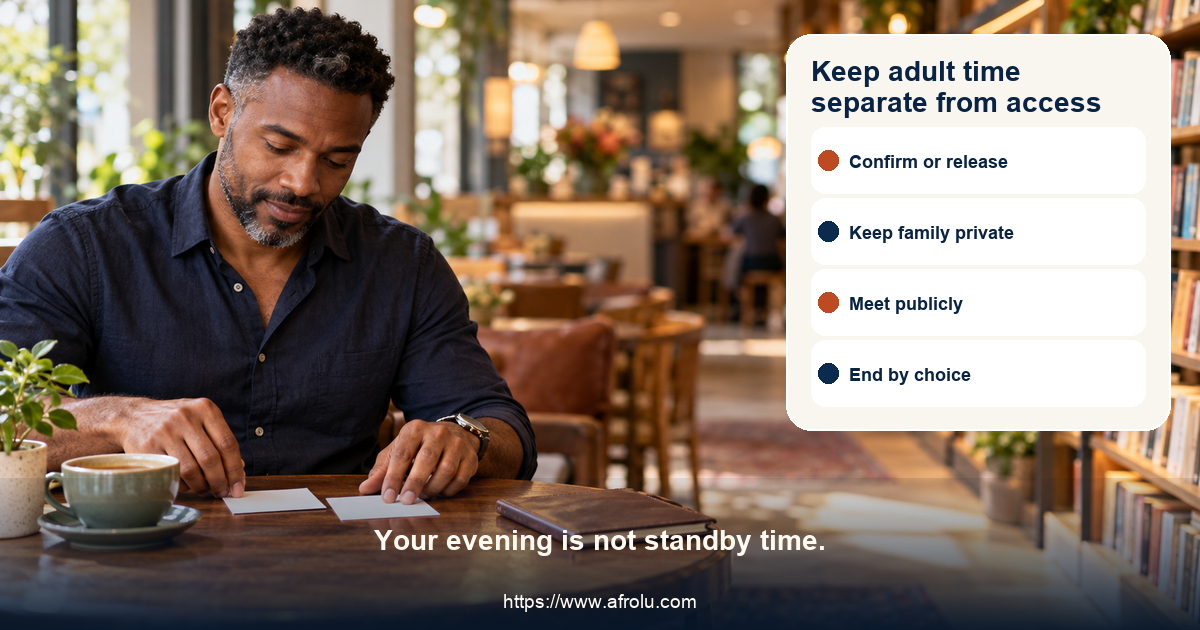
A casual plan stays vague until care and rest have been rearranged
A parent holds open a rare adult evening while a match gives no time or confirmation, then asks late whether they are still free.
Release the time and choose your own plan; accept a later specific invitation only if it works for you.One adult wants casual contact and the other wants more
A match states that they want a light connection, while the parent realises they need a different level of communication or consistency.
Treat the difference as information and decline respectfully instead of trying to negotiate yourself into comfort.A person offers a public, affordable date with a timely confirmation
A match names a venue, time, independent arrival, and easy reschedule point without pressing for family details.
Decide whether the plan suits you; clarity is useful even when the connection stays casual.A missed plan becomes an invitation to a private residence
After ghosting, a date asks to pick the parent up at home or says a private setting is the only way to make up for it.
Choose a public venue later, keep transport independent, or decline the restart.A new match asks where children are and who looks after them
A date treats logistical curiosity as a reason to seek names, schedules, schools, home details, or care arrangements.
Keep family information private and notice whether the limit is accepted without pressure.A casual contact asks for help after an emergency
A returning match describes a payment, travel, care, or account problem and asks for a transfer, code, or loan.
Do not transact or share account access; use independent official options if you are concerned about fraud.A boundary is carried through friends or family
After an ending, the date asks mutual contacts to share messages, updates, or pressure for another conversation.
Tell trusted people not to relay contact and reduce the channels that are being used to bypass your decision.A casual ending brings monitoring or threats
Someone uses repeated accounts, location information, intimate material, threats, or fear after being told the connection is over.
Prioritise safety, document only if safe, use reporting routes, and seek relevant support.Signals about casual honesty, adult time, family privacy, money, consent, and safety
They can say that a connection is casual while still making plans and changes clear.
They do not treat your limited availability as an invitation to ask for family details or household access.
They accept a public venue, independent transport, a short date, or a reschedule without resentment.
They understand that a confirmation point protects a rare adult evening rather than making dating overly formal.
They do not ask for children’s names, schools, routines, addresses, caregivers, or care schedules in early contact.
They respect that family introductions and home access are separate from attraction, apology, or casual status.
They do not use a meal, gift, ride, or expense to expect a longer date, private setting, touch, sex, or photos.
They keep payment requests, loans, account codes, investments, and financial emergencies outside the connection.
They accept that current consent can change when a venue, plan, drink, ride, or level of intimacy changes.
They respond to a returning-match boundary with a practical plan or a respectful exit, not persuasion.
They do not ask friends, relatives, co-parents, caregivers, or mutuals to relay messages or locate you.
They do not use new profiles, monitoring, surprise contact, or a shared community to bypass a no.
They understand that a casual connection can end without either adult providing a detailed defence.
They never use threats, humiliation, intimate material, fear, or persistent unwanted contact to keep access open.
Choose a proportionate next move
| Situation | What it may mean | What to do next |
|---|---|---|
| A casual chat fades after a few messages | There may be no need for a theory or a final negotiation. | Archive it, make your own plan, or send one concise check-in if an open plan needs closing. |
| A date wants casual but avoids every practical plan | The label may be covering an availability pattern that does not work for you. | Choose whether to stop investing instead of waiting for certainty. |
| A plan is confirmed early and publicly | The person may be offering a low-pressure but respectful connection. | Accept, decline, or revise based on your own comfort and schedule. |
| A plan changes to a private setting or late hour | The change may be inconvenient or may reduce your ability to leave. | Choose public, postpone, retain independent transport, or decline. |
| Someone asks for details about children or care | The request crosses a family privacy boundary before trust has been built. | Keep the answer broad and observe whether the boundary is respected. |
| A returning match asks for a second chance | An apology may be sincere but does not reset access or household boundaries. | Test a small public plan or decide the restart is not for you. |
| A date asks for money, a loan, a code, or account help | The request is about financial access, not casual dating compatibility. | Decline and do not use romance as a reason to bypass independent verification. |
| A mutual person brings messages from a date | Your support network is being used as a relay channel. | Ask them not to pass messages and consider reducing direct contact too. |
| A no is followed by extra accounts or surprise contact | The situation may be moving into repeated unwanted contact. | Reduce access and use platform, trusted, or local support as appropriate. |
| You feel afraid, threatened, watched, or blackmailed | This needs a safety response, not a better casual-dating script. | Prioritise safety and seek urgent relevant help when needed. |
Twelve lines for casual plans, family privacy, public dates, returns, and endings
“I am open to something casual, and I still prefer clear plans and direct communication.”
“If we have not confirmed by mid-afternoon, I will make another plan for tonight.”
“I keep my children’s and household details private while I am getting to know someone.”
“I prefer to meet at the venue and make my own way home.”
“I do not share my address or do pickups in early dating, but a public venue can work.”
“I do not lend, transfer, or handle accounts in dating connections.”
“The new time does not work for me, so I will leave this one and plan another day if we both want to.”
“I hear your apology. I would only consider a restart with a clear public plan and no pressure.”
“Please do not contact my friends or family about me.”
“This connection is not fitting my life, so I am going to leave it here.”
“I have said I do not want further contact. Do not use other accounts or people to reach me.”
“I need help keeping this person from using my support network to contact me.”
Know the difference
A casual mismatch, a clear plan, a return, family-detail pressure, and fear need different ghosting responses
A person can state a light intention, confirm or release a plan, respect family privacy, accept a public pace, and let either adult decline without persuasion.
Vague urgency, home shortcuts, family-detail requests, money stories, relay contact, monitoring, coercion, threats, blackmail, and fear make a casual connection less freely chosen.
Casual is a relationship preference, not a reason to make family privacy, consent, money, or ending access negotiable.

Casual can still protect choice.
Separate a casual mismatch, a public plan, pressure, and fear
| Type or dimension | What it describes | Best next question |
|---|---|---|
| A casual mismatch | Two adults want different kinds of contact but can say so honestly. | Decline respectfully and keep the difference out of a safety narrative. |
| A faded thread | Contact has stopped without a new request or pressure. | Archive, make your own plan, or send one line only if it serves you. |
| A clear casual plan | Time, public setting, confirmation, and exit remain visible. | Choose whether it fits your budget, schedule, and comfort. |
| A late private switch | A change may leave you with less control over timing or movement. | Choose public, postpone, or decline without having to justify it. |
| A respectful return | A person acknowledges a missed plan and accepts your choice about restarting. | Keep any restart small and separate from family access. |
| Family-detail pressure | A date wants names, routines, home access, or care information too early. | Keep details private and see whether the boundary is accepted. |
| A money request | A personal story is asking for financial or account access. | Do not transact, lend, transfer, or share codes. |
| A support-network bypass | Friends, family, or mutuals are being used to reopen personal contact. | Ask them not to relay messages and reduce access. |
| Fear or threats | The interaction has moved beyond ordinary casual dating uncertainty. | Prioritise safety and seek relevant urgent help when needed. |
Date casually without making family privacy or safety casual
Casual needs honesty
A connection can be light without making plans, consent, or endings unclear.
Adult time matters
A rare free evening does not become less valuable because a match has not confirmed.
Family access is separate
Attraction, apology, and a date do not create access to children, home, routines, or support people.
Public plans are practical
Independent transport, a public venue, and a clear exit can make early dating easier to assess.
Repair stays small
A returning match can earn a public conversation without immediately regaining personal information or household access.
Safety changes the response
Repeated contact, monitoring, coercion, threats, money pressure, or fear require protection rather than more dating negotiation.
Questions organised by purpose and depth
Choose a few prompts that fit the moment. This is a reference library, not a list to complete.
Name the offer
Separate casual dating from vague treatment.
- What do I actually want from this connection?
- What plan or communication standard matters to me?
- What is no longer working?
Protect the window
Review how uncertainty is affecting your time.
- What did I rearrange for this plan?
- When will I release the slot?
- What adult plan returns my evening to me?
Check family privacy
Choose what remains outside early dating.
- What household details are not needed here?
- Who should not be contacted about me?
- What would make a meeting feel publicly reversible?
Check escalation
Notice when an ordinary dating question has changed category.
- Has someone requested money, access, or a private route?
- Has my no been bypassed?
- Who can help me take a safer next step?
Look more closely at casual clarity, family boundaries, plans, returns, support routes, and escalation
Keep the label from doing too much work
Casual can describe desired commitment level while direct plans, privacy, consent, and endings remain non-negotiable.
Evidence limit: Do not accept vagueness as proof you are relaxed.
Make adult time concrete
A confirmation point and independent plan keep a rare window from being governed by an unanswered message.
Evidence limit: Do not build care or household changes around an idea that has not become a plan.
Keep family access separate
A date can know you are a parent without receiving names, routines, home information, or introductions.
Evidence limit: Do not let an apology or chemistry rush people who did not choose the connection into it.
Make public and reversible ordinary
Independent arrival, a public setting, budget choice, and an exit plan support a date that can change safely.
Evidence limit: Do not treat a ride, meal, or surprise venue change as an obligation.
Use a smaller restart
A brief public conversation can show whether someone respects confirmation, family privacy, and a no.
Evidence limit: Do not restore household access because a story about the gap sounds persuasive.
Protect support routes
Repeated contact, monitoring, threats, coercion, money pressure, and fear can require blocking, reporting, records, and outside support.
Evidence limit: Do not use friends or family to negotiate with someone who is bypassing your boundary.
Shortcuts that let a casual connection take more time, family information, or access than it has earned
Treating casual as vague by default
A light connection can still have clear plans, current consent, and a respected ending.
Rearranging family logistics for an unconfirmed plan
It lets another person’s uncertainty set the rhythm of your household.
Sharing family detail to prove trust
Information about children, home, routines, and support people is not the price of adult dating.
Accepting a late private switch
Urgency can reduce your choice of venue, transport, privacy, and exit.
Letting a gift or expense create a debt
Money spent on a date does not purchase access, intimacy, information, or a longer stay.
Using family members as relationship messengers
It spreads a short connection through people who did not choose to manage it.
Use a focused guide for casual honesty, practical boundaries, or a safer adult date
Choose one resource to define a casual connection, turn a family privacy or access limit into action, or prepare a public meeting with money and exit choices visible.
Explore the guide library
Show more related guides
Continue with Afrolu
Show more Afrolu guides
Sources used for this guide
Afrolu reviewed these health, research, safety, or public guidance resources while editing this page. They support the behaviour and safety guidance; they do not diagnose any individual described by a reader.
Questions about casual dating ghosting for parents
Can casual dating still have boundaries?
Yes. Casual describes the connection you want, not a waiver of clear plans, privacy, consent, money limits, or the right to leave.
Do I have to explain my family schedule to a date?
No. You can name limited availability without sharing details about children, care, home, routines, or support people.
What if a casual date ghosts after I held time open?
Release the slot, return to your own plan, and decide whether one concise check-in would help you close an open loop.
Should a first casual date be public?
A public, independently reachable plan can make it easier to assess comfort, timing, transport, and exit choices.
Can I refuse a home pickup or private venue?
Yes. You can prefer to meet at a public venue, use your own transport, reschedule, or decline entirely.
What if a date asks about my children or care arrangements?
Keep the answer broad. Early attraction does not create a right to names, schedules, schools, home details, or introductions.
What if a returning match says they have an emergency?
Do not send money, share codes, lend, invest, or route funds. Use independent official routes for real concerns.
How should I handle a mutual friend relaying messages?
Ask them not to pass messages or personal updates. Your support network does not need to become a dating channel.
Can I end a casual connection without a long explanation?
Yes. A short boundary or no further reply can be proportionate when a connection has faded or does not fit your life.
When should I treat the situation as a safety concern?
Repeated unwanted contact, monitoring, coercion, threats, blackmail, money pressure, or fear call for a safety-focused response.
One thing to do now
Choose an ending that keeps your household and peace intact
Choose the smallest next action that protects adult time, family privacy, home, money, independent movement, current consent, support relationships, and the ability to end contact without negotiation.