New daters · long-distance safety and clarity
Long-Distance Ghosting Safety for New Daters
Long-distance ghosting safety for new daters: handle silence without pursuit, protect travel, money and data, and know when pressure needs support now.
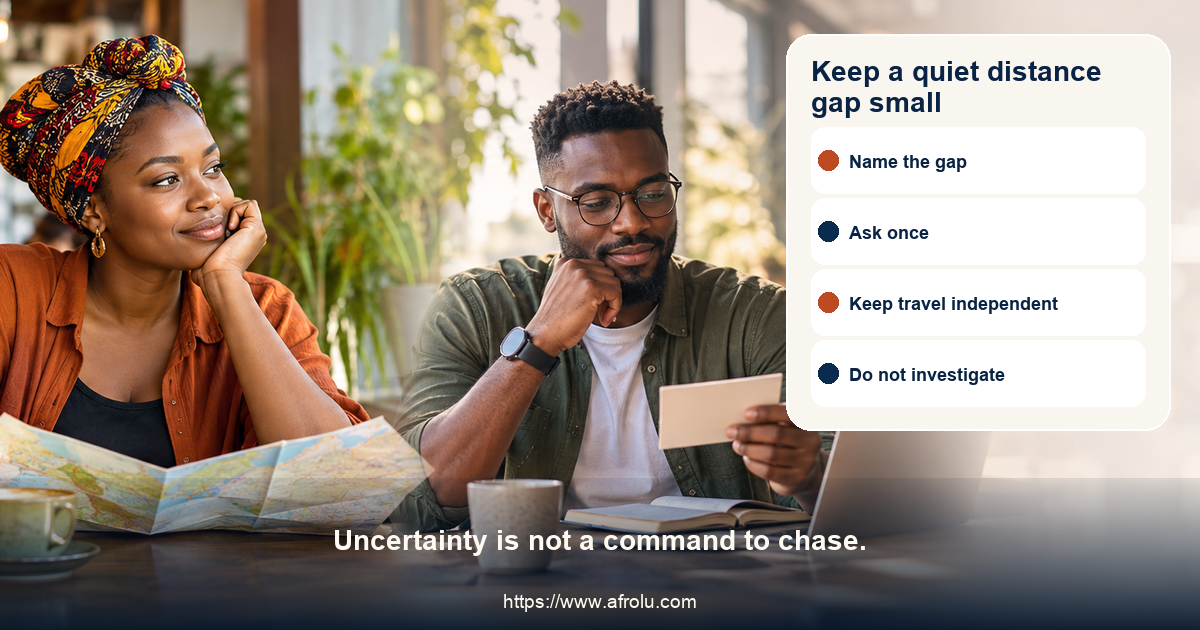
Distance does not require pursuit.
Written and edited by Clarisse Uwimana · Dating Culture Editor
A quiet long-distance chat can be painful without requiring pursuit or investigation. Name the actual gap, send one practical check-in only if it helps, and make travel plans smaller or pause them until contact is mutual. Keep visits independent, verification reciprocal, money and account access separate, and consent current. If pressure, financial urgency, invasive requests, repeat contact, threats, blackmail, monitoring, or fear appear, reduce access and seek appropriate support.
Dating behaviour · New Relationship Starters
Is this an ordinary quiet message, a missed call, a travel plan that should be paused, a reciprocal check, or a pattern involving itinerary pressure, money, accounts, documents, coercion, repeated unwanted contact, threats, blackmail, monitoring, or fear that needs a more protective response?
Long-distance ghosting is a reduction or end in a remote dating conversation without a direct explanation. It is not proof of danger or an invitation to investigate someone. The useful distinction is between a communication gap, an incompatible travel or contact rhythm, and conduct that reduces free choice through invasive verification, travel pressure, financial requests, account or document access, coercion, repeated unwanted contact, monitoring, threats, blackmail, or fear.
Leila is new to long-distance dating and pauses a possible visit after a planned video call goes quiet. She sends one practical note rather than searching for the match online. When the person reappears asking for her itinerary and a ticket transfer, Leila sees that the decision is no longer about guessing why a chat stopped; it is about protecting travel, money, data, and her ability to leave.
new daters · long-distance safety and clarity
Leila keeps a quiet distance connection from becoming a travel, money, data, or consent risk
This guide separates ordinary remote uncertainty from patterns that make a new dater's movement, money, information, body, support, or ending less freely chosen.
Name the gap, contact once, shrink a visit, verify proportionately, keep money and accounts separate, end at the level of risk, and choose an evidence-sized next action.
Do not investigate a quiet chat
A missed call is information, not a route into another adult's private life.
Keep the journey independent
A visit should preserve separate payment, lodging, transport, and a way home.
Verify without extraction
Small reciprocal checks help; passwords, documents, and tracking do not create safety.
Read the escalation
Money pressure, repeat contact, coercion, threats, blackmail, and fear need more protection.
distance makes a quiet phone feel like a larger gap
A new long-distance connection can be hopeful and still leave you uncertain when contact drops; uncertainty is not a command to investigate
When a relationship is new and distance is involved, messages can carry more weight than they would in an established local routine. You may not share friends, ordinary neighbourhood context, or the simple reassurance of seeing whether someone turns up for a plan. A quiet stretch can therefore feel like a void that needs to be filled. The important first step is to describe the gap without filling it with guesses about a person's intentions, identity, safety, or future.
Ask what actually happened. Did someone miss a scheduled video call? Did a date stop replying after a message? Was there a visit being planned, or only future talk? Has a person changed a basic fact, asked for money, requested private documents, or pressured you to act quickly? A single unanswered message can be disappointing and still remain an ordinary communication problem. New facts that make your money, privacy, movement, or consent less free require a different response.
You do not need to build a case file to decide what access to give. Avoid compulsive searches, contacting relatives, creating extra accounts, tracking public posts, demanding real-time proof, or trying to locate a quiet match through work or community. Those actions can cross privacy boundaries, increase your own exposure, and still fail to provide the trust you were hoping to feel. A relationship that needs surveillance to continue is not offering a useful foundation.
Instead, keep the next step small. You might send one direct message, pause a visit, choose not to confirm a booking, or return to your routine without waiting for a reply. You can want a serious long-distance relationship and still decide that it must grow through reciprocal, present-tense behaviour. Distance is a circumstance. It does not remove either adult's right to privacy, a slower pace, independent travel, current consent, or an ending without pursuit.
use direct contact once, then let the answer be information
A clear message can invite a practical response; continued chasing cannot make a remote connection reliable
If a video call or travel conversation has gone quiet, say only what the current plan needs: “We had planned to talk about the visit today. If this no longer works for you, please let me know; otherwise I will pause the plan.” This wording is not a test of affection. It gives a person a clear chance to respond without requiring them to disclose private health, family, work, travel, or immigration information.
Give yourself a limit after sending it. Do not keep booking, cancelling, checking, or rearranging in response to a thread that has no answer. Cancel or hold a booking through the relevant official provider if you need to, but do not send a payment, share a confirmation code, or disclose your new itinerary in the hope that it will restart the relationship. Your logistics should remain yours even when you are disappointed.
A response can be enough without being exhaustive. A person may say that they cannot continue, explain briefly that something changed, or offer a concrete new call time. You can choose whether the repair feels workable. A genuine repair shows up in the next action: a call kept, a public plan that can be revised, and no demand for extra proof. A long emotional story that leaves you with a greater financial, travel, or privacy risk is not the same thing.
If silence remains, do not mistake your curiosity for a duty to solve it. Archive the conversation, let the visit go, and choose support away from the device if the loss feels heavy. You can grieve a possibility without reopening every route to a person who is not meeting you in the present. A new relationship cannot become safe by making you more available than the other adult has chosen to be.
do not let a quiet connection turn a visit into a rescue mission
Travel should preserve a separate place to sleep, pay, leave, and change your mind even when a remote match reappears
Long-distance ghosting can create a tempting story: if you just travel, meet in person, or make one grand gesture, the uncertainty will disappear. Travel usually raises the cost of changing your mind. Before a first visit, choose arrangements that do not require you to depend on the other person's address, ticket, car, finances, mood, or permission to leave. Public meetings, independent bookings, separate accommodation when practical, and a return route you control are ordinary safeguards, not signs of distrust.
If someone goes quiet after you have discussed a visit, do not travel to find out why. Do not arrive at a home, workplace, hotel, airport, event, or neighbourhood because a public post suggested where they might be. A silent conversation is not consent to an in-person approach. Cancel, postpone, or change your own plans through independent channels. The cost of a booking cannot transform a quiet person into someone who owes you a meeting.
Be especially careful when a reappearing match makes the visit urgent. They may say that a ticket expires, a room is unavailable, a relative is waiting, an immigration deadline is close, or that meeting privately is the only way to prove seriousness. You can say no, choose another date, book separately, or decide not to go. A legitimate disappointment does not make someone entitled to your location, shared room, documents, money, body, or a trip you no longer want.
Consent remains current at every stage of a journey. A person may agree to a call and not a flight, a public coffee and not a hotel, a day together and not an overnight, affection and not sex, or a planned visit and not a changed itinerary. You can revise the plan after new information appears. If a long-distance connection cannot tolerate independent logistics and a current no, it is asking for compliance, not offering the kind of relationship you can safely build.
verify proportionately without turning trust into surveillance
Reciprocal reality checks can support a new relationship; invasive demands, tracking, and identity extraction do not create safety
New long-distance dating benefits from ordinary consistency. Can the person keep a planned call or offer a clear replacement? Can they speak about present intentions without making every concern a betrayal? Can they make a public plan without requiring you to give up independent travel? A reasonable check can help you decide whether to take the next step. It should not become a demand that either adult show private records or allow constant digital access.
If you want a live conversation, ask for one. If someone cannot do it at that moment, consider whether they offer another workable format. Do not demand identity documents, proof of address, pay information, family introductions, or a tour of private spaces as a condition of dating. You are not responsible for proving that their story is false, and they are not entitled to prove their story by taking your data. Trust grows when both people can choose small, reciprocal acts in the open.
Look for a pattern where every obstacle can only be solved by your larger risk. Perhaps a person cannot have a call but needs a transfer; cannot plan a public visit but wants your hotel details; cannot confirm travel but asks for a copy of your booking; or cannot explain a quiet period but wants instant exclusivity. Any single fact may have a benign explanation. The cumulative direction matters when your access keeps expanding while mutual reality keeps shrinking.
If evidence is still too thin, you do not need another digital investigation. Make the plan smaller or end it. A slower pace, a later call, a public meeting, no shared booking, no money, no documents, or no contact at all are complete choices. Safety is not achieved by extracting more intimate information from a stranger. It is achieved by retaining the ability to choose what happens next.

Let risk, not romance, size the move.
keep romance, money, and accounts on separate tracks
An abrupt silence followed by a crisis story does not make a transfer, code, document, or investment request your responsibility
Remote dating can make a crisis story sound especially persuasive because you cannot see the ordinary context around it. Someone may say a ticket, visa fee, hospital bill, delayed salary, customs problem, lost bag, hotel deposit, family emergency, or cryptocurrency opportunity is the last barrier to meeting. You can care that hardship exists without becoming the person who sends, receives, lends, invests, routes, or holds money for someone you barely know.
Keep your digital boundaries just as firm. Do not share a one-time code, bank screen, identity document, booking reference, password, recovery link, location history, private photo, device access, or account login to reassure a match or help them solve a problem. A relationship does not make a risky link trustworthy because it comes with a tender message. Use only official channels you find independently when you need information about travel, payments, or accounts.
If you have already sent money or data and suspect fraud, act toward protection rather than embarrassment. Contact the relevant bank, provider, platform, or official reporting route promptly, and tell a trusted person. Do not send more money to unlock a refund, keep a conversation private, or prove that you still believe the person. The faster your decisions return to independent channels, the less a dating story can control your next move.
Silence after a financial boundary is information. You do not need to reopen contact to demonstrate compassion or to receive an explanation. A genuine person may feel disappointed and still respect the limit. Someone who switches accounts, creates a new emergency, threatens loss, or frames your refusal as abandonment is asking you to carry a responsibility that a new relationship has not earned.

A future promise cannot overrule a present no.
end a distant connection at the level of risk
An ordinary quiet ending may need no further message; pressure, repeat contact, or fear may require a protected exit instead of another call
For an ordinary unanswered connection, you can archive the chat and let it end. If you choose to write, a short line is enough: “I am not continuing this connection. I wish you well.” You do not need to hold a final video call, explain every doubt, or leave the door open for a person to persuade you. A brief ending is not cruel when it is the clearest route out of an unclear situation.
If a visit was discussed or booked, change your logistics first when that feels safer. Use the provider or your own travel resources rather than telling the other person your updated hotel, flight, route, or dates. A cancelled visit may be disappointing to both adults. It does not require you to meet privately, reveal where you are staying, or give someone a chance to manage your decision in person.
If the person reappears after you end contact, you may decline without debate. Do not accept a new account, a different crisis story, a promise of immediate travel, or an offer of money as the price of reopening. You can block accounts after considering what is safe in your situation, keep records of concerning messages if useful, and tell trusted people not to share your whereabouts or booking information.
When threats, coercion, unwanted sexual material, financial exploitation, monitoring, repeated unwanted contact, blackmail, stalking behaviour, or fear appear, do not solve the situation as a long-distance communication issue. Seek relevant support, use a safe device if you believe your accounts or location may be monitored, and get urgent local help when you are in immediate danger. The goal is not to produce a perfect ending; it is to regain a safe amount of control over your movement and contact.

Choose the action that keeps your exit open.
make the next step evidence-sized
Hope can remain part of new long-distance dating when it does not require you to give up privacy, money, travel control, consent, or a free exit
Before you act, ask what is observable. Is there simply a quiet message? A missed call? A cancelled public plan? A request for a ticket, transfer, code, document, hotel information, intimate image, or private meeting? Has someone continued after you said no? Do you feel pressure, fear, or confusion that makes it hard to rest? The fact in front of you should decide the size of your response, not the romance of the story.
Then ask what the next step would cost. Does it reveal a location, spend money, create a debt, reduce your independent transport, give up an account, invite someone to a private space, or make a person responsible for your immediate safety? If so, make the action smaller. You can wait, use one direct message, decline, book independently, tell a friend, seek official help, or end contact. A small move can show whether a relationship can meet you in reality.
Do not mistake care for an obligation to become a detective, rescuer, lender, travel coordinator, or negotiator of another adult's reaction. New relationships are allowed to be uncertain. They are not entitled to your money, documents, location, body, sleep, or fear while certainty is being built. The more a connection asks you to give away in order to keep it alive, the more important it becomes to return to your own support and choices.
Long distance can support deliberate dating when both adults welcome gradual knowledge, reciprocal evidence, independent logistics, and the freedom to revise a plan. Your next action does not have to solve the whole future. It only has to protect enough of your present that you can decide the future without being rushed, exposed, isolated, or afraid.
Eight new-dater long-distance moments after quiet contact
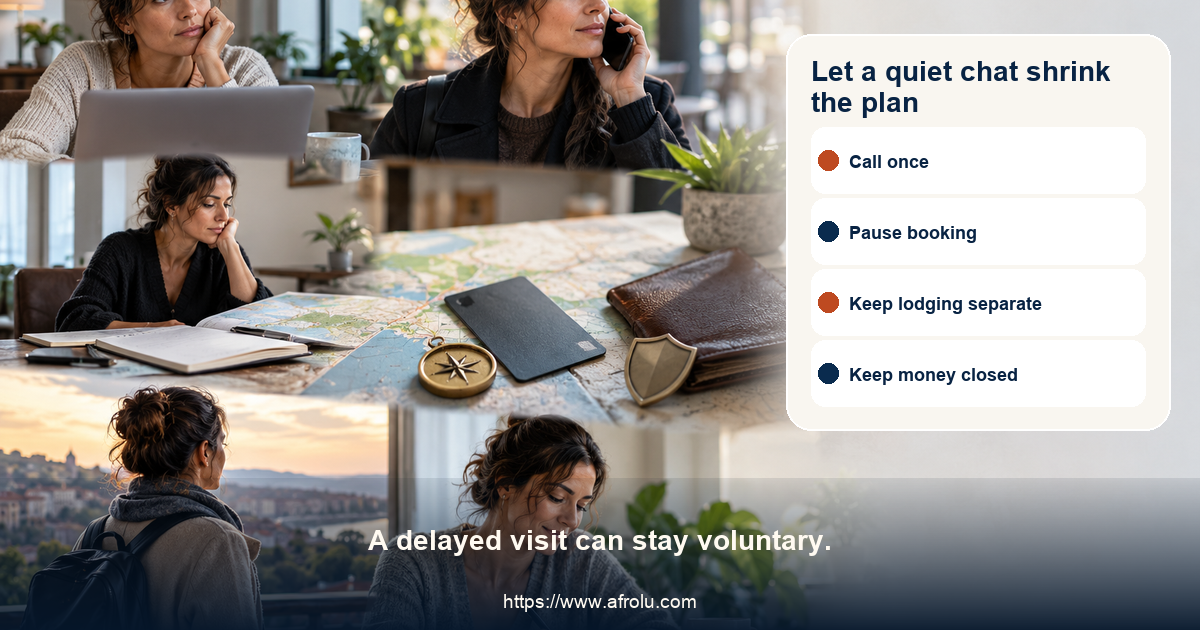
A planned call passes without a message
A new long-distance match misses a video call after several warm conversations, and the dater feels tempted to search their workplace and contact a public profile.
Send one direct practical note or release the plan; do not turn a communication gap into an investigation.A travel conversation goes quiet
Two adults have discussed a first visit but have not booked anything when one person stops responding for several days.
Pause the visit and make no new booking, payment, or disclosure of travel details until mutual contact is clear.A match returns with a workable call
A person acknowledges that a family emergency changed a planned call, offers a brief explanation, and proposes a new time that can be accepted or declined.
Decide whether the call and future pace work for you; observe the next action rather than demanding private proof.A reappearing match asks for hotel details
After silence, a match says they can finally meet but insists on knowing your hotel, flight, and arrival time before they will confirm a public plan.
Keep logistics independent and decline to share details that make you easier to locate.A reunion depends on money today
A person who has been quiet says a visa charge, flight balance, or hospital bill is the only barrier to the relationship and asks for a transfer.
Do not send, receive, or route money; use independent official channels if you suspect fraud.Travel is framed as proof of commitment
A match says a separate room is insulting because the distance travelled proves the relationship is serious.
Book independently, meet publicly, or postpone; travel never settles lodging, touch, sex, or overnight consent.An ending is bypassed
After a concise ending, a person creates another account and asks why you will not allow a final call before cancelling your trip.
Do not reopen the discussion; protect itinerary details, reduce contact, and seek support if persistence continues.Threats accompany a cancelled visit
A person sends repeated messages, says they know where you will be travelling, and threatens to share private images unless you respond.
Move to a safety-led response using trusted support, platform reporting, account protection, and urgent local help if needed.Signals about calls, travel, verification, money, data, consent, and safety
They can keep a planned call or offer a clear alternative without demanding that you prove your trust first.
They accept that one missed message or a delayed visit can be handled without surveillance, public searches, or contact through other people.
They can make a public meeting plan that leaves both adults with separate transport, payment, accommodation, and a route home.
They do not treat a ticket, hotel, travel effort, visa story, or distance as proof that you owe time, intimacy, a shared room, or private access.
They do not ask for an address, itinerary, booking reference, location history, document, code, password, banking screen, or intimate image as relationship proof.
They keep money, transfers, gifts, investment pitches, account recovery, tickets, and emergency payments outside a new dating connection.
They can offer a brief repair and a changed plan without asking you to disregard every prior concern.
They accept a pause, independent booking, public venue, slower pace, or cancelled visit without guilt, insult, or pressure.
They do not use a return after silence to demand exclusivity, private travel, a rushed reunion, or instant forgiveness.
They do not make secrecy the price of a visit or ask you to keep travel plans away from trusted support.
They keep current consent separate from prior messages, future promises, travel spending, a call, a date, or an earlier yes.
They do not create new accounts, contact your support network, monitor your public activity, or use location clues after a no.
They do not respond to boundaries with financial urgency, threats, coercion, blackmail, unwanted sexual material, or fear.
They leave you more able to sleep, move, spend, protect data, consult support, and revise or end a plan freely.
Choose a proportionate next move
| Situation | What it may mean | What to do next |
|---|---|---|
| A planned call is missed | A change may be ordinary, but the response shows whether a future plan can be reliable. | Name the missed call once and decide whether a specific alternative is enough for you. |
| A message goes quiet before a visit | Silence leaves you without a mutual travel plan, not with permission to locate a person. | Pause the visit and use only your own travel or booking channels. |
| They return with a clear call time | A repair can be useful when it changes the practical next action. | Choose whether to take the call without demanding private proof. |
| They request proof or tracking | Invasive verification can make a new relationship more exposed without making it safer. | Keep checks reciprocal and decline documents, passwords, live location, or account screens. |
| They ask for travel details | Itinerary access can reduce your ability to change a plan or move independently. | Share only what the public plan needs, if anything, and retain your own booking control. |
| They ask for money | Tickets, visas, emergencies, investments, and account stories can create serious financial risk. | Do not transact, share codes, or open sent links; use independent official help. |
| They pressure a shared room or private visit | Distance and spending can be used to make current consent look negotiable. | Choose separate lodging, a public plan, or cancellation without apology. |
| They ask for secrecy | Keeping a visit hidden can reduce your support and make you easier to pressure. | Tell a trusted person a broad plan and decline secrecy that makes you less safe. |
| They contact you through new routes | Repeat accounts, mutuals, or location clues can move beyond a communication gap. | Reduce access, preserve safe evidence, and seek support. |
| You feel fear | Fear changes the priority from understanding the relationship to protecting your movement and contact. | Use a protected exit and urgent local support when needed. |
Twelve lines for calls, visits, privacy, money, consent, and ending
“We had planned to talk today. If this no longer works, please let me know; otherwise I will pause the plan.”
“I am not confirming any travel until we have a clear mutual plan.”
“If we meet, I need a public plan with separate transport and my own accommodation.”
“I do not share my hotel, booking details, or route at this stage.”
“I do not send, receive, lend, invest, or move money in a dating connection.”
“I do not share codes, documents, passwords, booking references, or account access.”
“Travel does not mean I am agreeing to a shared room, a private visit, or anything physical.”
“I keep my travel plans visible to trusted support and do not make secret visits.”
“I want more reciprocal contact before I make a larger plan.”
“I am not continuing this connection. Please do not contact me through other accounts.”
“I have changed my arrangements and am not sharing the details.”
“I am not discussing this further. I am taking steps to protect my privacy and travel plans.”
Know the difference
A quiet distance chat, a repair, a smaller plan, pressure, and fear need different new-dater responses
A person can keep or reschedule a call, make a public plan, welcome reciprocal evidence, respect independent logistics, accept a pause, and let an ending stand without seeking more access.
Itinerary pressure, shared-room expectations, secrecy, money or account requests, invasive verification, repeat contact, monitoring, coercion, blackmail, threats, and fear make a new connection less freely chosen.
The romance of distance does not decide the risk; the observable pattern and your freedom to revise the plan do.

Name the fact before you offer more access.
Separate a quiet gap, a smaller plan, pressure, and fear
| Type or dimension | What it describes | Best next question |
|---|---|---|
| A quiet message | A new conversation pauses without a confirmed travel or financial plan. | Use one direct note if useful, then allow the chat to close. |
| A missed call | A planned call is not kept but a new time can be offered and accepted freely. | Decide whether the repair is workable. |
| A travel pause | A visit is not yet mutual or safe enough to confirm. | Postpone without using travel to force an answer. |
| A reciprocal check | A live call or public plan gives each adult a small way to assess the next step. | Keep verification narrow and non-invasive. |
| An invasive demand | Documents, live location, passwords, banking screens, or account codes are requested as proof. | Decline and reduce exposure. |
| A travel-pressure story | Tickets, visa stories, shared rooms, secrecy, or urgency are used to make access feel owed. | Keep logistics independent or cancel. |
| A money request | A remote connection asks for transfer, investment, code, payment, or account help. | Do not transact; use independent official help. |
| A reappearing contact | A person returns after silence and asks for immediate access, travel, or forgiveness. | Choose a slower plan or decline; a return is not a debt. |
| A safety concern | Repeated unwanted contact, monitoring, blackmail, coercion, threats, or fear appear. | Use a protected exit and relevant support. |
Handle a quiet distance connection without giving up a free exit
Name the exact gap
A quiet note, missed call, postponed visit, request for money, and threat require different responses.
Contact once
A short practical message can create room for a reply without turning you into a pursuer or investigator.
Keep travel separate
Independent booking, public meetings, separate lodging, and a route home preserve choice during a first visit.
Verify without extraction
Reciprocal live contact can be useful; passwords, documents, tracking, and identity demands do not make dating safer.
Keep funds and accounts closed
Romance, urgency, distance, and promised reunions do not make transfers, codes, or account access safe.
Escalate by behaviour
Repeat contact, coercion, monitoring, threats, blackmail, fraud, and fear change the response from dating advice to protection.
Questions organised by purpose and depth
Choose a few prompts that fit the moment. This is a reference library, not a list to complete.
Name the fact
Describe the current situation before trying to explain it.
- Was a message quiet, a call missed, a visit cancelled, or a request made?
- What has actually changed in my options?
- What story am I adding because distance feels uncertain?
Choose contact
Use one direct message only if it helps you decide what to do with your own plan.
- What exact call or visit needs an answer?
- What will I pause if no reply comes?
- Which contact routes will I not use?
Protect logistics
Review what a travel or verification request would cost you.
- Would this reveal my location, booking, documents, money, or free exit?
- Can I make the plan public and independent?
- Would I choose this if the person had not gone quiet?
Read escalation
Separate ordinary uncertainty from a pattern that needs protection.
- Has someone pressured money, access, intimacy, secrecy, or instant travel?
- Has contact continued after a clear no?
- Who can help me take a safer next action?
Look more closely at quiet contact, visits, verification, money, returns, and escalation
How to handle an unanswered remote plan
Name the planned call or visit once, pause your own logistics, and decide what you will do if a reply never comes.
Evidence limit: Do not use searches, extra accounts, mutuals, or location clues to keep pursuing contact.
How to protect an independent journey
Use public meetings, separately arranged transport and accommodation, your own payment control, and a route home you can change.
Evidence limit: A safer plan cannot guarantee compatibility; cancel when the plan no longer feels freely chosen.
How to keep reality checks reciprocal
Use narrow, voluntary checks such as a live call or public plan rather than documents, account access, tracking, or invasive proof.
Evidence limit: You do not need to prove someone false before deciding not to take a larger risk.
How to respond to a distant crisis story
Keep transfers, investment pitches, ticket requests, codes, links, and account requests outside the relationship and use official channels independently.
Evidence limit: Do not send more money or data to repair the connection or recover a prior loss.
How to evaluate a reappearing match
Look for a clear present plan that preserves public access, independent logistics, and your ability to decline without pressure.
Evidence limit: A future promise is not a substitute for a safe next action.
How to move toward protection
Repeat contact, tracking, threats, sexual coercion, blackmail, fraud, or fear call for less access, safe account choices, and relevant support.
Evidence limit: Choose actions that do not alert or endanger you if a person may react badly.
Shortcuts that make a quiet remote connection more exposed
Treating silence as consent to investigate
A quiet chat does not give you permission to search, track, visit, or contact people around another adult.
Using travel to force closure
A booking or distance travelled cannot turn an unanswered connection into an obligation to meet.
Trading privacy for reassurance
Documents, passwords, location, booking details, and account access can increase exposure without producing earned trust.
Paying to restore contact
A transfer, ticket, emergency payment, or investment does not solve the relationship uncertainty that made the request persuasive.
Assuming a trip settles consent
A visit does not decide a room, touch, sex, photographs, alcohol, or an extra day for either adult.
Meeting privately to settle pressure
A final call or in-person confrontation can create more access when a person is already bargaining or frightening you.
Choose one resource that fits the contact, travel, or boundary decision in front of you
Use a long-distance guide for independent planning, a consent resource for current agreements, or a red-flag guide when a pattern is making money, movement, privacy, or safety less freely chosen.
Explore the guide library
Show more related guides
Continue with Afrolu
Show more Afrolu guides
Sources used for this guide
Afrolu reviewed these health, research, safety, or public guidance resources while editing this page. They support the behaviour and safety guidance; they do not diagnose any individual described by a reader.
Questions about long-distance ghosting safety for new daters
Is a missed video call enough to call someone a ghost?
It can be disappointing, but the useful fact is a missed call. Look for the next practical response rather than deciding the person's character from one gap.
Should I search for a long-distance match who goes quiet?
No. A quiet connection is not permission to investigate, track, contact relatives, create accounts, or visit a person. Use a proportionate contact or let the plan go.
Can I ask for a live call before travel?
Yes. A voluntary live conversation can be a reasonable reciprocal check. It should not become a demand for invasive proof or surveillance.
What if they want my hotel and flight details?
Share only what a current public plan genuinely needs, if anything. Keep booking control, accommodation, transport, and changed itinerary details independent.
Does travelling mean we should share a room?
No. Travel does not settle accommodation, intimacy, touch, sex, or an overnight plan. Each person can make current choices throughout the visit.
What if they say money is the only barrier to meeting?
Do not send, receive, lend, invest, route, or hold money for a new dating connection. Use independent official channels if the story raises concern.
How much identity information should we exchange?
Use small, reciprocal reality checks suited to the next step. Do not trade documents, passwords, banking screens, codes, or live locations as proof of trust.
Can I cancel a visit without a final call?
Yes. You can change your own booking or plans without an in-person or video explanation, especially when you want to protect new details of your travel.
What if they return after I end things?
You can decline. A reappearing message, apology, crisis, or future promise does not create a right to reopen the relationship or receive travel information.
When should I seek safety support?
Seek support when there are threats, coercion, repeat contact, monitoring, unwanted sexual material, blackmail, financial exploitation, stalking behaviour, or fear.
One thing to do now
Make the next step evidence-sized
Choose the smallest next action that preserves reciprocal evidence, independent travel, privacy, money and account boundaries, current consent, trusted support, and the ability to pause or end the plan without a confrontation.