Faith-led daters · career safety and free choice
Faith-Led Dating Ghosting: A Career Safety Guide
A faith-aware, safety-first guide to ghosting during a career-heavy season: set clear plans, protect work privacy, and choose boundaries without pressure.

Values can protect choice.
Written and edited by Samira Benali · Faith and North Africa Editor
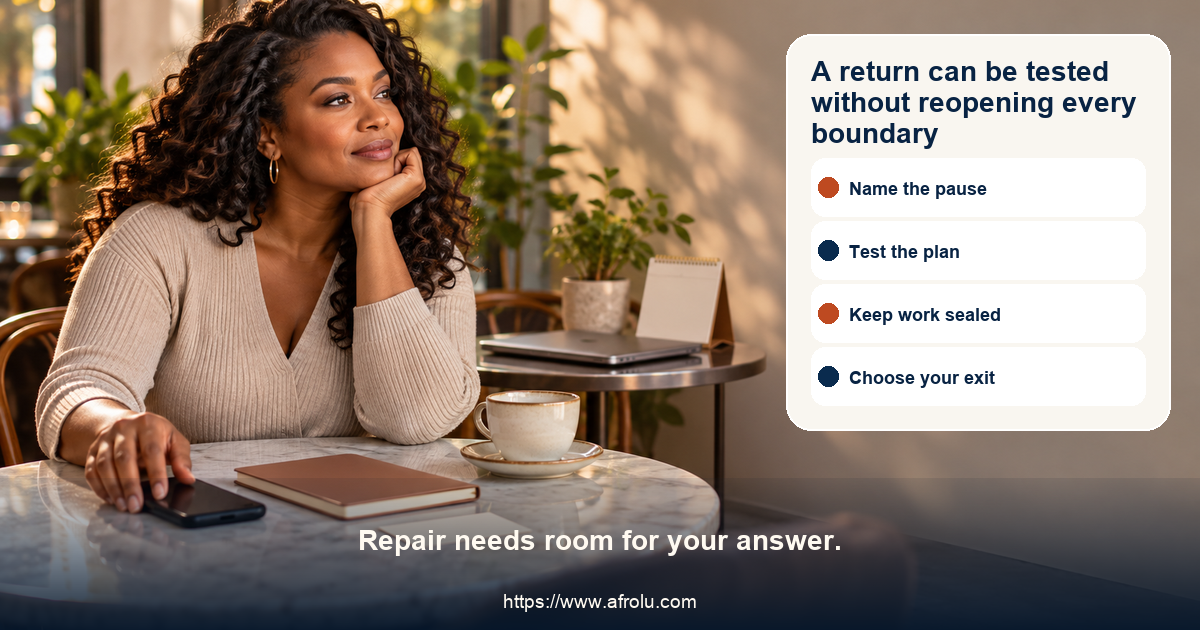
Do not turn silence into a verdict on your faith, worth, or future. Name the fact, offer or release one clear plan, keep work and money separate, and let any return earn a smaller public restart through conduct. Shared values never cancel current consent, privacy, or your ability to decline. If someone becomes coercive, financially urgent, repeatedly unwanted, threatening, monitoring, or frightening, reduce access and seek appropriate support.
Dating behaviour · Faith-Led Daters
Is this one quiet gap, a named work pause, a workable repair, an honest mismatch, values pressure, a request for career or financial access, repeated unwanted contact, or conduct that makes me feel controlled or afraid?
Faith-led career ghosting is a reduced or ended dating conversation experienced by an adult whose beliefs and work commitments both shape the pace they want. It is not proof that either person lacks values or cannot form a relationship. The useful distinction is between one quiet gap, named capacity, an honest mismatch, observable repair, values pressure, requests for work or money access, unwanted pursuit, and conduct that creates fear.
Mariam meets someone who speaks warmly about shared values and seems interested in her work. After an unconfirmed call, the person goes quiet, then returns with an apology, a request for a professional introduction, and pressure to meet privately that night. Mariam keeps her work network private, offers no money or access, and decides that any restart would need a clear public plan and room for her answer.
faith-led daters · career safety and free choice
Mariam keeps shared values from becoming a shortcut to her time, work, money, privacy, or consent
This guide separates ordinary dating uncertainty from patterns that use values language, career access, money, repeated contact, coercion, monitoring, threats, or fear to reduce an adult's choice.
Name the fact, make or release one plan, assess a return by conduct, keep work and money separate, make values practical, protect consent, and choose the next step that restores freedom.
Name the silence
A quiet thread is information, not a verdict on your faith or future.
Release the slot
A clear confirmation point keeps a vague promise from owning your evening.
Keep choice visible
Shared beliefs matter most when either adult can still say no.
Protect access
Work, money, privacy, consent, and endings remain separate from a return.
faith-led dating · safety and career boundaries
a quiet thread is not a verdict on your faith, worth, or future
When a promising conversation goes quiet, it can be tempting to make the silence carry more meaning than it has earned. You may wonder whether you were insufficiently patient, too clear about values, too focused on work, or somehow being taught a lesson. Those explanations can sound spiritual while still being guesses. Begin with the observable event: a message was unanswered, a plan was not confirmed, or a promised call did not happen.
A faith-led dating life does not require you to interpret every gap as evidence about destiny. Another adult may have lost interest, faced a real difficulty, avoided an uncomfortable ending, or simply lacked a communication rhythm that fits you. You can hold compassion for what you do not know while refusing to invent a private story on their behalf. Your standards for clarity do not need access to their motive.
Values are useful when they make your choices more honest and freely chosen. You might decide to send one direct message, release an unconfirmed evening, or take no further action. Each response can be kind without becoming self-erasure. Patience is not an obligation to remain indefinitely available, and forgiveness is not an instruction to reopen every door at the same pace.
Notice any language that turns uncertainty into pressure. A person may say that a meaningful connection should survive vague plans, that questioning them shows weak belief, or that you should overlook an uncomfortable request because they sound sincere. Shared words, prayer, service, family approval, or future talk do not replace practical reliability. The measure is whether both adults remain able to choose, pause, clarify, and leave without punishment.
career capacity · direct plans
work can limit availability without making your time provisional
Career-heavy seasons can make dating feel delicate. Shifts, projects, professional exams, travel, caregiving, and fatigue may genuinely narrow the time either adult has for a call or public meeting. It is reasonable to name that limit. It is not necessary to provide a detailed workload, share a work calendar, or leave every evening open because a new connection says they might become free.
A workable pause has a shape. Someone can say that this week is overloaded, propose a specific day, or clearly release the plan until they have capacity. That gives you information you can accept, decline, or revise. Repeated promises of “soon,” late-night invitations after silence, or requests that you remain flexible create a different arrangement: your life waits while the other person keeps every option open.
Match the specificity you want to receive. You might offer a short call after a deadline, a public coffee on a day off, or an honest break from dating until you can participate fully. A calm limit is not a test of devotion. It simply lets a new connection fit around the responsibilities and rest that already matter to you.
Work should never become a shortcut to intimacy or leverage. Do not share client information, internal systems, employer credentials, a referral, a professional event invitation, a private office address, or a colleague's contact details to reassure someone after ghosting. A match who respects your values can hear that work remains separate. Pressure, guilt, flattery, or urgency around career access are facts worth taking seriously.
return after ghosting · observable repair
a returning message gives you an option, not a duty
Someone may return after a quiet stretch with an apology, a family difficulty, a work explanation, or renewed warmth. You can acknowledge the message without immediately becoming available. Look for whether they name the missed contact, offer a concrete public next step, and make it easy for you to say no. A repair is not a speech that settles the past; it is evidence about how the next arrangement might work.
A small test can be enough. Suggest a short daytime call, a public meeting you can leave independently, or a plan with a confirmation point. If the person confirms, communicates an early change, accepts a slower pace, and respects your boundary, you have fresh information. If they become defensive, invoke spiritual language to hurry you, or return to vagueness, you have information too.
Do not treat someone's loneliness, attraction, apparent remorse, or shared values as a debt you must repay. You can decide that the silence did not suit you, that you need more direct communication, or that you are no longer interested. Declining a restart does not require proving that the other adult is bad. It only requires deciding what keeps your dating life workable and free.
If a return includes a request for money, a private meeting, work help, account access, intimate images, a change of channel, or secrecy from trusted people, switch from repair to protection. A new conversation does not need those forms of access. Reduce contact in the way that feels safest, use platform tools where useful, and involve trusted or relevant support if the conduct becomes coercive, threatening, persistent, or frightening.
safety · proportionate action
not every uncomfortable moment is danger, and danger is not a dating puzzle
One delayed reply, an honest mismatch, or a rescheduled plan can be disappointing without being unsafe. You may choose to wait, clarify once, or move on. Keeping those ordinary experiences distinct matters because it prevents you from turning every uncertainty into a crisis. It also makes serious conduct easier to see when it appears instead of explaining it away as normal dating awkwardness.
Financial urgency deserves a separate boundary. Do not lend, transfer, receive, invest, route money, share one-time codes, give documents, or solve an account problem for a person you are getting to know. A compelling story about a medical need, career setback, travel disruption, donation, or temporary lock does not make you the appropriate solution. Independent official support exists for genuine emergencies and fraud concerns.
Repeated unwanted contact, monitoring, threats, blackmail, coercion, pressure for images, pressure around sex, or attempts to reach you through work, family, or new accounts are not questions to answer with a better dating script. If you feel afraid or controlled, prioritise the step that restores safety. That may mean blocking, preserving relevant material if safe, reporting, telling someone you trust, or seeking local urgent help.
Your belief system may offer comfort, reflection, or community, but no spiritual authority needs to decide whether you are allowed to protect yourself. You can ask a trusted person for support without handing them control over your boundary. You do not owe a private meeting, a lengthy debate, or an explanation that someone accepts before you reduce access. Current consent and safety remain yours.

Name the pattern before acting.
values conversations · free agreement
shared beliefs should clarify consent, not make refusal harder
Faith, culture, family hopes, and relationship intentions can all matter deeply in dating. They are most useful when discussed as present choices: what pace feels right, what privacy is needed, what commitment means, how public a relationship should be, and what each person can honestly offer now. A shared identity does not guarantee compatible expectations, and a difference does not excuse disrespect.
Be cautious when values language becomes a way to hurry access. Someone might frame a rushed private meeting as proof of trust, insist that you keep a relationship secret, demand that you disclose work or family details, or say that a boundary is evidence that you lack compassion. Those claims try to turn your conscience against your own freedom. You can care about another person without giving them control over your time or body.
A useful conversation leaves room for more than one answer. You can say that you prefer public early meetings, want to keep work private, are not ready for intimacy, need direct plan confirmation, or do not want further contact. A compatible person may be disappointed but can still accept the limit. Compatibility is not obtained by persuading someone to abandon a boundary that keeps them safe.
If family or community involvement matters to you, decide the timing yourself. A new match does not need introductions, household information, a worship location, a regular routine, or the names of people who influence you before trust has been built. Let disclosure follow your genuine comfort and the decision at hand. You are allowed to protect both your spiritual life and your ordinary privacy.

A boundary can be warm and complete.
privacy · work and money
warmth does not require access to your private systems
After ghosting, you may feel an urge to prove that you are relaxed, forgiving, or serious by sharing more information. Pause before offering an address, live location, workplace, daily route, personal number, private social account, salary, identity document, account screen, or the names of people who could help a match. Information can seem ordinary while still making your life easier to enter, monitor, or disrupt.
Keep professional and financial systems particularly separate. Do not allow romance to create a referral, a work introduction, a shared device, a payment transfer, a verification code exchange, a business partnership, or a request to receive money. Even if someone seems credible, attraction is not independent verification. A clear no protects both your work life and the possibility of getting to know someone without a hidden transaction.
For an early meeting, choose arrangements that remain reversible. Meet at a public venue if that suits you, use your own transport or a plan you control, share only the detail needed for the outing, and remember that a meal, gift, prayer, apology, or long conversation does not purchase continued time, touch, images, or access. You can change your mind at any point.
When a person respects privacy, they do not turn your caution into a challenge. They can accept a platform message, a public plan, a later introduction, or a declined request without pushing for proof. If someone repeatedly presses for access, searches for work channels, contacts people around you, or treats your boundary as a spiritual failure, reduce the access that is safest to reduce and seek support if needed.
next step · grounded dignity
choose the action that returns your attention to your own life
If the thread has faded, doing nothing further can be a complete decision. Archive the conversation, mute the prompt, make the evening you planned, and let your attention return to work, rest, friendships, worship, or ordinary joy. If a sentence helps you close the loop, use one that names your decision rather than tries to manage their response: “I am looking for clearer plans, so I am stepping back.”
If you want to continue, make one practical offer and let the answer guide you. A public coffee, a short call, or a clear question about availability gives another adult room to participate. You do not have to become indifferent in order to avoid chasing. Clarity can be warm because it tells both people what is possible without pretending that either person can control the other's feelings.
Review what you learned about your own standards. You may want earlier confirmation, less late-night messaging, a clearer work boundary, a slower pace around disclosure, or a stronger separation between values language and actual agreement. These are not punishments for being open-hearted. They are usable knowledge for the next connection that asks for your time.
If the pattern includes fear, persistent unwanted contact, coercion, threats, monitoring, financial manipulation, image pressure, or blackmail, put safety before etiquette. Do not meet privately for closure because someone calls it mature or faith-based. Involve trusted people if safe, report through appropriate routes, and seek urgent local help if you think you are in immediate danger. Your right to end access does not depend on consensus.

Choose the action that returns your attention.
Eight faith-aware career dating moments after quiet contact
A warm values conversation stops after one evening
A dater rereads a thoughtful exchange and starts treating the missing reply as proof that they failed a spiritual test.
Name the unanswered message as a fact and do not turn it into a verdict about your worth or faith.A match names pressure but never names an opening
Someone says a project is intense, yet each proposed call or public meeting becomes another undefined promise.
Respect the stated capacity while keeping your own evenings available for real plans.A person apologises and proposes a concrete public call
A returning match acknowledges the missed plan, offers a time, and accepts that you may prefer a smaller restart.
Decide whether a bounded test suits you; apology does not require immediate restoration of trust.A boundary is framed as a lack of compassion
After quiet contact, someone says that a truly values-led person would meet privately, stay flexible, or overlook their request.
Keep the boundary and judge the response to it rather than debating your conscience.A match asks for a referral after disappearing
A person returns warmly, then requests an introduction, employer help, event access, or a reference from your work network.
Keep career access separate and decline without turning romance into a professional transaction.An emergency story becomes a payment request
A returning conversation pivots to travel money, an account issue, an investment, or a code that must be shared quickly.
Do not transfer funds, share codes, or verify through romance; use independent official information if needed.A new match wants a location or family detail to prove trust
Someone treats a request for a home address, worship location, route, or personal contact as a small test of sincerity.
Say no and keep early plans public and reversible; trust does not need a private locator.A clear ending is followed through work and new accounts
After you ask for space, the person contacts colleagues, friends, alternate profiles, or a professional channel to reopen the conversation.
Reduce access, keep only relevant evidence if safe, and seek support if the conduct persists or feels frightening.Signals about silence, values pressure, career access, money, consent, privacy, and safety
They can name reduced capacity with a concrete return point rather than asking you to remain indefinitely available.
They accept that faith or values language cannot override your current consent, privacy, timing, or ability to decline.
They respect a public, short, or rescheduled meeting without turning caution into a moral criticism.
They do not ask you to prove compassion by keeping a vague plan open after they have gone quiet.
They can discuss intentions and boundaries without using family, community, guilt, or destiny to hurry agreement.
They do not request a work referral, employer detail, client access, credential, code, or professional introduction.
They keep money, investments, transfers, account problems, and emergency requests outside early dating.
They do not seek your private address, live route, worship location, calendar, devices, or passwords as proof of trust.
They understand that a meal, gift, prayer, apology, or intense conversation does not purchase access or intimacy.
They can hear that a return needs a slower pace without calling you cold, unforgiving, or insufficiently values-led.
They do not use multiple accounts, colleagues, relatives, or friends to bypass a direct request for space.
They make repair visible by confirming plans, communicating changes early, and accepting the next agreement.
They let both adults define their own spiritual and relationship boundaries without coercion or ranking.
They never use threats, fear, intimate material, monitoring, humiliation, or persistent contact to keep you engaged.
Choose a proportionate next move
| Situation | What it may mean | What to do next |
|---|---|---|
| One message remains unanswered | There is not enough information to assign a moral reason or relationship meaning. | Keep your day intact and decide later whether one respectful check-in would actually help you. |
| A busy week comes with a specific alternative | Limited capacity may still be compatible with your preferred rhythm. | Accept, decline, or offer another time based on your own calendar. |
| A work explanation stays vague across several plans | The contact may not have a workable pattern for you. | Release unconfirmed time and stop doing more coordination than the other person. |
| A return includes an apology and a public plan | A repair may be possible, but trust has not automatically reset. | Try a small arrangement, ask for clarity, or decline without arguing about their character. |
| A return invokes belief to rush you | Values language may be being used to make your no harder to say. | Restate the boundary once and judge whether the person respects it. |
| Someone requests career help, a code, money, or a document | The request involves resources that should remain separate from new dating. | Say no, do not transact, and use independent verification rather than romance. |
| A person insists on a late or private meeting | Their urgency does not decide your setting, timing, or consent. | Choose public, postpone, request written clarity, or decline. |
| A limit is met with repeated or alternate-channel contact | The issue may be moving from disappointment into unwanted pursuit. | Reduce access, preserve relevant material only if safe, and use platform or local support. |
| You feel watched, threatened, blackmailed, or afraid | This needs a safety response rather than a clearer dating script. | Prioritise immediate safety and involve trusted or urgent local support as appropriate. |
| You are unsure whether to send another message | You may want closure more than another exchange can provide. | Choose one direct sentence or choose silence; neither needs the other person's agreement. |
Twelve lines for plans, values, work privacy, money, consent, returns, and endings
“I enjoyed talking with you. Are you still interested in a public coffee this week, or should I make other plans?”
“I have not heard back, so I am going to release the evening. Wishing you well.”
“This workweek is full for me. I could talk briefly on Sunday, or we can reconnect when we both have more room.”
“Shared values matter to me, and I still need clear plans and room to choose my pace.”
“I am open to meeting, but I prefer a public place and my own way home for now.”
“I hear your apology. If we restart, I would prefer one short call before making another plan.”
“I keep my employer, clients, and professional network separate from dating.”
“I do not lend, transfer, receive, or handle money in a new connection.”
“I am not sharing my address, regular route, or private accounts at this stage.”
“I am not comfortable with that. Please do not treat a previous conversation as permission now.”
“The communication rhythm does not work for me, so I am stepping back. Please do not contact me further.”
“I have asked for no further contact. I am blocking this account and will use appropriate support if it continues.”
Know the difference
A quiet gap, named work pause, repair, values pressure, financial urgency, and fear need different responses
A person can name capacity, make or release a plan, respect a public pace, accept work and privacy boundaries, and let either adult decline without moral pressure.
Vague urgency, values pressure, career shortcuts, money requests, access demands, repeated contact, monitoring, coercion, threats, blackmail, and fear make a connection less freely chosen.
Faith can guide conduct without making anyone's consent, time, or safety negotiable.

Compare conduct before assigning meaning.
Separate a quiet gap, workable capacity, repair, pressure, and fear
| Type or dimension | What it describes | Best next question |
|---|---|---|
| One quiet gap | A reply or plan has not arrived, but there is no wider pattern yet. | Wait, send one useful check-in if you want to, or release the thread. |
| Named work pause | Limited capacity is stated with a real return point and respectful follow-through. | Decide whether that rhythm works for your actual life. |
| Honest mismatch | Another adult offers less contact, different values, or a different dating intention. | Accept the information and choose whether to continue or leave. |
| Observable repair | A return acknowledges the impact and changes the practical next arrangement. | Use a small public test or decline. |
| Values pressure | Belief, family, or destiny language is used to make a boundary difficult to hold. | Restate the limit and do not trade conscience for access. |
| Career leverage | Work contacts, credentials, referrals, or employer access are requested through dating. | Keep professional systems separate and decline. |
| Financial pressure | A story becomes a request for money, codes, documents, or a transaction. | Do not transact; verify independently if relevant. |
| Unwanted pursuit | Contact continues after a clear no or expands through new channels. | Reduce access and use platform or trusted support. |
| Fear or threat | Conduct includes coercion, monitoring, blackmail, threats, or fear. | Prioritise safety and seek urgent help when needed. |
Keep faith, work, safety, and choice clear after ghosting
Faith is not a forecast
Use your values to choose conduct you can live with, not to predict why another adult went quiet.
Capacity has a shape
A specific alternative is different from being asked to wait indefinitely around someone else's work.
Repair is practical
An apology becomes useful when the next plan, pace, and boundary are handled differently.
Consent stays current
A shared identity, prior warmth, or spiritual language cannot turn an old yes into a present obligation.
Privacy is care
Keeping work, money, routes, and family information separate protects your freedom to decide later.
Safety is not discourtesy
When conduct becomes coercive or frightening, reducing access is more important than perfect etiquette.
Questions organised by purpose and depth
Choose a few prompts that fit the moment. This is a reference library, not a list to complete.
Name the event
Replace spiritual forecasting with observable information.
- What contact or plan actually happened?
- What am I assuming about myself or the other person?
- What response would preserve my attention today?
Check the work boundary
Keep capacity concrete without turning career detail into dating currency.
- What time can I honestly offer?
- What work information stays private?
- When will I release an unconfirmed plan?
Check freedom
Make sure values language is expanding rather than shrinking your choice.
- Can I say no without being shamed?
- What pace or setting feels voluntary now?
- What would respectful disappointment look like?
Choose protection
Separate ordinary uncertainty from conduct that needs a safety response.
- Has anyone asked for money, access, or secrecy?
- Has my boundary been bypassed?
- Who can help me choose the safest next step?
Look more closely at uncertainty, work capacity, values, repair, privacy, and escalation
Let values guide your response without pretending to know another person's motive
A values-led response can be direct, compassionate, and bounded: name the gap, choose a small action, and release what you cannot know.
Evidence limit: Do not turn faith into a reason to diagnose yourself or excuse another adult's pressure.
Distinguish a real workload from an arrangement that makes your life standby time
Specific alternatives and early changes show a different level of coordination than repeated vague promises.
Evidence limit: A busy season is not proof of a poor character; it may still be incompatible with your needs.
Use a small observable restart rather than a large emotional reset
A short call or public plan can reveal whether clarity, follow-through, and consent are now handled differently.
Evidence limit: No test obliges you to continue if the rhythm still does not fit.
Notice when meaningful language is being used to shrink your ability to say no
A respectful person can hear a boundary around pace, privacy, family, work, or intimacy without ranking your goodness.
Evidence limit: Do not attempt to solve coercion by proving that your values are valid.
Keep work, money, devices, and routes outside early repair
Connection can develop through ordinary conversation and public plans without referrals, funds, codes, documents, or live location.
Evidence limit: No safety practice can guarantee another person's character.
Move from dating etiquette to safety action when choice is being removed
Persistent unwanted contact, monitoring, threats, coercion, financial manipulation, and fear need proportionate protective steps.
Evidence limit: Urgent risk requires local help that a general guide cannot replace.
Shortcuts that let silence, values language, work access, or fear take more from you than they have earned
Treating silence as divine evidence
It makes an unknown private reason into a verdict on your identity and can keep you from choosing a clear next step.
Calling vagueness patience
Endless availability is not the same as compassion, especially when no practical plan appears.
Trading work access for reassurance
A referral, credential, or introduction turns a new connection into an unsafe professional shortcut.
Using values to bypass consent
Shared belief does not remove either adult's right to set pace, privacy, or intimacy limits.
Giving money to rescue the connection
Financial urgency and romance should remain separate until independent facts and appropriate support exist.
Meeting privately for closure under pressure
A person who does not respect a boundary has not earned a setting where your exit is harder.
Use a focused guide for boundaries, consent, or a safe response to concerning conduct
Choose one resource to turn a value into an action, keep current consent clear, or organise a concerning pattern without using a general guide as a safety guarantee.
Explore the guide library
Show more related guides
Continue with Afrolu
Show more Afrolu guides
Sources used for this guide
Afrolu reviewed these health, research, safety, or public guidance resources while editing this page. They support the behaviour and safety guidance; they do not diagnose any individual described by a reader.
Questions about faith-led ghosting in a career-heavy season
Does ghosting mean our values were incompatible?
Not necessarily. Silence may reflect lost interest, limited capacity, avoidance, or a communication style that does not work for you. You can decide that clarity matters without claiming to know the private reason.
Should I wait longer because a person says they are busy with work?
Wait only if you want to and the arrangement still fits your life. A specific return point offers more information than repeated undefined promises.
Can I ask once whether a conversation is continuing?
Yes. One direct, low-pressure question can close an open loop. If it is unanswered, you can release the thread rather than pursuing through more channels.
Is it unkind to decline a returning match?
No. You can hear an apology and decide that the prior rhythm did not work for you. You do not need to prove harm or persuade the person to agree.
What if someone says my boundary shows weak faith or trust?
A boundary around pace, privacy, work, public meetings, or intimacy remains valid. Shared beliefs do not remove your right to choose freely.
Should I share my workplace to show I am genuine?
No. Early dating does not require employer details, client information, credentials, work routes, or professional introductions.
What should I do about a money request after ghosting?
Do not lend, transfer, receive, invest, share codes, or provide documents. Use independent official information if a genuine issue needs verification.
Can a gift, prayer, or apology create an obligation?
No. None of those changes current consent or buys access to your time, body, private information, or a meeting.
When is ghosting a safety concern?
Treat repeated unwanted contact, monitoring, threats, coercion, blackmail, financial manipulation, image pressure, or fear as safety concerns rather than ordinary dating confusion.
How can I end contact in a way that fits my values?
Use a short truthful sentence if one helps, then make your actions match it. If contact feels unsafe, prioritise blocking, reporting, and support over a polished explanation.
One thing to do now
Choose the grounded next move that gives your attention back
Choose the smallest next action that protects your values, work, money, privacy, independent movement, current consent, support relationships, and ability to end contact without negotiation.