Six anchors for one culturally aware, public and leaveable date
Keep a Diaspora Casual First Date Low Pressure and Safe
A low-pressure diaspora first-date guide to anxiety, casual scope, culture, public plans, travel, privacy, money, consent, scripts and safe exits.
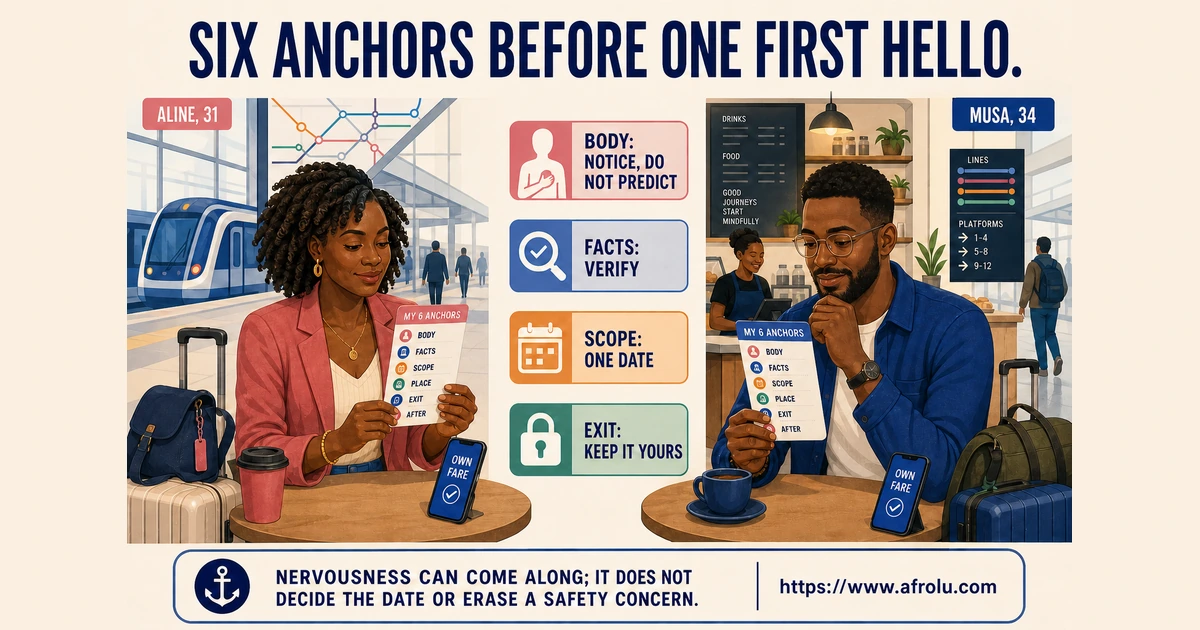
Notice the body, check the facts, name the scope, complete the public plan, retain the exit and review later.
Written and edited by Clarisse Uwimana · Dating Culture Editor
Use six anchors. Notice the body without asking it to predict the date; check identity and venue facts proportionately; define one casual meeting and what remains unpromised; choose a staffed public place with agreed community privacy; retain phone, payment, transport, check-in and a complete exit; and review only after returning home. Ask about culture instead of assuming it. Keep passports, visas, residence, workplace and money private. A meal, trip, shared heritage or casual label never supplies physical consent.
First dates · Diaspora Daters
How can a diaspora adult keep a casual first date small and safe without treating anxiety as a prediction or shared culture as automatic compatibility?
A low-pressure diaspora casual first date is one bounded adult meeting whose cultural and relationship scope is explicit, whose public logistics and independent exit are complete, and whose anxiety is treated as information rather than diagnosis, proof of danger or an obligation to perform.
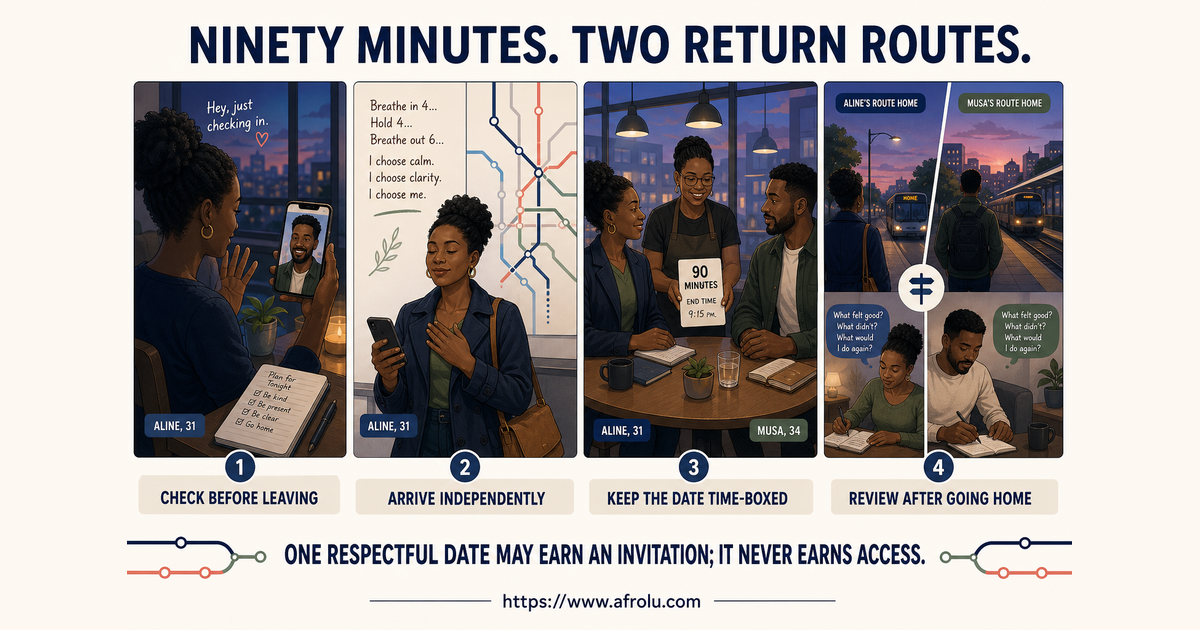
Aline and Musa are fictional diaspora adults, 31 and 34. They verify proportionately, agree on a ninety-minute public casual date and travel separately. Aline grounds before arrival, protects community and immigration privacy and declines a private extension. Musa respects the no. They review at home and choose one more public date while a cultural privacy difference remains open.
The six-anchor diaspora calm card
Let one first hello remain smaller than the culture, travel and future stories around it
Clarisse separates body cues, cultural compatibility, plan completeness and safety conduct without diagnosing the reader.
The card uses six anchors, follows a ninety-minute fictional date and ends with seven resolved arrival-and-return items.
Body and facts
Ground briefly, then check the person and plan proportionately.
Scope and culture
Name one casual date and ask rather than assume identity norms.
Place and exit
Use a staffed public venue, independent route and check-in.
After-date review
Sort nerves, mismatch, missing logistics and pressure at home.
Shrink the meaning of the first meeting
First-date nerves can accompany one casual date without deciding its outcome
A first date can feel unusually loaded in diaspora life. The match may understand familiar languages, food, faith or family references; they may also be connected to a community where dating visibility carries consequences. Travel, immigration stories and questions about belonging can make one coffee feel like an audition for an entire future. Shrink the scope deliberately: this is one meeting between consenting adults, not a decision about culture, marriage, relocation or community acceptance.
First-date anxiety may appear as a fast heartbeat, rehearsed speech, stomach discomfort, blankness or a wish to cancel. Those sensations are real, but they do not reliably tell you whether the person is compatible or safe. Use a brief grounding action, then check observable facts: identity consistency, public venue, duration, return route, money, trusted contact and the response to your limits. You may still cancel. The aim is choice, not forcing yourself through distress.
Casual describes the present relationship direction or structure, not the seriousness of consent and safety. A low-pressure date can be ninety minutes in public with separate transport and no promise of a second meeting. It still requires truthful scope, dependable planning and a complete no. Casual does not mean anonymous, careless or available for physical intimacy. State whether this is exploratory, non-exclusive and bounded before either adult uses chemistry to widen the agreement.
Diaspora identity should invite questions rather than assumptions. Two adults from the same country may have different language, religion, class, generation, migration history or family expectations. A respectful difference is incompatibility only when it matters to the relationship; it is not automatically danger. Pressure is different: demands for documents, money, secrecy, private space, community announcements or physical access after no require protective action rather than better cultural performance.
Use the six-anchor calm card
Anchor body, facts, scope, place, exit and after-date review
The body anchor is a brief pause. Feel both feet, notice the chair or ground, take a slower breath if that helps and name several things you can see or hear. The purpose is not to eliminate nervousness or prove you are ready. It is to create enough space to read the plan. If distress is severe, persistent or linked to immediate danger, a self-help exercise is not the right substitute for qualified or emergency support.
The facts anchor asks what is independently known. Does a live conversation broadly match the profile? Is the venue real and staffed? Is the meeting time clear? A video call can reduce uncertainty but does not prove identity, relationship status, employment or immigration claims. Do not exchange passports, visas, residence documents, banking records or authentication codes to reassure a match. Contradictions deserve a pause and smaller disclosure.
The scope and place anchors make the meeting finite. Say that it is one casual first date, choose a public venue and set an end time. Decide whether community visibility is comfortable; a venue near a tight social network may add pressure even when physically public. Ask before posting, tagging or introducing the match. Choose a neutral setting that allows conversation without forcing either adult to disclose home or work.
The exit and after anchors keep the decision open. Arrive and return independently, retain phone and money, tell a trusted person the broad plan and know how you will leave after a venue change. Review only after you are home and rested. Ask whether nerves eased, whether culture or intention actually mismatched, whether the plan was complete and whether no remained usable. One good date supports one proportional invitation, not automatic access.
Aline and Musa plan ninety minutes
A complete small meeting makes room for curiosity without future debt
Aline, 31, and Musa, 34, were fictional African diaspora adults living in the same host country. They had messaged for two weeks and wanted a casual first date. Aline felt nervous because mutual community connections made the meeting seem public before it happened. They used one short live call, confirmed a generic café near transport and agreed on ninety minutes. Neither shared a residence address, workplace or immigration document.
Before leaving, Aline used a brief grounding exercise and read her arrival card. She retained a charged phone, payment, return route and a trusted check-in. Musa travelled separately and accepted that the date would end before an evening family commitment. The plan did not ask Aline to become calm first. It gave her a clear sequence so nervousness did not have to answer every logistics question at once.
During coffee, they discovered a cultural mismatch: Musa expected a future partner to share community dating news early, while Aline valued extended privacy. Neither answer made the other unsafe. They asked what each preference meant and kept the casual scope unchanged. When Musa suggested continuing at his flat, Aline declined. He accepted without bargaining and helped close the café bill according to their earlier agreement.
They left on separate routes and reviewed later. Aline's nerves had eased, the privacy difference needed more discussion and Musa's response to no was respectful. She offered one more public date. If he had announced the match, demanded visa proof, requested money or punished the refusal, the same body discomfort would have sat beside materially different facts. Sorting feeling, mismatch and conduct kept the decision proportionate.
Sort discomfort into four readings
Nerves, incompatibility, missing logistics and safety pressure call for different moves
Ordinary anticipatory nerves may appear even when the identity story is consistent, the public plan is complete and the other person respects limits. Ground, shorten the date or cancel if that is what you choose. Do not use nervousness as proof that the match is dangerous, and do not shame yourself for needing more preparation. If similar anxiety is persistent and significantly affects daily life, qualified support may be useful; a dating article cannot assess or treat it.
Cultural or relationship mismatch is an honest difference: casual versus serious direction, community visibility, faith practice, communication style, language, family involvement or expectations about paying. Ask what the preference means rather than assigning a stereotype. If the need is core and cannot coexist, end respectfully. Neither adult must negotiate a major value away to make the first date successful.
An incomplete plan is a practical gap: no confirmed venue, unclear end time, unreliable transport, missing payment, no check-in or a proposed private switch. Complete the missing element or cancel. Anxiety may be responding to unresolved logistics, but finishing the checklist does not force attendance. You retain the right to decide that the remaining cost or uncertainty is not worth the meeting.
Safety pressure is observable conduct that reduces voluntary choice: identity contradictions, document or money requests, monitoring, threats, community outing, private-space pressure or disregard for consent. Preserve relevant evidence and reduce access. Use venue staff, platform, financial, legal, advocacy or emergency support appropriate to the risk. Do not reinterpret coercion as a cultural misunderstanding merely because the adults share heritage or community.

Sort the observable facts before treating discomfort as a command to flee or a challenge to overcome.
Prepare sentences before the room feels loud
Short scripts protect scope, culture, privacy and consent
For scope, say: ‘I am open to one casual first date; this is not a promise of exclusivity or a future.’ This protects both adults from hidden auditions. Ask the other person how they understand casual. If they seek serious partnership now, the answer may reveal incompatibility before either person invests more. Casual scope still includes honest communication about dating others and relevant sexual-health choices before activity.
For culture and community, use curiosity: ‘What does sharing dating news mean in your family or community?’ Then state your boundary: ‘Do not post, tag or announce this date without my agreement.’ Shared heritage does not create identical norms or permission to disclose. If the venue's community visibility would make free conversation difficult, choose another public place rather than moving private.
For documents and money, be direct: ‘My passport, visa, residence, workplace and banking details stay private.’ ‘I do not send travel or emergency money through a new connection.’ A legitimate immigration or travel process uses official channels, not a romantic request. If a payment is made under suspicious circumstances, contact the provider quickly, protect accounts and use reporting routes appropriate to your location.
For consent and ending, say: ‘I am not choosing that, and I am leaving at the planned time.’ If the date is pleasant, ‘I enjoyed meeting you and will decide about another date after I get home’ keeps review independent from immediate chemistry. If pressure appears, you do not owe a debate or private closure. Move toward staff or trusted support and leave through the route you prepared.

Say what the meeting is, what remains private and how you will leave before anxiety has to improvise.
Complete the arrival card before leaving
Seven resolved logistics give anxiety fewer jobs
Verify the person and venue in proportion to one first date. Use platform controls, consistent conversation, a live call and independent public information where appropriate. Check the venue's current opening, staffing, accessibility and transport yourself. Avoid sending identity or immigration documents in exchange. A person can appear consistent and still behave badly, so keep the remaining protections even after verification feels reassuring.
Choose a time box that leaves daylight or a familiar return if those conditions help. State the end before the meeting and schedule nothing essential immediately after if possible. Arrive separately. A host may offer transport out of hospitality, but accepting is optional; keep an independent alternative and do not reveal the exact residence door when a public stopping point works. Check current travel conditions close to departure.
Set a trusted check-in with enough detail to act: the person's first name or profile, venue, broad time and intended return. Agree what a missed check-in means. Keep phone, payment and essential money under your control. Do not allow the date to hold documents, device or fare. If you drink alcohol, make decisions that preserve awareness and transport; no substance or social custom changes another person's consent obligations.
Use the exit without waiting for certainty. A venue switch, document request, threat or repeated boundary violation is enough to end the meeting. Ordinary nervousness may also make a shorter date the right choice. After returning, review facts and feelings separately: what was the plan, what happened, how did difference feel, how did no function and what next step is proportionate? Delay the second-date answer if you need space.

Prepare the return before arrival and let ninety minutes be enough.
Choose the lowest useful load
The format should reduce uncertainty without deciding relationship meaning
A short live video meeting can test conversational ease before travel, though it cannot verify every identity or relationship claim. Public coffee creates a familiar time box and easy exit. A daytime walk may reduce face-to-face intensity but needs suitable weather, accessibility and staffed surroundings. A market or gallery supplies shared focus, which can ease interview pressure while increasing movement and sensory load.
An early meal offers longer conversation and clearer seating, with higher time and cost. Decide payment expectations in advance when ambiguity would add pressure. A permission-based group event can reduce one-to-one intensity and show social conduct, yet it increases community visibility and may make a private no harder. Ask before introductions, photos or posts, and ensure each adult can leave independently.
A cross-border first visit carries the highest travel, document, lodging and expectation load. Consider a live call and local public date first where possible. If travel occurs, retain itinerary, passport, separate accommodation, local transport, money, check-in and return. A host's effort or a visitor's cost does not create exclusivity, physical access or a second visit. Use current official travel guidance for the actual destination.
Select the format by the next question and your real capacity. If you need to learn whether conversation feels comfortable, choose a short low-load setting. If cultural expectations need discussion, choose enough quiet time without surrendering the exit. Continue when the plan was respectful and one more question feels worthwhile. Revise the format when logistics caused strain. Close when direction conflicts or pressure makes choice smaller.
Eight diaspora first-date moments where anxiety needs a smaller decision
Mutual acquaintances make the date feel public
The venue is safe enough, but social visibility increases pressure.
Choose another staffed public place and agree no posting.The complete plan still feels emotionally large
No contradiction, threat or boundary pressure is present.
Ground, shorten or cancel according to your choice.A match expects early family disclosure
The adults may have a respectful values difference.
Ask what it means and decide whether the mismatch fits.The meeting place has not been confirmed
Anxiety is carrying a practical unknown that can be resolved.
Complete a public plan by the deadline or cancel.Immigration documents are requested as trust
Sensitive information is unnecessary for one casual date.
Refuse and verify identity without document exchange.A paid meal is linked to private time
Spending is being used to expand the agreement and consent.
State no, use the independent exit and seek help if pressured.A pleasant date is moved toward private space
The casual first-date scope and public venue would change.
Decline and return independently.The date was respectful but the adult remains uncertain
No immediate answer is required at the café table.
Review at home and send one clear answer later.Signs of ordinary nerves, cultural mismatch, incomplete planning and pressure
{'label': 'Body', 'title': 'Nervousness is noticed without becoming prophecy', 'detail': 'The adult can ground, shorten or cancel without shame.', 'reading': 'Choice-aware'}
{'label': 'Facts', 'title': 'The person and venue are checked proportionately', 'detail': 'Reassurance does not require sensitive documents.', 'reading': 'Grounded'}
{'label': 'Scope', 'title': 'One casual date remains one date', 'detail': 'No exclusivity, intimacy or future is implied.', 'reading': 'Accurate'}
{'label': 'Culture', 'title': 'Differences receive questions rather than stereotypes', 'detail': 'Shared heritage is not treated as identical values.', 'reading': 'Curious'}
{'label': 'Community', 'title': 'Disclosure and posting require permission', 'detail': 'Visibility never becomes a romantic test.', 'reading': 'Private'}
{'label': 'Place', 'title': 'The plan stays staffed, public and time-boxed', 'detail': 'A venue change can be declined.', 'reading': 'Complete'}
{'label': 'Return', 'title': 'Phone, payment and route stand alone', 'detail': 'The match does not control the exit.', 'reading': 'Leaveable'}
{'label': 'Money', 'title': 'Travel and emergency requests remain outside romance', 'detail': 'Affection does not verify a financial claim.', 'reading': 'Independent'}
{'label': 'Consent', 'title': 'A no stops the request', 'detail': 'Casual scope, hospitality and cost create no access.', 'reading': 'Voluntary'}
{'label': 'After', 'title': 'The next answer waits for private review', 'detail': 'Chemistry does not eliminate reflection.', 'reading': 'Considered'}
Choose the next step from the six-anchor calm card
| Situation | What it may mean | What to do next |
|---|---|---|
| What is the body signal saying? | Fits: Nerves coexist with a complete, voluntary plan. Needs review: The adult needs grounding, a shorter date or more support. Stop: Immediate danger or severe distress needs urgent help. | Pause, ground and choose without shame. |
| Are basic facts consistent? | Fits: Independent signals support one public meeting. Needs review: One contradiction needs checking. Stop: Identity, relationship or document claims keep shifting. | Verify outside romance or cancel. |
| Is the casual scope mutual? | Fits: Both understand one exploratory date. Needs review: The label needs definition. Stop: Casual is used to hide demands or remove consent. | State what the date includes and excludes. |
| Is this cultural mismatch or pressure? | Fits: Different values are discussed respectfully. Needs review: A core expectation needs clarification. Stop: Culture is used to shame, expose or control. | Name mismatch or protect access. |
| Is community privacy intact? | Fits: No posting or introductions occur without permission. Needs review: The venue visibility needs adjustment. Stop: The date is announced or used as leverage. | Limit disclosure and preserve evidence. |
| Is the public plan complete? | Fits: Place, time, cost and end are confirmed. Needs review: One logistical gap can be fixed. Stop: Private or isolated changes are pressed late. | Complete the plan or cancel. |
| Can either adult leave independently? | Fits: Phone, funds, transport and check-in stand alone. Needs review: One backup needs completion. Stop: Documents, lodging or return are controlled by the match. | Restore independence before meeting. |
| Is money separate from trust? | Fits: Each adult funds the bounded plan. Needs review: Choose a lower-cost format. Stop: Travel, emergency or investment money is requested. | Transfer nothing and protect accounts. |
| How does no function? | Fits: The plan changes without punishment. Needs review: One misunderstanding is repaired. Stop: Spending, culture or attraction is used to demand access. | Leave and seek suitable support if needed. |
| What does the after-date review support? | Fits: One more bounded invitation. Needs review: More time or a different format. Stop: Pressure, incompatibility or unsafe conduct outweighs curiosity. | Continue, revise or close later. |
Scripts for casual scope, culture, privacy, documents, money and consent
“I am open to one casual first date; this is not exclusivity or a future promise.”
“What does family or community disclosure mean to you while dating is new?”
“Do not post, tag or announce this date without my agreement.”
“I am meeting at the confirmed public venue and leaving at the planned time.”
“My passport, visa, residence and workplace records stay private.”
“I do not send travel, emergency or investment money through a new connection.”
“I am not choosing that, and casual does not change my answer.”
“I am leaving now and will decide about another date after I get home.”
“Our expectations about privacy or relationship direction do not fit.”
“I enjoyed meeting you and can offer another public date next week.”
Know the difference
The low-pressure diaspora first-date format wheel
Video, coffee, walks, meals, group events and cross-border plans carry different practical loads and levels of community visibility.
Casual or serious direction, consent and cultural disclosure cannot be inferred from the format, distance travelled or money spent.
Choose a manageable public container, then decide scope, privacy, consent and any future step separately.

Choose the format that reduces unresolved logistics without turning community visibility into a test.
Compare eight low-pressure first-date formats by practical and social load
| Type or dimension | What it describes | Best next question |
|---|---|---|
| Short live video | ||
| Public short coffee | ||
| Daytime public walk | ||
| Market or bookshop visit | ||
| Gallery or museum | ||
| Early public meal | ||
| Permission-based group event | ||
| Cross-border first visit |
Prepare a low-pressure diaspora first date in six moves
Notice and ground
Check facts
Name casual scope
Complete place and return
Protect culture and consent
Review at home
Questions for body, facts, culture, arrival and after-date review
Choose a few prompts that fit the moment. This is a reference library, not a list to complete.
Body-and-facts questions
Notice the feeling, then read the observable plan.
- What do I notice physically?
- What is independently consistent?
- Which fact is still missing?
- Would a shorter date help?
- Do I freely want to go?
Culture-and-scope questions
Keep shared identity from writing hidden expectations.
- What does casual mean here?
- What privacy do we expect?
- May anyone post?
- Which family norms matter?
- Can a mismatch end respectfully?
Arrival questions
Complete the public plan and independent return.
- Is the venue staffed?
- What is the end time?
- How do I arrive and leave?
- Who holds my check-in?
- Are money and phone protected?
After-date questions
Sort feeling, fit, planning and conduct at home.
- Did nerves change?
- Was there a real mismatch?
- Did no remain usable?
- Was the plan respected?
- Is one next date worthwhile?
What anxiety research and official travel, scam and consent guidance can support
Daily dating experiences and social anxiety have been studied
A peer-reviewed daily diary study examined dating experiences among people with social anxiety disorder. Afrolu uses the research only to recognise that anxiety can affect dating experiences, not to diagnose readers or predict one date.
Evidence limit: A clinical study cannot establish whether an individual has a disorder or what treatment they need.
Anxiety during a date does not answer every future-interaction question
Peer-reviewed research examined momentary anxiety and desire for future interaction in dating contexts. The practical lesson is to separate a body state from compatibility, plan completeness and observable conduct rather than making one feeling a verdict.
Evidence limit: Study associations do not determine an individual's attraction, safety or relationship outcome.
Persistent social anxiety may deserve qualified support
The UK National Health Service describes social anxiety as more than shyness and provides information about symptoms and help. Readers whose anxiety persistently affects daily life may consider suitable professional support.
Evidence limit: This page is not a diagnostic screen, treatment plan or crisis resource.
Cross-border meetings need current official travel checks
The UK government foreign travel checklist covers items such as destination advice, documents, insurance and planning. A diaspora first visit should use the official guidance relevant to the traveller and destination and retain independent lodging and return.
Evidence limit: UK guidance serves UK travellers; requirements and emergency routes vary by nationality and destination.
Romantic trust can precede travel or emergency money requests
The U.S. Federal Trade Commission describes romance-scam patterns involving remote trust, excuses for not meeting and later money requests. Keep funds and immigration or banking documents outside a new connection.
Evidence limit: FTC reporting and remedies are U.S.-specific; use suitable local platform, financial and legal channels.
Casual scope and hospitality never create physical access
Healthdirect explains consent as knowingly and freely agreeing and notes that it can be withdrawn. A meal, ride, visit, gift, shared culture or earlier yes cannot decide another physical or digital act.
Evidence limit: Healthdirect services and legal context are Australia-specific; use suitable local health, legal or emergency resources.
Six ways anxiety or diaspora expectation can enlarge one casual date
Use a reviewed resource that matches the decision
This guide focuses on the relationship decision, so it does not rank dating apps. Check current prices, safety tools, and local availability before choosing a service.
Explore the guide library
Show more related guides
Continue with Afrolu
Show more Afrolu guides
Peer-reviewed anxiety research and official clinical, travel, scam and consent sources
Afrolu reviewed these health, research, safety, or public guidance resources while editing this page. They support the behaviour and safety guidance; they do not diagnose any individual described by a reader.
Low-pressure diaspora first-date anxiety questions
Is first-date anxiety a sign that I should cancel?
Not automatically. Anxiety can accompany a complete and respectful plan, but you remain free to cancel for any reason. Ground briefly if useful, then check identity consistency, public venue, duration, return, money and the response to boundaries. Immediate danger or severe distress needs appropriate support, not pressure to finish the date.
How can I keep a diaspora first date low pressure?
Define it as one casual public meeting with a clear end, separate transport and no immediate second-date decision. Choose a neutral venue whose community visibility feels manageable, agree no posting, keep documents and money private and review after going home. Low pressure should still include confirmed plans and mutual effort.
What if shared culture makes the date feel more serious?
Name the feeling and shrink the scope. Shared heritage may create familiarity or community expectations, but it does not establish values, exclusivity, family fit or future commitment. Ask specific questions about faith, privacy, disclosure and relationship direction. One respectful mismatch can be enough to decline another date.
Should I tell mutual community contacts about the date?
Only if you freely choose. Agree with the match about posting, tagging and introductions. A public venue does not make the romantic context public property. If visibility would make a no difficult or expose private information, choose another staffed public setting and tell only trusted support the broad plan.
Is a video call enough before meeting a diaspora match?
It can reduce uncertainty and test conversational consistency, but it cannot verify every identity, relationship, employment or immigration claim. Combine proportionate independent checks with a bounded public plan. Do not exchange passports, visas, residence records, bank statements or authentication codes as romantic proof.
What if the date asks about my visa or immigration status?
You may discuss broad life context if you want, but keep document numbers, scans, addresses, employer records and legal case details private unless an official process genuinely requires them. A casual first date has no need for evidence. Repeated document pressure is a reason to reduce access or cancel.
Who should pay on a low-pressure casual first date?
There is no universal rule. Discuss expectations when uncertainty would add pressure and choose a format each adult can afford. One person may offer, but payment creates no obligation for private time, touch, another date or gratitude beyond what is freely chosen. Retain enough independent money to leave.
How long should a first date last when I feel anxious?
Choose a manageable window rather than a proof test. Sixty to ninety minutes may work for some adults, while others prefer shorter or longer. State the end in advance and retain the right to shorten it. Duration does not measure attraction or seriousness; the useful question is whether the format supports choice and conversation.
How do I know whether discomfort is cultural mismatch or a red flag?
Name the observable fact. A respectful difference about faith, family visibility or relationship direction may be incompatibility. Deception, threats, document or money pressure, monitoring, outing or disregard for no reduces choice and needs protection. Severity and response to a boundary matter more than a cultural label.
When should I decide about a second date?
You do not need to decide at the table. Return independently, rest and review the facts, fit, feeling and response to boundaries. Offer one clear invitation if another bounded meeting is worthwhile, or send a concise decline. You owe no private closure meeting, immigration detail or debate about your answer.
One thing to do now
Let nervousness come along while the arrival card keeps the route
Use six anchors: body, facts, scope, place, exit and after-date review. Continue when the plan is complete, difference remains respectful and no is usable. Resize time or format when ordinary nerves or logistics need less load. Close and seek suitable support when deception, outing, document or money pressure, threats, coercion or disregard for consent reduces choice.