Adult students · serious weekend reality check
Serious Weekend Dating Red Flags for Adult Students
Serious weekend dating red flags for adult students: protect study, money, privacy and consent, spot pressure, and keep every weekend plan freely chosen.

Serious intent does not make your weekend less yours.
Written and edited by Thabo Mokoena · Dating Trends Editor
Serious adult-student dating can grow gradually. Name a present intention, make weekends public and reversible, protect study systems and money, use a sustainable contact rhythm, and watch the response to one clear boundary. Repeated availability guilt, private-plan pressure, account requests, financial urgency, monitoring, unwanted contact, coercion, threats, or fear deserve less access and a safety-led response.
Dating safety · Students
Is this serious weekend connection fitting an adult student’s real life, or are availability guilt, private-plan pressure, money, study access, digital monitoring, unwanted contact, coercion, or fear asking you to outrun your own choices?
Serious weekend dating red flags for adult students are observable behaviours that make time, study, money, privacy, digital access, consent, movement, or an exit less freely chosen. They can include availability guilt, private-plan pressure, study or workplace intrusion, financial requests, monitoring, unwanted contact, coercion, threats, or fear. The phrase describes conduct and its effect on freedom, not a diagnosis or a judgment about adult students, study paths, or serious dating.
Mpho is an adult student who wants a serious relationship but has a demanding weekend assessment. A match reacts well to a shorter public date at first, then begins to push for a private venue, asks for a study-calendar login, and says a paid ticket proves the relationship should move faster. Mpho keeps the plan independent, protects the account, and lets the response to a clear no decide what happens next.
adult students · serious weekend reality check
Mpho keeps serious dating connected to study, privacy, consent, and an independent weekend plan
This guide separates ordinary student scheduling differences from patterns that make an adult student’s time, studies, money, body, information, or exit less freely chosen.
Name present intent, make weekend plans reversible, protect study systems, keep money separate, read a clear no, end at the level of risk, and review whether serious dating leaves you more able to choose.
Serious does not mean urgent
A future wish can coexist with real study, work, and rest commitments.
Keep plans reversible
Public venues and independent transport leave room for a current choice.
Protect systems and time
Accounts, schedules, devices, and learning spaces can stay yours.
Match the risk
Clarify a mismatch and reduce access or seek support when pressure or fear appears.
serious does not mean urgent
An adult student can want a meaningful relationship without turning every free weekend into a test of commitment
Adult students date from many different lives: degree programs, professional training, evening courses, distance learning, return-to-study pathways, paid work, family responsibilities, and personal projects. There is no single student timetable or relationship pace. A person who values a serious relationship can still choose short public dates, protect study time, decline a last-minute trip, or say no to an overnight plan without becoming less interested or less mature.
It helps to separate intent from availability. You may want a long-term relationship while only having a few weekend hours to offer. Another adult may want more spontaneous time or faster physical closeness. That can be an honest mismatch, not a moral failure. The concern begins when someone uses serious language to make ordinary scheduling limits, a study deadline, a need for rest, or an independent plan look like evidence that you do not care enough.
A serious connection has room for present-tense questions. What do we each mean by serious now? How do weekends realistically work around existing commitments? What do we need to know before a trip, a sleepover, a public event, shared spending, sex, or exclusivity? What happens when a plan changes? A date does not need a perfect answer, but they do need to leave room for yours without punishing uncertainty.
You do not need to rush toward a relationship label because you are balancing study and dating. Choose one plan that is manageable, public if that feels right, and independent enough that you can leave. A meaningful connection can survive a slower weekend, a postponed plan, a boundary around contact, or a decision to keep personal information and money separate. The relationship is not more serious because you have less room to think.
make a weekend plan small enough to revise
A date can be intentional without becoming an all-day obligation, a private trip, or a reason to abandon your own route home
Before a first or early weekend date, decide the parts you actually want. A coffee, lunch, a public event, a walk, or a short meal may be enough. Choose the start and end window, how you will arrive and leave, and whether you want alcohol, a second venue, or any private setting in the plan. You do not have to make a whole day available because someone has travelled, paid for tickets, or says serious daters should maximise limited time.
Keep lodging and transport separate when distance is involved. A weekend trip does not settle where you will stay, whether you share a room, whether you drink, whether you have sex, or how long you remain. A person can be disappointed by a limit and still respect it. If they say the cost of the trip, the scarcity of weekends, or the seriousness of the relationship means you owe more access, the plan is no longer simply romantic logistics.
Watch late changes carefully. A public venue may become a private apartment, a short plan may become an overnight request, or a meeting time may move so late that your independent route feels less available. One change may have a normal explanation. You can still decline it. Repeated changes that only work when you accept more privacy, more alcohol, more dependence, or less time to think are a pattern worth treating as information.
A useful weekend plan gives each adult a graceful exit. You can leave after an hour, meet only in a public setting, make a separate booking, take your own transport, or cancel before you travel. These choices do not undermine a serious intention. They make it possible to discover whether the relationship can handle reality. A person who can enjoy your company without controlling the plan is offering more than an impressive itinerary.
keep study and personal systems out of the relationship test
An adult student’s course, workplace, devices, schedule, and academic support network can remain private while a relationship is new
Give broad information at first. You might say that a weekend includes study time, that some details are confidential, or that you prefer not to share your full timetable. You do not need to provide a campus map, course platform, student number, class list, library routine, work shift, or the name of every person you study with. This is not about hiding a relationship; it is about preserving enough privacy for you to make decisions without a new date knowing where to find you.
Keep devices and accounts separate. Do not share passwords, verification codes, learning-platform logins, email access, cloud storage, calendar control, or location services to show that a relationship is serious. A person may frame this as transparency, support, or a way to coordinate a weekend. It remains a request for access that you can decline. Real trust grows through consistent conduct, not through making your studies or accounts harder to control.
Notice whether a person protects or erodes your attention. They may respect a planned study block, make a modest date plan, and accept that a reply will come later. Or they may call repeatedly, demand proof of where you are, turn an assessment into a reason to test your devotion, message people in your cohort, or tell you that someone who wants a future should put romance ahead of study. The second pattern does not make a relationship more serious; it makes your choices smaller.
If someone contacts your classmates, tutors, workplace, or online learning community without permission, treat the contact as a boundary issue. You can ask relevant people not to share information, keep a record if it is safe, and use a more protected exit. You do not have to wait for an academic consequence before acting. Your ability to learn, work, and rest deserves a clear perimeter, even in a relationship that feels emotionally important.

Let your study calendar, consent, and choices set the next level of access.
keep student budgets and practical help separate from romance
A limited budget, scholarship, job, loan, family support, or weekend travel cost does not make you responsible for someone else’s emergency
Adult learners can be balancing uneven income, tuition, transport, housing, paid work, scholarships, and shifting weekend availability. Before a new match asks for financial help, make the boundary specific: personal banking, bursary records, loan paperwork, devices, and payment codes are unavailable for a romance. Do not become a payment route, guarantor, lender, recipient, or intermediary for someone you are dating.
Expense can be part of a date without becoming a transaction. Decide whether you would rather pay your share, accept a gift, or choose a cheaper plan, then notice the response. A person who treats tickets, distance, or an expensive meal as a reason to request a bedroom, a private photo, a longer night, or emotional compliance is converting generosity into leverage.
Be cautious about rescue language. Someone may say they can solve a transport issue, cover tuition, help with a device, invest in your future, or need your account to receive funds. You do not need to decide whether the story is believable. You can decide that your bank, financial aid, education records, and personal account are not part of a dating connection. Use independent official channels for any real practical question.
If you have shared money or identifying information and feel concerned, seek practical help quickly through the relevant provider, platform, or official support route. Tell someone trusted rather than trying to solve it alone. If the person responds with threats, image pressure, repeated contact, monitoring, blackmail, unwanted sexual contact, or fear, shift away from the financial story and toward a safety plan. Embarrassment should not isolate you from support.
keep consent current when a weekend feels important
A serious relationship, a weekend booking, a meal, a ride, a shared interest, or previous intimacy never settles what you freely choose next
State the boundary that fits the moment: no private venue, no alcohol, no overnight plan, no physical contact, no photographs, no pressure to leave with them, no more time, no money, no location sharing, or no further date. You are not required to attach a personal history to it. A short sentence gives the other person a chance to demonstrate that their serious intention includes respect for your decision.
Sometimes someone makes an assumption and repairs it. They hear that a comment or invitation did not work, apologise without insisting on forgiveness, and change the next plan. That differs from a person who calls you immature, says you led them on, claims a ticket or dinner created a right to intimacy, keeps asking in different language, pressures you after alcohol, or treats a weekend visit as a reason you cannot leave. Repair is visible in conduct, not just words.
Do not let a relationship goal make you second-guess a present no. Serious dating may involve future questions about values, commitment, family, or lifestyle, but none of them makes access automatic now. You can pause an intimate conversation, decline an image request, sleep in your own space, leave early, or end contact even when you previously hoped the relationship might last. A future possibility is not a debt against your current freedom.
When a boundary has been ignored or leaving feels difficult, choose the smallest amount of engagement that keeps you safe. Move toward staff, transport, a trusted contact, or urgent local help; block an account if that is useful. Threats, stalking, coercion, sexual harm, image-based abuse, blackmail, or immediate danger call for support and distance, not one more attempt to settle a dating conversation. You owe nobody a polished explanation before protecting yourself.

A direct boundary can make serious dating more real, not less.
end a serious-seeming connection at the level of risk
A clear no can be short, adult, and protective even when weekends feel scarce or a relationship has involved future talk
When the connection is simply not for you, a final message can be brief: “I am stepping away from this. Please do not contact me again.” Send it in the format that leaves you most in control, cancel the weekend plan, and skip a final call if one would prolong pressure. You are allowed to end a relationship because its pace, communication, or expectations no longer fit your studies, finances, or wellbeing.
Where pressure keeps returning, make the outcome unmistakable: “This relationship is over. Do not ask me to reconsider.” There is no need to litigate the price of dinner, the effort of a visit, or the sincerity of a future promise. Those details can become openings for further bargaining. The point of an ending is to close the pattern that was making your access feel conditional.
If a former date can trace your class schedule, job, accommodation, or online spaces, adjust the practical details around you. Let supportive people know not to pass on information, stop live location posts, save unwanted-contact evidence when safe, and decline any private meeting sold as closure. You can choose a safer route through a weekend event, workplace, or learning setting before the behaviour needs a dramatic label.
When an ending brings repeated messages, accounts created to bypass a block, threats, pressure involving images or money, contact with classmates or staff, stalking, coercion, unwanted sexual contact, or fear, make safety the priority. Use platform reporting, relevant institution or workplace support, local services, and urgent help when required. The aim is to restore your ability to learn, work, move, and rest without someone else using a relationship as a route to control.

Choose the move that keeps your future in your hands.
review whether serious dating leaves you more able to choose
A relationship worth pursuing should make room for study, rest, money boundaries, privacy, consent, trusted support, and an independent exit
After a few dates, ask specific questions. Can I study or work without a reaction? Can I decline a last-minute plan, a private venue, a ride, a financial request, an image, or intimacy without managing the other person’s mood? Can I keep my accounts, course details, schedule, address, and transport under my control? Can I tell a trusted person what is happening? Can I leave a date without depending on them? These questions make relationship quality practical.
An ordinary mismatch may involve different weekend capacity, different relationship goals, different budgets, or different ideas about public and private time. A mistake may involve a late arrival followed by accountability and a changed plan. A concerning pattern may include repeated venue switches, financial pressure, access to your study life, guilt about your availability, boundary bargaining, monitoring, unwanted contact, coercion, threats, or fear. Different facts call for different levels of distance and support.
Choose the action that matches the fact. That may be another public coffee, a more realistic contact rhythm, a clearer financial rule, a day to think, no overnight plan, no sharing of course details, a concise ending, a block, a record, or a call to someone trusted. You do not need to resolve every uncertainty before you protect a boundary. A smaller step can show whether a relationship can remain respectful without more of your life being handed over.
Adult students can date seriously with hope, intimacy, ambition, curiosity, and care while still keeping their studies and choices intact. The quality of a relationship is not measured by how much of a weekend it can consume or how quickly it can become intense. It is measured by whether both people can be honest, autonomous, and safe while the future remains a possibility rather than a demand.
Eight serious weekend dating moments for adult students
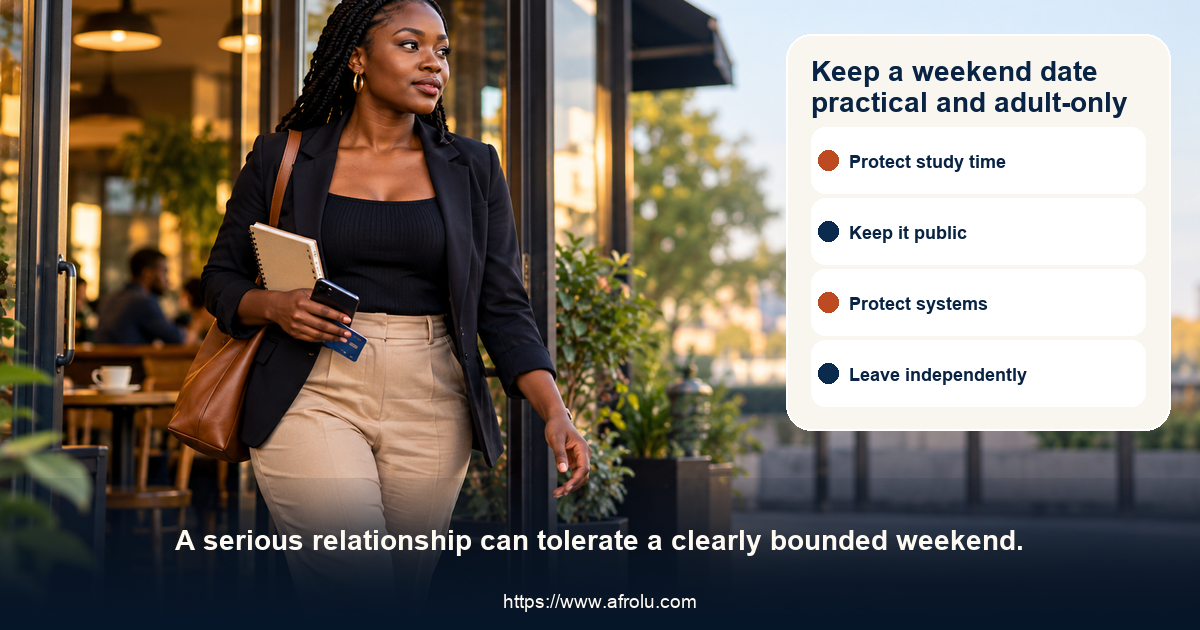
A study deadline changes the date
An adult student explains that a planned date must shorten because of an assessment, and the other person asks about another public time without demanding proof.
Treat this as a normal scheduling fact and choose another plan only if it fits your life.Serious dating becomes a test of availability
A match says a meaningful weekend must include a full-day trip and reacts badly when you prefer a short public date.
Keep the plan small or decline; seriousness does not require surrendering the whole weekend.A public event becomes an apartment invitation
After a public plan is confirmed, the person changes it to a private venue and says an adult student should not need safety rules.
Keep the public plan or leave; a late switch does not remove the right to decline.Practical help becomes financial access
A date offers to solve a money worry but asks for account details, a transfer, a code, or a secret repayment promise.
Do not share financial or education records; use independent official channels for real support.Transparency becomes account access
A person says sharing a learning-platform login or calendar would prove you are not hiding anything.
Keep accounts and schedules private; serious intent does not need surveillance.Travel becomes a claim on intimacy
A person says the cost of weekend transport or a hotel means you should stay longer or have sex.
Leave independently and name that spending does not create consent or access.A clear boundary changes the next plan
After assuming a sleepover, a date hears your no, apologises without bargaining, and arranges a daytime public plan next time.
Treat the changed conduct as useful evidence while keeping your pace.An ending is bypassed through study contacts
After you end contact, the person messages someone in your course or work network to ask where you will be.
Ask contacts not to share information, preserve concerning contact if safe, and seek support if it continues.Signals about weekend plans, study, money, privacy, consent, and exits
They can name serious intent without treating your study, work, rest, or existing commitments as obstacles to overcome.
They accept a short public weekend plan and independent transport without calling it a lack of maturity or interest.
They respect a no to a private venue, overnight stay, alcohol, sex, images, extended date, or late change.
They can handle a study deadline or changed plan without demanding proof, guilt, punishment, or a compensating favour.
They do not ask for learning-platform logins, passwords, verification codes, calendar control, live location, or access to devices.
They do not turn a ticket, meal, ride, gift, or booking into a claim on intimacy, time, money, or another date.
They do not ask for transfers, loans, account access, documents, scholarship details, or help moving funds.
They respect a broad answer about your course, workplace, accommodation, schedule, classmates, and future plans.
They can discuss future hopes while leaving room for gradual knowledge and a change of mind.
They do not make a serious relationship label a reason to rush exclusivity, travel, sexual contact, or merged routines.
They make a repair visible in the next plan instead of using an apology to resume pressure.
They do not contact classmates, tutors, coworkers, workplace accounts, or online study spaces to bypass a boundary.
They do not use new accounts, indirect contacts, or routine places to continue contact after an ending.
They leave you able to study, work, rest, speak to trusted people, and end contact without fear.
Choose a proportionate next move
| Situation | What it may mean | What to do next |
|---|---|---|
| A study deadline changes a plan | A real commitment can be ordinary; the response shows whether your time is respected. | Give only the update you want and see whether a new plan can be discussed calmly. |
| They want a full private weekend | Preference may be genuine, but a plan can become pressure if it removes an independent exit. | Choose a short public date, separate lodging, or no trip. |
| A public venue becomes private | Convenience can be real, yet privacy needs separate consent. | Keep the original plan or leave without defending the decision. |
| They ask for course or login access | Curiosity can be ordinary; account or schedule control creates a different risk. | Keep systems private and do not share passwords, codes, or calendars. |
| They offer money or ask for it | A gift can be freely given; financial access or urgency is a risk you can decline. | Do not transfer, lend, receive, invest, or share financial information. |
| They pay for travel or dinner | Expense does not create an entitlement to time, sex, a private plan, or another date. | Leave on your own schedule and retain current consent. |
| They apologise for an assumption | A repair matters only if the next plan changes. | Name the needed boundary and observe conduct. |
| They say serious adults should move faster | A relationship preference can be incompatible; pressure is not a preference. | Return to a present, reversible next step or end the mismatch. |
| They contact your study or work network | Indirect contact can turn dating pressure into intrusion. | Ask people not to share details, preserve evidence if safe, and reduce access. |
| You feel fear or cannot leave freely | The question has changed from dating pace to immediate safety. | Use a protected exit and relevant urgent local support rather than another relationship conversation. |
Twelve lines for time, study systems, money, consent, and ending
“I am open to serious dating, and I want our weekend plans to fit real life rather than rush it.”
“I can meet for this time, then I am leaving as planned.”
“I am meeting at the venue and making my own way back.”
“That change does not work for me. I will keep the public plan or head home.”
“I do not share logins, codes, calendars, or course details early on.”
“I do not lend, transfer, receive, or share financial details in dating.”
“I am enjoying the date, and I am not agreeing to that tonight.”
“I can talk at these times, and I protect study and sleep outside them.”
“I heard the apology. I need the next plan to respect the limit I named.”
“A serious relationship does not require me to decide that today.”
“This pace and level of access do not work for me, so I am not continuing.”
“I asked for no more contact. Do not use new accounts or people around my studies to reach me.”
Know the difference
A study change, a serious mismatch, mounting pressure, and fear need different weekend dating responses
A person can respect a study deadline, accept a short public plan and current no, keep accounts and money separate, use a sustainable rhythm, and alter the next plan after impact is named.
Availability guilt, private-venue pressure, demanded account access, financial urgency, monitoring, study or work intrusion, unwanted contact, coercion, threats, or fear turn serious dating into a claim on access.
The seriousness of a future does not decide the risk. The observed pattern and your freedom to choose do.

A serious weekend plan earns trust through study-safe, freely chosen actions.
Separate a scheduling change, mismatch, pressure, and fear
| Type or dimension | What it describes | Best next question |
|---|---|---|
| A study change | A deadline or work shift is named, respected, and met with a practical new option. | Decide whether the revised rhythm suits you. |
| Availability guilt | A study or rest boundary is used to demand proof, more time, or a compensating private plan. | Keep the limit and make access smaller. |
| A serious intention | Two adults describe a future possibility while allowing gradual evidence and a change of mind. | Keep the next plan practical and reversible. |
| Urgent commitment | Future language is used to bypass public plans, privacy, money rules, consent, or independent movement. | Return to observable present behaviour. |
| A public weekend plan | Both adults retain transport, time, money, current consent, and an exit. | Confirm only the plan you freely want. |
| Weekend leverage | Travel, a ticket, a meal, or scarce time is used to claim a private venue, a longer date, or sex. | Change or cancel the plan. |
| A repair | Impact is acknowledged and the following plan respects the boundary. | Watch consistency before sharing more access. |
| Financial extraction | Money, accounts, education records, codes, or a rescue story are framed as care or a future investment. | Keep resources and systems separate. |
| A safety concern | Threats, stalking, coercion, unwanted contact, image pressure, workplace or study intrusion, or fear appears. | Use a protected exit and appropriate local support. |
Start with a serious intention that still leaves room for a real adult life
Keep intent present-tense
A serious wish can be real without turning one weekend or one decision into proof of commitment.
Make plans reversible
A public venue, independent route, finish time, and separate lodging preserve choice when a weekend changes.
Protect study systems
Course details, devices, logins, schedules, classmates, and online spaces can remain private while trust is earned.
Keep money outside romance
Tuition, transport, financial aid, accounts, documents, loans, gifts, and transfers do not prove trust.
Keep consent current
A booking, meal, ride, relationship label, or prior intimacy never replaces a present freely chosen yes.
Match an ending to risk
Use a short close for mismatch and a more protected route when unwanted contact, threats, intrusion, or fear appear.
Questions organised by purpose and depth
Choose a few prompts that fit the moment. This is a reference library, not a list to complete.
Before a weekend plan
Make serious dating practical.
- What time, venue, and route keep me comfortable?
- What study, work, rest, or budget boundary stays intact?
- What would make a late change a no?
Before a bigger promise
Keep future talk connected to current capacity.
- What do we each mean by serious now?
- What would I keep independent for now?
- What small next step would create more evidence?
When money or access enters
Use a firm independent pause.
- Would I make this payment or share this login without a dating story?
- Is urgency or secrecy being used?
- Which official channel could verify the claim?
Before continuing
Check whether the relationship is still voluntary.
- Can I say no without managing their mood?
- Does the plan protect study, privacy, money, and consent?
- Would a smaller next step restore freedom?
Look more closely at intent, weekend plans, study, money, consent, and endings
Serious dating needs a present agreement
Discuss current capacity, contact, public plans, travel, privacy, money, sex, exclusivity, and what each person can genuinely offer now.
Evidence limit: No guide can decide the arrangement for two adults.
A practical plan preserves current choice
Use a public venue, independent transport, a finish time, separate lodging, and enough money to change course if the date shifts.
Evidence limit: A public plan cannot eliminate every risk.
Academic and work life need a perimeter
Keep course, campus, work, devices, accounts, schedules, classmates, and online communities under your control until sharing is freely chosen and safe.
Evidence limit: Changing digital settings may need a safety plan if another person could notice and escalate.
Romance should not set a student’s financial risk
Pause loans, transfers, tickets, tuition stories, payment links, accounts, documents, codes, and offers to receive money for someone else.
Evidence limit: A concerning request is not proof that every person is committing fraud.
A current yes is specific
Check in around touch, sex, alcohol, sleepovers, images, travel, and changes of plan; make leaving possible without a social penalty.
Evidence limit: General advice cannot assess a particular encounter.
Risk changes the amount of contact you need
Use a short close for an ordinary mismatch and a support-led route when pressure, stalking, threats, coercion, study intrusion, or fear appear.
Evidence limit: Blocking by itself may not resolve every safety concern.
Shortcuts that make serious weekend dating less freely chosen
Treating student life as a deadline
A serious relationship is not improved by overriding study, work, health, care, or rest to prove availability.
Making a long weekend the test
Time or travel can make it harder to leave but never makes intimacy, secrecy, or a private setting owed.
Sharing study systems to appear open
Accounts, devices, calendars, course details, and locations create exposure rather than evidence of trust.
Letting a paid plan create debt
A meal, ticket, ride, or booking does not purchase your time, body, money, or a next date.
Explaining every boundary
A short no is easier to maintain than a personal case someone can cross-examine.
Seeking a final meeting when fear is present
More contact can increase pressure when a protected exit is the safer choice.
Choose one resource that fits the fact in front of you
Use a serious-dating guide to clarify present intent, a slow-dating guide to protect your pace, or a boundary guide when a weekend, study, money, privacy, or contact limit needs clear follow-through.
Explore the guide library
Show more related guides
Continue with Afrolu
Show more Afrolu guides
Sources used for this guide
Afrolu reviewed these health, research, safety, or public guidance resources while editing this page. They support the behaviour and safety guidance; they do not diagnose any individual described by a reader.
Questions about serious weekend dating red flags for adult students
Can an adult student want serious dating and still have limited weekends?
Yes. Serious intent can be expressed through a realistic present plan, clear communication, and repeated respect rather than unlimited availability.
Is it immature to keep early dates public?
No. A public venue and independent transport are ordinary adult ways to keep a first or early plan comfortable and easy to leave.
Does a weekend trip imply a shared room or sex?
No. Travel, expense, affection, and a relationship label do not replace a current freely chosen yes to any specific plan.
Should I share my course schedule or student login?
No. You can describe your study life broadly without giving account access, live location, class details, or a map of your routine.
What if a date says my studies come before the relationship?
Your priorities may be incompatible, but a date cannot use that difference to make you prove care through more access or less privacy.
Can I accept a meal, ticket, or ride?
You can accept, split, or decline freely. Expense never creates a debt of time, money, intimacy, a private venue, or another date.
What if someone offers help with tuition or transport?
You can decline. Do not share accounts, codes, records, documents, or a financial obligation with a new dating connection.
How much weekend time should I offer?
There is no universal amount. Choose a plan that leaves room for study, work, rest, support, independent travel, and a free exit.
Can I end a serious-seeming connection by message?
Yes. A concise message can close an ordinary mismatch. Choose less direct contact if a call, trip, or meeting could create pressure or fear.
When should I seek outside support?
Seek urgent or specialist local support when there are threats, stalking, coercion, unwanted sexual contact, financial exploitation, image abuse, repeated unwanted contact, or fear.
One thing to do now
Let serious dating support the future you are building
Choose the smallest next action that preserves a realistic adult schedule, public and independent movement, study and account privacy, current consent, money boundaries, trusted support, and a genuine ability to change or end the plan.