Adult students · long-distance clarity
Adult Student Dating Red Flags for Long-Distance Clarity
Adult student long-distance dating red flags: protect study time, clear agreements, digital privacy, travel, money, consent and a free exit with no pressure.
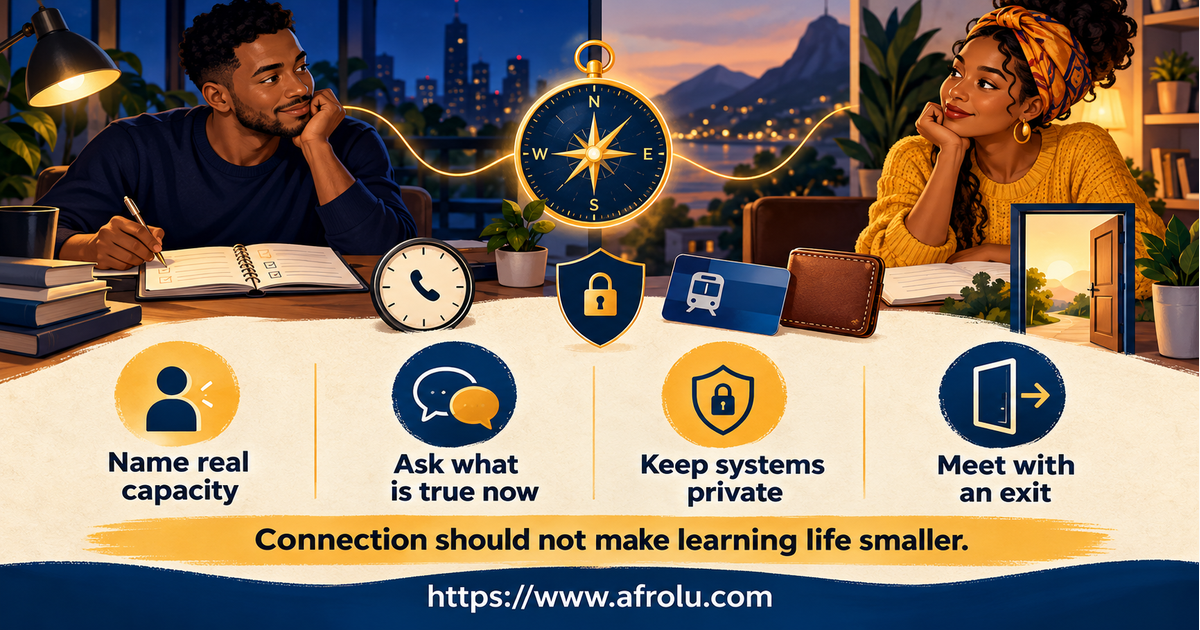
A future promise does not replace a present agreement.
Written and edited by Thabo Mokoena · Dating Trends Editor
Build long-distance clarity around a rhythm you can sustain, present agreements rather than future fog, private learning systems, independent travel, no financial rescue, and a real ability to change your mind. A missed call or capacity difference may be ordinary. Repeated monitoring, proof demands, money urgency, private-meeting pressure, coercion, unwanted contact, threats, or fear deserve less access and a more protected response.
Dating safety · Students
Is this long-distance connection creating practical clarity around study capacity, contact, travel, privacy, money, and consent, or is it using future promise and digital access to make your choices smaller?
Adult student long-distance dating red flags are observable behaviours that make study, work, rest, privacy, money, travel, consent, or a free exit less voluntary. They can include monitoring, future talk used as leverage, account or image pressure, financial urgency, travel coercion, threats, unwanted contact, or fear. The phrase describes conduct, not a diagnosis of a person or a judgement on distance relationships.
Kofi enjoys a long-distance connection until a study schedule, future promise, private video request, travel idea, and course-fee story begin to feel like tests he must pass. He stops treating constant access as reassurance, names a rhythm he can maintain, asks what is true now, protects his systems and money, and chooses a public, independent plan. The response tells him more than the promise ever could.
adult students · long-distance clarity
Kofi keeps a distant connection from turning study time, travel, and digital access into proof
This guide treats adult students as adults with full lives. It separates a normal capacity mismatch from conduct that tries to turn educational routines and distance into controllable access.
Name a sustainable rhythm, ask what is true now, protect digital systems, make visits reversible, keep money separate, choose a risk-matched ending, and review what access you freely want next.
Keep a real rhythm
Study and work time are relationship information, not evidence you must constantly submit.
Ask about today
A future dream does not replace an agreement about current access and expectation.
Make meetings reversible
Public plans, separate logistics, and a route home preserve a changed mind.
Match the risk
Clarify a mismatch; reduce access and seek support when pressure or fear appears.
Treat study capacity as relationship information, not a flaw to repair
Adult students need a distance rhythm that leaves space for classes, paid work, deadlines, rest, friends, and independent thought
Kofi is completing an adult degree while working evenings. A long-distance match says the connection feels special because they can talk for hours, then becomes irritated when he declines a call before an exam. Kofi does not need to prove that coursework matters more than romance. He names a weekly rhythm he can keep, says when he is less available, and notices whether the other person can hear a limit without converting it into a verdict about his feelings.
Long-distance dating asks for some coordination, but coordination is not surveillance. A practical agreement might include one planned call, a broad heads-up before an intense study week, and permission to miss a message without a crisis. It should not require a timetable screenshot, location proof, a constant camera, access to a student portal, or repeated explanations for being in class, at work, asleep, or with friends.
Some contact differences are simply mismatches. One adult may enjoy daily messages while another can offer a slower rhythm; one might prefer video calls while another feels drained by them after online learning. The issue becomes a red flag when disappointment turns into monitoring, guilt, insults, threats, repeated calls, or a demand that a student make their learning and rest smaller to soothe a new partner’s anxiety.
Start with the smallest agreement that leaves both lives intact. You can say that you are available on a particular evening, that you will not take calls during lectures, that messages do not require an immediate answer, or that you are pausing dating through a deadline. A compatible person may decide the rhythm does not work for them, but they do not gain the right to manage your schedule, phone, friendships, sleep, academic work, or future in exchange for staying connected.
Replace future fog with present agreements
Distance can make imagined potential feel more solid than the actual relationship, so bring the conversation back to what is true this month
Ask questions that fit the present: Are we exploring, dating exclusively, making time to meet, keeping the connection online for now, or seeing whether our schedules work? What information matters for informed consent? What happens when a semester, shift pattern, placement, or family responsibility changes? Neither person has to offer a polished five-year plan. But evasive affection, changing labels, or promises that appear only when you ask for a boundary can keep someone emotionally invested without useful clarity.
Listen for whether language and logistics meet. A person who calls you a priority while refusing every reasonable call window, declining to discuss whether they date others, or insisting that a first meeting must be private is not offering clarity through intensity. Likewise, an adult student who knows they cannot sustain a relationship during a deadline period can say so plainly rather than leaving another person on standby. Honesty may reduce fantasy, but it gives both adults a better choice.
Long-distance future talk becomes concerning when it creates urgency for access. Someone may say that a future move makes it sensible to share passwords, send money, skip verification, exchange private images, meet in isolation, or overlook inconsistency. A possible future does not settle present safety. Keep your current boundary and ask whether the next planned action—not the imagined destination—still leaves each adult free to revise, decline, or leave.
If the answer remains hazy, use a smaller decision rather than another long debate. Continue with one public video call, move communication back to the app, postpone travel, state that you are not exclusive, pause intimacy, or end the connection. Clarity is not forcing certainty from someone who cannot give it. It is making sure your own next action fits the information you actually have rather than the relationship you hope a distant screen will become.
Use technology for connection without letting it turn into proof
A call, profile, photo, voice note, shared playlist, study check-in, or virtual date can build familiarity, but none should become a test of obedience or a substitute for independent judgement
Video can help two adults decide whether they want to continue talking, yet it has limits. A camera can be off, a call can be delayed, a background can remain private, and a person can decline to introduce roommates, classmates, children, colleagues, or family. A respectful date may ask once for a format that suits them; they do not demand live tours, screen sharing, recorded calls, account access, or visual proof after a boundary has been stated.
Adult students often have digital systems worth protecting: learning platforms, institutional email, library accounts, cloud storage, coursework, scholarship information, accommodation portals, class groups, and payment apps. Keep passwords, authentication codes, recovery links, device passcodes, shared calendars, private folders, and assignment drafts outside a dating connection. Someone who says access will prove honesty is asking you to make a security decision for their emotional comfort.
Private images and sexual conversation require the same current freedom as an in-person plan. You can decide not to send material, change your mind, keep an image out of cloud storage, or avoid a call when you are tired or isolated. A person who bargains, sulks, threatens to withdraw affection, claims that a previous image is permanent permission, or says a long-distance partner owes more visual access is giving information about how they treat consent.
If unwanted contact or digital pressure begins, make the channel smaller before explaining further. Save relevant information only where safe, adjust audiences and account settings, tell a trusted person, and use platform tools if appropriate. Do not recruit classmates to monitor the person or trade intimate screenshots through a group. The goal is a safer, clearer next action, not a public case that proves you were entitled to stop responding.

Read the response to your limit, not the promise alone.
Let the first in-person plan answer its own safety questions
A future meeting can be exciting, but travel, novelty, cost, fatigue, and anticipation can make an adult feel responsible for continuing a plan that no longer feels right
Before meeting, discuss only the practical facts you need: a public location, independent transport, a reasonable start and end point, enough money and charge to leave, separate accommodation if travelling, and how each person will handle a cancelled plan. You do not need to share an exact address, passport, campus timetable, room number, or live travel trail to make a meeting real. A grounded plan can be specific about safety without becoming an identity audit.
If a date repeatedly moves a public plan toward a private residence, an isolated site, a late hour, a shared room, or transport controlled by them, let that pattern matter. They may call a separate plan expensive, unromantic, or evidence that you are not serious. The test is not whether they feel disappointed; it is whether you remain free to say no, leave, use your own phone, and get home without retaliation, pressure, or a long negotiation designed to wear down your answer.
Consent stays current after distance closes. A hug, a meal, a previous call, a ticket, or months of messages does not determine the next contact. Keep your own device, travel options, and a route to a staffed public place. If you want to change the plan, simple language is enough: I am leaving now; I am not going somewhere private; I do not want that. A caring person can take a no without turning it into an accusation against the relationship.
Where threats, coercion, unwanted sexual contact, image-based pressure, stalking, refusal to let you leave, or fear appear, switch from date management to safety planning. Preserve information if safe, contact emergency help if you face immediate danger, and use a trusted, specialist, health, legal, security, campus, or local support route that fits the situation. No article can assess an individual risk; it can affirm that you do not need to finish a trip or an explanation before seeking help.

A relationship question does not require access to your whole life.
Keep tuition, travel, and rescue stories out of the bond
A connection across distance should not need a loan, code, account, document, payment receipt, accommodation deposit, fee rescue, or investment to prove that it matters
Students may be approached through stories that sound tailored to their lives: a tuition shortfall, a placement cost, a device repair, a travel ticket, a visa appointment, a course fee, a business opportunity, or a need to receive funds temporarily. The story may be sincere, exaggerated, or false; you do not have to determine which before keeping your money and identity separate. Do not transfer funds, share one-time codes, co-sign, lend documents, forward payments, or use your institutional or banking access as a gesture of trust.
Gifts can be freely offered, but they should not create a ledger. A person who paid for a meal, data, a ticket, a ride, a course resource, or a small present does not acquire a claim on your images, body, time, grades, location, accommodation, or continued attention. If spending is later used to shame a boundary, keep future plans independent and reconsider whether the connection leaves genuine room for a no.
Different budgets are not automatically a red flag. One adult may have a grant, a job, family responsibilities, debt, or no travel funds, and another may have more flexibility. That difference can be discussed plainly. Pressure is different: secrecy, repeated urgency, changing stories, requests to receive money for someone else, or a proposal that financial merging will prove seriousness. A compatible adult can hear a financial limit without making it a personal insult.
If you sent something or disclosed an account detail and now feel worried, focus first on recovery. Contact the relevant financial institution, payment service, account provider, platform, or professional support route promptly where useful; change credentials from a safer device if needed; and do not arrange a private meeting to settle the story. You can take a protective step without first deciding whether you were naive, generous, or wrong to have trusted someone.

Choose the step that keeps your learning life and exit yours.
End at the level of risk, not the level of a long-distance fantasy
A long thread can feel like a relationship history, but an ordinary mismatch can still be ended in one clear sentence and a concerning pattern may need less access, not more closure
For a contact or future mismatch, a short message can be enough: I do not think this connection fits what I can offer, so I am stepping back. You do not need to list every message that made you uncertain or answer an invitation to debate. Another adult can be disappointed without gaining access to your calendar, student life, family, device, travel plans, home, or emotional labour.
For repeated pressure, make the route narrower. If it feels safe, state one boundary in writing, stop sharing plans, remove unnecessary visibility, decline a call that is designed to change your mind, and tell one trusted person the broad situation. Blocking can be practical when someone keeps using new accounts, classmates, social platforms, or constant calls after you said contact is unwelcome. You do not have to stay available in order to make the other person understand.
For threats, stalking, coercion, non-consensual image pressure, unwanted attendance near a campus or workplace, financial exploitation, or fear, use a protected exit. Preserve relevant records if safe, review account protections, avoid predictable private contact, and seek appropriate support. If you are in immediate danger, use emergency assistance. A guide cannot decide whether a particular situation meets a legal definition, and you do not need such a label before choosing a safer plan.
After ending, return to the part of life that exists outside a screen: coursework, work, food, sleep, movement, friends, family, and ordinary tasks. A distance connection can be meaningful, but it never becomes proof that you must tolerate a smaller life. Restoring your ability to concentrate, rest, and speak freely is a valid outcome even if you never reach agreement about what the relationship was supposed to become.
Review consistency without turning dating into an investigation
The point of checking a long-distance connection is not to prove a hidden motive; it is to decide what access you freely want to offer next
Use a simple review after several interactions. Can I keep study, work, rest, and friends without being punished? Can I miss a message or call safely? Can I ask what we are doing now and receive a usable answer? Are my devices, accounts, images, documents, money, and location still mine to manage? Can I meet publicly, leave independently, and change my mind? Can I end contact without fearing that someone will use a campus, workplace, group, or new account to reach me?
A stable pattern may include missed calls handled with grace, direct answers about scope, plans that respect deadlines, independent travel, a genuine repair, and no pressure for private access. An amber pattern may be a different communication style, incompatible study capacity, or a travel budget mismatch. A red pattern includes repeated monitoring, financial urgency, deception used to gain access, coercion, threats, unwanted contact, or fear. Each pattern needs a proportionate response rather than one universal verdict.
Choose the next action that fits the evidence: keep the relationship online for now, schedule a bounded public meeting, narrow the contact rhythm, ask one direct question, decline travel, pause intimacy, stop a transfer, tell a trusted person, end contact, or seek support. A smaller move is not a failure of romance. It is a way to preserve the conditions under which both adults can make a real choice.
Long-distance dating should not demand that a student rent out their judgement to a future promise. If a connection leaves you more able to learn, sleep, work, manage money, see friends, and say no, there may be room to discover more. If it turns your phone, studies, travel, or private life into proof you must keep supplying, step back. You can want connection and still keep the rest of your life legible to yourself.
Eight adult student long-distance dating moments

A deadline becomes evidence of disloyalty
A date calls during Amara's final revision session, then says a serious long-distance partner would make time no matter what.
Amara states the study boundary, offers only a time she can keep, and observes whether the answer is accepted without punishment.Relocation talk replaces present clarity
A match talks intensely about living together one day but avoids answering whether they date others or when they can realistically meet.
The student asks for a current agreement and reduces emotional investment if future language keeps replacing usable facts.A video call turns into surveillance
After a missed call, a person asks Malik to turn on the camera and show his room, class notes, and who is nearby.
Malik declines the demand, protects his learning environment, and treats repeated proof-seeking as a boundary issue.Urgency is tied to affection
A long-distance match says a small transfer for an application fee will demonstrate that Tumi believes in their shared future.
Tumi sends no money, code, document, or account access and verifies independently only if she chooses.A first visit loses its public plan
After months of calls, a date says the booked hotel is unnecessary and asks Noor to come directly to a private apartment.
Noor keeps the public meeting and independent lodging or cancels without arguing about the expense.A previous photo becomes continuing permission
A person asks for another private image and says distance makes visual access the least a partner can offer.
The student declines, does not negotiate with more material, and uses platform tools if pressure or threats continue.Two adults want different contact rhythms
One person needs daily evening calls; the other can offer two reliable calls around work and classes.
They name the difference without shaming either rhythm and leave if no shared plan works.A break becomes unwanted contact
After a clear pause, a date creates new accounts and messages classmates asking why Ayo will not answer.
Ayo tells classmates not to relay information, preserves relevant records if safe, blocks the accounts, and seeks support if it continues.Signals about study time, clarity, digital access, travel, money, consent, and safe exits
They can hear that study, work, rest, or caregiving limits your contact without demanding proof.
They turn delayed replies, a camera-off call, or a missed message into a demand for live location, video, or access.
They can name what the connection is now instead of relying only on future relocation or commitment fantasies.
They accept a public first meeting, separate lodging, independent transport, and a right to change plans.
They ask for passwords, student-platform access, verification codes, account screens, cloud folders, or a calendar as proof of honesty.
They pressure you for money, tuition support, travel funding, payment forwarding, documents, loans, or account use.
They understand that a ticket, meal, gift, data purchase, or previous intimacy does not create a debt.
They can discuss different schedules and budgets without framing your capacity as a moral failure.
They make a specific repair after a disappointment rather than restarting the same demand through an apology.
They keep images, calls, personal disclosures, and study-life details out of classmates, group chats, and social media.
They do not make a private image, live call, screen share, or constant response a condition of affection.
They do not recruit friends, classmates, colleagues, or new accounts to bypass a clear boundary.
They do not make leaving a visit harder by controlling a ride, room, phone, money, or itinerary.
They do not leave you afraid to say no, decline travel, end a call, continue coursework, or return to ordinary life.
Choose a proportionate next move
| Situation | What it may mean | What to do next |
|---|---|---|
| They want more calls than you can sustain | A communication mismatch can be ordinary until a limit becomes a reason for guilt or punishment. | Offer only the rhythm you can keep or name the incompatibility. |
| They promise a future but avoid present questions | Intensity may be covering a lack of agreement about access, exclusivity, or meeting plans. | Ask one clear question about now and choose from the answer you receive. |
| They ask for a campus or room tour | A casual request can become identity, location, or surveillance access. | Keep your environment private and decline a demand for proof. |
| They need money or account help | Urgency may be a scam, an access test, or a burden you do not want to carry. | Do not transfer funds, codes, documents, or account access; verify independently or end contact. |
| They want a first visit to be private | Travel and anticipation can make a difficult plan feel hard to revise. | Keep public plans, separate lodging, and independent transport or postpone the meeting. |
| They seem hurt by your boundary | Feeling disappointed is not the concern; bargaining, retaliation, or repeated pressure is. | Keep the boundary and watch whether their next conduct changes. |
| They request a private image | A request is not automatically unsafe, but pressure or retaliation removes free choice. | Decline without an explanation and never send material to stop a demand. |
| They contact people around you | Social overlap can become a route around an ending or privacy boundary. | Ask others not to relay information and reduce exposed routine details. |
| You feel confused after every call | Confusion can signal a mismatch, inconsistent conduct, or pressure that needs a factual review. | Write down what happened and choose one smaller access step. |
| You feel afraid to leave or say no | Fear turns relationship clarification into a safety issue. | Prioritise a protected exit and appropriate trusted, local, specialist, or emergency support. |
Twelve lines for capacity, clarity, digital privacy, travel, and an ending
“I can offer one call this week. I do not answer on demand during classes, work, or rest.”
“I can talk about the future, but I need to know what you are offering now.”
“I do not share my learning accounts, codes, calendar, drafts, or device access with someone I am dating.”
“I am not showing my room, class, or location to prove anything. We can speak another time or leave it there.”
“If we meet, I will use my own transport and accommodation and keep the first plan public.”
“I do not send money, receive payments, share codes, or use my account for a dating connection.”
“I am not sending that, and I need you not to ask again.”
“Our contact needs do not fit what I can offer while I study and work.”
“I am not continuing somewhere private. I am using my own plan to leave now.”
“I asked for space. Do not use other accounts or contact people around me.”
“I do not want to continue this connection. Please do not contact me again.”
“I am not discussing this privately. I am getting support and need no further contact.”
Know the difference
A capacity mismatch, future hope, and access pressure need different responses
A person can state their contact preference, accept your study capacity, discuss what is true today, keep accounts and travel separate, make a repair, and leave room for a current no.
Monitoring, future fog, proof demands, private-meeting pressure, financial urgency, coercion, threats, unwanted contact, or fear make distance a claim on access you have not freely offered.
The relationship label and future story do not decide the risk. The observed pattern and your freedom to choose do.

The observed pattern matters more than distance or promise.
Separate a capacity difference, future hope, and access pressure
| Type or dimension | What it describes | Best next question |
|---|---|---|
| A capacity mismatch | Two adults want different call, message, travel, or study-life rhythms and can name that without punishment. | Clarify the offer or leave the arrangement. |
| Monitoring | A delayed reply, camera, location, or schedule is treated as proof a person must keep supplying. | Protect devices and reduce access; seek support if it continues. |
| Future hope | Both adults can discuss a possible next stage while remaining honest about what is true today. | Make a present agreement and keep it revisable. |
| Future fog | Relocation or commitment language appears whenever current clarity or a boundary is requested. | Ask one direct question or step back from emotional investment. |
| A public visit | Travel includes separate plans, a practical exit, and room for either adult to change their mind. | Choose only a plan you can leave independently. |
| Travel pressure | Cost, distance, or anticipation is used to demand private access, a room, or intimacy. | Keep the plan public or cancel without paying emotional debt. |
| Free generosity | A gift, meal, ticket, or data purchase carries no later claim on access or affection. | Accept or decline while maintaining independent choices. |
| Financial leverage | Fees, tickets, accounts, codes, documents, or urgency are used to test loyalty. | Pause, verify independently, and make no transfer under pressure. |
| Safety concern | Threats, coercion, stalking, unwanted contact, image pressure, or fear require more than a relationship talk. | Use a protected exit and appropriate support. |
Start with the capacity and access you can freely sustain
Capacity is useful data
A realistic study and work rhythm is more valuable than constant availability that cannot last.
The present deserves words
A future dream cannot replace an answer about today’s scope, access, and expectations.
Technology needs boundaries
Calls, images, profiles, and portals should support connection, not collect proof or control.
Travel needs an exit
Separate transport, lodging, funds, and public plans make a meeting easier to revise.
Money needs separation
Tuition, travel, accounts, documents, and transfers do not belong in early trust-building.
A clean ending protects study
You do not need a final call or a perfect theory before returning attention to your own life.
Questions organised by purpose and depth
Choose a few prompts that fit the moment. This is a reference library, not a list to complete.
Capacity audit
Use before setting a new contact rhythm.
- What can I sustain beside study and work?
- What reply expectation would feel free rather than monitored?
- What part of my routine remains private?
Clarity audit
Use when future language becomes intense.
- What is offered now?
- What information do I need for informed choice?
- What future claim should not change today’s boundary?
Meeting audit
Use before travel or an in-person plan.
- Can I leave independently?
- What stays public and separate?
- Who knows the broad plan if I need support?
Digital audit
Use when a request feels hard to decline.
- Is this voluntary or proof on demand?
- What account or image access stays private?
- What is the smallest safer next action?
Look more closely at capacity, clarity, technology, meetings, money, and endings
Build contact around a real learning life
Name a sustainable rhythm that leaves room for classes, work, deadlines, sleep, friendships, and an independent mind.
Evidence limit: A guide cannot decide what workload or relationship rhythm fits every adult.
Ask what is true before asking what is possible
Discuss current scope, contact, exclusivity, meetings, disclosure, and what will happen when capacity changes.
Evidence limit: A clear conversation cannot guarantee compatibility or honesty.
Keep voluntary connection separate from proof
Protect accounts, devices, portals, images, location, calls, and shared digital spaces when a request becomes hard to decline.
Evidence limit: Change settings carefully if another person could notice and escalate.
Make a first visit reversible
Use public plans, independent transport, separate lodging, charge, funds, and a direct route home before distance closes.
Evidence limit: A public plan cannot guarantee safety in every circumstance.
A learning life is not a financial access point
Pause tuition, travel, fee, account, document, code, and payment-forwarding requests and verify independently.
Evidence limit: A concerning request is not proof that every person is committing fraud.
Risk changes how much closure you owe
Use a brief ending for mismatch and less contact with more support when pressure, threats, unwanted contact, or fear emerge.
Evidence limit: Blocking alone may not resolve every safety concern.
Shortcuts that can make long-distance dating harder to read
Treating access as reassurance
A live location, video demand, password, screen share, or campus tour may create surveillance rather than trust.
Using future talk as current evidence
A relocation or commitment dream does not answer what a person can honestly offer this month.
Overextending to prove interest
Sacrificing study, sleep, work, or friends can make a new connection feel urgent when it is simply unsustainable.
Meeting privately to save a trip
Cost and anticipation do not cancel your ability to choose a public plan or go home.
Letting a gift become a ledger
A ticket, meal, data purchase, or present does not buy images, intimacy, money, or continued contact.
Waiting for certainty about danger
You can make a smaller plan or seek support because conduct feels unsafe, even before you can name every motive.
Choose one resource that fits the fact in front of you
Use a guide for a clearer study or communication boundary, a safety plan for concerning conduct, or a slower route when you need more present-day evidence.
Explore the guide library
Show more related guides
Continue with Afrolu
Show more Afrolu guides
Sources used for this guide
Afrolu reviewed these health, research, safety, or public guidance resources while editing this page. They support the behaviour and safety guidance; they do not diagnose any individual described by a reader.
Questions about adult student long-distance dating red flags
Are long-distance dating red flags different for adult students?
The core issue is whether behaviour reduces free choice. Student schedules, learning systems, travel limits, budgets, shared spaces, and future plans can add particular access points that deserve clear boundaries.
How often should long-distance partners talk while I study?
There is no universal number. Choose a rhythm both adults can sustain around classes, work, rest, and family. The concern is not a different preference; it is pressure, monitoring, guilt, or retaliation after you name a limit.
Do I need to prove I am busy with coursework?
No. A broad explanation or no explanation may be enough. You do not owe a timetable, screen share, location, class recording, or access to a learning system to establish a boundary.
Can future relocation talk be a red flag?
Future talk is not inherently concerning. It becomes risky when it replaces present clarity or is used to rush money, documents, travel, private access, or intimacy before trust and practical compatibility exist.
Should I send money for a tuition or travel emergency?
Do not transfer funds, codes, documents, account access, or payment-forwarding help to create early trust. Pause and independently verify where appropriate; a real hardship does not make your financial boundary wrong.
Is a video call enough to know someone is safe?
Video may offer some information, but it cannot verify every claim or guarantee safety. Keep independent judgement, public first-meeting plans, and privacy boundaries.
What should I do before a first long-distance visit?
Use a public plan, independent transport and lodging, enough money and charge to leave, a clear end point, and a trusted person who knows a broad plan if that is useful.
Can I decline private images in a long-distance relationship?
Yes. An earlier image, relationship label, call, gift, or distance does not settle the next choice. Pressure, bargaining, threats, or retaliation are meaningful reasons to reduce access and seek support.
How do I end a long-distance connection safely?
For an ordinary mismatch, a concise written ending can be enough. If pressure, threats, stalking, image abuse, or fear appear, use a more protected plan and appropriate trusted, platform, specialist, local, or emergency support.
How do I stop overthinking every missed call?
Use observable patterns. Separate a respectful disruption, a capacity mismatch, a repaired mistake, and repeated pressure. Then choose a small next action rather than trying to prove a motive.
One thing to do now
Let every next call, trip, or boundary leave your learning life and exit under your control
Choose the smallest next action that protects learning and work capacity, current clarity, accounts and images, independent travel, money, present consent, trusted support, and a real ability to pause, decline, or leave.