Parents · clear weekend dating
Dating Red Flags for Parents Seeking Clarity in Weekend Dating
Dating red flags for parents in weekend dating: protect child privacy, clear schedules, consent and a safe exit without making family time a dating test.

A weekend window is an offer, not a debt.
Written and edited by Miriam Otieno · Senior Kenya Editor
Keep weekend dating adult-only and practical at first. Offer the time you freely have, protect child and household details, use public plans and independent travel, and read the response to a family boundary. Repeated pressure for child access, home information, money, proof, routine details, indirect contact, coercion, unwanted contact, or fear deserves less access and a support-led safety response.
Dating safety · Parents Returning To Dating
Is this weekend connection making room for family life, or is it using guilt, child access, household information, money, monitoring, pressure, or fear to shrink a parent’s choices?
Dating red flags for parents in weekend dating are observable behaviours that make family time, child privacy, home access, money, consent, routines, or an adult exit less voluntary. They include repeated family-boundary bargaining, household intrusion, financial leverage, monitoring, unwanted contact, coercion, threats, or fear. The phrase describes conduct, not a diagnosis or a judgment about a parent’s availability.
Miriam enjoys a new weekend connection until a cancelled brunch becomes a demand for proof, a helpful lift becomes a request for her address, and interest in family life becomes pressure to meet her child. She stops apologising for capacity, keeps adult dating separate from children, names one boundary, and uses the response to decide whether to reschedule, slow down, or end contact.
parents · clear weekend dating
Miriam dates around family life without making children, home, or availability a claim another adult can negotiate
This guide separates normal capacity differences from conduct that makes a parent’s family routine, household information, finances, body, or exit less freely chosen.
Name the real weekend window, make a modest adult plan, layer family information, notice care language that becomes leverage, keep child introduction parent-led, end in a family-safe format, and review the room a connection leaves for ordinary life.
Offer time freely
A family commitment can change a date without becoming a debt to repay.
Keep the household layered
Child details, home access, schedules, and co-parenting information can wait.
Keep adults and children separate
A new adult connection does not earn early access to a child.
Protect the routine
Clarify a mismatch; reduce access and seek support when household pressure or fear enters.
a weekend is not blank space
Date around family life without treating caregiving time as a hurdle to overcome
Weekend dating can look simple from outside: two adults have time off and want to meet. For a parent, the same hours may hold childcare handovers, a child's plans, sleep, errands, co-parenting logistics, family meals, financial limits, and a need to recover before a new week. None of that needs to be offered as evidence that a date is important enough.
A new match may be disappointed by limited windows, but disappointment is not the concern. The concern is what follows. Do they accept a proposed daytime plan, a short date, a cancellation for a child's need, or a request to keep home and family details private? Or do they frame parenting responsibilities as an obstacle you must compensate for with extra access, secrecy, speed, or emotional labour?
Clear weekend dating does not require revealing every schedule. You can say you have family commitments, offer a time that works, and leave the details broad. A considerate adult can make a plan around a boundary. A person who demands to know who is with your child, where you are, when a handover happens, or why a date cannot take priority is asking for access they have not earned.
Your available time is not a debt. You can choose a weekend date, choose no date, change a plan, or decide that a connection does not fit family life. The best early arrangements leave you able to care for children and yourself without rehearsing excuses, hiding a date from people who need to know, or feeling that another adult controls the pace of your home.
say what the weekend can hold
Make a modest plan instead of using future-family fantasies as a shortcut
Start with one plan that fits the actual week. A public brunch, a walk near a familiar area without naming your home, or a short coffee after a handover may be more useful than a grand promise of a whole weekend away. Independent transport and a finish time allow both people to leave without relying on persuasion, a lift, or access to a parent’s private space.
Be cautious when someone uses imagined family closeness to speed the relationship. They may talk about meeting children after a handful of messages, suggest that a real partner would bring them home, offer to solve childcare, or use kindness toward a child as a reason to gain information or routine access. Genuine care respects the parent's judgment about when, whether, and how a child ever meets someone.
Clarity also helps with money and logistics. A person might offer a ride, a meal, tickets, childcare advice, or a costly weekend plan. An offer becomes a concern when declining it produces guilt or when expense is used to challenge your parenting choices. Keep money, transport, household keys, school details, documents, and family plans separate while trust is still being tested.
If two adults want different things, name the mismatch plainly. One may want a relationship that moves toward a blended family; the other may want companionship that stays separate from children for a long time. Neither adult must defend that preference into agreement. A clear no to a future path can be more caring than staying in a connection that requires a parent to betray their own pace.

Read the response to family boundaries, not the promise alone.
keep a child's world out of early due diligence
Family information can stay broad until sharing it is freely chosen and practically safe
Early on, a date can know that you are a parent without receiving a child's name, age, photograph, school, activity, health information, co-parent's details, home address, building, neighbourhood route, or weekend calendar. A broad truth gives someone enough context to make their own choice. More detailed information can wait until it serves the parent's and child's wellbeing, not someone else's curiosity.
Digital information deserves the same care. Check public social posts, shared photo albums, location tags, school mentions, event calendars, family group chats, and account recovery details before a date becomes regular. A playful request to see pictures, a claim that they are good with children, or a flattering comment about your family does not create a right to material that could expose a child's routine or identity.
A date may ask about a co-parent or a former relationship. It can be reasonable to share a broad fact that affects present availability. You do not owe court documents, messages, contact details, conflict history, custody schedules, private medical information, or a narrative that satisfies a stranger. Repeated questioning after a boundary is an access issue, not a communication gap you must close.
If you have already shared more than feels right, move toward recovery rather than embarrassment. Adjust account privacy from a safer device if needed, tell relevant people not to relay family details, change routines only when useful, and decide later whether there is a relationship conversation to have. Restoring choice for you and your child matters more than explaining why you changed your mind.
notice when care language becomes leverage
A date can admire your parenting without using it to purchase access, speed, or obedience
A person may say they want to make life easier: they can collect you, come over after the children sleep, help with a repair, pay for an outing, solve a school problem, or watch a child so you can relax. Offers can be kind. Slow down when an offer becomes the reason they should know where you live, meet a child, see your schedule, use your money, or receive a level of trust you did not choose.
Watch how they respond to a routine parenting change. A child becomes ill, a handover shifts, or a school event runs late. A compatible date can accept disappointment and reschedule. Pressure may show up as sulking, demands for proof, criticism of your parenting, jealousy of a child, a claim that you owe a longer date later, or messages designed to make you feel selfish for keeping a commitment.
Financial pressure needs a particular pause. Do not lend, transfer, invest, co-sign, receive money through your account, share benefits information, provide documents, or accept an urgent travel or medical story because a dating contact says it will protect the future. A parent’s resources, including time and professional contacts, are not a test of romantic seriousness.
When a connection begins to shrink your ability to make ordinary family decisions, treat that as evidence. You might stop sharing updates, move dates to public venues, say no to a weekend away, tell a trusted person, or end contact. If threats, stalking, coercion, unwanted contact around home or school, financial exploitation, image abuse, or fear enter, choose a support-led safety plan rather than another round of relationship explanation.
separate adult connection from child introduction
Meeting a child is not an early relationship milestone that a date gets to claim
Some people speak about children quickly because family matters to them. That interest can be compatible with a firm boundary. The distinction is whether they can hear, 'I do not introduce dates to my child early,' without turning the answer into a referendum on their worth. A patient person may decide the pace is not for them, but they do not campaign for an exception.
Do not let a date use a child-facing gesture to move the adult relationship faster. A present, a proposed outing, a promise to help, a story about being wonderful with children, or a request to come by when a child is asleep can still create a route into a household. Trust should be built through consistent adult conduct over time, not through an early performance directed at a family.
If co-parenting or family networks are involved, retain control of communication and logistics. A new date does not need to contact a co-parent, school, caregiver, sibling, neighbour, or child to demonstrate commitment. Indirect outreach after you said no can be a serious boundary bypass, especially if it exposes a child’s routine or puts other adults in the role of managing your dating life.
Choose an introduction only if it fits your values, family circumstances, professional advice if you use it, and the demonstrated stability of the adult relationship. There is no universal timetable. The right question is practical: does this choice protect the child’s sense of safety and routine while preserving the parent’s ability to slow down or end the adult connection without fallout?

You do not have to debate a family boundary.
end the adult connection in the format that protects the family
A parent does not owe a private closure meeting to make an ending seem mature
For a straightforward mismatch, say what is necessary: 'I do not want to continue this connection. I wish you well.' You do not need to cite children, a co-parent, or your home as reasons that someone can debate. Keeping the message focused on your decision protects family details and prevents an ending from becoming an inquiry into your household.
If a person has ignored boundaries, change the channel rather than adding explanations. Do not meet at home, accept a ride, arrange a private handover of belongings without considering safety, or agree to a weekend conversation merely because they say a parent should be fair. Use written contact if safer, retain records where appropriate, block accounts, and tell a trusted person the broad facts.
If someone uses children, schools, a co-parent, family contacts, or predictable routines to continue access, take it seriously. Ask others not to share information, consider how to reduce digital visibility, document concern when safe, and seek appropriate local specialist, legal, security, school, healthcare, advocacy, or emergency support. General guidance cannot assess a specific danger, so use immediate help when you are in danger.
After an ending, return the weekend to its real purposes: care, rest, play, errands, friendship, and your own recovery. A date's disappointment does not need to become the family's emotional task. You can choose another connection later with stronger boundaries, without teaching yourself or your child that closeness requires giving up privacy and an independent exit.

Choose the move that leaves your household and exit yours.
measure the connection by the room it leaves for family life
A good weekend date does not require a parent to make their household smaller
Use a quick review after several interactions. Can I protect my child's information without being punished? Can I cancel or shorten a plan for family needs? Can I keep independent transport, home privacy, money, co-parenting details, and adult-only space? Does a date accept that child introduction is my decision? Can I say no to a weekend away, a private visit, a gift, or a request for access without managing retaliation?
A stable pattern includes someone who respects a short window, communicates a delay, accepts a public plan, handles a cancelled date with grace, makes a repair, and does not turn family responsibilities into competition. A caution pattern may be a normal mismatch in available time or future hopes. A serious pattern includes repeated pressure, household intrusion, financial leverage, monitoring, unwanted contact, coercion, threats, or fear.
Choose the action that fits the evidence: another bounded date, a clear schedule conversation, less sharing, a pause, an adult-only relationship for longer, no family introduction, a concise ending, documentation, or a support-based exit. You do not have to decide someone is a villain before choosing a smaller level of access around the people and routines you protect.
A parent can date with warmth and standards at the same time. The right connection leaves you more able to parent, rest, work, see friends, manage money, and return home peacefully. If a relationship makes those ordinary freedoms harder, slowing down or leaving can be a more loving decision for your family than trying to win someone’s understanding.
Eight parent weekend dating moments
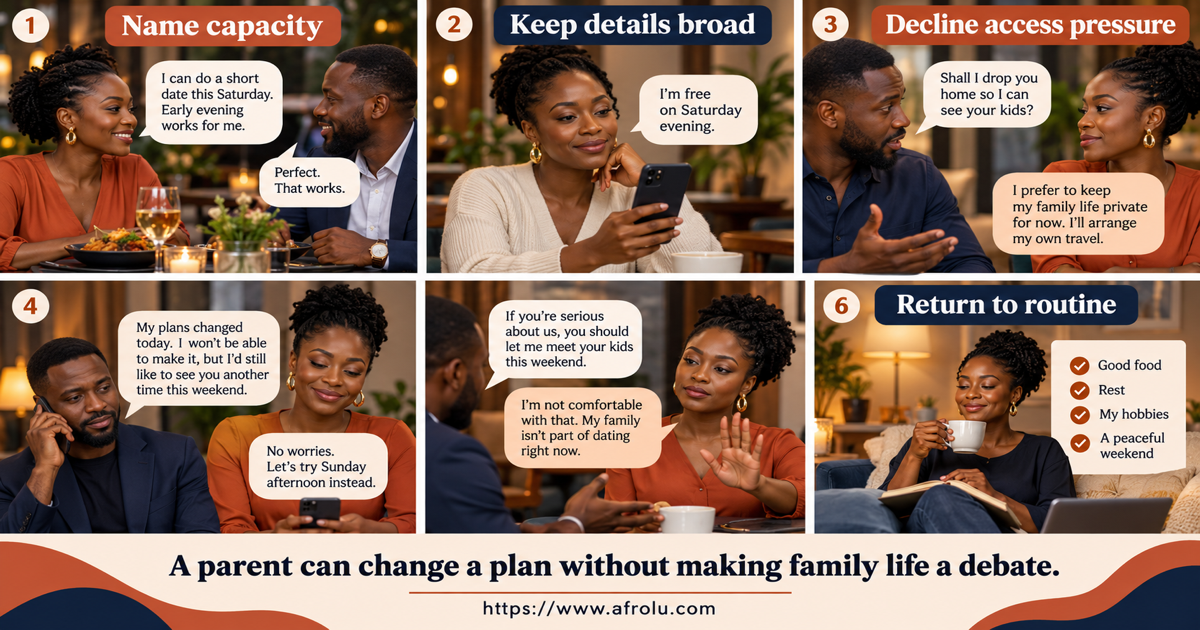
A child need changes a weekend plan
A parent cancels a public brunch because their child is unwell; the date demands proof and says they are always last.
Keep the family detail private, decline the guilt, and reschedule only if the response remains respectful.A match wants to meet the child early
After two enjoyable dates, a person offers to bring a gift and says meeting the child would show the connection is serious.
State that adult dating stays separate from children for now and observe whether the limit is accepted.Transport becomes home access
A date insists on collecting the parent from home because public transport after a weekend event is inconvenient.
Use independent travel or meet elsewhere; convenience does not override address privacy.Curiosity turns into a routine map
A match repeatedly asks where the child goes to school, what activities they attend, and who collects them.
Give no more detail and step back if a broad answer is not enough.Two adults have different weekend capacity
One person wants spontaneous overnight trips while the parent can offer short daytime dates twice a month.
Name the mismatch without apology and let either person choose not to continue.A family emergency becomes a money request
A date says they need funds for travel to see a sick relative and asks the parent to receive or send a transfer quickly.
Do not move money or use an account; verify independently and end contact if pressure continues.A parent names an unfair comment
A date jokes that children always come first, hears that the comment was hurtful, apologises, and proposes a plan that respects the schedule.
Treat the changed conduct as a repair while still watching the larger pattern.An ending is routed through family
After a clear no, a person sends messages to a sibling asking where the parent will be that weekend.
Ask family not to relay information, preserve messages if safe, and seek support if contact persists.Signals about time, child privacy, home, money, household pressure, and exits
They accept that a family commitment can change a dating plan without asking for proof or repayment.
They can make a short public weekend plan without treating limited availability as a personal slight.
They respect a parent’s decision not to introduce children early or share child information.
They do not ask for names, photographs, schools, routines, addresses, health details, or co-parenting documents.
They can hear a no to a home visit, lift, sleepover, weekend trip, or private conversation without bargaining.
They do not use gifts, childcare offers, repairs, tickets, or expense to purchase family access.
They do not compete with a child or frame caregiving as evidence that a parent is unavailable or ungrateful.
They handle a schedule change with a practical response rather than jealousy, sulking, or repeated calls.
They do not seek contact through a child, co-parent, school, caregiver, family member, or neighbour.
They do not ask for money, documents, benefits information, account access, or urgent travel help.
They make a specific repair after a boundary is named instead of promising that a parent misread them.
They accept that private family history can remain broad while an adult connection is new.
They do not use new accounts, mutual contacts, or routine places to bypass an adult ending.
They do not leave you afraid to make an ordinary parenting decision, change a plan, or return home.
Choose a proportionate next move
| Situation | What it may mean | What to do next |
|---|---|---|
| A child need changes a date | A cancelled plan can be ordinary; the response shows whether family care is respected. | Give only the broad update you choose and observe whether the date can reschedule without guilt. |
| They want to meet children early | Interest in family life may be sincere, but access to children stays the parent’s decision. | Keep the relationship adult-only and do not negotiate a timetable you do not want. |
| They ask about school or routines | Curiosity can become a map of a child’s private life. | Offer no additional detail and reduce contact if a broad answer is not accepted. |
| They offer a lift or repair | Help can be kind, but it does not create a right to home access. | Use a public plan and independent transport or decline the offer. |
| They dislike your weekend availability | A future or time mismatch does not need a winner. | Name the real capacity and let the connection go if it does not fit. |
| They offer to pay or solve childcare | Generosity becomes risky when declining it makes you feel indebted. | Keep money and childcare decisions independent until trust and appropriateness are clear. |
| They request money or account help | Urgency can be a scam, a leverage test, or a risk you need not take. | Do not transfer, lend, receive, invest, or share account or document access. |
| They apologise after a boundary | An apology becomes useful only when later plans respect the limit. | Name the change you need and watch the next action. |
| They contact family or a co-parent | Indirect outreach can bypass both privacy and an ending. | Ask others not to relay information and use a support-led plan if it continues. |
| You feel fear or household intrusion | The situation has moved beyond dating clarity into safety planning. | Prioritise a protected exit and urgent local or specialist support where needed. |
Twelve lines for capacity, child privacy, public plans, and ending
“I can meet for a short public date this weekend, and I will confirm once my family plans are settled.”
“I do not share my child’s details or introduce dates early. That is a firm parenting boundary.”
“I will meet you there and make my own way home.”
“I am not hosting dates or sharing my address. A public plan works for me.”
“My family need changed. I can offer another time, but I am not debating the decision.”
“My weekends have limits that will not work for everyone. I need a connection that respects them.”
“I do not send money, use accounts, or handle urgent transfers for someone I am dating.”
“I am getting to know you as an adult first. Meeting my child is not part of this stage.”
“That family detail is private. I have given the amount of context I want to give.”
“I heard the apology. I need the next plan to respect the boundary I named.”
“I do not want to continue this relationship. Please do not contact my family or people around me.”
“I am not discussing this further. I am taking steps to protect my family and need no more contact.”
Know the difference
A respectful time mismatch, family-access pressure, and household intrusion need different responses
A person can accept a short window, a changed plan, adult-only dating, home and child privacy, independent travel, and a clear no while allowing family life to remain the parent's responsibility.
Guilt, demanded proof, child-access urgency, household questions, money requests, indirect outreach, monitoring, coercion, threats, unwanted contact, or fear make dating a claim on a family rather than a freely chosen adult connection.
A family future story does not decide the risk. The observed pattern and the parent's freedom to choose do.

The pattern and freedom decide the next move, not a family fantasy.
Separate a time mismatch, family-access pressure, and household intrusion
| Type or dimension | What it describes | Best next question |
|---|---|---|
| A schedule change | A parent gives a broad update and the date can reschedule without demanding family proof. | See whether the practical response fits both lives. |
| Family guilt | A cancelled plan is used to extract more time, private details, or a compensating favour. | Keep the boundary and choose less access. |
| Adult-only dating | Two adults build trust before anyone has a role in a child’s life. | Let introduction remain parent-led and gradual. |
| Child access pressure | Gifts, charm, childcare offers, or future talk are used to make early access sound owed. | Keep children and household routines outside the connection. |
| A repair | A careless comment is heard, acknowledged, and followed by different conduct. | Observe whether the changed plan holds over time. |
| Household intrusion | Home, school, co-parenting, family contacts, or routines become routes around a boundary. | Reduce visibility and seek support if it continues. |
| Generosity | A date can offer a meal or plan without expecting access to a parent’s family life. | Accept, split, or decline freely. |
| Financial leverage | Urgent money, childcare, travel, documents, or account access are framed as a test of care. | Keep resources separate and verify independently. |
| A safety concern | Threats, stalking, coercion, unwanted contact near family routines, or fear appear. | Use a protected exit and appropriate local support. |
Start with the weekend capacity and family access you freely choose
Treat availability as a choice
Family time can be offered freely; it is not a debt created by dating interest.
Keep plans modest
A short public date with independent travel can reveal more than a dramatic weekend promise.
Layer family information
Names, routines, schools, addresses, co-parenting details, and photographs can remain private early on.
Separate adults from children
An adult connection can develop without early access to a child or household.
Read the response to care
A compatible person can handle a family need without turning it into jealousy or leverage.
Match an ending to risk
Use a short close for mismatch and a more protected route when household intrusion or fear appears.
Questions organised by purpose and depth
Choose a few prompts that fit the moment. This is a reference library, not a list to complete.
Weekend plan audit
Use before agreeing to a date.
- What time can I genuinely offer?
- Does this plan preserve independent travel and a simple exit?
- What family detail remains broad?
Family privacy audit
Use before sharing more information.
- Does this person need this detail to make a present choice?
- Could it expose my child’s routine?
- Would sharing make an ending harder?
Introduction audit
Use before involving a child.
- What has this adult relationship demonstrated over time?
- Does this choice serve my child’s stability?
- Can I slow down without fallout?
Ending audit
Use when a connection stops fitting.
- What communication route protects family privacy?
- Who should know the broad facts?
- What access or visibility needs to become smaller?
Look more closely at capacity, privacy, introduction, digital safety, money, and endings
A full weekend can still be an honest dating life
Name the actual time you can offer without giving a detailed family schedule or promising a future pattern you cannot sustain.
Evidence limit: A guide cannot decide compatibility for two adults.
A child’s routine is not early dating information
Keep names, images, schools, activities, locations, health details, handovers, and home access private until sharing is genuinely appropriate.
Evidence limit: No privacy practice removes all risk in every situation.
Child access is a parent-led choice
Build adult trust over time and decide whether an introduction serves the child’s stability as well as the adult relationship.
Evidence limit: There is no universal timeline that fits every family.
Family visibility can outlast a date
Review posts, tags, calendars, photo albums, recovery details, and shared contacts, especially when a connection becomes pressuring.
Evidence limit: Change settings carefully if someone could notice and escalate.
Romance should not set household risk
Pause requests for childcare funds, travel, transfers, investments, documents, benefits information, or account use and verify independently.
Evidence limit: A concerning request does not prove every person is committing fraud.
Family protection can change the communication route
Use a concise adult ending for mismatch and a more protected, support-led plan when someone uses family routines, pressure, threats, stalking, or fear.
Evidence limit: Blocking alone may not resolve every safety concern.
Shortcuts that make a parent’s weekend dating less freely chosen
Apologising for family commitments
A parent can be considerate without treating care as an inconvenience that requires repayment.
Using a child introduction as proof
Children should not be recruited to validate a new adult connection.
Sharing a detailed schedule too early
Routine information can make a household easier to monitor or approach.
Calling every time mismatch a red flag
Different weekend capacity can be an ordinary incompatibility when both adults are respectful.
Accepting a rescue story as care
Help becomes leverage when it purchases access, money, gratitude, or a quicker pace.
Meeting privately to calm an ending
A date’s need for closure does not override family privacy or a parent’s safer exit.
Choose one resource that fits the fact in front of you
Use a parent-focused boundary guide for a clear limit, a ghosting guide for stop-start contact, or a dating-structure guide when you are comparing what fits your family capacity.
Explore the guide library
Show more related guides
Continue with Afrolu
Show more Afrolu guides
Sources used for this guide
Afrolu reviewed these health, research, safety, or public guidance resources while editing this page. They support the behaviour and safety guidance; they do not diagnose any individual described by a reader.
Questions about dating red flags for parents on weekends
Is it unfair to date only on limited weekends?
No. State the time you can genuinely offer and let another adult decide whether it fits their life. Availability is not a proof of affection.
When should a date meet my child?
There is no universal timetable. Keep the decision parent-led and based on the child’s stability, your values, and demonstrated adult consistency rather than early pressure.
Do I need to explain a cancelled date because of my child?
No. A broad update is enough. You can reschedule if you want without offering private family details or accepting guilt.
Is it rude not to share my address or school details?
No. Home, school, routines, and child information can stay private early on. A considerate date can accept a broad answer.
What if someone says they are great with children?
That may be true, but it does not create a right to meet, photograph, contact, or learn details about your child before you choose.
Can a parent have a casual relationship?
Yes. Casual dating can be ethical when scope, consent, privacy, family boundaries, money, and endings are clear and freely chosen.
Should I accept childcare or financial help from a date?
Be cautious. Early help can create leverage. Keep resources and childcare decisions independent until trust and appropriateness are clear.
What if a date contacts my co-parent or family?
Treat it as a boundary concern. Ask others not to share information, preserve records if safe, limit visibility, and seek appropriate support if it continues or creates fear.
Can I end a relationship by text?
Usually, yes. A concise message is sufficient for an ordinary mismatch. Use the format that best protects you and your family if there has been pressure or fear.
How do I avoid becoming guarded around everyone?
Use observable facts. Separate a respectful time mismatch, a repairable mistake, repeated family-access pressure, and conduct that makes you or your household afraid.
One thing to do now
Let every weekend date leave your family life and exit under your control
Choose the smallest next action that protects family time, child information, home privacy, money, current consent, independent transport, trusted support, and an adult ability to decline or leave.