Dating again · Nairobi clarity and free choice
Nairobi Dating Red Flags When You Are Starting Again
Nairobi dating red flags when you are dating again: protect privacy, public plans, money and consent, read pressure clearly, and keep your exit yours.

Dating again can be open without giving away your exit.
Written and edited by Miriam Otieno · Senior Kenya Editor
Start again with layered access: choose public plans, independent transport, broad truth instead of private data, no money or account sharing, and a clear route home. Read what follows a boundary. A repaired mistake or mismatch may need a conversation; repeated private-plan pressure, address or location demands, financial requests, isolation, threats, unwanted contact, or fear need reduced access and a safety response.
Dating safety · New Relationship Starters
Is this new Nairobi connection creating a clearer, more respectful path to know one another, or is it asking for address, route, money, private access, social leverage, or attention that you do not freely want to give?
Dating again means returning to dating after a break, ending, or changed life season. A red flag is an observed behaviour that changes what access is safe to give, including repeated pressure, monitoring, financial leverage, coercion, threats, unwanted contact, or fear. These terms describe conduct rather than diagnosing a person's character, intentions, or future.
Wanjiku wants to be open to a new relationship without treating openness as an instruction to surrender her address, routine, money, or exit. She chooses a simple public Nairobi plan, shares information in layers, and watches what happens when she says no. The response gives her the clarity she needs: continue slowly, name a mismatch, or protect herself by stepping away.
dating again · Nairobi clarity and free choice
Wanjiku makes a new Nairobi connection easier to assess without making herself easier to pressure
This guide separates ordinary city-date logistics and early uncertainty from conduct that makes a fresh start less private, less voluntary, or harder to leave.
Name present capacity, make a public plan, read the pattern, share information in layers, keep money separate, choose a risk-matched ending, and review the access you want to offer next.
Begin in the present
A new chapter can be paced without making past caution a debt to a new date.
Keep the exit practical
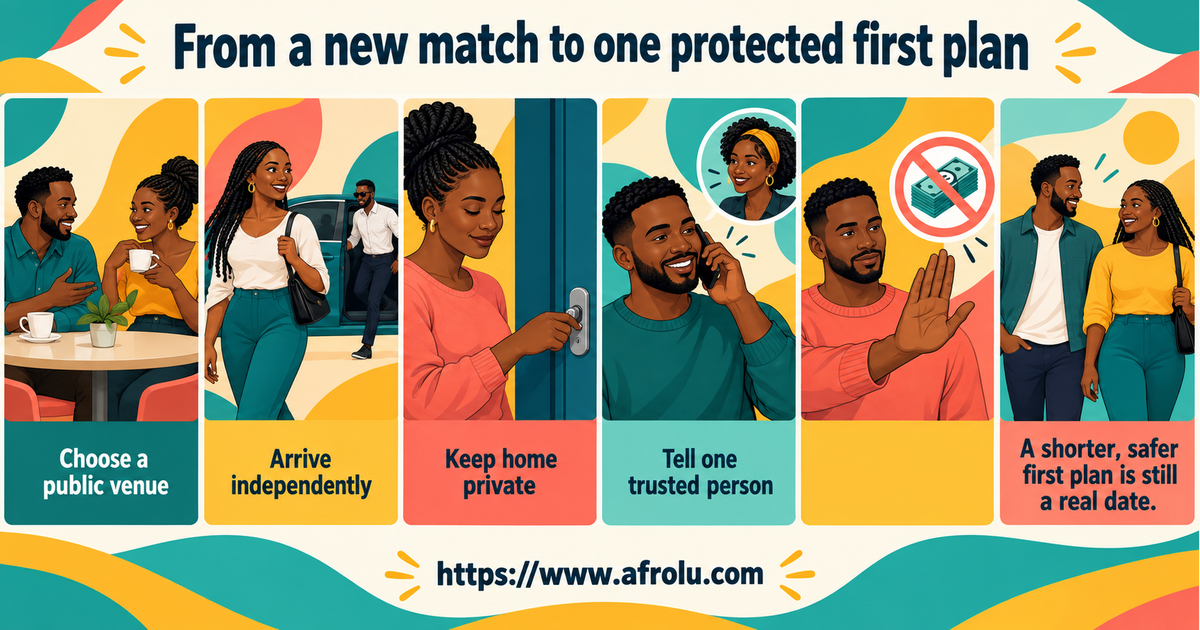
Public venues, independent transport, and a time boundary make changing your mind possible.
Share in layers
Broad truth can be honest without turning home, work, family, or accounts into early access.
Read the choice left
Continue only where interest and respect remain compatible with a real no.
Dating again needs a present-tense standard
A new start does not require you to ignore your past, but it should not make every new person answer for it either
Dating again can bring grief, optimism, loneliness, relief, family expectations, changed routines, or anxiety about getting it wrong. Those feelings are not a red flag in themselves. They can make a person more vulnerable to urgency, intense attention, promises of rescue, or a date who insists that a healthy boundary is evidence of damage from the past. A new connection should not require you to prove that you are healed enough to deserve patience, nor should it ask you to lower basic safety habits to prove you are ready.
A red flag is an observed behaviour that changes what access is safe to give. A slightly awkward first message, a late arrival with a sincere apology, or different dating goals may be manageable. Repeated pressure for private details, a home visit, money, photos, location, immediate exclusivity, isolation from friends, unwanted contact, threats, or fear call for a different response. The important question is not whether the other person has a dramatic motive. It is whether their conduct makes your next choice less free.
Start with a small, reversible plan. Choose a staffed public venue you independently want to visit, keep transport and payment under your own control, use a time boundary, and tell one trusted person a broad plan if that supports you. You do not need to disclose your exact home, children, employer, past relationship, financial history, or private routine to be genuine. A person who wants to know you can respect the pace at which you choose to become known.
This approach is not a promise that every date will be simple or that no one will disappoint you. It gives you a practical baseline from which to notice the difference between a respectful adult and a person who treats caution as an obstacle to overcome. You can be warm, curious, and interested while still preserving the parts of your life that a new connection has not yet earned the right to enter.
Use city planning to preserve an easy exit, not to test trust
A public date is more useful when both adults can arrive, leave, and change the plan without one person controlling the route, cost, or privacy.
A person might offer to collect you, book a ride, or choose a venue. An offer can be kind when it remains free. It becomes concerning if the other person needs your exact address before you are ready, uses the fare or booking as leverage, resists a public alternative, or turns a declined ride into guilt. You can say that you will meet there, arrive separately, and leave at the time you decide. You do not owe a detailed explanation about safety to make an independent plan reasonable.
Shared networks also need boundaries. A mutual friend, school, faith community, workplace area, gym, or favourite venue may make a stranger feel less strange, but it does not make private information public property. Do not ask friends to investigate a date, and do not accept a date recruiting others to learn your routine or change your answer. If a connection ends, mutual circles should not become a relay system for unwanted messages, pressure, reputation threats, or updates about where you are.
Plan for ordinary disruptions without losing your standard. A late arrival can be handled with a message and a revised time. A traffic problem does not require a new date to access your home, car, funds, phone, or private route. If a plan repeatedly moves into secrecy, dependence, or fear, simplify it or leave it. The ability to choose a shorter date, a different venue, your own ride, or no date at all is part of the clarity you are trying to build.
The same freedom should apply to both people. If you cannot make a date, say so plainly rather than disappearing or expecting another adult to keep time open. If a date's constraints do not work for you, say that too. Clear city logistics are not unromantic; they are evidence that two adults can make plans without requiring one person to absorb all the risk, expense, or uncertainty.
Name the pattern before asking what it means
Clarity is not a theory about a new date; it is enough observable information to choose your next level of access
Use four questions after a confusing interaction. What exactly happened? What did it cost or change for me? What followed my boundary? What will I do next? For example: 'They asked for my location after I said I would meet them at the venue; I felt pressured to disclose my route; they kept asking after I declined; I will not share it and I will choose my own transport.' Facts make it easier to distinguish a mismatch from conduct that keeps testing access.
Look for repair, not perfection. A date may make an assumption, hear your correction, apologise, and change the plan. That can be ordinary early-dating friction. Repeatedly telling you that a concern is overthinking, blaming past hurt for present boundaries, escalating after a no, or becoming charming only after you start withdrawing is different. The task is not to punish imperfection; it is to stop giving a pattern more access than it has earned.
You do not need to search social accounts, contact an ex, question mutual friends, or become a detective to have permission to step back. If you feel unsafe, preserve the relevant information only when safe and use platform, account, or local support tools as appropriate. If you simply decide that the offer does not work, a short decline is enough. Clarity includes knowing that you can leave a connection because it costs too much attention, not only because you can prove something worse.
A factual approach can also protect you from making the past choose the present. You may notice an old alarm without treating it as a prophecy. Choose a smaller, public, independent plan and see what happens when you name a real limit. If the response is respectful, there can be another step. If it is not, you have protected yourself without having to decide that every new person is the same as the last.

A delayed date and an access demand need different responses.
Give new people information in layers, not all at once
A dating profile, a good conversation, or a mutual connection does not require you to reveal home, work, family, financial, health, device, or location details before you freely choose to.
Digital privacy deserves the same care. Do not share one-time codes, passwords, banking screens, identity documents, private photographs, cloud accounts, calendar permissions, or device access because someone calls it openness. Review audience, location, and account-recovery settings before a date becomes a regular contact. If someone uses fake accounts, repeated calls, threats to expose information, or an old image to secure more access, treat the behaviour seriously rather than trying to soothe it with more visibility.
A new journey may involve a past partner, a change in living arrangements, or a family transition. You do not need to explain those facts in detail to earn a date's respect. A considerate person can hear a broad boundary and wait. A person who turns curiosity into interrogation, criticises you for protecting children or friends, or treats private history as material to use in an argument is giving you information about their capacity for respect.
If you have already shared more than you wanted, do not turn embarrassment into more disclosure. Change what you can safely change, use relevant provider or platform support, tell a trusted person where appropriate, and avoid meeting privately to recover access. The immediate goal is to restore choice. You can decide later whether the relationship deserves another conversation; you do not have to make that decision while someone is pressing you.
Privacy works best as an ongoing practice rather than a test you either pass or fail. You may choose to share more after repeated respectful dates, or you may decide that a particular detail remains private even in a serious relationship. A compatible person can live with that distinction. Trust is not measured by how rapidly another adult becomes able to locate, monitor, or explain you.

A clear boundary can leave a new beginning genuinely open.
Keep payment, rescue stories, and future promises outside the early bargain
A date may be generous, but generosity remains free; it does not buy a private venue, more contact, sexual access, loyalty, or a decision about the future.
Online and early dating also attracts urgent stories: a broken phone, hospital bill, business opportunity, travel problem, rental crisis, account verification, or a request to receive money for someone else. Compassion does not require an immediate transfer. Keep bank details, mobile-money access, codes, documents, workplace resources, and family funds private. A person who responds to a financial no with anger, pity, urgency, or a promise of a future together is asking for more access than the relationship has earned.
A future plan should stay separate from a current payment. Someone may talk about a home, marriage, travel, business, or family life; none of those topics makes it safe to merge accounts, borrow, lend, co-sign, provide a device, share a lease, host a stranger, or fund a visit. The more urgent the story, the more useful it is to slow down, independently verify what can be verified, and make no decision while a new date is watching for an answer.
If you have sent money, shared access, or feel that a gift is trapping you, focus on practical recovery without self-blame. Contact the relevant financial institution, provider, platform, or account service promptly; change credentials from a safer device where necessary; and ask for trusted or specialist support. Do not send more money, meet alone, or offer further private information to make the pressure stop. A new journey does not need to begin with a debt you did not freely choose.
A financial boundary is also a way to keep dating choices honest. If someone cannot continue without access to your money, accounts, work, family resources, or housing, they are not offering a relationship on terms you can freely choose. You do not have to judge their whole story to decline the role they are asking you to play. Protecting your finances protects the freedom to decide what comes next.
Choose an exit that lets your fresh start remain yours
An ordinary mismatch may need a short direct ending; pressure, unwanted contact, threats, stalking, or fear may need fewer openings for discussion and more practical support.
For repeated pressure, use a smaller communication route. State a written boundary if that feels safe, stop sharing your plan, remove unnecessary digital visibility, avoid a private conversation designed to change your mind, and ask one trusted person to know the broad situation. You can block a person who keeps calling or messaging. Keeping a door open is not required to show that you are kind, healed, or fair.
For threats, unwanted attendance near your home or workplace, financial pressure, image-based abuse, impersonation, stalking, coercion, or fear, shift from relationship etiquette to safety planning. Preserve relevant information when safe, use platform and account tools, and seek appropriate urgent, local, legal, health, specialist, security, or trusted support. This article cannot assess immediate danger or replace an emergency service; seek urgent help if you are in danger now.
After an ending, reclaim the routines that support your fresh start: your work, rest, friends, family, interests, and time away from a thread that kept asking you to explain yourself. Dating again after a difficult chapter does not require performing fearlessness. It can mean keeping a thoughtful standard: warmth is welcome, but it must coexist with a public plan, privacy, voluntary consent, financial independence, and an exit you still control.
You do not have to turn an ending into a public account of what happened, and you do not have to be persuaded into renewed contact by a late apology or a promise of change. If you consider another chance, choose a small, observable step rather than restoring all the access at once. If you do not want another chance, that decision remains complete even if another person sees the story differently.

Choose the next move that keeps your fresh start yours.
Review a new connection by the room it leaves for your actual life
Before sharing more time, trust, intimacy, family access, or data, ask whether the relationship is becoming more usable, more respectful, and easier to leave if you need to.
A green pattern can include an adult who accepts a public plan, respects a privacy boundary, communicates a delay, offers a specific repair, and stays kind when the answer is no. An amber pattern may be a different pace, a budget issue, or a genuine mismatch. A red pattern includes repeated pressure, monitoring, money requests, isolation, threats, unwanted contact, or fear. Keeping these categories separate prevents both minimising danger and treating every human imperfection as evidence of harm.
Choose a small next action: another public daytime date, a clearer conversation, a slower pace, fewer app details, no financial sharing, a pause, an ending, or a safety response. You do not need to give someone your home, work, body, money, accounts, family, or future to show that you are ready to date. A connection worth exploring can tolerate the amount of access you freely choose now.
Let the facts in front of you set the pace. Where unwanted sexual contact, stalking, threats, coercion, or fear appear, leave relationship analysis behind and use immediate local support that fits the risk. For everyday uncertainty, choose only the next date that lets a recovering person keep ordinary routines, friendships, work, and a sense of spaciousness. A fresh connection should expand a rebuilding life, never quietly shrink it.
The standard is deliberately ordinary: can you make plans, say no, protect your privacy, spend within your means, talk to people you trust, and return home without managing another person's anger? If yes, you may have room to keep learning. If no, a smaller plan, a pause, an ending, or support can be a stronger next step than trying to explain yourself into a safer relationship.
Eight dating-again moments in Nairobi
A ride offer becomes a demand for home access
Before meeting, a date says they cannot plan without Wanjiku's building and gate details.
Wanjiku chooses a public meeting point and her own route; she shares no address to make the date happen.A delay becomes pressure for a private venue
Traffic makes the original date shorter, and the date proposes going straight to a private apartment instead.
Wanjiku keeps the public plan brief or leaves, rather than treating an inconvenience as a reason to remove her exit.Social proximity is used to bypass privacy
A match mentions someone Wanjiku knows and asks that person for details after she declines to share her routine.
Wanjiku asks the friend not to relay information and treats indirect access as a boundary issue.An early financial emergency asks for proof of care
A date says their phone and transport problem will be solved only if Wanjiku sends money quickly.
Wanjiku sends no transfer or code, keeps her account private, and does not let urgency decide the connection.Curiosity becomes interrogation
A date repeatedly demands details about a past breakup after Wanjiku gives a broad answer.
Wanjiku says the topic is private for now and observes whether the boundary is accepted.A previous photo becomes a new demand
After sharing one ordinary photo, a match asks for private images and becomes cold when declined.
Wanjiku sends nothing further, preserves pressure if safe, and blocks or reports as appropriate.An assumption is corrected with care
A date chooses a venue that does not work for Wanjiku's plan, hears the concern, apologises, and offers a public alternative.
Wanjiku can treat it as a repairable mistake while continuing to watch future conduct.A boundary is followed by unwanted contact
After Wanjiku ends the chat, the date uses another account and waits near a place she often visits.
Wanjiku does not meet privately, tells a trusted person, preserves relevant records if safe, and seeks appropriate support.Signals about public plans, privacy, money, social circles, consent, and safe exits
They accept a public meeting point without requesting your exact address, route, or private routine.
They can hear a broad answer about work, family, or a past relationship without turning curiosity into interrogation.
They respect independent transport, payment, timing, and an easy way to leave a first date.
They repeatedly turn traffic, a delay, or a venue change into pressure for a private plan.
They use a mutual friend, neighbourhood, work area, or group connection to collect private information.
They accept a no without shame, guilt, repeated bargaining, or a claim that you are too guarded to date.
They ask for money, mobile-money access, codes, devices, documents, or financial rescue early in contact.
They treat a gift, ride, booking, or paid meal as a debt of intimacy, time, or loyalty.
They ask for live location, passwords, account access, private images, or constant updates as proof of trust.
They make a mistake, acknowledge the impact, and change the plan rather than becoming defensive or demanding.
They recruit friends, family, colleagues, or social circles to pressure you after a boundary.
They use fake accounts, repeated calls, unwanted attendance, threats, or reputation pressure after you step back.
They try to make your past relationship explain away every present boundary.
They make you afraid to change a plan, decline a request, return home, or end contact.
Choose a proportionate next move
| Situation | What it may mean | What to do next |
|---|---|---|
| A date asks where to meet | A practical venue question can be answered without revealing your exact home or route. | Choose a public meeting point you can reach and leave independently. |
| Traffic changes a plan | A delay may be ordinary; pressure to move private or become dependent is a different issue. | Keep the date shorter, choose a new public option, or leave. |
| They ask about your past | Curiosity can be respectful when a broad answer and a pause are accepted. | Share only what you freely choose and keep details private. |
| They demand a full explanation for a boundary | A reasonable question can become pressure when your no is treated as a debate to win. | Repeat the boundary once or end the conversation. |
| They mention a mutual connection | Social overlap can be ordinary but does not grant access to your routine or private history. | Keep mutual people outside the dating negotiation. |
| They offer a ride | An offer may be kind when declining it remains easy and consequence-free. | Arrange your own transport if that preserves your choice. |
| They request money or account access | Urgency and a romantic story do not make financial sharing a safe early-dating step. | Do not send funds, codes, documents, or access under pressure. |
| They apologise and change the plan | A repair may be credible when the impact is acknowledged and conduct is different afterward. | Choose a modest next step and continue observing. |
| They contact you through new channels after an end | Repeated unwanted contact can shift from persistence to harassment or stalking. | Reduce contact, preserve relevant evidence if safe, and seek support if fear enters. |
| You feel afraid to leave or say no | Fear changes the task from dating clarity to safety planning. | Prioritise a protected exit and appropriate urgent or local support. |
Twelve lines for public planning, privacy, money, social boundaries, and ending contact
“I will meet you there. I am arranging my own transport.”
“I am not sharing my home details while we are getting to know each other.”
“I am not changing this to a private place. I can stay here until this time.”
“That part of my history is private for now. I will share more if and when I choose.”
“I do not send money, codes, or account access to someone I am dating.”
“I am not sending that. Please do not ask again.”
“Please do not contact my friends or ask them for information about me.”
“I said no to that plan, and I need you to stop trying to change my answer.”
“The plan changed. Can you offer a public alternative that works for both of us?”
“I am slowing this down and will not make plans while I think.”
“I do not want to continue this connection. Please do not contact me again.”
“I will not meet privately to discuss this. I am getting support and need no further contact.”
Know the difference
A public invitation, an ordinary mismatch, and access pressure need different responses
A date can offer a public plan, accept layered privacy, repair a delay, respect independent transport, and remain kind after a no.
Address, location, private-venue, money, account, social-network, image, or unwanted-contact pressure makes the next choice less free and needs a stronger response.
A fresh start is not evidence that you should give more access than you want to offer.

A new start does not need to surrender privacy for possibility.
Separate public interest, mismatch, repair, and access pressure
| Type or dimension | What it describes | Best next question |
|---|---|---|
| Public date planning | A venue, time, and route can be agreed while both adults retain independent arrival and departure. | Choose a simple plan you can freely revise. |
| Private-plan pressure | A delay or romantic gesture is used to make private access seem like the only reasonable option. | Keep the plan public or leave. |
| Respectful curiosity | A question receives a broad answer and the boundary is accepted. | Share more only when you want to. |
| Interrogation | A date keeps demanding details after you say a topic is private. | Restate the limit or reduce access. |
| Free generosity | A ride, meal, or gift remains free after you decline intimacy, a longer date, or another plan. | Accept or decline without debt. |
| Financial leverage | A payment, urgent story, or future promise is used to obtain money, access, or loyalty. | Keep accounts and transfers separate. |
| Shared circle | A mutual person is not asked to monitor, mediate, or relay private information. | Keep the social network outside the relationship boundary. |
| Repair | A mistake is acknowledged and followed by a changed public plan or behaviour. | Observe follow-through without erasing your original boundary. |
| Safety concern | Threats, stalking, unwanted contact, coercion, or fear require a protected exit rather than another date conversation. | Use appropriate local, urgent, specialist, platform, or trusted support. |
Start with the access that fits your new journey now
Fresh starts can be paced
Being ready to date does not require revealing everything or accepting every invitation.
Public logistics are care
A simple venue, independent transport, and a time boundary make a change of mind possible.
Privacy is layered
Broad truth can be honest without giving a new date home, work, family, account, or route details.
Patterns beat theories
You can act on repeated pressure or a boundary response without proving a person's motive.
Generosity must stay free
A ride, meal, gift, or booking does not buy access to your body, time, money, or future.
Clarity can include leaving
A relationship need not be dangerous to be too costly, intrusive, or incompatible to continue.
Questions organised by purpose and depth
Choose a few prompts that fit the moment. This is a reference library, not a list to complete.
First-plan audit
Use before meeting a new date.
- Can I arrive and leave independently?
- What information am I not sharing yet?
- What time boundary will I keep?
Pattern audit
Use after a confusing interaction.
- What happened without interpretation?
- What followed my boundary?
- What action do I control next?
Privacy audit
Use before moving a chat or sharing more.
- What would this person learn from this detail?
- Can I share a broader truth instead?
- What setting should I review?
Exit audit
Use when a connection becomes pressuring.
- Is a short message safe enough?
- Who can know the broad plan?
- Do I need urgent local help instead of another conversation?
Look more closely at restart, city planning, privacy, money, networks, and endings
Date from present capacity
Name what you can offer now and allow a new connection to earn deeper access through respectful behaviour.
Evidence limit: This guide cannot decide whether you are personally ready to date.
Make a first date easy to revise
Use public venues, independent transport, a time boundary, and a simple return plan that you control.
Evidence limit: No logistical plan removes every risk or replaces local safety choices.
Share information in layers
Keep home, work, family, past, financial, device, and location details private until you freely choose otherwise.
Evidence limit: Changing access may need a safety plan when unwanted contact already exists.
Keep early care and finance separate
Do not let gifts, urgent stories, travel, or future promises decide a transfer, account share, or debt.
Evidence limit: A request is not automatic proof of fraud, but pressure needs a pause.
Do not turn mutual circles into relationship access
Ask friends not to relay messages or private details and do not use them to investigate a date.
Evidence limit: Community support can still be valuable when it respects confidentiality.
Use the least exposure that keeps you safe
A short ending can work for mismatch; threats, stalking, coercion, unwanted contact, or fear call for a protected support-based exit.
Evidence limit: Seek urgent local help when immediate danger is present.
Shortcuts that make a new journey harder to protect
Forcing yourself to be more open than you feel
Readiness does not require revealing an address, past history, family details, or financial information before trust exists.
Treating traffic or romance as a reason to lose the exit
A delay does not make private travel, accommodation, or a ride controlled by a new date necessary.
Making mutual circles investigate a date
Social networks can become a source of pressure, gossip, and unwanted contact rather than clarity.
Letting a past relationship invalidate a present boundary
A new date does not need to agree with your history in order to respect your no.
Paying to prove that you are serious
Money, accounts, codes, and rescue plans make a new connection more dependent, not more trustworthy.
Waiting for dramatic proof before leaving
You can step back because an offer feels intrusive, exhausting, or unworkable without proving a hidden motive.
Use one resource that matches the current fact
Choose a guide for a boundary or fresh-start pacing question, a Nairobi-facing dating resource for local planning, or a private tool when observed conduct raises a safety concern.
Explore the guide library
Show more related guides
Continue with Afrolu
Show more Afrolu guides
Sources used for this guide
Afrolu reviewed these health, research, safety, or public guidance resources while editing this page. They support the behaviour and safety guidance; they do not diagnose any individual described by a reader.
Questions about Nairobi dating red flags when you are dating again
How do I date again without becoming overly guarded?
Use layered access rather than an all-or-nothing rule. Choose a public plan, share broad facts, and increase trust only where boundaries, repair, and practical safety remain strong.
Should I give a first date my address?
No. Choose a public meeting point and arrange your own transport if that keeps you more comfortable. You do not owe exact home details to make a date possible.
Does a late arrival mean a red flag?
Not by itself. Look at whether the delay is communicated, whether a practical repair is offered, and whether your public plan and exit are still respected.
What if they say I am too guarded because of my past?
Your past does not make a present boundary invalid. A compatible person can be curious and still accept that trust, family details, privacy, and pace are yours to choose.
Can I use a mutual friend to verify a date?
Avoid turning mutual circles into an investigation or a relay for private information. Keep direct dating decisions direct, and use a trusted person for support rather than surveillance.
Should I accept a ride from a new match?
You can accept or decline freely. Independent transport often makes an early date easier to revise and avoids making a ride the price of a private plan.
What if a date asks for money after a few good conversations?
Do not send money, codes, documents, or account access under pressure. Pause, independently verify where appropriate, and keep financial decisions separate from romance.
Can I say no to a private venue without seeming rude?
Yes. A simple public-plan boundary is enough. Someone who respects you can accept a no, a shorter date, a different venue, or an end to the plan.
What should I do if they keep contacting me after I end it?
Reduce contact, preserve relevant information when safe, block or report as appropriate, tell a trusted person, and seek local or specialist support if you are afraid.
When should I treat a concern as urgent?
Threats, unwanted sexual contact, stalking, coercion, financial exploitation, unwanted attendance, or fear call for safety planning and appropriate urgent local support rather than another dating conversation.
One thing to do now
Let a new connection add possibility without taking ownership of your life
Choose the smallest next action that protects public access, independent transport, home and work privacy, money, current consent, social support, digital accounts, and a real ability to decline or leave.