Diaspora daters · casual safety and honest scope
Safety-First Casual Dating Red Flags for Diaspora Daters
Diaspora casual dating red flags: protect identity, location, money and consent across distance and culture while keeping a casual connection honest and free.
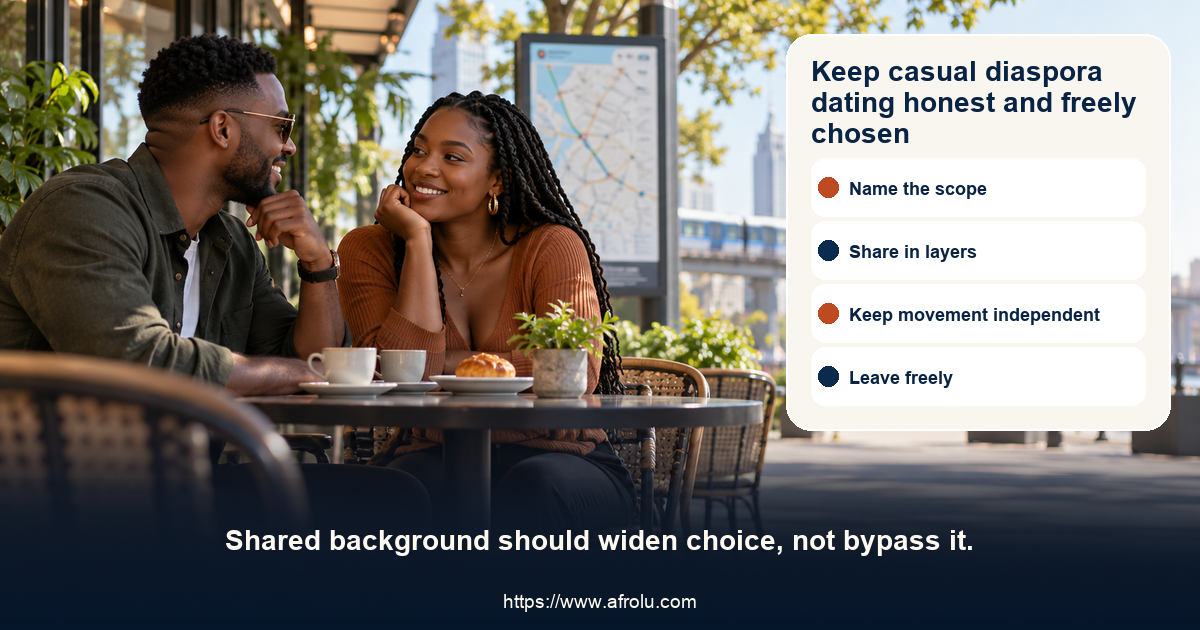
Familiarity can be warm without becoming a shortcut to access.
Written and edited by Tariro Ncube · Diaspora Dating Editor
Casual diaspora dating can still be clear. Name the present scope, verify proportionately without surveillance, keep visits public and independent, layer identity and location details, separate money and documents from romance, and read the response to one boundary. Repeated contradictions, familiarity leverage, private-plan pressure, transfer requests, monitoring, unwanted contact, coercion, or fear deserve less access and a safety-led response.
Dating safety · Diaspora Daters
Can this casual diaspora connection remain warm and freely chosen, or are familiarity, identity, travel, money, culture, digital access, pressure, unwanted contact, or fear being used to speed up unsafe trust?
Diaspora casual dating red flags are observable behaviours that make scope, identity, location, money, digital access, consent, culture, time, or an exit less freely chosen. They can include familiarity leverage, verification avoidance paired with access demands, private-plan pressure, financial requests, cultural shame, monitoring, unwanted contact, coercion, threats, or fear. The phrase describes conduct and its effect on choice, not a judgment about any culture, migration story, or casual relationship.
Sami enjoys a new connection with someone who understands a piece of their diaspora experience. Before a public event, the person asks for a hotel detail, an urgent transfer, and a promise that the connection will stay private from mutual acquaintances. Sami keeps the plan public, declines money, shares no location, and lets the response to those boundaries decide whether the casual connection remains worth pursuing.
diaspora daters · casual safety and honest scope
Sami keeps cultural familiarity separate from identity, location, money, and consent choices
This guide separates ordinary cultural or casual differences from patterns that make a diaspora dater’s plan, body, information, money, community connection, or exit less freely chosen.
Name casual scope, verify proportionately, keep movement independent, separate money and documents, refuse cultural leverage, read the first no, and review whether casual still feels freely chosen.
Keep the present honest
Casual can be warm, direct, and clear without a future promise.
Share in layers
Familiarity can coexist with reciprocal evidence and private details.
Keep plans independent
Public venues and separate routes leave room for current choice.
Protect your freedom
Clarify a mismatch and reduce access or seek support when pressure or fear appears.
casual is a present agreement, not a cultural shortcut
A diaspora connection can be light, warm, and honest without making heritage, distance, or shared background a substitute for clarity
Diaspora dating can carry extra currents: a shared language, a familiar joke, a hometown connection, a family link, a homecoming story, or the relief of not explaining a part of yourself. Those moments can be genuinely meaningful. They do not confirm identity, compatibility, intentions, or safety. A familiar reference may create warmth quickly, but warmth is different from the practical information that lets two adults choose an early plan freely.
Casual-but-honest dating does not need a universal script. One pair may want occasional public dates and little messaging; another may want weekly contact, sexual health conversations, or a clear non-exclusivity agreement. The useful question is not whether the arrangement sounds modern, traditional, easygoing, or culturally familiar. It is whether each person can describe the present offer without pretending they want less, more, or different access than they do.
Do not let a shared background make ordinary questions feel disloyal. You can ask how someone knows a mutual community, what a visit means, what they are offering now, or why a story changed. You can also decline to answer a question about family, immigration history, faith, finances, language, or identity that feels too personal for the stage. Mutual recognition is not a debt of disclosure.
A casual connection remains healthy when it makes choice easier, not when it removes the need for it. You can stay on a dating platform, give a broad location rather than an address, keep a date public, make your own way home, pause before travel, and name a current no without becoming paranoid or rejecting your heritage. A relationship that can tolerate those ordinary safeguards has more room for genuine ease.
verify without treating identity as a performance
A few reciprocal reality checks can protect a casual plan without demanding documents, tracking, or proof of someone’s belonging
Start with ordinary consistency. Does the person keep a planned live call when that feels appropriate, communicate a changed plan, and describe their current life in ways that remain coherent? Can they suggest a public meeting that does not depend on your home, vehicle, documents, or money? A person may have privacy needs, travel restrictions, or complex family history. Those facts do not prevent them from offering enough respectful reality for you to decide whether a small next step works.
Keep verification reciprocal and narrow. A video chat, public meeting, independent booking, or conversation about a mutual connection can be useful. Passport scans, immigration records, banking screens, social-account passwords, live location, family names, or a demand to prove cultural authenticity are not reasonable early-dating requirements. If someone asks for those things, or says your refusal shows disrespect for a shared community, they are making belonging into leverage.
A concern often appears in the gap between what someone will give and what they demand. They may avoid a basic live conversation while asking you to host them; claim privacy while requesting your location; say a community connection should be trusted while asking for money; or reject a public date while wanting intimate photographs. You do not have to label every contradiction a lie. You can simply keep your plan at the level of evidence available.
Use independent sources for practical questions. Verify a travel, payment, event, or official process outside a link sent by a match. Talk to a trusted person who can hear the facts without treating a shared background as proof or a reason to panic. If a person reacts to reasonable caution with insults, shame, threats, or renewed pressure, the task is no longer verification. It is reducing access and choosing a safer route.

Look at the pattern and its effect on your choices.
keep distance, visits, and location under your control
Cross-border or cross-city connection does not turn a public plan into an invitation to your home, hotel, route, or body
Before an in-person meeting, agree only to the parts you actually want: a public venue, a start and finish window, independent transport, a broad check-in with trusted support, and the option to change the plan. You do not need to reveal where you are staying, accept a pickup at a private address, share a vehicle, or let a person who has travelled decide the timing because you feel responsible for their effort.
A visitor’s distance or expense does not create a claim on lodging, intimacy, alcohol, a second location, a longer date, or an introduction to family and friends. A date may be disappointed if a plan remains short or public, but they can handle that disappointment without turning it into a test of warmth, cultural hospitality, or casual confidence. If the plan needs you to surrender your independent way home, it may be asking for more than a meeting.
Be alert to location pressure that arrives as convenience. Someone may say they only need your hotel name to make plans, your home address because the restaurant is nearby, your live location because traffic is uncertain, or a private venue because public places are too noisy. There can be ordinary reasons for each request. You can still say no, offer a public alternative, or postpone. The response tells you whether convenience matters more to them than your freedom.
If travel plans change after you arrive, treat the new facts as new facts. You can leave a venue, change accommodation, contact a trusted person, cancel a second meeting, or use staff or local support if needed. You do not have to continue because a person travelled, made a booking, or says it would be embarrassing to separate. A casual arrangement can stay kind without asking either adult to remain in an unsafe or unwanted situation.
keep money, documents, and remittance stories outside the dating test
Affection, a shared community, travel, or a family story do not make a financial request your responsibility
Do not send, lend, receive, hold, invest, forward, or move money for a dating connection. Do not buy a ticket, pay a fee, act as an intermediary, use a payment link, share a code, provide a document, or allow someone to use your account. Romance scams can use an emergency, visa, medical issue, parcel, travel disruption, investment, family request, or promise of a future visit. You do not need to settle whether the story is true before declining the risk.
Be careful with requests that use community ties as a shortcut. A person may say that someone from the same background would understand why you should help, that a private transfer avoids embarrassment, or that refusal means you do not take the relationship seriously. Those claims make generosity into a loyalty test. A respectful person can hear a clear money boundary without making your empathy the object of a negotiation.
Financial privacy includes more than cash. Keep account recovery details, identity documents, address information, employment records, ticket references, travel documents, images of cards, and screenshots of transfers under your control. If someone offers to pay for you, decide whether you freely want that offer and whether accepting it creates any practical dependence. You are allowed to split, decline, or choose a plan that costs less rather than accept a gift you may later be asked to repay with access.
If you have sent money or sensitive information and suspect harm, act quickly through independent official channels. Contact the payment provider, bank, platform, or relevant service, tell a trusted person, and avoid allowing embarrassment to isolate you. If the person responds with threats, repeated contact, blackmail, image pressure, monitoring, or fear, stop trying to repair the relationship privately. Safety and support are more important than a final explanation.
keep culture from becoming a lever
Shared or different cultural backgrounds can be discussed with curiosity without becoming a test of authenticity, obedience, secrecy, or access
It can be wonderful to share food, music, language, events, diaspora experience, stories of home, or questions about family. Those conversations should remain invitations, not examinations. You can decline to explain a personal tradition, a migration history, a spiritual practice, a relative, or a political view. You can also ask a date not to use a shared community to gather information about you from people you have not introduced.
Watch for pressure disguised as familiarity. Someone may say that a “real” person from your background would host them, send money, accept a private meeting, tolerate jealousy, answer a family question, or keep the connection secret. Another person may use cultural difference to dismiss your boundary as overly strict, overly casual, or impossible to understand. Neither move is a reason to abandon what you need in order to feel safe and free.
A cultural or relocation mismatch can be honest. Two adults may want different levels of family involvement, a different country, different language use at home, a different religious rhythm, or different ideas about casual dating. They can say so and leave respectfully. That is distinct from deception, pressure, tracking, forced secrecy, financial requests, a claim on documents, repeated unwanted contact, or fear. A disagreement does not need a safety label to justify an ending.
Use community carefully after a boundary is crossed. A trusted friend may offer grounding, but you do not need to involve a whole network to validate your experience. Choose people who will protect your privacy and not carry messages. If someone threatens to expose you, contacts community members to bypass you, or uses cultural shame to keep you engaged, make the circle smaller and seek specialist or local support as appropriate.

Choose the move that leaves the next day in your hands.
read the first no as useful information
A casual connection can include affection and still leave your privacy, money, body, location, and exit untouched
Try a small, actionable boundary: stay on the app for now, meet publicly, no home or hotel detail, no live location, no money, no documents, no private photographs, no second venue, no overnight plan, no contact through community members, or no further date. The point is not to test a person. It is to make your own choice visible enough that you can observe whether the relationship can handle an answer that does not give it more access.
A person may make a mistake and repair it. They hear that a question landed badly, apologise without turning their discomfort into your task, and change the next plan. That is different from a person who says you are paranoid, says shared culture should make you trust them, keeps asking through a different wording, uses a paid meal as leverage, or becomes distant until you soften the boundary. Pressure changes form when the original no remains intact.
Do not confuse casual with endlessly available. You can want warmth, flirtation, sex, travel, or occasional connection and still set limits around each part. A casual label does not make silence, deception, coercion, financial risk, digital access, or an assumed claim on your body less serious. The question is not whether you are relaxed enough. It is whether your present choice remains recognisable once the other person wants more.
When a boundary brings fear, stop seeking a perfect conversation. Cancel private plans, reduce contact, remove visibility where safe, block or report an account if useful, tell trusted people not to share information, and seek local help if there are threats, stalking, coercion, unwanted sexual contact, blackmail, or immediate danger. You do not need a community consensus before choosing an exit that gives you room to breathe.

A brief boundary can keep a casual connection voluntary.
review whether casual still feels freely chosen
A good casual diaspora connection leaves room for your existing life, your privacy, and your different relationships to culture and distance
After a few interactions, ask practical questions. Can I say no without managing their mood? Do I know enough to choose the current plan without sharing more than I want? Can I keep money, documents, location, account details, family information, images, and travel under my control? Can I speak to trusted people freely? Can I leave a date independently? These questions protect choice without asking you to distrust every person or culture.
Separate a difference from a danger pattern. Different dates may want different levels of messaging, different countries, different relationships to family, different casual scope, or different ways to speak about culture. Those can be honest incompatibilities. Repeated contradictions, identity avoidance combined with access demands, money pressure, private-plan pressure, monitoring, unwanted contact, coercion, threats, or fear require a more protective response. The fact determines the next step, not the label.
Choose one action that you can complete now. Ask for a public plan, keep the conversation on a platform, give a broad answer, decline a payment request, book independently, pause an intimate plan, tell a friend, end contact, preserve a message if safe, or seek support. You do not need to resolve the whole relationship to make one choice that keeps you safer and clearer tomorrow.
Diaspora dating can make space for joy, recognition, curiosity, and complex identities when it remains voluntary. You are allowed to enjoy familiarity while keeping it separate from evidence. You are allowed to value culture without giving it the power to decide your consent, money, private information, travel, or exit. The connection stays light because your choices stay real.
Eight diaspora casual dating moments
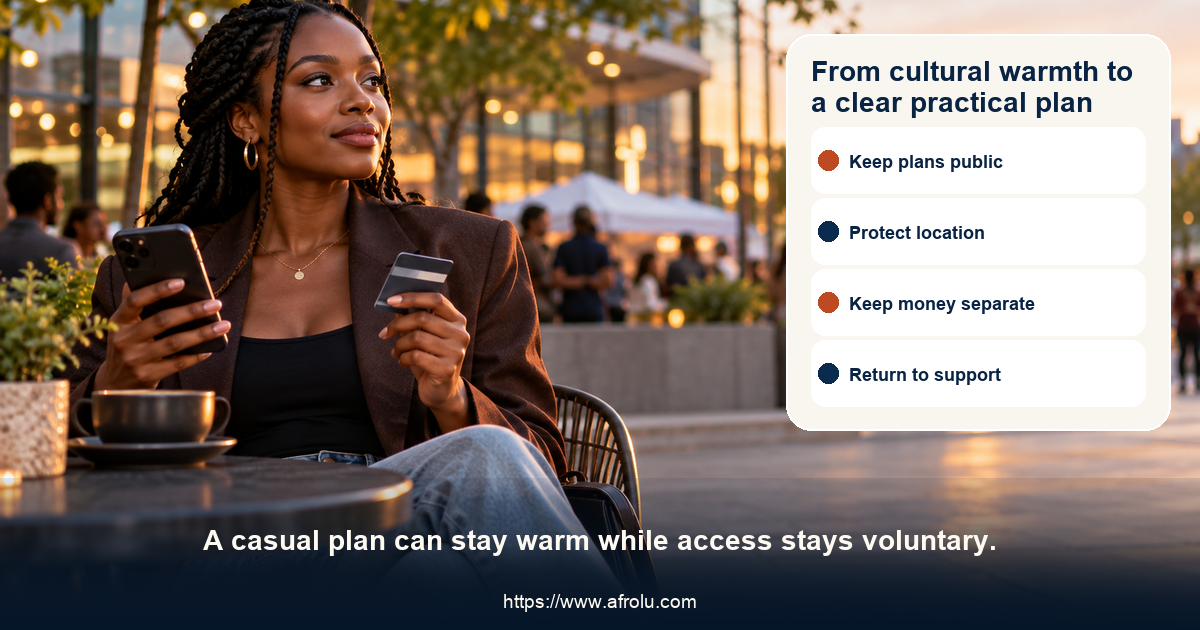
Shared background speeds up disclosure
A match knows a language or community reference that feels comforting and quickly asks for family names, immigration history, and private social profiles.
Keep the conversation warm but broad; familiarity does not create a right to personal records or network access.A casual plan has no reciprocal reality
A person avoids every reasonable live conversation or public meeting while asking for a hotel detail and a promise that you are not seeing others.
Keep access small and do not travel, host, or make exclusivity decisions without workable reciprocal evidence.A visitor expects private lodging
Someone says a shared background means it would be inhospitable to book their own place and asks to stay with you after a first meeting.
Offer a public plan or decline; distance and cultural familiarity do not decide home access.Urgency is framed as community care
A match says a small transfer will solve a family emergency and implies that only someone from the same background would understand.
Do not send, receive, or move funds; verify independently and step away from loyalty pressure.Two adults want different casual scope
One person prefers occasional local dates and the other wants daily messaging and future travel, with both able to state that plainly.
Name the mismatch and choose whether a lighter connection is genuinely workable.A public event becomes a hotel invitation
After agreeing to meet at a cultural event, the person changes the plan to a private location and says public spaces are too impersonal.
Keep the original public plan or leave; a late switch never removes the right to decline.A personal question changes the next conversation
A date realises a question about family was intrusive, apologises, and does not return to it after you set a boundary.
Treat the changed conduct as useful evidence while continuing to choose your pace.A boundary is bypassed through a community contact
After you end contact, the person asks a mutual acquaintance where you will be at a weekend gathering.
Ask contacts not to share information, save concerning messages if safe, and seek support if it continues.Signals about identity, cultural overlap, travel, location, money, consent, and exits
They can enjoy shared background without treating it as proof of trust or a claim on your private story.
They can name a casual offer without using the label to avoid honesty, consent, care, or a free exit.
They accept a public plan and independent transport without calling it a rejection of familiarity or hospitality.
They respect a broad answer about family, migration, language, faith, work, location, or community ties.
They offer reasonable reciprocal reality without demanding documents, tracking, passwords, location, or proof of belonging.
They do not use a visit, homecoming, event, distance, or cultural reference to claim lodging, home access, sex, or a longer date.
They do not ask for transfers, tickets, remittances, investments, codes, account access, or documents as proof of care.
They accept that flirting, a meal, a community event, or a casual label does not settle current consent.
They do not ask you to keep the connection secret from trusted support or hide a plan that affects your safety.
They do not turn cultural shame, praise, or authenticity tests into a way to weaken a boundary.
They can handle a difference in location, family involvement, or casual scope without deception, punishment, or retaliation.
They make a repair visible in the next plan instead of using an apology to reopen the same pressure.
They do not use new accounts, mutual contacts, events, or routine places to bypass an ending.
They leave you able to ask questions, protect information, see trusted people, and stop contact without fear.
Choose a proportionate next move
| Situation | What it may mean | What to do next |
|---|---|---|
| A shared background feels instantly familiar | Warmth can be real, but familiarity is not verification or a reason to disclose more. | Keep the present plan modest and share information in layers. |
| They avoid every live or public check | Privacy may matter, yet repeated avoidance can leave requested access unsupported by reality. | Do not host, travel, pay, or promise more access until a workable alternative exists. |
| They want family or migration details | Curiosity can be ordinary; persistence after a broad answer is information gathering. | Give only what you freely choose and make the channel smaller if the boundary is negotiated. |
| A public plan becomes private | Convenience can be genuine, yet privacy needs separate consent. | Keep the public plan or leave without defending the decision. |
| They ask for money or a transfer | Urgency may be a scam or a risk you do not want to take. | Do not send, receive, lend, invest, or share account information. |
| They want home or hotel information | A visit can be exciting, but location access should remain optional. | Keep lodging and address details private and arrange your own route. |
| They say your boundary rejects culture | Shame can be a way to turn a personal limit into a loyalty test. | Restate the limit once or end contact; you do not need to prove belonging. |
| They apologise for an intrusive question | A repair has value only when the next action changes. | Name the boundary and observe whether it remains respected. |
| They contact a mutual person after an ending | Indirect contact can become a boundary bypass. | Ask others not to relay details, block accounts, and preserve evidence if safe. |
| You feel fear or cannot leave freely | The concern has moved from casual clarity to immediate safety. | Use a protected exit and relevant urgent local support rather than another dating conversation. |
Twelve lines for scope, identity, location, money, consent, and ending
“I am open to a casual connection, and I still want us to be clear about the next plan.”
“That part of my family and background is private for now. I have shared what I want to share.”
“A short live conversation or public plan would help me decide whether to continue.”
“I am meeting there, not at either home or hotel. I will make my own way back.”
“That change does not work for me. I will keep the public plan or head home.”
“I do not send money, use payment links, share codes, or handle transfers in dating.”
“My boundary is not a judgment of our shared background. It is how I date safely.”
“I like the conversation, and I am not agreeing to that tonight.”
“I am staying on this app for now and I do not share live location or private images early on.”
“I heard the apology. I need the next plan to respect the limit I named.”
“Our expectations are different enough that I am not continuing this connection.”
“I asked for no more contact. Do not use new accounts or other people to reach me.”
Know the difference
A cultural difference, a casual mismatch, recurring pressure, and fear need different responses
A person can enjoy shared background, state a casual preference, accept a public plan and current no, respect family and location privacy, keep money separate, and alter the next plan after impact is named.
Familiarity leverage, repeated avoidance, private-visit pressure, money or document urgency, cultural shame, monitoring, unwanted contact, coercion, threats, or fear turn casual dating into a claim on access.
The shared background does not decide the risk. The observed pattern and your freedom to choose do.

The shared background does not decide the risk; the pattern and freedom do.
Separate cultural difference, mismatch, recurring pressure, and fear
| Type or dimension | What it describes | Best next question |
|---|---|---|
| Cultural familiarity | A shared reference creates warmth but leaves privacy, consent, money, and exit choices intact. | Enjoy the connection while keeping the next plan proportionate. |
| Familiarity leverage | A shared background is used to demand disclosure, hosting, secrecy, transfers, or faster trust. | Keep access small and restate the boundary once. |
| A casual difference | Two adults can name different contact, travel, family, or casual-scope preferences respectfully. | Decide whether the arrangement fits without pathologising either person. |
| Vague access | One person receives intimacy or attention while avoiding the information needed for an informed choice. | Ask once for clarity or leave the arrangement. |
| A public visit | Both adults retain independent transport, lodging, consent, money, and an exit. | Confirm only the plan you freely want. |
| Travel leverage | Distance or an event is used to claim home access, a private venue, a longer date, or sex. | Keep the public plan or cancel. |
| A repair | Impact is acknowledged and the following action respects the boundary. | Watch consistency before sharing more access. |
| Financial extraction | Money, documents, payment links, or accounts are framed as community care or proof of trust. | Keep money and records entirely separate. |
| A safety concern | Threats, stalking, coercion, image pressure, unwanted contact, or fear appears. | Use a protected exit and appropriate local support. |
Start with the casual scope and access you freely choose
Keep familiarity separate from evidence
A shared language, community, or history can matter without replacing ordinary reality checks.
Define casual in the present
Scope, contact, travel, intimacy, privacy, and ending expectations can be named without a permanent promise.
Layer identity information
A broad truth may be enough while documents, locations, family details, accounts, and routines remain private.
Design independent movement
Public plans, separate lodging, your own route, and a finish time preserve choice across distance.
Keep money outside care
A transfer, ticket, remittance, investment, or document request should not be the proof of connection.
Let culture support choice
A shared background should widen understanding, not make a no feel like betrayal.
Questions organised by purpose and depth
Choose a few prompts that fit the moment. This is a reference library, not a list to complete.
Before a first plan
Make a warm connection practical.
- What venue and route keep me comfortable?
- What information stays private today?
- What would make a late change a no?
Before sharing identity detail
Use a privacy pause.
- Does this person need this for the present plan?
- Could this detail expose family, documents, routine, or location?
- Would a broader answer be enough?
When money or travel enters
Use a firm independent pause.
- Is this my responsibility to solve?
- Would I make this payment without a dating story?
- Which official channel could verify the claim?
Before continuing
Check whether casual still feels chosen.
- Can I say no without managing their mood?
- Is access reciprocal and informed?
- Would a smaller next step restore my freedom?
Look more closely at scope, identity, movement, money, culture, and endings
Casual dating needs a present agreement
Discuss current contact, intimacy, privacy, safer sex, travel, exclusivity, plans, and endings at the level that lets each adult choose freely.
Evidence limit: No guide can decide the arrangement for two people.
Use proportional reciprocal checks
A live conversation, public plan, coherent details, and independent arrangements can support a decision without demanding documents, tracking, or a performance of cultural authenticity.
Evidence limit: No one method can establish another person’s intent with certainty.
Distance should not make access automatic
Keep public venues, independent transport, separate lodging, a finish time, and a route home under your own control.
Evidence limit: Local circumstances and personal needs may require additional safety planning.
Romance does not set your financial risk
Pause transfer, remittance, ticket, visa, investment, payment-link, document, account, and code requests, then use independent official channels to check a story.
Evidence limit: A concerning request is not proof that every person is committing fraud.
Shared background is not a boundary exception
Allow curiosity about identity and community while declining shame, secrecy, authenticity tests, or access claims that make a personal limit feel disloyal.
Evidence limit: A guide cannot define a person’s culture or community for them.
Risk changes the amount of contact you need
Use a short close for a mismatch and a more protected, support-led plan when pressure, stalking, threats, coercion, unwanted contact, or fear appear.
Evidence limit: Blocking by itself may not resolve every safety concern.
Shortcuts that make a casual diaspora connection less freely chosen
Treating shared culture as proof
Familiarity can be genuine while still leaving identity, safety, money, and consent questions unresolved.
Explaining every private boundary
A short no is easier to hold than a personal history someone can debate.
Making hospitality a debt
Travel, food, events, or a shared background do not create access to your home, body, money, or documents.
Solving a community crisis privately
Urgent transfers and secrecy can create financial and safety risk without resolving the story.
Calling every cultural difference a red flag
Different family, language, location, or casual-dating preferences can be honest incompatibility.
Seeking community approval for an exit
You can end contact without turning private dating decisions into a public discussion.
Choose one resource that fits the fact in front of you
Use a slow-dating guide for more evidence, a casual-dating guide to clarify scope, or a boundary guide when location, privacy, money, travel, or contact access needs a clear limit.
Explore the guide library
Show more related guides
Continue with Afrolu
Show more Afrolu guides
Sources used for this guide
Afrolu reviewed these health, research, safety, or public guidance resources while editing this page. They support the behaviour and safety guidance; they do not diagnose any individual described by a reader.
Questions about safety-first casual dating red flags for diaspora daters
Can a casual diaspora connection still be serious about safety?
Yes. Casual describes possible scope, not a lower standard for consent, honesty, privacy, money boundaries, respectful contact, or a free exit.
Does a shared background mean I should trust someone faster?
No. Familiarity can be meaningful without replacing ordinary reciprocal verification or your own pace.
Do I owe a date family or migration details?
No. Share only what you freely want to share. A broad answer can be enough for an early plan.
Is it rude to keep a first meeting public?
No. A public venue, independent transport, and private lodging are ordinary ways to preserve comfort and a free exit.
What if a visitor expects to stay with me?
You can decline. Travel, distance, and hospitality never create a right to your home, hotel, body, time, or a longer date.
What if someone says my boundary rejects our culture?
A preference can be incompatible, but it cannot cancel your limit. You do not have to prove belonging in order to date safely.
Should I send money for a family or travel emergency?
No. Do not send, receive, lend, invest, or verify funds through a dating contact. Pause and use an independent route to verify any story.
Can I enjoy cultural events with a new date safely?
Yes. Choose the parts you want, keep a public plan and independent route, and do not let an event decide location, lodging, money, or consent.
Can I end a casual connection by message?
Yes. A short message is enough for an ordinary mismatch. Choose a safer format if private discussion could create pressure or fear.
When should I seek outside support?
Seek urgent or specialist local support when there are threats, coercion, stalking, unwanted sexual contact, financial exploitation, image abuse, repeated unwanted contact, or fear.
One thing to do now
Let a casual connection stay light because your choices stay intact
Choose the smallest next action that preserves clear scope, reciprocal evidence, layered identity and location, independent movement, current consent, money and data boundaries, trusted support, and a genuine ability to decline or leave.