Seven-light re-entry runway · diaspora and distance
Return to Diaspora Dating on a Low-Pressure Route With Clear Exits
A low-pressure diaspora guide to dating after heartbreak: set a gentle rhythm, protect family privacy, plan safe travel, keep consent specific and pause freely.
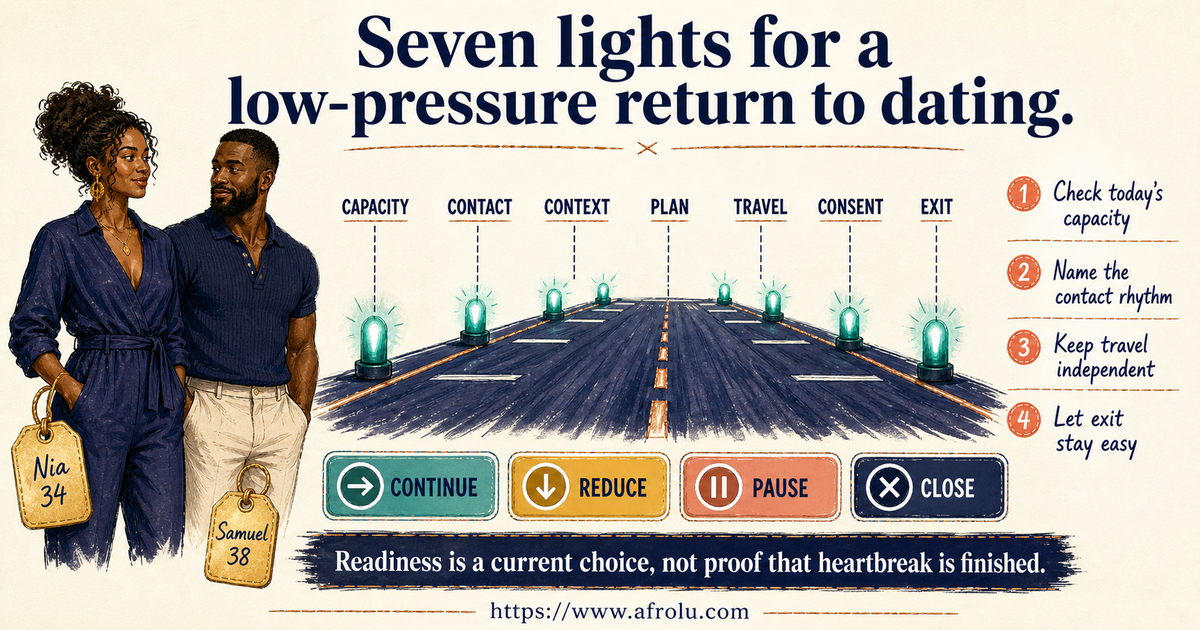
A gentle pace still needs a clear route and a working exit.
Written and edited by Adwoa Boateng · Dating Safety Editor
Use seven independent runway lights: CAPACITY, CONTACT, CONTEXT, PLAN, TRAVEL, CONSENT and EXIT. State what you can offer now, keep past and family information optional, make meetings public and bounded, control bookings and return independently, and let every disclosure and physical step remain reversible. Choose CONTINUE, REDUCE, ASK ONCE, PLAN LIGHTLY, PAUSE, CLOSE, SEEK CARE or SEEK SAFETY HELP. No universal recovery deadline exists. Persistent impairment belongs with qualified care; fraud, threats, tracking, coercion or blocked movement bypass ordinary dating review.
Starting over · Diaspora Daters
How can a diaspora adult date gently after heartbreak without turning recovery into a performance or low pressure into vague, unsafe or one-sided contact?
Low-pressure dating after heartbreak is a clear, mutual and reversible adult route with less intensity. It is not a clinical recovery stage, permission for vagueness or an obligation to disclose a painful past. Slow dating, ordinary delay, avoidance, mismatch, respectful closure, impairment, fraud and unsafe control are distinct routes.
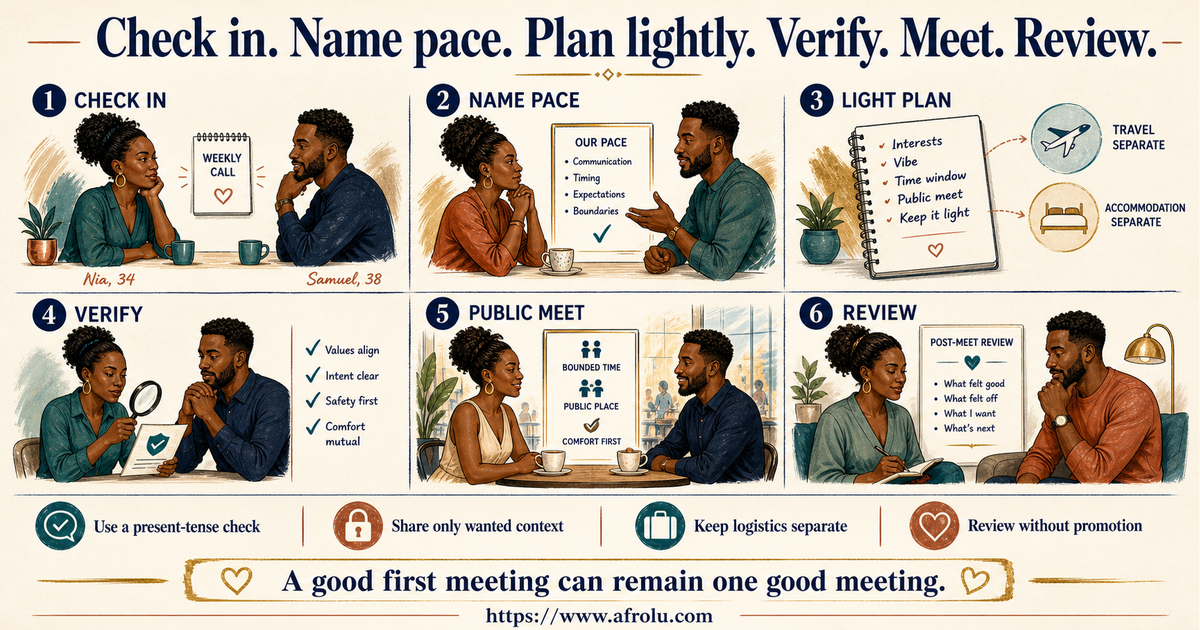
Across six fictional stops, Nia, 34, names one-call-a-week capacity and keeps her breakup history private. Samuel, 38, accepts the limit. They build one public meeting with separate travel, accommodation and costs, then retain the same rhythm without treating a good date as automatic promotion.
The seven-light diaspora re-entry runway
Let a gentle route keep clear edges
Amahle separates capacity, contact, context, plan, travel, consent and exit so healing never becomes an audition.
Name today's offer, preserve private history, plan lightly, verify independently and route mismatch, care, fraud or danger precisely.
Check capacity
Offer only the attention genuinely available today.
Protect context
Past and family details remain voluntary.
Plan lightly
Public logistics stay small, separate and leaveable.
Keep exit visible
Reduce, pause and close remain complete choices.
A gentle return is still a real route
Date from present capacity without turning healing into a performance
Diaspora life can add distance, travel cost, family visibility, cultural interpretation and pressure to explain the past. Those facts may matter, but none gives a new contact access to private history, relatives, community networks, home details or immigration information. Context can be shared gradually and only when the adult wants to share it.
Low pressure does not mean vague. A useful route states contact rhythm, current intention, meeting scope, travel control and exit. It allows either adult to reduce or pause without punishment. Warmth and clarity can coexist: one weekly call and one public meeting may be more honest than daily messages carrying an unspoken future.
Begin with a present-tense capacity check. Ask what kind of contact is wanted this week, what topic remains private and what plan would feel proportionate. Do not demand a heartbreak story as proof of openness. A concise answer, counterproposal or no can all be respectful forms of adult clarity.
If the route becomes unwanted, close it without calling yourself damaged or the other adult impatient. Persistent impairment belongs with qualified care for the affected person. Fraud, threats, tracking, coercion, image abuse or blocked movement require direct protective action and should not be processed as ordinary recovery discomfort.
The seven-light re-entry runway
Separate capacity, contact, context, plan, travel, consent and exit
CAPACITY asks what emotional and practical attention is genuinely available now. CONTACT names frequency and channel. A person may enjoy meeting while declining daily messaging. A quieter rhythm is not defective when mutual and clear; it becomes difficult when one adult must continually decode whether any route exists.
CONTEXT covers optional history, family and community information. No new contact is owed details about an ex, painful events, relatives, immigration status or community schedules. PLAN names public place, time, duration, ordinary costs and exit. A plan should stay small enough that declining it does not produce punishment or debt.
TRAVEL keeps bookings, accommodation, return and identity information independently controlled. Diaspora connection does not make ticket money, visas, emergency payments or account credentials a romantic duty. Verify providers through independently found channels and keep early meetings public, leaveable and separate from home access. Familiar culture cannot substitute for independent checks.
CONSENT applies to each disclosure, image, touch and physical step; prior heartbreak, travel effort or a good conversation cannot pre-authorise anything. EXIT keeps the profile, channel, plan, money, travel and physical space separately closable. A route is genuinely low pressure only when no remains workable in practice.
Six stops, no recovery audition
Follow Nia and Samuel from a quiet introduction to one bounded meeting
Nia says she enjoys meeting Samuel but has capacity for one scheduled call each week, not an all-day message thread. Samuel accepts the rhythm and asks which two evenings are workable. He does not interpret reduced contact as a challenge to chase, and Nia does not disappear to test whether he will pursue her.
When Samuel asks about the previous relationship, Nia says she will share more later and prefers to discuss what a new connection could look like now. He accepts that limit. They name a low-pressure intention: learn whether conversation and values fit, without exclusivity, family introductions or travel promises being implied.
They plan one daytime meeting at a staffed public venue, with a ninety-minute window and independent transport, accommodation and ordinary costs. Each checks the venue and route through official channels. Neither requests passport images, ticket funds, home access or relative contacts, and both keep a simple exit plan.
Afterward, Nia says she liked the meeting but wants the same weekly rhythm. Samuel can accept, counter or close; he accepts for now. The story ends with one reviewed agreement, not a relationship promotion. A pause or respectful mismatch would have been equally complete outcomes.
Fourteen signals without a healing score
Notice mutual gentleness, hidden pressure and conduct that changes the question
At CAPACITY and CONTACT, mutual gentleness looks like a stated bandwidth, workable rhythm and accepted counterproposal. Pressure appears when every pause becomes an accusation, immediate replies are demanded or reduced contact triggers pursuit through new channels. One missed call differs from a pattern that defeats a clearly stated limit.
At CONTEXT and PLAN, respect means private history stays optional and a meeting remains bounded. Pressure appears through demands for a full breakup account, family proof, community access or an elaborate trip before trust exists. Curiosity can be answered with a boundary; intimacy is not measured by how quickly painful facts are disclosed.
At TRAVEL and CONSENT, each adult controls bookings, return, accommodation, money and every physical or digital step. Ticket urgency, immigration leverage, sexual pressure, image demands or home-access requests change the route. A caring tone cannot neutralise exposure, and past heartbreak never reduces the need for present specific consent.
At EXIT, a low-pressure route remains closable without retaliation. Respectful disappointment may be expressed once; threats, tracking, impersonation, account compromise or repeated channel bypass are not ordinary mismatch. Protect access and use appropriate platform, financial, legal, health or emergency help rather than collecting more signals.

Low pressure means clear and reversible, not vague or consequence-free.
Twelve lines for gentle clarity
Use words for capacity, pace, privacy, travel, consent, pause and closure
Capacity language can be simple: 'I enjoy talking, and I have room for one planned call this week.' Pace language adds what is not offered: 'I am not available for an all-day thread.' These are present choices, not promises about next month and not invitations to argue whether the adult is sufficiently healed.
Context language protects privacy: 'I will share more about my previous relationship when I choose.' Diaspora boundaries may add, 'I do not introduce family or community contacts as proof.' A respectful contact can feel disappointed and still accept the limit without seeking information through mutual networks.
Plan and travel lines keep the meeting small: 'I can meet in a staffed public place for ninety minutes, and I will control my own transport and accommodation.' Money stays separate. Consent language remains specific: a ticket, meal, disclosure or emotional conversation never purchases access to body, home, images or future status.
Pause and closure need no recovery verdict: 'I am pausing dating and will not set a return date,' or 'This route does not fit me, so I am closing it.' When safe, one sentence is enough. Harassment or channel bypass should be handled through protection rather than a longer explanation.

A boundary can be warm, short and complete.
The smallest honest next route
Continue, reduce, ask once, plan lightly, pause, close, seek care or seek safety help
CONTINUE keeps a wanted rhythm. REDUCE makes contact smaller and explicit. ASK ONCE requests one missing answer without repeated pursuit. PLAN LIGHTLY creates a public, bounded meeting with separate logistics. None is a hidden test, and none obliges an adult to disclose why a smaller route is needed.
PAUSE may be indefinite and does not reserve either adult. CLOSE ends the romantic route without declaring someone unhealed, avoidant or culturally incompatible. A good conversation, shared diaspora experience or family enthusiasm does not create an obligation to remain available. Warmth can be acknowledged while the route closes.
SEEK CARE addresses persistent impairment in the affected adult through qualified local support; it does not diagnose a contact from message frequency. SEEK SAFETY HELP addresses fraud, threats, tracking, coercion, image abuse, account compromise or blocked movement. Care and protection may coexist but answer different questions.
Review the route after real information changes, not against a universal recovery deadline. A smaller agreement may remain satisfying, expand through mutual choice or end. The aim is not maximum intimacy. It is an honest, reversible adult route that preserves privacy, resources, consent and exit.

Continue, reduce, pause and close are all complete adult choices.
Nine nearby routes
Separate low pressure from slow dating, delay, avoidance, mismatch, impairment, fraud and control
LOW-PRESSURE DATING is a clear, mutual and reversible route with less intensity. MUTUAL SLOW DATING is an agreed pace that may still carry serious intention. ORDINARY DELAY has a stated constraint, realistic counterproposal and delivered follow-through. Each remains answerable even when contact is infrequent, and each adult can request a review.
An AVOIDANT PATTERN is used cautiously for repeated movement away from agreed closeness; it is not a remote attachment diagnosis. PLAN MISMATCH means adults want different frequency, travel or future scope while each remains free to close. RESPECTFUL CLOSURE ends that difference without punishment or a recovery verdict.
PERSISTENT IMPAIRMENT belongs with qualified assessment of the affected adult. ROMANCE FRAUD belongs with providers, platforms and current reporting channels. UNSAFE CONTROL belongs with immediate protective planning and appropriate local services. Concrete harm should not wait for a perfect explanation of heartbreak, personality, attachment or romantic motive.
Several routes can coexist: mutual slow dating can meet an ordinary delay, and mismatch can coexist with pressure. The strongest safety-relevant fact decides the immediate move. Relationship interpretation can wait until identity, money, family privacy, digital access and movement are protected. No gentleness label should average concrete harm downward.
Eight diaspora re-entry moments where gentleness still needs clear edges
One planned call replaces all-day contact
Nia names capacity without promising that the rhythm will expand later.
Agree it, counter it or close.Samuel asks about the breakup
Curiosity does not create access to painful history or details about another adult.
Accept a short boundary.A relative wants to join the call
Shared culture can feel warm while family access remains premature and optional.
Keep the contact adult-to-adult.They choose ninety minutes in a staffed venue
A small plan preserves transport, cost, accommodation and exit independence.
Verify the venue separately.One adult proposes paying the other's fare
Generosity can create dependence before identity and intentions are established.
Keep bookings and payment separate.Warmth creates pressure to promote the route
One enjoyable meeting does not require exclusivity, home access or faster contact.
Review the existing agreement.Nia no longer wants to date
A pause can be complete without a return date, detailed defence or reservation.
State it once and disengage.A closed contact appears through relatives
Bypassing a clear exit changes the question from mismatch to unwanted access.
Protect networks and seek fitting help.Fourteen signals across capacity, contact, privacy, plans, travel, consent and exit
Current emotional and practical capacity is stated without a recovery promise.
Contact frequency is mutual, specific and open to a respectful counterproposal.
A delayed reply does not trigger accusations, tests or pursuit through new channels.
Past relationship details remain optional and controlled by the person concerned.
Family, community and immigration information are not used as proof of trust.
Meeting proposals name public place, time, duration, ordinary costs and exit.
Travel, accommodation and return remain independently booked and controlled.
Ticket, visa, emergency and investment money stay outside new affection.
A good meeting does not automatically create exclusivity or home access.
Consent stays specific to every disclosure, image, touch and physical step.
Reduction and pause are accepted without punishment or a healing verdict.
Closure works across profiles, channels, plans, money and physical access.
Persistent impairment is routed to qualified care without diagnosing a contact.
Fraud, threats, tracking, coercion or blocked movement bypass ordinary review.
Review the low-pressure runway through ten independent questions
| Situation | What it may mean | What to do next |
|---|---|---|
| Is capacity present-tense? | Fits: A specific offer exists today. Needs review: One limit needs wording. Stop: Recovery promises are demanded. | Name today's bandwidth only. |
| Is the rhythm mutual? | Fits: Frequency works for both adults. Needs review: A counterproposal is possible. Stop: Reduced contact triggers pursuit. | Agree, reduce or close. |
| Is history optional? | Fits: Past details remain controlled. Needs review: Curiosity needs a boundary. Stop: Disclosure is treated as proof. | Protect the private story. |
| Is diaspora privacy intact? | Fits: Family and community stay optional. Needs review: One introduction needs review. Stop: Networks are used to verify or pressure. | Keep adult routes separate. |
| Is the meeting bounded? | Fits: Place, time, duration and exit are clear. Needs review: One detail is missing. Stop: A vague trip advances emotionally. | Complete or decline the plan. |
| Does travel stay independent? | Fits: Each controls booking and return. Needs review: One dependency needs repair. Stop: Money or documents are requested. | Stop exposure and verify. |
| Is consent still specific? | Fits: Every step remains reversible. Needs review: One expectation needs clarification. Stop: Effort is treated as access. | Separate gratitude from consent. |
| Can the route stay small? | Fits: A good date can remain one date. Needs review: Promotion is being assumed. Stop: Intensity is imposed after warmth. | Review rather than promote. |
| Does exit work? | Fits: Pause and close are respected. Needs review: One safe sentence may help. Stop: Channels or relatives bypass no. | Protect access directly. |
| Which authority fits? | Fits: Pace stays in adult choice. Needs review: Impairment may need care. Stop: Fraud or danger needs protection. | Prioritise the strongest fact. |
Twelve lines for pace, past, family, travel, consent and closure
“I enjoy talking, and I have room for one planned call this week.”
“I am not available for an all-day message thread.”
“I am open to learning whether we fit; I am not agreeing a future yet.”
“I will share more about my previous relationship when I choose.”
“I am not introducing relatives or community contacts at this stage.”
“I can meet in a staffed public place for ninety minutes.”
“I will control my own booking, accommodation and return.”
“My home is not part of this first meeting plan.”
“I do not fund tickets, visas, emergencies or investments for a new contact.”
“Travel, gifts and personal disclosure do not pre-authorise physical contact.”
“I am pausing dating and will not set a return date.”
“This route does not fit me, so I am closing it.”
Know the difference
Low-pressure dating and an avoidant pattern require different evidence
A clear, mutual, reversible route offers less intensity while boundaries and plans remain answerable.
Agreed closeness is repeatedly displaced without a delivered counterproposal; motive remains uncertain.
Judge the agreement and delivered behaviour, not disclosure volume or a remote attachment label.

Name the narrowest supported route before choosing a response.
Separate low pressure, slow dating, delay, avoidance, mismatch, care, fraud and control
| Type or dimension | What it describes | Best next question |
|---|---|---|
| Low-pressure dating | Less intensity is explicit, mutual and reversible. | Keep or revise the agreement. |
| Mutual slow dating | Both adults choose a slower developing route. | Review it when facts change. |
| Ordinary delay | A stated constraint receives a delivered revision. | Use the counterproposal. |
| Avoidant pattern | Agreed closeness repeatedly moves without completion. | Describe behaviour and ask once. |
| Plan mismatch | Adults want different contact or travel scope. | Counter, reduce or close. |
| Respectful closure | One adult ends the route without punishment. | Accept the ending. |
| Persistent impairment | Wider daily functioning remains affected. | Seek qualified local care. |
| Romance fraud | Affection seeks money, documents or credentials. | Stop exposure and report appropriately. |
| Unsafe control | Threats, tracking or defeated exits change the route. | Protect access and use safety help. |
Use the seven-light re-entry runway in deliberate moves
Check today's capacity
Readiness is specific to this contact and this week.
Name the rhythm
Low frequency becomes clear through mutual agreement.
Keep history optional
Painful detail is not proof of romantic openness.
Protect diaspora networks
Family and community contacts remain private.
Plan lightly
Public, bounded logistics preserve independent exit.
Route precisely
Mismatch, care, fraud and control use different responses.
Questions for capacity, diaspora privacy, meetings, consent and exit
Choose a few prompts that fit the moment. This is a reference library, not a list to complete.
Capacity and contact
Define the smallest honest route today.
- What contact is wanted?
- Which channel fits?
- What remains private?
- What would be too much?
Context and community
Protect history and diaspora networks.
- What can be shared?
- Which family details stay private?
- Who is not a verifier?
- What boundary needs wording?
Plan and travel
Keep one meeting bounded and independent.
- Which public place?
- How long?
- Who controls booking?
- How does each leave?
Consent and exit
Make every step reversible.
- Continue or reduce?
- Pause or close?
- Does care fit?
- Does danger bypass review?
What current safety, fraud, privacy, consent and wellbeing guidance supports
eSafety covers safer online dating
The guidance supports platform privacy and public, leaveable meetings.
Evidence limit: No practice certifies another adult.
FTC guidance describes money requests
The material supports independent travel and stopping transfers.
Evidence limit: U.S. routes do not replace local remedies.
Kenya ODPC explains personal data
The context supports protecting identity, family and location information.
Evidence limit: It is not personalised legal advice.
eSafety explains voluntary consent
The guidance supports specific, informed and reversible choices.
Evidence limit: It does not replace local law.
eSafety describes technology-facilitated control
The material supports taking tracking and channel bypass seriously.
Evidence limit: Australian services may differ locally.
WHO describes wellbeing and functioning
The context supports qualified care for persistent impairment.
Evidence limit: A fact sheet cannot diagnose an individual.
Six ways a gentle return can acquire hidden pressure
Offering a recovery forecast
Future certainty is promised. Repair: name today's capacity.
Using silence as a test
Pursuit is provoked. Repair: state the wanted rhythm.
Demanding the breakup story
Disclosure becomes proof. Repair: keep history optional.
Introducing family too early
Community warmth becomes access. Repair: preserve privacy.
Paying to make the meeting happen
Hope becomes dependence. Repair: keep travel separate.
Promoting one good date
Warmth becomes status. Repair: review the existing agreement.
Use a reviewed resource that matches the decision
This guide focuses on the relationship decision, so it does not rank dating apps. Check current prices, safety tools, and local availability before choosing a service.
Explore the guide library
Show more related guides
Continue with Afrolu
Show more Afrolu guides
Current safety, fraud, privacy, consent, control and wellbeing guidance
Afrolu reviewed these health, research, safety, or public guidance resources while editing this page. They support the behaviour and safety guidance; they do not diagnose any individual described by a reader.
Diaspora questions about dating gently after heartbreak
How do I know whether I am ready to date after heartbreak?
There is no universal readiness test. Ask what contact, disclosure, meeting and future scope you genuinely want now. Readiness may differ by person and week. You may reduce, pause or close without proving that healing is complete.
What does low-pressure dating actually mean?
It means lower intensity with explicit mutual agreements and workable exits. It does not mean vague contact, hidden expectations or consequence-free boundary crossing. Name frequency, intention, meeting scope, travel control and how either adult may pause.
Do I need to explain my previous relationship?
No. You can share context voluntarily, but a new contact is not owed painful details, an ex's information or a recovery narrative. Explain the present boundary and offer only the current route you want.
How can diaspora family expectations affect a new connection?
Family and community may bring warmth, advice or pressure. Keep introductions, names, schedules and opinions optional. A relative cannot certify identity, compatibility or safety, and shared heritage does not create access to your private networks.
Is a long-distance first meeting too much after heartbreak?
It may or may not fit. Use a small public plan, independent verification, separate bookings, accommodation and return, and no money or document exchange. You may decline travel because the route is unwanted without diagnosing your readiness.
Can I ask for less messaging without seeming uninterested?
Yes. State the frequency and channel you can genuinely offer and allow a counterproposal. Interest is not measured by constant availability. If the rhythm does not fit the other adult, respectful closure is a valid result.
Should I accept help with tickets or accommodation?
Early romantic contact should not require dependence. Keep ordinary costs, bookings, accommodation and return under your own control. Do not share credentials, codes or sensitive documents, and verify provider information through independently found channels.
Can I pause without promising to return?
Yes. An indefinite pause is complete and does not reserve either adult. When safe, say you are pausing and will not set a return date. You do not need to debate whether heartbreak is a sufficient reason.
When does discomfort belong with professional care?
Persistent changes in sleep, appetite, concentration, enjoyment or daily functioning deserve qualified local assessment. Care supports the affected adult without assigning a remote diagnosis to a dating contact or setting a mandatory dating timetable.
What should bypass a low-pressure conversation?
Threats, tracking, impersonation, financial exploitation, image abuse, compromised accounts, repeated channel pursuit or blocked movement need direct protection. Use relevant platform, financial, legal, health or emergency routes rather than another clarity script.
One thing to do now
Choose the smallest honest route and keep every exit working
Continue only while the pace is mutually named, privacy remains voluntary, plans are bounded, travel and money stay independent, consent is specific and exit works. Reduce, pause or close without a recovery verdict. Use qualified care for persistent impairment and appropriate protection for fraud or danger.