Dating again · faith-led values · weekends
The new person did not send the old silence
Faith-led adults can date again after ghosting by separating old fear from a new person's plans, discussing weekend contact and keeping values free of pressure.

A prior disappearance can inform a boundary without writing the new person's story in advance.
Written and edited by Liya Bekele · Horn of Africa Editor
A past disappearance can make a delayed reply feel loud, but this new person must be assessed by what they have actually agreed to and done. Start with one modest weekend plan and a contact rhythm both choose. Notice whether they keep the plan, name a change and offer repair; do not require constant availability to prove they are different from the last person. Faith-led values can guide honesty, patience and respect, but should never be used to demand forgiveness, intimacy or waiting. Keep support outside the new connection and step back if its real conduct does not fit.
Dating recovery · Faith-Led Daters
How can I trust a new weekend connection when someone else vanished, without ignoring a real new pattern?
Dating after being ghosted means beginning a new connection while carrying the memory of a previous person's unexplained disappearance. The useful task is to distinguish that memory from evidence about the new adult, not to diagnose either person's character.
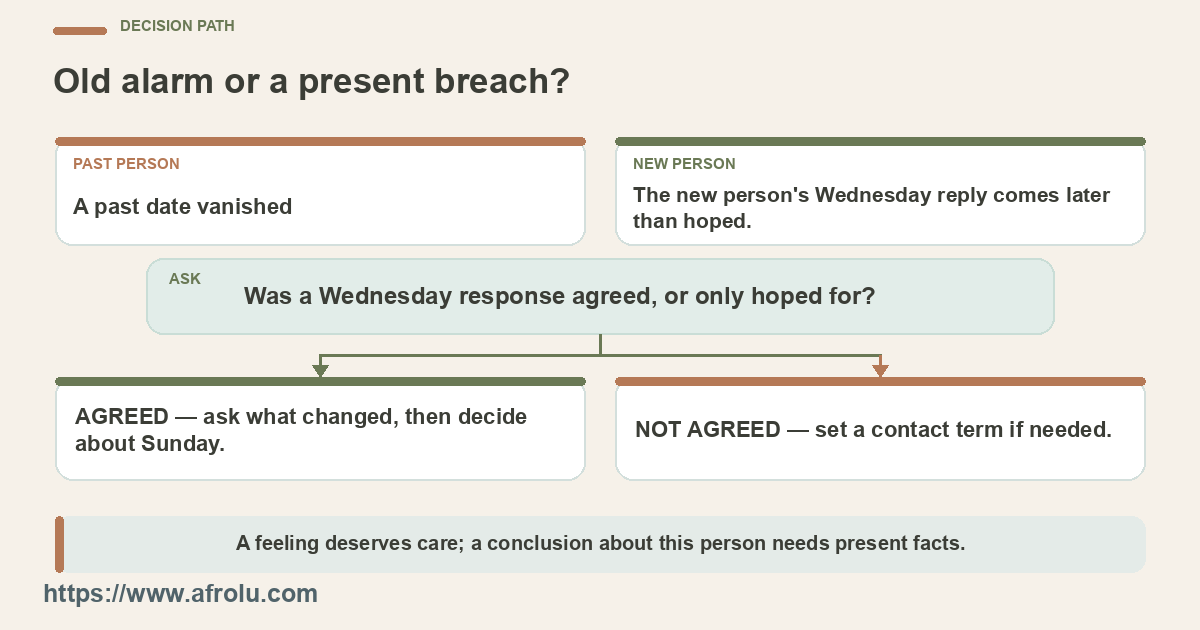
Illustrative scenario: A former date stopped replying after confirming a Sunday meet-up. Months later, a different person from a weekend community project suggests meeting again. Their Wednesday reply comes later than expected, and the old alarm returns. Before accusing them of vanishing, the reader checks what was actually agreed, proposes a feasible Sunday time and watches whether this new adult confirms or honestly changes it. They also speak with a trusted friend about the old hurt rather than asking the new date to carry it alone.
Two timelines
Keep the old wound and the new evidence in view
The body can recognise a familiar silence before the mind checks whether the new person has broken any agreement. Both experiences deserve attention.
Write down the old event, the present agreement and the new person's actual action. Choose a small next step from the present facts.
Name the trigger
What happened with the person who vanished?
Check the agreement
Was a reply time or weekend plan actually chosen?
Choose your limit
Honesty and respect can be requested without a test.
Keep more than one anchor
A friend or community can hear the old hurt.
Separate two people
An old alarm is real, but it is not a new event
When a former date vanished after making a plan, waiting may have become associated with embarrassment, uncertainty or wasted travel. A new person's late reply can wake that memory even if the new person never agreed to answer by a certain hour. Pause long enough to name both facts: what the former person did, and what the new person has actually done so far.
This distinction is not an instruction to talk yourself out of discomfort. If the new adult repeatedly breaks agreed plans or disappears after asking you to reserve a Sunday, that is current evidence. But if the only issue is a reply gap during an unagreed workday, you can ask about a contact rhythm before deciding that history is repeating itself.
Faith-led readers may value patience, forgiveness and hope. Those values can help you speak kindly, but they do not require denial of your own needs or certainty about a stranger. You may pursue a new connection slowly and still decide that an actual pattern of unreliability does not fit your life.
Make the next plan small
A real Sunday invitation can replace a week of guessing
If you want to meet, propose a public weekend plan you can afford and reach independently. 'Would Sunday at 3 at the community garden work?' gives both people a decision. You can ask for a confirmation by a practical time if travel or care duties require it. The purpose is to organise a date, not to make them prove they will never leave.
Be willing to hear a counteroffer. A new person might be unavailable on Sunday yet offer another feasible afternoon. That is different from leaving you to hold the whole weekend indefinitely. You may release the slot when it is not confirmed and make other plans without announcing a punishment.
love is respect encourages people to discuss expectations rather than assume them. Its guidance cannot set a universal reply interval for your faith community or this particular date. Your own fair contact term can be simple: tell me if a chosen plan changes. You can then see whether both adults freely accept that term.

Spiritual language should never excuse coercion.
Watch this person's conduct
Notice a change and what follows it
A new adult who says they cannot meet this weekend but proposes a real later time has given you information. So has one who confirms, then gives prompt notice when an unavoidable change arises and offers an alternative. An apology matters most when it is joined to a practical repair and the pattern does not keep repeating.
If the person leaves a confirmed meeting unexplained, you may ask once what happened if you want to. You need not remain available for repeated vanishing to prove you are patient. Conversely, if no time was ever agreed, do not score them as having missed a plan they did not make. Let the actual terms set the standard you apply.
You can also notice whether you enjoy their company and share values in ordinary action. At a community project, do they listen, make space for disagreement and treat other people respectfully? Those observations belong to this connection. The previous person's disappearance tells you why clarity matters to you; it does not tell you who this person is.

The other adult may offer a different workable rhythm.
Keep faith freely chosen
Shared values should widen honesty, not silence it
Two adults may both describe themselves as faith-led and still differ about pace, exclusivity, family involvement or what a weekend date means. Ask about the present terms rather than assuming a shared tradition has already answered them. love is respect's dating-definitions guidance explains that ground rules vary even within familiar labels; the adults have to choose them together.
If a date asks you to overlook a repeated broken plan because you should be forgiving, you may say that forgiveness and continuing to date are different decisions. Similarly, do not use a shared spiritual identity to demand instant reassurance, passwords or constant contact from the new person. Respect gives both adults room to state a limit and leave if the arrangement is wrong for them.
A faith community, trusted friend or mentor may help you reflect, but avoid turning them into an audience that decides the new person's worth from a few messages. Keep private details private and ask for support with your own uncertainty. The relationship remains between two adults who must be able to choose freely.
Choose from the present
Hope and caution can travel together
After a few actual weekends, ask what you know: did plans happen as agreed, were changes explained, and could you say what you needed without being mocked? Also ask how you feel when you are not together. A sustainable connection need not remove every old fear; it should not require you to monitor the person all week to feel permitted to rest.
If the arrangement is promising, you may gradually discuss more substantial hopes, including exclusivity and how faith shapes your choices. Do it because the subject now affects your decisions, not because an old ghosting incident created a deadline. If the new person's real behaviour repeatedly fails your modest terms, you may close the connection kindly and clearly.
Keep a life that does not depend on this date for repair of the past. Friends, routines, community and professional support where needed can help you carry an old hurt while learning about a new adult. The fairest measure of the new connection is what the two of you actually choose and do now.

Do not make a new connection the only source of support.
Old fear in a new weekend
A new date answers after a busy workday
No response time was agreed; an old fear has been stirred.
Ask about the contact rhythm if it matters.The new adult does not arrive or send notice
This is a present broken plan.
Ask once about repair if desired, then choose.They warn early that Sunday no longer fits
The plan changed, but the change was communicated.
Consider the offered alternative.Someone says patience means accepting repeated no-shows
Shared values are being used to pressure a boundary.
Keep forgiveness separate from continuing to date.Evidence this person can actually provide
A chosen weekend plan is confirmed or changed before travel.
A missed plan receives a specific explanation and repair where possible.
Both adults can state a contact preference without demanding constant access.
Shared faith is not used to force forgiveness or intimacy.
The reader still has support outside the new relationship.
Separate a missed plan from a late reply
| Situation | What it may mean | What to do next |
|---|---|---|
| The old alarm rises | A prior person's silence is being remembered. | Write down what this new adult actually agreed to. |
| No plan was broken | Reply timing may be an unspoken expectation. | Propose a workable rhythm if needed. |
| A plan was broken | Present conduct now matters. | Ask for repair once if you want to continue. |
| Repair is offered | The other person names the miss and a real alternative. | Decide whether the pattern still fits your values. |
| Pressure repeats | Values language is replacing respect for a limit. | Step back and seek trusted support. |
Ask for a workable notice
“I would like to meet at the community garden Sunday at 3. If something changes, please tell me before I travel.”
“We agreed to meet today and I did not hear from you. What happened? I will decide about another date after we speak.”
“I value patience, but I cannot keep reserving Sundays after repeated no-shows.”
“An old disappearance is making this new pause feel larger. Could we talk about what is past and what is happening now?”
Know the difference
A new person's evidence versus the old person's silence
Notice agreed plans, honest limits, actual changes and attempts to repair.
A delay feels like an earlier disappearance even when no current agreement was broken.
A feeling deserves care; a conclusion about this person needs present facts.

No diagnosis or guaranteed trust timeline is suggested.
The past has a voice, not a vote
| Type or dimension | What it describes | Best next question |
|---|---|---|
| Old ghosting | A prior person's unexplained departure. | Name the hurt without attributing it to the new adult. |
| Late reply | A delay with no agreed reply time. | Discuss contact expectations if needed. |
| Missed date | A confirmed plan was not kept. | Ask whether repair is wanted and possible. |
| A changed plan | Notice arrived and an alternative was offered. | Judge the actual proposal. |
| Values pressure | Patience or faith is invoked to override a limit. | Keep the ability to say no. |
Keep hope and caution together
Two timelines can coexist
Past hurt is real while present evidence stays person-specific.
A small agreement helps
A real Sunday time is clearer than indefinite reassurance seeking.
Faith is not a waiver
Shared values cannot remove the need for consent and reliable choices.
Questions for values and present facts
Choose a few prompts that fit the moment. This is a reference library, not a list to complete.
When fear rises
Find the event on the correct timeline.
- What did the former person do?
- What did this person agree to?
- Which action is observable now?
Before another weekend
Make a plan both can keep without a loyalty test.
- Is the venue and time chosen?
- How will changes be communicated?
- Do I still freely want this date?
What readiness and respect sources can say
Readiness
love is respect invites reflection on emotional capacity and commitments when dating.
Evidence limit: Self-reflection, not a rule to wait until fear is gone.
Expectations
love is respect recommends discussing boundaries and contact expectations.
Evidence limit: It does not set a universal reply-time rule.
Dating terms
love is respect explains that dating labels and ground rules are chosen by participants.
Evidence limit: Shared faith does not automatically settle exclusivity or availability.
Respect
love is respect describes respect as trusting another person's judgment and choices.
Evidence limit: Respect does not require remaining in a connection that does not fit.
When old silence writes a new script
Making the new adult prove the past wrong
Constant reassurance cannot undo another person's departure.
Excusing repeated misses as patience
Faith-led values do not require accepting a harmful pattern.
Treating every delay as a no-show
An unagreed reply time is not the same as a broken date.
Judge this new plan
State one modest weekend term and watch this person's own response.
Explore the guide library
Continue with Afrolu
Readiness, boundaries and dating terms
Afrolu reviewed these health, research, safety, or public guidance resources while editing this page. They support the behaviour and safety guidance; they do not diagnose any individual described by a reader.
Questions after being ghosted
Is it wrong to feel wary after ghosting?
No. The feeling is real. Let the new person's actual agreements and conduct inform the decision about them.
How long should I wait for a reply?
There is no universal interval. If contact timing affects plans, discuss a practical expectation together.
What if a new date misses a confirmed Sunday?
That is present evidence. You may ask what happened once and decide whether any repair is enough for you.
Does shared faith mean we are serious?
No. Pace, exclusivity and family involvement still need a conversation both adults choose.
Must I forgive a repeated no-show?
Forgiveness and continuing to date are separate decisions. Your boundary may still end the arrangement.
What if I keep needing reassurance?
Name one workable contact term and use support outside the new date for the old hurt. You may also slow or pause dating.
One thing to do now
Let this person's own conduct count
Let the old hurt inform a modest boundary; let this person's own agreements and repairs inform the decision to continue.