Dating after ghosting · serious intent · career seasons
Dating seriously after ghosting when work is demanding
After ghosting, discuss serious dating without guessing from work delays. Ask about present intentions, protect work privacy and plan around real schedules.

Two adults discuss serious dating around a real work calendar and shared plans.
Written and edited by Adwoa Boateng · Dating Safety Editor
Ask what serious dating means in present choices, agree on a realistic way to make plans and look for mutual follow-through over time. A full calendar can be real context; it does not obligate you to accept an arrangement that leaves you uncertain. Keep private work details private and decide from the agreement you actually have.
Dating recovery · Diaspora Daters
How can I discuss serious intent after ghosting without treating every busy workday as a warning?
Serious intent is a conversation about what each adult is choosing now and hopes to build over time. It is not proved by a title, frequent messages or a promise alone. Ghosting describes a prior unexplained cutoff; neither term diagnoses a person's motive.
After a former match stopped replying during a critical project, 39-year-old Kofi worries that a new date's late-night messages mean the same thing will happen again. He asks what kind of relationship each person is seeking, suggests a realistic date window and notices whether planning becomes mutual.
Start with the earlier ending
A past silence can matter without becoming today's verdict
When someone disappears after promising to meet, the lack of an explanation can leave a practical question unanswered. You may wonder whether you missed a sign or said the wrong thing. The missing conversation is not proof that you caused the cutoff, and it cannot explain a new match's intentions before you speak.
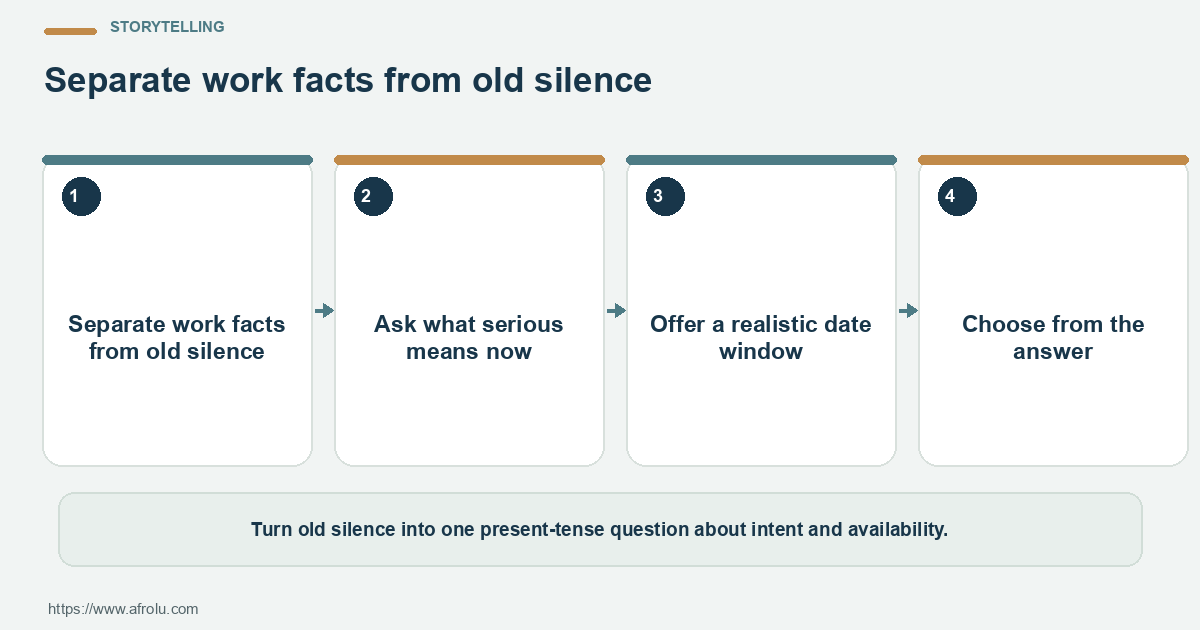
Separate the history from the present: what the former match did, what you learned you need and what the new adult has actually agreed to. This keeps a prior experience from becoming a rule that every delayed reply means rejection. It also helps you hold onto the boundary that mattered without asking a new person to answer for someone else.
A study of adults who reported ghosting experiences found varied associations and limits; it cannot diagnose an individual or predict a future connection. Use research to understand that people report different experiences, then make decisions from your own comfort, the words you hear and the follow-through you can observe.
Define serious in present terms
A direction is clearer when you can name the choices
One person may mean exclusive dating; another may mean intentional dates while learning compatibility. Someone else may want a committed partnership eventually but is not ready to make a promise after one conversation. Ask what the word means now, rather than treating a shared label as a complete agreement.
You can say, 'I am looking for a committed relationship if we are compatible. Are you dating toward that too?' Then discuss what each of you wants to do in the meantime. You are not asking for a guarantee of marriage or a deadline; you are checking whether the current direction is close enough to continue.
If the answer is uncertain, decide whether you can enjoy getting to know the person without assuming the uncertainty will resolve in your preferred direction. Set a point to revisit the question if that would help. You can also step back now; a mismatch in readiness is enough reason without proving either person wrong.
Talk about work without mind-reading
Busy weeks and one-sided planning are different facts
Careers can include travel, unpredictable shifts, deadlines, caregiving alongside work and recovery time. A person may genuinely have little capacity this week. That context matters, but it does not make you responsible for waiting indefinitely or carrying all the planning while they decide when to reappear, especially when capacity is limited.
Notice the observable response to a change. Does the person communicate when they can, suggest a realistic alternative and help confirm it? You can respect their workload and still decide that the available rhythm does not fit your life. The choice concerns compatibility, not whether you can prove the explanation is valid.
Try a concrete question: 'Would Thursday after work or Sunday afternoon be realistic? If neither works, suggest a window that does.' The answer gives both adults a practical next step. If the conversation stays vague, you can make other plans instead of repeatedly rescheduling around a date that has not been agreed.

Ask what serious intent means now without requesting a future guarantee.
Build a plan around real capacity
A good plan does not need access to your whole calendar
Start with a time range you can offer rather than disclosing your whole schedule. A daytime coffee, a meal near public transport or a brief call may be realistic during a busy month. Ask the other adult to choose a time or propose another one, so scheduling does not quietly become your sole responsibility.
If work changes often, say when you will know more: 'My rota is confirmed on Wednesday; I can plan after that.' This gives a clear expectation without asking someone to keep an unconfirmed evening open. Both adults can decide whether the uncertainty suits them, and either can suggest a different kind of date.
Avoid promising a level of availability you cannot sustain to seem serious. Reliability is easier when plans match actual capacity. You can offer a slower rhythm, explain that travel weeks are difficult and revisit the arrangement later. A career season may change; your dating decision can respond to the facts you have now.

A workable plan includes capacity, shared effort and clear updates.
Keep work details under your control
Dating clarity does not require employer access
A new date may ask where you work or when you finish so they can suggest a plan. You can answer at a broad level, choose a public place away from your office or say that you prefer not to share a routine yet. Your privacy boundary is not evidence that you are hiding a relationship status.
Do not share workplace passwords, one-time codes, employee records or financial credentials to prove trust. If a match asks you to move money, invest, pay for an emergency or access an employer account, stop and verify independently. U.S. consumer guidance on romance scams is not a Kenya prevalence measure, but the financial boundary remains sensible.
Serious dating still leaves each adult room to say no, change a plan or keep professional life separate. If a person reacts to a reasonable privacy limit with threats, pressure or punishment, you can end contact and use the platform's reporting tools. You do not owe a meeting to someone who ignores your stated boundary.
Look for partnership in the small plans
Intent becomes useful when both people can act on it
Watch whether the person keeps a plan, lets you know when it changes and suggests another time when they still want to meet. These actions do not certify future commitment, but they show whether the current interaction includes shared effort. You are allowed to value practical consideration even while the relationship remains new.
A strong conversation about the future can coexist with inconsistent present behaviour. Ask whether the two fit together for you instead of choosing the more flattering signal. You can say that you enjoy the conversation but need dates to be arranged with enough notice. Then decide based on what both adults choose next.
Do not use message frequency, job title, income or an elaborate date as a substitute for a direct agreement. If you want exclusivity, ask about exclusivity; if you want more time together, ask about time. Each question can have its own honest answer, and you can choose whether those answers are enough.
Choose what fits this season
You can seek a serious future at a manageable pace
You may continue with a realistic weekly or fortnightly date, pause while work is intense or end a connection whose available time does not meet your needs. Those choices do not make you demanding. They describe what kind of relationship you can participate in without resenting your calendar or asking another person to become someone else.
If a person says they want commitment but cannot make plans now, ask what they are able and willing to offer. You can accept the current limits, suggest a later check-in or decide that you want a more available partner. Keep the decision about your own life rather than a prediction about how the person will change.
If the earlier ghosting still affects how you feel, support from a trusted person or qualified professional may be useful if you choose it. The research cited here concerns particular groups and experiences; it does not label you or tell you what you should feel. You can date again slowly, or take more time away.

Protect work privacy while choosing a pace that fits this season.
Three ways this can show up
A deadline moves a date
A work emergency cancels a confirmed evening
See whether the person communicates and proposes a workable replacement.Serious means different things
One adult means exclusive; the other means intentional but open
Ask what each person is choosing about exclusivity now.Only late-night messages
The person contacts you after work but never suggests a date
Offer a realistic window and look for shared planning.A schedule is confidential
A match asks for an employer, roster or office location
Give a broad availability window instead of private work details.An unpredictable month
You have limited energy during a major project
Offer only the time you can genuinely sustain.Future talk replaces time
A person describes a shared future but cannot name the next date
Ask about one present action instead of treating a promise as an agreement.A work code request
A date asks for a one-time code or account access
Decline and verify any claim independently; a match does not need your access.The same cancellation repeats
Plans are moved several times without a replacement
Decide whether the current availability meets your needs.What to notice before you react
A deadline moves a date: A work emergency cancels a confirmed evening
Serious means different things: One adult means exclusive; the other means intentional but open
Only late-night messages: The person contacts you after work but never suggests a date
A schedule is confidential: A match asks for an employer, roster or office location
An unpredictable month: You have limited energy during a major project
Future talk replaces time: A person describes a shared future but cannot name the next date
A work code request: A date asks for a one-time code or account access
The same cancellation repeats: Plans are moved several times without a replacement
An agreement includes a time, place or contact expectation that both adults can describe.
A change is communicated before the other person begins travelling or waiting.
A clear no is heard without repeated pressure to reconsider.
One adult carries the planning while the other leaves each next step open.
A future promise is offered in place of a present answer.
A privacy or money boundary is treated as a choice rather than a challenge.
Read the moment without overbuilding the story
| Situation | What it may mean | What to do next |
|---|---|---|
| A deadline moves a date | A work emergency cancels a confirmed evening | See whether the person communicates and proposes a workable replacement. |
| Serious means different things | One adult means exclusive; the other means intentional but open | Ask what each person is choosing about exclusivity now. |
| Only late-night messages | The person contacts you after work but never suggests a date | Offer a realistic window and look for shared planning. |
| A schedule is confidential | A match asks for an employer, roster or office location | Give a broad availability window instead of private work details. |
| An unpredictable month | You have limited energy during a major project | Offer only the time you can genuinely sustain. |
| Future talk replaces time | A person describes a shared future but cannot name the next date | Ask about one present action instead of treating a promise as an agreement. |
| A work code request | A date asks for a one-time code or account access | Decline and verify any claim independently; a match does not need your access. |
| The same cancellation repeats | Plans are moved several times without a replacement | Decide whether the current availability meets your needs. |
| A new need appears | Your preference changes after the arrangement begins | Describe the change and ask whether the other adult wants it too. |
| A boundary receives pressure | The other person argues that your limit is unnecessary | Keep the limit and choose whether to continue the conversation. |
Three calm ways to start the conversation
“I am dating toward commitment if we are compatible.”
“I can meet Sunday, but not during the project week.”
“Are we choosing exclusivity now or still learning about fit?”
“I prefer to keep my employer and work roster private.”
“Could you choose a time for the next date?”
“I want more availability than this connection can offer.”
“I want to understand what we are choosing now. Can we talk about it directly?”
“I can make that plan if we confirm the details today. Otherwise I will use the evening differently.”
“Thanks for being clear. I will decide what works for me from here.”
“If either of our needs changes, I would rather talk than assume the old terms still apply.”
“I need a little time before deciding what I want to do next.”
“I hear what you want, and I do not think our current preferences match.”
Know the difference
A real work constraint versus Unclear availability
The person names a limit, shares a realistic window and updates you when a plan changes.
Future intentions are discussed, but no current time or shared plan ever becomes possible.
You can respect a workload and still decide whether the available relationship fits.

A real schedule limit differs from a plan that never becomes clear.
Compare the closest dating types before choosing a label
| Type or dimension | What it describes | Best next question |
|---|---|---|
| A real work constraint | The person names a limit, shares a realistic window and updates you when a plan changes. | Ask what the current agreement says. |
| Unclear availability | Future intentions are discussed, but no current time or shared plan ever becomes possible. | Decide whether the arrangement works for you. |
| One delayed reply | A single gap has several possible explanations. | Wait for the agreed window or ask once. |
| A repeated pattern | The same missing detail or cancelled plan happens again. | Name the actions and set a boundary. |
| A stated preference | An adult explains what they want now. | Check whether you want the same arrangement. |
| A future possibility | A hope or promise describes something that has not happened yet. | Do not treat it as a present agreement. |
| A changed need | One person wants a different pace or term later. | Revisit the arrangement and hear the answer. |
| A respectful no | Someone declines a date, boundary or new term. | Accept the choice and make your own decision. |
| A practical constraint | Time, distance, transport or privacy affects the next step. | Find a mutual option or decide it does not fit. |
A simple plan you can use today
Development and validation of a questionnaire (GHOST) to assess sudden, unexplained communication exclusion or ‘ghosting’
An online survey of 811 adults tested a measure of reported ghosting experiences. The questionnaire describes patterns; it cannot explain why one person stopped replying.
Psychological Correlates of Ghosting and Breadcrumbing Experiences: A Preliminary Study among Adults
An online sample of 626 adults aged 18 to 40 reported varied experiences. The study found no significant relation between ghosting and the measured correlates; it does not diagnose an individual or establish causation.
Time for Each Other: Work and Family Constraints Among Couples
A U.S. time-use analysis considered work and family demands among established couples. It cannot set a dating cadence for an individual or a different country.
Communication, the Heart of a Relationship: Examining Capitalization, Accommodation, and Self-Construal on Relationship Satisfaction
This study examines communication constructs in a defined sample. It cannot identify a new match's intent or establish one universal message rhythm.
Romance Scams
The FTC explains U.S. consumer guidance about romance scams and money transfers. It is not a measure of scam prevalence in Kenya or other diaspora communities.
Rights of a Data Subject
Kenya's regulator outlines data-subject rights. Those rights do not verify a dating profile or remove every privacy risk in a new conversation.
Questions organised by purpose and depth
Choose a few prompts that fit the moment. This is a reference library, not a list to complete.
Serious intent
Name what the word means in your present choices.
- What am I seeking now?
- What am I not ready to promise?
- Which terms need a direct answer?
Work and capacity
Share a useful limit without exposing private details.
- Which time can I genuinely offer?
- What changes during a deadline?
- Can both adults plan around this?
Old silence
Keep the past event separate from a new person's actions.
- What happened before?
- What has the new person done?
- Which question would clarify the next step?
A next choice
Decide whether today's availability fits your season.
- What does the current arrangement offer?
- What would need to change?
- Am I willing to wait for that change?
What deserves a closer look
Development and validation of a questionnaire (GHOST) to assess sudden, unexplained communication exclusion or ‘ghosting’
An online survey of 811 adults tested a measure of reported ghosting experiences. The questionnaire describes patterns; it cannot explain why one person stopped replying.
Evidence limit: Use this source only within its study population, scope and stated limits.
Psychological Correlates of Ghosting and Breadcrumbing Experiences: A Preliminary Study among Adults
An online sample of 626 adults aged 18 to 40 reported varied experiences. The study found no significant relation between ghosting and the measured correlates; it does not diagnose an individual or establish causation.
Evidence limit: Use this source only within its study population, scope and stated limits.
Time for Each Other: Work and Family Constraints Among Couples
A U.S. time-use analysis considered work and family demands among established couples. It cannot set a dating cadence for an individual or a different country.
Evidence limit: Use this source only within its study population, scope and stated limits.
Communication, the Heart of a Relationship: Examining Capitalization, Accommodation, and Self-Construal on Relationship Satisfaction
This study examines communication constructs in a defined sample. It cannot identify a new match's intent or establish one universal message rhythm.
Evidence limit: Use this source only within its study population, scope and stated limits.
Romance Scams
The FTC explains U.S. consumer guidance about romance scams and money transfers. It is not a measure of scam prevalence in Kenya or other diaspora communities.
Evidence limit: Use this source only within its study population, scope and stated limits.
Rights of a Data Subject
Kenya's regulator outlines data-subject rights. Those rights do not verify a dating profile or remove every privacy risk in a new conversation.
Evidence limit: Use this source only within its study population, scope and stated limits.
Four mistakes that make this harder
Treating one delay as proof
A single gap cannot reveal motive; check the agreement and the pattern.
Using a label as a verdict
Popular terms describe concerns, not a complete account of another person's intent.
Promising more than you can offer
An honest pace is more sustainable than availability chosen to avoid rejection.
Reading a future promise as a present plan
A hope does not confirm a date, exclusivity or consent.
Sharing private access to build trust
Passwords, money and work accounts are not relationship tests.
Waiting without a boundary
An unconfirmed invitation does not require you to keep all your time open.
Ask what direction and time are available now
These information links are labelled, non-commercial and do not promise a match or relationship outcome.
Explore the guide library
Show more related guides
Continue with Afrolu
Show more Afrolu guides
Sources used for this guide
Afrolu reviewed these health, research, safety, or public guidance resources while editing this page. They support the behaviour and safety guidance; they do not diagnose any individual described by a reader.
Dating seriously after ghosting when work is demanding Questions
How soon should serious intent be discussed?
Ask when the answer would affect whether you continue investing time. You can discuss direction without demanding a future guarantee.
Is a demanding job an excuse?
You cannot infer motive from a job. Notice whether the person communicates limits and whether the available relationship suits you.
Should I share my employer?
No. You may keep workplace details private and share only the availability needed to make a plan.
What if we want different timelines?
Acknowledge the difference and decide whether the current arrangement works for you. Neither adult has to be at fault.
Does frequent texting show commitment?
It can show contact, but commitment and exclusivity require a conversation and mutual agreement.
Can work explain cancellations?
It may provide context. You can respect the reason and still ask for a replacement plan or decide the pattern does not fit.
Does ghosting prove something is wrong with me?
No. The cutoff describes another person's communication choice; it cannot establish your worth or diagnose the reason.
Should I send several messages to get closure?
You may send one clear message if you choose. You are not owed a reply, and you can close contact without one.
Can research tell me what my date intends?
No. Studies describe samples and group-level patterns; ask the person directly and decide from the agreement you have.
When should I seek support?
You may talk with someone you trust or a qualified professional if that feels useful. There is no required response or timetable.
One thing to do now
Turn the lesson into a better match pool
Separate schedule facts from dating choices, ask one answerable question and measure fit by the agreement each adult can keep.