Dating after ghosting · weekend plans · personal choice
Plan a safer weekend date after being ghosted
Dating again after ghosting? Build a weekend plan with a public place, independent transport and clear check-ins; keep the next step yours to choose today.
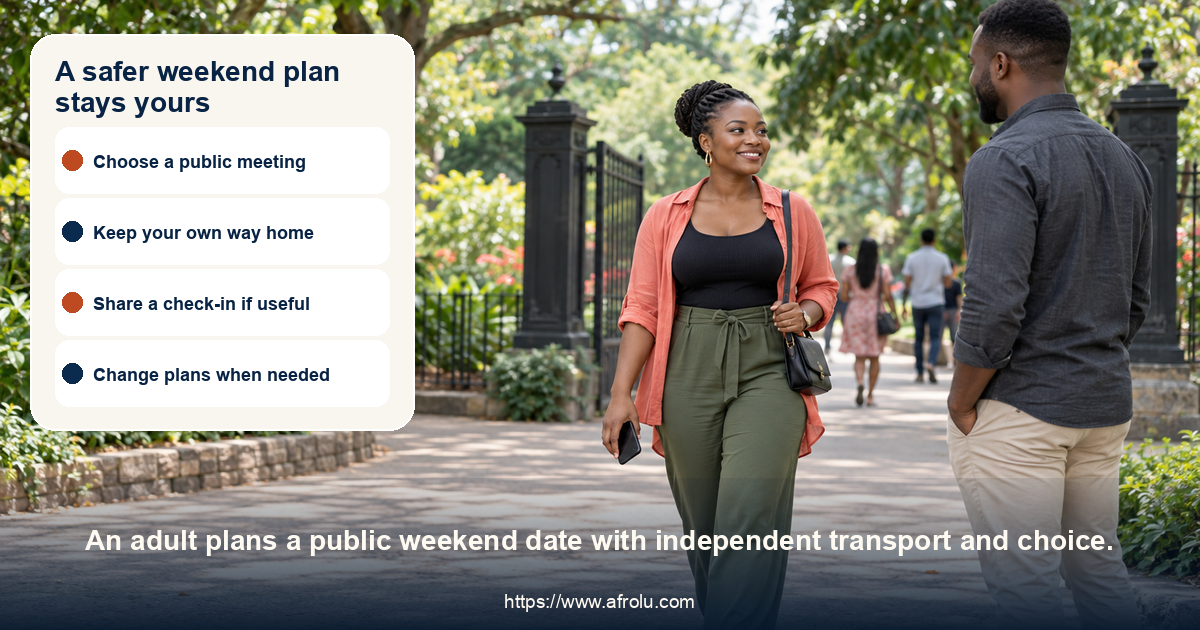
An adult plans a public weekend date with independent transport and choice.
Written and edited by Nadine El-Sayed · Verification Editor
Choose a public place and time you can leave independently, tell a trusted person the plan if you want to, and keep money, codes and private details in your control. These steps can support your options but cannot guarantee another person's behaviour. You may change the plan, decline or leave whenever you choose.
Dating recovery · Diaspora Daters
How can I plan a weekend date after ghosting while keeping safety steps practical and proportionate?
A safer-date plan is a set of choices that can help preserve your options; it cannot make another person safe or remove every risk. Ghosting describes an unexplained end to contact, not a forecast that future dating will be dangerous.
After a former date disappeared without explanation, 34-year-old Leila wants to meet someone new but feels uneasy about an evening invitation. She suggests a busy daytime café, arranges her own ride and decides what information to share. The plan makes room for curiosity and an easy exit.
Keep the past in context
Ghosting is not a forecast of future danger
Being ignored after a meaningful conversation can feel unsettling. It may make a later invitation harder to assess, but a past cutoff does not establish that a new person will behave the same way. Keep the events distinct: one person ended contact, and a different adult is offering a new plan.
Research on ghosting studies particular experiences and samples; it cannot determine how you should feel or assess a date you have not met. You do not need a label for your reaction before deciding whether a location, time or pace feels comfortable. Your own judgment can guide a practical choice without becoming a diagnosis.
A safety plan is an option, not a test you must pass. If a checklist increases worry, simplify it to a few steps that restore control: public venue, independent transport and someone who knows your broad plans. You can also decline the meeting. Dating is optional, and a weekend at home is a valid choice.
Set the plan before leaving
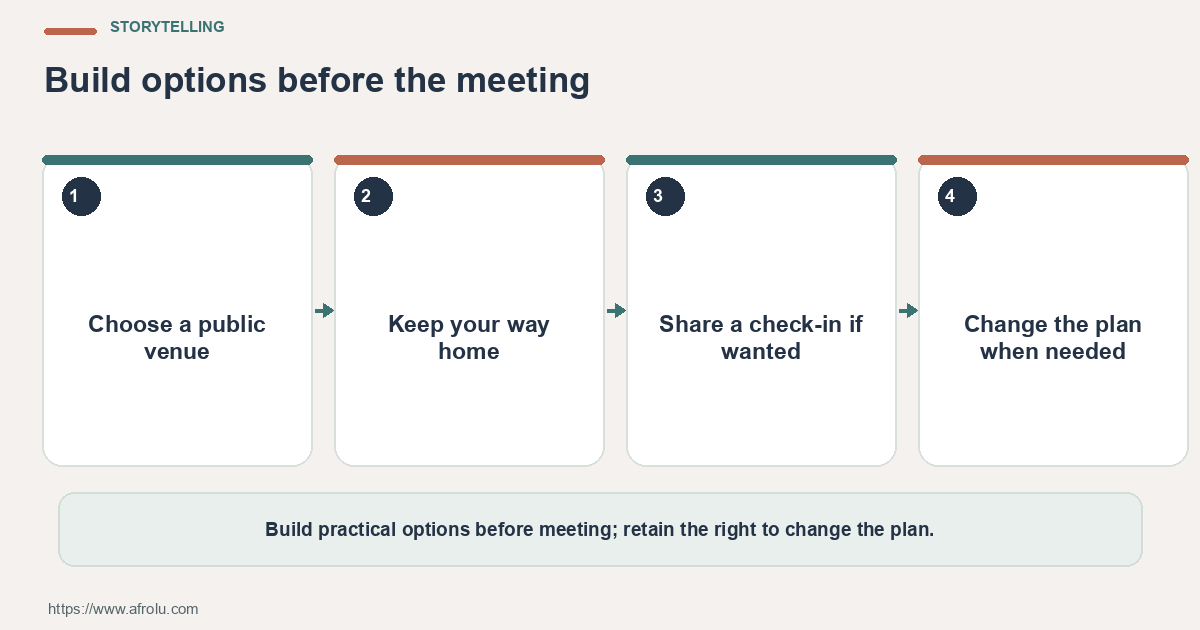
A confirmed date has a place, time and way home
Choose a meeting place with ordinary public activity and a time that fits your energy. Confirm the venue before travelling, especially if a match changes it at the last minute. A familiar area or daytime coffee may feel easier, but there is no single location that guarantees safety for every adult.
Arrange your own transport where possible and keep enough battery and fare to change plans. You may tell a friend where you are going and agree on a check-in, if that helps you feel supported. Share only a broad itinerary; your full address and regular route are not required to make a first date.
If you are meeting while travelling, decide where you will stay separately from a new match and keep control of your documents, money and return plans. Do not let a date hold your passport, book a room you cannot access or make your ability to leave depend on their generosity.
Make the check-in yours
A trusted-person plan should support, not supervise, you
You might send a trusted person the venue and expected end time, or simply arrange a message after the date. Different adults need different levels of contact. You do not have to report every conversation, provide live location data or disclose that you are dating if that would compromise your privacy.
Agree what you want the other person to do if you miss a check-in. Maybe they should call once, send a neutral message or contact someone else you named. A clear plan can prevent confusion, but it should still respect your choices and should not be used to shame you for changing your mind.
The purpose is to make help easier to reach if you want it. It is not a substitute for your judgment, and a friend cannot verify another person's identity by looking at a profile. If the date is going well, you can extend it; if it is not, you can leave without waiting for a scheduled check-in.

State a venue preference and a time that feels workable.
Keep digital details private
A profile is not a reason to hand over access
Stay on the dating platform until you want to move elsewhere, and use its block or report features when a conversation becomes coercive. Do not share passwords, one-time codes, bank details, identity documents or workplace access to prove you are genuine. A new match can arrange a public date without any of these things.
If someone asks for money to cover travel, a medical emergency, a ticket or an investment, pause rather than responding to urgency. The FTC's scam guidance is written for U.S. consumers, so it is not a local measure of prevalence; its warning about sending money to an online romantic contact is still a useful boundary.
Think before sharing a home address, live location or intimate image, especially if you have not met. You can say that you prefer to keep details private. If the other person turns that limit into pressure or a threat, end the exchange and contact someone you trust or the relevant platform support.

Respectful planning leaves each person a clear choice and exit.
Notice how a boundary is received
Respect looks like leaving room for a real choice
A match may be disappointed that you prefer a public venue or need to leave at a set time. They can feel that and still respect your decision. Repeated attempts to move the date to a private home, control your ride or make you feel guilty are observable actions you can respond to without explaining the person's motive.
Consent is specific and can change. A yes to coffee is not a yes to alcohol, touch, a home visit or sharing photos. You can pause, decline or leave at any point. Clear boundaries do not guarantee another adult will honor them, so keep the practical option to end the meeting if you want to.
If a plan changes in a way that leaves you uncomfortable, you may return to the original venue, arrange a new ride or cancel. You do not owe a long justification. A short statement such as 'This change no longer works for me, so I am heading home' is enough when you choose to say it.
Close the loop on your terms
You decide whether the next date happens
After the meeting, ask whether you felt heard, whether the plan stayed mutual and whether you would freely choose another date. You do not have to decide before you get home. If you want another meeting, suggest a plan that fits; if not, a brief message or no further contact may suit the situation.
If contact ends without explanation, you may feel disappointed again. That does not mean your safety plan failed or that you should have acted differently. Another person's decision to stop communicating is their choice. You can close the channel, take time away from the app and speak with someone supportive if that feels useful.
Keep screenshots or details only when you have a practical reason, such as reporting harassment or documenting a financial request. You do not need to preserve every message as a record of your worth. The aim of a weekend plan is to support the experience you want, not to prevent all disappointment.
Choose a proportionate next step
You can make room for interest and caution together
You may prefer a public daytime date, a video call first, a shorter meeting or no date this weekend. Each option can be reasonable. Try not to turn another person's timeline into a test of your recovery. You can move at the speed that fits your responsibilities and your sense of ease.
If someone you trust offers a different safety idea, treat it as information and decide whether it fits. Official safety guidance also cannot guarantee outcomes. You remain the person who chooses what to share, whether to continue and when to leave; responsibility for another adult's harmful action is not transferred to you.
When an earlier experience still feels difficult, you may talk with a trusted person or seek qualified support if that is accessible and useful. Studies describe group patterns rather than individual diagnoses. You can receive help without being defined by ghosting, and you can wait until dating feels worthwhile again.

Confirm the details while keeping personal information and money private.
Three ways this can show up
A first date is suggested
A match proposes an evening at a private home
Offer a public venue if that is more comfortable, or decline.The venue changes late
A confirmed café is replaced with an unfamiliar location
Keep the original plan or cancel until the new details work for you.Transport is offered
The other adult wants to control both the ride and return
Choose independent transport or another plan with an exit.A friend asks for a check-in
You would like support but want to keep your location private
Agree on the level of information and contact that helps you.A check-in is missed
Your friend does not hear from you at the planned time
Decide in advance what response you want, without creating shame.A money request arrives
A match asks for travel funds or emergency help
Pause, verify independently and do not send money under pressure.The date feels wrong
The conversation becomes coercive or uncomfortable
Leave or end contact when you choose; no explanation is required.You are not ready this weekend
You feel more obligation than interest about meeting
Move the date or cancel; dating is optional.What to notice before you react
A first date is suggested: A match proposes an evening at a private home
The venue changes late: A confirmed café is replaced with an unfamiliar location
Transport is offered: The other adult wants to control both the ride and return
A friend asks for a check-in: You would like support but want to keep your location private
A check-in is missed: Your friend does not hear from you at the planned time
A money request arrives: A match asks for travel funds or emergency help
The date feels wrong: The conversation becomes coercive or uncomfortable
You are not ready this weekend: You feel more obligation than interest about meeting
An agreement includes a time, place or contact expectation that both adults can describe.
A change is communicated before the other person begins travelling or waiting.
A clear no is heard without repeated pressure to reconsider.
One adult carries the planning while the other leaves each next step open.
A future promise is offered in place of a present answer.
A privacy or money boundary is treated as a choice rather than a challenge.
Read the moment without overbuilding the story
| Situation | What it may mean | What to do next |
|---|---|---|
| A first date is suggested | A match proposes an evening at a private home | Offer a public venue if that is more comfortable, or decline. |
| The venue changes late | A confirmed café is replaced with an unfamiliar location | Keep the original plan or cancel until the new details work for you. |
| Transport is offered | The other adult wants to control both the ride and return | Choose independent transport or another plan with an exit. |
| A friend asks for a check-in | You would like support but want to keep your location private | Agree on the level of information and contact that helps you. |
| A check-in is missed | Your friend does not hear from you at the planned time | Decide in advance what response you want, without creating shame. |
| A money request arrives | A match asks for travel funds or emergency help | Pause, verify independently and do not send money under pressure. |
| The date feels wrong | The conversation becomes coercive or uncomfortable | Leave or end contact when you choose; no explanation is required. |
| You are not ready this weekend | You feel more obligation than interest about meeting | Move the date or cancel; dating is optional. |
| A new need appears | Your preference changes after the arrangement begins | Describe the change and ask whether the other adult wants it too. |
| A boundary receives pressure | The other person argues that your limit is unnecessary | Keep the limit and choose whether to continue the conversation. |
Three calm ways to start the conversation
“I would like to meet in a public café.”
“I will make my own way home.”
“I will message my friend when I get home.”
“I do not send money to someone I have met online.”
“The new venue does not work for me, so I am cancelling.”
“I am going to head home now.”
“I want to understand what we are choosing now. Can we talk about it directly?”
“I can make that plan if we confirm the details today. Otherwise I will use the evening differently.”
“Thanks for being clear. I will decide what works for me from here.”
“If either of our needs changes, I would rather talk than assume the old terms still apply.”
“I need a little time before deciding what I want to do next.”
“I hear what you want, and I do not think our current preferences match.”
Know the difference
A choice that supports options versus A guarantee no plan can give
You choose a public venue, arrange transport and can change your mind at any point.
No checklist can verify another person or promise that nothing harmful will happen.
Use precautions for your choices; responsibility for harm remains with the person who causes it.

Precautions can support options but cannot guarantee another person's conduct.
Compare the closest dating types before choosing a label
| Type or dimension | What it describes | Best next question |
|---|---|---|
| A choice that supports options | You choose a public venue, arrange transport and can change your mind at any point. | Ask what the current agreement says. |
| A guarantee no plan can give | No checklist can verify another person or promise that nothing harmful will happen. | Decide whether the arrangement works for you. |
| One delayed reply | A single gap has several possible explanations. | Wait for the agreed window or ask once. |
| A repeated pattern | The same missing detail or cancelled plan happens again. | Name the actions and set a boundary. |
| A stated preference | An adult explains what they want now. | Check whether you want the same arrangement. |
| A future possibility | A hope or promise describes something that has not happened yet. | Do not treat it as a present agreement. |
| A changed need | One person wants a different pace or term later. | Revisit the arrangement and hear the answer. |
| A respectful no | Someone declines a date, boundary or new term. | Accept the choice and make your own decision. |
| A practical constraint | Time, distance, transport or privacy affects the next step. | Find a mutual option or decide it does not fit. |
A simple plan you can use today
Resilience to ghosting? A randomized controlled trial examining the consequences of ghosting on sleep quality in potential romantic relationships
A small U.S. emerging-adult experiment modeled a brief online interaction that ended abruptly. Its short, controlled scenario cannot predict an individual's response to a longer relationship ending.
Development and validation of a questionnaire (GHOST) to assess sudden, unexplained communication exclusion or ‘ghosting’
An online survey of 811 adults tested a measure of reported ghosting experiences. The questionnaire describes patterns; it cannot explain why one person stopped replying.
Tips for Safer Dating: Online and In-Person
RAINN offers U.S.-based safety guidance. Its precautions can support options but cannot guarantee another person's behavior, and its U.S. services are not Kenya-specific.
Romance Scams
The FTC explains U.S. consumer guidance about romance scams and money transfers. It is not a measure of scam prevalence in Kenya or other diaspora communities.
Rights of a Data Subject
Kenya's regulator outlines data-subject rights. Those rights do not verify a dating profile or remove every privacy risk in a new conversation.
Safety Tips
Tinder's platform guidance describes safety tools for its service. Other apps may offer different features, and no platform checklist guarantees safety.
Questions organised by purpose and depth
Choose a few prompts that fit the moment. This is a reference library, not a list to complete.
Weekend comfort
Choose the safeguards that support your actual plan.
- Which venue feels comfortable?
- How will I leave if I want to?
- What details should stay private?
A trusted check-in
Set support at a level that respects your autonomy.
- Who do I want to tell?
- What should happen if I miss a check-in?
- Which location details can remain private?
Changing plans
Prepare a simple option if the date changes.
- What change would make me pause?
- Can I keep the public venue?
- What can I say if I leave?
Readiness
Decide whether you want to meet at all this weekend.
- Am I curious or pressured?
- Would a shorter date feel better?
- Would a quiet weekend be my real preference?
What deserves a closer look
Resilience to ghosting? A randomized controlled trial examining the consequences of ghosting on sleep quality in potential romantic relationships
A small U.S. emerging-adult experiment modeled a brief online interaction that ended abruptly. Its short, controlled scenario cannot predict an individual's response to a longer relationship ending.
Evidence limit: Use this source only within its study population, scope and stated limits.
Development and validation of a questionnaire (GHOST) to assess sudden, unexplained communication exclusion or ‘ghosting’
An online survey of 811 adults tested a measure of reported ghosting experiences. The questionnaire describes patterns; it cannot explain why one person stopped replying.
Evidence limit: Use this source only within its study population, scope and stated limits.
Tips for Safer Dating: Online and In-Person
RAINN offers U.S.-based safety guidance. Its precautions can support options but cannot guarantee another person's behavior, and its U.S. services are not Kenya-specific.
Evidence limit: Use this source only within its study population, scope and stated limits.
Romance Scams
The FTC explains U.S. consumer guidance about romance scams and money transfers. It is not a measure of scam prevalence in Kenya or other diaspora communities.
Evidence limit: Use this source only within its study population, scope and stated limits.
Rights of a Data Subject
Kenya's regulator outlines data-subject rights. Those rights do not verify a dating profile or remove every privacy risk in a new conversation.
Evidence limit: Use this source only within its study population, scope and stated limits.
Safety Tips
Tinder's platform guidance describes safety tools for its service. Other apps may offer different features, and no platform checklist guarantees safety.
Evidence limit: Use this source only within its study population, scope and stated limits.
Four mistakes that make this harder
Treating one delay as proof
A single gap cannot reveal motive; check the agreement and the pattern.
Using a label as a verdict
Popular terms describe concerns, not a complete account of another person's intent.
Promising more than you can offer
An honest pace is more sustainable than availability chosen to avoid rejection.
Reading a future promise as a present plan
A hope does not confirm a date, exclusivity or consent.
Sharing private access to build trust
Passwords, money and work accounts are not relationship tests.
Waiting without a boundary
An unconfirmed invitation does not require you to keep all your time open.
Plan the date around the choices you want to keep
These information links are labelled, non-commercial and do not promise a match or relationship outcome.
Explore the guide library
Show more related guides
Continue with Afrolu
Show more Afrolu guides
Sources used for this guide
Afrolu reviewed these health, research, safety, or public guidance resources while editing this page. They support the behaviour and safety guidance; they do not diagnose any individual described by a reader.
Plan a safer weekend date after being ghosted Questions
Can a checklist guarantee a safe date?
No. Practical steps may support your choices, but no checklist can guarantee another person's behavior.
Do I have to tell a friend where I am?
That is your choice. Some people find a check-in useful; choose the amount of detail that respects your privacy.
Should I accept a ride?
You may, but you can also arrange your own transport if that leaves you more comfortable or flexible.
Can I leave a date without explaining?
Yes. You can end a meeting or conversation when you choose.
Is a private venue always unsafe?
A venue alone cannot establish risk. If a public place is your preference, state it and notice how the other person responds.
What if I am not ready to date?
You can wait or cancel. Dating is optional, and no recovery timetable applies to everyone.
Does ghosting prove something is wrong with me?
No. The cutoff describes another person's communication choice; it cannot establish your worth or diagnose the reason.
Should I send several messages to get closure?
You may send one clear message if you choose. You are not owed a reply, and you can close contact without one.
Can research tell me what my date intends?
No. Studies describe samples and group-level patterns; ask the person directly and decide from the agreement you have.
When should I seek support?
You may talk with someone you trust or a qualified professional if that feels useful. There is no required response or timetable.
One thing to do now
Turn the lesson into a better match pool
Choose safeguards that fit the actual meeting, keep control of your exit and treat any pressure to surrender that control as useful information.