Dating after ghosting · distance · a gentler pace
Dating again after ghosting across distance
Dating after ghosting across countries? Separate old silence from current evidence, set a contact rhythm and plan visits without pressure on either adult.
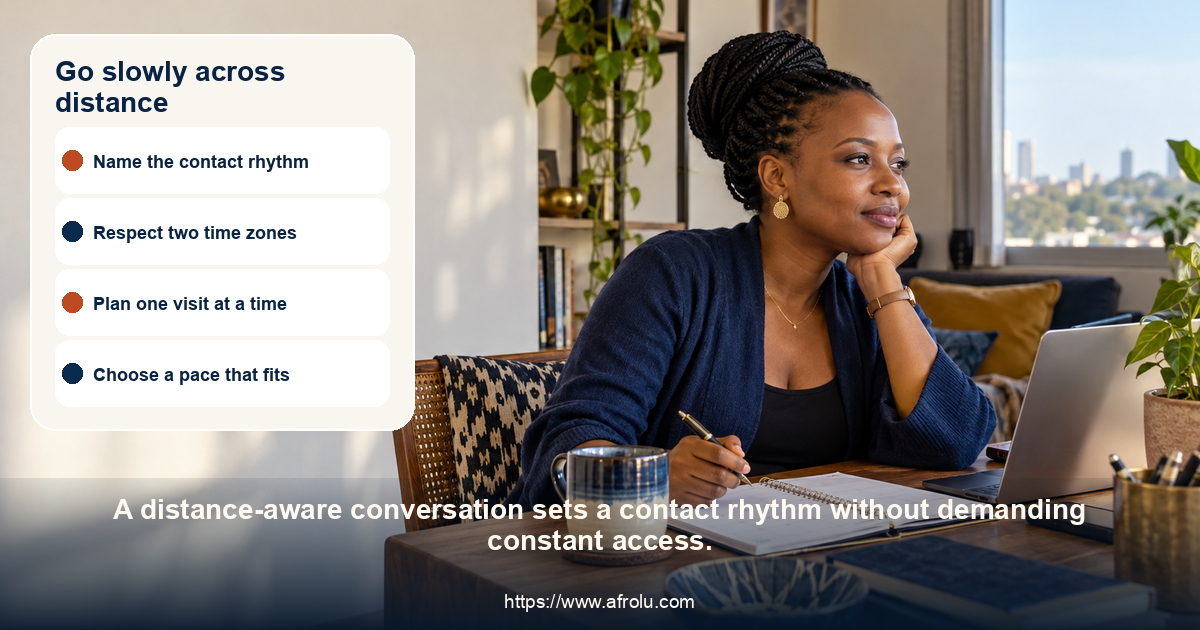
A distance-aware conversation sets a contact rhythm without demanding constant access.
Written and edited by Tariro Ncube · Diaspora Dating Editor
Call a past unexplained cutoff what it was for you, but do not use it to diagnose a new person. Agree a realistic way to stay in touch, make one specific plan at a time and decide whether the connection suits your life as it is now. You can pause, decline or change pace whenever you choose.
Dating recovery · Diaspora Daters
How can I date across distance at a calmer pace after someone disappeared without explanation?
Ghosting is a common informal term for someone ending communication without an explanation. It describes what happened from your perspective; it does not tell you the other person's reason, establish a clinical condition or predict what a new match will do.
After a previous match stopped replying during a long-distance connection, 36-year-old Amara finds herself checking time stamps when a new date is travelling for work. She writes down what has actually been agreed, asks what contact feels practical across time zones and keeps the rest of her evening for herself.
Name what happened
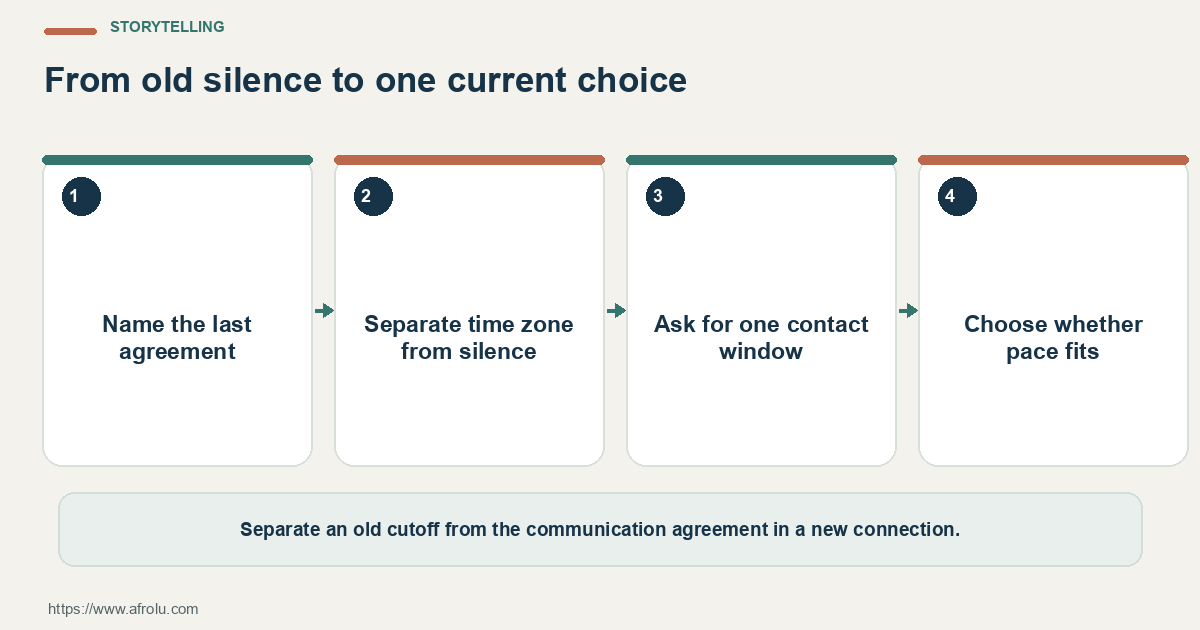
Ghosting describes a cutoff; it does not explain it
People use ghosting to describe an abrupt stop in contact without an explanation. It can happen after a short chat, several dates or a longer relationship, and those situations are not identical. The word helps you describe a missing conversation, but it cannot reveal what the other person thought or what caused the silence.
Write down the sequence in ordinary terms: what you had discussed, when contact stopped, whether you tried to reach them and what response followed. Keep interpretations in a separate column. This small distinction makes room for your feelings while keeping future decisions anchored to facts you can actually verify.
A person can end contact without handling it well, and you can still decide that you do not want to resume it. You do not need a complete explanation before setting a boundary. If practical belongings, shared care or safety are involved, use a suitable direct channel and ask a trusted person for support where needed.
Read the current evidence
One delayed reply is not the same as disappearing
When two adults live in different places, workdays and sleeping hours may rarely line up. A reply arriving the next morning can be ordinary, especially if nobody promised immediate messages. Before deciding that a new match has vanished, check what contact was discussed and whether the conversation is simply between agreed windows.
A pattern looks different when plans are repeatedly announced and abandoned, questions about a visit go unanswered, or one adult carries every attempt to reconnect. Those actions matter because of their effect on your time and confidence, even when the hidden reason remains unknown. You can assess the arrangement without assigning a label.
Try one proportionate check-in that says what you need to know. If it receives a clear answer, decide whether that answer works. If no answer comes, you may stop waiting and continue your plans. Repeatedly sending new explanations or tracking online status rarely creates the mutual clarity that a direct conversation would provide.
Choose a workable rhythm
Low pressure still needs a clear agreement
Long-distance research has studied communication among established couples and emerging adults; it does not set a required reply schedule for new matches. Use it as a reason to discuss what feels connecting, not as a rule that somebody must text every morning or call every night to prove interest.
Ask practical questions: Would a short call once a week feel good? Is texting between shifts easy, or does it interrupt work? Do travel days call for a quick note or a longer conversation later? Both adults can suggest a routine, change it when life changes and say when the current arrangement no longer feels useful.
A flexible agreement can sound like, 'I am often offline during work, but I can make time for a call on Sunday. If that stops working, let us say so.' The goal is shared expectation, not constant access. Keep your own sleep, responsibilities and friendships intact while you learn whether the rhythm suits both people.

Ask what rhythm feels sustainable across different time zones.
Decide about a past contact
You do not owe a former match another opening
Someone who disappeared may return months later with an apology, a greeting or no explanation at all. You can ignore the message, ask what changed, accept an apology without dating again, or explore a new conversation. The fact that you once cared does not remove your right to choose what happens now.
If you want to reply, keep it proportionate: 'I was confused when contact stopped. What are you hoping for by reaching out?' You can decide whether the answer feels accountable and specific. A polished message does not erase the earlier effect, and you are not responsible for making the other person feel forgiven.
If earlier contact involved threats, coercion, unwanted exposure or a request for money, you do not need to arrange a private meeting to hear an explanation. Use block or reporting features when appropriate, save evidence you may need and seek support from someone you trust. Safety choices belong to you, not to a former match.

Mutual contact includes realistic windows and updates when plans change.
Make a visit a real choice
Travel should not become proof of commitment
A visit can involve airfare, accommodation, leave from work, visa requirements and time away from family. Talk about who is travelling, how costs will be handled, where each person will stay and what the visit means to both of you. Do not spend money you cannot comfortably lose to secure a relationship label.
Meet first in a public place and make your own transport and lodging plan when possible. Tell a trusted person the broad itinerary and agree how you will check in. These steps can leave you more options, but no checklist can guarantee another adult's behavior or remove every travel risk.
If a match asks you to pay an emergency fee, transfer money, share a one-time code or invest before meeting, pause. Verify the claim through an independent source and do not use urgency or affection as evidence that it is safe. You may decide not to travel, even after discussing dates or buying a ticket.
Look for shared effort
A connection can be warm and still impractical
Someone may have demanding shifts, caring duties or a different time zone and still be interested. The useful question is whether the two of you can agree on a realistic next step. Does each person offer a time, update the other when plans change and take responsibility for their part of the conversation?
Avoid converting a missed call into a complete theory about character. Ask whether the appointment should move, then observe what happens next. A clear apology and a workable replacement plan are different from repeating the same vague promise without details. Neither response reveals everything about a person, but it does help you assess the arrangement.
If you are doing all the organising, say what shared effort would look like: 'I can plan one call this week; could you choose the time?' You can also decide that the available effort is not enough for you. There is no need to keep investing in a connection just because travel or messaging once felt promising.
Choose your next pace
You can stay curious without staying on standby
You might enjoy a low-pressure call, want to meet only after a video conversation, or decide that a long-distance arrangement is not right for you. Each choice is valid when it reflects your preference rather than a fear that someone will disappear if you ask for clarity. You do not have to prove that you are easygoing.
Before making another plan, ask yourself what you would choose if you were not trying to prevent a repeat of the past. Would you keep the trip, date other people, ask for a different rhythm or close the conversation? The answer may change as new information arrives; you are allowed to revise your decision.
If the experience continues to weigh on you, speak with a trusted friend or a qualified professional if that is accessible and useful. Research about ghosting describes group-level experiences, not a diagnosis of your own response. Support is a choice, and you can seek it without treating yourself as damaged or behind.

Choose a low-pressure next step while protecting travel and personal time.
Three ways this can show up
A reply crosses time zones
A message arrives after you have gone to sleep
Check the rhythm you discussed before treating the gap as a decision.A promised call slips
A call is missed during a workday and no new time is offered
Ask once whether the person wants to choose another window.Travel comes up early
A new match suggests you fly to meet before details are clear
Discuss cost, timing and independent lodging before committing.Warm messages, no next step
You exchange long texts but never choose a call or visit
Offer one specific option and decide how long you will wait.A former match returns
Someone who vanished sends a casual greeting months later
Reply only if you want to, and ask what they are seeking now.Family time is private
A date asks for your relatives' location or travel plans
Share only what is needed to arrange your own next choice.One adult plans every call
You choose each time and send every reminder
Ask the other person to suggest the next realistic window.You want a slower start
A new connection expects daily updates immediately
Explain the contact pace you can enjoy and see if it fits both people.What to notice before you react
A reply crosses time zones: A message arrives after you have gone to sleep
A promised call slips: A call is missed during a workday and no new time is offered
Travel comes up early: A new match suggests you fly to meet before details are clear
Warm messages, no next step: You exchange long texts but never choose a call or visit
A former match returns: Someone who vanished sends a casual greeting months later
Family time is private: A date asks for your relatives' location or travel plans
One adult plans every call: You choose each time and send every reminder
You want a slower start: A new connection expects daily updates immediately
An agreement includes a time, place or contact expectation that both adults can describe.
A change is communicated before the other person begins travelling or waiting.
A clear no is heard without repeated pressure to reconsider.
One adult carries the planning while the other leaves each next step open.
A future promise is offered in place of a present answer.
A privacy or money boundary is treated as a choice rather than a challenge.
Read the moment without overbuilding the story
| Situation | What it may mean | What to do next |
|---|---|---|
| A reply crosses time zones | A message arrives after you have gone to sleep | Check the rhythm you discussed before treating the gap as a decision. |
| A promised call slips | A call is missed during a workday and no new time is offered | Ask once whether the person wants to choose another window. |
| Travel comes up early | A new match suggests you fly to meet before details are clear | Discuss cost, timing and independent lodging before committing. |
| Warm messages, no next step | You exchange long texts but never choose a call or visit | Offer one specific option and decide how long you will wait. |
| A former match returns | Someone who vanished sends a casual greeting months later | Reply only if you want to, and ask what they are seeking now. |
| Family time is private | A date asks for your relatives' location or travel plans | Share only what is needed to arrange your own next choice. |
| One adult plans every call | You choose each time and send every reminder | Ask the other person to suggest the next realistic window. |
| You want a slower start | A new connection expects daily updates immediately | Explain the contact pace you can enjoy and see if it fits both people. |
| A new need appears | Your preference changes after the arrangement begins | Describe the change and ask whether the other adult wants it too. |
| A boundary receives pressure | The other person argues that your limit is unnecessary | Keep the limit and choose whether to continue the conversation. |
Three calm ways to start the conversation
“I like hearing from you, and Sunday calls work best for me.”
“I am interested, but I want to plan a public first meeting before booking.”
“What are you hoping for by reaching out now?”
“I will make other plans if we have not confirmed the call.”
“That pace does not work for me, so I am stepping back.”
“Can we revisit our rhythm now that my schedule has changed?”
“I want to understand what we are choosing now. Can we talk about it directly?”
“I can make that plan if we confirm the details today. Otherwise I will use the evening differently.”
“Thanks for being clear. I will decide what works for me from here.”
“If either of our needs changes, I would rather talk than assume the old terms still apply.”
“I need a little time before deciding what I want to do next.”
“I hear what you want, and I do not think our current preferences match.”
Know the difference
A time-zone gap versus An unclear pattern
A reply lands in the next agreed window; each person still communicates about plans.
Questions and plans repeatedly remain unanswered, leaving one adult to carry every next step.
Timing is context; a repeated unconfirmed arrangement is a choice you can review.

A timing gap is context; repeated unclear plans are a separate pattern.
Compare the closest dating types before choosing a label
| Type or dimension | What it describes | Best next question |
|---|---|---|
| A time-zone gap | A reply lands in the next agreed window; each person still communicates about plans. | Ask what the current agreement says. |
| An unclear pattern | Questions and plans repeatedly remain unanswered, leaving one adult to carry every next step. | Decide whether the arrangement works for you. |
| One delayed reply | A single gap has several possible explanations. | Wait for the agreed window or ask once. |
| A repeated pattern | The same missing detail or cancelled plan happens again. | Name the actions and set a boundary. |
| A stated preference | An adult explains what they want now. | Check whether you want the same arrangement. |
| A future possibility | A hope or promise describes something that has not happened yet. | Do not treat it as a present agreement. |
| A changed need | One person wants a different pace or term later. | Revisit the arrangement and hear the answer. |
| A respectful no | Someone declines a date, boundary or new term. | Accept the choice and make your own decision. |
| A practical constraint | Time, distance, transport or privacy affects the next step. | Find a mutual option or decide it does not fit. |
A simple plan you can use today
Development and validation of a questionnaire (GHOST) to assess sudden, unexplained communication exclusion or ‘ghosting’
An online survey of 811 adults tested a measure of reported ghosting experiences. The questionnaire describes patterns; it cannot explain why one person stopped replying.
Psychological Correlates of Ghosting and Breadcrumbing Experiences: A Preliminary Study among Adults
An online sample of 626 adults aged 18 to 40 reported varied experiences. The study found no significant relation between ghosting and the measured correlates; it does not diagnose an individual or establish causation.
Long-distance texting: Text messaging is linked with higher relationship satisfaction in long-distance relationships
A survey of 647 emerging adults, including people in long-distance relationships, examined communication and satisfaction. It does not prescribe reply frequency for new matches or diaspora couples.
Tips for Safer Dating: Online and In-Person
RAINN offers U.S.-based safety guidance. Its precautions can support options but cannot guarantee another person's behavior, and its U.S. services are not Kenya-specific.
Rights of a Data Subject
Kenya's regulator outlines data-subject rights. Those rights do not verify a dating profile or remove every privacy risk in a new conversation.
Romance Scams
The FTC explains U.S. consumer guidance about romance scams and money transfers. It is not a measure of scam prevalence in Kenya or other diaspora communities.
Questions organised by purpose and depth
Choose a few prompts that fit the moment. This is a reference library, not a list to complete.
Your contact rhythm
Choose a routine that connects without taking over the day.
- Which days and time zones matter?
- How do I want plans confirmed?
- What can I offer consistently?
The earlier cutoff
Notice what you learned without making a new person answer for it.
- What was actually agreed?
- Which boundary still helps me?
- What do I want to leave in the past?
Travel choices
Separate interest from cost and logistics.
- Would I travel if the date did not promise a future?
- What would make lodging independent?
- Can I comfortably change my plan?
A next step
Decide from current terms, not an imagined outcome.
- Do I want a call or a pause?
- What detail is missing?
- How will I use my time if there is no answer?
What deserves a closer look
Development and validation of a questionnaire (GHOST) to assess sudden, unexplained communication exclusion or ‘ghosting’
An online survey of 811 adults tested a measure of reported ghosting experiences. The questionnaire describes patterns; it cannot explain why one person stopped replying.
Evidence limit: Use this source only within its study population, scope and stated limits.
Psychological Correlates of Ghosting and Breadcrumbing Experiences: A Preliminary Study among Adults
An online sample of 626 adults aged 18 to 40 reported varied experiences. The study found no significant relation between ghosting and the measured correlates; it does not diagnose an individual or establish causation.
Evidence limit: Use this source only within its study population, scope and stated limits.
Long-distance texting: Text messaging is linked with higher relationship satisfaction in long-distance relationships
A survey of 647 emerging adults, including people in long-distance relationships, examined communication and satisfaction. It does not prescribe reply frequency for new matches or diaspora couples.
Evidence limit: Use this source only within its study population, scope and stated limits.
Tips for Safer Dating: Online and In-Person
RAINN offers U.S.-based safety guidance. Its precautions can support options but cannot guarantee another person's behavior, and its U.S. services are not Kenya-specific.
Evidence limit: Use this source only within its study population, scope and stated limits.
Rights of a Data Subject
Kenya's regulator outlines data-subject rights. Those rights do not verify a dating profile or remove every privacy risk in a new conversation.
Evidence limit: Use this source only within its study population, scope and stated limits.
Romance Scams
The FTC explains U.S. consumer guidance about romance scams and money transfers. It is not a measure of scam prevalence in Kenya or other diaspora communities.
Evidence limit: Use this source only within its study population, scope and stated limits.
Four mistakes that make this harder
Treating one delay as proof
A single gap cannot reveal motive; check the agreement and the pattern.
Using a label as a verdict
Popular terms describe concerns, not a complete account of another person's intent.
Promising more than you can offer
An honest pace is more sustainable than availability chosen to avoid rejection.
Reading a future promise as a present plan
A hope does not confirm a date, exclusivity or consent.
Sharing private access to build trust
Passwords, money and work accounts are not relationship tests.
Waiting without a boundary
An unconfirmed invitation does not require you to keep all your time open.
Agree on one realistic way to stay in touch
These information links are labelled, non-commercial and do not promise a match or relationship outcome.
Explore the guide library
Show more related guides
Continue with Afrolu
Show more Afrolu guides
Sources used for this guide
Afrolu reviewed these health, research, safety, or public guidance resources while editing this page. They support the behaviour and safety guidance; they do not diagnose any individual described by a reader.
Dating again after ghosting across distance Questions
How often should we message long-distance?
There is no universal number. Discuss what feels sustainable across time zones, then notice whether the agreement works for both adults.
Should I travel to prove I am serious?
No. Travel is a practical choice involving time and cost; it does not prove commitment. Plan only when details and your own budget work.
Does a late reply mean ghosting?
One delay cannot establish that. Compare it with the contact you discussed and the pattern over time.
Can I reply if a former match returns?
Only if you want to. You can ask what they are seeking now, accept an apology without restarting or leave the message unanswered.
Can a video call verify someone?
It may add context, but it cannot certify every identity claim. Make important decisions using independent information and your own boundaries.
What if the contact rhythm stops working?
Say what changed and ask whether the other person wants a different arrangement. You may also decide to stop.
Does ghosting prove something is wrong with me?
No. The cutoff describes another person's communication choice; it cannot establish your worth or diagnose the reason.
Should I send several messages to get closure?
You may send one clear message if you choose. You are not owed a reply, and you can close contact without one.
Can research tell me what my date intends?
No. Studies describe samples and group-level patterns; ask the person directly and decide from the agreement you have.
When should I seek support?
You may talk with someone you trust or a qualified professional if that feels useful. There is no required response or timetable.
One thing to do now
Turn the lesson into a better match pool
Name the current agreement, notice repeated actions and choose a contact rhythm you can enjoy without monitoring another adult.