Dating later in life · career boundaries · safer choices
Dating later in life while protecting work and personal safety
Dating alongside demanding work? Set a realistic pace, protect work details, plan safer first meetings and ask for clarity without guessing what a gap means.
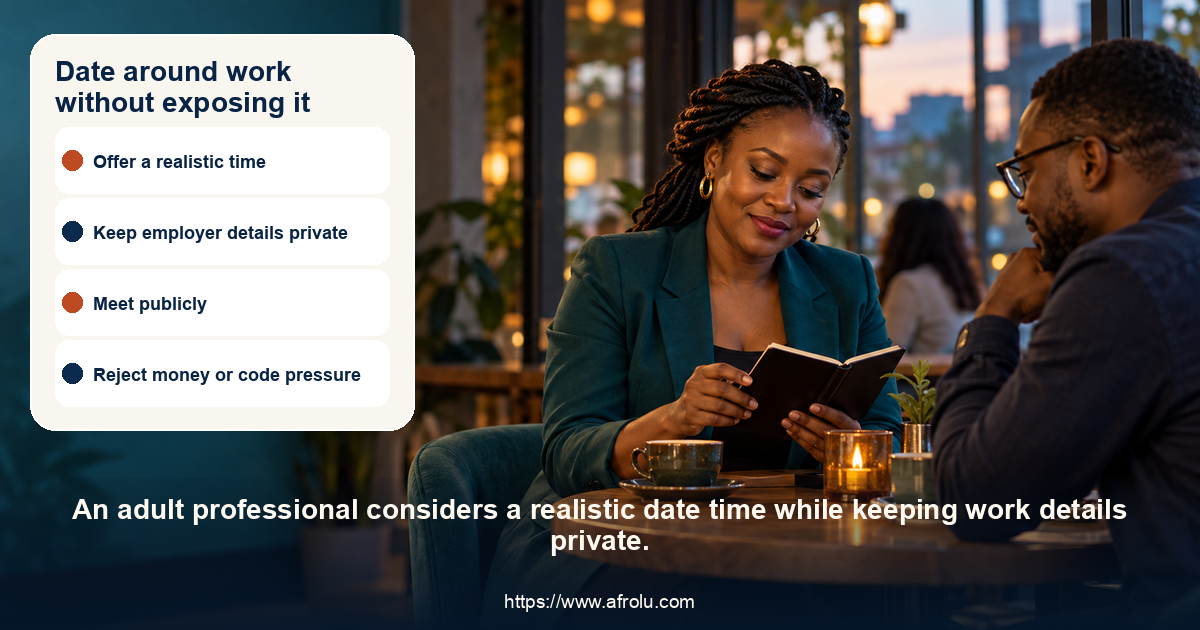
An adult professional considers a realistic date time while keeping work details private.
Written and edited by Grace Mutiso · Kenya Guides Editor
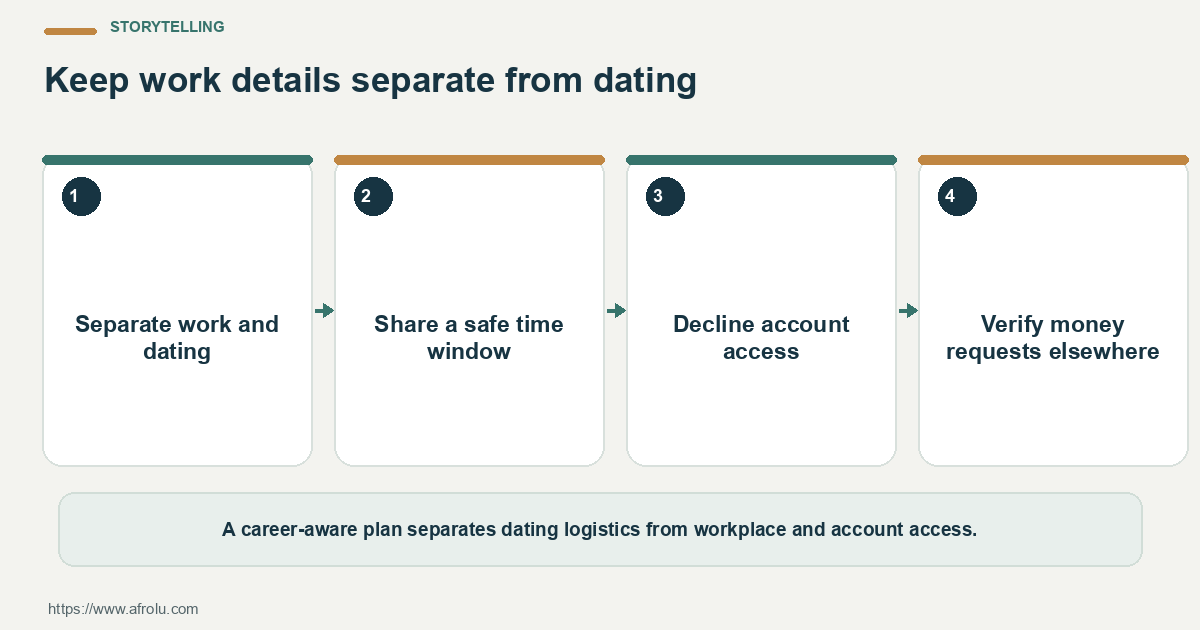
Share availability without exposing your exact work routine, use a public first-meeting plan and keep independent transport. Ask whether the other person wants to set a specific date; a delayed reply alone cannot explain their motive. Choose the pace and level of disclosure that fit your work and comfort.
Modern dating terms · Late Entrants
How can I date around a demanding career without sharing too much or accepting unsafe, uncertain plans?
Benching is an informal term for intermittent attention that appears to keep a connection open without mutual plans. It cannot establish intent. Career privacy means choosing what work information to share and when; it is compatible with honest dating and a clear invitation.
At 41, analyst Samira starts dating after years of building a career and caring for family. A match asks for her office location and suggests a late meeting near work without confirming a venue. Samira wants to keep dating, but not make her workday public. She proposes a daytime public café and shares only a general availability window.
Choose a workable pace
A full calendar does not need a full explanation
A demanding job may mean changing shifts, travel, deadlines or periods when you cannot check messages. You can tell a date when you are generally free without naming a client, office entrance, security routine or exact return time. Honest availability does not require unrestricted access to your work life.
If your calendar is uncertain, state when you will know more and offer a realistic alternative. For example, you can say that a rota is finalized Thursday and suggest confirming after that. This gives the other adult a choice without promising a date that could conflict with a responsibility you already have.
A later start to dating can make it tempting to prove that you are easy to accommodate. You do not need to accept a midnight invitation after a long shift or use leave to make a new match comfortable. A date that fits your health and work commitments is a reasonable date.
Studies of work and couple time examine specific populations and established relationships; they do not prescribe the right dating cadence for you. Use them as a reminder that schedules have context, then talk with the person about the time both of you can actually offer.
Keep work information bounded
A promising match does not need your access details
Avoid sharing access badges, internal documents, staff names, customer information, passwords or one-time codes during early dating. A request framed as curiosity can still expose information you are expected to protect. If a question crosses a line, say that work details stay private and redirect the conversation.
You can describe your field broadly without naming a team, project or daily route. If someone wants to meet near your office, suggest a public place away from a work entrance and choose a time that does not reveal when you are alone or leaving.
Do not send a work email, payroll record or professional reference to prove who you are. Use the platform's normal verification tools if available and decide independently what information you share. A confident online profile is not enough to confirm every claim about a person's identity or job.
Kenya's data-protection regulator provides information about rights concerning personal data. That source does not resolve employer-specific obligations or give a dating platform a safety guarantee. Follow your workplace policies, minimize what you disclose and seek qualified advice if a request could affect your professional duties.
Plan an early meeting
Choose a date with an easy exit
For an early meeting, choose a public, populated place and a time that does not leave you rushing from a sensitive work event. Tell a trusted person your plan if that helps, keep your phone charged and arrange a way home that does not depend on the match.
Confirm the venue and timing before leaving. A message saying 'I will pick you up at the office' changes your privacy and transport choices; you can decline and offer to meet there instead. You do not owe a stranger your building, home address or commute to make the date convenient.
If you are coming from a workday, consider whether you will have enough energy and whether the clothes or equipment you carry reveal more than you want. A shorter coffee can be a useful first plan. It creates a natural end time and lets you decide later whether to meet again.
RAINN suggests practical steps such as public meeting places and independent transportation while emphasizing that no checklist can guarantee safety. Its support information is U.S.-based, so use local services for local help. The principle is to preserve choice, not to promise that a set of steps removes all risk.

Use clear words for work delays, privacy limits and financial pressure.
Keep finances separate
Urgency and affection do not verify a request
A new match may describe a travel emergency, investment opportunity, medical bill or work problem. Do not let a compelling story turn into a rushed transfer. The U.S. Federal Trade Commission advises consumers not to send money to an online love interest; it is not a Kenya-specific fraud estimate, but it supports a prudent boundary.
Never provide banking passwords, card details, one-time codes or work account access to someone you have met through a dating service. If the request arrives with pressure to keep it secret or act immediately, stop and check with someone you trust before responding. Legitimate employers do not need a date to handle this.
A person may be busy or unavailable without being a scammer; one missed call or postponed date proves nothing. Focus on concrete conduct that affects your decision, such as a request for funds, refusal to meet in any reasonable way or repeated pressure to move money through unusual channels.
If you already transferred funds or disclosed information, contact your financial institution or relevant local authority promptly and preserve messages. Do not continue paying to recover a previous payment. A respectful connection will not require you to risk your savings to demonstrate care. Report account misuse through official channels when practical.

A respectful match accepts schedule boundaries and never needs a work code.
Ask about the pattern
A workday gap cannot explain itself
A slow reply during a deadline, travel day or long shift does not tell you what the other adult feels. A longer pattern of promising to meet without selecting a time may leave you uncertain, but the label benching still cannot identify the reason. Describe what happened and ask about the next choice.
Try, 'We have talked about meeting, but we have not set a date. Would you like to choose one for next week?' This question is specific and gives the person room to say yes, no or not now. You do not need to share your full schedule to ask it.
If the person suggests a time that conflicts with work, offer a window you can genuinely keep. Notice whether they engage with that option or keep returning to plans that require you to disclose too much. The practical fit matters even when you do not know their private explanation.
Research about ghosting and dating rejection covers defined behaviors and samples; it cannot diagnose a match or forecast how a connection will develop. Let evidence sharpen your questions rather than label another person. You can choose based on whether the current arrangement works for you.
Protect time and role boundaries
Professional competence is not unlimited availability
Some adults find it difficult to switch from work messages to personal conversation, especially when clients or teams expect a quick response. Decide when you want to check a dating app and tell a match what contact you can return. You do not owe instant replies during a meeting or on-call shift.
Avoid bringing a new date into your workplace or asking a colleague to verify a match unless you have a clear reason and policy permits it. A work network is not a universal screening service. Keep professional relationships professional while you get to know someone in an appropriate personal setting.
If the other person expects you to cancel responsibilities to prove interest, explain what time you can offer instead. They can decide whether the schedule suits them. A mismatch in availability may be disappointing, but it does not mean you have failed to prioritize dating correctly.
Keep notes or messages if repeated contact starts affecting your workplace or feels threatening. Use your organization's support channels where appropriate and seek local professional help if you believe there is immediate danger. You can end communication even before you decide what label applies to the behavior.
Decide with the facts you have
You can protect your career and stay open to connection
Ask whether the next step respects both your schedule and your privacy. If the match can plan around a realistic window, choose a public meeting and decide again afterward. If the arrangement requires work access, financial risk or constant availability, you may decline without giving a detailed case.
A calm message might say, 'I am available for a public coffee next Thursday. I do not share work-site details with a new match.' This makes the offer and limit visible. The other person's response helps you decide whether further conversation feels workable. A trustworthy match can respect this boundary without argument.
You can end contact if pressure continues, block the account or report threatening messages through the platform. If you feel unsafe at work or at home, tell someone you trust and use appropriate local support. You do not have to keep engaging to obtain a perfect explanation.
Dating later in life can happen alongside a serious career, care duties and private goals. None needs to be hidden to make you dateable. Offer the time you want to share, protect the details you need to keep private and let the other adult choose whether that arrangement fits.

Check the meeting plan and pause any urgent money request.
Eight situations where work and dating boundaries meet
A meeting runs late
A work commitment makes the original date time impossible
Send an update and offer a replacement window only if you want to meet.Your employer is requested
A new match wants your workplace name or exact office location
Keep work identifiers private while offering a public meeting place.Your schedule is probed
Someone asks for your full rota or a recurring work pattern
Share only the time information needed for this plan.A work account request
A match asks you to use a work login or one-time code
Do not share credentials or codes; contact your employer’s official security channel if exposed.An investment pitch
A dating conversation turns into a request for crypto or a financial opportunity
Stop the transfer, verify independently and do not let affection set a deadline.A cash emergency
A person you have not met asks you to cover travel or bills
Do not send money to an online love interest; preserve messages and use official advice.Busy week, unclear interest
Messages slow during an important work deadline
Do not diagnose the reason from timing; ask about a practical date when you are ready.An isolated first meeting
A match wants you to visit a home or office on the first date
Choose a public place and a way to leave independently, or decline.Watch how a match responds to time and privacy
A meeting runs late: A work commitment makes the original date time impossible
Your employer is requested: A new match wants your workplace name or exact office location
Your schedule is probed: Someone asks for your full rota or a recurring work pattern
A work account request: A match asks you to use a work login or one-time code
An investment pitch: A dating conversation turns into a request for crypto or a financial opportunity
A cash emergency: A person you have not met asks you to cover travel or bills
Busy week, unclear interest: Messages slow during an important work deadline
An isolated first meeting: A match wants you to visit a home or office on the first date
Both adults treat a date as confirmed only after agreeing on its details.
A change is communicated as soon as reasonably practical.
Each person can decline without insults, threats or punishment.
Time, money, travel and privacy are discussed before they become pressure.
Planning effort can be shared and adjusted when circumstances change.
Either adult may revisit an arrangement and explain what they want now.
Protect work information while making a real plan
| Situation | What it may mean | What to do next |
|---|---|---|
| A meeting runs late | A work commitment makes the original date time impossible | Send an update and offer a replacement window only if you want to meet. |
| Your employer is requested | A new match wants your workplace name or exact office location | Keep work identifiers private while offering a public meeting place. |
| Your schedule is probed | Someone asks for your full rota or a recurring work pattern | Share only the time information needed for this plan. |
| A work account request | A match asks you to use a work login or one-time code | Do not share credentials or codes; contact your employer’s official security channel if exposed. |
| An investment pitch | A dating conversation turns into a request for crypto or a financial opportunity | Stop the transfer, verify independently and do not let affection set a deadline. |
| A cash emergency | A person you have not met asks you to cover travel or bills | Do not send money to an online love interest; preserve messages and use official advice. |
| Busy week, unclear interest | Messages slow during an important work deadline | Do not diagnose the reason from timing; ask about a practical date when you are ready. |
| An isolated first meeting | A match wants you to visit a home or office on the first date | Choose a public place and a way to leave independently, or decline. |
| A reply arrives later | Timing alone cannot tell you why the person was quiet. | Ask for the information that would change your next choice. |
| The same uncertainty repeats | The reason may remain unknown while the effect on your time is clear. | Choose whether the current arrangement still meets your needs. |
Set a realistic pace without exposing your workplace
“My day ends around six, but I will confirm once the meeting is over.”
“I do not share my exact work location with a new match. We can meet in public.”
“Work ran over, and I cannot make tonight. I can suggest another day if you would like.”
“I do not send money or invest through a dating connection. Please do not ask again.”
“I will not share work logins or verification codes. That request is not appropriate.”
“I can meet at a busy public café and will arrange my own transport.”
“Would you like to choose a day and public place, or should I make other plans?”
“I like getting to know someone gradually, and I still prefer confirmed plans.”
“That timing does not work for me. I can offer another window if you want one.”
“When you say ‘casual’, what are you choosing about exclusivity and time together?”
“My needs have changed. Can we talk about what we each want now?”
“I do not want to continue dating. Please do not contact me again.”
Know the difference
Work privacy versus avoiding a date
Keeping employer, account and schedule details private
Offering a safe public place and a realistic time window
You can make a date plan without exposing work identifiers.

A useful time window is different from employer or account access.
Work privacy is different from avoiding a date
| Type or dimension | What it describes | Best next question |
|---|---|---|
| A realistic work window | A time estimate can help without revealing a full schedule. | Confirm after the work commitment is settled. |
| A request for account access | Dating does not require work passwords or verification codes. | Decline and use official account-security support if exposed. |
| A financial opportunity | Romance language cannot verify an investment or emergency. | Pause payments and verify through independent official channels. |
| One delayed reply | A single gap can have many explanations and does not establish a pattern. | Look at what happens over time and decide what contact works for you. |
| A confirmed invitation | A date includes details both adults have accepted. | Make plans around the agreement and update each other if something changes. |
| A personal boundary | A limit applies even when the other adult dislikes it. | State the limit and choose whether the response feels respectful. |
| An explanation | A reason may be sincere while the resulting arrangement still does not suit you. | Acknowledge what was said, then decide from the practical outcome. |
| A future possibility | An intention describes a direction, not a guarantee. | Check whether current actions and terms work for you today. |
| A changed preference | Adults can revise what they want as they learn more. | Talk before assuming the other person has accepted new terms. |
A simple plan you can use today
Work can shape availability
A U.S. study of established couples cannot prescribe a schedule for a Nairobi professional.
A financial request deserves independent checks
U.S. fraud guidance is not a local prevalence estimate, but money should remain separate from romantic pressure.
A label is informal
‘Benching’ has no diagnostic authority and cannot establish what another person intends.
A study has a population
Samples, locations and relationship stages limit what research can tell a particular reader.
Uncertainty is not evidence of fault
A mismatch in timing or communication does not prove either adult is immature or deceptive.
Your choice can be present-sized
You can decide whether to keep planning without deciding the whole future of the connection.
Questions organised by purpose and depth
Choose a few prompts that fit the moment. This is a reference library, not a list to complete.
Before sharing information
Keep professional access separate from a dating chat.
- Does this person need this detail?
- Could it expose my employer or accounts?
- Can I offer a safer alternative?
When money comes up
Slow the decision and verify outside the relationship conversation.
- Is there urgency or secrecy?
- Can I check through an official source?
- Who can review this with me?
Before you reply
Use these privately to locate your own choice.
- What fact do I know?
- What am I assuming?
- Which answer would help me plan?
After the conversation
Review what both people chose and what happened next.
- Were the terms clear?
- Did each adult have room to say no?
- Does this arrangement still fit?
What deserves a closer look
Romance Scams
U.S. consumer guidance warns against sending money to an online love interest; it is not a Kenya-specific prevalence estimate or legal rule.
Evidence limit: Use this evidence only within the study population and limits described in the source note.
Tips for Safer Dating: Online & In-Person
A U.S.-based sexual-violence organization suggests privacy, public-meeting and transport precautions while stating that no step guarantees safety; its support channels are not Kenyan services.
Evidence limit: Use this evidence only within the study population and limits described in the source note.
Rights of a Data Subject
Kenya’s regulator describes rights concerning personal information; those rights are not a dating safety certification or a guarantee about an app or individual.
Evidence limit: Use this evidence only within the study population and limits described in the source note.
From Looking for Love to Swiping the Field: Online Dating in the U.S.
A representative survey of 6,034 U.S. adults conducted in July 2022 explored site experiences, harassment and perceived scams; it does not measure Nairobi or diaspora adults as a whole.
Evidence limit: Use this evidence only within the study population and limits described in the source note.
Time for Each Other: Work and Family Constraints Among Couples
A U.S. time-use analysis examined work, family demands and shared time among established couples; it cannot prescribe a dating cadence for other populations.
Evidence limit: Use this evidence only within the study population and limits described in the source note.
Development and validation of a questionnaire (GHOST) to assess sudden, unexplained communication exclusion or ‘ghosting’
An online survey of 811 adults supported a measure of ghosting experiences. Ghosting is not benching, and a questionnaire cannot explain why one person has not replied.
Evidence limit: Use this evidence only within the study population and limits described in the source note.
Keep urgency, money and account access separate
Giving a match work access
A new dating connection has no need for a password or work code.
Treating busyness as a character flaw
A full calendar may be real, while the available pace still may not fit you.
Sending money to preserve a connection
A request tied to urgency or secrecy deserves independent scrutiny.
Diagnosing intent
A slang label turns an incomplete story into a claim you cannot verify.
Treating flexibility as consent
An open calendar or casual label does not make every request acceptable.
Overexplaining a boundary
A short limit can be clear without convincing the other adult to agree.
Explore more about dating alongside a demanding career while protecting work privacy and personal safety
This guide is general editorial information. It is not diagnosis, therapy, legal advice or emergency support.
Explore the guide library
Show more related guides
Continue with Afrolu
Show more Afrolu guides
Sources used for this guide
Afrolu reviewed these health, research, safety, or public guidance resources while editing this page. They support the behaviour and safety guidance; they do not diagnose any individual described by a reader.
Questions about career, privacy and dating safety
Should I share my exact workplace with a new match?
No. Share only the details needed to arrange a meeting, such as a general time window.
Is a delayed reply during work proof of disinterest?
No. Work and message timing cannot reveal motive by themselves.
Can a dating match ask me to invest?
You can refuse. Do not send money or crypto to someone you met online, and verify claims independently.
Should I share a work login or verification code?
No. Keep passwords, one-time codes and work account access private.
What if a match asks for travel money?
Do not send it. Preserve messages and contact your financial institution if you already transferred funds.
How do I plan around a demanding job?
Offer a realistic window and confirm it after work commitments are clear.
Should a first date happen at my office?
You may choose a public venue instead and keep work and dating separate.
Can I change plans when work runs late?
Yes. Send an update as soon as practical and suggest another time only if you want to.
Is ‘benching’ a clinical diagnosis?
No. It is informal language and cannot establish a person’s motive or mental health.
Can a safety checklist guarantee what will happen?
No. Precautions can support your choices, but no plan guarantees another person’s conduct.
One thing to do now
Choose a next step that respects work and life
Protect information that could affect your work or safety, ask for a practical plan, and judge the connection by choices both people actually make.