Dating later in life · low-pressure Nairobi · practical plans
Low-pressure dating in Nairobi, with plans that still make sense
Starting to date later in Nairobi? Keep a low-pressure pace without vague plans. Choose public meetups and protect your time, budget, privacy and comfort.
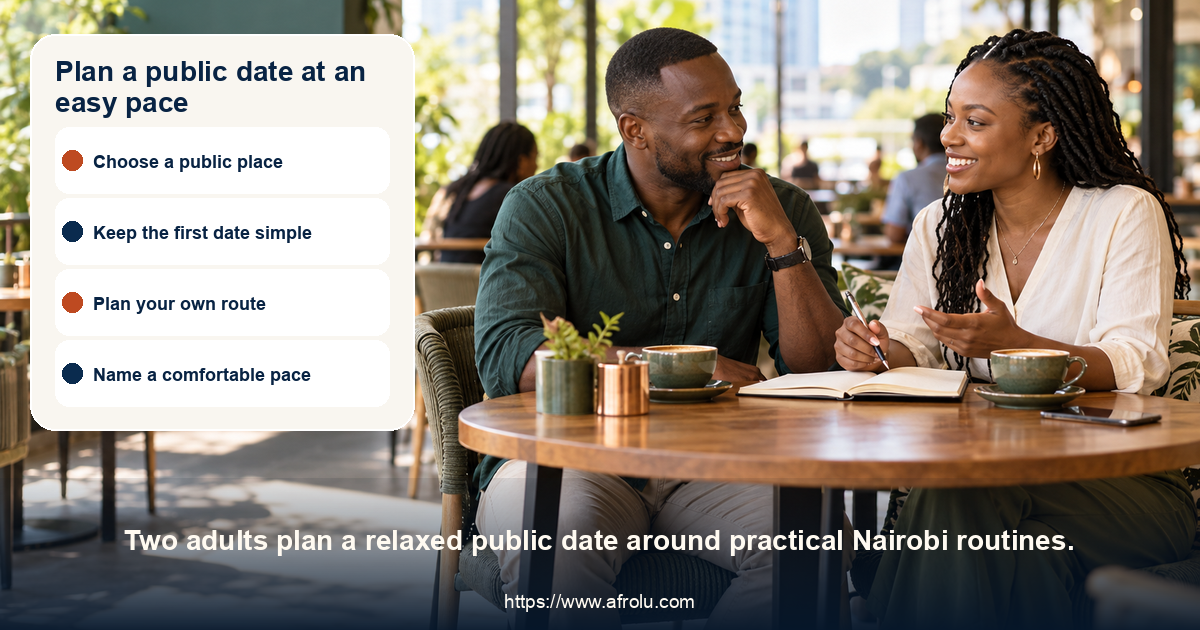
Two adults plan a relaxed public date around practical Nairobi routines.
Written and edited by Jean-Claude Mukendi · Relationship Guides Editor
Define low pressure in terms of pace, notice, contact and the kind of date you want. Offer a realistic public meeting window, agree on the details and keep your own transport and budget in view. A later start is not a reason to accept vague invitations or hurry a label.
Modern dating terms · Late Entrants
How can low-pressure dating in Nairobi feel relaxed without leaving every plan uncertain?
Low-pressure dating means the adults choose a pace without coercion or an assumed timetable. It can still include clear dates, mutual effort and boundaries. Benching is an informal label for attention that feels intermittent; it cannot explain motive or prove that an unclear Nairobi plan is intentional.
At 39, Wanjiku begins dating after a long period of running a small business. A match in Nairobi sends lively messages but suggests only that they meet 'around town sometime.' Wanjiku likes an easy pace, yet she needs to plan around deliveries and transport. She asks for a public place, a day and a budget-friendly option before reserving time.
Define an easy pace
Relaxed does not have to mean vague
Low pressure may mean fewer dates, no early label, a short first meeting or a slower introduction to friends. It does not have to mean accepting last-minute changes or waiting all day for a location. Ask yourself which parts of dating you want to keep open and which need clarity.
A later start can make app conventions feel like rules everyone else knows. They are not universal. You can tell a match that you enjoy getting to know someone at a measured pace and still prefer a date to have a day, time and public place.
Try offering a small plan rather than a large commitment: one coffee after work or a daytime walk in a familiar public area. A short meeting is easier to fit around different routines and gives both people room to decide whether they want another date.
If your date hears 'low pressure' as permission to avoid every direct question, explain what you mean. You may be open to seeing where things go while still expecting mutual respect, a clear yes or no about the next meeting and honest communication about current intentions.
Coordinate the city
Make a plan that survives the journey
Nairobi is large enough that a vague 'let's meet in town' can leave important details unresolved. Ask which area and venue the other person has in mind, then compare travel time with your own work and home commitments. You can suggest a midpoint without making either person responsible for every trip.
Choose a public venue that is open at the agreed time and easy for each adult to locate. Confirm the plan before setting out, especially if rain, traffic or a changing shift could affect arrival. The details can stay simple; clarity does not make a relaxed date overly formal.
If a proposed place strains your budget, say so and offer a lower-cost alternative. You do not need to disclose your income or give a long explanation. A person who wants to meet can respond to the practical option; their reaction is more useful than guessing whether your budget seems impressive.
For an early meeting, retain independent transport and an exit option. Let someone you trust know the general plan if that helps you feel comfortable. You can choose a venue with people around and leave when you want; no city guide or checklist can guarantee another person's behavior.
Ask for the next step
One specific question can reduce the guesswork
If a match says 'we should meet sometime', offer two practical windows or ask which day they prefer. A question about a date is not a demand for exclusivity. It checks whether both people are willing to spend time together under the circumstances they have now.
When messages remain affectionate but plans do not materialize, describe the sequence rather than assigning a label. You might say, 'We have talked about meeting a few times, but we have not picked a day.' Then ask whether they want to choose one or would rather keep things online.
The term benching appears in everyday dating talk, but it has no settled clinical meaning. Research about ghosting, rejection or relationship uncertainty measures narrower behaviors in specific samples. None of those findings can tell you why a person in Nairobi has not answered your invitation.
You can make your next step depend on the answer you receive. If the person offers a day, decide whether it fits. If they remain uncertain, make your other plans and return to the conversation only if you want to. Clarity helps you choose; it does not force a particular outcome.

Use a calm script to agree on venue, notice and independent travel.
Start where you are
You can learn as you date
People begin dating later for many reasons: personal choice, caregiving, migration, work, health, a separation or a long period of focusing elsewhere. None makes you less capable of setting expectations. You may be learning the current app landscape while already knowing how you want to be treated.
Instead of trying to copy a friend's dating pace, notice what helps you feel at ease. Perhaps you want to message for a few days before meeting, or prefer a short public coffee soon after matching. You can revise the approach as you gain experience and learn what suits you.
If a person calls you inexperienced to win agreement, pause. You can ask what they mean, say you will decide at your own pace or end the exchange. Curiosity about dating does not mean you have to accept a private plan, disclose your history or agree to a label.
Choose one skill for the next date: propose a venue, say no to an unsuitable time or ask what 'casual' means. Practising one conversation at a time is more useful than trying to master every dating norm before you meet anyone. You can stop practising when the interaction no longer feels right.

A workable plan considers both routes, budgets and the ability to decline.
Watch mutual effort
A quiet rhythm can still be considerate
A person may be busy, unsure or simply prefer less dating. You cannot identify the reason from a gap between messages alone. You can notice whether they respond to a direct invitation, suggest a time when they cannot make yours and communicate when a plan changes.
If you always travel across town, choose the venue and follow up, ask for a more balanced arrangement. For example, invite the other person to select the next area or propose a time that works with their own schedule. Then decide whether the effort feels mutual to you.
Do not turn a single delay into a verdict, but do not erase a repeated pattern either. A series of vague invitations may mean the person cannot offer the kind of dating you want, whatever their private reason. You can base your choice on the practical effect rather than a diagnosis.
Low pressure should leave both people free to choose; it should not make one person responsible for all the planning. If you want a confirmed date and the match prefers spontaneity, discuss a compromise or decide that your styles do not fit well enough. That can be a fit question without making either person wrong.
Keep private details private
An easy date does not require extra disclosure
You can arrange a meetup using a general area and a public venue without providing your home address, exact worksite, daily route or full shift pattern. Share more only if you choose. If a match repeatedly asks for information that is not needed to plan the date, slow the conversation down.
Stay on the dating platform until moving to another channel feels right to you. Use blocking and reporting options if someone sends threats, pressure or unwanted material. Do not share passwords, one-time codes, private records or intimate images as a condition for continued attention. A match's disappointment does not change those limits.
A video call can add a conversational cue, but it cannot verify every identity claim. Confirm details independently if travel, money or another consequential decision depends on them. A public setting and your own transport can preserve choices, but they cannot guarantee a safe outcome.
Kenya's data-protection regulator explains rights concerning personal information. That guidance is not a dating safety certification, and an app's privacy notice cannot make an individual trustworthy. Protect the information you control and seek local help if you feel threatened or exploited. Do not share more than needed for a current choice.
Keep the choice yours
Change pace when your needs change
After a few conversations, ask whether the current pace still feels good. You might want another date, more notice or less messaging. Tell the other adult what you would like and invite their honest preference, without implying they must agree to prove their interest. An honest mismatch is useful information, not a personal failure.
If the match wants a different rhythm, compare the actual options. Could you meet less often but plan ahead? Would a short call help, or would you prefer to stop dating? You can consider a compromise only if it does not require giving up a boundary that matters to you.
When you decide to leave, a brief message is enough: 'I appreciate the conversation, but I am looking for a different planning style, so I will step away.' You do not have to debate whether the other person's behavior meets a slang definition before ending an arrangement.
A later start to dating can be an invitation to learn what fits, not a reason to speed-run a relationship. One clear plan, one public conversation and an honest review of how you feel are enough for the next step. You control whether there is another one.

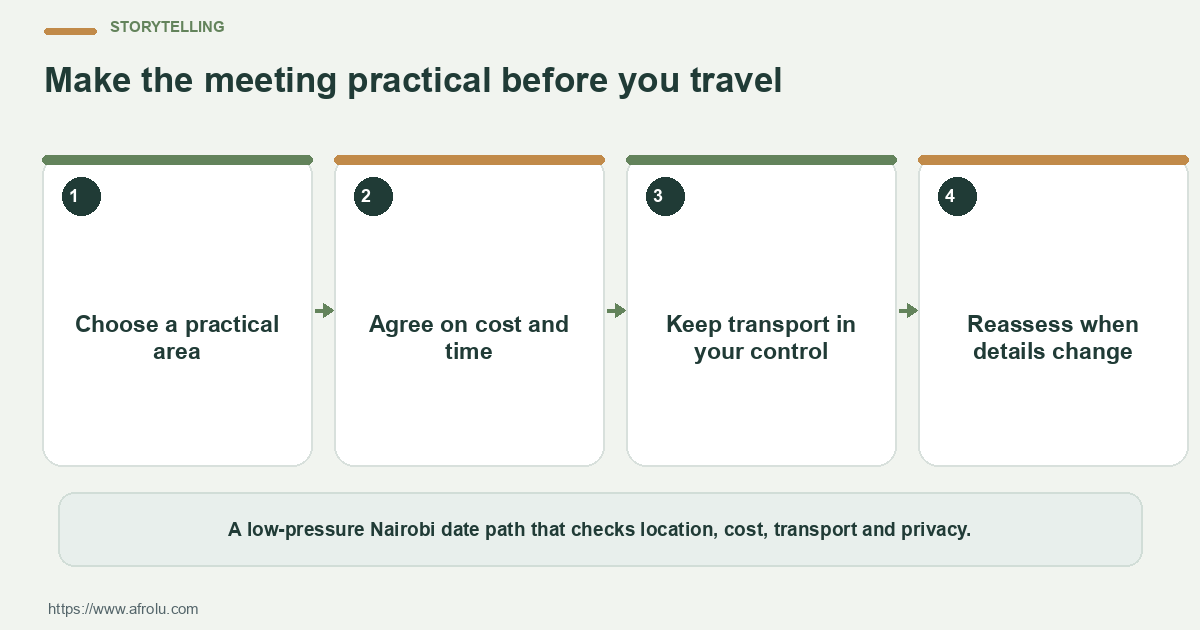
Confirm the public venue and details before starting the journey.
Eight Nairobi choices for a relaxed but practical first date
A vague Nairobi invitation
The suggestion is ‘somewhere in town’ without a day or place
Name a public area and time window that work for you, then ask for a specific answer.The trip is inconvenient
The proposed venue creates a long or costly journey for you
Suggest a nearer public option rather than treating travel burden as a test.A low-cost date
You want to meet but the suggested venue strains your budget
Offer a simple alternative and see whether the match can meet you there.Only late-night plans
Every invitation arrives late and depends on you being available immediately
Say what notice and timing work for you; decide whether the repeated pattern fits.A home address is requested
A new match asks where you live before a first meeting
Suggest a public venue and share only the area needed to coordinate.Transport is assumed
The other person offers to control the ride and return trip
Choose independent transport or another arrangement that leaves you options.The pace differs
You want fewer messages and a planned short date; the match prefers spontaneity
Discuss one manageable compromise or recognize a practical mismatch.The location changes
A public coffee plan is shifted to a private setting
Keep the original public arrangement or cancel if the change does not work for you.Notice whether pace, cost and travel remain mutual
A vague Nairobi invitation: The suggestion is ‘somewhere in town’ without a day or place
The trip is inconvenient: The proposed venue creates a long or costly journey for you
A low-cost date: You want to meet but the suggested venue strains your budget
Only late-night plans: Every invitation arrives late and depends on you being available immediately
A home address is requested: A new match asks where you live before a first meeting
Transport is assumed: The other person offers to control the ride and return trip
The pace differs: You want fewer messages and a planned short date; the match prefers spontaneity
The location changes: A public coffee plan is shifted to a private setting
Both adults treat a date as confirmed only after agreeing on its details.
A change is communicated as soon as reasonably practical.
Each person can decline without insults, threats or punishment.
Time, money, travel and privacy are discussed before they become pressure.
Planning effort can be shared and adjusted when circumstances change.
Either adult may revisit an arrangement and explain what they want now.
Build a public plan with room to say no
| Situation | What it may mean | What to do next |
|---|---|---|
| A vague Nairobi invitation | The suggestion is ‘somewhere in town’ without a day or place | Name a public area and time window that work for you, then ask for a specific answer. |
| The trip is inconvenient | The proposed venue creates a long or costly journey for you | Suggest a nearer public option rather than treating travel burden as a test. |
| A low-cost date | You want to meet but the suggested venue strains your budget | Offer a simple alternative and see whether the match can meet you there. |
| Only late-night plans | Every invitation arrives late and depends on you being available immediately | Say what notice and timing work for you; decide whether the repeated pattern fits. |
| A home address is requested | A new match asks where you live before a first meeting | Suggest a public venue and share only the area needed to coordinate. |
| Transport is assumed | The other person offers to control the ride and return trip | Choose independent transport or another arrangement that leaves you options. |
| The pace differs | You want fewer messages and a planned short date; the match prefers spontaneity | Discuss one manageable compromise or recognize a practical mismatch. |
| The location changes | A public coffee plan is shifted to a private setting | Keep the original public arrangement or cancel if the change does not work for you. |
| A reply arrives later | Timing alone cannot tell you why the person was quiet. | Ask for the information that would change your next choice. |
| The same uncertainty repeats | The reason may remain unknown while the effect on your time is clear. | Choose whether the current arrangement still meets your needs. |
Make low pressure specific enough to plan
“I can meet near a busy public café in the area that works for both of us. What is practical for you?”
“I would rather keep the first date simple. Would a coffee or short daytime meet-up suit you?”
“I do not make last-minute plans on workdays. Can we choose a time a day ahead?”
“I will arrange my own way there and back. Let us choose a place that works for both.”
“I prefer a public first meeting. If that does not work for you, we can leave it here.”
“I like taking time to get to know someone. A short, planned coffee feels right to me.”
“Would you like to choose a day and public place, or should I make other plans?”
“I like getting to know someone gradually, and I still prefer confirmed plans.”
“That timing does not work for me. I can offer another window if you want one.”
“When you say ‘casual’, what are you choosing about exclusivity and time together?”
“My needs have changed. Can we talk about what we each want now?”
“I do not want to continue dating. Please do not contact me again.”
Know the difference
A relaxed pace versus a vague plan
A pace both adults choose without a rushed label
A meeting idea without a day, place or workable route
An easy pace can still have clear details.

Flexible pace and vague logistics are different choices.
A relaxed pace does not require vague logistics
| Type or dimension | What it describes | Best next question |
|---|---|---|
| A flexible pace | Adults may choose fewer dates or shorter first meetings. | Keep the parts that matter to you explicit. |
| A vague venue | ‘Around town’ does not show whether either route or budget works. | Agree on a public place and practical time. |
| Independent transport | Each adult keeps a way to arrive and leave by choice. | Retain control of your own journey. |
| One delayed reply | A single gap can have many explanations and does not establish a pattern. | Look at what happens over time and decide what contact works for you. |
| A confirmed invitation | A date includes details both adults have accepted. | Make plans around the agreement and update each other if something changes. |
| A personal boundary | A limit applies even when the other adult dislikes it. | State the limit and choose whether the response feels respectful. |
| An explanation | A reason may be sincere while the resulting arrangement still does not suit you. | Acknowledge what was said, then decide from the practical outcome. |
| A future possibility | An intention describes a direction, not a guarantee. | Check whether current actions and terms work for you today. |
| A changed preference | Adults can revise what they want as they learn more. | Talk before assuming the other person has accepted new terms. |
A simple plan you can use today
Nairobi routines differ
A city name cannot tell you another adult’s commute, cost limits or preferred pace.
A precaution is an option
Safety guidance supports planning but cannot guarantee how another person behaves.
A label is informal
‘Benching’ has no diagnostic authority and cannot establish what another person intends.
A study has a population
Samples, locations and relationship stages limit what research can tell a particular reader.
Uncertainty is not evidence of fault
A mismatch in timing or communication does not prove either adult is immature or deceptive.
Your choice can be present-sized
You can decide whether to keep planning without deciding the whole future of the connection.
Questions organised by purpose and depth
Choose a few prompts that fit the moment. This is a reference library, not a list to complete.
Before meeting
Plan a first date that leaves both adults options.
- Is the venue public?
- Can I reach and leave independently?
- Does the cost feel comfortable?
Before accepting a pace
Name the parts that can stay flexible and the parts that need detail.
- How often do I want to meet?
- How much notice works?
- What personal details stay private?
Before you reply
Use these privately to locate your own choice.
- What fact do I know?
- What am I assuming?
- Which answer would help me plan?
After the conversation
Review what both people chose and what happened next.
- Were the terms clear?
- Did each adult have room to say no?
- Does this arrangement still fit?
What deserves a closer look
Rights of a Data Subject
Kenya’s regulator describes rights concerning personal information; those rights are not a dating safety certification or a guarantee about an app or individual.
Evidence limit: Use this evidence only within the study population and limits described in the source note.
Tips for Safer Dating: Online & In-Person
A U.S.-based sexual-violence organization suggests privacy, public-meeting and transport precautions while stating that no step guarantees safety; its support channels are not Kenyan services.
Evidence limit: Use this evidence only within the study population and limits described in the source note.
Safety tips
A dating platform’s own guidance covers public first meetings, personal information and money requests; it is not independent verification or a guarantee about a match.
Evidence limit: Use this evidence only within the study population and limits described in the source note.
Romance Scams
U.S. consumer guidance warns against sending money to an online love interest; it is not a Kenya-specific prevalence estimate or legal rule.
Evidence limit: Use this evidence only within the study population and limits described in the source note.
Time for Each Other: Work and Family Constraints Among Couples
A U.S. time-use analysis examined work, family demands and shared time among established couples; it cannot prescribe a dating cadence for other populations.
Evidence limit: Use this evidence only within the study population and limits described in the source note.
Communication, the Heart of a Relationship: Examining Capitalization, Accommodation, and Self-Construal on Relationship Satisfaction
This relationship-communication study examines defined constructs in a particular sample; it cannot set a universal message frequency or infer a new match’s intent.
Evidence limit: Use this evidence only within the study population and limits described in the source note.
Avoid treating convenience as a test of interest
Assuming every area is convenient
Travel, cost and schedule vary across people and days.
Confusing no pressure with no details
A relaxed pace still needs a workable place and time.
Sharing an address too soon
A first meeting rarely needs a private home location.
Diagnosing intent
A slang label turns an incomplete story into a claim you cannot verify.
Treating flexibility as consent
An open calendar or casual label does not make every request acceptable.
Overexplaining a boundary
A short limit can be clear without convincing the other adult to agree.
Explore more about choosing a low-pressure Nairobi dating pace with practical public plans and boundaries
This guide is general editorial information. It is not diagnosis, therapy, legal advice or emergency support.
Explore the guide library
Show more related guides
Continue with Afrolu
Show more Afrolu guides
Sources used for this guide
Afrolu reviewed these health, research, safety, or public guidance resources while editing this page. They support the behaviour and safety guidance; they do not diagnose any individual described by a reader.
Questions about low-pressure dating in Nairobi
Is low-pressure dating supposed to be spontaneous?
Not necessarily. You can prefer an easy pace and still ask for a confirmed day and place.
How do I choose a first meeting place in Nairobi?
Choose a public setting you can reach and leave independently; check current venue details yourself.
Do I need to travel across town to show interest?
No. Suggest a practical option and discuss the travel burden openly.
Should I share my home address?
You decide what to disclose. A public meeting plan usually does not require a home address.
Can I ask for a budget-friendly date?
Yes. Suggest a simple option before agreeing to spend more than you want.
What if they only offer late-night plans?
State what timing works for you and decide whether the repeated pattern is acceptable.
Does a Nairobi location verify a profile?
No. A city or neighborhood cannot confirm identity or intentions.
Can I cancel when the venue changes?
Yes. You can keep the original public plan, suggest another venue or cancel.
Is ‘benching’ a clinical diagnosis?
No. It is informal language and cannot establish a person’s motive or mental health.
Can a safety checklist guarantee what will happen?
No. Precautions can support your choices, but no plan guarantees another person’s conduct.
One thing to do now
Let the next date fit both real lives
Keep the pace flexible where you want flexibility, and make the details clear wherever your time, safety or money depends on them.