Dating later in life · Nairobi plans · clear choices
Dating later in life in Nairobi: ask for a clear plan
Dating later in life can make mixed signals feel weighty. Get clarity in Nairobi, protect your time and assess the pattern without guessing a match's motive.

Two adults can ask for a specific Nairobi date without guessing what an unanswered message means.
Written and edited by Tariro Ncube · Diaspora Dating Editor
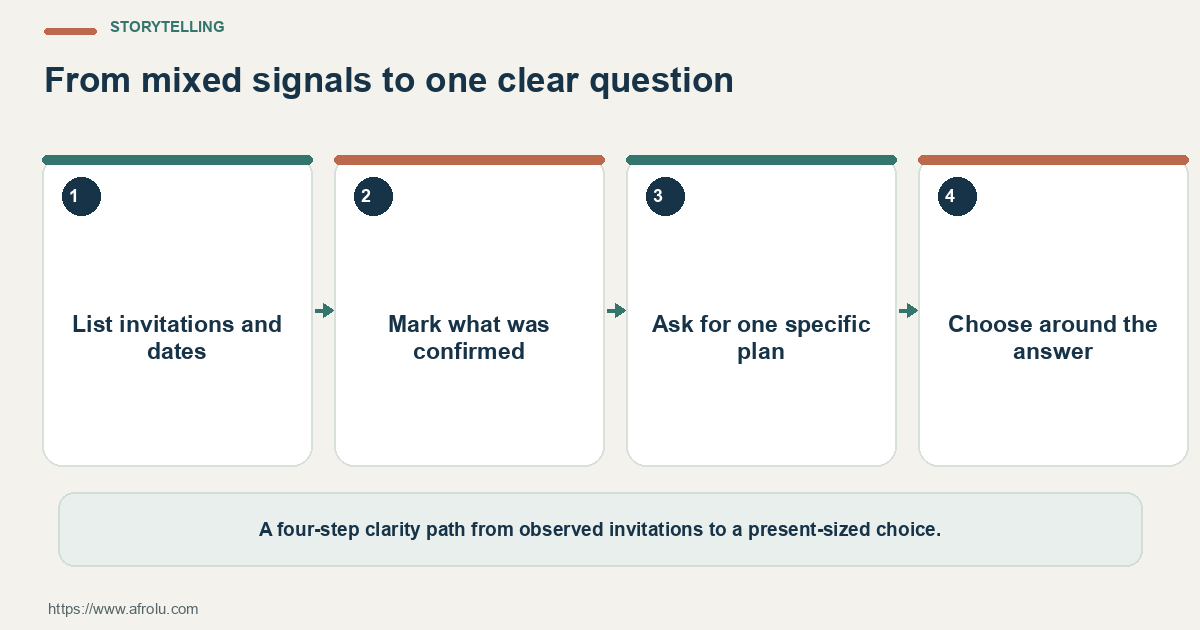
Treat benching as an informal label, not an explanation. List the observable pattern: invitations, confirmations, cancellations and follow-through. Then ask whether the person wants to plan a specific date. Decide whether the answer and later actions meet your needs; a late start does not require you to accept uncertainty or rush a commitment.
Modern dating terms · Late Entrants
How can I get a straight answer about a dating pattern while protecting my time and privacy in Nairobi?
Benching is a popular, informal word for intermittent attention that seems to keep a connection available without clear plans. It is not a clinical category and cannot prove what someone intends. A late start to dating describes timing in your life, not a deficit in maturity, desirability or relationship skill.
After years focused on work and family, 37-year-old Nia begins dating in Nairobi. One match sends friendly voice notes, says they should meet soon and then leaves each invitation without a day. Nia wonders whether her inexperience means she should wait. Instead, she asks for one specific plan and decides how long she is willing to keep the weekend open.
Start with what happened
A label names a worry, not a motive
People use benching to describe different experiences: warm messages without dates, an invitation that never firms up, or contact that returns after a quiet stretch. The word has no agreed clinical definition. It can help you name a concern, but it cannot tell you why this person has not made a plan.
Record the practical facts in plain language. Note who suggested meeting, whether a day and place were agreed, what changed and whether anyone proposed a replacement. Avoid adding conclusions such as 'they fear commitment' or 'I am only a backup.' The record is about the arrangement you can evaluate.
Research on online dating rejection describes several ways people end or avoid contact, including silence, but a study cannot identify the reason for one unanswered message. Likewise, a period of uncertainty in a dating interaction does not diagnose either adult. Evidence is a prompt for careful questions, not mind-reading.
Choose one decision that the timeline can answer: whether to keep Saturday free, continue messaging or accept another invitation. If no confirmed plan exists, you are free to schedule your day. You can remain open to a later date without treating an unmade arrangement as a promise.
Set your own learning pace
A later start does not put you behind
Adults arrive at dating through different routes: a demanding job, caregiving, migration, a separation, personal choice or simply a period when relationships were not a priority. Those histories do not create a single skill level. You may be new to an app and still know exactly which boundaries matter to you.
It can feel tempting to accept vague attention because you worry that asking a direct question will reveal inexperience. A respectful question is ordinary adult communication. You are checking whether two calendars and intentions can meet; you are not asking for a guarantee, exclusivity or a future declaration.
Choose a pace that lets you notice how you feel after each interaction. You might prefer a few messages, one public coffee and time to reflect before another date. Another adult may prefer more frequent contact. Neither rhythm is a test of maturity; the fit depends on what each person freely wants.
If someone mocks your age, compares you with past partners or uses your limited dating history to hurry you, pause the conversation. You can ask what they mean, state that the comment does not work for you, or leave. Your experience level is not permission for another person to set all the terms.
Ask one answerable question
Clarity can be calm and specific
A useful message describes the choice in front of both adults. Try, 'Would you like to meet this week? I can do Thursday after work or Sunday afternoon.' The options make the invitation concrete and let the other person suggest a different time without requiring a long explanation.
If the response is 'soon' or 'we should', you can gently ask which day they have in mind. You do not need to repeat the question many times. A clear answer, a counterproposal or no reply each gives you information about whether to keep planning around this connection.
Keep the tone factual rather than prosecutorial. 'You have been benching me' invites an argument about a label; 'We have discussed meeting twice without choosing a time' describes what you both can verify. Then state what works for you, such as confirming before you reserve the evening.
You can set a boundary without giving an ultimatum. For example, say that you are happy to choose a date when both schedules are known, but you will not hold an open-ended slot. The other adult can decide whether that arrangement suits them, and you can make your plans either way.

Use a direct question to turn a repeated vague invitation into a practical choice.
Plan around city logistics
A good Nairobi date fits both real days
Nairobi plans may involve traffic, work hours, distance between neighborhoods and different transport options. Ask what part of the city is practical rather than assuming a person can cross town at short notice. A nearby public café or daytime meeting can be easier to confirm than an elaborate evening plan.
Offer a public place you know and a time that leaves room for travel. Agree on the venue before starting the journey, and send a simple confirmation on the day. A plan is not settled merely because someone says 'we should link'; the details need to work for both calendars.
You do not need to share your home address, exact office, regular route or every shift to coordinate a first meeting. A general area and time are usually enough to decide whether the date works. If an invitation requires sensitive details before you are comfortable, suggest a less revealing alternative.
If the location changes to an isolated place or the other person insists on controlling your transport, reconsider the invitation. You can keep the original public venue, arrange your own way home or cancel. No polite explanation is more important than retaining a choice you feel comfortable making.

A confirmed plan includes shared details and communication when something changes.
Look for shared effort
A plan is different from a promise to plan
A person can have genuine work or family demands and still be unable to date at the pace you want. The explanation may be true, while the result is still too uncertain for your calendar. You can acknowledge their situation without promising to remain available until it changes.
Look at the sequence after a disruption. Did the person tell you the plan changed, suggest another time and respond when you offered a window? Those actions describe effort more clearly than a stream of affectionate messages. They still do not reveal every private motive, and you do not need a motive to choose.
If you carry all the scheduling, name the kind of shared effort that would help. You might ask the other person to choose a venue or confirm by a particular afternoon. Then evaluate what happens. The aim is not to score a match, but to see whether both adults are participating.
You may continue casually, negotiate a more reliable rhythm or stop arranging dates. Each option is reasonable when it reflects your preference. If the other person becomes angry because you made other plans after no confirmation, you can restate that an open invitation was never a settled agreement.
Keep information in your control
A profile and a promising chat are not verification
Use the app's reporting and blocking tools when a conversation turns intrusive, and avoid moving off-platform before you want to. A request for money, investment help, a verification code or account access is a reason to stop and review the situation. Affectionate language does not make a financial request safer.
For an early in-person date, you can choose a public, populated place, tell someone you trust where you will be and keep a way to leave independently. These steps create options; no arrangement can guarantee safety or prevent another adult from behaving badly. Make decisions using your own comfort.
Kenya's data-protection regulator explains rights related to personal information, but a privacy policy cannot verify a date or remove every risk. Do not send identity documents, private work records or intimate images to prove interest. If you shared something and feel pressured, seek support from a trusted person or appropriate local service.
Do not treat a person's neighborhood, employer, language or apparent social status as proof of identity. Verify important claims independently when a practical decision depends on them. A video call can add context, but it cannot certify every detail or substitute for your own boundaries.
Choose what fits today
You can leave an unclear exchange open or close it
Ask whether you can enjoy this connection as it currently operates, without relying on an imagined future. If yes, decide what limit helps you stay comfortable, such as planning only after confirmation. If not, say you want a more reciprocal arrangement and step back if the answer remains vague.
You do not need to persuade someone to become available. A concise message can close the loop: 'I am looking for dates we can plan together, so I am going to leave this here. I wish you well.' You can also end contact without another conversation if that feels safer or more appropriate.
If the person later offers a specific plan, consider it on its present merits. Check the date, location, cost and your interest; you do not owe acceptance because you once waited. A changed pattern may be useful information, but you can still say no when the offer no longer suits you.
Starting later does not mean you must catch up through constant availability or fast commitment. The next useful step can be one question, one public date or a decision to spend your weekend elsewhere. Your dating life belongs to you, even when a connection remains unfinished in another person's eyes.

Set a confirmation point, then make the weekend plan that works for you.
Eight Nairobi moments where vague attention affects a real plan
Warm messages, no date
A match sends thoughtful messages but has not suggested a day
Ask whether they want to choose a specific time; keep your calendar open only for confirmed plans.‘Soon’ stays vague
Two invitations end with ‘we should meet soon’ and no details
Offer one realistic time window and let the other adult accept or suggest another.Repeated cancellations
A meeting is canceled more than once without a replacement plan
Describe the sequence and decide whether you want to invite one concrete alternative.A delayed reply
A message has been unanswered for a day
Do not treat one gap as proof; decide what contact rhythm you need and ask once.Pressure to catch up
You worry that a later start means you must accept uncertainty
Set the same time and respect standards you would want at any age.Different schedules
A match proposes hours that conflict with your work or caregiving
Offer a time you can actually make rather than disclosing your full weekly schedule.A label replaces details
The other adult calls the connection serious but avoids agreeing on current terms
Ask what the word means in present choices, including exclusivity and plans.The question is ignored
You ask directly whether they want to meet and receive only another compliment
Repeat the practical question once if you choose; then decide from the answer you have.Look for repeated planning and respectful answers
Warm messages, no date: A match sends thoughtful messages but has not suggested a day
‘Soon’ stays vague: Two invitations end with ‘we should meet soon’ and no details
Repeated cancellations: A meeting is canceled more than once without a replacement plan
A delayed reply: A message has been unanswered for a day
Pressure to catch up: You worry that a later start means you must accept uncertainty
Different schedules: A match proposes hours that conflict with your work or caregiving
A label replaces details: The other adult calls the connection serious but avoids agreeing on current terms
The question is ignored: You ask directly whether they want to meet and receive only another compliment
Both adults treat a date as confirmed only after agreeing on its details.
A change is communicated as soon as reasonably practical.
Each person can decline without insults, threats or punishment.
Time, money, travel and privacy are discussed before they become pressure.
Planning effort can be shared and adjusted when circumstances change.
Either adult may revisit an arrangement and explain what they want now.
Choose from what was said and arranged
| Situation | What it may mean | What to do next |
|---|---|---|
| Warm messages, no date | A match sends thoughtful messages but has not suggested a day | Ask whether they want to choose a specific time; keep your calendar open only for confirmed plans. |
| ‘Soon’ stays vague | Two invitations end with ‘we should meet soon’ and no details | Offer one realistic time window and let the other adult accept or suggest another. |
| Repeated cancellations | A meeting is canceled more than once without a replacement plan | Describe the sequence and decide whether you want to invite one concrete alternative. |
| A delayed reply | A message has been unanswered for a day | Do not treat one gap as proof; decide what contact rhythm you need and ask once. |
| Pressure to catch up | You worry that a later start means you must accept uncertainty | Set the same time and respect standards you would want at any age. |
| Different schedules | A match proposes hours that conflict with your work or caregiving | Offer a time you can actually make rather than disclosing your full weekly schedule. |
| A label replaces details | The other adult calls the connection serious but avoids agreeing on current terms | Ask what the word means in present choices, including exclusivity and plans. |
| The question is ignored | You ask directly whether they want to meet and receive only another compliment | Repeat the practical question once if you choose; then decide from the answer you have. |
| A reply arrives later | Timing alone cannot tell you why the person was quiet. | Ask for the information that would change your next choice. |
| The same uncertainty repeats | The reason may remain unknown while the effect on your time is clear. | Choose whether the current arrangement still meets your needs. |
Ask for a date without accusing someone of a motive
“I enjoy our messages. Would you like to choose a day for coffee in Nairobi?”
“We have talked about meeting twice without setting a time. What would you like to do?”
“I can keep Sunday afternoon open until Friday evening. After that I will make other plans.”
“Thursday or Sunday works for me. Is there another time you can commit to?”
“I am open to meeting. Which day did you have in mind?”
“Thanks for telling me. I am looking for a date that can be planned, so I will leave it here.”
“Would you like to choose a day and public place, or should I make other plans?”
“I like getting to know someone gradually, and I still prefer confirmed plans.”
“That timing does not work for me. I can offer another window if you want one.”
“When you say ‘casual’, what are you choosing about exclusivity and time together?”
“My needs have changed. Can we talk about what we each want now?”
“I do not want to continue dating. Please do not contact me again.”
Know the difference
Warm conversation versus a confirmed plan
Contact may feel attentive while a date remains undecided
Both adults agree on a day, time and public place
Treat a date as confirmed only when the details are mutual.

Compare warm messages with the details that make a date mutual.
Warm conversation is different from a confirmed plan
| Type or dimension | What it describes | Best next question |
|---|---|---|
| A clear counterproposal | The person suggests a workable alternative rather than repeating ‘soon’. | See whether both of you can settle the details. |
| A compliment without an answer | Affectionate words do not say whether a date is planned. | Ask the practical question once more or move on. |
| A one-time cancellation | One disruption does not establish a recurring pattern. | Decide whether the replacement plan works for you. |
| One delayed reply | A single gap can have many explanations and does not establish a pattern. | Look at what happens over time and decide what contact works for you. |
| A confirmed invitation | A date includes details both adults have accepted. | Make plans around the agreement and update each other if something changes. |
| A personal boundary | A limit applies even when the other adult dislikes it. | State the limit and choose whether the response feels respectful. |
| An explanation | A reason may be sincere while the resulting arrangement still does not suit you. | Acknowledge what was said, then decide from the practical outcome. |
| A future possibility | An intention describes a direction, not a guarantee. | Check whether current actions and terms work for you today. |
| A changed preference | Adults can revise what they want as they learn more. | Talk before assuming the other person has accepted new terms. |
A simple plan you can use today
A label cannot explain silence
The GHOST questionnaire studies ghosting experiences, not the motive behind one Nairobi match’s reply.
Scheduling is a real compatibility question
Research on work and shared time involved established U.S. couples; use it as context, not a dating rule.
A label is informal
‘Benching’ has no diagnostic authority and cannot establish what another person intends.
A study has a population
Samples, locations and relationship stages limit what research can tell a particular reader.
Uncertainty is not evidence of fault
A mismatch in timing or communication does not prove either adult is immature or deceptive.
Your choice can be present-sized
You can decide whether to keep planning without deciding the whole future of the connection.
Questions organised by purpose and depth
Choose a few prompts that fit the moment. This is a reference library, not a list to complete.
Before asking
Prepare one practical question before opening the chat.
- Which date detail is missing?
- What answer would change my calendar?
- How long do I want to wait?
After the reply
Review the arrangement rather than the imagined motive.
- Did they answer the question?
- Was a specific plan offered?
- What do I want next?
Before you reply
Use these privately to locate your own choice.
- What fact do I know?
- What am I assuming?
- Which answer would help me plan?
After the conversation
Review what both people chose and what happened next.
- Were the terms clear?
- Did each adult have room to say no?
- Does this arrangement still fit?
What deserves a closer look
Development and validation of a questionnaire (GHOST) to assess sudden, unexplained communication exclusion or ‘ghosting’
An online survey of 811 adults supported a measure of ghosting experiences. Ghosting is not benching, and a questionnaire cannot explain why one person has not replied.
Evidence limit: Use this evidence only within the study population and limits described in the source note.
Communication, the Heart of a Relationship: Examining Capitalization, Accommodation, and Self-Construal on Relationship Satisfaction
This relationship-communication study examines defined constructs in a particular sample; it cannot set a universal message frequency or infer a new match’s intent.
Evidence limit: Use this evidence only within the study population and limits described in the source note.
Time for Each Other: Work and Family Constraints Among Couples
A U.S. time-use analysis examined work, family demands and shared time among established couples; it cannot prescribe a dating cadence for other populations.
Evidence limit: Use this evidence only within the study population and limits described in the source note.
Rights of a Data Subject
Kenya’s regulator describes rights concerning personal information; those rights are not a dating safety certification or a guarantee about an app or individual.
Evidence limit: Use this evidence only within the study population and limits described in the source note.
Tips for Safer Dating: Online & In-Person
A U.S.-based sexual-violence organization suggests privacy, public-meeting and transport precautions while stating that no step guarantees safety; its support channels are not Kenyan services.
Evidence limit: Use this evidence only within the study population and limits described in the source note.
Romance Scams
U.S. consumer guidance warns against sending money to an online love interest; it is not a Kenya-specific prevalence estimate or legal rule.
Evidence limit: Use this evidence only within the study population and limits described in the source note.
Avoid turning a gap into a diagnosis
Treating a compliment as a date
Warm messages may feel meaningful, but a plan needs mutual details.
Chasing a motive
You can decide whether the arrangement works without proving why it is happening.
Waiting without a deadline
An open-ended slot can quietly displace the rest of your life.
Diagnosing intent
A slang label turns an incomplete story into a claim you cannot verify.
Treating flexibility as consent
An open calendar or casual label does not make every request acceptable.
Overexplaining a boundary
A short limit can be clear without convincing the other adult to agree.
Explore more about getting a clear answer about inconsistent dating plans in Nairobi after a later start
This guide is general editorial information. It is not diagnosis, therapy, legal advice or emergency support.
Explore the guide library
Show more related guides
Continue with Afrolu
Show more Afrolu guides
Sources used for this guide
Afrolu reviewed these health, research, safety, or public guidance resources while editing this page. They support the behaviour and safety guidance; they do not diagnose any individual described by a reader.
Questions about dating later and getting clarity in Nairobi
Does a delayed message prove benching?
No. Timing alone cannot establish motive. Look at the wider pattern and ask whether a specific plan is wanted.
How do I ask for clarity without sounding demanding?
Describe the plan you can make and ask one answerable question. A respectful question does not demand a promise.
Should I keep waiting after ‘soon’?
You can set a reasonable confirmation point and make other plans if no details arrive.
Is dating later a disadvantage?
No. A later start is one part of your history, not a measure of maturity or desirability.
What if they cancel twice?
You can invite one replacement plan if you want, then decide from follow-through and your own needs.
Should I share my whole schedule?
No. Offer the time window needed to arrange a meeting without disclosing your full routine.
Does a serious label mean we have agreed on exclusivity?
No. Ask whether both adults have chosen exclusivity and what the label means today.
Can I continue chatting without planning a date?
Yes, if that is what you want. You can also pause or ask directly what each person is seeking.
Is ‘benching’ a clinical diagnosis?
No. It is informal language and cannot establish a person’s motive or mental health.
Can a safety checklist guarantee what will happen?
No. Precautions can support your choices, but no plan guarantees another person’s conduct.
One thing to do now
Decide from the arrangement you have today
Ask for the next concrete choice, observe whether both adults help make it happen, and decide from the arrangement you have rather than the story you fear.