Adult Nairobi dating · serious intent · personal faith
Build clear faith-led dating plans in Nairobi
Explore serious dating in Nairobi with personal faith in view. Define today’s terms, choose a public plan, keep independent transport and respect each no.

A serious direction can be discussed without rushing a promise or family role. Afrolu:
Written and edited by Grace Mutiso · Kenya Guides Editor
Say what serious dating means to you now, then ask what the other adult is choosing. Agree on a public place, a time and an easy way for each person to arrive and leave. Nairobi setting or shared faith does not establish commitment, safety, exclusivity or consent; discuss those choices directly.
Modern dating terms · Faith-Led Daters
How can you explore serious dating in Nairobi while keeping faith, safety and city plans grounded in each person's actual choices?
Serious dating describes an intention to explore a committed relationship, not a guarantee of marriage or a specific timeline. Faith-led refers to personal values. A Nairobi date is a local meeting choice; it does not tell either adult what the other believes, can afford or wants from the connection.
At 30, Grace has moved between work commitments across Nairobi and wants to date with a serious direction. Peter invites her to meet but leaves the venue and time vague, expecting her to travel to him after work. She asks to choose a familiar public place and confirm the plan in advance, then asks what serious means to him today.
Define the direction
Serious intent still needs present terms
Adults use serious dating to describe different hopes: exclusivity, a committed partnership, exploring a future or simply dating with intention. Ask what the other person means now and explain your own direction. Neither of you has to promise marriage or a timeline just to have an honest conversation.
A profile that names faith or Nairobi does not tell you whether the person wants exclusivity, children, a particular family role or a formal commitment. Those topics can matter, but ask separately and at a pace that gives each adult room to answer honestly for this relationship.
You can want a serious relationship while accepting that the first date is an introduction. Do not treat a meeting, a follow-up text or a kind gesture as an agreement. If you want to date exclusively, say that clearly and ask whether the other adult chooses the same terms.
If your definitions differ, decide whether the gap is manageable for now. One person may be ready for commitment while the other wants time. A difference does not prove that anyone is deceptive; it does tell you what arrangement exists today and whether you want to continue within it.
Make the first plan specific
Choose a public place and a clear time
Choose a public meeting place that you can identify and reach on your own. Confirm the day, start time and expected duration in the conversation rather than assuming that 'we will meet somewhere in town' is enough. If details remain vague, wait before setting out or changing other plans.
Nairobi traffic, work schedules and distance can affect whether a plan is practical, but neither adult needs to prove interest by accepting an inconvenient route. Offer a location and time that work for you, and invite the other person to suggest another option they can also manage.
For an early date, keep your own transport plan and enough flexibility to leave when you choose. A new match does not need to drive you, collect you from home or know your exact address. If a venue or route no longer feels right, you can change or cancel the plan.
Tell someone you trust where you expect to be if that would help you feel comfortable. This can be a simple check-in, not a detailed report of every movement. Safety preferences differ, and no routine can guarantee an outcome; choose measures that give you options without adding unwanted pressure.
Be honest about time and cost
Plan within the resources you actually have
A meaningful first conversation does not require an expensive meal or a long trip. Suggest an activity that fits your time and budget, and ask whether it works for the other adult. If the person expects you to pay, borrow money or travel farther every time, talk about what shared effort should look like.
Work hours, caregiving and other commitments can shape when you are available. You can share a realistic time window without revealing an employer, rota or home location. If your day changes, let the other person know as soon as you reasonably can and say whether you want to find another time.
Consider how you will return before you accept a meeting. If a plan ends later than you prefer or depends on a ride from the match, suggest an earlier time or another public location. You are allowed to choose arrangements that fit your energy, comfort and other responsibilities.
Financial transparency does not require disclosing account balances or personal documents. You can say that a proposed venue is outside your budget and offer a simpler alternative. A person interested in meeting can discuss options; they do not need to shame you for having a different budget or schedule.

A city or faith label cannot tell you a person's plans or beliefs. Afrolu:
Keep faith personal
Ask instead of assuming shared practice
Two people who live in the same city may have different faith traditions, levels of practice and views of dating. A name, language, neighborhood or family background cannot establish what someone believes. Ask open questions and let the person decide what they are comfortable sharing at this stage.
Tell the other adult which parts of your own practice matter for dating. It may affect your availability, boundaries or hopes for a future partner. Keep the explanation centered on your choice instead of presenting it as a rule that every person from your community follows.
Do not assume that serious dating means marriage is expected soon, or that a faith-led match wants the same rules around family introductions, intimacy or exclusivity. These questions can be important. Discuss them as separate choices and notice whether both adults can speak without pressure.
If a personal practice involves a community event, choose whether a new date may attend. An invitation is not proof of commitment, and declining it does not automatically mean disinterest. You can wait until you feel ready and ask what the invitation would mean to the other person before agreeing.

A serious direction grows through choices both people can make freely. Afrolu:
Keep boundaries clear
A serious goal does not override consent
A date in a public setting does not create consent to move to a private place. Ask before changing locations and accept a no without trying to trade it for another promise. Each adult can decide to leave, even when the conversation has been warm or the other person has travelled.
Keep your phone, money and route information under your control. You do not need to share passwords, location access, identity documents or private family contacts to prove that you are serious. Trust can grow through consistent respectful behavior without immediate access to every part of your life.
If someone ignores a clear limit or makes you feel pressured, you can end the interaction and contact someone you trust. Use a platform's reporting feature when appropriate. You are not responsible for another person's conduct because you accepted a date or did not anticipate how it would change.
Boundaries can also protect emotional pace. You may want to discuss exclusivity before becoming physically intimate, or wait before introducing a date to family. Explain the timing you prefer. The other adult can decide whether it suits them, while you remain free to maintain the boundary.
Read local advice with care
General guidance cannot assess your route
Advice about transport, opening hours, security arrangements and emergency services can change. If your date depends on any of those details, check the current information through an official or trusted local source before you leave. Do not rely on an old social post or a match's instructions alone.
A report about one venue or one incident does not describe every place in Nairobi. Research and public guidance can help you think through options, but they cannot tell you how a specific street, event or journey will feel at the time you visit in person.
Studies about religious similarity usually measure groups, couples or preferences in a particular sample. They do not predict what a Nairobi adult wants from a first date. Treat the study setting as part of the result and ask the person directly about their current expectations.
A city-specific dating guide should not make unsupported claims about who is safe, what a neighborhood is like or how all residents practise faith. Your own familiarity, current information and personal comfort are relevant. You may change a plan even if another person says it is unnecessary.
Decide after the conversation
Keep the next step mutual and manageable
After meeting, think about whether the plan matched what was discussed and whether each adult had room to speak and leave. Did the conversation clarify what serious intent means? Did both people respect the limits about time, money and personal practice? Those details matter more than a polished promise.
If you want another date, suggest one concrete next step that fits both calendars. You do not need to decide a relationship label in one evening. Give the connection time to show whether plans, communication and values can be discussed honestly in this particular relationship.
If the match wants a different pace or expectation, you can say so without arguing that one of you is less faithful or serious. A respectful mismatch can still be a mismatch. You may end contact, remain acquaintances or continue only if the current terms feel acceptable to you.
If a plan becomes uncomfortable before or during the date, change it or leave. You can contact someone you trust and use any support service you choose. Your decision is valid even when the other adult is kind, even when you travelled across Nairobi and even when you once hoped the connection might grow.

A public plan can be thoughtful without turning into a promise. Afrolu:
Eight practical choices for a Nairobi first date
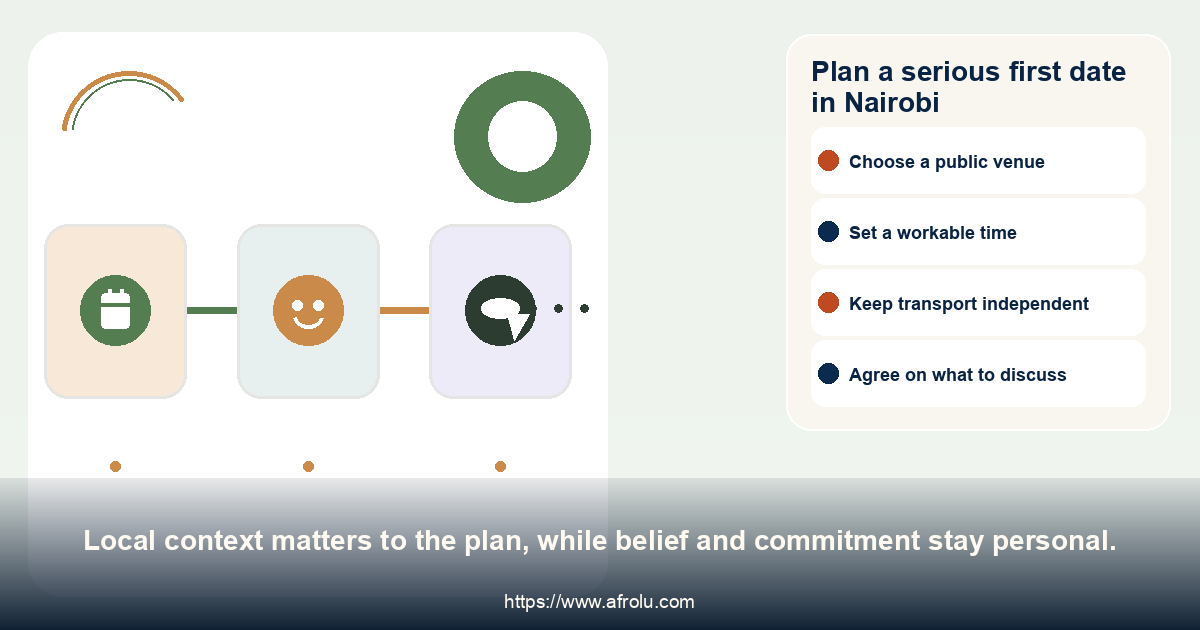
Choosing a first venue
You both want a serious conversation but have not set a place
Agree on a public location and a time that suits both.Faith and family
A family introduction is treated as an automatic promise
Ask each adult what the introduction means to them.Work hours
A shift pattern makes one evening difficult
Offer a realistic alternative rather than disclosing your full rota.Transport
A date assumes one person will provide the ride
Choose transport that leaves each adult an independent option.Different observance
A practice affects the proposed date
Ask about another time without assuming shared routines.Cost
The chosen venue strains one person's budget
Suggest a simpler plan and see whether it is welcomed.Public conversation
A serious topic feels too personal for the first meeting
Choose what to discuss now and what can wait.Unequal effort
One person makes every plan and adjustment
Ask for shared planning before deciding the next step.Notice whether time, cost and effort are shared
Choosing a first venue: You both want a serious conversation but have not set a place
Faith and family: A family introduction is treated as an automatic promise
Work hours: A shift pattern makes one evening difficult
Transport: A date assumes one person will provide the ride
Different observance: A practice affects the proposed date
Cost: The chosen venue strains one person's budget
Public conversation: A serious topic feels too personal for the first meeting
Unequal effort: One person makes every plan and adjustment
A specific plan is confirmed by both adults
A change is communicated when reasonably possible
Each person can decline without being punished
Personal details are shared by choice, not pressure
Planning effort does not fall on one person every time
Either adult can revisit an arrangement as needs change
Make one clear choice after another
| Situation | What it may mean | What to do next |
|---|---|---|
| Choosing a first venue | You both want a serious conversation but have not set a place | Agree on a public location and a time that suits both. |
| Faith and family | A family introduction is treated as an automatic promise | Ask each adult what the introduction means to them. |
| Work hours | A shift pattern makes one evening difficult | Offer a realistic alternative rather than disclosing your full rota. |
| Transport | A date assumes one person will provide the ride | Choose transport that leaves each adult an independent option. |
| Different observance | A practice affects the proposed date | Ask about another time without assuming shared routines. |
| Cost | The chosen venue strains one person's budget | Suggest a simpler plan and see whether it is welcomed. |
| Public conversation | A serious topic feels too personal for the first meeting | Choose what to discuss now and what can wait. |
| Unequal effort | One person makes every plan and adjustment | Ask for shared planning before deciding the next step. |
| A reply arrives later | Timing alone does not establish the reason or the person's whole intention. | Ask for the information that changes your next choice. |
| A plan is canceled | A cancellation can happen for many reasons; a new plan is separate information. | Decide whether to invite a replacement plan or move on. |
Ask about values without speaking for a community
“Could we meet Sunday afternoon at a public cafe that is easy for each of us to reach?”
“I am dating with a serious relationship in mind. What does serious dating mean to you?”
“My practice affects some of my dates and family decisions. What parts of your own values shape dating?”
“I will arrange my own transport so I can leave when I choose.”
“That place is more than I want to spend. Would you be open to a simpler plan?”
“I prefer to meet a few more times before an introduction. What would it mean to you?”
“I would rather understand what you want now than guess from a message pattern.”
“I can share a time window without giving my employer, address or full schedule.”
“Can we choose the time and place before I hold that day open?”
“That does not work for me. I am comfortable with the option we discussed.”
“I have thought about it again, and I want to change the plan.”
“I do not want to continue dating. Please do not contact me again.”
Know the difference
Serious direction versus a rushed commitment
A mutual intention explored over time
A future guarantee before either adult knows
Intent can be clear without a promise.

Intent can be clear without a promise. Afrolu:
Separate serious direction from a rushed promise
| Type or dimension | What it describes | Best next question |
|---|---|---|
| Nairobi location and trust | A city or venue cannot verify identity or intentions. | Use independent judgment and choose a public meeting place. |
| Serious dating and rushed commitment | A serious direction can be explored over time without an early guarantee. | Agree on one manageable next step. |
| Faith label and personal belief | A shared label may conceal different practice or meaning. | Ask each adult how faith affects their choices. |
| Affordable date and low effort | A simpler plan can still show care and mutual planning. | Choose a venue that respects both budgets and schedules. |
| Contact and commitment | Messages show contact; they do not establish exclusivity or a future promise. | Discuss the agreement directly. |
| A label and a boundary | A dating label does not cancel a person's individual limits. | Ask what each adult is comfortable with. |
| Interest and capacity | Someone can feel interested and still have limited time or money. | Look for an honest plan that fits real capacity. |
| A question and a diagnosis | A reader can describe a pattern without diagnosing the other adult. | Use observable actions and choose a boundary. |
| Similarity and agreement | Shared background or values do not guarantee agreement about a specific choice. | Ask what the person means in practice. |
A simple plan you can use today
A city is not a character test
Nairobi location cannot verify identity, intentions or relationship values.
Local logistics can change
Check current details for a particular route and venue before leaving.
Serious intent can move slowly
A clear direction does not require a rushed promise or family role.
Data privacy is a real choice
Kenya's ODPC describes rights concerning personal data, but it cannot certify a dating platform.
No single clue decides
A message gap, a profile label or one date cannot explain an entire relationship.
Your preference is relevant
A reader may choose an arrangement that does not suit someone else.
Questions organised by purpose and depth
Choose a few prompts that fit the moment. This is a reference library, not a list to complete.
A Nairobi plan
Choose practical details that fit both adults.
- Which public place works?
- What time suits each schedule?
- What budget feels comfortable?
Values
Ask about personal meaning rather than shared labels.
- What does faith change for you?
- What is private for now?
- Which future choices matter?
Next step
Decide what you want after the meeting.
- Would you meet again?
- What would you like to clarify?
- What would make you end contact?
One next choice
Keep the next decision small enough to make with the information you have.
- What do I know?
- What do I still need to ask?
- What choice stays mine?
What deserves a closer look
Rights of a Data Subject
Kenya's regulator describes data-subject rights including access, objection, correction and deletion of false or misleading data; these rights are not a safety guarantee for a platform.
Evidence limit: Use this source only within the population and limits named in its note.
Data Protection Handbook
The regulator's handbook explains Kenyan data-protection concepts and complaint options; consult current official guidance for a specific legal question.
Evidence limit: Use this source only within the population and limits named in its note.
Tips for Safer Dating: Online & In-Person
A U.S.-based sexual-violence organization suggests privacy, public-meeting and transport precautions while stating that no step can guarantee safety; its U.S. support channels are not Kenyan services.
Evidence limit: Use this source only within the population and limits named in its note.
Safety tips
A dating platform's own guidance covers public first meetings, personal information and money requests; it is not independent verification or a guarantee about any service or match.
Evidence limit: Use this source only within the population and limits named in its note.
The AFFIRM Model for Navigating Challenges in Continuously-Interfaith and Divergent-Interfaith Marriages
Qualitative interviews with 30 U.S. interfaith couples who self-reported happy, stable marriages and were raising or had raised children; a small purposive marriage sample, not a representative dating study.
Evidence limit: Use this source only within the population and limits named in its note.
Partnership Preferences in Modern Migration Societies: Religious Homophily Among Young Muslims and Christians in Germany
A vignette study of young Muslims and Christians in Germany varied denomination, religious importance and partnership type; it does not represent all diaspora adults or predict an individual's choices.
Evidence limit: Use this source only within the population and limits named in its note.
Avoid treating a city or faith label as proof
Assuming a venue is automatically safe
Local details and conditions can change; keep personal options.
Treating an introduction as a commitment
Ask what it means to the adults and families involved.
Over-disclosing work details
A time window is usually enough to schedule a first date.
Overspending to signal seriousness
Mutual care can be shown through a manageable plan.
Guessing instead of asking
A direct question gives both adults a chance to clarify current terms.
Treating a yes as permanent
Consent and preferences can change when the activity or circumstances change.
Explore more about serious dating in Nairobi where faith remains a personal choice and plans stay mutual
This guide offers editorial information, not diagnosis, therapy, custody, legal or emergency advice. Seek qualified support for individual questions.
Explore the guide library
Show more related guides
Continue with Afrolu
Show more Afrolu guides
Sources used for this guide
Afrolu reviewed these health, research, safety, or public guidance resources while editing this page. They support the behaviour and safety guidance; they do not diagnose any individual described by a reader.
Questions about serious dating in Nairobi
Does Nairobi dating have one shared faith norm?
No. Ask each adult what they personally believe, practise and want.
Does serious dating mean a quick family introduction?
No. Discuss what an introduction means and when each person feels ready.
Can a first serious-date conversation happen in public?
Yes. Choose a setting where both adults can talk and leave independently.
Do I need to share my work location?
No. Offer a time window without disclosing your exact routine or address.
Can a match decide my transport?
You may choose independent transport or change the plan.
What if our budgets differ?
Suggest a lower-cost option and see whether both adults can agree.
Does a Nairobi location make a profile trustworthy?
No. A city or neighborhood does not verify a person's identity or intentions.
Is the safety advice specific to every Nairobi venue?
No. Check current local details for the place and time you are considering.
Can I change my mind after agreeing to a date?
Yes. Tell the other person when you can, and choose the arrangement that feels right now.
Does one message or date prove a person's intention?
No. Ask directly and assess the conduct you can actually observe over time.
One thing to do now
Let one mutual next step be enough
Clarify your current relationship terms, choose a meeting plan that preserves both adults' options and judge the fit by mutual choices rather than a city or faith label.