Adult dating intentions · casual terms · personal faith
Hold serious intentions and casual dating terms separately
Want a serious relationship but dating casually? In faith-led dating, discuss today’s terms, personal values and follow-through without rushing a promise.
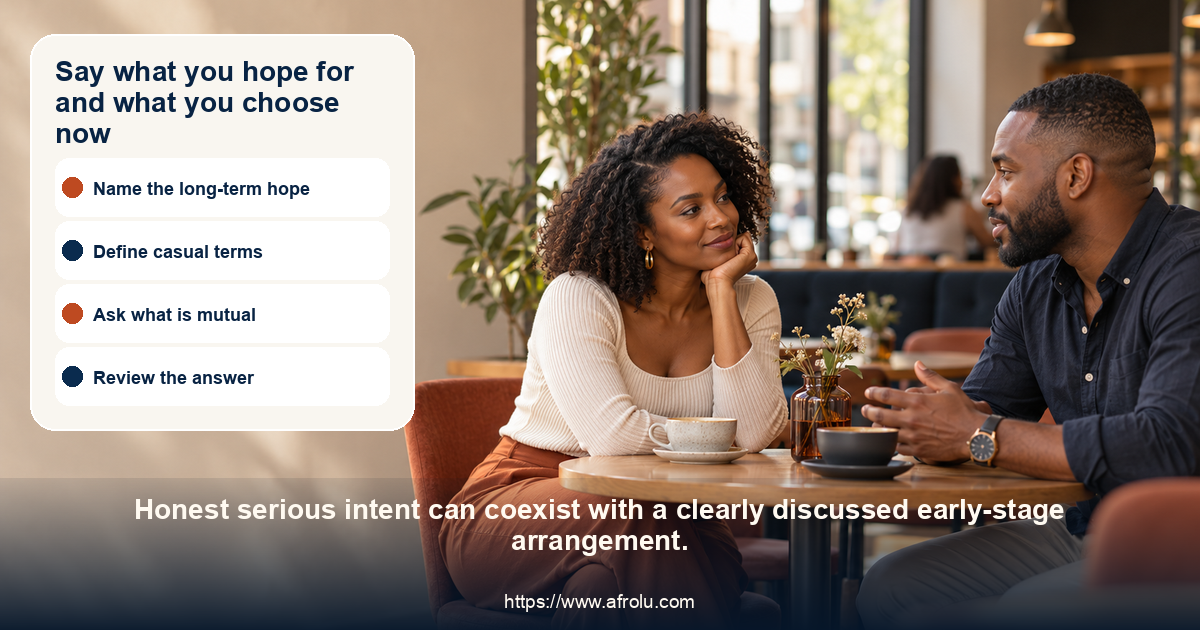
Honest serious intent can coexist with a clearly discussed early-stage arrangement. Afrolu:
Written and edited by Jean-Claude Mukendi · Relationship Guides Editor
State your longer-term preference without asking for a promise today. Then clarify what both adults mean by casual right now, including exclusivity, communication and boundaries. Faith may guide personal values, but neither faith nor serious intent determines another person's readiness or the agreement you currently share.
Modern dating terms · Faith-Led Daters
How can you be honest about a serious direction when the current dating arrangement is casual or still undefined?
Serious intent describes a direction an adult hopes to explore; it does not guarantee a relationship outcome. Casual dating may describe limited commitment or early exploration. Faith-led refers to personal values. The terms can overlap, but none of them establishes exclusivity, marriage, a timeline or another adult's intentions.
At 33, Jean-Claude wants a committed partnership eventually but has been on only three dates with Amara. She says she prefers to keep dating casual while she gets to know him. He values his faith and wants honesty, yet does not want to pressure her. He explains his hope, asks what casual means to her today and decides whether that arrangement suits him.
Separate hope from agreement
Serious intent is not a promise
Wanting a serious relationship can mean that you hope to build trust and commitment with someone over time. It does not mean that a new match owes you a label after a set number of dates. You can state your direction honestly without turning it into a deadline for another adult.
A person who says casual may mean something different from you: early exploration, no exclusivity, fewer expectations or a preference to decide later. Ask what they mean in the present. If their answer differs from your hope, you can decide whether the current arrangement is comfortable rather than arguing over which label is correct.
Faith-led does not settle the difference. Some adults connect faith with marriage goals; others connect it with honesty, compassion, personal discipline or community. Never infer a timeline, abstinence, family role or willingness to commit from a faith label. Ask the question relevant to the choice in front of you.
It is possible to be hopeful and still notice what has not been agreed. Write down the actual terms: whether you are meeting, whether either person is dating others and what contact you both expect. Keeping that list separate from your future wish can prevent a warm conversation from becoming a promise neither person made.
Clarify the current arrangement
Ask what casual means in practice
Ask whether casual means you are both free to date other people, whether either person wants regular planned dates and how much communication feels welcome. You do not need to settle every future question during one conversation. Start with the terms that affect your next choice and give the other adult room to answer.
If the other person is unsure, you can decide whether uncertainty works for you for now. You may continue one date at a time with an agreed check-in later, or choose not to invest in an arrangement without a direction. Both decisions are allowed; neither requires the other person to change their preference.
Do not use a serious-intention statement to imply exclusivity. If you want to stop dating others, ask whether the other adult wants the same agreement. If they do not, you can choose whether to remain in the connection without treating your own hope as a contract they accepted.
A fair conversation can include limits about time, money and intimacy as well as a preferred label. Say what would make the next few weeks feel manageable. If the person responds with contempt or keeps changing the meaning of casual to avoid a direct answer, consider whether the arrangement matches your values.
Make faith a personal conversation
Ask about values without assuming similarity
Two adults may both say faith matters while following different traditions or interpreting one tradition differently. One may practise regularly, another may be questioning, and another may use faith as a personal source of meaning. Ask what the person wants to share rather than assigning a practice from their background or name.
Explain the part of your faith that affects your dating decision. You might care about honesty, a regular community commitment or a future family question. Specific language helps the other adult understand your needs without making them guess what a broad identity label is supposed to mean.
Marriage, children, family involvement and sexual boundaries require their own conversations if they matter to you. A study about religious similarity or an established marriage cannot tell you what this person wants. Ask in a way that allows an honest no or an answer that is still developing.
Respect does not require you to give up a non-negotiable. If shared practice is essential to your future, say so without asking someone to change or pretending the issue does not matter. The other adult can decide whether their own goals fit; a mismatch can be real without either person being less sincere.

Honesty lets both adults choose whether the present arrangement suits them. Afrolu:
Plan the next date
Let a small plan match the present stage
Offer a day, place and activity that suit the time you both have now. If work or travel may affect the plan, say when you will know. A clear invitation is easier to answer than a general promise to meet soon, and it gives each person the option to accept, suggest another time or decline.
Confirm the plan before changing your calendar around it. If someone cancels, notice whether they communicate and suggest another time if they still want to meet. One change is not proof of motive, but a repeated pattern without replacement plans may show that the current arrangement does not meet your needs.
Keep cost and effort proportionate to how well you know each other. An expensive outing, a trip or an introduction to family can create expectations that neither adult intended. You can choose a modest public plan and discuss bigger steps after you have agreed what the relationship is today.
If one adult consistently organizes every date, name what shared effort would look like to you. The other person may have different resources or schedules, so talk about a realistic contribution. Then see whether the plan feels mutual rather than measuring care by a single gift, payment or gesture.

Watch how each person handles the present arrangement, not only future language. Afrolu:
Protect the boundaries that matter
Serious does not mean rushing
You can want a committed relationship and still take time before meeting family, sharing an address or becoming physically intimate. Explain the timing that feels right to you. Another adult may want a faster pace; they can say so, and you can decide whether that difference can be discussed respectfully.
Consent applies to each interaction, even when both people hope to build a serious relationship. A prior date, a faith conversation or a stated intention does not create permission for touch, photos or a private visit. Ask, listen and accept the answer without using future commitment as leverage.
Protect personal information while trust develops. Do not share account access, identity documents, private schedules or money to prove that you care. A serious goal does not make a new person automatically trustworthy. You can offer warmth and still maintain the privacy limits that help you feel secure.
If the other adult repeatedly pushes a boundary, notice the behavior instead of searching for a charitable explanation. You may restate the limit, leave the interaction or end contact. You do not have to decide whether the person is a bad partner before deciding that the current conduct is not acceptable to you.
Use evidence without overreach
Studies do not predict a single match
Some research on religion and relationships looks at marriages, cohabiting couples or young adults in a specific country. Those studies may identify questions worth discussing, but they do not show that a shared faith predicts readiness, honesty or serious intent in one person you have recently met.
Evidence about casual partnerships may describe attitudes reported by one participant group. It does not establish that every adult who chooses casual dating wants the same boundaries or future. Read the measures and population, then use the result as context rather than as a reason to classify someone.
A survey about dating experiences in the United States cannot automatically represent African diaspora adults across countries and generations. Social norms, platform use, age and community context can differ. Avoid importing a percentage into your personal decision unless the source truly measured a comparable group.
You do not need research to justify preferring a serious direction. Your values and life goals are yours. Research can help you ask better questions, while the two adults involved remain responsible for explaining their own terms and deciding what agreement, if any, they want to make.
Choose whether to continue
Your hope and today's choice can differ
Ask yourself whether you can enjoy this connection as it currently exists, without relying on a promise that has not been made. If the answer is yes, decide what limit or check-in would help you remain comfortable. If the answer is no, you can say you want a different arrangement.
Tell the other adult what you are choosing in plain language. You may say that you like them but want an exclusive relationship, or that you are content to date casually for now. The person can respond freely, and you can evaluate the answer without trying to persuade them to want the same future.
If terms change, revisit the conversation rather than assuming an earlier statement still applies. People can change their mind about seriousness, casual dating or faith practice. You can take new information seriously and decide again, including ending contact if the arrangement no longer fits your needs as an adult.
After a few dates, compare the stated agreement with the actual pattern: plans, communication, boundaries and mutual effort. This is not a scorecard that proves love. It is a practical way to notice whether your choices still match your values and whether you freely want another step.

You do not have to accept casual terms while waiting for a promise. Afrolu:
Eight moments when intention and terms diverge

Hope and label
You want marriage someday while the other person says casual today
Ask whether today's arrangement still suits you.A rushed promise
A match asks for a lifelong commitment after a few dates
State your direction and keep the decision present-sized.Faith compatibility
Similar beliefs are assumed to settle every future question
Discuss the specific practices and choices that matter.Nonexclusive terms
Both adults date casually but one assumes exclusivity
Clarify whether exclusivity has actually been agreed.Changed intention
Your goal shifts toward commitment
Tell the other person before treating the old terms as current.Mixed follow-through
Serious words are not matched by confirmed plans
Ask what they can choose now and decide from the answer.Physical boundary
A serious hope is used to push past a no
Consent still applies to each separate activity.Different timelines
One person wants a label sooner
Discuss timing without promising more than you mean.Watch how current agreements are handled
Hope and label: You want marriage someday while the other person says casual today
A rushed promise: A match asks for a lifelong commitment after a few dates
Faith compatibility: Similar beliefs are assumed to settle every future question
Nonexclusive terms: Both adults date casually but one assumes exclusivity
Changed intention: Your goal shifts toward commitment
Mixed follow-through: Serious words are not matched by confirmed plans
Physical boundary: A serious hope is used to push past a no
Different timelines: One person wants a label sooner
A specific plan is confirmed by both adults
A change is communicated when reasonably possible
Each person can decline without being punished
Personal details are shared by choice, not pressure
Planning effort does not fall on one person every time
Either adult can revisit an arrangement as needs change
Make your choice from the arrangement today
| Situation | What it may mean | What to do next |
|---|---|---|
| Hope and label | You want marriage someday while the other person says casual today | Ask whether today's arrangement still suits you. |
| A rushed promise | A match asks for a lifelong commitment after a few dates | State your direction and keep the decision present-sized. |
| Faith compatibility | Similar beliefs are assumed to settle every future question | Discuss the specific practices and choices that matter. |
| Nonexclusive terms | Both adults date casually but one assumes exclusivity | Clarify whether exclusivity has actually been agreed. |
| Changed intention | Your goal shifts toward commitment | Tell the other person before treating the old terms as current. |
| Mixed follow-through | Serious words are not matched by confirmed plans | Ask what they can choose now and decide from the answer. |
| Physical boundary | A serious hope is used to push past a no | Consent still applies to each separate activity. |
| Different timelines | One person wants a label sooner | Discuss timing without promising more than you mean. |
| A reply arrives later | Timing alone does not establish the reason or the person's whole intention. | Ask for the information that changes your next choice. |
| A plan is canceled | A cancellation can happen for many reasons; a new plan is separate information. | Decide whether to invite a replacement plan or move on. |
Talk honestly about serious hopes and casual terms
“I hope to build a serious relationship over time. What are you looking for from dating now?”
“I am open to casual dating right now, as long as we are honest about what that means.”
“I would like to know whether either of us expects exclusivity. We have not agreed to it yet.”
“Faith shapes some choices for me. Which parts would you want to talk through if we keep dating?”
“My goals have changed. I want to discuss whether our current terms still fit both of us.”
“I care about being honest, but I cannot promise a future I do not know yet.”
“I would rather understand what you want now than guess from a message pattern.”
“I can share a time window without giving my employer, address or full schedule.”
“Can we choose the time and place before I hold that day open?”
“That does not work for me. I am comfortable with the option we discussed.”
“I have thought about it again, and I want to change the plan.”
“I do not want to continue dating. Please do not contact me again.”
Know the difference
Serious intention versus today's casual agreement
A direction one adult wants to explore
What both people choose now
Be honest about both time horizons.

Be honest about both time horizons. Afrolu:
Separate a future direction from a present agreement
| Type or dimension | What it describes | Best next question |
|---|---|---|
| Serious intention and promise | Intention describes a direction; a promise claims a future outcome. | Say what you hope to explore without guaranteeing what you cannot know. |
| Casual terms and future hope | A present casual arrangement can coexist with a hope for more only when terms are honest. | Ask whether the other adult wants the same current arrangement. |
| Frequency and exclusivity | Regular messages or dates do not create exclusivity. | Ask directly and agree before relying on it. |
| Shared faith and shared expectations | A similar identity does not settle practice, intimacy or timing. | Discuss each decision as its own conversation. |
| Contact and commitment | Messages show contact; they do not establish exclusivity or a future promise. | Discuss the agreement directly. |
| A label and a boundary | A dating label does not cancel a person's individual limits. | Ask what each adult is comfortable with. |
| Interest and capacity | Someone can feel interested and still have limited time or money. | Look for an honest plan that fits real capacity. |
| A question and a diagnosis | A reader can describe a pattern without diagnosing the other adult. | Use observable actions and choose a boundary. |
| Similarity and agreement | Shared background or values do not guarantee agreement about a specific choice. | Ask what the person means in practice. |
A simple plan you can use today
Intention is not a guarantee
A serious direction says what a person wants to explore, not what the future must be.
Current terms matter
Casual arrangements should be described honestly even when someone hopes for more.
Exclusivity is a separate agreement
Contact frequency and serious hopes do not establish it.
Faith does not settle every choice
Practice, boundaries and timing need direct discussion.
No single clue decides
A message gap, a profile label or one date cannot explain an entire relationship.
Your preference is relevant
A reader may choose an arrangement that does not suit someone else.
Questions organised by purpose and depth
Choose a few prompts that fit the moment. This is a reference library, not a list to complete.
What you hope
Put the future direction in your own words.
- What does serious mean to you?
- What are you not promising?
- Which faith choices matter?
What you choose
Name the casual terms both adults have today.
- Is exclusivity agreed?
- What boundaries apply?
- What does each person understand?
What changes
Plan how you will revisit the arrangement.
- What if your goals change?
- How will you raise it?
- What boundary protects you?
One next choice
Keep the next decision small enough to make with the information you have.
- What do I know?
- What do I still need to ask?
- What choice stays mine?
What deserves a closer look
Evaluations and future plans after casual sexual experiences: Differences across partner type
An emerging-adult study compared reported experiences by partner type; its research categories do not define casual dating for every adult.
Evidence limit: Use this source only within the population and limits named in its note.
Commitment: Functions, Formation, and the Securing of Romantic Attachment
Review of relationship commitment theory; useful for distinguishing dedication and constraints, but not a diagnostic test or a timetable for a particular dating connection.
Evidence limit: Use this source only within the population and limits named in its note.
Partnership Preferences in Modern Migration Societies: Religious Homophily Among Young Muslims and Christians in Germany
A vignette study of young Muslims and Christians in Germany varied denomination, religious importance and partnership type; it does not represent all diaspora adults or predict an individual's choices.
Evidence limit: Use this source only within the population and limits named in its note.
The AFFIRM Model for Navigating Challenges in Continuously-Interfaith and Divergent-Interfaith Marriages
Qualitative interviews with 30 U.S. interfaith couples who self-reported happy, stable marriages and were raising or had raised children; a small purposive marriage sample, not a representative dating study.
Evidence limit: Use this source only within the population and limits named in its note.
Sexual Consent in Committed Relationships: A Dyadic Study
A dyadic study examined beliefs and communication in committed relationships; it does not replace asking for consent in a new dating interaction.
Evidence limit: Use this source only within the population and limits named in its note.
Relational Uncertainty and Cortisol Responses to Hurtful and Supportive Messages from a Dating Partner
Two studies examined physiological responses and uncertainty in dating-partner interactions; their findings do not reveal a new match's motive or diagnose anyone.
Evidence limit: Use this source only within the population and limits named in its note.
Avoid promising more than you mean
Calling a hope a promise
A future direction is not an outcome either adult can guarantee.
Hiding current casual terms
The other person needs an honest account of what you choose today.
Assuming exclusivity
Dating frequency does not establish a mutual agreement.
Using faith to pressure a yes
Personal belief does not remove another adult's right to decide.
Guessing instead of asking
A direct question gives both adults a chance to clarify current terms.
Treating a yes as permanent
Consent and preferences can change when the activity or circumstances change.
Explore more about serious relationship hopes alongside clearly agreed casual dating terms
This guide offers editorial information, not diagnosis, therapy, custody, legal or emergency advice. Seek qualified support for individual questions.
Explore the guide library
Show more related guides
Continue with Afrolu
Show more Afrolu guides
Sources used for this guide
Afrolu reviewed these health, research, safety, or public guidance resources while editing this page. They support the behaviour and safety guidance; they do not diagnose any individual described by a reader.
Questions about serious and casual dating
Can I want a serious relationship while dating casually now?
Yes, if you describe your hope honestly and both adults understand today's terms.
Does casual mean that no one may want commitment later?
No. People can change goals, but they should discuss the change before relying on new terms.
Should I promise marriage to show serious intent?
No. Say what direction you hope to explore without promising an outcome you cannot know.
Does shared faith settle exclusivity?
No. Ask whether both adults have chosen exclusivity.
Can a serious goal override a boundary?
No. Consent and personal boundaries apply regardless of relationship intention.
What if our timelines differ?
Discuss what each person wants now, then decide whether the gap is workable for you.
Does the word benching prove manipulation?
No. Describe the contact and planning pattern; a slang label cannot establish motive.
Can I stop dating if casual terms no longer fit?
Yes. You may end an arrangement that no longer matches your needs.
Can I change my mind after agreeing to a date?
Yes. Tell the other person when you can, and choose the arrangement that feels right now.
Does one message or date prove a person's intention?
No. Ask directly and assess the conduct you can actually observe over time.
One thing to do now
Choose a present arrangement that works for you
Separate what you hope to build from what both adults have agreed to now, then choose whether the current terms are acceptable to you.