Adult long-distance dating · personal faith · planned visits
Keep long-distance dating practical, private and safe
Plan faith-led long-distance dating safely: protect privacy, agree on travel and lodging, keep an exit plan and decide at your own pace before you book a visit.
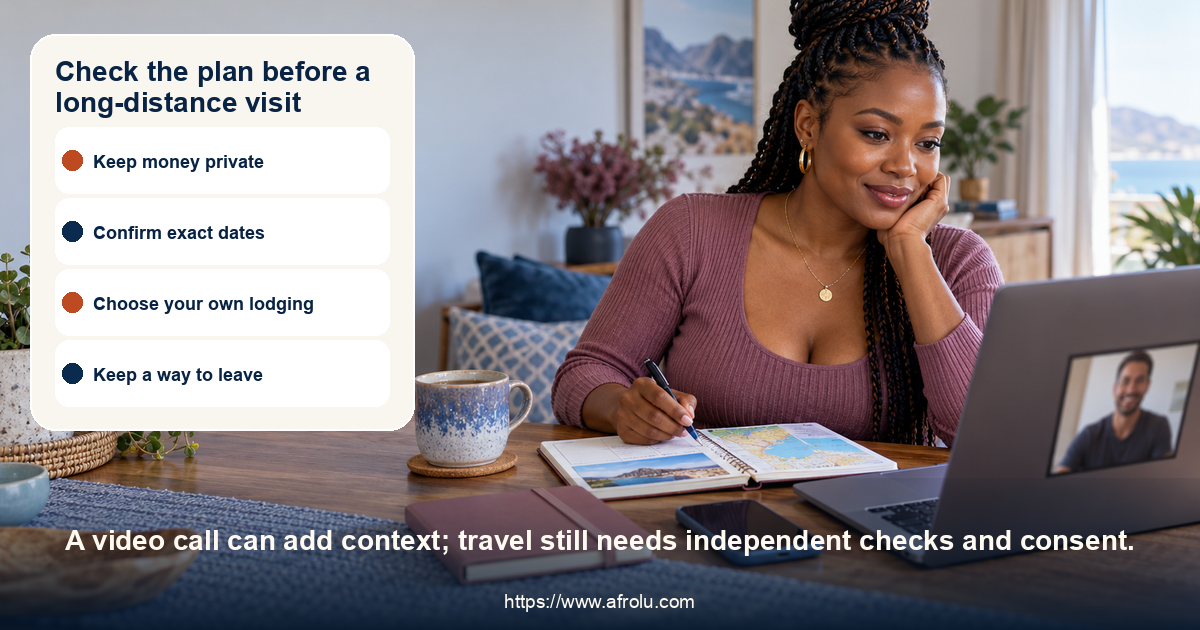
A video call can add context; travel still needs independent checks and consent. Afrolu:
Written and edited by Nadine El-Sayed · Verification Editor
Let comfort and evidence grow before spending money or sharing sensitive information. Confirm the dates, location, transport, lodging and each person's expectations separately. Tell someone you trust about your plan, keep control of your return options and remember that a visit does not promise intimacy, exclusivity or a relationship outcome.
Modern dating terms · Faith-Led Daters
How can you move from online contact toward a visit without confusing a travel plan with trust, commitment or consent?
Long-distance dating involves adults who live far enough apart that calls, travel or time zones shape how they meet. Faith-led describes personal values, not a safety credential. A planned visit is a practical meeting choice; it does not establish identity, commitment, consent or a promise about the future.
At 35, Nadine has been speaking with Youssef across two countries for several months. He suggests that she book a ticket and stay with his relatives, saying shared faith should make the arrangement comfortable. She wants to meet but has not visited the city before. Nadine asks to plan dates, a hotel and her own return transport before deciding whether a trip fits.
Let trust develop gradually
A video call is one detail, not proof of everything
A live call may help you see and hear someone, but it cannot confirm every claim in a profile. Keep observing whether names, work stories and plans stay consistent over time. If a detail feels unclear, ask a direct question and allow the answer to remain incomplete while you decide whether to continue.
You can meet through the original platform for longer if that feels more comfortable. A match who insists on moving to private channels immediately may be asking for access you are not ready to give. You can explain your preference and see whether it is respected without treating the request alone as a diagnosis.
Avoid sending identity documents, banking details, home addresses or one-time codes to someone you have not met and independently trusted. Do not open unfamiliar links or files to prove interest. If a profile asks for sensitive information or money, stop and check the request with a trusted person.
Identity verification is not a demand that you investigate another adult. You can decide that you need more time, ask for a simple additional conversation or decline to travel. A person who responds with threats, guilt or urgent pressure has shown you something about how they handle a boundary.
Keep money separate from affection
Do not fund an online love interest's emergency
Long-distance contact can include stories about medical costs, tickets, customs fees, visas or a sudden crisis. A compelling explanation still does not require you to transfer money. Financial assistance can expose you to loss or further requests, even when the person says the transfer will be repaid.
Avoid gift cards, cryptocurrency, wire transfers, payment apps or bank transfers to someone you only know online. Do not accept a check and forward part of it, receive money for another person or create an account in your name for their use. Those actions can involve you in a financial problem you did not intend.
If you already sent money, contact your bank or payment provider promptly and ask what steps are still possible. Save relevant messages if safe, report the account to the service and speak with someone you trust. You do not need to confront the person or wait for them to admit that the request was false.
A request for money is not evidence that you failed to understand a faith commitment or care enough. Affection does not require you to pay for travel, medical needs or an investment opportunity. You may continue or end a conversation based on your own judgement after declining the request.
Make the visit your own
Agree on travel, lodging and meetings separately
Before booking, confirm who is travelling, exact dates, where you will stay and how you can get between the airport or station and your accommodation. Check each detail through sources you choose rather than relying entirely on a new match. If a plan is not confirmed, wait before spending money.
Choose lodging you control and can afford independently if possible. You are not required to stay with the other adult or their family because a visit was discussed. Keeping your own room gives you privacy and a place to return to while you decide what kind of contact feels right.
Arrange your own return journey and keep enough funds for a change in plans. Share your itinerary with someone you trust if that would help. Discuss how you will check in and what you will do if a call, pickup or meeting does not happen as expected.
For an early meeting, choose a public place and a short plan with your own way home. You can leave, move to a different location or end a date at any point. Neither person is owed a private meeting, affection or extra time because the other travelled or paid for something.

A clear logistics conversation protects each adult's ability to decide. Afrolu:
Protect privacy across borders
Share only what supports a choice you want
Travel can involve forms and tickets, but a dating partner does not need to store your passport image, card number or account password. Keep official documents with you and use trusted travel providers. If another person asks to hold them, explain that you will manage your own paperwork.
Do not switch on continuous location sharing just to reassure a match. You can share a temporary check-in with someone you trust instead. Keep control of your phone, charger, transport payment and accommodation information so that you can make a decision without needing the other person's permission.
A public profile may reveal your routine, workplace, community or family relationships. Be thoughtful about pictures that show identifiable places and about the timing of travel posts. You can keep a trip private until after you return, if public updates would make you feel exposed.
If a person asks you to conceal their identity, stop speaking with friends or surrender private information as a faith test, take time before replying. You may ask why the request matters and decide that it crosses your limit. Shared values do not create a right to control another adult's access or choices.

A video call is one source of context, not proof of every claim. Afrolu:
Keep faith and consent distinct
A shared belief does not decide boundaries
People may describe themselves as faith-led while holding different beliefs, practices and expectations. Ask which parts affect this visit, such as the kind of public activity each person prefers or whether a community event feels appropriate. No one has to provide a complete religious history to make a travel plan.
Discuss physical affection, privacy and lodging separately rather than assuming that shared faith answers them. An adult may want a public date and a private room; another may have different preferences. Both can state their boundaries, and neither has to change them because a ticket was purchased.
Consent applies to each new activity and can change after arrival. Agreeing to meet does not mean agreeing to ride together, enter a home, share a room or continue after discomfort. Ask, listen and stop when an answer is uncertain. Either adult can end the meeting without debate.
If a conversation turns into pressure to prove sincerity, pause the travel decision. You may postpone, cancel or choose another format if you feel unsafe or uncertain. You do not need to demonstrate that a person is harmful before choosing a plan with more privacy and control.
Treat evidence as context
Published findings do not screen an individual match
Studies of app safety often examine specific groups and countries. Their findings can suggest that people use strategies such as meeting publicly or limiting personal information, but the study cannot predict the behavior of a particular adult. Read the sample details before applying any result to a diaspora relationship.
Government advice about romance scams documents requests for money and common pressure patterns in its jurisdiction. It does not mean every long-distance partner is a scammer. A request for funds is still a reason to stop, verify through independent channels and protect your accounts as a prudent precaution for a particular reader.
A dating service's safety page can explain its reporting tools and recommendations. The service cannot observe every conversation or guarantee what happens offline. Learn how to block and report, then make an independent plan that matches your own transport, accommodation and comfort in any specific new connection. Even a useful checklist cannot guarantee a safe outcome or predict a match's conduct.
Research on interfaith marriages or young adults in one country does not decide whether a long-distance date will work. Those studies concern different samples and relationship stages. Ask the person in front of you about their actual plans, and let what they do over time inform your decision.
Choose before you travel
A visit can wait until the plan feels workable
Write down the travel details you need before making a purchase. That list could include dates, a public first meeting, independent accommodation, a return route and a person who knows your itinerary. If any item remains vague, ask for a clear answer or decide that you are not ready to book.
If the other person helps confirm a practical plan and respects your boundaries, you may decide that a visit is right for you. A positive response does not make you obligated to continue dating or to accept a future promise. Let the meeting be one new experience rather than the conclusion of a relationship.
If your comfort changes, postpone or cancel. Check the travel provider's actual terms yourself and consider any cost you may lose. A match may feel disappointed, but that feeling does not cancel your right to choose what happens with your time, money, body or information.
After a visit, reflect on whether plans matched what was discussed and whether you could say no without pressure. You can decide to continue, change the pace or stop contact. Distance can make conversations meaningful, but it cannot replace repeated respect and choices you freely accept.

You can delay the visit until the full plan feels workable. Afrolu:
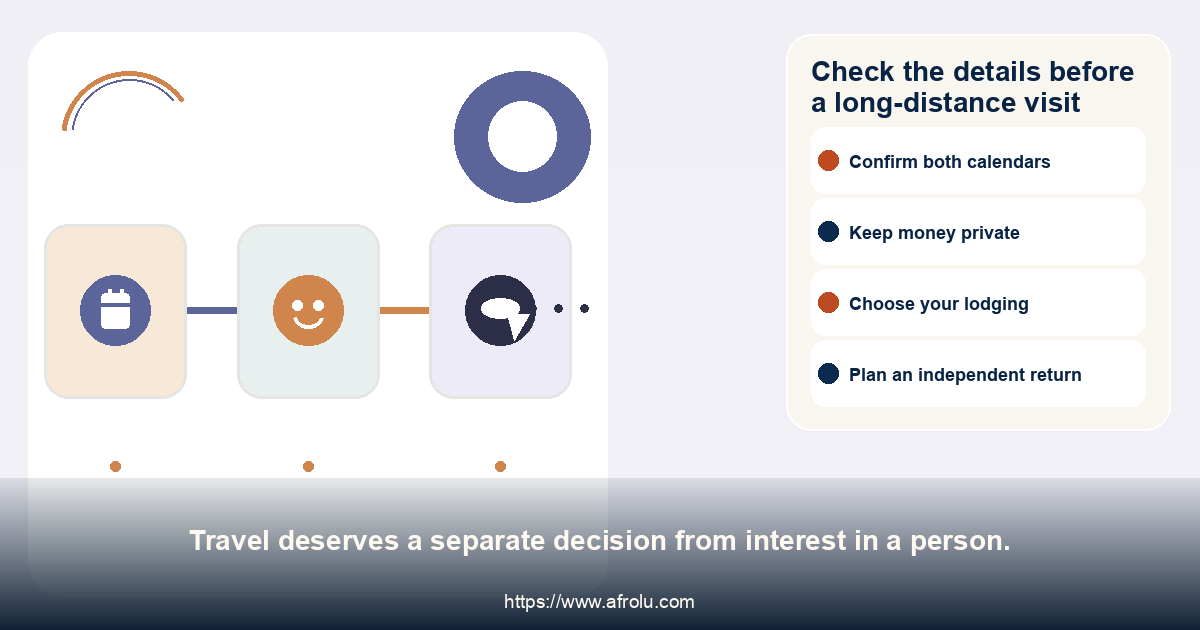
Eight decisions before a long-distance visit
A video call
A call feels reassuring but travel is still being discussed
Treat it as one detail and confirm other information independently.A ticket request
A match asks you to pay for their visit
Keep money separate from affection and pause the transfer.Unconfirmed leave
Your employer has not approved the days away
Wait before buying a ticket.Private lodging
The only proposed room is in the match's home
Choose accommodation you control or postpone.Remote first date
A meeting is proposed before you are comfortable
Continue online or decline until you are ready.Personal routine
A new match asks for your exact address and shifts
Share only the details needed to arrange the next step.Different faith practice
A call conflicts with an observance
Offer another time and ask what works for both people.Visit changes
The dates move after you book
Reconsider the trip and any costs before continuing.Look for shared logistics, not only warm calls
A video call: A call feels reassuring but travel is still being discussed
A ticket request: A match asks you to pay for their visit
Unconfirmed leave: Your employer has not approved the days away
Private lodging: The only proposed room is in the match's home
Remote first date: A meeting is proposed before you are comfortable
Personal routine: A new match asks for your exact address and shifts
Different faith practice: A call conflicts with an observance
Visit changes: The dates move after you book
A specific plan is confirmed by both adults
A change is communicated when reasonably possible
Each person can decline without being punished
Personal details are shared by choice, not pressure
Planning effort does not fall on one person every time
Either adult can revisit an arrangement as needs change
Review each travel detail before spending
| Situation | What it may mean | What to do next |
|---|---|---|
| A video call | A call feels reassuring but travel is still being discussed | Treat it as one detail and confirm other information independently. |
| A ticket request | A match asks you to pay for their visit | Keep money separate from affection and pause the transfer. |
| Unconfirmed leave | Your employer has not approved the days away | Wait before buying a ticket. |
| Private lodging | The only proposed room is in the match's home | Choose accommodation you control or postpone. |
| Remote first date | A meeting is proposed before you are comfortable | Continue online or decline until you are ready. |
| Personal routine | A new match asks for your exact address and shifts | Share only the details needed to arrange the next step. |
| Different faith practice | A call conflicts with an observance | Offer another time and ask what works for both people. |
| Visit changes | The dates move after you book | Reconsider the trip and any costs before continuing. |
| A reply arrives later | Timing alone does not establish the reason or the person's whole intention. | Ask for the information that changes your next choice. |
| A plan is canceled | A cancellation can happen for many reasons; a new plan is separate information. | Decide whether to invite a replacement plan or move on. |
Questions to ask before booking or meeting
“Before either of us books, can we confirm the dates, who is travelling and where we would meet?”
“I do not send money to people I have only met online, even for travel or an emergency.”
“I will arrange a place to stay that I control. If that does not work, I will postpone the visit.”
“I am open to a call, but I still want to check travel details independently.”
“The dates changed after I booked. I am going to pause and review my options before travelling.”
“My practice affects which dates work for me. Could we look for another window?”
“I would rather understand what you want now than guess from a message pattern.”
“I can share a time window without giving my employer, address or full schedule.”
“Can we choose the time and place before I hold that day open?”
“That does not work for me. I am comfortable with the option we discussed.”
“I have thought about it again, and I want to change the plan.”
“I do not want to continue dating. Please do not contact me again.”
Know the difference
Long-distance dating versus a confirmed visit
Conversation before a meeting is planned
Dates and logistics both adults confirm
A call is not a travel agreement.

A call is not a travel agreement. Afrolu:
An online connection is not a confirmed trip
| Type or dimension | What it describes | Best next question |
|---|---|---|
| Online-only and long-distance dating | A connection can stay online by choice; a visit adds separate travel, cost and meeting decisions. | Plan only the step both people want and can afford. |
| Video call and verification | A call adds context but cannot confirm every personal claim. | Check important details independently before travel. |
| Ticket and commitment | Paying for a visit does not create a relationship agreement. | Keep money and relationship decisions separate. |
| Public meeting and safety guarantee | A busy venue can be one precaution, not a promise of safety. | Keep control of your transport and permission to leave. |
| Contact and commitment | Messages show contact; they do not establish exclusivity or a future promise. | Discuss the agreement directly. |
| A label and a boundary | A dating label does not cancel a person's individual limits. | Ask what each adult is comfortable with. |
| Interest and capacity | Someone can feel interested and still have limited time or money. | Look for an honest plan that fits real capacity. |
| A question and a diagnosis | A reader can describe a pattern without diagnosing the other adult. | Use observable actions and choose a boundary. |
| Similarity and agreement | Shared background or values do not guarantee agreement about a specific choice. | Ask what the person means in practice. |
A simple plan you can use today
A call is one detail
It cannot prove every claim or make a visit automatically workable.
Travel needs a separate budget
Interest does not remove the cost of leave, tickets, lodging or return travel.
Online dating advice has a scope
U.S. and platform guidance can suggest options without describing Nairobi conditions.
Distance does not set a message quota
Adults can agree on contact that fits two schedules and time zones.
No single clue decides
A message gap, a profile label or one date cannot explain an entire relationship.
Your preference is relevant
A reader may choose an arrangement that does not suit someone else.
Questions organised by purpose and depth
Choose a few prompts that fit the moment. This is a reference library, not a list to complete.
Before booking
Make the trip decision from verified, practical details.
- Are dates confirmed?
- Can you afford the full trip?
- Where will you stay?
During contact
Keep digital privacy and money choices in your hands.
- Can you stay on the app?
- What would you never send?
- Who knows your plan?
After a change
Revisit a decision when costs, dates or comfort shift.
- Can the trip be postponed?
- Do you have your own return plan?
- Would a call be enough for now?
One next choice
Keep the next decision small enough to make with the information you have.
- What do I know?
- What do I still need to ask?
- What choice stays mine?
What deserves a closer look
Tips for Safer Dating: Online & In-Person
A U.S.-based sexual-violence organization suggests privacy, public-meeting and transport precautions while stating that no step can guarantee safety; its U.S. support channels are not Kenyan services.
Evidence limit: Use this source only within the population and limits named in its note.
Romance Scams
U.S. consumer guidance warns against sending money, gift cards, wire transfers or cryptocurrency to an online love interest; it is not a Kenya-specific prevalence estimate or legal rule.
Evidence limit: Use this source only within the population and limits named in its note.
Safety tips
A dating platform's own guidance covers public first meetings, personal information and money requests; it is not independent verification or a guarantee about any service or match.
Evidence limit: Use this source only within the population and limits named in its note.
From Looking for Love to Swiping the Field: Online Dating in the U.S.
A nationally representative survey of 6,034 U.S. adults conducted in July 2022 explored dating-site experiences, harassment and perceived scams; it does not measure Nairobi or diaspora adults as a whole.
Evidence limit: Use this source only within the population and limits named in its note.
Rights of a Data Subject
Kenya's regulator describes data-subject rights including access, objection, correction and deletion of false or misleading data; these rights are not a safety guarantee for a platform.
Evidence limit: Use this source only within the population and limits named in its note.
Moving in or Breaking Up? The Role of Distance in the Development of Romantic Relationships
A German Family Panel analysis followed non-marital living-apart-together couples; its definition of distance and established-relationship sample differ from a new cross-border date.
Evidence limit: Use this source only within the population and limits named in its note.
Keep a video call separate from verification
Booking before dates are agreed
An idea is not a confirmed visit.
Paying a match's emergency costs
Money requests from online love interests can carry serious fraud risk.
Relying on a video call alone
One interaction cannot verify every claim.
Giving up independent lodging
A private room elsewhere can preserve choice and rest.
Guessing instead of asking
A direct question gives both adults a chance to clarify current terms.
Treating a yes as permanent
Consent and preferences can change when the activity or circumstances change.
Explore more about privacy, money, travel and meeting decisions in faith-led long-distance dating
This guide offers editorial information, not diagnosis, therapy, custody, legal or emergency advice. Seek qualified support for individual questions.
Explore the guide library
Show more related guides
Continue with Afrolu
Show more Afrolu guides
Sources used for this guide
Afrolu reviewed these health, research, safety, or public guidance resources while editing this page. They support the behaviour and safety guidance; they do not diagnose any individual described by a reader.
Questions about long-distance dating safety
Does a video call verify a long-distance match?
It may add context, but it cannot confirm every claim or predict conduct.
Should I pay for a match's travel?
No. Do not send money to an online love interest, even for a plausible emergency.
Do I have to travel to prove serious interest?
No. A call or a postponed visit can be a valid next step.
Should we book before confirming leave?
No. Confirm dates, costs, lodging and each person's availability first.
Can I choose separate lodging?
Yes. You can arrange accommodation and transport that you control.
Does distance make frequent texting necessary?
No. Agree on a rhythm each adult can sustain; message volume is not a safety check.
Can I share my exact home address?
You decide what to disclose. General meeting arrangements rarely require sharing a home address.
Does a public meeting guarantee safety?
No. It can support an exit option but cannot guarantee what another person will do.
Can I change my mind after agreeing to a date?
Yes. Tell the other person when you can, and choose the arrangement that feels right now.
Does one message or date prove a person's intention?
No. Ask directly and assess the conduct you can actually observe over time.
One thing to do now
Choose the next step that feels workable
Confirm each travel detail independently, preserve your ability to leave and treat every change in comfort as a valid reason to pause.