Adult casual dating · personal faith · safer first plans
Date casually with clear boundaries and practical safety
Explore faith-led casual dating with clear consent and practical safety. Choose a public first plan, protect private details and define casual for yourself.
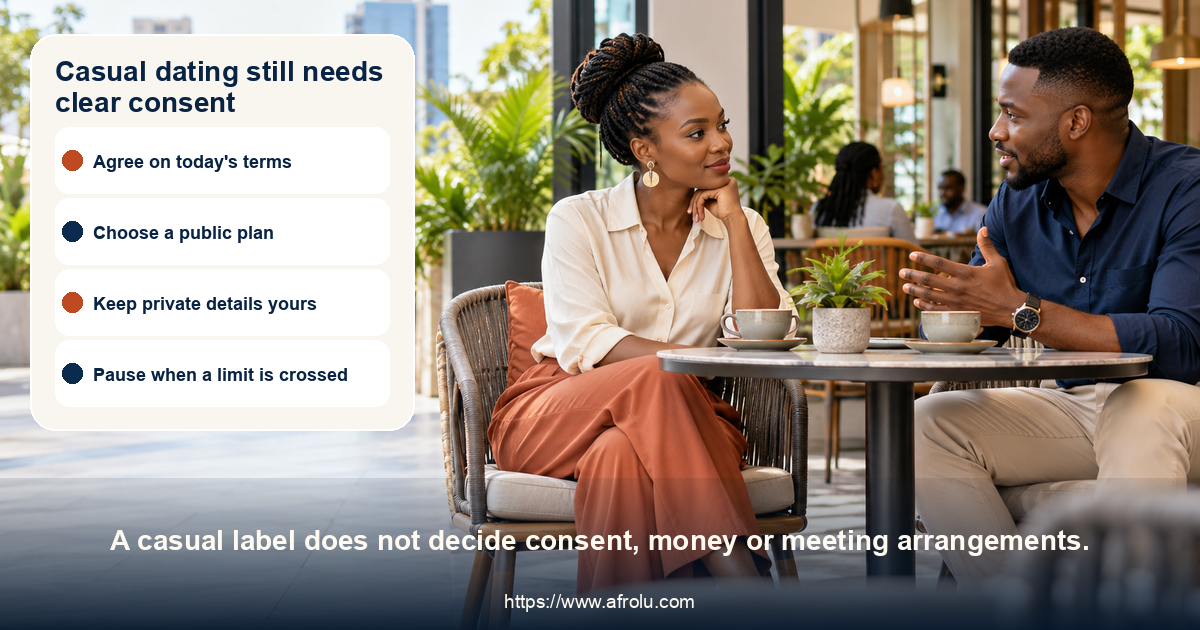
A casual label does not decide consent, money or meeting arrangements. Afrolu:
Written and edited by Adwoa Boateng · Dating Safety Editor
Define casual in present terms, including whether you are dating others, how you prefer to communicate and which boundaries matter. For an early meeting, choose a public place, arrange your own way home and tell someone you trust. Consent and faith-based boundaries must be discussed rather than inferred from a label.
Modern dating terms · Faith-Led Daters
How can you explore casual dating while keeping your boundaries, safety choices and relationship terms clear?
Casual dating is a broad description, not a standard contract. Adults may use it for limited commitment, early exploration or a different contact rhythm. Faith-led describes each person's own values. Neither phrase determines consent, exclusivity, marriage plans, sexual boundaries or what private information someone must share.
At 29, Adwoa is open to meeting someone without promising a relationship. Daniel says he wants to keep it casual, then suggests meeting at his apartment after work. She would rather start in a busy public place and wants to know whether he is dating others. She names both points clearly and watches whether he can discuss them without pressure.
Name what casual means
A broad label cannot replace an agreement
One adult may use casual to mean seeing each other occasionally; another may mean no exclusivity or no long-term planning. Neither person can know which meaning is intended from the word alone. Ask what the other adult is choosing now and say which parts of that arrangement you would accept.
You can discuss whether either person is dating others, how much notice you prefer for a date and whether you want contact between meetings. These are practical questions, not an attempt to turn casual dating into a formal partnership. Both adults can answer honestly and decide whether their preferences fit.
A casual label does not remove the need for respect or consent. You can set limits on physical affection, messages, alcohol, photos or personal details. The other person may have different boundaries; the useful question is whether each adult can state them without pressure and make choices freely.
Faith-led dating is also personal rather than a fixed format. You might want your values to guide how you date while staying open about the outcome. Another adult can define faith differently or prefer another pace. Ask about the specific choices that affect compatibility instead of assuming the label settles them.
Choose a first meeting
Make a public plan that leaves you options
For an early meeting, choose a populated public place that feels familiar enough for you to navigate. Let a trusted person know where you expect to be and when you plan to check in. These steps can help you keep options available; they cannot guarantee what another person will do.
Arrange your own transport to and from the meeting when you can. Avoid relying on a new match for a ride, a place to stay or an explanation of where you are. If your plans change, you can leave or choose another location without having to defend the decision.
Keep the first plan short enough that you can assess how the conversation feels. A coffee or a call does not create an obligation to meet again, continue the date or move to a private setting. You can end an interaction simply because your comfort changed, even if the other person seems disappointed.
Some adults prefer to video chat first; others prefer a direct public meeting. Neither choice verifies identity completely. Use your own judgement, avoid sending money or identity documents, and do not treat a successful call as proof that every detail in a profile is true.
Protect personal information
Share details at a pace you choose
Use the conversation to learn how the person communicates before sharing a phone number, home address, exact work location or regular schedule. You can keep messages on the dating platform while you decide whether moving elsewhere feels right. A request to leave immediately is not something you have to accept.
Think about the photos and profile details you make public. A workplace badge, street sign or familiar view can reveal more than you intend. If you have already shared information and feel uneasy, review account privacy options and consider asking the platform about reporting or blocking tools.
Do not send money, gift cards, cryptocurrency, identity documents or account credentials to a new online love interest. A request framed as an emergency or proof of care can still put you at risk. You may pause, ask someone you trust for a second opinion and decline without explaining your finances.
Keep faith or community details private until you choose to share them. You are not obligated to name a place of worship, a weekly schedule, family contacts or a private ceremony to prove that your values are genuine. A respectful person accepts a gradual conversation and does not use personal details to pressure you.

Make the arrangement answerable before either person relies on it. Afrolu:
Keep consent specific
Casual does not mean available by default
Consent is about the particular activity and moment, not a label on a dating profile. A person who agrees to dinner has not agreed to physical contact, a private visit, a photo or another date. Check in and make it easy for either adult to change their mind without being argued into continuing.
Talk about alcohol, medication or any circumstance that could make it hard for either person to make a clear choice. If someone seems uncomfortable, uncertain or unable to answer freely, pause rather than filling in the answer for them. You may also choose to leave when your own judgement feels affected.
A faith commitment may shape one person's comfort with physical affection, but it does not tell you what that boundary is. Ask respectfully and accept the answer without treating it as a negotiation challenge. People can have different practices even when they use similar language for belief or dating.
If someone continues after you have said no, pressures you to prove interest or treats a past encounter as permission, you can end the interaction and seek support from a person or service you trust. The responsibility for ignoring consent belongs to the person who ignores it, not to the adult who chose to date.

A casual label does not excuse pressure or entitlement. Afrolu:
Notice how limits are handled
Look for respect, not a perfect performance
A match may disagree with your preferred pace or meeting place. Disagreement alone does not establish danger. Notice what happens after you state a limit: do they listen, offer another option, ask what would work or keep pressing for the original plan? A repeated refusal to accept your answer deserves attention.
Be cautious if a person asks for money, tries to obtain passwords or documents, demands secrecy, discourages you from telling friends or invents urgency around travel. These behaviors warrant a pause and independent advice. They still do not allow you to diagnose the person; your choice can focus on the action and your safety.
A profile may be incomplete or misleading, and an app badge cannot guarantee another user's intent. You can ask a clarifying question, take time before meeting and end contact if information does not add up. You do not need to conduct a personal investigation or confront a person to justify leaving.
If something feels uncomfortable, you can change the plan, stop replying or use an app's report and block features. Tell someone you trust what is happening if that would help you feel supported. Save messages only if safe and useful to you; your next step should not increase exposure.
Read safety evidence carefully
A study cannot promise what a date will do
Safety research often describes the practices participants report, not a checklist proven to prevent every form of harm. A U.S. survey, a U.K. interview study or a platform's own guidance may raise useful questions while reflecting a different country, age group or dating community from yours.
When a survey describes online dating harassment, check which adults took part and how the questions were worded. The results may document experiences in that study population; they do not predict what will happen to you or establish that a specific match is unsafe based on identity or faith.
Guidance from a dating service can explain its own safety tools, but it is not an independent test of another member. Learn where reporting and privacy controls are located, then make your own decisions. A verification feature may confirm one limited detail and should not replace judgement or consent.
Use a source to expand your choices, not to transfer responsibility for someone else's behavior onto yourself. Planning a public date may help you feel more in control, but nobody can guarantee an outcome. You are entitled to support after an uncomfortable event regardless of whether you followed a recommended precaution.
Choose the arrangement
Continue, renegotiate or end contact
Before agreeing to another date, state the terms that matter to you: the kind of casual arrangement you want, whether you are dating other adults and which boundaries are non-negotiable. Ask the other person to describe their own expectations. A clear mismatch can end the conversation without either person needing to be blamed.
If the current plan feels workable, choose a public activity and tell someone you trust if that is useful to you. Set a check-in plan, keep your own exit options and decide what personal information stays private. You can adjust these choices as you learn more about the person and about yourself.
If the other adult says yes to your boundary but repeatedly acts against it, take the behavior seriously. You may remind them once if you want to, but you do not owe repeated explanations. Block or report through the platform if that fits the situation, and seek help if you feel at risk.
After the interaction, ask whether you felt free to choose the date, the contact and the ending. If your answer is no, you may pause before deciding about future contact. Casual dating can be meaningful for a time, and it can also stop when its terms or safety no longer work for you.

You may cancel or leave when a plan no longer feels right. Afrolu:
Eight moments where casual terms need clarity
A private first meeting
The other person wants the first date at home
Keep the first plan in a public place if that is your preference.A consent assumption
Casual dating is treated as consent to a new activity
Pause and decide about that activity separately.Faith pressure
A personal boundary is framed as a test of belief
Restate the boundary and watch whether it is respected.An unwanted photo
Someone asks for an intimate image as proof of interest
Decline and keep control of private material.Money request
A new match asks you to cover an emergency or ticket
Do not send money to an online love interest.App exit
You are urged to move off-platform before you feel ready
Keep the conversation where reporting tools are available.Casual terms
One person expects exclusivity and the other does not
Discuss exclusivity directly before relying on an assumption.Changed venue
A public date is switched to a secluded location
Keep the agreed setting or cancel the plan.Notice how a match responds to limits
A private first meeting: The other person wants the first date at home
A consent assumption: Casual dating is treated as consent to a new activity
Faith pressure: A personal boundary is framed as a test of belief
An unwanted photo: Someone asks for an intimate image as proof of interest
Money request: A new match asks you to cover an emergency or ticket
App exit: You are urged to move off-platform before you feel ready
Casual terms: One person expects exclusivity and the other does not
Changed venue: A public date is switched to a secluded location
A specific plan is confirmed by both adults
A change is communicated when reasonably possible
Each person can decline without being punished
Personal details are shared by choice, not pressure
Planning effort does not fall on one person every time
Either adult can revisit an arrangement as needs change
Choose the response that preserves your agency
| Situation | What it may mean | What to do next |
|---|---|---|
| A private first meeting | The other person wants the first date at home | Keep the first plan in a public place if that is your preference. |
| A consent assumption | Casual dating is treated as consent to a new activity | Pause and decide about that activity separately. |
| Faith pressure | A personal boundary is framed as a test of belief | Restate the boundary and watch whether it is respected. |
| An unwanted photo | Someone asks for an intimate image as proof of interest | Decline and keep control of private material. |
| Money request | A new match asks you to cover an emergency or ticket | Do not send money to an online love interest. |
| App exit | You are urged to move off-platform before you feel ready | Keep the conversation where reporting tools are available. |
| Casual terms | One person expects exclusivity and the other does not | Discuss exclusivity directly before relying on an assumption. |
| Changed venue | A public date is switched to a secluded location | Keep the agreed setting or cancel the plan. |
| A reply arrives later | Timing alone does not establish the reason or the person's whole intention. | Ask for the information that changes your next choice. |
| A plan is canceled | A cancellation can happen for many reasons; a new plan is separate information. | Decide whether to invite a replacement plan or move on. |
Words for casual terms, consent and safety
“When you say casual, what are you choosing about seeing other people and making plans?”
“I would rather meet in a busy public place and arrange my own way home.”
“I am comfortable with this, but not the next step. Please check with me again.”
“I do not send intimate pictures. Please do not ask me again.”
“I cannot send money. I will keep this conversation on the app for now.”
“This arrangement does not feel right for me, so I am ending contact.”
“I would rather understand what you want now than guess from a message pattern.”
“I can share a time window without giving my employer, address or full schedule.”
“Can we choose the time and place before I hold that day open?”
“That does not work for me. I am comfortable with the option we discussed.”
“I have thought about it again, and I want to change the plan.”
“I do not want to continue dating. Please do not contact me again.”
Know the difference
Mutually agreed casual dating versus assumed access
Terms each adult understands and accepts
A label treated as automatic consent
Casual never replaces consent.

Casual never replaces consent. Afrolu:
Separate mutual casual terms from assumed access
| Type or dimension | What it describes | Best next question |
|---|---|---|
| Casual dating and situationship | People use both labels differently; the useful question is whether the present terms are understood. | Describe exclusivity, contact and boundaries in plain words. |
| Casual and consent | An arrangement label cannot provide consent to an activity. | Ask each time and accept a no without bargaining. |
| Public plan and guaranteed safety | A public setting may support options but cannot guarantee another person's behavior. | Choose the setting and exit plan that fit your comfort. |
| Faith identity and practice | A profile label does not establish a person's boundaries or expectations. | Ask what matters to each adult now. |
| Contact and commitment | Messages show contact; they do not establish exclusivity or a future promise. | Discuss the agreement directly. |
| A label and a boundary | A dating label does not cancel a person's individual limits. | Ask what each adult is comfortable with. |
| Interest and capacity | Someone can feel interested and still have limited time or money. | Look for an honest plan that fits real capacity. |
| A question and a diagnosis | A reader can describe a pattern without diagnosing the other adult. | Use observable actions and choose a boundary. |
| Similarity and agreement | Shared background or values do not guarantee agreement about a specific choice. | Ask what the person means in practice. |
A simple plan you can use today
Casual is not a consent category
Each activity requires its own unpressured agreement.
Platform tools have limits
Blocking and reporting can help, but they cannot control every offline interaction.
Personal information has a cost
An address, work routine or image can be difficult to take back once shared.
A money request is separate
An online connection does not create a duty to pay for an emergency or trip.
No single clue decides
A message gap, a profile label or one date cannot explain an entire relationship.
Your preference is relevant
A reader may choose an arrangement that does not suit someone else.
Questions organised by purpose and depth
Choose a few prompts that fit the moment. This is a reference library, not a list to complete.
Casual terms
Decide what you need to know before agreeing to an arrangement.
- Is exclusivity included?
- What boundaries matter?
- What does each person want now?
Meeting choices
Keep consent and safety options individual.
- Where do you prefer to meet?
- How will you get home?
- Which information stays private?
Review
Use conduct and your comfort to decide what comes next.
- Was a no accepted?
- Did the setting stay agreed?
- Do you want another date?
One next choice
Keep the next decision small enough to make with the information you have.
- What do I know?
- What do I still need to ask?
- What choice stays mine?
What deserves a closer look
Evaluations and future plans after casual sexual experiences: Differences across partner type
An emerging-adult study compared reported experiences by partner type; its research categories do not define casual dating for every adult.
Evidence limit: Use this source only within the population and limits named in its note.
Sex at Sea: Undergraduates' Perceptions of Sexual Relationships During Their Semester at Sea Voyage
A small, travel-specific undergraduate sample described communication and boundaries; its setting and age group do not represent adult diaspora daters generally.
Evidence limit: Use this source only within the population and limits named in its note.
Tips for Safer Dating: Online & In-Person
A U.S.-based sexual-violence organization suggests privacy, public-meeting and transport precautions while stating that no step can guarantee safety; its U.S. support channels are not Kenyan services.
Evidence limit: Use this source only within the population and limits named in its note.
Safety tips
A dating platform's own guidance covers public first meetings, personal information and money requests; it is not independent verification or a guarantee about any service or match.
Evidence limit: Use this source only within the population and limits named in its note.
Romance Scams
U.S. consumer guidance warns against sending money, gift cards, wire transfers or cryptocurrency to an online love interest; it is not a Kenya-specific prevalence estimate or legal rule.
Evidence limit: Use this source only within the population and limits named in its note.
Sexual Consent in Committed Relationships: A Dyadic Study
A dyadic study examined beliefs and communication in committed relationships; it does not replace asking for consent in a new dating interaction.
Evidence limit: Use this source only within the population and limits named in its note.
Avoid treating a label as permission
Treating casual as consent
Each activity still needs an unpressured yes.
Sharing a full work routine
A match can plan without knowing an address or shift pattern.
Sending money to prove care
Financial help does not secure affection or verify a story.
Staying after the venue changes
You can cancel when a new setting does not suit you.
Guessing instead of asking
A direct question gives both adults a chance to clarify current terms.
Treating a yes as permanent
Consent and preferences can change when the activity or circumstances change.
Explore more about casual dating agreements, consent, personal faith and safer in-person choices
This guide offers editorial information, not diagnosis, therapy, custody, legal or emergency advice. Seek qualified support for individual questions.
Explore the guide library
Show more related guides
Continue with Afrolu
Show more Afrolu guides
Sources used for this guide
Afrolu reviewed these health, research, safety, or public guidance resources while editing this page. They support the behaviour and safety guidance; they do not diagnose any individual described by a reader.
Questions about safe, faith-led casual dating
Does casual dating include consent to sex?
No. Consent is specific to each activity and can be changed or withdrawn.
Can I ask for a public first meeting?
Yes. You can choose a public setting and your own way home.
Does faith-led casual dating require one set of rules?
No. Explain your own practice and ask the other adult about theirs.
Should I send money to someone I met online?
No. The FTC advises U.S. consumers not to send money to an online love interest; keep funds private regardless of the story.
Do I have to move a chat off the app?
No. Continue where you feel comfortable and where reporting options remain available.
Can casual dating be exclusive?
Yes, if both adults clearly choose exclusivity; the casual label does not answer that question.
Can I change the venue or cancel?
Yes. You may revise a plan when the details change or feel wrong.
Does a checklist guarantee my safety?
No. Precautions can give you options, but no plan can guarantee another person's conduct.
Can I change my mind after agreeing to a date?
Yes. Tell the other person when you can, and choose the arrangement that feels right now.
Does one message or date prove a person's intention?
No. Ask directly and assess the conduct you can actually observe over time.
One thing to do now
Keep only the terms you freely choose
Choose the arrangement and first meeting you can freely accept, then notice whether the other adult respects the same terms in action.