Adult faith-led dating · weekend plans · an easy pace
Keep a low-pressure pace when faith shapes your weekends
Plan low-pressure weekend dating around your own faith, rest and real availability. Define the pace, confirm a date and leave room for either person to say no.
A low-pressure invitation can still have a day, time and a clear answer. Afrolu:
Written and edited by Tariro Ncube · Diaspora Dating Editor
Explain what low pressure means to you in practical terms: how often to meet, how much notice helps and which weekend commitments are already protected. Ask what the other adult wants, then suggest one date both can confirm. Faith-led does not carry one universal schedule or set of relationship terms.
Modern dating terms · Faith-Led Daters
How can you date at an easy pace when weekends are also important for faith, community, rest or family life?
Low-pressure dating is a pace and set of expectations that the adults involved freely choose. Faith-led describes the role a person gives their own spiritual, religious or ethical commitments. Neither phrase establishes exclusivity, a future plan, a contact quota or what another person believes.
At 31, Tariro works in a regional role and keeps some weekends for a community practice that matters to her. Kofi suggests meeting but leaves the day open, then messages late on Saturday. She likes him and does not want a rushed label, yet she also wants plans she can rely on. She proposes one clear window and asks what kind of pace he has in mind.
Make the pace concrete
Low pressure still has clear terms
People use low pressure to describe different arrangements. One person may mean one date at a time; another may mean fewer messages, no early label or a slower introduction to friends. Ask what the phrase means now instead of expecting it to explain interest, exclusivity or a future commitment by itself.
You can prefer a relaxed pace while still wanting a date confirmed before you reserve your Saturday. A specific plan is not a demand for a relationship promise. It simply lets both adults decide whether the proposed time, activity and level of attention suit their current lives.
Faith-led dating also has no single calendar. A weekend may include worship, reflection, volunteering, family care, rest or no set practice at all. Do not assume which day is protected or what a person believes from a profile label. Let each adult describe their own commitments in their own words.
Try separating preferences from boundaries. You might prefer spontaneous coffee but require a message before someone changes the meeting place. You might enjoy a weekly date but not want daily check-ins. That distinction makes negotiation easier because each person can tell what is flexible and what would make the arrangement unworkable.
Protect the time you have
Plan around weekends you already value
Start with the time you can genuinely offer after work, rest and other responsibilities. If Saturday morning is committed, say it is unavailable; you do not owe details about a service, community, family member or personal practice. A simple calendar boundary is enough information to make a respectful plan.
When your schedule varies, suggest a window and a time you will know for certain. For example, you can say you will confirm after a shift rota arrives. The other adult can decide whether that uncertainty works for them, and you can avoid promising a date before your own time is clear.
A date can be modest: a public coffee, a walk in a place you already know or a call before deciding whether to meet. Choose an activity that leaves room to talk and end at a time that fits your next commitment. Spending more or staying later does not prove a connection is serious.
If an invitation conflicts with a protected plan, decline without turning the conflict into a test. You can suggest another time if you want to meet. If the other person takes a no personally or repeatedly pushes past the same limit, notice that response and decide what contact feels comfortable from here.
Choose a communication rhythm
Make contact fit real life
Some adults enjoy frequent messages through the weekend; others put their phones away during a practice, family visit or rest period. Neither routine has to be the correct one for everyone. Tell the other person what they can expect from you and ask what helps them feel informed without requiring constant access.
A delayed reply does not explain itself. A person may be busy, offline, uncertain or choosing not to continue, and an online status cannot tell you which. If a specific answer matters to a date, ask the practical question directly and set a reasonable time to make your own plans.
You can share a short notice such as, 'I will be offline until tomorrow evening.' That is useful when you want to stay connected, but it is not a duty to report every movement. Keep your home address, exact routine and private community details to yourself until you choose to share them.
If your preferred contact patterns differ, discuss a workable middle ground rather than promising a routine you will resent. A planned call can replace many messages; a quick confirmation can settle transport without opening a long conversation. Revisit the agreement if work or personal commitments change.

A direct invitation can leave room for faith, rest and a free answer. Afrolu:
Separate a label from a pattern
Use benching as a question, not a verdict
People use benching for different experiences, including occasional messages without a clear invitation. The word is not a clinical category and does not establish why someone is acting that way. Write down what happened: who suggested meeting, whether a time was set, how a change was handled and what each person actually said.
A weekend cancellation can have a real explanation, but the explanation does not create an obligation for you to keep the entire day open. If the person wants another date, they can suggest one; you can decide whether it works. A repeated absence of plans is information about the arrangement you currently have.
Ask one neutral question about the choice in front of you: 'Would you like to plan a specific day next weekend, or are you keeping things casual for now?' Listen to the answer and compare it with what happens later. You do not have to accuse anyone or guess whether faith or work caused the uncertainty.
If the answer remains vague, decide what you will do with your own time. You may keep meeting when plans are concrete, ask for a different arrangement or step away. Your decision can reflect your needs without proving that the other adult is careless, dishonest or less sincere.

Look for shared planning over several dates, not a single reply time. Afrolu:
Keep practice and boundaries personal
Explain what matters without assuming a match
Two people who describe dating as faith-led may mean different things by it. One may be observant, another may be exploring, and another may use the phrase for a personal ethical commitment. Do not infer prayer, abstinence, marriage goals, family rules or a shared tradition without a direct conversation.
If a practice changes when you are available, explain that connection rather than teaching the other adult a whole tradition. You can say that you keep a particular evening for reflection or do not schedule dates during a certain commitment. The person can ask a respectful question, and you can choose how much to share.
Intimacy, consent and exclusivity remain separate conversations. Shared faith language does not decide whether either person wants physical affection, a label, a future together or a particular boundary. Ask before an activity, listen to the answer and remember that either person can change a decision at any point.
If someone mocks a practice, pressures you to prove sincerity or demands private details before you feel ready, you can end the conversation. A respectful connection allows each adult to describe and revise their own choices. You are allowed to keep a boundary even when the other person says they share your beliefs.
Use research with limits
A study can suggest a question, not choose a partner
Research about religious similarity often studies marriage or established couples rather than adults arranging a first or early date. Those designs can help identify topics such as shared practice or family expectations, but they do not show that a person with a particular label will behave in a specific way during a weekend plan.
Studies based in Germany, the United States or Pakistan reflect their participants and social settings. Their findings should not be transferred directly to African diaspora communities or to every faith tradition. Use them as prompts for asking what each person personally values, rather than as a rule about who is compatible.
If a source examines marriages, do not treat it as proof about casual or low-pressure dating. Relationship status, age, community support and life stage can differ substantially. A responsible reading keeps the sample and question visible, then returns to the decision the adults in front of you can actually make.
Your own preference does not require a research citation. If you want Sunday dates, room for spiritual practice or less texting, those are valid details to discuss. Evidence can add context, but your consent, comfort, schedule and freely chosen relationship terms remain the information most relevant to your next step.
Choose what happens next
Keep the decision small and mutual
Before replying to an invitation, decide which part matters most today: a confirmed time, a slower pace, an honest conversation about faith or enough notice to arrange your travel. A clear request gives the other adult something they can answer without asking them to promise how the whole relationship will develop.
If you both want to continue, choose one date that fits each person's calendar and agree how you will confirm changes. Keep the plan proportionate to how well you know each other. You can talk about more serious intentions later, after both adults have had room to observe the connection.
If the other person's preferred schedule or expectations do not fit yours, a mismatch can be enough reason to stop. You do not need to decide that either adult is wrong or unfaithful. Thank them if safe, state that you want a different arrangement and protect the time you need for yourself.
Review the plan after you have seen how it works. Did both people contribute? Could either person say no? Did the communication leave room for rest and personal practice? Let those concrete answers guide your next choice, and change your mind if the arrangement stops feeling freely chosen.

You can date slowly without saving every weekend for a maybe. Afrolu:
Eight ways weekend plans can feel mutual
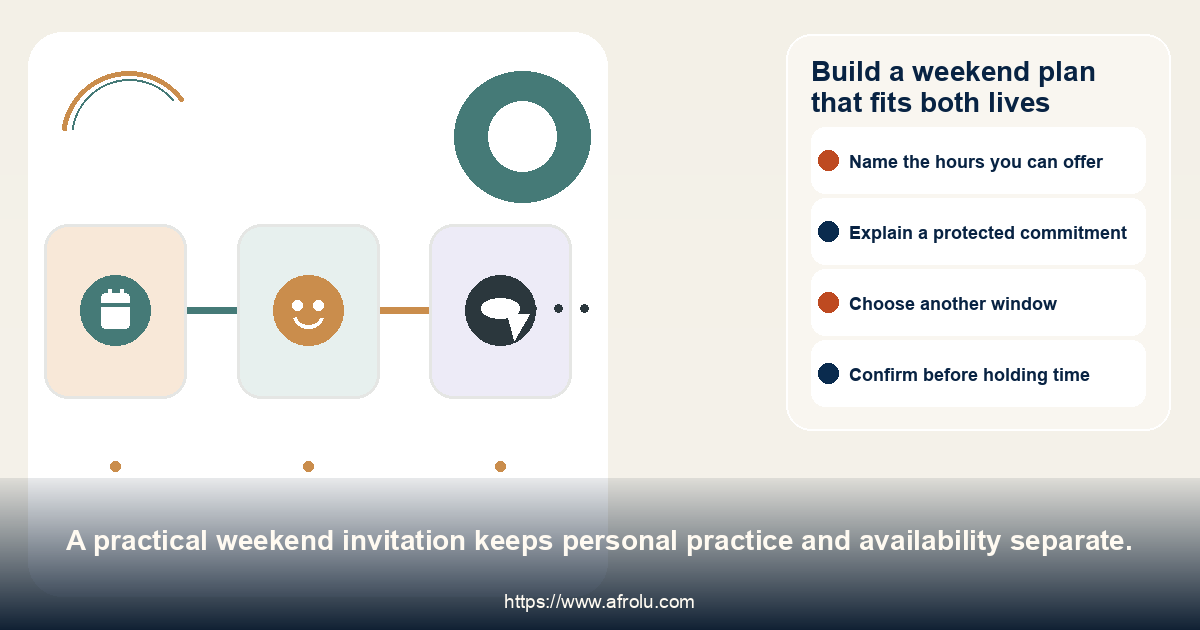
A protected Sunday
A match suggests a date during a time you keep for worship or community
Offer a different window without defending the practice.A vague invitation
Messages say 'this weekend' but no time is chosen
Ask for a day and place before reserving the hours.Different practices
Both adults mention faith but keep different routines
Share what affects your calendar and ask what matters to them.Late change
A plan moves after you have arranged your weekend
Decide whether the new time still works for you.Family expectation
A relative asks for an update before you are ready
Agree what, if anything, you want to share.One-sided planning
You are always asked to fit around the other person's schedule
Suggest one plan that includes your needs too.Faith label
A match treats a shared label as proof of compatibility
Discuss the actual decisions rather than relying on the label.Pace changes
You want more space during a busy month
Tell the other person what you can offer now.What a considerate weekend rhythm looks like
A protected Sunday: A match suggests a date during a time you keep for worship or community
A vague invitation: Messages say 'this weekend' but no time is chosen
Different practices: Both adults mention faith but keep different routines
Late change: A plan moves after you have arranged your weekend
Family expectation: A relative asks for an update before you are ready
One-sided planning: You are always asked to fit around the other person's schedule
Faith label: A match treats a shared label as proof of compatibility
Pace changes: You want more space during a busy month
A specific plan is confirmed by both adults
A change is communicated when reasonably possible
Each person can decline without being punished
Personal details are shared by choice, not pressure
Planning effort does not fall on one person every time
Either adult can revisit an arrangement as needs change
Choose from the plans and replies you can observe
| Situation | What it may mean | What to do next |
|---|---|---|
| A protected Sunday | A match suggests a date during a time you keep for worship or community | Offer a different window without defending the practice. |
| A vague invitation | Messages say 'this weekend' but no time is chosen | Ask for a day and place before reserving the hours. |
| Different practices | Both adults mention faith but keep different routines | Share what affects your calendar and ask what matters to them. |
| Late change | A plan moves after you have arranged your weekend | Decide whether the new time still works for you. |
| Family expectation | A relative asks for an update before you are ready | Agree what, if anything, you want to share. |
| One-sided planning | You are always asked to fit around the other person's schedule | Suggest one plan that includes your needs too. |
| Faith label | A match treats a shared label as proof of compatibility | Discuss the actual decisions rather than relying on the label. |
| Pace changes | You want more space during a busy month | Tell the other person what you can offer now. |
| A reply arrives later | Timing alone does not establish the reason or the person's whole intention. | Ask for the information that changes your next choice. |
| A plan is canceled | A cancellation can happen for many reasons; a new plan is separate information. | Decide whether to invite a replacement plan or move on. |
Words for setting a pace without hiding your interest
“I can meet Sunday after lunch. Would that fit, or is another day better for you?”
“I keep Saturday morning for a commitment that matters to me. I am free later in the day.”
“I enjoy getting to know you slowly. I still prefer to confirm a date before I hold the time.”
“I cannot make a plan with an hour's notice today. If you want, we can choose a time next weekend.”
“I am not ready to share details with family yet. I will tell you when that changes.”
“I liked our conversation. Would you like to arrange another date, or leave it here?”
“I would rather understand what you want now than guess from a message pattern.”
“I can share a time window without giving my employer, address or full schedule.”
“Can we choose the time and place before I hold that day open?”
“That does not work for me. I am comfortable with the option we discussed.”
“I have thought about it again, and I want to change the plan.”
“I do not want to continue dating. Please do not contact me again.”
Know the difference
A chosen slow pace versus an unconfirmed connection
Flexible pace with clear mutual plans
No shared terms or confirmed next date
A relaxed pace can still be specific.

A relaxed pace can still be specific. Afrolu:
Separate an easy pace from an unconfirmed connection
| Type or dimension | What it describes | Best next question |
|---|---|---|
| Slow pace and benching | Slow pace is a preference the adults can discuss; benching is a label people apply to uncertain contact. | Ask whether another date is wanted and decide how long uncertainty works for you. |
| Weekend availability and interest | One protected day does not tell you how much someone cares. | Offer a real alternate time and look at the response. |
| Schedule conflict and vague planning | A conflict explains one change; an ongoing lack of clear plans is a separate pattern. | Ask for a date that can be confirmed. |
| Serious hope and pressure | A long-term goal can be stated without asking for a promise today. | Discuss the next decision rather than the whole future. |
| Contact and commitment | Messages show contact; they do not establish exclusivity or a future promise. | Discuss the agreement directly. |
| A label and a boundary | A dating label does not cancel a person's individual limits. | Ask what each adult is comfortable with. |
| Interest and capacity | Someone can feel interested and still have limited time or money. | Look for an honest plan that fits real capacity. |
| A question and a diagnosis | A reader can describe a pattern without diagnosing the other adult. | Use observable actions and choose a boundary. |
| Similarity and agreement | Shared background or values do not guarantee agreement about a specific choice. | Ask what the person means in practice. |
A simple plan you can use today
Availability is not a verdict
A protected weekend window tells you when someone is free, not how much they care.
Low pressure can be explicit
A relaxed pace still allows direct dates, clear boundaries and confirmation.
Faith is personal
Shared words do not establish matching observance or relationship expectations.
A label cannot reveal motive
Benching describes one person's interpretation of a pattern, not a diagnosis.
No single clue decides
A message gap, a profile label or one date cannot explain an entire relationship.
Your preference is relevant
A reader may choose an arrangement that does not suit someone else.
Questions organised by purpose and depth
Choose a few prompts that fit the moment. This is a reference library, not a list to complete.
Your weekend
Separate a protected commitment from time you can offer.
- Which window is genuinely open?
- How much notice do you want?
- What stays private for now?
Their answer
Notice how the other adult responds to a clear invitation.
- Did they choose a time?
- Did they offer another option?
- Did both calendars matter?
Your choice
Choose how much uncertainty fits your life.
- When will you make other plans?
- What pace feels calm to you?
- What would make you stop waiting?
One next choice
Keep the next decision small enough to make with the information you have.
- What do I know?
- What do I still need to ask?
- What choice stays mine?
What deserves a closer look
Time for Each Other: Work and Family Constraints Among Couples
A U.S. time-use analysis examined work, family demands and shared time among established couples; it cannot prescribe a dating cadence for other populations.
Evidence limit: Use this source only within the population and limits named in its note.
Partnership Preferences in Modern Migration Societies: Religious Homophily Among Young Muslims and Christians in Germany
A vignette study of young Muslims and Christians in Germany varied denomination, religious importance and partnership type; it does not represent all diaspora adults or predict an individual's choices.
Evidence limit: Use this source only within the population and limits named in its note.
The AFFIRM Model for Navigating Challenges in Continuously-Interfaith and Divergent-Interfaith Marriages
Qualitative interviews with 30 U.S. interfaith couples who self-reported happy, stable marriages and were raising or had raised children; a small purposive marriage sample, not a representative dating study.
Evidence limit: Use this source only within the population and limits named in its note.
Commitment: Functions, Formation, and the Securing of Romantic Attachment
Review of relationship commitment theory; useful for distinguishing dedication and constraints, but not a diagnostic test or a timetable for a particular dating connection.
Evidence limit: Use this source only within the population and limits named in its note.
Relational Uncertainty and Cortisol Responses to Hurtful and Supportive Messages from a Dating Partner
Two studies examined physiological responses and uncertainty in dating-partner interactions; their findings do not reveal a new match's motive or diagnose anyone.
Evidence limit: Use this source only within the population and limits named in its note.
Sexual Consent in Committed Relationships: A Dyadic Study
A dyadic study examined beliefs and communication in committed relationships; it does not replace asking for consent in a new dating interaction.
Evidence limit: Use this source only within the population and limits named in its note.
Assumptions that turn availability into a verdict
Treating a protected weekend as rejection
Availability on one day cannot explain someone's whole interest.
Leaving every Saturday open
A vague possibility is not a shared plan.
Using faith as a compatibility shortcut
A label cannot replace questions about personal practice.
Waiting for a reply as a test
Message timing is not a reliable measure of commitment.
Guessing instead of asking
A direct question gives both adults a chance to clarify current terms.
Treating a yes as permanent
Consent and preferences can change when the activity or circumstances change.
Explore more about faith-led weekend dating at a personally chosen pace with clear mutual plans
This guide offers editorial information, not diagnosis, therapy, custody, legal or emergency advice. Seek qualified support for individual questions.
Explore the guide library
Show more related guides
Continue with Afrolu
Show more Afrolu guides
Sources used for this guide
Afrolu reviewed these health, research, safety, or public guidance resources while editing this page. They support the behaviour and safety guidance; they do not diagnose any individual described by a reader.
Questions about faith-led weekend dating
Does low-pressure dating mean keeping every weekend open?
No. Name which hours you can offer and keep the rest of your calendar.
Should I explain my faith practice before a first date?
Share what affects the plan; you decide how much personal history to disclose.
Does a delayed message prove benching?
No. Contact timing cannot establish motive. Ask whether a specific date is wanted.
Can I decline a weekend invitation?
Yes. You can offer another time or simply say the proposed time does not work.
Does a shared religion guarantee compatibility?
No. Discuss personal practices, values and expectations directly.
Can I want a serious relationship and still date slowly?
Yes. A long-term hope does not require a quick promise.
What if plans are always last-minute?
Explain how much notice you need and decide whether the pattern suits you.
Do I need to keep a date open without confirmation?
No. Set a reasonable confirmation point and make other plans if it passes.
Can I change my mind after agreeing to a date?
Yes. Tell the other person when you can, and choose the arrangement that feels right now.
Does one message or date prove a person's intention?
No. Ask directly and assess the conduct you can actually observe over time.
One thing to do now
Decide whether the next plan fits your life
Describe the weekend rhythm you can offer, ask for the other person's terms and judge the fit by the agreement and follow-through you both choose.