Adult faith-led dating · career seasons · clarity
Faith-Led Dating and Career Demands: Ask What Fits
When work and faith both shape your dating choices, clarify what each means, ask about current availability and keep personal beliefs and boundaries your own.

Ask what each person means by faith-led, then plan around real work windows. Afrolu:
Written and edited by Chipo Banda · Editorial Researcher
Begin with your own meaning of faith-led dating; it has no universal definition. Separate a busy schedule from relationship intent, then ask what the other adult wants and can realistically offer. Discuss only the beliefs and practices that matter to your decisions, including pace and boundaries if relevant, and decide whether the current arrangement fits without judging either person's faith.
Modern dating terms · Faith-Led Daters
How can you ask for clarity about a faith-led connection when work limits the time you can offer?
In this guide, faith-led dating means an adult wants their own religious, spiritual or ethical commitments to inform dating choices. It does not imply one tradition, level of observance, relationship structure, wedding goal, abstinence or family expectation. Benching describes a possible contact pattern; it cannot reveal why a person is quiet or how they practice.
At 31, Zahra works in health care in Nairobi with shifts that change each month. She values her Muslim practice and is getting to know Peter, who describes faith as important to him too. He sends warm messages but rarely suggests a date. Rather than assume they share the same beliefs or timing, Zahra explains her available evenings and asks what faith-led dating means to each of them now.
Start with your meaning
Let each adult define faith-led dating
Faith-led can refer to religious observance, spiritual practice, ethical commitments, community life or a personal sense of meaning. Adults may use the same phrase while intending different things. Start with your own priorities and ask the other person how their beliefs affect dating choices they make today.
Do not assume which religion someone follows, how often they attend services, what texts they value or whether they identify with a community. A profile label offers only a starting point. If it matters to you, ask respectfully and give the other adult room to describe what they do or do not want to share.
Faith can shape dating pace, holidays, food, family introductions, sexuality, marriage hopes or community participation for some people. It may matter in only a few areas for others. A useful conversation identifies which practical decisions affect you rather than requiring a complete account of private belief at the start.
You do not need to persuade another adult to adopt your beliefs, or to pretend that faith is irrelevant to you. State what you personally choose and what you hope to find. The other adult can answer in their own terms, including uncertainty or difference, and you can decide whether that answer fits.
Separate work from intent
A full calendar is not a relationship answer
Career demands can affect evenings, travel, rest and the ability to plan far ahead. A demanding role might explain why a date is difficult this week, but it does not answer whether someone wants to keep dating. Ask about the question you need answered instead of using availability as a proxy for intent.
Share only the schedule detail needed to make a plan. You might say that shifts are published on Thursday or that you can meet on one weekend afternoon. You do not owe a new match your employer's name, staff rota, client details or a live location to demonstrate that your calendar is busy.
If a person says they want to meet but cannot identify any possible window, ask whether they would like to suggest another time when their calendar is clearer. You can respect professional obligations and still choose not to remain indefinitely on standby. A limit protects your own time without judging their work.
Faith practices can also take time, but adults vary in how they observe, and work or caregiving may shape that practice. Do not assume a worship day or ritual schedule based on someone's tradition. Ask which times matter to them if you are planning together, then share your own constraints.
Ask about the connection
Describe the pattern and invite a clear answer
You can say, I enjoy our conversations, and we have not chosen a time to meet. Are you interested in arranging a date, or would you prefer to leave this as occasional contact? This describes what is happening and gives the other adult two possible answers without claiming that faith or work is the cause.
If the other adult says yes, move toward an actual plan that fits both calendars. If they say they are unsure, ask what they need to decide or whether a later check-in would be welcome. If they say no, accept the answer and choose what contact, if any, you want afterward.
You can add a faith-related question when it matters to a current choice: for example, whether shared worship is important, whether holidays need planning or what a respectful introduction to community might look like. Ask because you want to understand, not because one answer guarantees virtue or compatibility.
Avoid asking the other person to prove that they are devout, serious or morally good. Observable respect, honesty and care matter in any relationship, but no label certifies conduct. You may discuss a specific concern and set a limit based on what happens rather than rating someone's inner belief.

A balanced conversation about personal faith, career availability and direct dating clarity. Afrolu:
Discuss relevant practices
Explore similarities and differences without a test
If you continue dating, practical topics may include how each person observes holidays, whether religious community is central, which foods are important, whether a ceremony is desired or how family involvement is handled. No couple needs to cover every subject immediately. Start with what would change your next decision.
Ask how the other adult wants their practice respected rather than assuming that attendance, prayer or dietary rules work the same across traditions. You can offer support that is invited, and the other person can decline. Mutual respect does not require copying each other's rituals or giving up personal convictions.
Some differences may be workable; others may affect a non-negotiable value or future plan. Talk about examples rather than debating broad labels such as compatible or incompatible. Each adult can decide how important a practice is to them and whether a relationship would ask either person to conceal or abandon it.
Research on established interfaith marriages describes processes reported by a small purposive sample of couples who considered their marriages happy and stable. It offers questions about respect and communication, not a formula for new dating or evidence that every difference can be resolved. Your conversation and context remain central.

Observable coordination examples for personal faith, career availability and direct dating clarity. Afrolu:
Keep autonomy intact
Make room for faith, privacy and a no
If faith informs your boundaries around physical intimacy, exclusivity, cohabitation or marriage, explain the boundary in your own words. Do not assume the other person shares it because they belong to a tradition. Invite an honest response and remember that consent and agreement are needed for each relationship decision.
You can keep some beliefs private while deciding whether a connection is right for you. A first date does not create an obligation to disclose family history, religious doubts, trauma or community conflicts. Share more when trust and relevance make it useful, and respect the other person's choice to disclose at their own pace too.
A difference in belief is not permission to pressure, shame or threaten someone into agreement. If discussion becomes coercive or a boundary is repeatedly ignored, take the conduct seriously and choose distance or support. You do not need a theological argument or an expert label to leave a conversation that feels wrong.
Do not confuse agreement on faith with safety, honesty or kindness. Adults in the same community can still have different values and behaviours, and people with different beliefs can treat one another respectfully. Assess concrete conduct while recognizing that your own tradition or ethics may still shape whom you choose to date.
Notice what happens
Assess contact without decoding silence
People have different communication habits and work calendars. Notice whether plans are proposed and confirmed, whether a change is shared when possible and whether questions receive a response. These are observable points you can discuss; the exact number of messages does not establish spiritual maturity or relationship readiness.
If a planned date is cancelled, it is reasonable to ask whether the other adult wants to choose another time. A sincere work emergency may prevent immediate planning. Repeated gaps with no acknowledgement may still leave you without the kind of connection you want. Both realities can be true at once.
Consider whether the interaction leaves room for your work, rest, friends and personal practice. If you are always changing shifts or skipping commitments to catch last-minute invitations, pause and decide whether that pattern is sustainable. You can propose a schedule that respects your life and see whether the other person can meet it.
When faith communities or families are involved, notice whether each adult speaks about them with care and can make personal decisions. A partner may be close to family or community and still have private boundaries. Ask how introductions work for them, rather than using the timing of an invitation as proof of seriousness.
Choose a fitting pace
Let your answer guide the next step
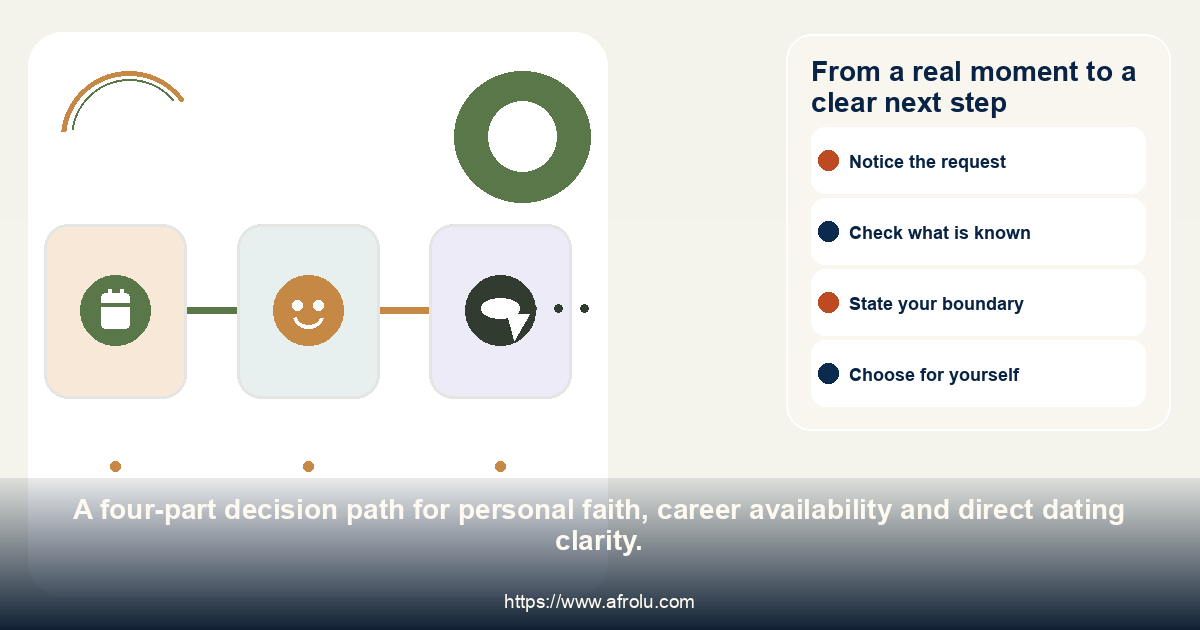
Write down the one issue you need to understand now: a date, a boundary, the meaning of a label or the role of faith in one upcoming choice. Keep the conversation narrow enough that both adults can answer. You can revisit larger questions as the relationship becomes more established.
If your goals align, choose a next step that fits both calendars and values. That might be a public coffee, a conversation about a holiday or a mutually agreed time to revisit future expectations. Do not move faster than you want because someone calls the connection destined or spiritually ordained.
If the other person's current preference conflicts with yours, acknowledge the mismatch without turning it into a judgment about either adult's faith. You can end dating kindly or take space. A person may be sincere and still not want the relationship you want; sincerity does not require you to remain in an arrangement that feels wrong.
A faith-led dating choice is still yours. Ask questions, observe what follows, protect your time and change your mind when new information arrives. No study, label or tradition can make the decision for you. A respectful connection gives both adults room to be honest, disagree and choose freely.

A reader-led next-step map for personal faith, career availability and direct dating clarity. Afrolu:
Eight choices about personal faith, career availability and direct dating clarity
Both profiles say faith matters but describe different practices
Ask what the phrase means personally. Keep the decision grounded in personal faith, career availability and direct dating clarity.
Ask one practical question about personal faith, career availability and direct dating clarity, then choose a response that protects your own agency.A shift change disrupts a possible date
Share a realistic window without exposing the full rota. Keep the decision grounded in personal faith, career availability and direct dating clarity.
Ask one practical question about personal faith, career availability and direct dating clarity, then choose a response that protects your own agency.A call conflicts with a personal observance
Ask about another time without assuming a universal schedule. Keep the decision grounded in personal faith, career availability and direct dating clarity.
Ask one practical question about personal faith, career availability and direct dating clarity, then choose a response that protects your own agency.Messages continue but no date is chosen
Ask directly whether meeting is still wanted. Keep the decision grounded in personal faith, career availability and direct dating clarity.
Ask one practical question about personal faith, career availability and direct dating clarity, then choose a response that protects your own agency.A relative asks whether the connection is serious
Agree what each adult is comfortable sharing. Keep the decision grounded in personal faith, career availability and direct dating clarity.
Ask one practical question about personal faith, career availability and direct dating clarity, then choose a response that protects your own agency.A faith-based limit is questioned repeatedly
Restate the limit and decide whether the response is respectful. Keep the decision grounded in personal faith, career availability and direct dating clarity.
Ask one practical question about personal faith, career availability and direct dating clarity, then choose a response that protects your own agency.Marriage is assumed from a shared faith label
Ask whether both adults actually want that future. Keep the decision grounded in personal faith, career availability and direct dating clarity.
Ask one practical question about personal faith, career availability and direct dating clarity, then choose a response that protects your own agency.Dating invitations arrive only after long shifts
Choose a pace that protects sleep and work. Keep the decision grounded in personal faith, career availability and direct dating clarity.
Ask one practical question about personal faith, career availability and direct dating clarity, then choose a response that protects your own agency.Notice how communication and plans unfold over time
A vague invitation becomes a specific plan. Check how it appears during personal faith, career availability and direct dating clarity.
Both adults can say what they want now. Check how it appears during personal faith, career availability and direct dating clarity.
A work limit is accepted without interrogation. Check how it appears during personal faith, career availability and direct dating clarity.
A cancellation includes a timely update when possible. Check how it appears during personal faith, career availability and direct dating clarity.
Planning effort moves between both people. Check how it appears during personal faith, career availability and direct dating clarity.
A no does not trigger bargaining or punishment. Check how it appears during personal faith, career availability and direct dating clarity.
Privacy requests are taken seriously. Check how it appears during personal faith, career availability and direct dating clarity.
A free evening is not treated as an automatic promise. Check how it appears during personal faith, career availability and direct dating clarity.
No one is expected to remain on standby. Check how it appears during personal faith, career availability and direct dating clarity.
Travel details are confirmed before money is spent. Check how it appears during personal faith, career availability and direct dating clarity.
A public meeting place remains acceptable to both. Check how it appears during personal faith, career availability and direct dating clarity.
Each next activity receives its own agreement. Check how it appears during personal faith, career availability and direct dating clarity.
Faith practices and boundaries are discussed without pressure. Check how it appears during personal faith, career availability and direct dating clarity.
The adults can revisit terms as circumstances change. Check how it appears during personal faith, career availability and direct dating clarity.
The connection leaves room for work and other relationships. Check how it appears during personal faith, career availability and direct dating clarity.
Move from a concrete moment to your own next choice
| Situation | What it may mean | What to do next |
|---|---|---|
| A date is left vague | A warm message does not contain a time or place. The relevant context is personal faith, career availability and direct dating clarity. | Ask for the specific detail that determines your calendar. Decide from the response and your own needs around personal faith, career availability and direct dating clarity. |
| A reply comes after a gap | Timing alone cannot establish why a person was unavailable. The relevant context is personal faith, career availability and direct dating clarity. | Return to the question you need answered now. Decide from the response and your own needs around personal faith, career availability and direct dating clarity. |
| A cancellation repeats | A change may be ordinary; a replacement plan is separate information. The relevant context is personal faith, career availability and direct dating clarity. | Notice whether the other adult shares responsibility for rescheduling. Decide from the response and your own needs around personal faith, career availability and direct dating clarity. |
| Work blocks a date | A full schedule describes capacity during that period. The relevant context is personal faith, career availability and direct dating clarity. | Offer a window you can actually keep and hear their response. Decide from the response and your own needs around personal faith, career availability and direct dating clarity. |
| A label creates pressure | People use benching, casual and serious in different ways. The relevant context is personal faith, career availability and direct dating clarity. | Describe the conduct instead of arguing about the label. Decide from the response and your own needs around personal faith, career availability and direct dating clarity. |
| A plan crosses borders | Distance adds costs and time that messages cannot resolve. The relevant context is personal faith, career availability and direct dating clarity. | Confirm travel, meeting and return details before deciding. Decide from the response and your own needs around personal faith, career availability and direct dating clarity. |
| A request feels intrusive | Early dating does not require full access to work or personal data. The relevant context is personal faith, career availability and direct dating clarity. | Share only what the current decision requires. Decide from the response and your own needs around personal faith, career availability and direct dating clarity. |
| An invitation is late | Last-minute timing may suit one calendar and exclude another. The relevant context is personal faith, career availability and direct dating clarity. | Choose whether that notice works for your day. Decide from the response and your own needs around personal faith, career availability and direct dating clarity. |
| One adult waits | Unequal planning can make a connection feel one-sided. The relevant context is personal faith, career availability and direct dating clarity. | Ask for a concrete contribution and assess what happens. Decide from the response and your own needs around personal faith, career availability and direct dating clarity. |
| Your preference changes | An adult may revise their terms as they learn more. The relevant context is personal faith, career availability and direct dating clarity. | Update the other person before acting on an assumption. Decide from the response and your own needs around personal faith, career availability and direct dating clarity. |
Questions for a clear, respectful discussion
“I have noticed we talk warmly but have not settled another date. What kind of connection do you want now?”
“I can meet Saturday at three near the station. Would you like to choose that or suggest another time?”
“I keep my employer and exact shift private early on. I can meet after work in a public place.”
“I need to know by Thursday noon before I hold Saturday open. If that is too early, I will make other plans.”
“I am dating with the hope of a serious relationship, and I want to know what you are looking for now.”
“My faith shapes some of my dating choices. What does that look like for you in practice?”
“I would like to get to know each other slowly, with planned dates and enough room for work and rest.”
“This practice matters to me, and I do not expect you to share it. Can we plan around the time I keep for it?”
“Please ask before posting a photo from our date. I prefer to choose what appears online.”
“I understand plans can change. Would you like to suggest a new day, or should we leave it here?”
“I am interested in meeting. I want us to confirm dates, costs and accommodation before I book.”
“I will arrange my own transport and lodging so I can change the plan if I need to.”
“I agreed to meet in public, not at a private home. I would rather keep the original plan.”
“This pattern no longer works for me, so I am going to stop dating. I wish you well.”
Know the difference
Faith identity and personal practice
A broad self-description
What each adult believes and does
Ask about the practice that matters.

A comparison that separates two decisions in personal faith, career availability and direct dating clarity. Afrolu:
Keep intentions, capacity and agreements distinct
| Type or dimension | What it describes | Best next question |
|---|---|---|
| Contact pattern | When messages arrive is different from what the adults have agreed. This distinction can matter in personal faith, career availability and direct dating clarity. | Ask what frequency each person wants and can sustain. Keep the discussion specific to the adults involved. |
| Interest | A person may enjoy a date without choosing a future direction. This distinction can matter in personal faith, career availability and direct dating clarity. | Ask what they want to explore at this point. Keep the discussion specific to the adults involved. |
| Availability | A demanding work week can limit time without explaining every choice. This distinction can matter in personal faith, career availability and direct dating clarity. | Offer an actual opening and see whether planning is mutual. Keep the discussion specific to the adults involved. |
| Follow-through | An invitation is not complete until details are confirmed. This distinction can matter in personal faith, career availability and direct dating clarity. | Agree on when and how a plan will be final. Keep the discussion specific to the adults involved. |
| Faith label | A religious or spiritual identity does not describe every personal practice. This distinction can matter in personal faith, career availability and direct dating clarity. | Ask how belief affects the choice in front of you. Keep the discussion specific to the adults involved. |
| Serious intent | A long-term hope is not the same as a present commitment. This distinction can matter in personal faith, career availability and direct dating clarity. | Discuss the next step without demanding a future promise. Keep the discussion specific to the adults involved. |
| Exclusivity | Frequency of dates does not create a mutual agreement. This distinction can matter in personal faith, career availability and direct dating clarity. | Ask directly whether both people have chosen exclusivity. Keep the discussion specific to the adults involved. |
| Digital privacy | Sharing a photo or location is a separate decision. This distinction can matter in personal faith, career availability and direct dating clarity. | Choose which information you are willing to make visible. Keep the discussion specific to the adults involved. |
| Distance | A call and a visit have different costs and limits. This distinction can matter in personal faith, career availability and direct dating clarity. | Plan travel only after both adults confirm practical details. Keep the discussion specific to the adults involved. |
| Low-pressure pace | An easy pace does not require vague plans or hidden expectations. This distinction can matter in personal faith, career availability and direct dating clarity. | Name what stays flexible and what needs a clear agreement. Keep the discussion specific to the adults involved. |
| Shared faith | Similar labels do not guarantee identical values or relationship plans. This distinction can matter in personal faith, career availability and direct dating clarity. | Ask which practices or future choices matter to each adult. Keep the discussion specific to the adults involved. |
A simple plan you can use today
A label is informal
Benching is used inconsistently in ordinary dating conversation. Apply this carefully to personal faith, career availability and direct dating clarity.
Belief is personal
A shared label may not describe two adults' daily practices. Apply this carefully to personal faith, career availability and direct dating clarity.
Schedules shape time
Work, travel, observance and rest affect availability in different ways. Apply this carefully to personal faith, career availability and direct dating clarity.
Timing is not motive
A gap in contact cannot reveal a person's whole intention. Apply this carefully to personal faith, career availability and direct dating clarity.
Distance has costs
Travel, employment and local ties can make visits harder to coordinate. Apply this carefully to personal faith, career availability and direct dating clarity.
Research is bounded
A study's country, faith community, age and relationship type matter. Apply this carefully to personal faith, career availability and direct dating clarity.
A plan can be checked
Specific dates and shared follow-through are easier to assess than hints. Apply this carefully to personal faith, career availability and direct dating clarity.
Questions organised by purpose and depth
Choose a few prompts that fit the moment. This is a reference library, not a list to complete.
What happened?
Separate concrete actions from the explanation you have imagined. Consider how this applies to personal faith, career availability and direct dating clarity.
- Which plan was confirmed?
- Who offered an alternative?
- What is still unknown?
What can I offer?
Use the calendar and resources you actually have. Consider how this applies to personal faith, career availability and direct dating clarity.
- Which window is realistic?
- What information can stay private?
- What travel cost is manageable?
What do I need to ask?
Choose one answer that would affect your next decision. Consider how this applies to personal faith, career availability and direct dating clarity.
- Do we want to meet again?
- What does casual mean today?
- Can we confirm a public plan?
What is my boundary?
Keep a choice available when plans or feelings change. Consider how this applies to personal faith, career availability and direct dating clarity.
- How long will I wait?
- What would make me postpone?
- How do I want to end contact?
What deserves a closer look
A small purposive sample offers discussion themes
Thirty U.S. couples who described their interfaith marriages as happy and stable discussed how they navigated differences.
Evidence limit: This is not a representative dating sample or a guaranteed formula for relationship success. The source sample differs from personal faith, career availability and direct dating clarity.
Preferences vary across religious and partnership scenarios
A vignette study varied denomination, perceived religious importance and whether a casual, committed or marital partnership was considered.
Evidence limit: The country and participant groups do not predict a particular diaspora adult's choice. The source sample differs from personal faith, career availability and direct dating clarity.
Context shapes what couples value
Researchers studied 49 self-described Muslim married couples in Pakistan alongside small Australian and Hong Kong samples.
Evidence limit: The findings should not be generalized to every faith, country, gender or dating stage. The source sample differs from personal faith, career availability and direct dating clarity.
Association is not an individual forecast
An observational study examined religious similarity and partnership quality in older American couples.
Evidence limit: Age, life stage and established partnership context differ from new dating. The source sample differs from personal faith, career availability and direct dating clarity.
Travel and work create practical constraints
Studies examine specific families, couples, samples and communication practices across distance.
Evidence limit: They cannot set one contact rhythm or prove why a person missed a call. The source sample differs from personal faith, career availability and direct dating clarity.
Questions can clarify what remains undecided
Relationship theory distinguishes an adult's dedication from constraints that make leaving or changing plans harder.
Evidence limit: A theoretical framework does not diagnose a connection or supply its timeline. The source sample differs from personal faith, career availability and direct dating clarity.
Assumptions that can add pressure to dating
Calling a motive from a gap
A missed message does not show the full reason for silence. A clearer choice is available in personal faith, career availability and direct dating clarity.
Keeping all time on standby
An uncertain invitation does not require you to cancel other plans. A clearer choice is available in personal faith, career availability and direct dating clarity.
Treating a label as a verdict
The term benching cannot establish someone's private intention. A clearer choice is available in personal faith, career availability and direct dating clarity.
Sharing a work route too early
A new match may need general availability, not a daily itinerary. A clearer choice is available in personal faith, career availability and direct dating clarity.
Buying travel to secure interest
A ticket cannot create mutual plans or a relationship agreement. A clearer choice is available in personal faith, career availability and direct dating clarity.
Using message volume as a score
Count the quality of shared decisions, not only phone activity. A clearer choice is available in personal faith, career availability and direct dating clarity.
Explore more about personal faith, career availability and direct dating clarity
This guide offers editorial information, not diagnosis, therapy, custody, legal or emergency advice. Seek qualified support for individual questions.
Explore the guide library
Show more related guides
Continue with Afrolu
Show more Afrolu guides
Sources used for this guide
Afrolu reviewed these health, research, safety, or public guidance resources while editing this page. They support the behaviour and safety guidance; they do not diagnose any individual described by a reader.
Questions about personal faith, career availability and direct dating clarity
Is benching a diagnosis?
No. People use the word in different ways; describe the observable pattern instead.
Does a delayed reply prove low interest?
No. Timing alone cannot establish motive; ask about the information that affects your choice.
Can I request a definite plan?
Yes. State the time and details you need before you keep space open.
Do I need to share my employer?
No. Give only the work context needed to arrange a date safely.
Can I change my mind about travel?
Yes. A booking does not remove your choice to postpone or cancel.
Does faith-led mean the same thing to everyone?
No. Ask what each adult personally means and practices.
Does a shared faith mean shared dating expectations?
No. Discuss pace, boundaries and future hopes directly.
Can low-pressure dating still have clear plans?
Yes. A relaxed pace can include confirmed dates and honest terms.
Can a video call guarantee who someone is?
No. It may add context, but it cannot confirm every claim or predict conduct.
Does faith-led mean the same thing to both people?
No. Ask what each adult personally believes and practices.
Should work details be shared to prove availability?
No. Share only the information needed to make a plan.
Can two adults value faith but practice differently?
Yes. Discuss which differences affect your own choices.
One thing to do now
Choose the next step that fits you
Name your own beliefs and practical needs, invite the other adult's answer and assess fit without treating similarity as an obligation.