Adult diaspora dating · serious intent · direct clarity
Serious Dating and Casual Contact: Ask What Is Offered
Want a serious relationship but getting occasional messages? Separate the pattern from the label, ask what is available now and choose a boundary now.
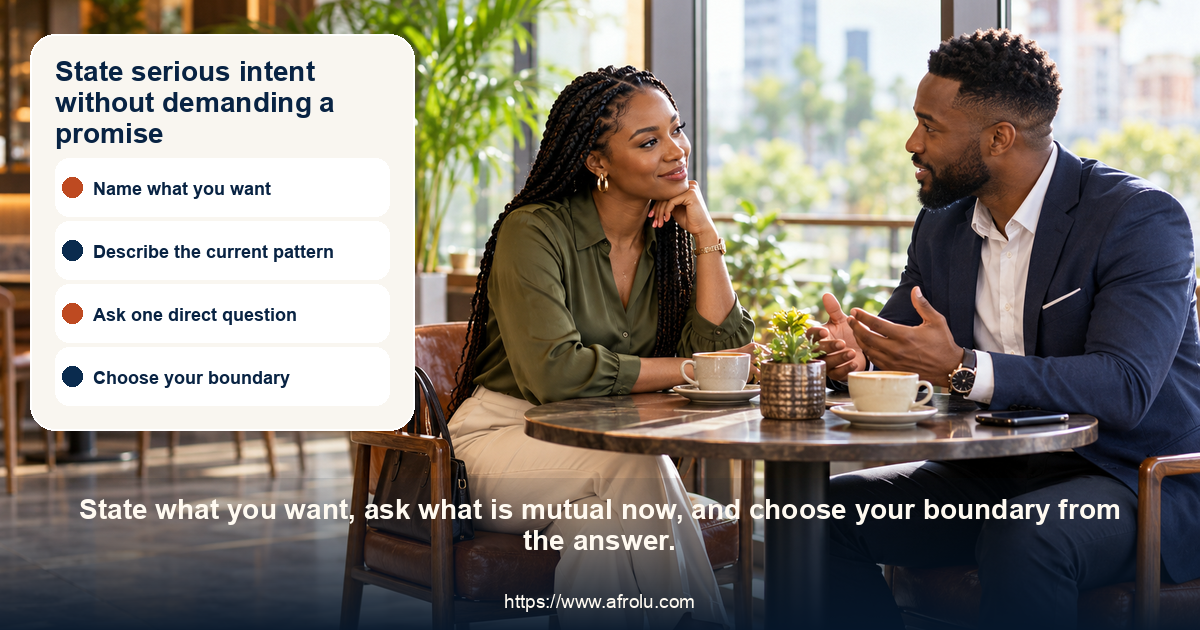
State what you want, ask what is mutual now, and choose your boundary from the answer. Afrolu:
Written and edited by Jean-Claude Mukendi · Relationship Guides Editor
Treat benching as a possible description of a pattern, not proof of motive. Record what has happened, then ask what the other adult wants and is able to offer now. Explain that you are dating with serious intent, define what you mean in present-day actions, and decide whether casual contact is comfortable while you learn more.
Modern dating terms · Diaspora Daters
How can you be honest about wanting a serious relationship when the other person offers occasional contact or describes the connection as casual?
This guide uses benching for a dating pattern that feels intermittent or short on plans, while recognizing that people use the word in different ways. It cannot establish why contact changed. Serious dating also has no single timetable: each adult must describe the direction, pace and agreements they personally want.
At 32, Nia lives in Amsterdam and has been seeing Kojo when their work trips overlap. He sends warm messages between visits but has not suggested another date. Nia would like a committed relationship eventually, yet does not expect a promise after a few meetings. She asks whether Kojo wants to keep dating intentionally or prefers occasional casual contact. His answer helps Nia decide whether to continue without treating her hopes as an agreement he never made.
Name what you know
Use benching as a question, not a verdict
People use benching for different experiences, often when a person keeps in touch without making clear plans. It is a popular label rather than a clinical category or reliable explanation of someone's motive. Start with dates, invitations, cancellations and follow-through that you can describe without guessing why they happened.
A warm check-in may show that someone wanted to make contact in that moment; it does not answer whether they want exclusivity, a committed partnership or another date. Silence may have many explanations, and none can be established from a message gap alone. Keep the observable fact separate from the story you are considering.
You can name the effect on you without presenting it as evidence against the other person. For example, say that occasional messages with no plan leave you uncertain about whether to reserve time. This tells the other adult what decision is difficult for you while leaving room for them to explain their own preference.
Look for a pattern across more than one interaction, while remembering that your threshold is personal. You do not need to prove that a label fits before deciding that an arrangement feels too uncertain. A direct conversation can clarify what is on offer; your own comfort helps determine what you do with the answer.
Define your direction
Explain what serious dating means to you now
Serious dating can mean different things to different adults. One person may mean exploring compatibility for a long-term partnership; another may mean dating one person at a time; a third may simply want to avoid casual sex. Ask what each person means instead of treating the phrase as a universal contract.
Name the present action that would make dating feel aligned for you. You might want planned dates, honest conversation about other partners, or a check-in after several weeks. These are examples rather than rules. Choose the request that would help you decide whether to continue, not a checklist that another person must pass.
A person can be interested in you and still prefer casual dating, a slower pace or no relationship at this time. You can respect that answer without changing your own goal. The useful question is whether both adults can choose the same arrangement freely, rather than whether one person can persuade the other to want it.
If your preference changes as you learn more, update the other person before acting on an assumed agreement. Serious intent does not remove the need for consent or negotiation. It gives you language for what you hope to build and a reason to check whether present choices are moving in a direction you also want.
Ask without pressure
Separate casual terms from serious hopes
Choose a calm moment rather than sending a long accusation after a delayed reply. You could say, I like spending time with you and want to understand whether you are interested in dating intentionally or keeping this casual. This names your question without claiming that the other person has misled you.
Make the question concrete enough to guide your next choice. Ask whether they want to arrange another date, whether they are dating other people if that matters to you, or whether they are open to a serious relationship in general. Each question concerns a different agreement, so avoid bundling all of them into one yes-or-no test.
Listen for both the words and the practical limits the person names. They may want a serious relationship someday but not with you, want to keep dating without exclusivity, or be unsure. You are allowed to ask a follow-up question, and they are allowed to decline details that are not part of a mutual agreement.
If their answer is uncertain, decide what you can comfortably do with that uncertainty. You might continue dating casually for a defined period, request clearer plans, or stop. The purpose of a conversation is not to force certainty on demand; it is to make your own next step more informed.

A balanced conversation about serious dating intent, casual contact and present agreements. Afrolu:
Assess the pattern
Notice whether effort is mutual
Reciprocity can look different across busy seasons, cultures and communication styles. Instead of counting every text, notice whether both adults propose dates, confirm details, share changes when they can and show interest in each other's lives. A mutual pattern does not require identical effort every day or a fixed message quota.
When plans are cancelled, the replacement conversation can be informative. Someone may have a genuine conflict and still suggest another window; another person may not be able to reschedule soon. Neither outcome proves a motive, but repeated lack of follow-through can help you assess whether the connection works for your calendar and hopes.
Notice how your stated boundary is received. A respectful response may include a different preference, a question or a clear no. Repeated pressure, mockery or punishment after you ask for clarity is relevant conduct. You can pause or leave an interaction without diagnosing the person or proving that their behaviour fits a popular term.
Keep a short record for yourself if the pattern feels confusing: what was proposed, what was agreed, what changed and what happened next. This is not a scorecard to send as evidence. It can help you distinguish a one-off misunderstanding from a recurring arrangement that you no longer want.

Observable coordination examples for serious dating intent, casual contact and present agreements. Afrolu:
Keep your choice
Do not put your life on hold for a maybe
You can like someone and still decline to keep every weekend open. Make your own plans until a date has a time and place that work for both adults. If a late invitation suits you, accept because you want that plan, not because you fear that refusing will eliminate your only chance at a relationship.
You do not owe continued casual contact while hoping the other person eventually changes their mind. If the present arrangement hurts or conflicts with your values, say so and step away. A boundary describes what you will choose; it does not require the other person to become ready for a different relationship.
There is no universal number of dates after which a person must define a connection. Your timing can depend on emotional comfort, sexual-health decisions, faith or personal values, family circumstances and practical needs. Ask for the conversation that matters to you, and allow the other adult to answer honestly rather than treating timing as a test.
If serious dating includes exclusivity for you, do not infer it from regular contact, affection or travel. Discuss it directly and agree on what each person will do. If the answer is no, you can choose whether non-exclusive dating is acceptable; consent to one date does not settle future agreements.
Read evidence carefully
Let research inform questions, not predict your match
Research on relationship standards and marriage can help show why people may value different forms of commitment, religion or family involvement. Studies commonly use particular countries, ages and established couples. They cannot tell you what a person in a new diaspora dating connection believes, how serious they are or whether your goals will align.
Some work on dating-partner messages studies uncertainty in a defined interaction rather than long-term commitment. A result about participants' responses to a message cannot decode another person's silence. Use research to notice concepts you might discuss, then rely on a direct conversation and your own experience to choose.
A small qualitative study of interfaith marriages interviewed couples who described their marriages as happy and stable. It can surface topics couples said mattered, such as respect for practice and difference, but its purposive U.S. sample is not a representative forecast for new relationships or African diaspora communities.
The evidence does not prescribe one correct relationship structure, faith practice, pace or endpoint. It can support careful questions, not a single standard for every reader. Your goal is not to make a connection match an article; it is to understand the agreement in front of you and decide whether it fits.
Choose the next step
Make a decision from the answer you receive
Before speaking, write down what you hope for, what would work now and what would not. This helps you stay clear if the other person is warm but vague. A useful question should be answerable in ordinary language, such as whether they want to plan another date and what kind of dating they are seeking.
After the conversation, compare the answer with the follow-through you observe. If both adults want to keep learning about one another, set a next date or a time to check in. If they prefer casual contact and you want a committed direction, acknowledge the difference without treating either person's preference as wrong.
If you decide to leave, keep the message brief and kind where it is safe to do so. You do not need to debate what benching means, supply a diagnosis or persuade the other adult to agree with your interpretation. A simple statement that the arrangement does not fit you is enough.
A serious relationship grows through repeated choices, not a single title or promise. Give yourself permission to want clarity and to move slowly at the same time. Keep meeting people and investing in your own life while you see whether this connection develops through mutual, freely chosen actions.

A reader-led next-step map for serious dating intent, casual contact and present agreements. Afrolu:
Eight choices about serious dating intent, casual contact and present agreements
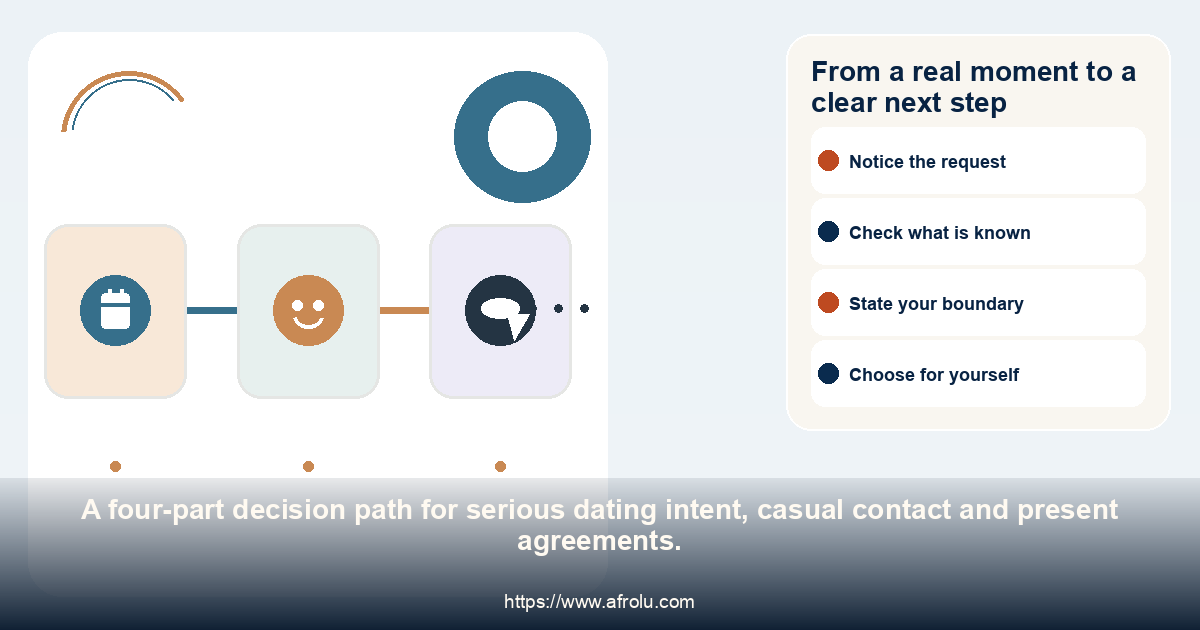
The conversation is affectionate but no next date is proposed
Ask whether both adults want to make a plan. Keep the decision grounded in serious dating intent, casual contact and present agreements.
Ask one practical question about serious dating intent, casual contact and present agreements, then choose a response that protects your own agency.One person wants a serious direction and the other says casual
Clarify what each person is choosing now. Keep the decision grounded in serious dating intent, casual contact and present agreements.
Ask one practical question about serious dating intent, casual contact and present agreements, then choose a response that protects your own agency.A long-term promise is requested after two dates
Share your intention without promising an outcome. Keep the decision grounded in serious dating intent, casual contact and present agreements.
Ask one practical question about serious dating intent, casual contact and present agreements, then choose a response that protects your own agency.A work conflict interrupts a planned date
Ask whether another time is genuinely wanted. Keep the decision grounded in serious dating intent, casual contact and present agreements.
Ask one practical question about serious dating intent, casual contact and present agreements, then choose a response that protects your own agency.Regular contact is treated as an agreement
Discuss exclusivity directly and separately. Keep the decision grounded in serious dating intent, casual contact and present agreements.
Ask one practical question about serious dating intent, casual contact and present agreements, then choose a response that protects your own agency.The answer remains maybe after a clear question
Choose whether you want to continue with that uncertainty. Keep the decision grounded in serious dating intent, casual contact and present agreements.
Ask one practical question about serious dating intent, casual contact and present agreements, then choose a response that protects your own agency.You do not want to reserve every weekend
Keep other plans until a time is confirmed. Keep the decision grounded in serious dating intent, casual contact and present agreements.
Ask one practical question about serious dating intent, casual contact and present agreements, then choose a response that protects your own agency.Your preference shifts from casual to serious
Tell the other adult before relying on a new assumption. Keep the decision grounded in serious dating intent, casual contact and present agreements.
Ask one practical question about serious dating intent, casual contact and present agreements, then choose a response that protects your own agency.Notice how communication and plans unfold over time
A vague invitation becomes a specific plan. Check how it appears during serious dating intent, casual contact and present agreements.
Both adults can say what they want now. Check how it appears during serious dating intent, casual contact and present agreements.
A work limit is accepted without interrogation. Check how it appears during serious dating intent, casual contact and present agreements.
A cancellation includes a timely update when possible. Check how it appears during serious dating intent, casual contact and present agreements.
Planning effort moves between both people. Check how it appears during serious dating intent, casual contact and present agreements.
A no does not trigger bargaining or punishment. Check how it appears during serious dating intent, casual contact and present agreements.
Privacy requests are taken seriously. Check how it appears during serious dating intent, casual contact and present agreements.
A free evening is not treated as an automatic promise. Check how it appears during serious dating intent, casual contact and present agreements.
No one is expected to remain on standby. Check how it appears during serious dating intent, casual contact and present agreements.
Travel details are confirmed before money is spent. Check how it appears during serious dating intent, casual contact and present agreements.
A public meeting place remains acceptable to both. Check how it appears during serious dating intent, casual contact and present agreements.
Each next activity receives its own agreement. Check how it appears during serious dating intent, casual contact and present agreements.
Faith practices and boundaries are discussed without pressure. Check how it appears during serious dating intent, casual contact and present agreements.
The adults can revisit terms as circumstances change. Check how it appears during serious dating intent, casual contact and present agreements.
The connection leaves room for work and other relationships. Check how it appears during serious dating intent, casual contact and present agreements.
Move from a concrete moment to your own next choice
| Situation | What it may mean | What to do next |
|---|---|---|
| A date is left vague | A warm message does not contain a time or place. The relevant context is serious dating intent, casual contact and present agreements. | Ask for the specific detail that determines your calendar. Decide from the response and your own needs around serious dating intent, casual contact and present agreements. |
| A reply comes after a gap | Timing alone cannot establish why a person was unavailable. The relevant context is serious dating intent, casual contact and present agreements. | Return to the question you need answered now. Decide from the response and your own needs around serious dating intent, casual contact and present agreements. |
| A cancellation repeats | A change may be ordinary; a replacement plan is separate information. The relevant context is serious dating intent, casual contact and present agreements. | Notice whether the other adult shares responsibility for rescheduling. Decide from the response and your own needs around serious dating intent, casual contact and present agreements. |
| Work blocks a date | A full schedule describes capacity during that period. The relevant context is serious dating intent, casual contact and present agreements. | Offer a window you can actually keep and hear their response. Decide from the response and your own needs around serious dating intent, casual contact and present agreements. |
| A label creates pressure | People use benching, casual and serious in different ways. The relevant context is serious dating intent, casual contact and present agreements. | Describe the conduct instead of arguing about the label. Decide from the response and your own needs around serious dating intent, casual contact and present agreements. |
| A plan crosses borders | Distance adds costs and time that messages cannot resolve. The relevant context is serious dating intent, casual contact and present agreements. | Confirm travel, meeting and return details before deciding. Decide from the response and your own needs around serious dating intent, casual contact and present agreements. |
| A request feels intrusive | Early dating does not require full access to work or personal data. The relevant context is serious dating intent, casual contact and present agreements. | Share only what the current decision requires. Decide from the response and your own needs around serious dating intent, casual contact and present agreements. |
| An invitation is late | Last-minute timing may suit one calendar and exclude another. The relevant context is serious dating intent, casual contact and present agreements. | Choose whether that notice works for your day. Decide from the response and your own needs around serious dating intent, casual contact and present agreements. |
| One adult waits | Unequal planning can make a connection feel one-sided. The relevant context is serious dating intent, casual contact and present agreements. | Ask for a concrete contribution and assess what happens. Decide from the response and your own needs around serious dating intent, casual contact and present agreements. |
| Your preference changes | An adult may revise their terms as they learn more. The relevant context is serious dating intent, casual contact and present agreements. | Update the other person before acting on an assumption. Decide from the response and your own needs around serious dating intent, casual contact and present agreements. |
Questions for a clear, respectful discussion
“I have noticed we talk warmly but have not settled another date. What kind of connection do you want now?”
“I can meet Saturday at three near the station. Would you like to choose that or suggest another time?”
“I keep my employer and exact shift private early on. I can meet after work in a public place.”
“I need to know by Thursday noon before I hold Saturday open. If that is too early, I will make other plans.”
“I am dating with the hope of a serious relationship, and I want to know what you are looking for now.”
“My faith shapes some of my dating choices. What does that look like for you in practice?”
“I would like to get to know each other slowly, with planned dates and enough room for work and rest.”
“This practice matters to me, and I do not expect you to share it. Can we plan around the time I keep for it?”
“Please ask before posting a photo from our date. I prefer to choose what appears online.”
“I understand plans can change. Would you like to suggest a new day, or should we leave it here?”
“I am interested in meeting. I want us to confirm dates, costs and accommodation before I book.”
“I will arrange my own transport and lodging so I can change the plan if I need to.”
“I agreed to meet in public, not at a private home. I would rather keep the original plan.”
“This pattern no longer works for me, so I am going to stop dating. I wish you well.”
Know the difference
Serious hope and present agreement
What you hope to build
What both adults choose now
Keep hope and agreement distinct.

A comparison that separates two decisions in serious dating intent, casual contact and present agreements. Afrolu:
Keep intentions, capacity and agreements distinct
| Type or dimension | What it describes | Best next question |
|---|---|---|
| Contact pattern | When messages arrive is different from what the adults have agreed. This distinction can matter in serious dating intent, casual contact and present agreements. | Ask what frequency each person wants and can sustain. Keep the discussion specific to the adults involved. |
| Interest | A person may enjoy a date without choosing a future direction. This distinction can matter in serious dating intent, casual contact and present agreements. | Ask what they want to explore at this point. Keep the discussion specific to the adults involved. |
| Availability | A demanding work week can limit time without explaining every choice. This distinction can matter in serious dating intent, casual contact and present agreements. | Offer an actual opening and see whether planning is mutual. Keep the discussion specific to the adults involved. |
| Follow-through | An invitation is not complete until details are confirmed. This distinction can matter in serious dating intent, casual contact and present agreements. | Agree on when and how a plan will be final. Keep the discussion specific to the adults involved. |
| Faith label | A religious or spiritual identity does not describe every personal practice. This distinction can matter in serious dating intent, casual contact and present agreements. | Ask how belief affects the choice in front of you. Keep the discussion specific to the adults involved. |
| Serious intent | A long-term hope is not the same as a present commitment. This distinction can matter in serious dating intent, casual contact and present agreements. | Discuss the next step without demanding a future promise. Keep the discussion specific to the adults involved. |
| Exclusivity | Frequency of dates does not create a mutual agreement. This distinction can matter in serious dating intent, casual contact and present agreements. | Ask directly whether both people have chosen exclusivity. Keep the discussion specific to the adults involved. |
| Digital privacy | Sharing a photo or location is a separate decision. This distinction can matter in serious dating intent, casual contact and present agreements. | Choose which information you are willing to make visible. Keep the discussion specific to the adults involved. |
| Distance | A call and a visit have different costs and limits. This distinction can matter in serious dating intent, casual contact and present agreements. | Plan travel only after both adults confirm practical details. Keep the discussion specific to the adults involved. |
| Low-pressure pace | An easy pace does not require vague plans or hidden expectations. This distinction can matter in serious dating intent, casual contact and present agreements. | Name what stays flexible and what needs a clear agreement. Keep the discussion specific to the adults involved. |
| Shared faith | Similar labels do not guarantee identical values or relationship plans. This distinction can matter in serious dating intent, casual contact and present agreements. | Ask which practices or future choices matter to each adult. Keep the discussion specific to the adults involved. |
A simple plan you can use today
A label is informal
Benching is used inconsistently in ordinary dating conversation. Apply this carefully to serious dating intent, casual contact and present agreements.
Belief is personal
A shared label may not describe two adults' daily practices. Apply this carefully to serious dating intent, casual contact and present agreements.
Schedules shape time
Work, travel, observance and rest affect availability in different ways. Apply this carefully to serious dating intent, casual contact and present agreements.
Timing is not motive
A gap in contact cannot reveal a person's whole intention. Apply this carefully to serious dating intent, casual contact and present agreements.
Distance has costs
Travel, employment and local ties can make visits harder to coordinate. Apply this carefully to serious dating intent, casual contact and present agreements.
Research is bounded
A study's country, faith community, age and relationship type matter. Apply this carefully to serious dating intent, casual contact and present agreements.
A plan can be checked
Specific dates and shared follow-through are easier to assess than hints. Apply this carefully to serious dating intent, casual contact and present agreements.
Questions organised by purpose and depth
Choose a few prompts that fit the moment. This is a reference library, not a list to complete.
What happened?
Separate concrete actions from the explanation you have imagined. Consider how this applies to serious dating intent, casual contact and present agreements.
- Which plan was confirmed?
- Who offered an alternative?
- What is still unknown?
What can I offer?
Use the calendar and resources you actually have. Consider how this applies to serious dating intent, casual contact and present agreements.
- Which window is realistic?
- What information can stay private?
- What travel cost is manageable?
What do I need to ask?
Choose one answer that would affect your next decision. Consider how this applies to serious dating intent, casual contact and present agreements.
- Do we want to meet again?
- What does casual mean today?
- Can we confirm a public plan?
What is my boundary?
Keep a choice available when plans or feelings change. Consider how this applies to serious dating intent, casual contact and present agreements.
- How long will I wait?
- What would make me postpone?
- How do I want to end contact?
What deserves a closer look
A small purposive sample offers discussion themes
Thirty U.S. couples who described their interfaith marriages as happy and stable discussed how they navigated differences.
Evidence limit: This is not a representative dating sample or a guaranteed formula for relationship success. The source sample differs from serious dating intent, casual contact and present agreements.
Preferences vary across religious and partnership scenarios
A vignette study varied denomination, perceived religious importance and whether a casual, committed or marital partnership was considered.
Evidence limit: The country and participant groups do not predict a particular diaspora adult's choice. The source sample differs from serious dating intent, casual contact and present agreements.
Context shapes what couples value
Researchers studied 49 self-described Muslim married couples in Pakistan alongside small Australian and Hong Kong samples.
Evidence limit: The findings should not be generalized to every faith, country, gender or dating stage. The source sample differs from serious dating intent, casual contact and present agreements.
Association is not an individual forecast
An observational study examined religious similarity and partnership quality in older American couples.
Evidence limit: Age, life stage and established partnership context differ from new dating. The source sample differs from serious dating intent, casual contact and present agreements.
Travel and work create practical constraints
Studies examine specific families, couples, samples and communication practices across distance.
Evidence limit: They cannot set one contact rhythm or prove why a person missed a call. The source sample differs from serious dating intent, casual contact and present agreements.
Questions can clarify what remains undecided
Relationship theory distinguishes an adult's dedication from constraints that make leaving or changing plans harder.
Evidence limit: A theoretical framework does not diagnose a connection or supply its timeline. The source sample differs from serious dating intent, casual contact and present agreements.
Assumptions that can add pressure to dating
Calling a motive from a gap
A missed message does not show the full reason for silence. A clearer choice is available in serious dating intent, casual contact and present agreements.
Keeping all time on standby
An uncertain invitation does not require you to cancel other plans. A clearer choice is available in serious dating intent, casual contact and present agreements.
Treating a label as a verdict
The term benching cannot establish someone's private intention. A clearer choice is available in serious dating intent, casual contact and present agreements.
Sharing a work route too early
A new match may need general availability, not a daily itinerary. A clearer choice is available in serious dating intent, casual contact and present agreements.
Buying travel to secure interest
A ticket cannot create mutual plans or a relationship agreement. A clearer choice is available in serious dating intent, casual contact and present agreements.
Using message volume as a score
Count the quality of shared decisions, not only phone activity. A clearer choice is available in serious dating intent, casual contact and present agreements.
Explore more about serious dating intent, casual contact and present agreements
This guide offers editorial information, not diagnosis, therapy, custody, legal or emergency advice. Seek qualified support for individual questions.
Explore the guide library
Show more related guides
Continue with Afrolu
Show more Afrolu guides
Sources used for this guide
Afrolu reviewed these health, research, safety, or public guidance resources while editing this page. They support the behaviour and safety guidance; they do not diagnose any individual described by a reader.
Questions about serious dating intent, casual contact and present agreements
Is benching a diagnosis?
No. People use the word in different ways; describe the observable pattern instead.
Does a delayed reply prove low interest?
No. Timing alone cannot establish motive; ask about the information that affects your choice.
Can I request a definite plan?
Yes. State the time and details you need before you keep space open.
Do I need to share my employer?
No. Give only the work context needed to arrange a date safely.
Can I change my mind about travel?
Yes. A booking does not remove your choice to postpone or cancel.
Does faith-led mean the same thing to everyone?
No. Ask what each adult personally means and practices.
Does a shared faith mean shared dating expectations?
No. Discuss pace, boundaries and future hopes directly.
Can low-pressure dating still have clear plans?
Yes. A relaxed pace can include confirmed dates and honest terms.
Can a video call guarantee who someone is?
No. It may add context, but it cannot confirm every claim or predict conduct.
Does wanting something serious require a quick commitment?
No. You can state your direction while allowing both adults time to decide.
Does occasional contact prove benching?
No. Describe the pattern and ask what is available now.
Can casual contact still work for me?
Yes, if both adults understand the terms and you freely choose them.
One thing to do now
Choose the next step that fits you
Compare the connection that is actually available with the direction you want, then choose whether to continue, renegotiate or step away.