Adult diaspora dating · career seasons · clear plans
Benching in Dating When Work Takes Up the Week
Understand benching in dating, clarify work schedules, ask for plans you can rely on, and decide which contact pattern fits your career and life today.
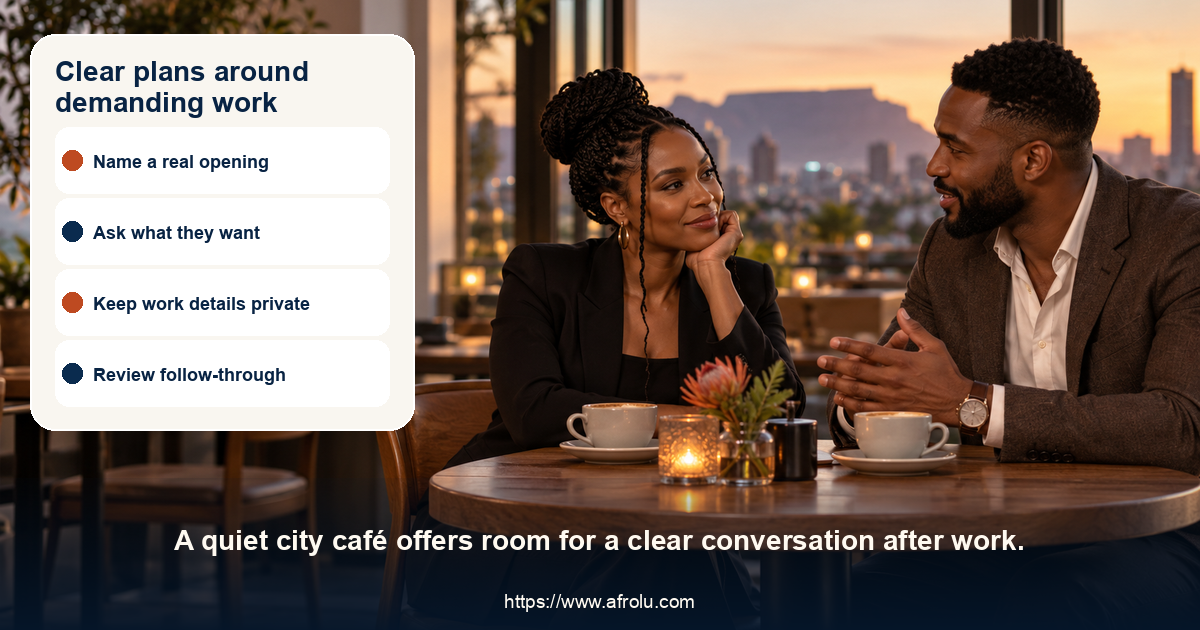
A quiet city café offers room for a clear conversation after work. Afrolu:
Written and edited by Nala Okafor · Africa Dating Platforms Editor
Treat benching as a description to clarify, not a diagnosis. Write down the concrete pattern: who initiates, whether dates are proposed, how cancellations are handled and what each person has said. Share the time you can offer, ask what the other adult wants now, then decide whether the available arrangement is workable for you.
Modern dating terms · Diaspora Daters
When work schedules are full, how can you tell whether a connection is simply hard to coordinate or whether its current pattern does not meet your needs?
People use benching for different dating experiences. In this guide it means a reader notices occasional contact without plans or a clear shared direction. The label cannot establish motive; observable behaviour and a direct conversation give you more useful information.
At 34, Nala manages projects between Johannesburg and Nairobi and has just moved into a role with irregular evening calls. Malik sends thoughtful messages most weeks, yet their last two plans were never replaced after cancellations. Nala is tempted to call the pattern benching, but instead separates the facts from the label. She tells Malik which evenings are realistic this month and asks whether he wants to plan a specific date. His answer, and what happens next, help Nala decide whether this connection belongs in her calendar.
Start with the facts
Use benching as a question, not a verdict
Benching is a popular dating word rather than a clinical category with one agreed definition. People may use it for intermittent messages, postponed dates or a connection that stays warm without becoming clearer. Those examples are not identical, so ask what someone means before treating the term as a finding about your match.
Make a short record of observable moments: the last invitation, any cancellation, whether an alternative was offered, and how you responded. Include supportive details too, such as an honest update or a date that was kept. A balanced account protects you from turning one disappointing evening into an explanation for an entire relationship.
A delayed answer during a launch, audit, night shift or family emergency may have a practical explanation. Repeatedly returning with flirtation while avoiding every attempt to make a plan is different information, but it still does not prove why the person behaves that way. You can judge whether the arrangement works without naming a hidden intention.
If the label helps you describe an uneasy feeling, use it privately as a prompt: what did I expect, what actually happened and what do I need to ask? Avoid sending a diagnosis as an accusation. A calm question about present interest creates room for an answer that is more useful than a debate over terminology.
Make capacity visible
Offer the time your work life can sustain
A career may involve rotating shifts, client deadlines, travel, on-call duties or a workday that ends at a different hour each week. Pick a period you can see clearly, perhaps the next seven or ten days, and offer only a window you can protect. This is more honest than promising to be free once a difficult month ends.
If your role crosses time zones, give the other adult the local time zone with the suggested hour. A message that says ‘Thursday evening’ can mean very different things to someone working in another country. Confirm the time and a backup option in writing so neither person has to guess which calendar was intended.
A demanding job can limit contact while still leaving someone able to communicate clearly. You might explain that a client week leaves little phone time but that you can confirm the following weekend by Tuesday. The other person can then decide whether that amount of uncertainty suits them; they do not need to infer your whole career from a few replies.
You are not responsible for making an unrealistic schedule fit because someone is disappointed. If you cannot offer the weekly calls or spontaneous visits another adult wants, say that directly and ask whether a smaller plan is worthwhile. A mismatch in capacity is important information, even when neither person has acted badly.
Ask what is wanted
Distinguish limited time from limited intent
Someone can be interested in dating and unavailable for several weeks; another person can enjoy a conversation without wanting to build a relationship. A full inbox cannot distinguish these situations. Ask a direct question such as, ‘Would you like to keep dating, and what kind of plan can you realistically make this month?’
Listen for the content of the answer and notice whether it matches what you were asking. ‘Work is hectic’ describes a circumstance; it does not tell you whether the adult wants to see you or how they prefer to handle plans. You can invite that missing piece once without demanding a detailed account of their employer or private life.
If a person says they want to meet but cannot choose a date yet, decide what follow-up window feels reasonable to you. You might leave the invitation open until Friday, then make other plans. The window is your own boundary, not a deadline you impose to make somebody prove their affection.
If the other adult is unsure, you may keep the connection casual, pause, or stop dating. You do not have to remain available until their calendar or feelings settle. State the option you prefer in plain language and allow the other person to choose for themselves without promising a future you cannot know.

A balanced conversation about work schedules and dating plans. Afrolu:
Make a next date
Choose a plan with a clear shape
A useful invitation includes the actual day, local time, public venue and a realistic end point. ‘Let us meet soon’ leaves all the work for a future message. You might suggest coffee near a transit connection after work, then ask the other adult to propose an alternative if that location or hour does not suit.
Agree how a cancellation will be handled before it becomes another unanswered thread. A person may send a short update when an urgent work event appears and offer a replacement date once they know the next opening. You can decide whether that arrangement provides enough care, without expecting anyone to disclose confidential workplace details.
A backup plan can reduce stress when schedules move. If your shift runs late, perhaps you can switch to a shorter lunch on Saturday rather than keep the other person waiting. Both adults should be able to say no to the alternative. Flexibility has value when it is mutual and does not repeatedly cost one person their rest.
Notice whether planning effort is shared over several meetings. You may alternate between choosing a venue and checking travel time, or divide the work in another way that feels fair. One unbalanced week is not a complete answer; a repeated refusal to take part in practical planning is information you can use.

Observable coordination examples for work schedules and dating plans. Afrolu:
Keep context individual
Discuss cross-border lives without stereotyping
People who live away from a country of origin may juggle travel, remittances, community events, family calls or paperwork, while others may have none of those demands. Ask what is relevant to the adult in front of you. A surname, accent or country connection cannot tell you how quickly someone should reply or what kind of relationship they want.
If a visit or future move matters to you, bring it up as its own topic rather than treating steady messaging as a promise to relocate. Discuss which country each person currently calls home, what work options are realistic and when it would make sense to revisit the question. An exploratory date does not settle immigration or employment plans.
You can protect personal information while still sharing enough to coordinate a plan. A new match may need to know that you will be overseas in July; they do not automatically need your full address, employer, travel document or family details. Choose a level of disclosure that matches the decision you are making.
Some relationships involve friends, family or community members who know both adults. Decide together what, if anything, should be shared beyond the two of you. A private dating conversation should not become public evidence for other people to interpret. Your preference for discretion is valid whether or not your match has the same social network.
Review a pattern
Compare promises with repeated follow-through
After a few weeks, review what actually happened rather than counting every text. Did the other adult offer a plan, keep it or communicate a change? Did they ask about your work constraints as well as explain their own? These questions describe coordination without turning your phone into a scorecard for attraction.
Research on work and couples' shared time uses particular populations and measures; one U.S. time-use analysis cannot prescribe a contact routine for a diaspora dating connection. It can remind readers that competing roles shape time. Let your own conversations and lived experience guide what cadence you need from a new match.
If someone repeatedly cancels but later starts affectionate conversations without addressing the missed plans, you can say how that pattern lands for you. For example, you may want to hear about a change and receive one concrete alternative. The other adult can respond, and you can decide whether the adjustment lasts rather than relying only on an apology.
A sequence can also improve. A person who once misread a busy week may take your feedback seriously, explain their availability and start sharing the planning. Leave room for actual repair while keeping your standards. You are allowed to change your decision if the revised pattern becomes clearer or if your own needs shift.
Choose for yourself
Decide how much room this connection gets
There is no requirement to keep a calendar slot empty for someone who may or may not ask to see you. Make the work, friendship and rest plans you already value. If the other adult proposes a date later, consider it against your current wishes rather than treating their arrival as an automatic priority.
If a low-frequency arrangement suits you, name that choice and clarify what you have agreed. If you want more regular dates or a clearer relationship direction, state that too. A preference does not become unreasonable because the other person cannot meet it; both adults can decide whether their overlap is enough.
When you want to step away, keep the message brief and final enough to protect your boundary. You might say that the pattern is not working for you and you are ending contact. You do not need to prove that the person intended harm or make a career-based theory about why they acted this way.
Ask for support from a trusted friend if the uncertainty has begun to disrupt sleep, work or confidence. A conversation with someone who knows your life can help you sort facts from assumptions. It does not need to produce a label; the next step can simply be one that gives you more steadiness and choice.

A reader-led next-step map for work schedules and dating plans. Afrolu:
Eight choices about work schedules and dating plans
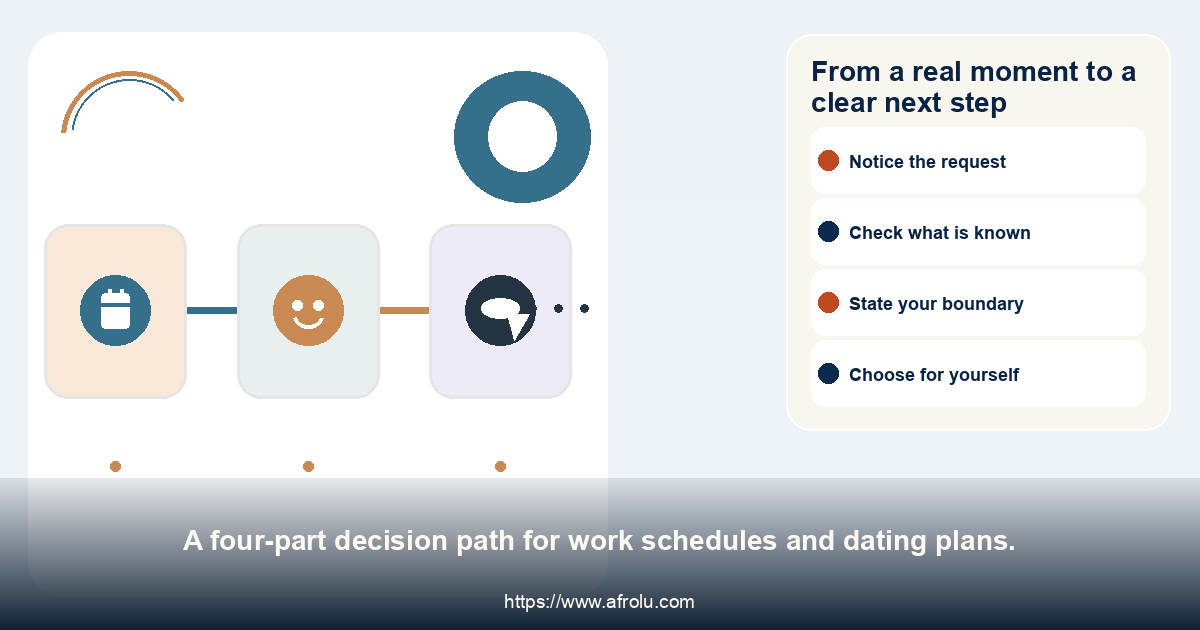
A launch week leaves only one free evening
Offer the window you can protect rather than a vague promise. Keep the decision grounded in work schedules and dating plans.
Ask one practical question about work schedules and dating plans, then choose a response that protects your own agency.A date is cancelled during a client deadline
Ask whether the other adult wants to suggest a new time. Keep the decision grounded in work schedules and dating plans.
Ask one practical question about work schedules and dating plans, then choose a response that protects your own agency.A message arrives after one person is asleep
Agree which local time zone a proposed call uses. Keep the decision grounded in work schedules and dating plans.
Ask one practical question about work schedules and dating plans, then choose a response that protects your own agency.Work may interrupt the planned dinner
Choose a low-cost plan with a clear update point. Keep the decision grounded in work schedules and dating plans.
Ask one practical question about work schedules and dating plans, then choose a response that protects your own agency.A trip changes the next two weekends
Explain when you will know your next opening. Keep the decision grounded in work schedules and dating plans.
Ask one practical question about work schedules and dating plans, then choose a response that protects your own agency.One person waits for a shift to end
Set a time after which you will make another plan. Keep the decision grounded in work schedules and dating plans.
Ask one practical question about work schedules and dating plans, then choose a response that protects your own agency.A match asks where the office is
Share a neutral meeting area rather than an exact work address. Keep the decision grounded in work schedules and dating plans.
Ask one practical question about work schedules and dating plans, then choose a response that protects your own agency.Messages continue but no date is chosen
Ask directly whether meeting is still something both adults want. Keep the decision grounded in work schedules and dating plans.
Ask one practical question about work schedules and dating plans, then choose a response that protects your own agency.Notice how communication and plans unfold over time
A vague invitation becomes a specific plan. Check how it appears during work schedules and dating plans.
Both adults can say what they want now. Check how it appears during work schedules and dating plans.
A work limit is accepted without interrogation. Check how it appears during work schedules and dating plans.
A cancellation includes a timely update when possible. Check how it appears during work schedules and dating plans.
Planning effort moves between both people. Check how it appears during work schedules and dating plans.
A no does not trigger bargaining or punishment. Check how it appears during work schedules and dating plans.
Privacy requests are taken seriously. Check how it appears during work schedules and dating plans.
A weekend slot is not treated as an automatic promise. Check how it appears during work schedules and dating plans.
No one is expected to remain on standby. Check how it appears during work schedules and dating plans.
Travel details are confirmed before money is spent. Check how it appears during work schedules and dating plans.
A public meeting place remains acceptable to both. Check how it appears during work schedules and dating plans.
Each next activity receives its own agreement. Check how it appears during work schedules and dating plans.
The adults can revisit terms as circumstances change. Check how it appears during work schedules and dating plans.
The connection leaves room for work and other relationships. Check how it appears during work schedules and dating plans.
Move from a concrete moment to your own next choice
| Situation | What it may mean | What to do next |
|---|---|---|
| A date is left vague | A warm message does not contain a time or place. The relevant context is work schedules and dating plans. | Ask for the specific detail that determines your calendar. Decide from the response and your own needs around work schedules and dating plans. |
| A reply comes after a gap | Timing alone cannot establish why a person was unavailable. The relevant context is work schedules and dating plans. | Return to the question you need answered now. Decide from the response and your own needs around work schedules and dating plans. |
| A cancellation repeats | A change may be ordinary; a replacement plan is separate information. The relevant context is work schedules and dating plans. | Notice whether the other adult shares responsibility for rescheduling. Decide from the response and your own needs around work schedules and dating plans. |
| Work blocks a date | A full schedule describes capacity during that period. The relevant context is work schedules and dating plans. | Offer a window you can actually keep and hear their response. Decide from the response and your own needs around work schedules and dating plans. |
| A label creates pressure | People use benching, casual and serious in different ways. The relevant context is work schedules and dating plans. | Describe the conduct instead of arguing about the label. Decide from the response and your own needs around work schedules and dating plans. |
| A plan crosses borders | Distance adds costs and time that messages cannot resolve. The relevant context is work schedules and dating plans. | Confirm travel, meeting and return details before deciding. Decide from the response and your own needs around work schedules and dating plans. |
| A request feels intrusive | Early dating does not require full access to work or personal data. The relevant context is work schedules and dating plans. | Share only what the current decision requires. Decide from the response and your own needs around work schedules and dating plans. |
| An invitation is late | Last-minute timing may suit one calendar and exclude another. The relevant context is work schedules and dating plans. | Choose whether that notice works for your day. Decide from the response and your own needs around work schedules and dating plans. |
| One adult waits | Unequal planning can make a connection feel one-sided. The relevant context is work schedules and dating plans. | Ask for a concrete contribution and assess what happens. Decide from the response and your own needs around work schedules and dating plans. |
| Your preference changes | An adult may revise their terms as they learn more. The relevant context is work schedules and dating plans. | Update the other person before acting on an assumption. Decide from the response and your own needs around work schedules and dating plans. |
Questions for a clear, respectful discussion
“I have noticed we talk warmly but have not settled another date. What kind of connection do you want now?”
“I can meet Saturday at three near the station. Would you like to choose that or suggest another time?”
“I keep my employer and exact shift private early on. I can meet after work in a public place.”
“I need to know by Thursday noon before I hold Saturday open. If that is too early, I will make other plans.”
“I like seeing you on weekends; I would also like to agree how we handle plans during the week.”
“I am comfortable dating casually, and I want to know whether we are exclusive or still deciding.”
“Please ask before posting a photo from our date. I prefer to choose what appears online.”
“I understand plans can change. Would you like to suggest a new day, or should we leave it here?”
“I am interested in meeting. I want us to confirm dates, costs and accommodation before I book.”
“I will arrange my own transport and lodging so I can change the plan if I need to.”
“I agreed to meet in public, not at a private home. I would rather keep the original plan.”
“This pattern no longer works for me, so I am going to stop dating. I wish you well.”
Know the difference
Work capacity and dating intent
Hours you can offer now
What you want to explore
A calendar cannot answer both.

A comparison that separates two decisions in work schedules and dating plans. Afrolu:
Keep intentions, capacity and agreements distinct
| Type or dimension | What it describes | Best next question |
|---|---|---|
| Contact pattern | When messages arrive is different from what the adults have agreed. This distinction can matter in work schedules and dating plans. | Ask what frequency each person wants and can sustain. Keep the discussion specific to the adults involved. |
| Interest | A person may enjoy a date without choosing a future direction. This distinction can matter in work schedules and dating plans. | Ask what they want to explore at this point. Keep the discussion specific to the adults involved. |
| Availability | A demanding work week can limit time without explaining every choice. This distinction can matter in work schedules and dating plans. | Offer an actual opening and see whether planning is mutual. Keep the discussion specific to the adults involved. |
| Follow-through | An invitation is not complete until details are confirmed. This distinction can matter in work schedules and dating plans. | Agree on when and how a plan will be final. Keep the discussion specific to the adults involved. |
| Casual dating | A common label can cover several different arrangements. This distinction can matter in work schedules and dating plans. | Describe what the term means in the present. Keep the discussion specific to the adults involved. |
| Exclusivity | Frequency of dates does not create a mutual agreement. This distinction can matter in work schedules and dating plans. | Ask directly whether both people have chosen exclusivity. Keep the discussion specific to the adults involved. |
| Digital privacy | Sharing a photo or location is a separate decision. This distinction can matter in work schedules and dating plans. | Choose which information you are willing to make visible. Keep the discussion specific to the adults involved. |
| Distance | A call and a visit have different costs and limits. This distinction can matter in work schedules and dating plans. | Plan travel only after both adults confirm practical details. Keep the discussion specific to the adults involved. |
| Safety plan | Precautions preserve options but cannot guarantee an outcome. This distinction can matter in work schedules and dating plans. | Keep transport, meeting place and exit choices in your control. Keep the discussion specific to the adults involved. |
A simple plan you can use today
A label is informal
Benching is used inconsistently in ordinary dating conversation. Apply this carefully to work schedules and dating plans.
Schedules shape time
Work, travel and rest affect availability in different ways. Apply this carefully to work schedules and dating plans.
Timing is not motive
A gap in contact cannot reveal a person's whole intention. Apply this carefully to work schedules and dating plans.
Distance has costs
Travel, employment and local ties can make visits harder to coordinate. Apply this carefully to work schedules and dating plans.
Research is bounded
A study's country, age group and relationship type matter. Apply this carefully to work schedules and dating plans.
A plan can be checked
Specific dates and shared follow-through are easier to assess than hints. Apply this carefully to work schedules and dating plans.
Questions organised by purpose and depth
Choose a few prompts that fit the moment. This is a reference library, not a list to complete.
What happened?
Separate concrete actions from the explanation you have imagined. Consider how this applies to work schedules and dating plans.
- Which plan was confirmed?
- Who offered an alternative?
- What is still unknown?
What can I offer?
Use the calendar and resources you actually have. Consider how this applies to work schedules and dating plans.
- Which window is realistic?
- What information can stay private?
- What travel cost is manageable?
What do I need to ask?
Choose one answer that would affect your next decision. Consider how this applies to work schedules and dating plans.
- Do we want to meet again?
- What does casual mean today?
- Can we confirm a public plan?
What is my boundary?
Keep a choice available when plans or feelings change. Consider how this applies to work schedules and dating plans.
- How long will I wait?
- What would make me postpone?
- How do I want to end contact?
What deserves a closer look
Some studies measured responses to partner messages
Researchers considered uncertainty and physiological responses in particular dating-partner interactions.
Evidence limit: Those results do not diagnose a person or explain an individual silence. The source sample differs from work schedules and dating plans.
Time-use measures reflect a defined population
A U.S. analysis examined work, family demands and time spent with an established partner.
Evidence limit: It cannot set a weekend routine for a new diaspora date. The source sample differs from work schedules and dating plans.
Migration can shape everyday rhythms
Qualitative interviews explored time and communication among Filipino migrant spouses in Singapore and the Philippines.
Evidence limit: That family and policy context is not all diaspora dating. The source sample differs from work schedules and dating plans.
Distance adds costs in a German panel sample
Researchers followed non-marital couples living apart and tracked relationship transitions.
Evidence limit: The findings do not predict whether one visit or match will succeed. The source sample differs from work schedules and dating plans.
Research categories vary
A travel-semester study and other work used specific participant groups and definitions.
Evidence limit: Neither study supplies one universal meaning for casual dating. The source sample differs from work schedules and dating plans.
Privacy and consent are separate decisions
Official data-rights material and relationship research address different questions.
Evidence limit: Neither source certifies a dating platform or removes the need to ask. The source sample differs from work schedules and dating plans.
Assumptions that can add pressure to dating
Calling a motive from a gap
A missed message does not show the full reason for silence. A clearer choice is available in work schedules and dating plans.
Holding every weekend open
An uncertain invitation does not require you to cancel other plans. A clearer choice is available in work schedules and dating plans.
Treating a label as a verdict
The term benching cannot establish someone's private intention. A clearer choice is available in work schedules and dating plans.
Sharing a work route too early
A new match may need general availability, not a daily itinerary. A clearer choice is available in work schedules and dating plans.
Buying travel to secure interest
A ticket cannot create mutual plans or a relationship agreement. A clearer choice is available in work schedules and dating plans.
Using message volume as a score
Count the quality of shared decisions, not only phone activity. A clearer choice is available in work schedules and dating plans.
Explore more about work schedules and dating plans
This guide offers editorial information, not diagnosis, therapy, custody, legal or emergency advice. Seek qualified support for individual questions.
Explore the guide library
Show more related guides
Continue with Afrolu
Show more Afrolu guides
Sources used for this guide
Afrolu reviewed these health, research, safety, or public guidance resources while editing this page. They support the behaviour and safety guidance; they do not diagnose any individual described by a reader.
Questions about work schedules and dating plans
Is benching a diagnosis?
No. People use the word in different ways; describe the observable pattern instead.
Does a delayed reply prove low interest?
No. Timing alone cannot establish motive; ask about the information that affects your choice.
Can I request a definite plan?
Yes. State the time and details you need before you keep space open.
Do I need to share my employer?
No. Give only the work context needed to arrange a date safely.
Can I change my mind about travel?
Yes. A booking does not remove your choice to postpone or cancel.
Does casual dating require daily contact?
No. The adults involved should clarify a rhythm that works for them.
Can a video call guarantee who someone is?
No. It may add context, but it cannot confirm every claim or predict conduct.
Can a career explain every missed plan?
It may explain limited time, but only the adults can discuss interest and follow-through.
Should I share my exact workplace?
No. General availability can be enough to arrange a public date.
What if a shift changes?
Update the other person when practical and offer a new window only if you want to.
One thing to do now
Choose the next step that fits you
Compare the contact you receive with the plans and clarity you want, then make a choice from the pattern rather than a guessed explanation.