Working professionals · long-distance · safety
Long-Distance Dating Safety: Keep Your Choices in View
Plan a long-distance first meeting with identity checks, independent travel and clear consent. Use practical options without treating them as guarantees.

An adult professional plans a video call and possible visit with a long-distance match. Afrolu:
Written and edited by Ruth Akinyi · Local Dating Editor
Take time to confirm the person and details through more than one channel, meet first in a public place, arrange your own transport and lodging, and keep money and account credentials private. Discuss the visit's expectations before travel. These choices can support control, but no call, venue or checklist guarantees another person's conduct.
Attachment styles · Professionals
How can adults keep control of travel, information and boundaries when a long-distance match proposes a first meeting?
Long-distance dating safety means making informed choices about identity, travel, personal data, money and consent before and during an in-person meeting. It is practical risk management, not a promise that a date will be free of harm.
Mumbi works in Nairobi and has been talking with David, who lives in Eldoret. After several calls he offers to pay for a weekend visit and asks her to stay at his apartment. Mumbi suggests meeting for lunch in a busy public place, books her own accommodation and checks the travel schedule herself. They clarify that either person can end the visit early and discuss whether casual or exclusive terms are even on the table. David accepts the plan. Mumbi still makes her own decision about comfort when they meet; a pleasant voice call or prepaid ticket cannot guarantee how a person will behave.
Clarify before booking
Ask what kind of visit each person is proposing
Distance can make the first meeting feel like a major event because transport requires money and time off. Ask what the other person expects from the visit, including whether the plan is one meal, a day together or a longer stay. State the version you would consider comfortable before accepting an invitation.
A ticket, hotel booking or paid meal does not purchase an overnight stay, intimacy, another date or continued contact. If the visitor's budget changes what is feasible, explain your limit. The person who pays does not gain authority to choose where you sleep, how long you remain or whether you continue a conversation.
People can use labels such as serious or casual differently. Ask whether the visit is meant to help you learn about each other or whether someone assumes a relationship step. You can enjoy the possibility of meeting while leaving exclusivity, relocation and future plans for separate conversations.
Share the basic facts you need in order to decide, but keep a private address, account password and work calendar under your control. Someone may say that a boundary proves distrust. You can explain that independence is your preferred arrangement and choose whether to proceed based on the response.
Check details carefully
Use more than one signal to confirm who you are meeting
A live video call may help you recognise a person when you arrive, but it cannot confirm a biography, employer or complete identity by itself. Take time to compare details shared over several conversations, and independently verify travel or accommodation information rather than relying on a screenshot sent in a chat.
Keep communication in the dating platform until you decide that another contact method suits you. Do not click an unfamiliar payment or identity link because a match says a verification badge expired. Use the service's official help centre for account questions and avoid sharing one-time codes with anyone.
If photographs, voice notes and personal stories seem inconsistent, you may ask a direct question and wait before booking. You are not required to resolve every inconsistency. A match who respects a slower decision gives you room to assess what you know without making urgency the price of continuing.
Avoid asking a stranger for sensitive documents that you would not want to share yourself. A dating guide cannot run a background check or certify an account. Use any verification tools the service offers with their stated limits, and make the meeting plan independent of a single badge or mutual follower.
Choose a first setting
Begin in a public place you can leave
Choose a cafe, restaurant or daytime public event that is straightforward for you to reach and leave. Confirm the location yourself and set a meeting window that feels manageable. If the other person changes the venue after you start travelling, pause and decide whether the new plan still suits you before going anywhere.
Arrange transportation under your own control when possible, and keep enough access to pay for a return trip. A ride offer is optional even after someone has travelled a long way. If you do accept one, you may still change your mind about the outing or ask to be dropped at a public place.
You can tell a trusted person the broad plan if that feels useful, but a check-in is a personal option rather than proof that risk has been removed. Share only information needed for the support you want. A trusted contact does not need your match's private account details or your entire itinerary.
A public venue cannot screen a person or control what happens after you arrive. DCI notices about an individual investigation describe that case and cannot establish a general risk level for Nairobi, long-distance dating or every app. Use current local information for a specific concern rather than treating one news item as a statistic.

A balanced conversation about long-distance first-meeting choices for professionals, including identity, travel, data and consent. Afrolu:
Keep travel independent
Choose lodging and costs without pressure
If a visit spans several days, choose accommodation that lets you rest and leave on your own schedule. Discuss the cost and cancellation terms before booking. A private home may be comfortable for some adults later in a connection, but a first meeting does not require accepting that invitation.
Do not send money to reserve a room or release a ticket for a new match unless you have independently confirmed the provider and the payment request. Be cautious when a request is urgent, changes destination or asks you to share bank access. You can meet another time if travel costs are not manageable now.
Check current departure times, arrival arrangements and return options using sources you trust. Keep your own booking details accessible. If a person asks to hold your passport, phone or ticket, decline. A match does not need these items to demonstrate care or to coordinate a public date.
Work travel, leave approval and budget limits can affect what is possible. Give a broad explanation if you wish, and do not disclose private employer systems to establish that your constraint is real. A visit should fit the visitor's ordinary responsibilities rather than demanding sacrifice as proof of intent.

Observable coordination examples for long-distance first-meeting choices for professionals, including identity, travel, data and consent. Afrolu:
Protect personal information
Keep account, work and location details private
Review profile photos for an employer badge, home address, commute sign or another account username that links to identifying details. Disable live location sharing unless you choose it for a specific purpose. You can decide when to provide a personal number rather than treating a request as a condition of meeting.
Kenya's Office of the Data Protection Commissioner publishes general information about data-subject rights and handling personal data. Consult its official material for questions about your own data. This guide cannot decide whether a particular dating service complies with Kenyan law or advise on an individual complaint.
Do not send a login code, banking PIN, passport image or intimate photograph because a match describes an emergency or a future commitment. Pause and check a request independently. If you already shared a credential, contact the relevant provider through its official channel as soon as practical.
A screenshot of a private conversation may reach someone else without permission. Avoid posting identifying messages or travel details during a disagreement. If you want to block or report an account, review the platform's current controls and preserve information privately when you believe it may be needed.
Keep consent specific
Treat every part of the visit as a new choice
A long trip may cause either person to feel pressure to make the visit worthwhile. Neither adult owes physical intimacy, an overnight stay or an extra day because another person paid for transport. Ask before each new activity and accept the answer without bargaining, ridicule or threats.
You can change your mind after a conversation, meal or walk. Tell the person what you want to do and leave if a boundary is ignored. A respectful match may feel disappointed but still let you choose. You do not need to diagnose the person's attachment style before deciding to stop.
Discuss alcohol and sexual-health expectations only if relevant and only as much as you are comfortable sharing. General dating content is not medical advice. A clinician can help with personal questions; each adult can also set their own conditions for physical contact and future meetings.
If a situation feels unsafe or coercive, prioritize getting to support that is appropriate for what is happening. This article cannot provide an emergency response for every location. Check current local services and contact people or authorities you trust when you need direct assistance. If you face immediate danger, use the emergency service available where you are and move toward a place with other people if that is safe to do.
Decide what follows
Review the interaction after you return
After the date, consider whether the agreed plan was followed and whether your limits were treated with respect. Notice how you felt before, during and after the meeting. These observations can guide your next choice, but they do not prove every claim about a person's character or predict a future relationship.
If you want to meet again, make the next plan under terms that still feel comfortable. If you are uncertain, you can wait before replying. A match may ask for immediate reassurance after travelling; their effort does not take away your ability to decide at your own pace.
If you do not want further contact, send a concise message or use the service's controls. You do not have to provide a detailed argument. If a specific incident concerns you, seek qualified local support and consult current official information for reporting options suited to that event.
Different expectations can end a connection even when neither adult acted maliciously. One person may want frequent visits while another cannot travel during a work season. An honest mismatch is enough reason to stop. No checklist, public cafe or successful call guarantees safety or a lasting match.

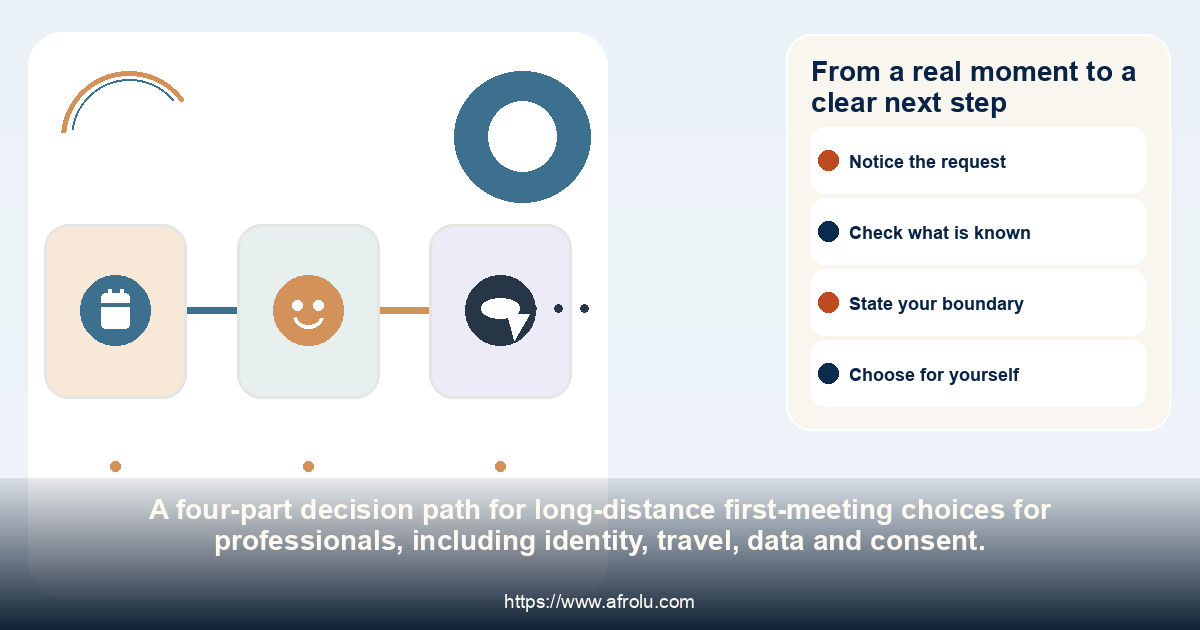
A reader-led next-step map for long-distance first-meeting choices for professionals, including identity, travel, data and consent. Afrolu:
Eight choices about long-distance first-meeting choices for professionals, including identity, travel, data and consent
A match offers to pay for a weekend visit
Confirm dates, lodging and costs before booking. Keep the decision grounded in long-distance first-meeting choices for professionals, including identity, travel, data and consent.
Ask one practical question about long-distance first-meeting choices for professionals, including identity, travel, data and consent, then choose a response that protects your own agency.A video call feels reassuring
Treat it as one signal and verify practical details independently. Keep the decision grounded in long-distance first-meeting choices for professionals, including identity, travel, data and consent.
Ask one practical question about long-distance first-meeting choices for professionals, including identity, travel, data and consent, then choose a response that protects your own agency.The first meeting is moved to a private home
Pause and suggest a public start you can leave. Keep the decision grounded in long-distance first-meeting choices for professionals, including identity, travel, data and consent.
Ask one practical question about long-distance first-meeting choices for professionals, including identity, travel, data and consent, then choose a response that protects your own agency.A new contact requests fare through a link
Check the request outside the conversation before paying. Keep the decision grounded in long-distance first-meeting choices for professionals, including identity, travel, data and consent.
Ask one practical question about long-distance first-meeting choices for professionals, including identity, travel, data and consent, then choose a response that protects your own agency.A match asks for your work address
Share only the detail needed for the current plan. Keep the decision grounded in long-distance first-meeting choices for professionals, including identity, travel, data and consent.
Ask one practical question about long-distance first-meeting choices for professionals, including identity, travel, data and consent, then choose a response that protects your own agency.Lunch is treated as agreement to extend the date
Decide on the next activity separately. Keep the decision grounded in long-distance first-meeting choices for professionals, including identity, travel, data and consent.
Ask one practical question about long-distance first-meeting choices for professionals, including identity, travel, data and consent, then choose a response that protects your own agency.Travel plans are altered after you arrive
Confirm the new details before choosing to continue. Keep the decision grounded in long-distance first-meeting choices for professionals, including identity, travel, data and consent.
Ask one practical question about long-distance first-meeting choices for professionals, including identity, travel, data and consent, then choose a response that protects your own agency.The visit went well but you need time
Choose when or whether to answer a new invitation. Keep the decision grounded in long-distance first-meeting choices for professionals, including identity, travel, data and consent.
Ask one practical question about long-distance first-meeting choices for professionals, including identity, travel, data and consent, then choose a response that protects your own agency.Notice how communication and plans unfold over time
Both adults can name what they want today. Check how it appears during long-distance first-meeting choices for professionals, including identity, travel, data and consent.
A question receives a direct answer. Check how it appears during long-distance first-meeting choices for professionals, including identity, travel, data and consent.
Plans reflect the calendars discussed. Check how it appears during long-distance first-meeting choices for professionals, including identity, travel, data and consent.
Changes are communicated when practical. Check how it appears during long-distance first-meeting choices for professionals, including identity, travel, data and consent.
Each person contributes ideas. Check how it appears during long-distance first-meeting choices for professionals, including identity, travel, data and consent.
Privacy requests are heard. Check how it appears during long-distance first-meeting choices for professionals, including identity, travel, data and consent.
A no is accepted without repeated pressure. Check how it appears during long-distance first-meeting choices for professionals, including identity, travel, data and consent.
Contact expectations are revisited openly. Check how it appears during long-distance first-meeting choices for professionals, including identity, travel, data and consent.
A date remains a separate choice. Check how it appears during long-distance first-meeting choices for professionals, including identity, travel, data and consent.
Travel is planned with full logistics. Check how it appears during long-distance first-meeting choices for professionals, including identity, travel, data and consent.
Family details are shared by choice. Check how it appears during long-distance first-meeting choices for professionals, including identity, travel, data and consent.
Work and rest boundaries are respected. Check how it appears during long-distance first-meeting choices for professionals, including identity, travel, data and consent.
Uncertainty can be named without a label. Check how it appears during long-distance first-meeting choices for professionals, including identity, travel, data and consent.
Either adult can revise the arrangement. Check how it appears during long-distance first-meeting choices for professionals, including identity, travel, data and consent.
Move from a concrete moment to your own next choice
| Situation | What it may mean | What to do next |
|---|---|---|
| A plan changes | A change is an event, not a complete explanation. The relevant context is long-distance first-meeting choices for professionals, including identity, travel, data and consent. | Ask for an update and decide whether the revised plan works. Decide from the response and your own needs around long-distance first-meeting choices for professionals, including identity, travel, data and consent. |
| A reply is delayed | Response timing alone does not establish intention. The relevant context is long-distance first-meeting choices for professionals, including identity, travel, data and consent. | Compare the timing with the contact agreement you made. Decide from the response and your own needs around long-distance first-meeting choices for professionals, including identity, travel, data and consent. |
| A label feels unclear | People use common dating words in different ways. The relevant context is long-distance first-meeting choices for professionals, including identity, travel, data and consent. | Ask what action the word describes today. Decide from the response and your own needs around long-distance first-meeting choices for professionals, including identity, travel, data and consent. |
| A boundary is questioned | A preference remains yours even when another adult disagrees. The relevant context is long-distance first-meeting choices for professionals, including identity, travel, data and consent. | Repeat it once and choose whether the connection still fits. Decide from the response and your own needs around long-distance first-meeting choices for professionals, including identity, travel, data and consent. |
| A date is cancelled | Work, health and family can affect an ordinary calendar. The relevant context is long-distance first-meeting choices for professionals, including identity, travel, data and consent. | Look for a clear update and whether both people can reschedule. Decide from the response and your own needs around long-distance first-meeting choices for professionals, including identity, travel, data and consent. |
| A future is raised | A hopeful conversation is not a settled commitment. The relevant context is long-distance first-meeting choices for professionals, including identity, travel, data and consent. | Separate the present choice from the longer-term question. Decide from the response and your own needs around long-distance first-meeting choices for professionals, including identity, travel, data and consent. |
| One person plans more | Different schedules can hide an uneven organising load. The relevant context is long-distance first-meeting choices for professionals, including identity, travel, data and consent. | Invite shared planning and observe how the request is received. Decide from the response and your own needs around long-distance first-meeting choices for professionals, including identity, travel, data and consent. |
| You want more time | A preference for contact is useful information, not a universal rule. The relevant context is long-distance first-meeting choices for professionals, including identity, travel, data and consent. | Ask what cadence is possible and decide whether it meets your needs. Decide from the response and your own needs around long-distance first-meeting choices for professionals, including identity, travel, data and consent. |
| You need privacy | Trust does not require disclosing every detail immediately. The relevant context is long-distance first-meeting choices for professionals, including identity, travel, data and consent. | Share the minimum context needed for the current plan. Decide from the response and your own needs around long-distance first-meeting choices for professionals, including identity, travel, data and consent. |
| Your wishes shift | Adults can update an arrangement as their experience changes. The relevant context is long-distance first-meeting choices for professionals, including identity, travel, data and consent. | Tell the other person before relying on a new assumption. Decide from the response and your own needs around long-distance first-meeting choices for professionals, including identity, travel, data and consent. |
Questions for a clear, respectful discussion
“I am open to a committed relationship and want to learn about compatibility over time. What are you looking for now?”
“When you say casual, do you mean one date, an ongoing connection or something else?”
“My next two weeks are busy; I can meet on Thursday afternoon. Would that work?”
“I do not check messages during work. I usually reconnect after my shift.”
“I keep family details private early on, but I can explain the schedule limits that affect plans.”
“Are we choosing to date only each other now, or have we not made that agreement?”
“I would like to see you and keep Sunday morning for rest. Could we plan Saturday afternoon?”
“I can plan one call each week. What time works in your ordinary schedule?”
“I am interested in meeting; I want to confirm dates, costs and lodging before booking.”
“My work schedule changed. I can no longer make Friday, but I can meet next Wednesday if you want.”
“I am not ready to include family in dating plans. I will let you know if that changes.”
“I do not think our expectations fit, so I am going to stop dating. I wish you well.”
Know the difference
Travel preparation and guaranteed safety
More control over logistics
No checklist can provide it
Preserve options without treating them as certainty.

A comparison that separates two decisions in long-distance first-meeting choices for professionals, including identity, travel, data and consent. Afrolu:
Keep intentions, capacity and agreements distinct
| Type or dimension | What it describes | Best next question |
|---|---|---|
| Intent | A relationship direction describes what someone is open to. This distinction can matter in long-distance first-meeting choices for professionals, including identity, travel, data and consent. | Ask about present hopes without requesting a guarantee. Keep the discussion specific to the adults involved. |
| Capacity | A calendar shows time available in a particular season. This distinction can matter in long-distance first-meeting choices for professionals, including identity, travel, data and consent. | Offer a realistic plan and revisit it when circumstances change. Keep the discussion specific to the adults involved. |
| Casual | A broad label needs a shared present-tense meaning. This distinction can matter in long-distance first-meeting choices for professionals, including identity, travel, data and consent. | Clarify the actions and terms it includes. Keep the discussion specific to the adults involved. |
| Exclusivity | Dating only one person is an agreement, not a hint. This distinction can matter in long-distance first-meeting choices for professionals, including identity, travel, data and consent. | Ask whether both adults have chosen it. Keep the discussion specific to the adults involved. |
| Privacy | A personal detail can be relevant later without being needed now. This distinction can matter in long-distance first-meeting choices for professionals, including identity, travel, data and consent. | Choose what you disclose and when. Keep the discussion specific to the adults involved. |
| Contact | A message habit is one part of communication. This distinction can matter in long-distance first-meeting choices for professionals, including identity, travel, data and consent. | Discuss an arrangement both people can keep. Keep the discussion specific to the adults involved. |
| A visit | Travel is a practical meeting decision. This distinction can matter in long-distance first-meeting choices for professionals, including identity, travel, data and consent. | Confirm costs, dates and expectations first. Keep the discussion specific to the adults involved. |
| Family involvement | Meeting family members is a distinct choice. This distinction can matter in long-distance first-meeting choices for professionals, including identity, travel, data and consent. | Decide based on your context rather than a universal timeline. Keep the discussion specific to the adults involved. |
| Future plans | Moving or making long-term plans changes many parts of life. This distinction can matter in long-distance first-meeting choices for professionals, including identity, travel, data and consent. | Return to that question when you have enough information. Keep the discussion specific to the adults involved. |
A simple plan you can use today
Labels are not diagnoses
A common relationship term cannot explain a person from one interaction. Apply this carefully to long-distance first-meeting choices for professionals, including identity, travel, data and consent.
Intent and time differ
An adult may want commitment while having limited capacity in a particular season. Apply this carefully to long-distance first-meeting choices for professionals, including identity, travel, data and consent.
Words need examples
Ask what casual, serious or exclusive means in present behaviour. Apply this carefully to long-distance first-meeting choices for professionals, including identity, travel, data and consent.
Research has limits
Studies use particular samples and do not predict every new match. Apply this carefully to long-distance first-meeting choices for professionals, including identity, travel, data and consent.
Privacy can be gradual
Share information because it helps the current decision, not to prove trust. Apply this carefully to long-distance first-meeting choices for professionals, including identity, travel, data and consent.
Plans can change
A clear update lets both adults choose whether the new option works. Apply this carefully to long-distance first-meeting choices for professionals, including identity, travel, data and consent.
Questions organised by purpose and depth
Choose a few prompts that fit the moment. This is a reference library, not a list to complete.
What do I want today?
Separate a present preference from a prediction about the future. Consider how this applies to long-distance first-meeting choices for professionals, including identity, travel, data and consent.
- What kind of next step feels welcome?
- Which current term changes my choice?
- What do I want to ask?
What can I share?
Choose information that supports the current conversation. Consider how this applies to long-distance first-meeting choices for professionals, including identity, travel, data and consent.
- What detail is necessary now?
- What can remain private?
- What does my profile reveal?
What can I sustain?
Check time, cost, energy and other responsibilities. Consider how this applies to long-distance first-meeting choices for professionals, including identity, travel, data and consent.
- Does the plan fit an ordinary week?
- Can either person revise it?
- What alternative is realistic?
What comes next?
Use the answer and observed conduct rather than an assumed deadline. Consider how this applies to long-distance first-meeting choices for professionals, including identity, travel, data and consent.
- Continue or pause?
- What needs a separate conversation?
- When should we review?
What deserves a closer look
Studies report patterns within defined samples
Reviews and diary studies consider attachment dimensions and relationship experiences in specific adult groups.
Evidence limit: They cannot diagnose a new match from a delayed reply or a boundary. The source sample differs from long-distance first-meeting choices for professionals, including identity, travel, data and consent.
Time constraints depend on the population studied
Time-use research examines particular couples, occupations, households and periods.
Evidence limit: It does not prescribe a dating cadence for working parents. The source sample differs from long-distance first-meeting choices for professionals, including identity, travel, data and consent.
Parent well-being findings are sample-specific
One study considered dating transitions among U.S. mothers after divorce.
Evidence limit: It does not establish a universal partner-introduction timeline or represent all families. The source sample differs from long-distance first-meeting choices for professionals, including identity, travel, data and consent.
Communication links are not simple causes
Surveys and relationship studies report associations in selected long-distance groups.
Evidence limit: They cannot prove a message frequency will work for every adult or parent. The source sample differs from long-distance first-meeting choices for professionals, including identity, travel, data and consent.
Research categories differ from everyday usage
Some studies focus on undergraduates or defined sexual experiences.
Evidence limit: Their terminology cannot settle what two people mean by casual dating. The source sample differs from long-distance first-meeting choices for professionals, including identity, travel, data and consent.
Privacy context matters
App and disclosure research covers particular users, platforms and questions.
Evidence limit: A profile or video call cannot guarantee identity, privacy or future conduct. The source sample differs from long-distance first-meeting choices for professionals, including identity, travel, data and consent.
Assumptions that can add pressure to dating
Treating availability as proof
A calendar cannot establish the full depth of another adult's interest. A clearer choice is available in long-distance first-meeting choices for professionals, including identity, travel, data and consent.
Assuming labels have one meaning
People use serious and casual differently unless they clarify terms. A clearer choice is available in long-distance first-meeting choices for professionals, including identity, travel, data and consent.
Sharing more than you want
A personal history or family detail can wait until it helps a decision. A clearer choice is available in long-distance first-meeting choices for professionals, including identity, travel, data and consent.
Promising an ideal schedule
A realistic plan is easier to maintain than an impressive promise. A clearer choice is available in long-distance first-meeting choices for professionals, including identity, travel, data and consent.
Reading one gap as a diagnosis
Message timing alone cannot reveal attachment style or intention. A clearer choice is available in long-distance first-meeting choices for professionals, including identity, travel, data and consent.
Bundling separate choices
A date, exclusivity, travel and family involvement each need their own agreement. A clearer choice is available in long-distance first-meeting choices for professionals, including identity, travel, data and consent.
Explore more about long-distance first-meeting choices for professionals, including identity, travel, data and consent
This guide offers editorial information, not diagnosis, therapy, custody, legal or emergency advice. Seek qualified support for individual questions.
Explore the guide library
Show more related guides
Continue with Afrolu
Show more Afrolu guides
Sources used for this guide
Afrolu reviewed these health, research, safety, or public guidance resources while editing this page. They support the behaviour and safety guidance; they do not diagnose any individual described by a reader.
Questions about long-distance first-meeting choices for professionals, including identity, travel, data and consent
Does serious dating mean exclusivity?
Not automatically. Ask whether both adults have agreed to date only one another.
Can my schedule change after we start dating?
Yes. Share a change when you can and discuss what plan remains workable.
Do attachment labels explain a slow reply?
No. Timing alone cannot diagnose a person or reveal a complete motive.
How much of my history should I disclose?
Share what helps the current decision and keep other details private until you choose.
Can I change the terms later?
Yes. Tell the other adult when your preference changes and hear their response.
What if we want different amounts of contact?
Compare practical options and decide whether the overlap is comfortable for both.
Does one good date predict a relationship?
A date gives you information about that meeting; it cannot settle the future.
Does a video call verify a match completely?
No. It can support recognition but cannot confirm every claim or predict conduct.
Should I stay with a long-distance match on a first visit?
No. Lodging is a separate choice; decide what preserves your independence.
Does paying for travel create an obligation?
No. A ticket does not require intimacy, an overnight stay or another date.
One thing to do now
Choose the next step that fits you
Confirm the visit's terms, keep transport and lodging independently manageable, protect credentials and review each new choice as it happens.