Parents returning · distance · clarity
Long-Distance Dating as a Parent: Set a Workable Rhythm
Plan long-distance dating as a parent with clear calls, travel choices and privacy boundaries. Keep family decisions separate from relationship promises.

An adult parent prepares for a thoughtful evening video call For adults exploring a parent's long-distance dating rhythm with optional travel, selective disclosure and shared planning. Afrolu:
Written and edited by Miriam Otieno · Senior Kenya Editor
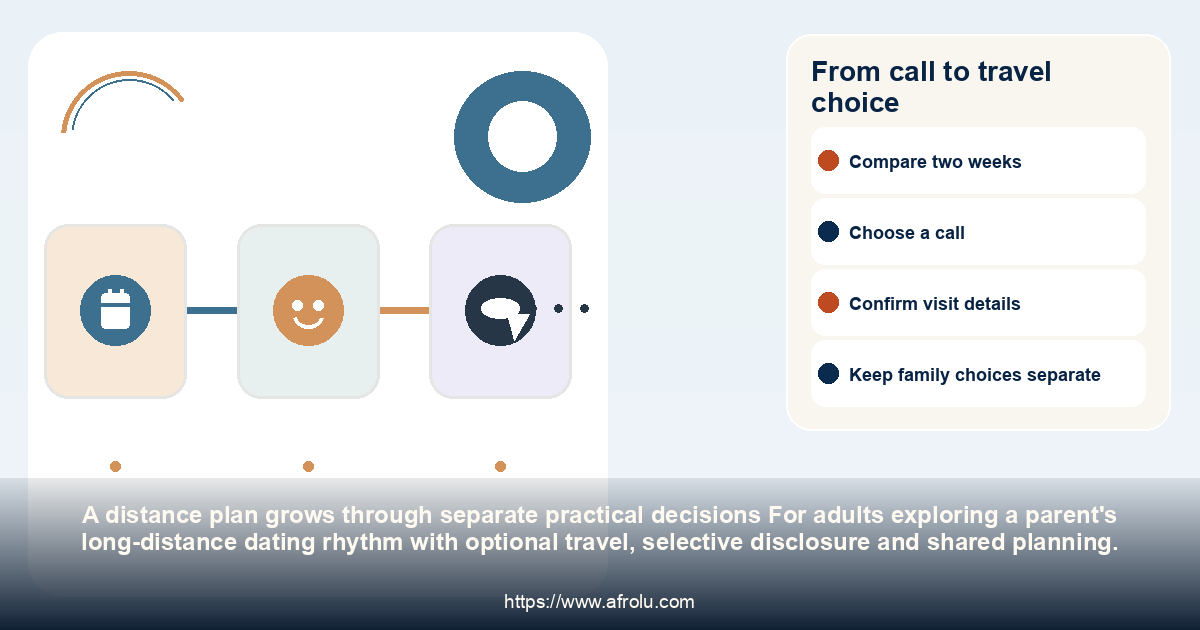
Compare ordinary weeks, choose one call window both adults can maintain and discuss what a visit would involve before anyone books. Keep travel, exclusivity, moving and family involvement as separate decisions. You can share a general explanation of your availability without exposing a child's identity, schedule or location.
Attachment styles · Parents Returning To Dating
How can a parent build a clear long-distance dating rhythm while keeping care schedules, travel costs and family privacy in view?
A workable long-distance dating rhythm is an agreed pattern for contact and possible visits that fits both adults' schedules, resources and boundaries. For a parent, the plan can account for care responsibilities without requiring immediate access to family routines or a commitment to relocate.
Ruth lives in Kisumu and begins talking with Malik, who works in Nairobi. She has a child and a rotating co-parenting schedule, but she does not want a new match to know exact handover details. They compare their usual weeks and choose a Thursday call after dinner. After a month they discuss meeting, including cost, dates and separate accommodation. Malik suggests that she bring her child on the first visit; Ruth says she keeps dating and parenting plans separate while the connection is new. He accepts the boundary. They agree to meet as adults first and revisit other questions only if both still want to continue.
Compare real weeks
Build a rhythm from normal schedules
Long-distance dating can begin with long late-night calls that are difficult to maintain once the excitement settles. Compare work, sleep, time zones, care responsibilities and rest across an ordinary week. You do not need to reveal exact family handover times; a broad available window can be enough to coordinate.
Ask the other person what their typical week looks like and name the limits that affect yours. If Thursday after dinner is usually possible but school holidays change your routine, explain that the schedule varies. An agreement can include a way to update each other rather than pretending life will stay predictable.
A contact plan might be one scheduled call and optional short messages, or something different that suits both adults. Decide how you will handle a missed call and whether you will reschedule. The purpose is to reduce guesswork while leaving each person free to ask for more or less contact later.
Long-distance research may focus on students, couples already together or specific communication patterns. Those findings do not tell a parent in a new connection how many calls to make. Treat them as context, then test the schedule against your lived week and change it when the arrangement becomes burdensome.
Make missed plans easy to repair
Agree what happens when a call cannot happen
Parents and nonparents alike may have work, illness or family events interrupt a planned call. Discuss a simple update habit before a disruption occurs. For example, each adult can send a short note when a call will not happen and say whether they want to reschedule. The message should inform, not demand immediate access.
If a call is missed without notice, wait for context before deciding what it means. The person may explain, apologise or suggest a new time. You can decide whether that response meets your needs. If the same disruption repeats and leaves you holding the schedule alone, raise the pattern and ask whether the agreement needs changing.
Attachment vocabulary is sometimes used to explain silence, but it cannot tell you why a particular call was missed. Ask about the event and the current plan. You do not need to excuse repeated unreliability, and you do not need to diagnose the other adult before you decide that the arrangement no longer works.
A realistic rhythm includes room for ordinary changes, but flexibility should not become a permanent expectation that one person waits. Agree on how much notice is useful and how long you are willing to keep a call window open. The other adult can share their preference, and together you can see whether a practical overlap exists.

Two adults choose a repeatable contact plan For adults exploring a parent's long-distance dating rhythm with optional travel, selective disclosure and shared planning. Afrolu:
Plan travel independently
Discuss the full visit before committing money
Travel can make a distant connection feel more settled than it is. Before buying tickets, compare exact dates, total cost, time away from care responsibilities and a plan for accommodation. Ask what both people think the visit is for. A first meeting can be exploratory; neither adult has to imply a future commitment.
Choose transport and lodging that fit your budget and preserve your ability to change plans. You can meet in a public setting and arrange an independent return route. Accepting an invitation does not require staying in another person's home, introducing family members or agreeing to intimacy. Those choices remain separate and specific.
A long-distance match asking for urgent travel funds deserves a pause. Do not send money because a story feels romantic, a departure is supposedly imminent or a ticket is described as the only way to meet. Verify claims independently and use official consumer or local reporting guidance if you suspect deception.
If travel is not affordable or practical, say so rather than promising a date you cannot book. You can continue calls, wait for a future opening or decide that the distance is incompatible with your life. The other adult may choose differently. Both people deserve to make the decision with accurate information about time and cost.

A timeline for practical long-distance coordination For adults exploring a parent's long-distance dating rhythm with optional travel, selective disclosure and shared planning. Afrolu:
Keep later choices separate
Do not turn a call routine into a future promise
A weekly call shows that two adults have made a communication plan. It does not establish whether they are exclusive, when they will visit again or whether either person might relocate. If those questions matter, bring them into conversation one at a time. Different answers can coexist while you learn about the connection.
Parents may need to consider how a relationship fits with children, co-parenting arrangements and household routines. These considerations can be important without being disclosed in detail to a new match. Decide privately what must be understood before a later step and what professional support might help with a specific family question.
There is no universal rule about when a dating partner should meet a child. Family circumstances, children's needs and adult relationships differ, and the available research does not establish one safe timeline for every household. Keep any introduction decision reader-led and consider qualified guidance if you need advice for a particular situation.
A match might ask about moving closer after a few good calls. You can respond that you are not ready to consider a move and want more experience first. That is information, not rejection. If the other adult needs a decision sooner, compare what each person wants and decide whether waiting remains comfortable for both.
Review the arrangement
Keep the plan only while it fits both lives
After several weeks, look at call frequency, travel discussion and how updates were handled. Did the plan leave enough rest? Did both adults initiate? Did you feel able to keep family information private? These practical questions help you see whether the arrangement has room to grow without requiring you to predict the whole relationship.
You might keep the rhythm, add a visit, ask about current dating terms or reduce calls during a demanding month. Each option can be discussed separately. A change in schedule does not automatically mean someone has lost interest, but both adults can say how the change affects them and what would help.
If the distance continues to be difficult, compare the parts that could change and the parts that cannot. Work location, childcare and money may set real limits. You can decide that a local connection would suit you better even when you value the person you have been speaking with. Preference is enough reason to choose differently.
A pause can be clear and kind: name the question you need to consider and when you expect to reconnect, if you want to. An ending can also be direct. You do not owe a trip, a family introduction or a move because the other person invested time or money. Your future decisions remain yours.

Four choices before booking a long-distance visit For adults exploring a parent's long-distance dating rhythm with optional travel, selective disclosure and shared planning. Afrolu:
Eight choices about a parent's long-distance dating rhythm with optional travel, selective disclosure and shared planning
A proposed call lands during a care routine
Suggest a broad alternate window that protects family privacy. Keep the decision grounded in a parent's long-distance dating rhythm with optional travel, selective disclosure and shared planning.
Ask one practical question about a parent's long-distance dating rhythm with optional travel, selective disclosure and shared planning, then choose a response that protects your own agency.The two schedules leave only late-night calls
Compare other days before accepting a tiring pattern. Keep the decision grounded in a parent's long-distance dating rhythm with optional travel, selective disclosure and shared planning.
Ask one practical question about a parent's long-distance dating rhythm with optional travel, selective disclosure and shared planning, then choose a response that protects your own agency.A match suggests an immediate overnight stay
Discuss dates, lodging and separate comfort boundaries first. Keep the decision grounded in a parent's long-distance dating rhythm with optional travel, selective disclosure and shared planning.
Ask one practical question about a parent's long-distance dating rhythm with optional travel, selective disclosure and shared planning, then choose a response that protects your own agency.One adult is expected to fund every trip
Talk about budget limits and shared planning directly. Keep the decision grounded in a parent's long-distance dating rhythm with optional travel, selective disclosure and shared planning.
Ask one practical question about a parent's long-distance dating rhythm with optional travel, selective disclosure and shared planning, then choose a response that protects your own agency.Someone asks for exact child handover times
Keep identifying family routines private. Keep the decision grounded in a parent's long-distance dating rhythm with optional travel, selective disclosure and shared planning.
Ask one practical question about a parent's long-distance dating rhythm with optional travel, selective disclosure and shared planning, then choose a response that protects your own agency.A planned call is missed
Ask what happened and revisit the repair agreement. Keep the decision grounded in a parent's long-distance dating rhythm with optional travel, selective disclosure and shared planning.
Ask one practical question about a parent's long-distance dating rhythm with optional travel, selective disclosure and shared planning, then choose a response that protects your own agency.A good month of calls prompts relocation talk
Treat moving as a separate future decision. Keep the decision grounded in a parent's long-distance dating rhythm with optional travel, selective disclosure and shared planning.
Ask one practical question about a parent's long-distance dating rhythm with optional travel, selective disclosure and shared planning, then choose a response that protects your own agency.Travel remains difficult to arrange
Decide whether calls, a later visit or ending fits your life. Keep the decision grounded in a parent's long-distance dating rhythm with optional travel, selective disclosure and shared planning.
Ask one practical question about a parent's long-distance dating rhythm with optional travel, selective disclosure and shared planning, then choose a response that protects your own agency.Notice how communication and plans unfold over time
Both adults can name what they want today. Check how it appears during a parent's long-distance dating rhythm with optional travel, selective disclosure and shared planning.
A question receives a direct answer. Check how it appears during a parent's long-distance dating rhythm with optional travel, selective disclosure and shared planning.
Plans reflect the calendars discussed. Check how it appears during a parent's long-distance dating rhythm with optional travel, selective disclosure and shared planning.
Changes are communicated when practical. Check how it appears during a parent's long-distance dating rhythm with optional travel, selective disclosure and shared planning.
Each person contributes ideas. Check how it appears during a parent's long-distance dating rhythm with optional travel, selective disclosure and shared planning.
Privacy requests are heard. Check how it appears during a parent's long-distance dating rhythm with optional travel, selective disclosure and shared planning.
A no is accepted without repeated pressure. Check how it appears during a parent's long-distance dating rhythm with optional travel, selective disclosure and shared planning.
Contact expectations are revisited openly. Check how it appears during a parent's long-distance dating rhythm with optional travel, selective disclosure and shared planning.
A date remains a separate choice. Check how it appears during a parent's long-distance dating rhythm with optional travel, selective disclosure and shared planning.
Travel is planned with full logistics. Check how it appears during a parent's long-distance dating rhythm with optional travel, selective disclosure and shared planning.
Family details are shared by choice. Check how it appears during a parent's long-distance dating rhythm with optional travel, selective disclosure and shared planning.
Work and rest boundaries are respected. Check how it appears during a parent's long-distance dating rhythm with optional travel, selective disclosure and shared planning.
Uncertainty can be named without a label. Check how it appears during a parent's long-distance dating rhythm with optional travel, selective disclosure and shared planning.
Either adult can revise the arrangement. Check how it appears during a parent's long-distance dating rhythm with optional travel, selective disclosure and shared planning.
Move from a concrete moment to your own next choice
| Situation | What it may mean | What to do next |
|---|---|---|
| A plan changes | A change is an event, not a complete explanation. The relevant context is a parent's long-distance dating rhythm with optional travel, selective disclosure and shared planning. | Ask for an update and decide whether the revised plan works. Decide from the response and your own needs around a parent's long-distance dating rhythm with optional travel, selective disclosure and shared planning. |
| A reply is delayed | Response timing alone does not establish intention. The relevant context is a parent's long-distance dating rhythm with optional travel, selective disclosure and shared planning. | Compare the timing with the contact agreement you made. Decide from the response and your own needs around a parent's long-distance dating rhythm with optional travel, selective disclosure and shared planning. |
| A label feels unclear | People use common dating words in different ways. The relevant context is a parent's long-distance dating rhythm with optional travel, selective disclosure and shared planning. | Ask what action the word describes today. Decide from the response and your own needs around a parent's long-distance dating rhythm with optional travel, selective disclosure and shared planning. |
| A boundary is questioned | A preference remains yours even when another adult disagrees. The relevant context is a parent's long-distance dating rhythm with optional travel, selective disclosure and shared planning. | Repeat it once and choose whether the connection still fits. Decide from the response and your own needs around a parent's long-distance dating rhythm with optional travel, selective disclosure and shared planning. |
| A date is cancelled | Work, health and family can affect an ordinary calendar. The relevant context is a parent's long-distance dating rhythm with optional travel, selective disclosure and shared planning. | Look for a clear update and whether both people can reschedule. Decide from the response and your own needs around a parent's long-distance dating rhythm with optional travel, selective disclosure and shared planning. |
| A future is raised | A hopeful conversation is not a settled commitment. The relevant context is a parent's long-distance dating rhythm with optional travel, selective disclosure and shared planning. | Separate the present choice from the longer-term question. Decide from the response and your own needs around a parent's long-distance dating rhythm with optional travel, selective disclosure and shared planning. |
| One person plans more | Different schedules can hide an uneven organising load. The relevant context is a parent's long-distance dating rhythm with optional travel, selective disclosure and shared planning. | Invite shared planning and observe how the request is received. Decide from the response and your own needs around a parent's long-distance dating rhythm with optional travel, selective disclosure and shared planning. |
| You want more time | A preference for contact is useful information, not a universal rule. The relevant context is a parent's long-distance dating rhythm with optional travel, selective disclosure and shared planning. | Ask what cadence is possible and decide whether it meets your needs. Decide from the response and your own needs around a parent's long-distance dating rhythm with optional travel, selective disclosure and shared planning. |
| You need privacy | Trust does not require disclosing every detail immediately. The relevant context is a parent's long-distance dating rhythm with optional travel, selective disclosure and shared planning. | Share the minimum context needed for the current plan. Decide from the response and your own needs around a parent's long-distance dating rhythm with optional travel, selective disclosure and shared planning. |
| Your wishes shift | Adults can update an arrangement as their experience changes. The relevant context is a parent's long-distance dating rhythm with optional travel, selective disclosure and shared planning. | Tell the other person before relying on a new assumption. Decide from the response and your own needs around a parent's long-distance dating rhythm with optional travel, selective disclosure and shared planning. |
Questions for a clear, respectful discussion
“I am open to a committed relationship and want to learn about compatibility over time. What are you looking for now?”
“When you say casual, do you mean one date, an ongoing connection or something else?”
“My next two weeks are busy; I can meet on Thursday afternoon. Would that work?”
“I do not check messages during work. I usually reconnect after my shift.”
“I keep family details private early on, but I can explain the schedule limits that affect plans.”
“Are we choosing to date only each other now, or have we not made that agreement?”
“I would like to see you and keep Sunday morning for rest. Could we plan Saturday afternoon?”
“I can plan one call each week. What time works in your ordinary schedule?”
“I am interested in meeting; I want to confirm dates, costs and lodging before booking.”
“My work schedule changed. I can no longer make Friday, but I can meet next Wednesday if you want.”
“I am not ready to include family in dating plans. I will let you know if that changes.”
“I do not think our expectations fit, so I am going to stop dating. I wish you well.”
Know the difference
Contact rhythm and family choices
How adults stay in touch
Separate decisions at home
One connection routine does not decide family involvement.

Panels distinguish a connection rhythm from family decisions For adults exploring a parent's long-distance dating rhythm with optional travel, selective disclosure and shared planning. Afrolu:
Keep intentions, capacity and agreements distinct
| Type or dimension | What it describes | Best next question |
|---|---|---|
| Intent | A relationship direction describes what someone is open to. This distinction can matter in a parent's long-distance dating rhythm with optional travel, selective disclosure and shared planning. | Ask about present hopes without requesting a guarantee. Keep the discussion specific to the adults involved. |
| Capacity | A calendar shows time available in a particular season. This distinction can matter in a parent's long-distance dating rhythm with optional travel, selective disclosure and shared planning. | Offer a realistic plan and revisit it when circumstances change. Keep the discussion specific to the adults involved. |
| Casual | A broad label needs a shared present-tense meaning. This distinction can matter in a parent's long-distance dating rhythm with optional travel, selective disclosure and shared planning. | Clarify the actions and terms it includes. Keep the discussion specific to the adults involved. |
| Exclusivity | Dating only one person is an agreement, not a hint. This distinction can matter in a parent's long-distance dating rhythm with optional travel, selective disclosure and shared planning. | Ask whether both adults have chosen it. Keep the discussion specific to the adults involved. |
| Privacy | A personal detail can be relevant later without being needed now. This distinction can matter in a parent's long-distance dating rhythm with optional travel, selective disclosure and shared planning. | Choose what you disclose and when. Keep the discussion specific to the adults involved. |
| Contact | A message habit is one part of communication. This distinction can matter in a parent's long-distance dating rhythm with optional travel, selective disclosure and shared planning. | Discuss an arrangement both people can keep. Keep the discussion specific to the adults involved. |
| A visit | Travel is a practical meeting decision. This distinction can matter in a parent's long-distance dating rhythm with optional travel, selective disclosure and shared planning. | Confirm costs, dates and expectations first. Keep the discussion specific to the adults involved. |
| Family involvement | Meeting family members is a distinct choice. This distinction can matter in a parent's long-distance dating rhythm with optional travel, selective disclosure and shared planning. | Decide based on your context rather than a universal timeline. Keep the discussion specific to the adults involved. |
| Future plans | Moving or making long-term plans changes many parts of life. This distinction can matter in a parent's long-distance dating rhythm with optional travel, selective disclosure and shared planning. | Return to that question when you have enough information. Keep the discussion specific to the adults involved. |
A simple plan you can use today
Labels are not diagnoses
A common relationship term cannot explain a person from one interaction. Apply this carefully to a parent's long-distance dating rhythm with optional travel, selective disclosure and shared planning.
Intent and time differ
An adult may want commitment while having limited capacity in a particular season. Apply this carefully to a parent's long-distance dating rhythm with optional travel, selective disclosure and shared planning.
Words need examples
Ask what casual, serious or exclusive means in present behaviour. Apply this carefully to a parent's long-distance dating rhythm with optional travel, selective disclosure and shared planning.
Research has limits
Studies use particular samples and do not predict every new match. Apply this carefully to a parent's long-distance dating rhythm with optional travel, selective disclosure and shared planning.
Privacy can be gradual
Share information because it helps the current decision, not to prove trust. Apply this carefully to a parent's long-distance dating rhythm with optional travel, selective disclosure and shared planning.
Plans can change
A clear update lets both adults choose whether the new option works. Apply this carefully to a parent's long-distance dating rhythm with optional travel, selective disclosure and shared planning.
Questions organised by purpose and depth
Choose a few prompts that fit the moment. This is a reference library, not a list to complete.
What do I want today?
Separate a present preference from a prediction about the future. Consider how this applies to a parent's long-distance dating rhythm with optional travel, selective disclosure and shared planning.
- What kind of next step feels welcome?
- Which current term changes my choice?
- What do I want to ask?
What can I share?
Choose information that supports the current conversation. Consider how this applies to a parent's long-distance dating rhythm with optional travel, selective disclosure and shared planning.
- What detail is necessary now?
- What can remain private?
- What does my profile reveal?
What can I sustain?
Check time, cost, energy and other responsibilities. Consider how this applies to a parent's long-distance dating rhythm with optional travel, selective disclosure and shared planning.
- Does the plan fit an ordinary week?
- Can either person revise it?
- What alternative is realistic?
What comes next?
Use the answer and observed conduct rather than an assumed deadline. Consider how this applies to a parent's long-distance dating rhythm with optional travel, selective disclosure and shared planning.
- Continue or pause?
- What needs a separate conversation?
- When should we review?
What deserves a closer look
Studies report patterns within defined samples
Reviews and diary studies consider attachment dimensions and relationship experiences in specific adult groups.
Evidence limit: They cannot diagnose a new match from a delayed reply or a boundary. The source sample differs from a parent's long-distance dating rhythm with optional travel, selective disclosure and shared planning.
Time constraints depend on the population studied
Time-use research examines particular couples, occupations, households and periods.
Evidence limit: It does not prescribe a dating cadence for working parents. The source sample differs from a parent's long-distance dating rhythm with optional travel, selective disclosure and shared planning.
Parent well-being findings are sample-specific
One study considered dating transitions among U.S. mothers after divorce.
Evidence limit: It does not establish a universal partner-introduction timeline or represent all families. The source sample differs from a parent's long-distance dating rhythm with optional travel, selective disclosure and shared planning.
Communication links are not simple causes
Surveys and relationship studies report associations in selected long-distance groups.
Evidence limit: They cannot prove a message frequency will work for every adult or parent. The source sample differs from a parent's long-distance dating rhythm with optional travel, selective disclosure and shared planning.
Research categories differ from everyday usage
Some studies focus on undergraduates or defined sexual experiences.
Evidence limit: Their terminology cannot settle what two people mean by casual dating. The source sample differs from a parent's long-distance dating rhythm with optional travel, selective disclosure and shared planning.
Privacy context matters
App and disclosure research covers particular users, platforms and questions.
Evidence limit: A profile or video call cannot guarantee identity, privacy or future conduct. The source sample differs from a parent's long-distance dating rhythm with optional travel, selective disclosure and shared planning.
Assumptions that can add pressure to dating
Treating availability as proof
A calendar cannot establish the full depth of another adult's interest. A clearer choice is available in a parent's long-distance dating rhythm with optional travel, selective disclosure and shared planning.
Assuming labels have one meaning
People use serious and casual differently unless they clarify terms. A clearer choice is available in a parent's long-distance dating rhythm with optional travel, selective disclosure and shared planning.
Sharing more than you want
A personal history or family detail can wait until it helps a decision. A clearer choice is available in a parent's long-distance dating rhythm with optional travel, selective disclosure and shared planning.
Promising an ideal schedule
A realistic plan is easier to maintain than an impressive promise. A clearer choice is available in a parent's long-distance dating rhythm with optional travel, selective disclosure and shared planning.
Reading one gap as a diagnosis
Message timing alone cannot reveal attachment style or intention. A clearer choice is available in a parent's long-distance dating rhythm with optional travel, selective disclosure and shared planning.
Bundling separate choices
A date, exclusivity, travel and family involvement each need their own agreement. A clearer choice is available in a parent's long-distance dating rhythm with optional travel, selective disclosure and shared planning.
Explore more about a parent's long-distance dating rhythm with optional travel, selective disclosure and shared planning
This guide offers editorial information, not diagnosis, therapy, custody, legal or emergency advice. Seek qualified support for individual questions.
Explore the guide library
Show more related guides
Continue with Afrolu
Show more Afrolu guides
Sources used for this guide
Afrolu reviewed these health, research, safety, or public guidance resources while editing this page. They support the behaviour and safety guidance; they do not diagnose any individual described by a reader.
Questions about a parent's long-distance dating rhythm with optional travel, selective disclosure and shared planning
Does serious dating mean exclusivity?
Not automatically. Ask whether both adults have agreed to date only one another.
Can my schedule change after we start dating?
Yes. Share a change when you can and discuss what plan remains workable.
Do attachment labels explain a slow reply?
No. Timing alone cannot diagnose a person or reveal a complete motive.
How much of my history should I disclose?
Share what helps the current decision and keep other details private until you choose.
Can I change the terms later?
Yes. Tell the other adult when your preference changes and hear their response.
What if we want different amounts of contact?
Compare practical options and decide whether the overlap is comfortable for both.
Does one good date predict a relationship?
A date gives you information about that meeting; it cannot settle the future.
How often should long-distance parents call?
Choose a repeatable window that fits both ordinary schedules and revise it when needed.
Should I introduce a distant match to my child?
That is a separate family decision with no single timeline that fits every household.
Should I pay for a match's travel?
Do not send money under pressure. Confirm travel plans independently and stay within your budget.
One thing to do now
Choose the next step that fits you
Agree on a repeatable call rhythm, keep visits optional until logistics are explicit and treat family involvement as separate.