Parents returning · clarity · casual dating
Dating as a Parent: Make Casual Terms Clear
Dating as a parent can start with one useful question: what does casual mean now? Set adult boundaries, protect private details and choose your pace today.
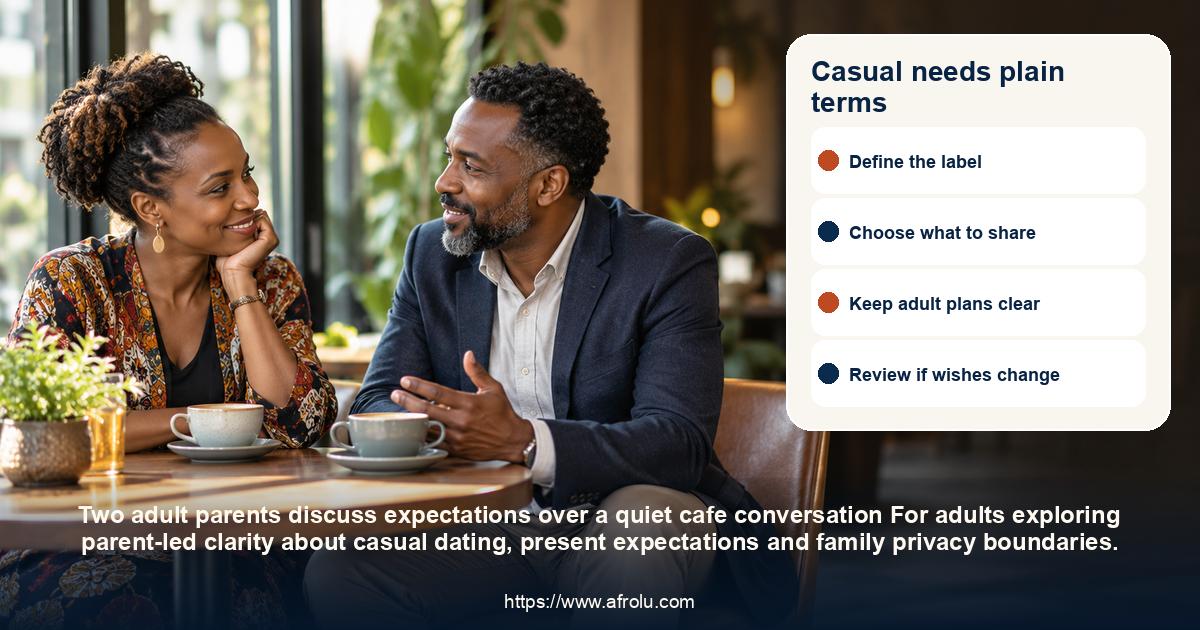
Two adult parents discuss expectations over a quiet cafe conversation For adults exploring parent-led clarity about casual dating, present expectations and family privacy boundaries. Afrolu:
Written and edited by Ruth Akinyi · Local Dating Editor
Ask what casual means to the other adult in present terms: one date, ongoing dating, non-exclusivity or something else. Explain what you are comfortable with, what stays private and how much time you have. Parenting status does not require one universal dating timeline; adults can set their own boundaries and revisit them when circumstances change.
Attachment styles · Parents Returning To Dating
How can I clarify casual dating as a parent while keeping family information private and leaving room for my own preferences to change?
Casual dating has no single shared definition. It can describe a relaxed first meeting, an ongoing connection without exclusivity or a different arrangement. For a parent, clarity means discussing present expectations and practical boundaries while deciding personally what family details to share and when.
After her separation, Nandi makes a dating profile and meets Peter for coffee. When he says he wants to keep things casual, she asks what that means to him. Peter says he hopes to keep seeing each other but has not decided about exclusivity. Nandi replies that she is comfortable with a few low-pressure dates, prefers to discuss current terms before intimacy, and keeps her children's routines and identifying details private early on. They agree to meet again without involving family plans. The conversation does not settle how the relationship will develop. It gives both adults a clear choice about what happens next.
Define the word
Ask what casual includes for each adult
Casual can mean a single date without a forecast, an ongoing connection without exclusivity, or simply a relaxed way to begin. A parent and a child-free date may attach different assumptions to the same word. Ask the other person to describe what they mean now, rather than guessing from a profile or tone.
You might ask whether either person expects to keep meeting other people, how often they hope to connect and whether they are open to physical intimacy. Not every subject needs to be decided on the first coffee. Focus first on the question that changes your own next step, then agree when to revisit the rest.
State what you want in matching concrete language. For example, you may be open to relaxed dates and not ready to offer exclusivity. Or you may find that casual is not a fit unless the connection is exclusive. You are allowed to have either preference and to change it when your experience changes.
A direct answer is useful even if it reveals a mismatch. If the other adult avoids defining terms, notice whether they are asking you to proceed without information you consider important. You can pause, ask again or decline. Clarity is not a demand for commitment; it is a request to understand the choice in front of you.
Protect family privacy
Share only details that suit the present conversation
A parent may want to mention that family responsibilities shape availability without sharing a child's name, school, photograph or weekly route. General information can help explain your schedule. Specific identifying details are a separate choice. You can keep them private until you decide there is a clear reason and an appropriate level of trust.
Think about what a detail would reveal if it were copied, forwarded or seen outside the app. A public profile photo near a school logo, a precise pickup time or a child's social account may disclose more than you intended. Review what your own profile shows and remove details that do not serve your dating goals.
You can set a boundary in a neutral way: you talk about parenting in general, but keep your children's identifying information offline. A respectful adult can accept that limit without insisting that openness means immediate access. You also do not need to apologise for maintaining a boundary that feels right for your family.
There is no universal number of dates after which a parent should share more. Families differ, and an article cannot know your child, co-parenting arrangement or local context. Treat timing as your own decision. If a specific concern involves family law, custody or a child's wellbeing, consult a qualified professional who understands your circumstances.
Describe your capacity
Make plans around the time you can really offer
Care responsibilities can make some days predictable and others dependent on school, health or co-parenting arrangements. You do not have to disclose private family logistics to explain that a certain evening will not work. Share the general boundary and offer another time if you want the connection to continue.
Try a small first plan that does not require an elaborate backup system. A daytime coffee during an available window may be easier than a late evening with complicated transport. If your schedule changes, update the other adult as soon as practical. You can show consideration without promising that family life will never interrupt a date.
A match may ask for more time than you can give. Ask what rhythm they hope for and compare it with your actual week. It is fair to say that you cannot offer regular weekend travel or last-minute plans. They can decide whether that works, and you can decide whether their expectations fit your life.
Work-family research describes constraints in specific populations; it does not define the amount of dating time a parent should have. Use a calendar as a planning aid, not as proof that you are ready or unready. Your decision can reflect energy, privacy, finances and desire, all of which may change over time.

A two-way conversation about present terms For adults exploring parent-led clarity about casual dating, present expectations and family privacy boundaries. Afrolu:
Use labels with care
Do not turn a parenting boundary into a diagnosis
Online dating advice sometimes calls a person avoidant when they keep a relationship away from family life. That label can erase the practical reasons a parent may have for moving carefully. A privacy boundary cannot diagnose a person. Privacy, childcare, co-parenting, personal comfort and a child's needs are distinct considerations; a stranger cannot infer an attachment style from one boundary.
If you feel yourself pulling back from a match, ask what exactly changed. Was a personal question asked too early? Did the connection stop feeling casual? Did a scheduling request assume unlimited access? Naming the event may show whether you want a smaller step, a direct conversation or a clean ending.
A date may also need time or prefer a different level of disclosure. You can ask what information they need to understand the current arrangement, then decide what you are comfortable sharing. An adult's curiosity does not create an obligation to tell the full story of a separation or parenting history.
Attachment studies examine measured patterns in defined samples, not parental disclosure timelines for every family. Use research to stay curious about reactions, not to grade your openness. Your boundaries can be valid even if they are different from another parent's, and you can revisit them without calling an earlier choice a mistake.

Observable behaviours around clear dating agreements For adults exploring parent-led clarity about casual dating, present expectations and family privacy boundaries. Afrolu:
Keep choices specific
Separate dating, exclusivity and family involvement
Two adults can agree to keep dating casually and still have different expectations about exclusivity, intimacy, communication or meeting friends. Ask about each topic when it becomes relevant. A yes to another date is only a yes to that date; it does not give permission for a different kind of contact or disclosure.
If intimacy is part of the conversation, discuss consent and sexual health with clear, current language. You may pause or change your mind at any point. An existing dating arrangement does not remove the need to listen and check in. If you feel pressured to prove trust or commitment, you can stop and reassess.
Keep family involvement as its own decision. A casual relationship need not automatically include children, relatives or household spaces. Some parents prefer strict separation; others may make different choices later. This guide does not prescribe a child-introduction age or waiting period, because families and circumstances are not interchangeable.
A practical boundary conversation can be brief: explain the current arrangement, say what is private and ask whether the other adult can accept those terms. If they want something different, listen to the difference and choose whether to continue. Compatibility includes respecting a no, not only agreeing on the appealing parts of dating.
Review as life changes
Notice whether casual still fits your actual experience
A connection that began casually may become more important, feel less comfortable or remain exactly what both people expected. Check how you feel after several meetings. Are the current terms clear? Does the amount of contact fit? Are you choosing freely, or continuing because you fear a difficult conversation?
If your goals shift, tell the other adult before acting on an assumption that they have changed too. You can say you are starting to want exclusivity or that you would rather keep the relationship casual. They may want the same thing, need time or prefer to stop. Each response deserves room to be honest.
Notice whether family privacy remains respected. A partner who asks to meet a child, see a home or receive a schedule should hear your boundary without turning it into a loyalty test. You can explain your decision, offer a different form of connection or decline the request. The choice is yours to make for your circumstances.
Research on dating after divorce includes particular samples and outcomes; it cannot decide whether your casual arrangement supports your wellbeing. Use your own observations and, if helpful, trusted or professional support. If a connection brings ongoing distress or conflict, you can pause while deciding what would feel healthier for you and your family.
Choose the next conversation
Make one decision without solving the whole future
Before your next date, write down the answer you need to decide whether to continue. It might be whether the other adult expects exclusivity, how often they want to meet or whether they can keep family details private. One focused question is more likely to produce a useful conversation than a broad demand for certainty.
You can also decide what you do not want to discuss yet. Perhaps your past relationship can wait while you learn whether the current connection is respectful. A short reply such as 'I keep that private early on' communicates enough. You are not required to add details that would make the other person more comfortable.
If the answer works for you, agree on a modest next step. If it does not, you can say that the terms are not a fit and stop dating. A person can be kind, attractive and still want an arrangement that does not suit your life. Ending does not erase the value of meeting them.
Keep the decision centered on adult choices you control: how you spend time, what information you share and what arrangement you accept. You do not need to borrow a dating timeline from a headline or attachment checklist. Your family context matters, and your next step can be revised as you learn more.

Four reader choices for casual dating as a parent For adults exploring parent-led clarity about casual dating, present expectations and family privacy boundaries. Afrolu:
Eight choices about parent-led clarity about casual dating, present expectations and family privacy boundaries
A date says casual but cannot explain what that includes
Ask about exclusivity, frequency and current expectations separately. Keep the decision grounded in parent-led clarity about casual dating, present expectations and family privacy boundaries.
Ask one practical question about parent-led clarity about casual dating, present expectations and family privacy boundaries, then choose a response that protects your own agency.A photo reveals a child's school badge
Choose an image that does not expose identifying details. Keep the decision grounded in parent-led clarity about casual dating, present expectations and family privacy boundaries.
Ask one practical question about parent-led clarity about casual dating, present expectations and family privacy boundaries, then choose a response that protects your own agency.Someone asks when they can meet your children
Decide privately whether that step is appropriate for your family. Keep the decision grounded in parent-led clarity about casual dating, present expectations and family privacy boundaries.
Ask one practical question about parent-led clarity about casual dating, present expectations and family privacy boundaries, then choose a response that protects your own agency.Care arrangements make a planned evening unavailable
Offer another time without sharing the household timetable. Keep the decision grounded in parent-led clarity about casual dating, present expectations and family privacy boundaries.
Ask one practical question about parent-led clarity about casual dating, present expectations and family privacy boundaries, then choose a response that protects your own agency.A match asks for details about your separation
Answer only what is relevant and comfortable now. Keep the decision grounded in parent-led clarity about casual dating, present expectations and family privacy boundaries.
Ask one practical question about parent-led clarity about casual dating, present expectations and family privacy boundaries, then choose a response that protects your own agency.A yes to a date is treated as a yes to touch
State the current choice and expect it to be respected. Keep the decision grounded in parent-led clarity about casual dating, present expectations and family privacy boundaries.
Ask one practical question about parent-led clarity about casual dating, present expectations and family privacy boundaries, then choose a response that protects your own agency.You begin wanting different terms
Tell the other adult before assuming they feel the same. Keep the decision grounded in parent-led clarity about casual dating, present expectations and family privacy boundaries.
Ask one practical question about parent-led clarity about casual dating, present expectations and family privacy boundaries, then choose a response that protects your own agency.Casual no longer matches your preference
Ask for a conversation or end the arrangement clearly. Keep the decision grounded in parent-led clarity about casual dating, present expectations and family privacy boundaries.
Ask one practical question about parent-led clarity about casual dating, present expectations and family privacy boundaries, then choose a response that protects your own agency.Notice how communication and plans unfold over time
Both adults can name what they want today. Check how it appears during parent-led clarity about casual dating, present expectations and family privacy boundaries.
A question receives a direct answer. Check how it appears during parent-led clarity about casual dating, present expectations and family privacy boundaries.
Plans reflect the calendars discussed. Check how it appears during parent-led clarity about casual dating, present expectations and family privacy boundaries.
Changes are communicated when practical. Check how it appears during parent-led clarity about casual dating, present expectations and family privacy boundaries.
Each person contributes ideas. Check how it appears during parent-led clarity about casual dating, present expectations and family privacy boundaries.
Privacy requests are heard. Check how it appears during parent-led clarity about casual dating, present expectations and family privacy boundaries.
A no is accepted without repeated pressure. Check how it appears during parent-led clarity about casual dating, present expectations and family privacy boundaries.
Contact expectations are revisited openly. Check how it appears during parent-led clarity about casual dating, present expectations and family privacy boundaries.
A date remains a separate choice. Check how it appears during parent-led clarity about casual dating, present expectations and family privacy boundaries.
Travel is planned with full logistics. Check how it appears during parent-led clarity about casual dating, present expectations and family privacy boundaries.
Family details are shared by choice. Check how it appears during parent-led clarity about casual dating, present expectations and family privacy boundaries.
Work and rest boundaries are respected. Check how it appears during parent-led clarity about casual dating, present expectations and family privacy boundaries.
Uncertainty can be named without a label. Check how it appears during parent-led clarity about casual dating, present expectations and family privacy boundaries.
Either adult can revise the arrangement. Check how it appears during parent-led clarity about casual dating, present expectations and family privacy boundaries.
Move from a concrete moment to your own next choice
| Situation | What it may mean | What to do next |
|---|---|---|
| A plan changes | A change is an event, not a complete explanation. The relevant context is parent-led clarity about casual dating, present expectations and family privacy boundaries. | Ask for an update and decide whether the revised plan works. Decide from the response and your own needs around parent-led clarity about casual dating, present expectations and family privacy boundaries. |
| A reply is delayed | Response timing alone does not establish intention. The relevant context is parent-led clarity about casual dating, present expectations and family privacy boundaries. | Compare the timing with the contact agreement you made. Decide from the response and your own needs around parent-led clarity about casual dating, present expectations and family privacy boundaries. |
| A label feels unclear | People use common dating words in different ways. The relevant context is parent-led clarity about casual dating, present expectations and family privacy boundaries. | Ask what action the word describes today. Decide from the response and your own needs around parent-led clarity about casual dating, present expectations and family privacy boundaries. |
| A boundary is questioned | A preference remains yours even when another adult disagrees. The relevant context is parent-led clarity about casual dating, present expectations and family privacy boundaries. | Repeat it once and choose whether the connection still fits. Decide from the response and your own needs around parent-led clarity about casual dating, present expectations and family privacy boundaries. |
| A date is cancelled | Work, health and family can affect an ordinary calendar. The relevant context is parent-led clarity about casual dating, present expectations and family privacy boundaries. | Look for a clear update and whether both people can reschedule. Decide from the response and your own needs around parent-led clarity about casual dating, present expectations and family privacy boundaries. |
| A future is raised | A hopeful conversation is not a settled commitment. The relevant context is parent-led clarity about casual dating, present expectations and family privacy boundaries. | Separate the present choice from the longer-term question. Decide from the response and your own needs around parent-led clarity about casual dating, present expectations and family privacy boundaries. |
| One person plans more | Different schedules can hide an uneven organising load. The relevant context is parent-led clarity about casual dating, present expectations and family privacy boundaries. | Invite shared planning and observe how the request is received. Decide from the response and your own needs around parent-led clarity about casual dating, present expectations and family privacy boundaries. |
| You want more time | A preference for contact is useful information, not a universal rule. The relevant context is parent-led clarity about casual dating, present expectations and family privacy boundaries. | Ask what cadence is possible and decide whether it meets your needs. Decide from the response and your own needs around parent-led clarity about casual dating, present expectations and family privacy boundaries. |
| You need privacy | Trust does not require disclosing every detail immediately. The relevant context is parent-led clarity about casual dating, present expectations and family privacy boundaries. | Share the minimum context needed for the current plan. Decide from the response and your own needs around parent-led clarity about casual dating, present expectations and family privacy boundaries. |
| Your wishes shift | Adults can update an arrangement as their experience changes. The relevant context is parent-led clarity about casual dating, present expectations and family privacy boundaries. | Tell the other person before relying on a new assumption. Decide from the response and your own needs around parent-led clarity about casual dating, present expectations and family privacy boundaries. |
Questions for a clear, respectful discussion
“I am open to a committed relationship and want to learn about compatibility over time. What are you looking for now?”
“When you say casual, do you mean one date, an ongoing connection or something else?”
“My next two weeks are busy; I can meet on Thursday afternoon. Would that work?”
“I do not check messages during work. I usually reconnect after my shift.”
“I keep family details private early on, but I can explain the schedule limits that affect plans.”
“Are we choosing to date only each other now, or have we not made that agreement?”
“I would like to see you and keep Sunday morning for rest. Could we plan Saturday afternoon?”
“I can plan one call each week. What time works in your ordinary schedule?”
“I am interested in meeting; I want to confirm dates, costs and lodging before booking.”
“My work schedule changed. I can no longer make Friday, but I can meet next Wednesday if you want.”
“I am not ready to include family in dating plans. I will let you know if that changes.”
“I do not think our expectations fit, so I am going to stop dating. I wish you well.”
Know the difference
A label and its shared terms
A broad word
Actions we have discussed
Clarify what each adult means now.

Two panels show a label beside the terms people discuss For adults exploring parent-led clarity about casual dating, present expectations and family privacy boundaries. Afrolu:
Keep intentions, capacity and agreements distinct
| Type or dimension | What it describes | Best next question |
|---|---|---|
| Intent | A relationship direction describes what someone is open to. This distinction can matter in parent-led clarity about casual dating, present expectations and family privacy boundaries. | Ask about present hopes without requesting a guarantee. Keep the discussion specific to the adults involved. |
| Capacity | A calendar shows time available in a particular season. This distinction can matter in parent-led clarity about casual dating, present expectations and family privacy boundaries. | Offer a realistic plan and revisit it when circumstances change. Keep the discussion specific to the adults involved. |
| Casual | A broad label needs a shared present-tense meaning. This distinction can matter in parent-led clarity about casual dating, present expectations and family privacy boundaries. | Clarify the actions and terms it includes. Keep the discussion specific to the adults involved. |
| Exclusivity | Dating only one person is an agreement, not a hint. This distinction can matter in parent-led clarity about casual dating, present expectations and family privacy boundaries. | Ask whether both adults have chosen it. Keep the discussion specific to the adults involved. |
| Privacy | A personal detail can be relevant later without being needed now. This distinction can matter in parent-led clarity about casual dating, present expectations and family privacy boundaries. | Choose what you disclose and when. Keep the discussion specific to the adults involved. |
| Contact | A message habit is one part of communication. This distinction can matter in parent-led clarity about casual dating, present expectations and family privacy boundaries. | Discuss an arrangement both people can keep. Keep the discussion specific to the adults involved. |
| A visit | Travel is a practical meeting decision. This distinction can matter in parent-led clarity about casual dating, present expectations and family privacy boundaries. | Confirm costs, dates and expectations first. Keep the discussion specific to the adults involved. |
| Family involvement | Meeting family members is a distinct choice. This distinction can matter in parent-led clarity about casual dating, present expectations and family privacy boundaries. | Decide based on your context rather than a universal timeline. Keep the discussion specific to the adults involved. |
| Future plans | Moving or making long-term plans changes many parts of life. This distinction can matter in parent-led clarity about casual dating, present expectations and family privacy boundaries. | Return to that question when you have enough information. Keep the discussion specific to the adults involved. |
A simple plan you can use today
Labels are not diagnoses
A common relationship term cannot explain a person from one interaction. Apply this carefully to parent-led clarity about casual dating, present expectations and family privacy boundaries.
Intent and time differ
An adult may want commitment while having limited capacity in a particular season. Apply this carefully to parent-led clarity about casual dating, present expectations and family privacy boundaries.
Words need examples
Ask what casual, serious or exclusive means in present behaviour. Apply this carefully to parent-led clarity about casual dating, present expectations and family privacy boundaries.
Research has limits
Studies use particular samples and do not predict every new match. Apply this carefully to parent-led clarity about casual dating, present expectations and family privacy boundaries.
Privacy can be gradual
Share information because it helps the current decision, not to prove trust. Apply this carefully to parent-led clarity about casual dating, present expectations and family privacy boundaries.
Plans can change
A clear update lets both adults choose whether the new option works. Apply this carefully to parent-led clarity about casual dating, present expectations and family privacy boundaries.
Questions organised by purpose and depth
Choose a few prompts that fit the moment. This is a reference library, not a list to complete.
What do I want today?
Separate a present preference from a prediction about the future. Consider how this applies to parent-led clarity about casual dating, present expectations and family privacy boundaries.
- What kind of next step feels welcome?
- Which current term changes my choice?
- What do I want to ask?
What can I share?
Choose information that supports the current conversation. Consider how this applies to parent-led clarity about casual dating, present expectations and family privacy boundaries.
- What detail is necessary now?
- What can remain private?
- What does my profile reveal?
What can I sustain?
Check time, cost, energy and other responsibilities. Consider how this applies to parent-led clarity about casual dating, present expectations and family privacy boundaries.
- Does the plan fit an ordinary week?
- Can either person revise it?
- What alternative is realistic?
What comes next?
Use the answer and observed conduct rather than an assumed deadline. Consider how this applies to parent-led clarity about casual dating, present expectations and family privacy boundaries.
- Continue or pause?
- What needs a separate conversation?
- When should we review?
What deserves a closer look
Studies report patterns within defined samples
Reviews and diary studies consider attachment dimensions and relationship experiences in specific adult groups.
Evidence limit: They cannot diagnose a new match from a delayed reply or a boundary. The source sample differs from parent-led clarity about casual dating, present expectations and family privacy boundaries.
Time constraints depend on the population studied
Time-use research examines particular couples, occupations, households and periods.
Evidence limit: It does not prescribe a dating cadence for working parents. The source sample differs from parent-led clarity about casual dating, present expectations and family privacy boundaries.
Parent well-being findings are sample-specific
One study considered dating transitions among U.S. mothers after divorce.
Evidence limit: It does not establish a universal partner-introduction timeline or represent all families. The source sample differs from parent-led clarity about casual dating, present expectations and family privacy boundaries.
Communication links are not simple causes
Surveys and relationship studies report associations in selected long-distance groups.
Evidence limit: They cannot prove a message frequency will work for every adult or parent. The source sample differs from parent-led clarity about casual dating, present expectations and family privacy boundaries.
Research categories differ from everyday usage
Some studies focus on undergraduates or defined sexual experiences.
Evidence limit: Their terminology cannot settle what two people mean by casual dating. The source sample differs from parent-led clarity about casual dating, present expectations and family privacy boundaries.
Privacy context matters
App and disclosure research covers particular users, platforms and questions.
Evidence limit: A profile or video call cannot guarantee identity, privacy or future conduct. The source sample differs from parent-led clarity about casual dating, present expectations and family privacy boundaries.
Assumptions that can add pressure to dating
Treating availability as proof
A calendar cannot establish the full depth of another adult's interest. A clearer choice is available in parent-led clarity about casual dating, present expectations and family privacy boundaries.
Assuming labels have one meaning
People use serious and casual differently unless they clarify terms. A clearer choice is available in parent-led clarity about casual dating, present expectations and family privacy boundaries.
Sharing more than you want
A personal history or family detail can wait until it helps a decision. A clearer choice is available in parent-led clarity about casual dating, present expectations and family privacy boundaries.
Promising an ideal schedule
A realistic plan is easier to maintain than an impressive promise. A clearer choice is available in parent-led clarity about casual dating, present expectations and family privacy boundaries.
Reading one gap as a diagnosis
Message timing alone cannot reveal attachment style or intention. A clearer choice is available in parent-led clarity about casual dating, present expectations and family privacy boundaries.
Bundling separate choices
A date, exclusivity, travel and family involvement each need their own agreement. A clearer choice is available in parent-led clarity about casual dating, present expectations and family privacy boundaries.
Explore more about parent-led clarity about casual dating, present expectations and family privacy boundaries
This guide offers editorial information, not diagnosis, therapy, custody, legal or emergency advice. Seek qualified support for individual questions.
Explore the guide library
Show more related guides
Continue with Afrolu
Show more Afrolu guides
Sources used for this guide
Afrolu reviewed these health, research, safety, or public guidance resources while editing this page. They support the behaviour and safety guidance; they do not diagnose any individual described by a reader.
Questions about parent-led clarity about casual dating, present expectations and family privacy boundaries
Does serious dating mean exclusivity?
Not automatically. Ask whether both adults have agreed to date only one another.
Can my schedule change after we start dating?
Yes. Share a change when you can and discuss what plan remains workable.
Do attachment labels explain a slow reply?
No. Timing alone cannot diagnose a person or reveal a complete motive.
How much of my history should I disclose?
Share what helps the current decision and keep other details private until you choose.
Can I change the terms later?
Yes. Tell the other adult when your preference changes and hear their response.
What if we want different amounts of contact?
Compare practical options and decide whether the overlap is comfortable for both.
Does one good date predict a relationship?
A date gives you information about that meeting; it cannot settle the future.
What does casual dating mean for a parent?
The adults should define current expectations themselves; parenthood does not create one definition.
When should a dating partner meet my child?
There is no universal timeline in this guide; decide for your family and seek qualified advice if needed.
Must I share my parenting schedule?
No. You can explain general availability while keeping identifying routines private.
One thing to do now
Choose the next step that fits you
Clarify what casual means now, protect family information by your own standard and revisit terms when your preference changes.