Faith-led dating · distance · safer choices
Build Safer Long-Distance Dating Around Faith and Clear Terms
Explore long-distance dating guided by faith: clarify casual intent, protect privacy, confirm a public meeting and keep travel choices under your control.

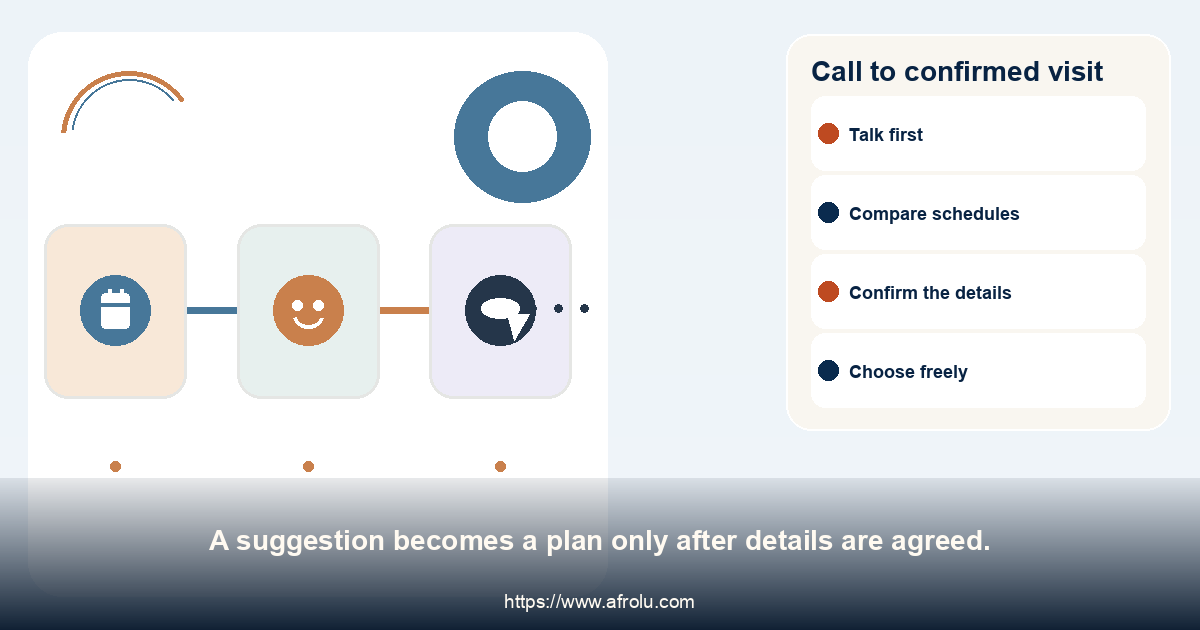
A visit is optional and should remain independently manageable. Afrolu:
Written and edited by Nala Okafor · Africa Dating Platforms Editor
Discuss what casual and faith-led mean to each of you before making expensive or private plans. Use a video call as one conversation tool, protect personal and financial information, confirm travel details through current official sources, and choose an in-person meeting that remains public and independently manageable.
Attachment styles · Faith-Led Daters
How can adults explore a faith-led long-distance connection while keeping privacy, travel and present relationship terms clear?
Long-distance dating includes travel and separate routines that affect how adults communicate or meet. Faith-led describes the reader's own values; it does not establish shared practice, casual intent, exclusivity, identity verification or a promise to relocate.
Samira lives in Nairobi and has been speaking with Daniel, who works in another country. They both mention faith and call the connection casual, but neither has defined what that means. Daniel proposes that she visit for a weekend and offers to book everything. Samira asks for a video call first, describes the practice that matters to her and suggests checking dates and costs together before either buys a ticket. Daniel agrees to discuss a public meeting and a short stay, but they leave exclusivity and future geography open. Samira keeps her documents and accommodation under her own control, then decides whether a visit fits her budget and comfort after the conversation.
Define the connection
Clarify casual intent before planning travel
People can use casual to mean a slow start, a non-exclusive arrangement, a connection without an immediate future plan or something else. Distance adds another layer because a visit can feel like a major investment. Ask which choices are open today rather than treating regular calls or affectionate messages as a commitment.
Say what you want in your own words: “I am open to meeting and seeing how this develops, but I am not assuming exclusivity.” Then ask how the other adult describes the connection. If your definitions differ, discuss whether a smaller step still feels worthwhile before anyone buys a ticket or rearranges work.
Keep the faith conversation personal and concrete. Explain what practice or value affects your date planning, privacy or boundaries. A shared tradition may still involve different routines, while different traditions may leave room for mutual respect. No article can decide compatibility; the useful question is what each adult freely chooses in this relationship.
Long-distance research often studies established couples or young adult samples in specific countries. It cannot determine whether a casual cross-border connection should become serious. Treat research as context for discussing communication and effort, then base your decision on direct answers, a manageable plan and the conduct you actually observe.
Build confidence gradually
Use a call as a conversation, not a background check
A short video call can help you hear one another, notice whether conversation feels mutual and ask what a proposed visit would involve. It is one data point, not an identity certificate. If a person repeatedly refuses any reasonable conversation while demanding travel or money, you can decline without launching an investigation.
Ask for consistency between what a person says and the ordinary details they volunteer over time. Do not demand access to accounts, private messages, workplace systems or live location as proof. Verification should respect both adults' privacy; public information can be incomplete or misleading and is not a substitute for a direct conversation.
Keep the interaction inside the dating service until you are comfortable with a change. Review its current reporting, blocking and privacy options rather than assuming a platform checks every profile. If you share a phone number or personal account, consider how that information could connect to other details you have posted publicly.
A trustworthy pace leaves room for questions and a no. Requests for secrecy, urgent payment, identity documents, passwords, intimate images or an investment transfer deserve a pause. Do not send money to secure affection or travel. Ask someone you trust to help assess an unusual request before sharing sensitive details or making a financial choice.
Keep control of details
Protect data, documents and financial independence
Avoid sharing a passport scan, banking code, account password or one-time verification code with a dating contact. A person may need some information to coordinate a real plan, but you can choose what is necessary and when. Never let romantic urgency replace the same careful checks you would use for another unfamiliar request.
Limit details that map your daily routine, such as your exact home address, regular commute or workplace entrance. You can tell someone your general city or preferred meeting area while keeping specific location information private. A boundary like “I will confirm the venue after we agree on a public place” is clear and sufficient.
For international visits, check current visa, entry, health and transport requirements through the relevant government sources close to departure. Rules can change and depend on passport and itinerary. This article cannot confirm eligibility, safety or cost, so do not rely on a dating contact's summary as your only travel information.
Keep enough money and a backup route to change your plan if needed. You do not need to accept accommodation, transport or tickets paid for by another adult if that creates pressure. If you do accept shared expenses, agree who pays for what and what happens if either person cancels before committing.

A serious or casual label does not confirm travel. Afrolu:
Plan the visit
Make each travel decision explicit and reversible
Start with a short meeting in a public place and decide how you will arrive and leave. If a visit requires an overnight stay, choose accommodation that gives you privacy and a way to change plans. Sharing a room or address is not a test of affection, seriousness or religious compatibility.
Put the plan in plain writing: travel dates, arrival time, meeting point, approximate duration and who pays each cost. A message such as “come soon and I will handle everything” leaves too much undefined. You can ask for specific details or postpone until both adults can confirm a realistic arrangement.
Share an itinerary with a trusted person only if that feels right to you, and agree on a check-in time that does not expose your accounts or live location more broadly than you choose. A check-in is a support option, not a guarantee. Keep your own documents and make sure your return plan remains possible.
If work, family or money changes before travel, revisit the whole plan rather than pushing ahead because someone already mentioned a date. A cancellation can disappoint both adults while still being the sensible choice. Notice whether the other person accepts a change or uses the expense to demand intimacy, secrecy or a commitment.

Notice who helps make a plan possible and who accepts a no. Afrolu:
Keep boundaries current
Discuss practice and intimacy as separate choices
A person may want a private faith conversation, a public date, physical affection or no intimacy at all; these are distinct choices. Do not assume that matching religious labels or paying for travel resolves any of them. Ask directly, listen to the answer and leave the other adult room to change their mind.
If sexual health or physical intimacy becomes relevant, discuss boundaries and safer-sex preferences before acting, not while someone feels unable to leave. Consider qualified health information for medical questions. A guide about dating logistics cannot provide personal medical advice or replace a conversation about what both people freely want.
Attachment concepts can help a reader notice a personal response to uncertainty, such as wanting extra reassurance or a pause after an intense call. They cannot diagnose someone through message timing or a preference for space. Ask what the person means, then decide whether the arrangement meets your own need for contact and clarity.
A boundary can sound calm and still be firm: “I am not comfortable staying overnight together; I can meet for lunch in public.” If the other adult keeps bargaining, you may stop planning the trip. A respectful disagreement does not require either person to abandon faith, privacy, comfort or independent choice.
Watch the pattern
Look at shared planning over time
A long-distance connection requires practical work: time-zone planning, call changes, travel research and realistic budgeting. Contributions can differ without being unfair. The question is whether both adults understand who is doing what and can ask to change an arrangement without being shamed or told that a serious person would simply pay.
One missed call or postponed ticket does not reveal a person's character. Look at repeated behaviour after a direct conversation: do they update you, offer another time and help solve the same problem? A pattern of vague plans that leaves you holding work, costs and uncertainty is information about the arrangement you are being offered.
Notice whether values are respected in ordinary logistics. Does the person make room for the practice you explained, avoid pressuring you to share private details and accept an alternative meeting plan? They do not need to copy your beliefs; they do need to treat your stated limits as real choices.
If discussions about distance repeatedly become demand and withdrawal, try a focused question with one next step and a return point. Research finds group-level links among attachment, communication and satisfaction, not a prediction for this pair. If the same conversation stays stuck, consider whether a relationship with these constraints currently fits your life.
Choose from today's facts
Decide whether a visit or another call makes sense
Before committing money or leave, list what has been agreed and what remains open: casual intent, contact, exclusivity if relevant, travel dates, expenses, lodging and the first meeting plan. If one missing answer would change your decision, ask about it now instead of trying to infer it from compliments or online status.
If both adults answer clearly and the practical plan fits your budget and comfort, you may choose a short call or public meeting as the next step. You are not required to move from call to visit, or from visit to commitment. Each step can have its own pause and decision point.
If uncertainty remains, choose a time limit that works for you and state when you will revisit the question. Waiting is a choice with a cost in attention and planning; you can decide how much is acceptable. The other adult may need more time, and you can still decide not to wait indefinitely.
If pressure, money requests or boundary violations make the plan feel wrong, stop the travel process and use the support or platform tools available to you. This guide cannot assess an immediate threat or current border requirements. For individual travel, legal or safety decisions, consult qualified and up-to-date sources in the places involved.

Do not spend money to prove affection or seriousness. Afrolu:
Eight situations in faith-led long-distance dating with privacy and independent travel choices
Time zones make a regular call difficult
Compare normal weeks and select a window both can keep. Consider how this applies to faith-led long-distance dating with privacy and independent travel choices.
Ask a clear question about faith-led long-distance dating with privacy and independent travel choices, then choose a response that respects your own values and limits.A proposed trip has no confirmed dates
Keep it tentative until dates, costs and lodging are clear. Consider how this applies to faith-led long-distance dating with privacy and independent travel choices.
Ask a clear question about faith-led long-distance dating with privacy and independent travel choices, then choose a response that respects your own values and limits.A video call feels reassuring
Treat it as one conversation, not proof of identity. Consider how this applies to faith-led long-distance dating with privacy and independent travel choices.
Ask a clear question about faith-led long-distance dating with privacy and independent travel choices, then choose a response that respects your own values and limits.A match requests a passport image
Keep identity papers private unless an official process requires them. Consider how this applies to faith-led long-distance dating with privacy and independent travel choices.
Ask a clear question about faith-led long-distance dating with privacy and independent travel choices, then choose a response that respects your own values and limits.The other person offers a place to stay
Choose lodging that preserves your independence and comfort. Consider how this applies to faith-led long-distance dating with privacy and independent travel choices.
Ask a clear question about faith-led long-distance dating with privacy and independent travel choices, then choose a response that respects your own values and limits.One person is expected to pay for all travel
Discuss the cost split before booking. Consider how this applies to faith-led long-distance dating with privacy and independent travel choices.
Ask a clear question about faith-led long-distance dating with privacy and independent travel choices, then choose a response that respects your own values and limits.Both say faith matters but mean different routines
Ask which practice affects the current plan. Consider how this applies to faith-led long-distance dating with privacy and independent travel choices.
Ask a clear question about faith-led long-distance dating with privacy and independent travel choices, then choose a response that respects your own values and limits.A message arrives later than expected
Check the contact agreement rather than diagnosing a motive. Consider how this applies to faith-led long-distance dating with privacy and independent travel choices.
Ask a clear question about faith-led long-distance dating with privacy and independent travel choices, then choose a response that respects your own values and limits.Fourteen observable signs of a respectful agreement
The dating label is explained in concrete present-day terms. Check how it appears during faith-led long-distance dating with privacy and independent travel choices.
Each adult can state a preference without being pressured to match the other. Check how it appears during faith-led long-distance dating with privacy and independent travel choices.
The first meeting has a public place and a clear time window. Check how it appears during faith-led long-distance dating with privacy and independent travel choices.
Each person has a way to leave independently if they choose. Check how it appears during faith-led long-distance dating with privacy and independent travel choices.
Sensitive details are shared at a pace each adult accepts. Check how it appears during faith-led long-distance dating with privacy and independent travel choices.
A video call is treated as context rather than proof of identity. Check how it appears during faith-led long-distance dating with privacy and independent travel choices.
Travel dates and costs are confirmed before money is spent. Check how it appears during faith-led long-distance dating with privacy and independent travel choices.
A boundary is heard without guilt, ridicule or repeated bargaining. Check how it appears during faith-led long-distance dating with privacy and independent travel choices.
Consent is checked for each new activity and can be changed. Check how it appears during faith-led long-distance dating with privacy and independent travel choices.
Faith or spirituality is described by the person who practises it. Check how it appears during faith-led long-distance dating with privacy and independent travel choices.
A direct question receives an answer or a clear return point. Check how it appears during faith-led long-distance dating with privacy and independent travel choices.
Both adults contribute to planning in a way that feels voluntary. Check how it appears during faith-led long-distance dating with privacy and independent travel choices.
A changed plan receives an update and a practical alternative. Check how it appears during faith-led long-distance dating with privacy and independent travel choices.
Either person can continue, revise, pause or end the arrangement. Check how it appears during faith-led long-distance dating with privacy and independent travel choices.
A cue-to-choice decision map
| Situation | What it may mean | What to do next |
|---|---|---|
| The word casual feels unclear | It can describe a first meeting or an ongoing arrangement. The context is faith-led long-distance dating with privacy and independent travel choices. | Ask which terms are open now. Choose from the answer and your own needs around faith-led long-distance dating with privacy and independent travel choices. |
| A serious goal sounds like an immediate promise | Intent, exclusivity and a future commitment are distinct. The context is faith-led long-distance dating with privacy and independent travel choices. | State your direction and ask what is mutually agreed. Choose from the answer and your own needs around faith-led long-distance dating with privacy and independent travel choices. |
| A venue changes at the last minute | The new plan may alter comfort, cost or transport. The context is faith-led long-distance dating with privacy and independent travel choices. | Pause and choose whether the revised plan still works. Choose from the answer and your own needs around faith-led long-distance dating with privacy and independent travel choices. |
| A match requests personal data | More information is not always necessary for a first meeting. The context is faith-led long-distance dating with privacy and independent travel choices. | Share only details you freely choose. Choose from the answer and your own needs around faith-led long-distance dating with privacy and independent travel choices. |
| A call or message is delayed | Timing can have many explanations. The context is faith-led long-distance dating with privacy and independent travel choices. | Ask about a contact plan instead of assigning motive. Choose from the answer and your own needs around faith-led long-distance dating with privacy and independent travel choices. |
| Travel money is requested urgently | Romantic urgency can make a financial request harder to assess. The context is faith-led long-distance dating with privacy and independent travel choices. | Do not pay under pressure; verify independently. Choose from the answer and your own needs around faith-led long-distance dating with privacy and independent travel choices. |
| A boundary is challenged | Disappointment does not create permission to keep asking. The context is faith-led long-distance dating with privacy and independent travel choices. | Restate the limit and end contact if you want. Choose from the answer and your own needs around faith-led long-distance dating with privacy and independent travel choices. |
| Faith practice differs | Similar labels can describe different routines. The context is faith-led long-distance dating with privacy and independent travel choices. | Discuss the specific choice that matters to you. Choose from the answer and your own needs around faith-led long-distance dating with privacy and independent travel choices. |
| One person does all the organising | Contributions may differ but should remain voluntary. The context is faith-led long-distance dating with privacy and independent travel choices. | Name the pattern and invite a shared next task. Choose from the answer and your own needs around faith-led long-distance dating with privacy and independent travel choices. |
| A life-history question arrives too soon | Curiosity does not require immediate disclosure. The context is faith-led long-distance dating with privacy and independent travel choices. | Share only the context you are ready to discuss. Choose from the answer and your own needs around faith-led long-distance dating with privacy and independent travel choices. |
Twelve ways to ask clearly and set a boundary
“I am open to a committed relationship, but I treat each first date as exploratory. What are you looking for now?”
“When you say casual, do you mean a relaxed first date or a relationship without commitment?”
“Are we dating only each other now, or have we not made that agreement?”
“This practice matters to me in dating. Would you be comfortable hearing what it means for my choices?”
“I do not share my exact address or workplace early. I can suggest a public meeting place instead.”
“I would rather meet in public for the first date. Would this place and time work for you?”
“I will make my own way there and home. Let us confirm the venue before I leave.”
“Would you like to hold hands, or would you rather not?”
“I am not comfortable with that, and I do not want to keep discussing it tonight.”
“I can manage one planned call this week. Which evening works for you?”
“I need time to think. Can we return to this question on Sunday?”
“I do not think our current expectations fit, so I am going to end the connection respectfully.”
Know the difference
A visit is separate from commitment
What each adult wants to explore now.
Dates, costs, lodging and transport that are confirmed.
Do not treat a ticket or call as a relationship promise.

Keep geography open unless both adults choose a real plan. Afrolu:
Separate a label from the present agreement
| Type or dimension | What it describes | Best next question |
|---|---|---|
| First-date style | A relaxed meeting describes the tone of one step. This may matter in faith-led long-distance dating with privacy and independent travel choices. | Ask what each person wants from dating now. Keep the discussion specific to the adults involved. |
| Relationship intent | A preference for commitment is a direction, not a completed agreement. This may matter in faith-led long-distance dating with privacy and independent travel choices. | State what you are open to today. Keep the discussion specific to the adults involved. |
| Exclusivity | Dating only one another is a separate present choice. This may matter in faith-led long-distance dating with privacy and independent travel choices. | Confirm whether both adults have agreed. Keep the discussion specific to the adults involved. |
| Faith label | A broad identity can include different practices and boundaries. This may matter in faith-led long-distance dating with privacy and independent travel choices. | Ask what matters to each person in daily life. Keep the discussion specific to the adults involved. |
| Consent | Permission for one activity does not cover another. This may matter in faith-led long-distance dating with privacy and independent travel choices. | Ask and listen whenever the activity changes. Keep the discussion specific to the adults involved. |
| Privacy | A match can learn about you without receiving every personal detail. This may matter in faith-led long-distance dating with privacy and independent travel choices. | Share only what is necessary and freely chosen. Keep the discussion specific to the adults involved. |
| Travel | A proposed visit may remain tentative until its details are confirmed. This may matter in faith-led long-distance dating with privacy and independent travel choices. | Compare dates, costs, lodging and transport first. Keep the discussion specific to the adults involved. |
| Communication | Contact preferences can differ without proving care or motive. This may matter in faith-led long-distance dating with privacy and independent travel choices. | Agree on a realistic rhythm and update changes. Keep the discussion specific to the adults involved. |
| Future plans | A hope about marriage, family or location is not a current promise. This may matter in faith-led long-distance dating with privacy and independent travel choices. | Keep each question open until both adults choose. Keep the discussion specific to the adults involved. |
A simple plan you can use today
Labels need detail
Translate casual, serious or faith-led into choices that matter today. Apply this to faith-led long-distance dating with privacy and independent travel choices.
Intent is not exclusivity
A hoped-for direction and a present agreement are different. Apply this to faith-led long-distance dating with privacy and independent travel choices.
Privacy supports agency
A match can learn about you at the pace you choose. Apply this to faith-led long-distance dating with privacy and independent travel choices.
Consent stays specific
A yes to one date or activity never supplies another yes. Apply this to faith-led long-distance dating with privacy and independent travel choices.
Plans have practical costs
Time, route, budget and access shape what each adult can offer. Apply this to faith-led long-distance dating with privacy and independent travel choices.
One moment is incomplete
Repeated conduct gives more useful information than a diagnosis. Apply this to faith-led long-distance dating with privacy and independent travel choices.
Questions organised by purpose and depth
Choose a few prompts that fit the moment. This is a reference library, not a list to complete.
What do I want now?
Separate a present preference from a promise about the future. Consider faith-led long-distance dating with privacy and independent travel choices.
- What am I open to?
- What agreement matters today?
- Which answer would change my next step?
What should remain private?
Choose what to share because it is useful, not because you feel pressured. Consider faith-led long-distance dating with privacy and independent travel choices.
- Which details are necessary?
- What can wait?
- Who do I trust with my plan?
What does the plan require?
Check time, place, cost and a way to leave. Consider faith-led long-distance dating with privacy and independent travel choices.
- Is the venue public?
- Can I manage the route?
- What changes would make me decline?
What will I choose?
Use the answer and conduct you observe to decide. Consider faith-led long-distance dating with privacy and independent travel choices.
- Continue or pause?
- What is my limit?
- When will I revisit an open question?
What deserves a closer look
Group findings are not a diagnosis
Studies examine patterns across samples and couples.
Evidence limit: A delayed reply, a request for space or a careful pace cannot identify an individual's attachment style. The source sample differs from faith-led long-distance dating with privacy and independent travel choices.
Research definitions vary
Some studies examine students or sexual experiences rather than the full range of adult dating.
Evidence limit: A sample category cannot decide what a reader means by casual. The source sample differs from faith-led long-distance dating with privacy and independent travel choices.
Relationship context shapes assumptions
Dyadic research has examined consent communication in established relationships.
Evidence limit: The current activity still calls for the adults involved to ask and answer clearly. The source sample differs from faith-led long-distance dating with privacy and independent travel choices.
Place and life stage matter
Studies have sampled young adults in Germany or the United States.
Evidence limit: Those results cannot prescribe a religious practice or partnership choice in Kenya. The source sample differs from faith-led long-distance dating with privacy and independent travel choices.
Platform findings have limits
App analyses and older-adult studies describe specific services or participant groups.
Evidence limit: No study guarantees that a profile or video call proves identity or safety. The source sample differs from faith-led long-distance dating with privacy and independent travel choices.
Local research has boundaries
Available studies may focus on youth, health settings or historical periods.
Evidence limit: They offer context but do not represent every current adult dating in Nairobi. The source sample differs from faith-led long-distance dating with privacy and independent travel choices.
Common shortcuts that add uncertainty
Treating casual as a universal definition
People use the label for different stages and agreements. A clearer choice is available in faith-led long-distance dating with privacy and independent travel choices.
Assuming serious means exclusive
A shared direction does not settle current dating behaviour. A clearer choice is available in faith-led long-distance dating with privacy and independent travel choices.
Sharing details to prove trust
Trust does not require passwords, documents or an exact address. A clearer choice is available in faith-led long-distance dating with privacy and independent travel choices.
Using a delay as a diagnosis
Timing alone cannot establish attachment or intention. A clearer choice is available in faith-led long-distance dating with privacy and independent travel choices.
Booking travel before details are confirmed
Dates, costs and lodging need an explicit plan. A clearer choice is available in faith-led long-distance dating with privacy and independent travel choices.
Explaining a boundary until it is accepted
You can choose a limit even when another adult disagrees. A clearer choice is available in faith-led long-distance dating with privacy and independent travel choices.
Choose what helps with faith-led long-distance dating with privacy and independent travel choices
This guide is editorial information, not diagnosis, therapy, religious instruction, legal, financial, travel-security or emergency advice. Seek qualified support for individual questions.
Explore the guide library
Show more related guides
Continue with Afrolu
Show more Afrolu guides
Sources used for this guide
Afrolu reviewed these health, research, safety, or public guidance resources while editing this page. They support the behaviour and safety guidance; they do not diagnose any individual described by a reader.
Questions about faith-led long-distance dating with privacy and independent travel choices
Does a casual first date mean neither person wants commitment?
No. Casual can describe the meeting or a broader arrangement; ask what the other adult means and state what you are open to.
Does a serious intention mean we are exclusive?
No. Exclusivity is a present agreement that both adults should discuss directly.
Do I have to share my relationship history right away?
No. Share information that matters to the current choice at a pace you freely choose.
Can I change the date plan after agreeing?
Yes. You can suggest a new plan or decline if your comfort, schedule or circumstances change.
Does a delayed reply prove someone is avoidant?
No. Message timing cannot diagnose attachment or establish a motive; ask about the communication agreement if it affects you.
How can I keep a first meeting manageable?
Choose a public place, a clear time window and a way to arrive and leave that works for you.
Should I book a visit before we meet online?
Only if the dates, cost and plan work for you; another call is a valid next step.
Can a video call verify identity?
No. It may add context to a conversation but cannot prove identity or guarantee safety.
Should I send money for a ticket?
Do not send money under romantic pressure; independently verify any legitimate travel arrangement.
How do we handle a time-zone gap?
Compare ordinary schedules and choose a contact window both adults can realistically keep.
One thing to do now
Choose a next step that fits
Discuss present terms first, use limited checks without surveillance, and make travel only when timing, cost and independent choices work for you.