Faith-led dating · low pressure · Nairobi
Keep Faith-Led Dating Low-Pressure and Clear in Nairobi
A Nairobi guide to low-pressure, faith-led dating: choose a manageable public first meeting, share your own values plainly, and keep both adults free to decide.

Keep the meeting public and the exit independent. Afrolu:
Written and edited by Thandiwe Mbeki · Southern Africa Dating Editor
Suggest a short public meeting, say what you are open to now and ask one question about the other adult's intentions or practice. Keep your transport and personal details under your control. A slow start should make choices easier to understand, not leave either person waiting without a clear answer.
Attachment styles · Faith-Led Daters
How can a first Nairobi date stay low-pressure while faith and relationship expectations remain clear?
Low-pressure dating means keeping early steps voluntary and manageable. Faith-led describes the reader's own commitments, not a rule that every dater follows. A gentle pace still includes honest communication, respect for boundaries and a clear way for either adult to continue or decline.
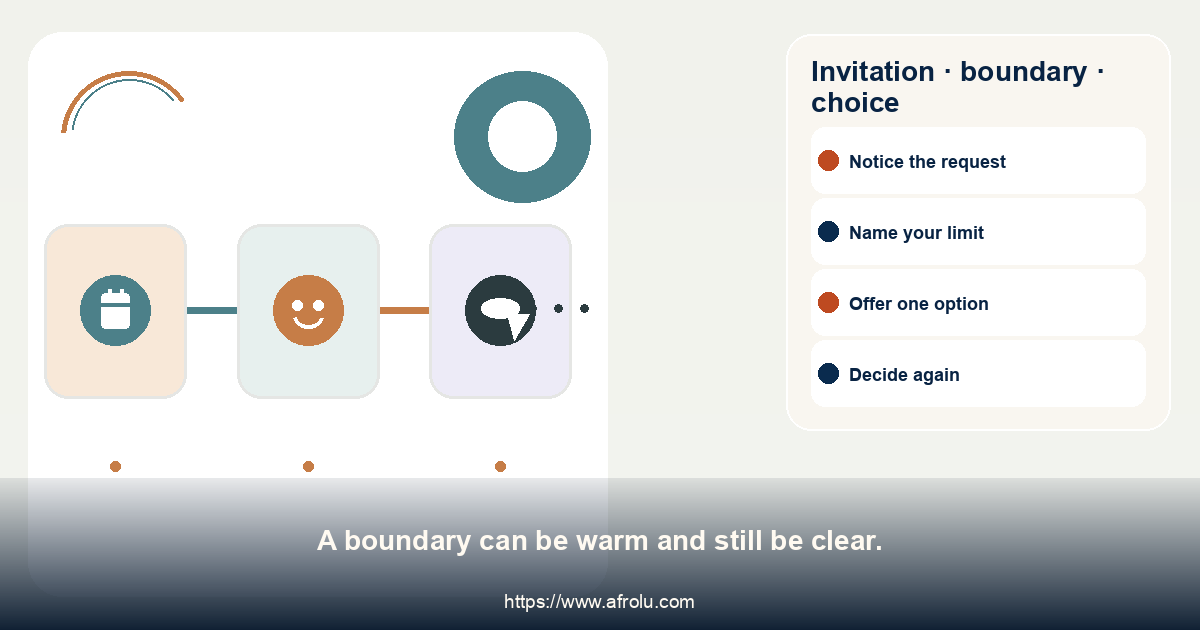
Nia lives in Nairobi and wants faith to be part of how she dates, but she does not want a first meeting to feel like an interview. A match suggests spending the entire Sunday together and meeting several relatives afterward. Nia prefers to begin with tea in a public place for an hour. She explains that she would like to hear what matters to each of them, without deciding their future on one date. The match accepts the shorter plan and asks what kind of conversation would feel comfortable. Nia keeps her own transport and decides after the meeting whether she wants another one. The invitation can be warm while every next step remains optional.
Set a gentle pace
Make low pressure specific instead of vague
Low pressure might mean meeting once before planning a long outing, keeping a first date short or leaving exclusivity for a later conversation. Tell the person which step you are comfortable with today. Without a concrete description, one adult may hear “slow” as a gentle start while the other hears an indefinite wait.
You can say, “I would like to meet for tea and learn a little about each other. I am not deciding about commitment on the first date.” This shows interest and sets a limit at the same time. The other adult can choose whether that pace works rather than trying to interpret a silent test.
A preference for privacy or a gradual beginning has many possible explanations. It does not establish an attachment style. If you use that language to reflect on yourself, hold it lightly and focus on what you can communicate: the time you have, the conversation you want and the boundary that needs respect.
The other person also has a right to decide whether a low-pressure arrangement suits them. If they want faster clarity, you can give the answer you have or ask for time to think. Gentle dating is mutual when each adult can say yes, no or not yet without punishment or misleading reassurance.
Plan a manageable first date
Choose a public place and a clear end time
A first meeting can be a brief café conversation, a walk in a busy public area or another activity where both adults can arrive and leave independently. Agree on the place before setting out. If the location changes to a private home or an isolated venue, pause and decide again rather than following momentum.
Check current opening hours, transport and the route on the day. A guide cannot supply live Nairobi traffic or security information. Keep your phone charged and enough time to get home without depending on a new match. Share the meeting details with someone you trust if that supports your own comfort.
You can say what would make the plan manageable: an hour, daytime, a place near a route you know or a quieter venue. If the other person prefers another option, compare choices together. Practical disagreement is useful information, but neither adult needs to prove trust by accepting a plan that feels wrong.
A public location does not guarantee compatibility or safety. It simply keeps more choices available. You may decline a ride, leave early, change your mind about physical contact or end the conversation. Paying for a meal or agreeing to meet does not create an obligation to extend the date.
Talk about faith without an interview
Ask what matters in everyday practice
You might ask, “Does your faith or spiritual practice shape how you date?” Then share what matters to you, such as a weekly gathering, a personal boundary or a hope for a shared community. Do not assume that a person who uses a familiar label interprets it exactly as you do.
If the answer is private or uncertain, respect that response and decide what you need to know before continuing. Some adults want to discuss beliefs gradually. Others need clarity early because a particular practice affects intimacy, family plans or future commitment. State your timing without presenting it as the only correct approach.
Avoid turning the conversation into a quiz about doctrine, scripture or community status. A first date can ask whether each adult is open to learning about the other's life without demanding agreement. If a difference matters to your own choice, ask how it affects a concrete situation rather than debating an abstract label.
Research on religion and partnership has focused mainly on married or established couples in particular settings. It cannot tell Nairobi daters which beliefs must match. You can use your own priorities as a guide, ask direct questions and decide whether the answer fits the kind of relationship you want to build.

Make the exchange mutual and let either person keep private details private. Afrolu:
Agree on a follow-up
Close the loop without creating a reply test
After meeting, a short message can say that you enjoyed the conversation and would like another date. If you are unsure, you can say you need time and give a day when you expect to reply. This lets the other adult choose whether to wait without promising a feeling or decision you do not yet have.
Work, faith gatherings and family responsibilities may make immediate replies difficult. Agree on what contact feels comfortable rather than setting an unspoken quota. If you need a call before another date, ask for one. If the other person prefers text, discuss a channel both can manage instead of interpreting silence alone.
A read receipt or online status cannot establish intent. You can ask whether the person wants another meeting, then use their answer and follow-through. If they do not respond, you can decide not to continue without sending repeated messages or inventing a psychological story about why the conversation ended.
If you need quiet after a personal conversation, name it and say when you can return. If the other adult needs more contact than you want, consider whether a workable middle ground exists. Clear communication allows both people to decide; it does not require either one to stay available at every moment.

Focus on conduct and avoid assigning an attachment label to a stranger. Afrolu:
Keep boundaries and transport yours
Choose what to share and what to leave private
You can keep your home address, workplace, documents and exact weekly routine private while getting to know someone. A public meeting point is enough to arrange a first date. If a person asks for account codes, money, sensitive documents or urgent personal access, pause and decide independently rather than treating the request as proof of closeness.
A boundary around physical affection, alcohol, food or time can be stated before or during a date. You may change your mind. A faith-based reason is not required for a boundary to count, and you do not have to defend a personal choice by persuading the other adult to adopt the same belief.
If someone invokes faith, family or community reputation to pressure you, return to the actual choice: do you want this meeting, conversation or introduction? You can decline even when the invitation is framed as respectful or serious. A relative, leader or date cannot consent on your behalf to a relationship step.
If you feel uncomfortable, move to a public area or leave using your own transport. You can call a trusted person if you want support. If there is immediate danger, seek current local emergency assistance. This article is not live safety guidance and cannot replace an appropriate local service.
Notice respect in the response
Look for behaviour after you state a limit
An adult may misunderstand a boundary and then accept your explanation. Notice what happens next instead of diagnosing a person from one sentence. A pattern of repeated requests after a clear no, anger about your transport or demands for private details affects your ability to choose and can be reason to end the date.
You do not need to prove that a person intended harm before protecting your time. Repeat the limit once if you want to, then take the action you planned. You may leave, stop replying or decline a second meeting. Politeness does not require giving someone repeated opportunities to negotiate a boundary.
Attachment words such as avoidant or anxious are not reliable labels for a new match. A person can be direct, reserved, enthusiastic or uncertain for many reasons. Focus on observable actions: whether plans are mutual, whether a no is respected and whether the person can discuss the relationship without threats or guilt.
Religious values can make a conversation meaningful, but they should not be used to remove choice. If an adult says that your boundaries prove you are not serious, ask whether that framing respects both people's autonomy. You can seek counsel from someone you trust while making the dating decision yourself.
Choose the next step
Continue only at a pace you both understand
After the date, ask whether you felt able to be honest about your values and whether the plan respected your time. If you want another meeting, offer one specific option. If you need more information, name the question and decide when you want to return to it rather than leaving the other person to guess.
You can like someone and still decide that your schedules, beliefs or preferred pace do not fit. Attraction does not require you to share more information, travel farther or accelerate commitment. Compatibility includes whether both adults can make ordinary decisions without one person carrying all the planning or accepting unwanted pressure.
If you often say yes before you know what you want, or withdraw when a conversation becomes important, reflection may help. A qualified counsellor can explore these patterns without diagnosing you from a dating choice. This guide is educational and cannot assess mental health or replace individual support.
Choose a next step you can stand behind even if the other person answers differently than you hope. A clear invitation, a direct boundary or a respectful ending gives both adults real information. You do not need to make a long-term promise to show that your present interest was sincere.

Change the plan if the location or duration no longer suits you. Afrolu:
Eight situations in a low-pressure first Nairobi date where spiritual values, public planning and independent choice matter
A match proposes a private all-day outing
Offer a shorter public meeting with an independent exit. Consider how this applies to a low-pressure first Nairobi date where spiritual values, public planning and independent choice matter.
Ask a clear question about a low-pressure first Nairobi date where spiritual values, public planning and independent choice matter, then choose a response that respects your own values and limits.A first date becomes a quiz about religious knowledge
Share one open question and make the exchange mutual. Consider how this applies to a low-pressure first Nairobi date where spiritual values, public planning and independent choice matter.
Ask a clear question about a low-pressure first Nairobi date where spiritual values, public planning and independent choice matter, then choose a response that respects your own values and limits.A new match asks for a home address to collect you
Keep your route independent and share only a public meeting point. Consider how this applies to a low-pressure first Nairobi date where spiritual values, public planning and independent choice matter.
Ask a clear question about a low-pressure first Nairobi date where spiritual values, public planning and independent choice matter, then choose a response that respects your own values and limits.One person wants an immediate label after tea
State what you know today and what needs more time. Consider how this applies to a low-pressure first Nairobi date where spiritual values, public planning and independent choice matter.
Ask a clear question about a low-pressure first Nairobi date where spiritual values, public planning and independent choice matter, then choose a response that respects your own values and limits.A date overlaps with an important practice
Name the time constraint and offer another option if you want to. Consider how this applies to a low-pressure first Nairobi date where spiritual values, public planning and independent choice matter.
Ask a clear question about a low-pressure first Nairobi date where spiritual values, public planning and independent choice matter, then choose a response that respects your own values and limits.A date treats a personal limit as negotiable
Restate the boundary and leave if pressure continues. Consider how this applies to a low-pressure first Nairobi date where spiritual values, public planning and independent choice matter.
Ask a clear question about a low-pressure first Nairobi date where spiritual values, public planning and independent choice matter, then choose a response that respects your own values and limits.A relative is invited before you have agreed
Pause and decide together whether that step feels right. Consider how this applies to a low-pressure first Nairobi date where spiritual values, public planning and independent choice matter.
Ask a clear question about a low-pressure first Nairobi date where spiritual values, public planning and independent choice matter, then choose a response that respects your own values and limits.One adult waits for the other to chase after a date
Replace a hidden test with a direct invitation or ending. Consider how this applies to a low-pressure first Nairobi date where spiritual values, public planning and independent choice matter.
Ask a clear question about a low-pressure first Nairobi date where spiritual values, public planning and independent choice matter, then choose a response that respects your own values and limits.Fourteen observable signs of a respectful agreement
Each adult can describe what faith or spirituality means in their own dating choices. Check how it appears during a low-pressure first Nairobi date where spiritual values, public planning and independent choice matter.
The current relationship direction is stated rather than inferred from a label. Check how it appears during a low-pressure first Nairobi date where spiritual values, public planning and independent choice matter.
Exclusivity is discussed separately from affection or a regular meeting pattern. Check how it appears during a low-pressure first Nairobi date where spiritual values, public planning and independent choice matter.
Both adults can keep work, worship, family and rest commitments. Check how it appears during a low-pressure first Nairobi date where spiritual values, public planning and independent choice matter.
A date plan includes a duration and a practical way to change it. Check how it appears during a low-pressure first Nairobi date where spiritual values, public planning and independent choice matter.
A delayed message is discussed without using read receipts as proof. Check how it appears during a low-pressure first Nairobi date where spiritual values, public planning and independent choice matter.
Both people suggest plans or share some part of the organising. Check how it appears during a low-pressure first Nairobi date where spiritual values, public planning and independent choice matter.
A boundary can be heard without guilt, ridicule or repeated pressure. Check how it appears during a low-pressure first Nairobi date where spiritual values, public planning and independent choice matter.
Each adult may keep private details private while trust develops. Check how it appears during a low-pressure first Nairobi date where spiritual values, public planning and independent choice matter.
Questions about future family or practice have a time to be revisited. Check how it appears during a low-pressure first Nairobi date where spiritual values, public planning and independent choice matter.
A changed plan receives a straightforward update when practical. Check how it appears during a low-pressure first Nairobi date where spiritual values, public planning and independent choice matter.
A difference in faith practice can be discussed without stereotypes. Check how it appears during a low-pressure first Nairobi date where spiritual values, public planning and independent choice matter.
Neither adult has to perform belief or commitment to earn respect. Check how it appears during a low-pressure first Nairobi date where spiritual values, public planning and independent choice matter.
Either person can continue, revise, pause or end the arrangement. Check how it appears during a low-pressure first Nairobi date where spiritual values, public planning and independent choice matter.
A cue-to-choice decision map
| Situation | What it may mean | What to do next |
|---|---|---|
| A shared faith label seems to mean different things | A familiar word can cover distinct beliefs and routines. The context is a low-pressure first Nairobi date where spiritual values, public planning and independent choice matter. | Ask what practice or value matters to each person in everyday life. Choose from the answer and your own needs around a low-pressure first Nairobi date where spiritual values, public planning and independent choice matter. |
| A weekend date overlaps with worship or rest | The available time may be limited without changing relationship intent. The context is a low-pressure first Nairobi date where spiritual values, public planning and independent choice matter. | State the commitment and offer another window only if you want to. Choose from the answer and your own needs around a low-pressure first Nairobi date where spiritual values, public planning and independent choice matter. |
| The word serious remains unclear | Intent, exclusivity and future plans are separate questions. The context is a low-pressure first Nairobi date where spiritual values, public planning and independent choice matter. | Ask what relationship direction is open now and what remains undecided. Choose from the answer and your own needs around a low-pressure first Nairobi date where spiritual values, public planning and independent choice matter. |
| One person requests more time together | Contact preferences can differ without proving motive or care. The context is a low-pressure first Nairobi date where spiritual values, public planning and independent choice matter. | Compare realistic schedules and decide whether the overlap works for both. Choose from the answer and your own needs around a low-pressure first Nairobi date where spiritual values, public planning and independent choice matter. |
| A family introduction is proposed | The step may carry different meaning for each adult. The context is a low-pressure first Nairobi date where spiritual values, public planning and independent choice matter. | Ask what the introduction means before agreeing to it. Choose from the answer and your own needs around a low-pressure first Nairobi date where spiritual values, public planning and independent choice matter. |
| A work deadline interrupts a plan | Capacity can change during a demanding season. The context is a low-pressure first Nairobi date where spiritual values, public planning and independent choice matter. | Update the other adult and offer only a time you can keep. Choose from the answer and your own needs around a low-pressure first Nairobi date where spiritual values, public planning and independent choice matter. |
| A boundary is challenged | Disappointment does not create permission to keep asking. The context is a low-pressure first Nairobi date where spiritual values, public planning and independent choice matter. | Restate the limit and choose whether to continue the date. Choose from the answer and your own needs around a low-pressure first Nairobi date where spiritual values, public planning and independent choice matter. |
| An answer needs more time | Uncertainty may remain while someone reflects. The context is a low-pressure first Nairobi date where spiritual values, public planning and independent choice matter. | Agree on a return point and decide how long you can wait. Choose from the answer and your own needs around a low-pressure first Nairobi date where spiritual values, public planning and independent choice matter. |
| Planning feels one-sided | Contributions can differ but still need mutual agreement. The context is a low-pressure first Nairobi date where spiritual values, public planning and independent choice matter. | Name the pattern and invite the other adult to share a next task. Choose from the answer and your own needs around a low-pressure first Nairobi date where spiritual values, public planning and independent choice matter. |
| A future move or marriage is assumed | A possibility is not a present commitment. The context is a low-pressure first Nairobi date where spiritual values, public planning and independent choice matter. | Keep long-term decisions open until both adults choose a real plan. Choose from the answer and your own needs around a low-pressure first Nairobi date where spiritual values, public planning and independent choice matter. |
Twelve ways to ask clearly and set a boundary
“My faith shapes this part of how I date. Would you like to hear what it means to me?”
“What does your spiritual or religious practice look like in an ordinary week?”
“I am open to building a committed relationship. What are you looking for now?”
“Are we dating only each other today, or are we still meeting other people?”
“I can meet Saturday after my morning commitment for about two hours. Would that work?”
“This month is busy at work; I can keep one planned call each week. What suits you?”
“I am comfortable discussing this, but I do not want to decide it on our first date.”
“What would an introduction to family mean to you at this stage?”
“I prefer a planned call over messages all day. Would that give you enough connection?”
“I want to think this through; can we return to it on Thursday evening?”
“My schedule changed and I cannot make today. I can meet next Sunday if you still want to.”
“Our current direction does not fit what I want, so I am ending the connection respectfully.”
Know the difference
A gentle first date still has a clear plan
A short public invitation with an independent exit.
A key question stays open with no return point.
Keep the meeting manageable and say what you are open to now.

Name the amount of time and information you can offer now. Afrolu:
Separate a label from the present agreement
| Type or dimension | What it describes | Best next question |
|---|---|---|
| Faith label | A broad identity can cover different routines and beliefs. This may matter in a low-pressure first Nairobi date where spiritual values, public planning and independent choice matter. | Ask which practice matters to each person now. Keep the discussion specific to the adults involved. |
| Personal practice | A chosen routine can affect a date, boundary or weekly plan. This may matter in a low-pressure first Nairobi date where spiritual values, public planning and independent choice matter. | Describe it in your own words instead of assuming shared meaning. Keep the discussion specific to the adults involved. |
| Relationship direction | A wish to build commitment does not settle every current term. This may matter in a low-pressure first Nairobi date where spiritual values, public planning and independent choice matter. | Ask what each adult is open to today. Keep the discussion specific to the adults involved. |
| Exclusivity | Dating only one another is a distinct present agreement. This may matter in a low-pressure first Nairobi date where spiritual values, public planning and independent choice matter. | Discuss it separately from serious intent or frequent dates. Keep the discussion specific to the adults involved. |
| Weekend pattern | Repeated Saturday or Sunday meetings show a schedule overlap. This may matter in a low-pressure first Nairobi date where spiritual values, public planning and independent choice matter. | Ask about terms rather than treating frequency as a promise. Keep the discussion specific to the adults involved. |
| Low-pressure pace | A gradual start can still include an honest next step. This may matter in a low-pressure first Nairobi date where spiritual values, public planning and independent choice matter. | Set a window to meet or return to an open question. Keep the discussion specific to the adults involved. |
| Need for space | A pause may reflect many parts of someone's life. This may matter in a low-pressure first Nairobi date where spiritual values, public planning and independent choice matter. | Ask what the pause means for the shared plan without diagnosing. Keep the discussion specific to the adults involved. |
| Family introduction | A meeting with relatives can carry different meanings. This may matter in a low-pressure first Nairobi date where spiritual values, public planning and independent choice matter. | Ask what each adult understands before agreeing. Keep the discussion specific to the adults involved. |
| Future possibility | A future city, marriage or practice may remain undecided. This may matter in a low-pressure first Nairobi date where spiritual values, public planning and independent choice matter. | Keep long-range choices open until both adults choose them. Keep the discussion specific to the adults involved. |
A simple plan you can use today
Labels need detail
Translate a faith or relationship label into the practices and terms that matter today. Apply this to a low-pressure first Nairobi date where spiritual values, public planning and independent choice matter.
Capacity is real
Work, community, care and rest shape what a person can offer in an ordinary week. Apply this to a low-pressure first Nairobi date where spiritual values, public planning and independent choice matter.
Intent is not exclusivity
A committed direction and a decision to date only one another are distinct. Apply this to a low-pressure first Nairobi date where spiritual values, public planning and independent choice matter.
A feeling is not a fact
Notice uncertainty, then ask for information that can change your next choice. Apply this to a low-pressure first Nairobi date where spiritual values, public planning and independent choice matter.
Boundaries keep agency
A person can set limits without providing a diagnosis or persuading someone to agree. Apply this to a low-pressure first Nairobi date where spiritual values, public planning and independent choice matter.
Repair is observable
Updates, a workable alternative and a review point make a changed plan clearer. Apply this to a low-pressure first Nairobi date where spiritual values, public planning and independent choice matter.
Questions organised by purpose and depth
Choose a few prompts that fit the moment. This is a reference library, not a list to complete.
What matters to me?
Translate your values into the choices you want to make. Consider a low-pressure first Nairobi date where spiritual values, public planning and independent choice matter.
- Which practice affects dating?
- What boundary do I want respected?
- What is flexible for me?
What do we know now?
Separate the agreement from assumptions about the future. Consider a low-pressure first Nairobi date where spiritual values, public planning and independent choice matter.
- What have we said?
- What remains unanswered?
- Which question matters next?
What can I offer?
Choose a plan that fits ordinary capacity. Consider a low-pressure first Nairobi date where spiritual values, public planning and independent choice matter.
- When am I available?
- What should remain private?
- What can I keep consistently?
What will I choose?
Decide from the other adult's answer and your own needs. Consider a low-pressure first Nairobi date where spiritual values, public planning and independent choice matter.
- Continue or revise?
- How long will I wait?
- What would make me step back?
What deserves a closer look
A reflection lens, not a diagnosis
Studies report patterns across groups and relationships.
Evidence limit: A delayed reply or preference for space cannot identify an individual's attachment style. The source sample differs from a low-pressure first Nairobi date where spiritual values, public planning and independent choice matter.
Associations are not a prediction
Dyadic research has examined communication and satisfaction over time.
Evidence limit: Results from a sample do not forecast what a particular couple will choose. The source sample differs from a low-pressure first Nairobi date where spiritual values, public planning and independent choice matter.
Research samples have limits
Studies have measured religious practice and partnership quality in specific groups.
Evidence limit: Marriage or older-adult findings do not prescribe a rule for younger daters in Kenya. The source sample differs from a low-pressure first Nairobi date where spiritual values, public planning and independent choice matter.
Capacity changes by season
Work-family research looks at demands across specific occupations and settings.
Evidence limit: A study cannot explain an individual professional's time or commitment. The source sample differs from a low-pressure first Nairobi date where spiritual values, public planning and independent choice matter.
Values belong to the adults involved
A direct question can reveal which practices or terms matter to each person.
Evidence limit: A guide cannot rank religions or decide what a reader should believe. The source sample differs from a low-pressure first Nairobi date where spiritual values, public planning and independent choice matter.
Use present evidence
Plans, updates, boundaries and mutual answers give concrete information.
Evidence limit: No short checklist can guarantee a relationship outcome. The source sample differs from a low-pressure first Nairobi date where spiritual values, public planning and independent choice matter.
Common shortcuts that add uncertainty
Treating a shared label as a shared agreement
People can use the same word while wanting different present choices. A clearer choice is available in a low-pressure first Nairobi date where spiritual values, public planning and independent choice matter.
Promising time you do not have
An unrealistic schedule can create pressure and disappointment. A clearer choice is available in a low-pressure first Nairobi date where spiritual values, public planning and independent choice matter.
Testing someone with silence
A hidden test makes the actual question harder to answer. A clearer choice is available in a low-pressure first Nairobi date where spiritual values, public planning and independent choice matter.
Rushing a future topic
Marriage, family or religious practice may deserve a fuller conversation than one date allows. A clearer choice is available in a low-pressure first Nairobi date where spiritual values, public planning and independent choice matter.
Treating boundaries as proof of motive
A no or a request for space cannot diagnose a person. A clearer choice is available in a low-pressure first Nairobi date where spiritual values, public planning and independent choice matter.
Leaving every open question indefinite
Without a return point, one adult may wait longer than they want. A clearer choice is available in a low-pressure first Nairobi date where spiritual values, public planning and independent choice matter.
Choose what helps with a low-pressure first Nairobi date where spiritual values, public planning and independent choice matter
This guide is editorial information, not diagnosis, therapy, religious instruction, legal, financial, travel-security or emergency advice. Seek qualified support for individual questions.
Explore the guide library
Show more related guides
Continue with Afrolu
Show more Afrolu guides
Sources used for this guide
Afrolu reviewed these health, research, safety, or public guidance resources while editing this page. They support the behaviour and safety guidance; they do not diagnose any individual described by a reader.
Questions about a low-pressure first Nairobi date where spiritual values, public planning and independent choice matter
Does a shared faith label mean we want the same relationship?
No. Ask what each person means by serious, exclusive or intentional and discuss the present behaviour you both choose.
Can attachment research explain why someone needs space?
No. Research describes patterns in studied groups; it cannot diagnose an individual or identify the motive behind one dating choice.
Do regular weekend dates make us exclusive?
No. A routine and an exclusivity agreement are separate. Ask whether either adult is seeing other people and decide together.
How do I talk about a faith difference?
Describe the practice or value that matters to your own choice, ask an open question and leave room for an honest answer.
Can I change a boundary or agreement later?
Yes. You can ask to revise the terms, pause or end a connection when your needs or priorities change.
What if a values conversation keeps getting delayed?
Name the question, suggest a time to return to it and decide how long you are comfortable waiting for an answer.
Where should I meet someone for a first Nairobi date?
Choose a public place and check current venue and transport details yourself; conditions can change.
Do I need to share my home address?
No. A public meeting point is enough to arrange a first date, and you control what personal details to share.
How can I discuss faith without an interview?
Ask one open question, share your own perspective and let the conversation move both ways.
What if the person asks me to change the plan?
Pause and choose only a location and duration that remain comfortable for you.
One thing to do now
Choose a next step that fits
Choose the smallest public next step that lets both adults speak honestly and retain control over their time, transport and boundaries.