Parenting · long-distance dating · family privacy
Anxious Attachment in Long-Distance Dating as a Parent
Plan long-distance dating around caregiving without sharing a child's identity, school or routine. Set contact windows, visit boundaries and privacy terms.
A dating call does not create access to a child.
Written and edited by Jean-Claude Mukendi · Relationship Guides Editor
Keep adult reassurance separate from a child's access. Name realistic call windows, update a date when caregiving changes a plan, and keep identifying details private. A long-distance visit should include clear costs, public meetings and independent transport. There is no universal introduction timeline; seek qualified local guidance when individual family or legal facts matter.
Attachment styles · Parents Returning To Dating
How can I manage uncertainty in a long-distance dating connection without exposing my child's information or rushing a family introduction?
Anxious attachment in dating is a non-diagnostic lens some adults use to notice worry around closeness or uncertainty. It does not decide whether to share a child's image, routine, identity, or access with a new match.
Leah likes a person who lives abroad and worries that limited call windows will make him lose interest. She offers two evenings that fit her adult schedule, keeps family details private, and asks whether that rhythm works for him. They can assess their connection without involving a child in the reassurance question.
Adult connection · child privacy · distance
Keep reassurance adult-to-adult
A parent can date while deciding carefully what family information belongs in a new connection.
Agree on adult contact, protect identifying details, plan visits independently, and consider introductions separately.
What can I offer?
Choose call windows around care and rest.
What stays private?
Keep names, images, places and routines protected.
How do we meet?
Plan public meetings and independent travel.
Is access ready?
Treat an introduction as its own decision.
adult identity · family context · choice
You can date and still keep family life private
A parent may want companionship, commitment, casual dates, or a slower return to dating. Parenting changes practical questions about time and privacy, but it does not decide what relationship structure you must want. You can mention that family responsibilities affect your schedule without disclosing a child's name, school, routine, or location.
When dating remotely, decide which personal details are relevant now. A broad note such as “I have caregiving commitments on some evenings” can explain availability. You do not need to forward a school calendar, custody message, location history, or family photograph as proof. A new match can assess whether the contact rhythm works without seeing a child's private life.
Leah is a parent returning to dating after a long relationship. She likes a person who lives abroad and feels tempted to stay available late every night so he will not lose interest. They agree on a couple of windows that fit her adult schedule. She keeps family time private and learns whether he can respect the boundary without interpreting it as rejection.
You may also decide that the current season leaves little capacity for dating. That is a valid choice, not a failure to be emotionally available. If you do date, describe the offer you can make honestly and let the other adult decide whether it fits. Your child does not need to carry the task of proving your interest or securing a new connection.
message · access · adult reassurance
Do not use a child's access to settle adult uncertainty
A delayed reply from a long-distance date can trigger worry, especially when schedules are limited. An attachment label cannot tell you what the delay means. Ask whether a shared call is still planned, discuss an alternate time, and observe follow-through. Do not respond by sharing a child's image, arranging an early introduction, or exposing family details to demonstrate trust.
Research on adult attachment describes patterns in close relationships, not a rule for when a child should meet a parent's date. A parent's desire for reassurance and a child's readiness for family change are different questions. Neither an anxious moment nor a partner's request should compress them into one decision.
A considerate match can accept: “I can talk after bedtime, but I keep my child off calls while we are getting to know each other.” They may ask what an eventual introduction would mean to you, but they do not need access now. If you are unsure about timing, keep it open and discuss it with a qualified child or family professional who knows your circumstances.
There is no universal number of dates that makes an introduction right for every family. Readiness may depend on the child's needs, the adult relationship, existing family arrangements, and any safety or legal considerations. If a court order or protective concern applies, seek qualified local guidance rather than relying on general dating content.
availability · rhythm · return
Build a remote contact rhythm around care and rest
Before promising a daily video call, consider work shifts, school runs, elder care, household tasks, and your own rest. You may have two dependable windows each week rather than open-ended access. Naming those windows is more honest than agreeing to a routine that will repeatedly conflict with family life.
Agree on a simple repair plan when care needs interrupt a call: send a short update when practical, then suggest another slot if both still want to connect. You do not need to show the child or share a private message from a caregiver to justify the change. A partner can be disappointed while still respecting that your family need comes first.
If a quiet evening makes you worry that the match is fading, separate the fact from the story. Did the planned call change? Did you receive an update? Has the person proposed another time? Ask one clear question. Keep the decision between adults, and do not ask your child to wait by a device, deliver a message, or reassure you about the relationship.
Caregiving capacity can change week to week. A reliable relationship does not require identical availability every day; it does benefit from truthful expectations and follow-through. If the other adult repeatedly treats normal family limits as rejection, that is worth discussing. If they need more access than you can offer, the mismatch may be real even when affection is present.

A realistic call plan respects family time and adult connection.
images · places · routines
Keep identifying family details out of early dating channels
A photograph can include a school uniform, a recognisable building, a street sign, a sports badge, a house number, or a routine visible in the background. A dating profile or private chat does not control what happens after an image leaves your device. Consider whether a new match needs that detail to understand your adult availability.
Do not send a child's full name, school, live location, medical detail, custody information, or private message as a way to show trust. You can talk about family values in general terms and explain that you keep identifying details private. A person who is compatible with your boundary can discuss adult plans without collecting child information.
Digital privacy advice from child-safety organisations can help parents consider audiences, identifying details, and the long life of shared images. This guide applies that caution to early dating; it does not claim that every photo creates immediate danger. Choose the level of sharing from the child's privacy interest, not from pressure to prove you are an involved parent.
If a match asks repeatedly for photos, school details, location access, or a direct channel to the child, say no and pause the connection. If they bypass you and contact the child, seek suitable support and take steps that fit the situation. For a specific legal or custody issue, consult a qualified local professional.

Private information can travel farther than intended.
venue · transport · expectation
Keep an early meeting between the adults
For a long-distance meeting, talk about dates, lodging, cost, the meeting place, and what each adult expects. Each person should retain their own return plan. A plane ticket or hotel booking does not purchase time, intimacy, a home invitation, or access to a child's routine. You can keep the first meeting short and public.
If the match wants to meet your child or stay in your home on the first trip, you can decline without framing the boundary as a test of affection. A parent can say, “I am glad we are meeting, and family introductions are a separate decision I will make later.” The other adult can decide whether that pace works for them.
Travel costs and romance can become entangled when someone asks for help with a ticket, visa, medical emergency, or investment. Consumer guidance describes online romance scams that use such requests to prompt transfers. Do not send money, gift cards, cryptocurrency, or payment codes to an online love interest. Seek your bank or payment provider quickly if money has already been sent.
A first visit can produce new information about compatibility, but it cannot establish that an adult is ready for a family role. Keep parenting responsibilities with the parent and existing caregivers. If a particular family arrangement has legal constraints, get advice from a qualified professional familiar with the facts.
respect · pressure · repair
Notice how a match responds to family boundaries
A respectful date can hear that you are unavailable during family time and ask when you are free instead. They can accept a public meeting, a separate hotel, or a no-photo boundary without requiring private proof. These behaviours are encouraging signals, not guarantees that a person is safe in every setting.
Be cautious when a match asks you to keep the relationship secret from everyone, pushes to contact a child directly, requests money repeatedly, demands access to accounts, or says a serious relationship entitles them to family details. You can refuse the request without diagnosing the person's motive. The response after your refusal will help you decide what access comes next.
A clear limit might be: “I do not share my child's images or schedule with someone I am newly dating.” If it is ignored, stop sharing and reconsider contact. Use platform tools to report harassment or impersonation. If a child is at risk or the behaviour becomes threatening, seek appropriate local help; do not rely on a guide to assess the danger.
Attachment anxiety can make a boundary feel like a risk to the relationship. It may help to remember that a suitable adult can choose whether your terms work while still respecting them. You do not have to trade family privacy for a faster reply, a promise of marriage, or relief from uncertainty.
capacity · family privacy · next step
Review whether the adult connection fits the family life you have
Ask whether you enjoy the connection when it fits around ordinary routines, not only during an exciting trip or late-night call. Do both people plan and repair? Does the match accept that your availability changes? Can you discuss a future without promising an introduction? Is the adult relationship clear enough to consider another level of family access?
Continue when contact is realistic, privacy is respected, and the adult terms work for both people. Adjust a call window or visit plan when one clear change could help. Pause when family needs or your own energy require it. End when a boundary is repeatedly challenged or your connection depends on you hiding important parts of your life.
An introduction is not a reward for staying together a certain number of months, nor a way to prove to a partner that you are serious. Consider the individual child, the stability of the adult connection, and any professional guidance that may apply. Avoid making the child responsible for welcoming, rejecting, or keeping secrets about a new date.
If the relationship ends, tell the other adult directly and set practical contact boundaries. If the person threatens you, seeks a child through another channel, or disregards a protective arrangement, prioritise qualified local help. You can make a dating decision from fit and conduct without turning family privacy into a negotiation.

Each introduction and information-sharing step is a separate choice.
Eight parent and distance scenarios
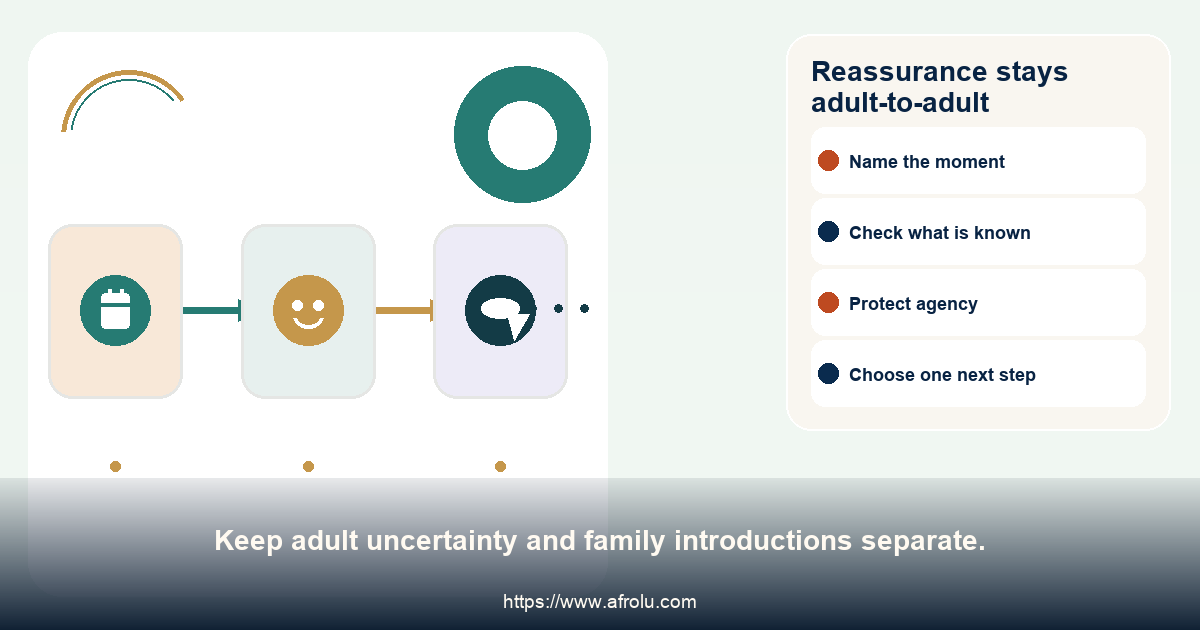
A child's routine overlaps with the planned video call
A parent can keep a contact window without bringing a child into it.
Offer an adult-only alternate time.A match asks for a child's full name
The detail is not needed to discuss adult compatibility.
Keep identifying information private.Caregiving changes a weekend plan
A change can be explained without exposing family messages.
Update when practical and offer a new time.A distant match requests a family image
A child's digital privacy is a separate decision from dating.
Do not share until you have chosen freely.The guest expects to stay at your home
Travel effort does not create home or family access.
Arrange independent lodging and a public meeting.A serious label is used to ask to meet a child
Adult commitment and family integration are different decisions.
Set timing separately and without pressure.A date needs help paying for travel
Romance scams can use urgent travel stories to request funds.
Do not transfer money to the match.A person contacts the child directly
The parent may need to protect privacy and get help.
Stop access and seek appropriate local advice.Fourteen signs of respectful family privacy
The parent can describe availability without sharing a child's schedule.
A match can accept that caregiving may change a planned call.
Child names, photos, school details and location remain private early on.
A long-distance visit includes public meetings and independent transport.
No one treats an introduction as proof of adult commitment.
The parent is not expected to provide a child photograph as reassurance.
A changed plan receives an update without demands for private proof.
Adult contact windows respect work, caregiving and rest.
Money for household needs stays separate from romantic access.
The partner does not contact the child or caregiver without agreement.
The parent can say no to a home stay or family meeting.
Both adults discuss the meaning of any future introduction.
The child's feelings are heard without asking them to decide the relationship.
A family boundary is respected without shame or repeated bargaining.
A contact-to-access decision map
| Situation | What it may mean | What to do next |
|---|---|---|
| I have limited time | Caregiving and work may define real contact windows. | Offer only a rhythm you can sustain. |
| A call is missed | Family needs may have changed the plan. | Update and reschedule without private proof. |
| A match asks about parenting | They may want broad compatibility context or private identifiers. | Share only what is relevant and safe. |
| A child image is requested | The person may not understand a child's privacy interest. | Decline until you choose otherwise. |
| An introduction is requested | Adults may have different ideas about pace. | Make family access a separate conversation. |
| Travel is planned | Distance creates costs and logistics, not entitlement. | Keep transport, lodging and meeting choices independent. |
| Travel money is requested | A remote romance contact may be seeking a transfer. | Do not send money or payment details. |
| A boundary is ignored | The parent-child privacy limit may not be respected. | Stop access and seek suitable help. |
| The child feels unsure | A family change may need more time or context. | Pause an introduction and listen without blame. |
| The relationship is unclear | Adult terms may not yet support family decisions. | Clarify the relationship before expanding access. |
Twelve scripts for schedules, privacy and visits
“I can talk Tuesday after eight and Sunday afternoon.”
“I am a parent and keep my child's identifying details private while dating.”
“My care plan changed; I need to move our call.”
“I do not share my child's photos with a new match.”
“Let us meet in public and arrange our own transport.”
“I am not ready to invite a date to my home.”
“Meeting my child is a separate decision for a later time.”
“Some evenings are family time; I will respond afterward.”
“I keep household and dating finances separate.”
“Please do not contact my child or caregiver directly.”
“Can our call rhythm work with both of our real schedules?”
“I am ending the dating connection; do not contact my family.”
Know the difference
Adult dating contact versus family access
Two adults choose messages, calls, visits and commitment for themselves.
A child may be exposed through images, location, routines, introductions or direct contact.
Decide adult terms first; consider each family step separately.

Dating access does not equal child access.
Adult dating versus family access
| Type or dimension | What it describes | Best next question |
|---|---|---|
| Remote dating | Messages and calls begin the connection across distance. | Keep child and home identifiers private. |
| Weekend-first dating | Dates fit around existing caregiving time. | Name a realistic start, end and return. |
| Casual dating | Present commitment may remain limited. | Clarify contact and family privacy. |
| Serious dating | Adults may be exploring future compatibility. | Do not assume a child introduction is automatic. |
| Slow dating | A relationship takes time before changing access. | Agree how routines and images stay private. |
| Exclusive dating | Both adults agree whether they date others. | Keep exclusivity apart from family roles. |
| Online dating | A profile or message starts contact. | Review backgrounds and identifying details. |
| Public-first dating | Early meetings occur in a setting you can leave. | Arrange your own route and check-in. |
| Family introduction | A child becomes part of a planned meeting. | Consider readiness and seek qualified guidance if needed. |
A simple plan you can use today
Parenting is context
It changes logistics without removing adult choice.
A child is not proof
Do not use images or introductions to reassure a match.
Privacy includes location
A background, uniform or predictable routine may identify a child.
Calls can be adult-only
Remote contact does not require family access.
Visits need logistics
Discuss dates, cost, lodging and independent travel.
There is no universal introduction clock
Consider the child and seek qualified advice when individual facts matter.
Questions organised by purpose and depth
Choose a few prompts that fit the moment. This is a reference library, not a list to complete.
Availability
Describe the adult contact you can keep without exposing a family schedule.
- Which windows exist?
- What can change?
- How will I update?
Privacy
Check what a new match can learn from profile and chat details.
- What identifies my child?
- Which image can wait?
- What stays private?
Distance
Make a future visit concrete and independently manageable.
- Who travels?
- Where will we meet?
- What costs fit?
Family step
Keep adult dating and child introductions as separate choices.
- Is the adult connection ready?
- What does my child need?
- Who can advise me?
What deserves a closer look
Keep adult reassurance separate from child access
Adult attachment research considers emotion regulation and support in close relationships; a child's involvement is a distinct family decision.
Evidence limit: Research on adult couples does not set an introduction timeline for a particular child.
Review who can identify a child
UNICEF parenting resources discuss online privacy and the identifying details that can appear in shared images and information.
Evidence limit: General privacy guidance cannot assess the risks of a particular profile or household.
Contact should fit actual availability
A study of remote communication in long-distance relationships found patterns that varied by communication channel in a sample of emerging adults.
Evidence limit: Its findings do not determine how often a parent must be available.
Consider the individual child and situation
Family integration decisions depend on a child's needs, the relationship, and any existing family arrangements.
Evidence limit: There is no universal number of dates or months that guarantees readiness.
Keep financial help away from early romance
Federal consumer guidance describes romance scams involving travel, emergencies and requests for money.
Evidence limit: This is risk guidance and does not label a specific person a scammer.
Get help for case-specific legal questions
A qualified local family-law professional can review an individual's order, custody arrangement or protective concern.
Evidence limit: This editorial does not interpret a court order or give legal advice.
Shortcuts that expose family information
Sharing a school or routine as proof
A match does not need identifying information to discuss fit.
Using a child photo as reassurance
The child's image is not an adult relationship tool.
Making a child attend a video call
Remote dating does not create family access.
Promising an introduction date
One timeline cannot account for every child's needs.
Booking travel before discussing terms
Logistics and expectations may be unclear.
Sending emergency travel money
Online romance requests may create financial loss.
Choose a rhythm that protects family time and your own rest
This guide is editorial information, not child-development, legal, financial or emergency advice. Get qualified local support for case-specific family and safety concerns.
Explore the guide library
Show more related guides
Continue with Afrolu
Show more Afrolu guides
Sources used for this guide
Afrolu reviewed these health, research, safety, or public guidance resources while editing this page. They support the behaviour and safety guidance; they do not diagnose any individual described by a reader.
Questions about parents and long-distance dating
Should I tell a match I am a parent?
Share the broad context when it matters to an honest decision. You can keep a child's name, school, routine and images private.
How often should I call a long-distance date?
Choose a schedule that fits work, caregiving and rest and that both adults can keep.
Should my child join our video calls?
Only if you choose to involve them. Remote dating does not create an automatic introduction or family-access expectation.
When should a date meet my child?
There is no universal timeline. Consider the individual child, the adult relationship and any relevant professional or legal guidance.
Do I have to share my schedule to explain a missed call?
No. You can say caregiving changed the plan without sending a private calendar, custody message or child's information.
What if I worry a delayed reply means rejection?
Check the agreed plan, ask one direct question if needed, and keep adult reassurance separate from child access.
Should I let a visiting date stay at my home?
You can decide that separately. A public first meeting and independent lodging can preserve choice.
Should I send money for travel?
Do not transfer money to an online romantic contact. Contact your bank or payment provider if you have already sent funds.
What if someone contacts my child directly?
Stop sharing access, document what happened if safe, and seek appropriate local advice or support.
Is this legal or parenting advice?
No. Consult a qualified local family or legal professional for individual custody, safety or court-order questions.
One thing to do now
Choose adult terms before family access
Describe the adult availability you can offer, keep child identifiers and access private, plan any visit independently, and review the other adult's response to boundaries. Make family introductions as a separate decision based on the individual child and relevant qualified advice.