Later start · serious hopes · honest casual terms
Anxious Attachment for Adults Starting Dating Later: Serious or Casual?
Starting or returning to dating later? Separate anxious cues, serious hopes and casual present terms with clear scripts, a chosen pace and practical boundaries.
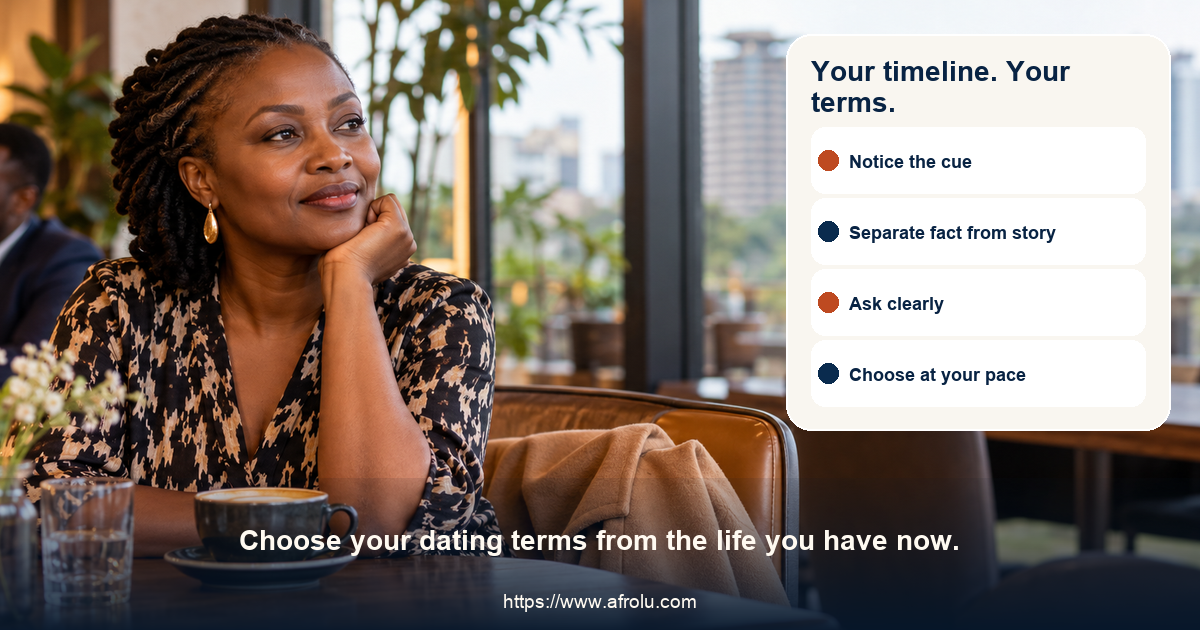
There is no universal relationship timetable.
Written and edited by Tariro Ncube · Diaspora Dating Editor
You are not behind a universal dating schedule. Treat anxious cues as information, not diagnosis, and state both your long-term hopes and today's agreement. Casual dating is not a promise of future commitment; serious intent is not automatic exclusivity. Ask for specific terms, move at a pace you choose, and protect privacy, consent and finances.
Attachment styles · Late Entrants
How can I date on my own timeline, describe a serious hope honestly, and still choose casual or uncertain terms in the present?
Anxious attachment in dating is a non-diagnostic lens some adults use to notice worry around closeness, rejection, or unclear terms. A later start or limited dating history does not establish that label or determine readiness.
Nia is in her early forties and new to dating apps. She hopes for a committed partnership but is unsure about exclusivity after one date. Rather than apologising for her history or implying an agreement that does not exist, she tells the match what she hopes for and asks what casual means to him today.
Life stage · intent · present terms
Date from your current life, not a countdown
A later start can still leave room for serious, casual or undecided choices.
Name the goal, define the present agreement, set a chosen pace, and review fit from conduct.
What do I hope for?
State direction without promising an outcome.
What exists now?
Define casual, serious and exclusivity in behaviour.
What feels workable?
Move one decision at a time.
Does this suit me today?
Choose without an age-based deadline.
life stage · experience · agency
Starting later does not mean you are behind in a race
Adults begin or return to dating for many reasons: work, caregiving, faith, grief, relocation, health, personal preference, or a relationship that ended. The phrase “late to dating” describes a comparison someone may feel; it does not measure their worth or predict whether they can build a good connection now.
Later-life relationship research describes varied choices and concerns rather than one expected route. Some adults want a committed partnership; others value companionship, privacy, or a casual arrangement. A study from another country or age group cannot tell a Kenyan reader what is typical or required. The useful starting point is what you want and can offer in this season.
Nia is in her early forties and has never used a dating app. She worries that a match will expect her to explain the gap. She chooses to say, “I am new to online dating, and I am taking time to learn what works for me.” That answer offers context without turning her history into an apology or a promise to move quickly.
You may have learned what you value through friendships, work, family, or periods on your own. Those experiences count, but you do not need to claim expertise either. A new dater can ask basic questions, decline an unfamiliar pace, and request clarity. A suitable match will not use your experience level to rush, shame, or set the terms for you.
serious hope · casual present · clarity
Separate a serious hope from the agreement you have today
“Serious” might mean looking for a long-term partner, prioritising commitment, or considering marriage. “Casual” can mean no exclusivity, lighter planning, fewer expectations, or simply a slower start. These terms vary across adults. Ask what they mean in observable choices such as seeing other people, contact, intimacy, family introductions, and future planning.
You might say, “I hope to build a committed partnership, and I am currently meeting people without exclusivity. I want to be honest about both.” The other person can welcome the arrangement, ask for a different one, or opt out. Their choice does not erase your long-term hope, and your hope does not create a promise they never made.
Do not accept casual terms while privately counting dates until the other adult must become serious. That hidden deadline can turn an open choice into pressure. If your needs change, tell the person and ask whether they want the same present agreement. If they do not, you can end the connection without proving that their approach is wrong.
If you are unsure whether you want marriage, exclusivity, or a long-term partnership, say that. Uncertainty can be honest if you do not imply a commitment you cannot offer. A clear “I do not know yet” is more useful than a confident label that leaves the other person making decisions from a mistaken assumption.

Specific terms make an honest answer possible.
uncertainty · evidence · response
Read anxious moments in context instead of treating them as a verdict
A new app, unfamiliar flirting, or first discussion of exclusivity may create uncertainty. Adult attachment research often measures anxiety as a dimension connected to concerns about closeness or rejection; it is not a fixed identity or clinical diagnosis. You can notice that a moment feels familiar without concluding that every date will repeat the same story.
Write the event in neutral terms: “They have not replied since yesterday” or “They said they are dating casually.” Then write the meaning you fear: “They are ashamed of me” or “They will never choose commitment.” The meaning may be possible, but it needs evidence. A direct question about current terms usually gives more usable information than checking app activity.
Before acting, take a pause that fits your life. Speak with a trusted friend, walk, journal, pray or reflect if you choose, or return to a task. Then decide whether the unanswered question affects your consent or next plan. You can request clarity while still accepting that the answer may remain uncertain or be different from the one you hoped for.
Regulation is not self-silencing. If contact is consistently unreliable, the other person lies, or a boundary is ignored, you can address that behaviour directly. A label should never explain away mistreatment or make you believe that leaving proves you are incapable of a relationship. The decision belongs to you and can rest on fit rather than diagnosis.
experience · intimacy · timing
Choose a pace that lets you learn without catching up
You may want to spend more time together because the connection feels promising or because you worry another match will not arrive. Notice which motivation is leading. A pace chosen from scarcity can make it harder to hear your own limits. You can keep early meetings short, maintain other routines, and decide after each step whether you want another.
Talk about physical intimacy, privacy, sexual health, money, travel, and family involvement separately. A serious intention does not substitute for present consent. A long first date does not create a relationship label. A warm introduction does not promise marriage. Each decision can be discussed when it becomes relevant rather than bundled into a single “where is this going?” test.
If the other person wants to move faster, you can say what feels manageable and ask what they need. Both adults may discover that their preferred pace differs. That is compatibility information, not a contest where one person wins by being less careful. A match who respects your boundary can still decide the pace is too slow for them.
A review point can help when both people want one: after a few meetings, discuss whether to keep dating casually, change a term, or stop. The timing is a choice, not a universal rule. Do not let an app's constant stream of profiles turn your private decision into a deadline set by imagined competition.

A match should not turn age into pressure.
history · values · present fit
Share life context without turning a date into a background audit
Adults may bring past relationships, caregiving responsibilities, faith, finances, health considerations, or a wish for privacy. These details can matter to compatibility, but the first date does not need to become an interview. Choose what is relevant now and what you would rather discuss after mutual trust develops.
Instead of demanding a full history, ask a specific present question: “What kind of relationship are you open to now?” or “How much family involvement feels comfortable?” Share your answer too. If a topic involves legal, medical, financial, or family advice, keep the conversation between the adults and an appropriately qualified professional.
A match may be curious about why you started dating later. You can answer briefly, change the subject, or say you prefer to share more later. A person who treats privacy as deception may not be a fit. At the same time, honesty about current responsibilities and relationship terms helps the other adult make an informed choice.
Avoid making age or experience do too much explanatory work. A younger dater is not automatically unserious; an older dater is not automatically ready for commitment. Ask about actual behaviour, values, capacity, and boundaries. A person is more than the age-based story you may have heard about dating.
privacy · finances · boundaries
Keep finances, consent and privacy outside the pressure to catch up
Do not share passwords, verification codes, banking access, intimate images, or home access with a new match. If you meet through an app, choose a public place and arrange your own return. Tell someone the broad plan if that supports you. These practices are useful at any age and do not require you to assume bad intent.
Be cautious of urgent requests for travel money, medical expenses, investment access, gift cards, cryptocurrency, or a transfer to help someone you have not met. Consumer guidance warns that romance scammers can build closeness before asking for funds. You may decline the transfer without investigating the person's background or proving that their story is false.
Consent remains specific, mutual, and changeable. You may enjoy a date, choose a second one, and still decline physical intimacy. You may want a serious relationship and still need time to decide whether this person fits. Neither adult owes access in exchange for persistence, an expensive outing, or a promise of future commitment.
If someone repeatedly pressures you after a no, asks for secrecy, or uses age or inexperience to make you feel lucky to be chosen, pause and seek perspective. Report concerning platform behaviour where appropriate. If you feel threatened, use local support. An editorial guide cannot assess a particular risk or replace emergency assistance.
continue · revise · pause · end
Review the connection for fit rather than age or experience
After several meetings, ask whether you feel heard, whether plans happen, and whether each person can state a boundary. Are serious hopes and casual terms both described accurately? Can you talk about a difference in pace without punishment? Does the connection add something you want to your life today, rather than only promising to repair past regret?
Continue when interest, respect, and current terms line up. Revise one detail if a change could make the arrangement workable. Pause when you need reflection. End when goals do not match or pressure repeats. You can want more commitment without apologising for it, and you can choose casual dating without implying that it will later become serious.
If you decide to become exclusive, state the agreement and when it begins. If you decide not to, tell the other person before relying on a different expectation. If you do not know, name what you know and when you would like to revisit it. Clear uncertainty is fairer than using a label to postpone an uncomfortable conversation.
Starting later than you expected does not require you to make the next person your last chance. Let the actual pattern guide your choice. You may build a partnership, choose companionship, take a break, or change direction. None of those paths needs to justify itself against someone else's timetable.

Each choice is valid when made honestly and freely.
Eight later-start dating moments
A match asks how many relationships you have had
You can offer context without submitting a full history.
Answer only what you want to share.You hope for a partner but are unsure today
Future direction and present commitment can differ.
Say what is open and what is undecided.A date hears seriousness as exclusivity
The same word can mean different current choices.
Ask what would change now.No message arrives after a promising date
Interest and communication are not fully known from silence.
Send one direct question if you want.A match suggests moving faster because of age
Age does not remove the right to choose timing.
Name the pace that feels workable.A private history comes up on date one
Honesty does not require immediate full disclosure.
Offer relevant context at your chosen pace.A new date asks for help with an urgent bill
An emotional story can still create financial risk.
Do not transfer money or codes.A partner says you are lucky to be chosen
Age or experience should not be used to shrink your choices.
Pause and seek a trusted perspective.Fourteen signs of clear and respectful terms
Your dating history is discussed without shame or pressure.
You can ask basic questions without being mocked for inexperience.
The other person describes current terms rather than relying on labels alone.
A serious hope is not treated as instant exclusivity.
A casual agreement is not sold as a guaranteed path to commitment.
Both people can name a comfortable pace and hear a difference.
Family, faith, finances and health are discussed at a chosen level of detail.
Your age is not used to rush a decision or make you feel replaceable.
The other person follows through on plans and updates changes.
A no to intimacy, travel, money or disclosure is accepted.
You are free to keep personal routines and other relationships.
Neither person makes a single date carry a future guarantee.
The next review happens by agreement rather than a hidden countdown.
You can stop dating without proving the other person's character.
A timeline-to-terms decision map
| Situation | What it may mean | What to do next |
|---|---|---|
| I started later | Your history is context, not a measure of value. | Choose what you want to share today. |
| I want commitment | The other person may or may not want the same present terms. | Ask what serious means in practice. |
| I want casual | A casual choice can be valid without a future promise. | Define what is open and what is agreed. |
| I am uncertain | You may not yet know which structure fits. | State what remains undecided. |
| A reply is delayed | The gap may have many explanations. | Ask about the plan rather than infer a diagnosis. |
| A match rushes me | The person may want a faster pace than you do. | Name your limit and check their response. |
| A private topic appears | You control when to share more detail. | Answer at a level that feels appropriate. |
| Money is requested | An online romance may involve financial pressure. | Decline transfers and protect account access. |
| Anxious thoughts rise | A cue may call for regulation or more information. | Separate event, story and next question. |
| The terms do not fit | A serious or casual mismatch may be real. | Revise by mutual choice or end clearly. |
Twelve scripts for serious hopes and casual terms
“I am new to dating apps, and I am learning what works for me.”
“I hope for a committed partnership, though I am not exclusive today.”
“What does casual mean for you around contact and seeing others?”
“What would being serious change for us this month?”
“I am still deciding what I want and do not want to imply a promise.”
“I would like a few more dates before changing the agreement.”
“I prefer to discuss that part of my history after we know each other better.”
“My age does not change the pace I need to decide.”
“I do not send money or verification codes to a new online match.”
“Would you like to continue casually, change a term, or stop?”
“I am not ready for that; please do not keep asking.”
“Our current goals do not match, so I am ending this connection.”
Know the difference
Serious hope versus the current casual agreement
An adult hopes to build a committed relationship but is still learning about this match.
Two people decide whether they are casual, exclusive, open to others, or still unsure today.
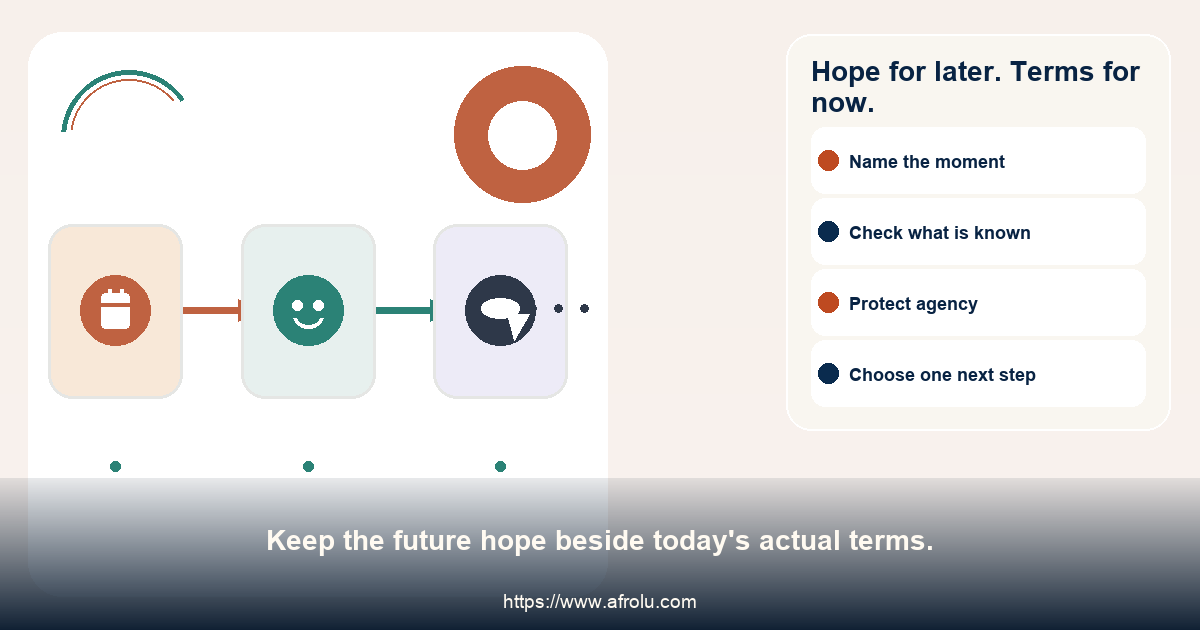
Keep the future hope beside the agreement you have now.

Define the agreement both adults have today.
Future direction versus current status
| Type or dimension | What it describes | Best next question |
|---|---|---|
| New-to-dating | Experience may be limited or newly returning. | Ask questions and choose a manageable pace. |
| Casual dating | Present commitment may be lighter or open. | Name what contact and exclusivity mean. |
| Serious dating | The adults are exploring a longer-term direction. | Clarify which commitments exist today. |
| Slow dating | Decisions are made with more time between steps. | Choose a voluntary review point. |
| Exclusive dating | Both adults agree whether other romantic dates stop. | State when the agreement begins. |
| Later-life dating | People's goals and responsibilities vary by season. | Ask about the person rather than an age stereotype. |
| Online dating | A profile begins the contact, not a relationship guarantee. | Protect details and meet publicly. |
| Companionship | People may value time together without a marriage plan. | Discuss expectations rather than assuming. |
| Dating pause | Someone may want time before another decision. | Say whether and when contact resumes. |
A simple plan you can use today
There is no dating deadline
Your age or relationship history does not set a universal schedule.
Experience is not worth
A match should not use inexperience to define your choices.
Intent and status differ
Serious hopes do not automatically create exclusivity.
Casual means different things
Ask about conduct and current expectations directly.
Anxiety is not a verdict
A cue invites attention and questions, not self-diagnosis.
Money stays separate
Romantic interest does not require financial transfers or codes.
Questions organised by purpose and depth
Choose a few prompts that fit the moment. This is a reference library, not a list to complete.
My present goal
Name what you want in this season, not what you think your age requires.
- Serious?
- Casual?
- Still deciding?
Current agreement
Turn labels into present-day behaviour.
- Are we exclusive?
- What contact fits?
- What remains open?
An anxious cue
Separate the event from the meaning you fear.
- What happened?
- What do I know?
- What can I ask?
Next step
Choose continue, adjust, pause or end from fit.
- What works now?
- Which boundary matters?
- What answer do I need?
What deserves a closer look
Research describes variation, not a timetable
A national US study using older adults' survey data described dating in later adulthood and the varied circumstances associated with it.
Evidence limit: Its sample and date do not describe Kenyan daters or set a benchmark for anyone.
Life histories shape relationship choices
A 2026 qualitative study interviewed 21 older adults about romantic relationships and changing agency across later life.
Evidence limit: The small US sample offers themes, not population estimates or rules for dating.
Anxiety is a dimension, not a permanent identity
Reviews discuss adult attachment dimensions and how relationship stress may activate different emotional responses.
Evidence limit: Research does not diagnose an individual from age, dating history or one interaction.
Use strategies that fit the situation
A 2024 study examined flexible use of interpersonal and intrapersonal emotion regulation in romantic contexts.
Evidence limit: Its findings do not establish a mandatory self-help method.
Ask for support while keeping boundaries
A daily-diary study examined the relationship between reassurance seeking and trust in couples.
Evidence limit: Association does not mean a request is excessive or a partner owes unlimited certainty.
Separate romantic interest from financial transfer
Federal Trade Commission resources explain how online romance scams can request travel, emergency or investment funds.
Evidence limit: Consumer advice identifies a risk pattern; it cannot verify a specific person's story.
Shortcuts that turn age into pressure
Calling yourself behind
A comparison cannot establish what relationship you should choose.
Rushing to catch up
Compressed decisions can hide whether the terms fit.
Treating serious hope as exclusivity
The other person may understand the current status differently.
Using casual as a promise
A future commitment needs a new mutual agreement.
Overdisclosing on date one
Trust and personal disclosure can develop at a chosen pace.
Sending money to keep interest
Financial transfers are not evidence of commitment.
Put your serious hope beside today's agreement
This guide is editorial information, not diagnosis, therapy, legal or financial advice. Seek qualified local help for personal clinical, safety or legal questions.
Explore the guide library
Show more related guides
Continue with Afrolu
Show more Afrolu guides
Sources used for this guide
Afrolu reviewed these health, research, safety, or public guidance resources while editing this page. They support the behaviour and safety guidance; they do not diagnose any individual described by a reader.
Questions about starting or returning to dating later
Am I too old to start dating?
There is no universal age deadline. Decide from your current interest, capacity, boundaries and goals.
Should I tell a match that I am new to dating?
You can share that if it helps the conversation. You do not need to explain every part of your history at once.
Can I want marriage and date casually?
Yes, if you state both honestly and do not imply that today's casual agreement guarantees future commitment.
Does serious mean exclusive?
Not automatically. Ask whether either person is still dating others and when a different agreement would begin.
What does casual mean?
It varies. Discuss contact, exclusivity, intimacy and future expectations rather than relying on the word alone.
How fast should I move?
There is no age-based rule. Choose a pace that allows both adults to decide freely.
Does anxiety mean I am not ready?
Not by itself. A feeling can be noticed without becoming a diagnosis or a condition for dating.
What if my date asks about my past?
Share what is relevant and comfortable. You may return to private details later.
Should I send money to someone I met online?
No. Do not transfer funds or payment codes to an online romantic contact.
When should I end a connection?
When the current terms do not fit or a boundary is repeatedly ignored, you can end without diagnosing anyone.
One thing to do now
Choose from the terms you have today
Choose from the present arrangement rather than an age-based deadline. Explain what you want and what remains open, ask the other adult for their current terms, and continue only when the pace, boundaries and expectations fit both people.