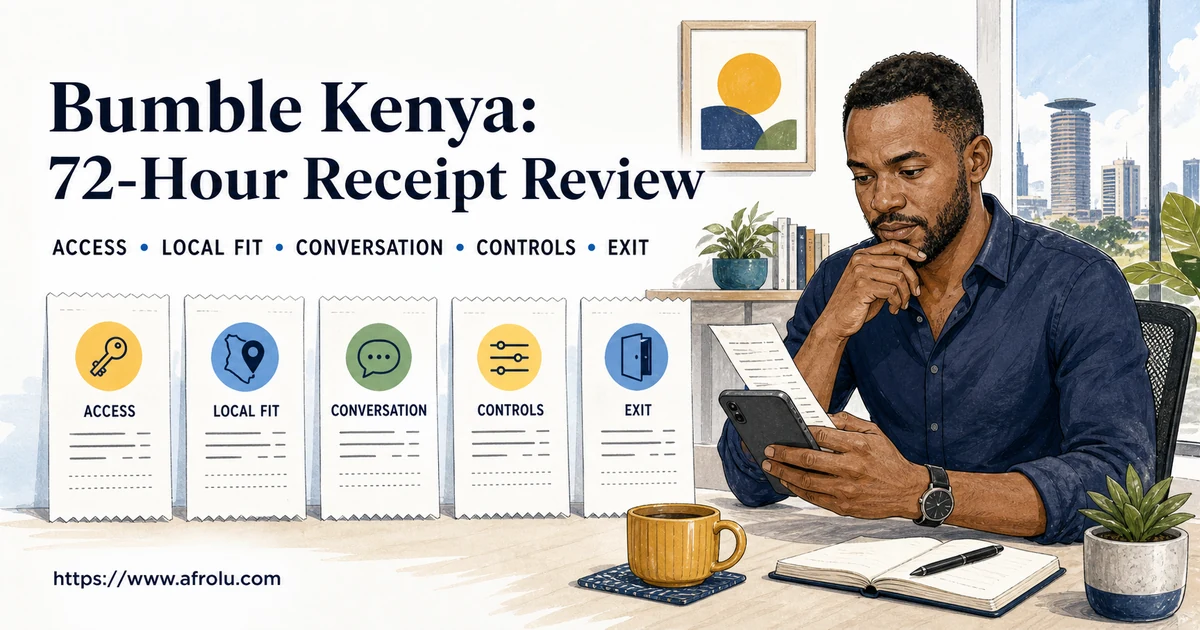
Direct answer: Bumble is currently listed in Apple’s Kenya storefront, so it is a reasonable product to inspect on a compatible iPhone. That listing does not prove Android access, a useful nearby pool, every feature, good matches or safe people. Inspect the current listing through the evidence register, stay free long enough to test your own account, and pay only if one named control solves a problem you actually observed.
The Bumble review you remember is obsolete
A Kenya page that still assigns initiation to only one gender or describes the retired short first-move window is reviewing a former product. Bumble’s official conversation guidance was updated on 10 August 2026: Opening Moves are no longer part of the experience; both members get one opening message; both initially have 72 hours from matching; and when one person sends first, the other receives 72 hours from that message to reply. The regular conversation opens after that reply.
This is not a small wording edit. It changes who can initiate, what the timer means and how a reader should judge inbox control. It does not prove that the new design produces better conversations in Kenya. This review therefore records the current mechanic as a product fact and treats conversation quality as something each adult must observe privately.
The five receipts, before any recommendation
A receipt is something another reader can check again: a storefront page, a setting visible in their account, an official help article, or a purchase record naming the merchant. It is not an attractive profile, a short personal anecdote, an app-store star average or an unsupported local user count. Afrolu has no audited Kenya dataset for Bumble activity, match rates, neighbourhood density, reply rates, demographics, relationship outcomes or safety outcomes.
Use your genuine adult account and current photos. Do not create fictional men or women to “test the market,” scrape profiles, save strangers’ photos, or publish private conversations. A clean review asks whether the product works for your disclosed goal and boundaries. The Nairobi app-bench guide explains how to compare accounts without turning people into a dataset.
Provisional pass, not a Kenya-market verdict
Apple’s Kenya listing supports an iOS access check. Bumble Web was discontinued in March 2026, so a browser is not a fallback for using the dating service. Confirm the live device, operating-system and sign-in path you need.
Unresolved until your own account is configured
Preference controls can narrow what you ask to see. They cannot create a nearby pool. Kenya was absent from Bumble’s published distance-filter country list when checked, so do not promise a Kenya distance slider before seeing it.
Clear mechanic; unknown personal outcome
The one-message opening and 72-hour reply flow are documented. Whether you receive relevant, respectful replies depends on people and context, not the timer alone.
Useful tools with narrow jobs
Calls, verification, reporting and purchase-channel cancellation each solve a different problem. None is a background check, safety promise, moderation guarantee or refund promise.
Receipt one: access means app access now
The Kenya App Store page is an access clue, not a census. It cannot establish how many Kenyan adults are active, where they live, why they joined or what another reader will see. Bumble’s own March 2026 notice says its web version has been discontinued and now directs people to download the mobile app. A reader who needs keyboard navigation, a large desktop display, a shared computer or browser-only access should treat that as a real fit constraint rather than assume the old web login still works.
Before making a profile, check four ordinary things: the listing is available in your current store; your device can install the current build; the sign-in and notification paths are accessible to you; and you can protect the device with a lock other people do not know. Never borrow a partner’s or colleague’s account to test access. If the app-only requirement fails, stop there. A paid feature cannot repair a platform you cannot comfortably operate.
Receipt two: local fit is a settings test, not a popularity claim
Complete the profile truthfully and minimise what you expose. A broad city is enough at the discovery stage; a home, workplace, daily route, child’s school, identity number or live timetable is not profile material. State a relationship intention in plain language, select only the preferences that matter, and see whether the settings visible in your Kenya account match the official description.
If you are reviewing the profile before another 72-hour test, change one evidence-bearing element at a time: a current solo photograph, a concrete ordinary-week detail, or one answerable intent line. Do not replace the whole profile and then attribute any change to Bumble. Use the Kenya profile-photo privacy check to check current likeness, consent, visible location clues and reuse risk before uploading; this guide stays focused on Bumble’s live profile controls and conversation receipt.
Bumble’s filter guidance describes preference controls and publishes a limited country list for the distance filter. Kenya was not on that list when Afrolu checked. This does not mean no Kenyan account can ever show a distance-related control; builds and experiments can differ. It means the editorially honest sentence is “verify the current account,” not “set a Kenya radius.” If distance is essential, take a dated screenshot of your own settings without capturing another member’s profile.
Give free mode a bounded trial across times you would genuinely use it. Do not count strangers or announce a “response rate.” Record only decision notes: Is your goal expressible? Are the visible preferences relevant? Can you control location exposure? Are profiles within a journey you would independently make? Does the app show a clear pause or visibility option? A thin or unsuitable result is useful information, not a reason to widen age, location or intentions beyond your real boundaries.
Receipt three: understand the two-opening-message flow
The current sequence in plain English
- After a match, both people can send one opening message.
- Both initially have 72 hours from matching to send that opener.
- If one sends first, the other then has 72 hours from that message to reply.
- The ordinary chat unlocks after the reply; if neither opens in time, the match expires.
A Note counts as an opening message. Bumble says a very short opener may trigger a suggestion, but it can still be sent. An opening message can be edited once within five minutes, and editing does not restart the timer.
The practical change is parity, not an open inbox. A match still precedes the opening message, each person gets one initial attempt, and a reply is required before normal chat. That is different from both the historic gender-gated initiation rule and the former Opening Moves prompt system. Open the app only after accepting that current flow.

Write an opener that leaves room for a real answer
A good first line is specific without being invasive. It does not ask for a number, home address, work schedule, private photo, money or a rushed meeting. The other person may not reply; the timer does not create an obligation. If they answer, notice whether the exchange becomes reciprocal. One person carrying every question is a conversation fact worth acting on, regardless of which person opened.
Do not let the longer window become a reason to monitor the app constantly. Notifications are a convenience, not a contract. Send one thoughtful opener, return to normal life, and accept an expiry without pursuing the person through another platform. If the mechanic feels calm and relevant, test it with one honest opener.
Receipt four: a control stack, not a safety badge
In-app voice and video calls can add context without requiring a phone number. They can help confirm that the conversation is reciprocal and that basic details remain coherent. They do not prove a legal name, age, relationship status, criminal history, employment, intentions or future conduct. A person can decline a call for accessibility, bandwidth, privacy or comfort reasons; offer another on-app step rather than treating refusal as automatic guilt.
Bumble documents Photo Verification, a separate ID process, a way to request Photo Verification, blocking and reporting. Photo Verification compares a prompted selfie with profile images. ID Verification checks age and photo likeness under the documented flow. These are narrower than a background check. A badge should never override contradictory stories, financial pressure, coercion, harassment or a meeting plan that removes your exit.
| Control | Useful for | Cannot establish |
|---|---|---|
| In-app call | More conversation context without sharing a number | Identity, background, marital status or safety |
| Photo or ID verification | Documented likeness and, for ID, age checks | Character, consent, intentions or future behaviour |
| Report and block | Sending platform-relevant context and ending contact | A guaranteed outcome, emergency response or criminal investigation |
| Share Date | Giving a trusted person selected plan details | Live emergency monitoring or a safe venue |
Use the smallest control that answers the actual question. Inspect the in-app call option when number privacy matters. Inspect verification requests when photo coherence is unresolved. Locate Report before you need it; Bumble asks for context but does not promise a particular moderation result.
For a first meeting, agree an occupied, staffed public place during confirmed hours, a short plan, two independent arrivals and two independent exits. Tell a trusted person what you choose to share. Bumble’s Share Date can help package plan details, but it is not emergency dispatch and cannot make a person or venue safe. Afrolu’s Kenya online-dating safety guide covers the full check-in and exit plan, while the Utawala control-stack guide separates visibility, screening, meeting choice and exit without assigning responsibility for harm to the person targeted.

Receipt five: the price is the live receipt, not an old article
Bumble says paid-feature pricing varies by plan, duration and package, and directs members to the current Pay Plan screen. That is why this review publishes no fixed Kenya figure and gives no blanket “worth it” verdict. The useful question is whether a named paid feature resolves friction already visible in your free account. Paying to discover whether a local pool exists reverses the order.
Before purchase, capture the displayed total, currency, duration, renewal date, trial terms if any, included feature and merchant. The merchant matters because cancellation follows the purchase channel. Apple, Google Play and Bumble document different paths. A phone’s payment options can also vary; do not assume a particular Kenya method will appear until the actual checkout screen shows it. Never send a match money to buy your subscription, “verify” an account or unlock a conversation.
Keep four nouns separate on the receipt. Product is the Bumble feature under consideration. Merchant is the party shown as taking and managing the purchase. Funding rail is the card, mobile-money option or other method the merchant actually offers to that account. Subscription owner is the place where renewal must be stopped. A screenshot that shows only a familiar payment logo does not identify all four, and a Kenya payment-method help page does not promise that method inside every Bumble checkout.
Google Play currently documents M-PESA Xpress among eligible payment methods in Kenya, while Apple publishes a separate country-specific payment-method list. Those records establish possible storefront rails, not a Bumble promise. If M-PESA is absent from the legitimate checkout you reached, do not pay a match, agent, reseller or social-media account to “activate” it. Stay free, use another payment method you independently trust, or leave the purchase. If it is present, read the merchant name, displayed total, billing period and renewal wording before authenticating.
Run the exit on paper before the purchase: “I bought through ___; renewal appears on ___; I cancel at ___; continued access ends or changes on ___.” Then compare that sentence with the live terms. Cancelling a subscription, deleting an account, hiding a profile and uninstalling the app are distinct actions. A cancellation confirmation should name the subscription or merchant and carry a date; it does not promise a refund or erase the dating account.
The billing-exit test
- Find the live Pay Plan screen and name the exact feature you need.
- Read the total and renewal wording before authentication.
- Record whether Apple, Google Play or Bumble is the merchant.
- Find that merchant’s cancellation path before paying.
- After cancelling, retain the dated confirmation. Deleting or uninstalling the app is not a substitute.
If any part is unclear, remain free. A timer or match does not turn uncertainty into value.
Inspect the current Pay Plan only after the free test. If you do buy, return to the merchant immediately and locate the exit rather than relying on memory later.
The 72-hour personal test: one real account, no performance theatre
- Before the clock: write one relationship goal, three privacy boundaries and the journey radius you can independently sustain. Check app access and the cancellation route.
- First session: build a truthful profile. Do not publish exact routines, workplace access, children, identity documents or financial details.
- If a match occurs: use one profile-connected opener. Record whether the new timer and interface are understandable, not whether a stranger behaves as hoped.
- If a reply arrives: look for reciprocity, consistent ordinary facts and respect for staying on-app. A call is optional context, not proof.
- At 72 hours: decide among keep free, pause, or leave. “Buy” is a fourth option only when a specific paid control addresses observed friction and its exit is clear.
This method cannot estimate a Kenya success rate or predict a relationship. It gives one adult a bounded way to decide whether the current product deserves more attention. If the app creates pressure to overexpose yourself, widen non-negotiable preferences or buy before learning, that is a legitimate reason to stop.
Who may find the current Bumble useful—and who should pass
Consider a free test if you have compatible mobile access, want either person to be able to open, value an on-app call before sharing a number, and can evaluate local fit inside your own settings. Pass for now if browser access is essential, the current filters cannot express a genuine boundary, the visible pool creates impractical journeys, or the purchase and cancellation route is unclear.
The app is not a substitute for careful cross-cultural questions, ordinary-week logistics or adult-controlled travel. Readers dating across borders can use Afrolu’s three-location truth check. Readers over 50 can use the five established-life choices for present history, household, care, account-help and pace fit. For a location-first meeting plan, the Malindi status-before-swipe guide and Mlolongo ordinary-week test keep app discovery separate from a workable date route.
Final editorial judgement
Bumble earns a place on a Kenya shortlist only as a current, app-only product to inspect—not as a winner, a safety label or a promise of local activity. Its August 2026 opening-message change is clear enough to assess: either person can open, each gets one initial message, and a reply opens the chat within the documented timer. Whether that structure improves your experience is personal evidence, not a universal rating.
Start free, keep the profile truthful and minimal, test the opening flow without chasing expiry, and use controls for their narrow jobs. Pay only after identifying one solvable problem and reproducing the cancellation path. Run the free receipt review; retain the app only if all five receipts remain clear.
Frequently asked questions
Does Bumble still make women message first?
No. Bumble’s official guidance updated 10 August 2026 says Opening Moves are retired. Both people now receive one opening message, both initially have 72 hours, and the ordinary chat opens after a reply.
Is Bumble officially available in Kenya?
Bumble is currently listed in Apple’s Kenya iPhone storefront. That supports an iOS access check only; it does not prove Android access, nearby activity, feature parity, match quality or outcomes.
Can I set a Bumble distance radius in Kenya?
Do not assume so. Kenya was absent from Bumble’s published distance-filter country list when checked. Inspect the controls in your current account rather than relying on a generic or older guide.
Do Bumble verification badges prove identity or safety?
No. Photo and ID processes perform the limited likeness and age checks Bumble documents. They do not establish character, intentions, relationship status, background or future safety.
Can I pay for Bumble with M-Pesa in Kenya?
Google Play currently lists M-PESA Xpress among eligible Kenya payment methods, but that does not prove it will appear for every account or Bumble purchase. First identify the live merchant, then use only a payment method shown by that legitimate checkout. Record the total, term, renewal and the matching merchant cancellation route before authorising payment.
Does deleting Bumble cancel a subscription?
Do not assume it does. Cancellation depends on the original Apple, Google Play or direct purchase channel. Cancel through that channel, retain confirmation and verify renewal status.
Method, sources and limits
Method: Afrolu checked five reproducible receipts on 23–25 August 2026: Kenya iOS listing, app-only access, current conversation rules, documented controls, and the live-price/cancellation path. Editorial assessment separates provider-documented mechanics from user-dependent local fit. No fake profile, private-message scrape, member count, popularity estimate, numerical score or fixed Kenya price supports this page.
Primary sources: Apple’s Kenya Bumble listing; Bumble’s current conversation-start rules, conversation tools, web discontinuation notice, filter guidance, in-app call guidance, Photo Verification, ID Verification, reporting guidance, Share Date, live-pricing explanation, and channel-specific cancellation. Payment-method boundaries use Google Play’s Kenya payment-method record and Apple’s Kenya payment-method record; cancellation also follows Google Play’s subscription route or Apple’s subscription route when that storefront is the merchant.
Limits: storefront access cannot prove Android access, feature parity, nearby supply, user intent, moderation quality, match quality or outcomes. A timer, call, badge, report, shared plan, public meeting or cancellation receipt cannot establish identity, background, consent, safety or value for another reader. Products, experiments, prices, filters, payment methods and merchant paths can change after review.
Governance: editorial methodology, affiliate disclosure and privacy policy.


