New dating · weekend budget · safety
Make the bill a small decision, not the meaning of the date
New to dating and unsure who pays? Handle a late venue change, choose a bill you can afford, keep your fare home and remember payment buys no intimacy.
A freely chosen treat changes a bill, not either adult's right to leave or decline intimacy.
Written and edited by Liya Bekele · Horn of Africa Editor
There is no universal rule that one gender, inviter or higher earner must pay. Pick a place where you can cover your own order and your trip home, then speak plainly if the arrangement matters: 'Shall we each pay for our own today?' An offer to treat can be generous when it is freely given and accepted; it does not create a debt of affection, another date or physical intimacy. If the bill becomes pressure, you can settle your part and leave by your own route. You do not need to reveal your income or justify a modest budget to make a respectful plan.
Who should pay on an early date, and how can I keep the conversation comfortable and safe?
Paying for a date is an agreed practical arrangement about the cost of an outing. It is separate from consent, exclusivity, relationship status and anyone's worth.
At the venue door
A new price needs a new yes
You have arrived expecting a modest public lunch, and the suggestion changes to a restaurant you did not budget for. You can pause outside rather than reading the menu in embarrassed silence. 'I planned for the market lunch we discussed; I would rather keep it' names the change exactly. A respectful date may agree, offer a different affordable place, or decide that the plan no longer works. No one needs to perform wealth to keep the invitation alive.

The venue changed; must I follow?
View full-size imageA simple weekend market lunch is unexpectedly changed to a costly restaurant.
Can the new venue fit my chosen budget and independent return?
- YESagree payment plainly before ordering.
- NOkeep the original plan or leave kindly.
Money can pay a bill; it cannot purchase romantic or physical consent.
Three sentences at the venue door
Each sentence meets a different moment. Use only the one that matches what actually happened.
The place changes
That restaurant is more than I planned; I would rather keep the market lunch.
The old plan or a kind decline remains possible.
The bill is unclear
Shall we each pay for our own order today?
Neither person's wallet is a test of interest.
A treat becomes pressure
Thank you, but paying does not change my decision to head home.
Own return route and a free no remain intact.
Before the menu
Choose a date that leaves both adults room to say yes
If an invitation names a costly restaurant, you can suggest a simpler public place before either person travels. 'I would enjoy a walk and lunch at the market' is a real date, not a lesser one. You need not announce your salary or debt to explain a preference. A person who invited you may offer to pay, but that offer is still yours to accept or decline. A chosen budget is a practical boundary, not a measure of interest.
Keep the cost of getting home separate from the cost of the meal. Even if someone offers to cover lunch, you should be able to leave on your own terms. RAINN's safer-dating guidance recommends public early meetings and control over transport as risk reduction. It cannot guarantee that any venue or payment arrangement will be safe.
The table before the bill
Which cost is actually yours to choose?
A changed venue and the trip home are the two costs that can quietly reduce choice. The bill can then be discussed in ordinary words, without a gender script.
Check the new setting and preserve the return first; use the venue-door script to settle the bill before ordering.
Can I enjoy this place?
A modest public setting leaves room for conversation.
Can I leave independently?
Keep enough money or a separate transport plan to go home.

Words before ordering
View full-size imageThis place looks good, but I am keeping today's budget simple. Shall we each pay for our own order?
- Name simple budget
- Suggest own order
- Allow their choice
Name the budget before ordering, without apologizing for it.
At the counter
Say the small sentence before the large assumption
At a food market or café, the simplest script may be 'Shall we each pay for our own order?' It gives both people a way to choose. Another adult might say, 'I invited you; I would like to treat today.' You can accept, offer to split, or explain that you are more comfortable paying your part. The moment need not become an argument about what men, women or serious partners should do.
When a bill is shared, check that the split matches what was ordered and what both agreed. If one adult wants an expensive extra, nobody has to quietly subsidize it to appear easygoing. The larger skill is to handle a small difference without humiliation or control. The same conversation can reveal whether a new date hears a modest preference and adjusts kindly.
The late venue change may seem solved when someone says 'I'll pay for everything.' You can still ask whether you want that offer. If accepting would leave you uncomfortable, keep the original place or pay your own part. If you accept, a simple thank-you is enough. Neither person has to attach a promise about the rest of the evening to the amount on a receipt.

Four costs in one weekend date
View full-size image- Changed venue
- The venue cost changed before agreement.
- Agreed bill
- The payment preference was spoken.
- Return money
- Fare or other return plan remains independent.
- Response to no
- The answer to a limit carries more weight than the bill.
Notice the cost change, spoken arrangement, independent trip home and any pressure after payment.
If generosity acquires conditions
A paid meal cannot create a romantic debt
A generous offer can be lovely. The problem begins if someone later says you owe them affection, private time or a second date because they paid. Consent is specific and can be changed; RAINN's consent guidance does not convert one yes into another. You can say, 'Thank you for lunch, but I am heading home now.' You do not need to negotiate about what the receipt supposedly entitles them to.
If the exchange feels unsafe, prioritize leaving and seek help from staff or a trusted person where appropriate. You can settle your own share if that is practical, but you do not have to remain in a pressured setting to complete a perfectly balanced accounting. Keep your phone and route home available. A pattern of using money to override boundaries is useful information about whether you want another date.

A treat is not a contract
View full-size imageFree offer
One adult offers to cover a meal with no condition.
Costly condition
Payment is later cited as a reason for touch, time or another date.
- Cost known?
- Terms spoken?
- Return funded?
- No pressure?
Money can pay a bill; it cannot purchase romantic or physical consent.
After the receipt
Decide whether the company, not the spending, was worth repeating
Later, remember the conversation as a whole. Did you enjoy talking? Could you name a preference without being mocked? Did the other person keep the plan affordable after hearing you? The amount on the bill answers none of those questions by itself. An expensive date can be warm or uncomfortable; a low-cost date can be careless or deeply attentive. Choose from the behavior you actually saw.
If you want another outing, offer one that still fits your budget and schedule. If you do not, a brief no is enough, even if the other person treated last time. Money can be discussed with ordinary clarity. It should never become a hidden contract that limits either adult's freedom to stop dating.

Leave with the same freedom you arrived
View full-size image- Pause at changePause when the agreed cost changes.
- Name affordable planName a place and bill you can afford.
- Agree the billKeep the trip home available.
- Keep freedomTreat a paid meal and consent as separate matters.
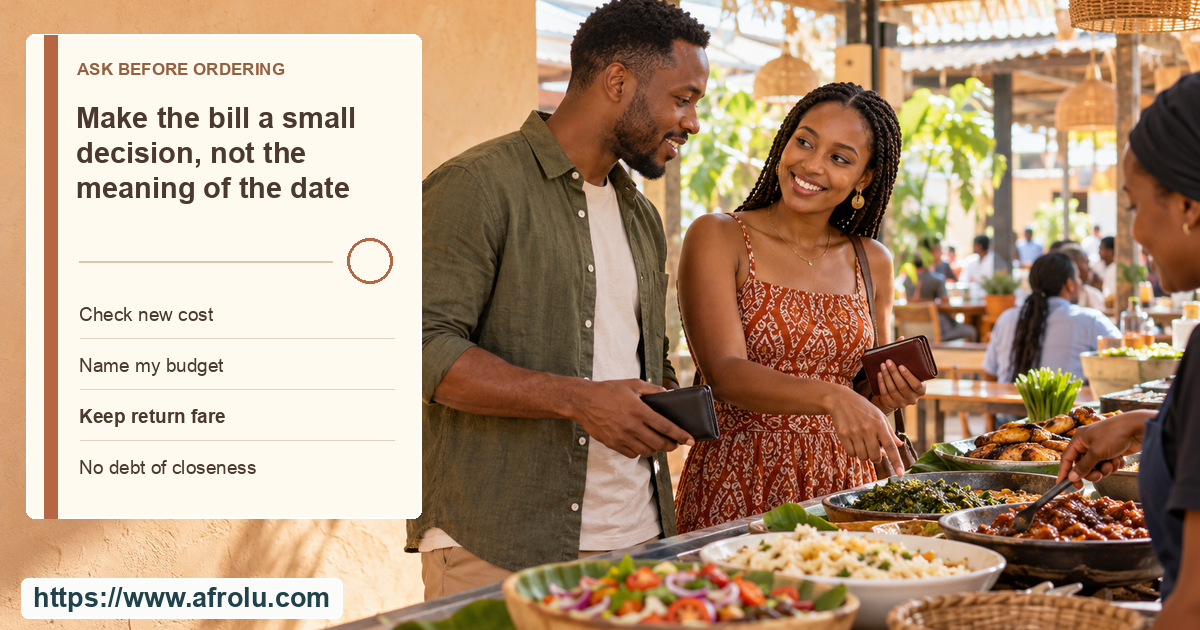
Name a budget before the changed venue becomes a commitment, agree who pays, retain return money, and keep consent separate from a treat.
Next choice
Keep the outing within reach
Choose an affordable public plan and retain your own route home.
About these links These information links are not affiliate buttons and are clearly labelled. They do not promise a match or relationship outcome.
Sources on consent, boundaries and return money
Consent sources do not prescribe a bill split. Their voluntary-choice principle applies separately from payment.
Questions about paying on a date
Does the inviter have to pay?
There is no universal rule. Agree on a plan both can afford and a payment arrangement both accept.
Is splitting always fairest?
Not necessarily. Paying for your own order, splitting or accepting a treat can each be fair when freely chosen.
May I refuse an expensive venue?
Yes. Suggest a public place within your budget or decline the outing.
Do I owe another date if they paid?
No. A paid meal does not create a romantic or physical obligation.
What if they argue at the bill?
Address the practical amount if safe. If payment becomes pressure, leave by your own route and seek help if needed.