Faith-led · work life · community privacy
An app pause is not a community announcement
Faith-led daters may share a community before a relationship label. Choose an app pause, agree on exclusivity and photo tags, then close billing carefully.
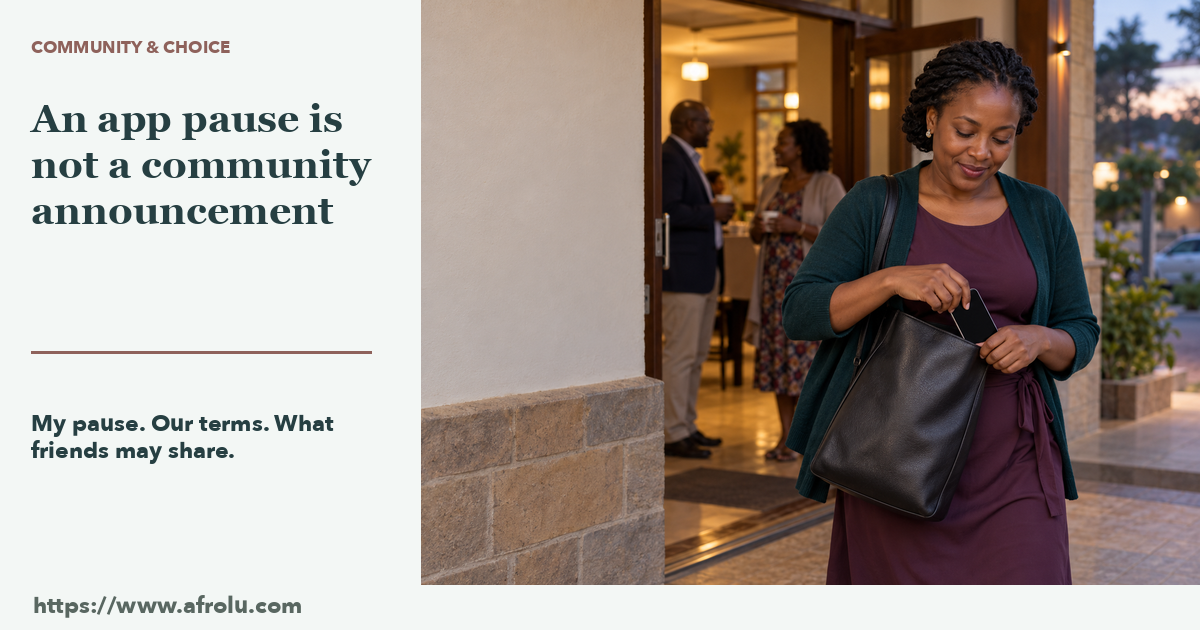
What you do alone, what two adults agree, and what others may share are separate choices.
Written and edited by Liya Bekele · Horn of Africa Editor
You can pause or remove an app for your own focus without declaring that you and another adult are exclusive. If people in a shared faith circle may notice a profile, a photo or your time together, talk privately with the person you are dating about two separate questions: are you dating only each other, and what may others be told or shown? Neither answer follows from an icon disappearing. You may keep the connection private while learning each other, and either adult may decline a public tag or introduction. If you pay for an app, check the biller and stop renewal through its current controls; then check the dating service's account and data settings. Keep a respectful closing message for active matches only when it is safe and true.
Faith-led · work life · community privacy
If I delete my dating apps, what can our faith community assume, and what should we agree first?
Deleting an app removes software from a device. It does not by itself establish exclusivity, close a dating-service account or subscription, or give friends permission to describe a new connection publicly.
The pause after work
Choose the app break for yourself first
A demanding workweek can leave little attention for several simultaneous chats. You may pause an app because you want a quieter week, or because one connection deserves more of your attention. Neither reason automatically says you expect the other adult to stop dating elsewhere. If that distinction matters, put it into words instead of hoping a disappearing profile will explain itself.
Faith may shape how you want to date, how you involve community and what pace feels respectful. The adult you are seeing may share that identity yet have a different view of when a connection should become exclusive or public. love is respect explains why assumed expectations need a real conversation; its guidance cannot settle a doctrinal rule for the two of you.
Three audiences, three permissions
Who is entitled to know what?
A personal app break, a shared dating agreement and a public story are different levels of disclosure. A close community can make the third feel urgent before the first two are settled.
Answer each audience in its own words. No friend, community leader or app setting can answer the couple's question for them.
May I pause the apps?
Yes; a break for work or attention is a personal choice.
Are we dating only each other?
Ask and let each adult answer freely.
May others tag or describe us?
Agree on what, if anything, may be shared.

Private choice versus public label
Open full-size visualPrivate pause
One adult can stop swiping for work or focus without speaking for the pair.
Public description
A tag, photo or couple introduction needs both adults' permission.
- My reason clear?
- Exclusive agreed?
- Tagging agreed?
- Closeout checked?
No community assumption can replace the two adults' own answer.
At the community supper
Do not let a friend's question become the couple's answer
At the supper, a friend asks whether she can tag the two daters in a photo and introduce them as a couple. That question deserves an answer, but not a hurried relationship announcement. 'Please leave it untagged; we are getting to know each other' can protect both adults while they talk privately. It does not require hiding the friendship or making the community the referee.
Digital boundaries guidance from love is respect specifically invites partners to discuss tagging, check-ins and public relationship status. Ask whether either adult wants photos shared, who may know they are seeing each other and how an introduction should sound. A yes to one photo is not a yes to every later post, and a request for privacy is not proof of shame.

The question at the supper
Open full-size visualA friend at a shared faith-community supper asks to tag the two daters as a couple after one paused the apps.
Have both adults agreed what their circle may share?- Shared permissionuse only the agreed wording or photo permission.
- Permission unsettledleave it untagged and talk privately first.
No community assumption can replace the two adults' own answer.
Between the two adults
Ask about exclusivity apart from public visibility
If you want to date only each other, ask directly. Their answer may be yes, later or no. Then ask a different question: if you do agree on exclusivity, do you also want friends to know now? Some couples keep a new exclusive connection private while they learn; others are comfortable with an introduction earlier. Neither answer is a universal faith rule.
The Hotline describes healthy relationships as honest, equal and respectful of privacy. Do not demand an app-deletion screenshot or inspect a phone as a pledge. If one adult needs public acknowledgement while the other needs time, name the difference and decide whether the arrangement still fits. You can keep your own app pause even if mutual exclusivity is not agreed.

Three audiences, one admin note
Open full-size visual- Only me: app break
- One adult can pause an app for focus without promising exclusivity.
- Between us: dating terms
- The pair must say what dating terms they actually choose.
- Beyond us: tagging
- A photo tag or couple introduction needs both adults' permission.
- Admin: billing
- Billing and account settings are handled with their providers.
Keep a personal app pause, mutual dating terms and friends' visibility in different circles; leave billing as a separate admin note.

Before a friend tags the photo
Open full-size visualI paused the apps for my own focus. Before friends tag or introduce us as a couple, can we talk about what we each want and what stays private?
- Name app pause
- Ask dating terms
- Ask about tags
Ask about dating terms and public visibility without asking the other adult for a screenshot or proof.
Other conversations
Close active threads without claiming a status you do not have
If you no longer want to meet an active, respectful match, a short message can be enough: 'I am stepping back from dating apps and will not continue this conversation. I wish you well.' Do not announce that you are in an exclusive relationship if no such agreement exists. If you are only pausing, you can simply say you are stepping back without promising a return later.
If another contact has been coercive or frightening, prioritize privacy and trusted support over etiquette. Save relevant messages if you may need them before closing an account. You have the right to stop contact without sending a polished explanation to that person.
The administrative closeout
Check who bills you before removing the icon
Find a current receipt. If Google Play bills the app, its official help says uninstalling does not cancel and points to the subscription in Google Play to stop renewal. If Apple bills it, Apple directs iPhone users through Settings, their name, Subscriptions and the cancellation control. If a different company bills you, use that company's current support. Keep the cancellation confirmation and check the next renewal date rather than treating the absent icon as proof.
The profile still visible
Choose the service setting and read its data terms
If you want to hide, deactivate or delete a dating profile, use the service's own current account settings. Those options may differ in who can see you, what happens to matches and whether you can return. If data removal matters, read the current privacy and deletion policy; this guide cannot promise one tap erases every message or payment record.
Think about the social consequence as well as the technical one. A friend may still remember seeing the profile; a screenshot may exist outside the app. You can ask for a photo or post not to be shared, but you cannot control every interpretation. The agreement you make with the person you are dating should rest on what you both said, not on what a circle inferred from a profile.

Leave with permission clear
Open full-size visual- Pause for yourselfChoose your app break privately.
- Ask each otherSpeak dating terms with the other adult.
- Agree on sharingAgree on what friends may share.
- Check paid planClose billing and account costs with the right providers.
Choose the app break privately, discuss dating terms and community visibility as two free agreements, then handle billing and account settings as an administrative closeout.
Agree before others speak for you
Choose the app break yourself; ask the other adult about dating terms and what friends may share, then check any billing and account details.
About these links These information links are not affiliate buttons and are clearly labelled. They do not promise a match or relationship outcome.
Sources for tagging, privacy and account closeout
Digital-boundary guidance covers tags and public status; Google and Apple billing instructions apply only when those companies bill the subscription.
Questions about an app pause in shared community
Does an app pause make us exclusive?
No. One adult can pause for focus; both need to agree on exclusivity.
May a friend call us a couple at a community supper?
Ask what both adults are comfortable with first. You can request an untagged photo and an ordinary introduction.
Can we be exclusive but keep it private?
Yes, if both freely agree on the dating term and on what stays private.
Do we need app-deletion proof?
No. Speak the agreement; neither partner needs to inspect the other's phone.
Will deleting an app stop billing or remove my profile?
Do not assume so. Check the actual biller's current subscription controls and the dating service's account and data settings.