Three clocks before one relationship upgrade
Choose a Dating Type That Fits Study, Career and Serious Intent
A practical guide for adult students balancing serious dating, early-career goals, time, money, support, consent, privacy and relationship review.
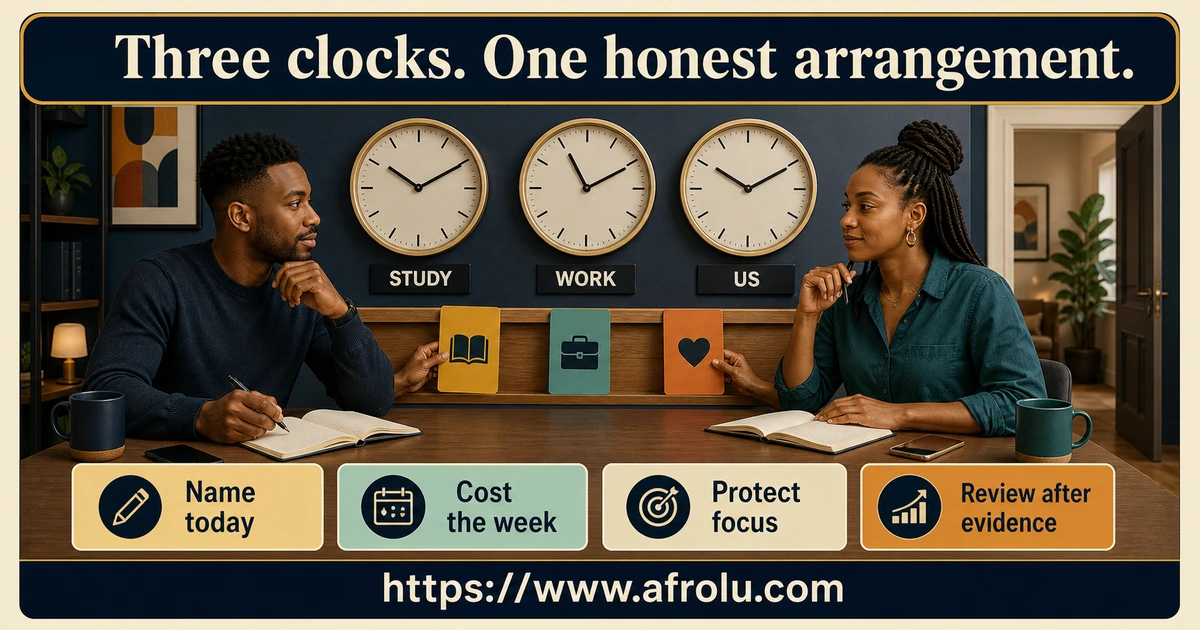
Name the relationship, then budget study, career and connection time separately.
Written and edited by Thabo Mokoena · Dating Trends Editor
Separate serious direction from the arrangement you have today. Map three clocks—study, work and relationship—using the full cost of each promise. Choose a repeatable communication and date rhythm, keep essential money, accounts, independent support and consent separate, and read how changes are repaired. After an ordinary four-week pattern, continue, adjust, pause or close. Escalate the label only when both adults freely name it and the real rhythm can carry it.
Dating basics · Students
Which present dating structure gives both adults enough connection while keeping study, career, money, privacy and consent under their own control?
A student career-stage dating arrangement is the present agreement between adults whose education, professional launch and relationship each need visible time, with support, privacy and commitment chosen rather than inferred from availability.
Amari and Naledi are fictional adult postgraduate students, 25 and 27. Across four weeks, a capstone, job interview, repaired cancellation and boundary around project help reveal whether their serious direction can support exclusivity.
The three-clock student arrangement studio
Give study, career and the relationship an honest clock
Thabo separates future direction from present structure, then follows a four-week pattern through deadlines, support and repair.
The studio uses three time budgets, six capacity dials and four equal review outcomes so no single busy week decides the relationship.
Study
Protect fixed learning, concentration, sleep and recovery before offering time.
Career
Include paid work, applications, placement, uncertainty and travel.
Relationship
Promise a connection rhythm both adults can actually repeat.
Begin with the present agreement
Serious-minded students still need a dating type that fits this term
A student can want a lasting relationship and still have a week shaped by laboratories, clinical placement, fieldwork, examinations, professional registration or a first job search. Another adult may have fewer formal deadlines but more paid hours, care duties or commuting. Those pressures matter because a relationship needs time and attention, yet they do not automatically prove disinterest. Start by naming the arrangement in ordinary language: learning through bounded dates, dating openly with serious direction, dating exclusively, or building a defined partnership. Then ask whether the current week can support what that label requires.
Do not use availability as a hidden moral scale. Constant replies can coexist with poor reliability, and delayed replies can coexist with a well-kept plan. The informative pattern is whether each adult says what they can offer, protects agreed moments, gives useful notice when something changes and accepts that the other person also has work worth protecting. A serious claim earns weight through repeated conduct across normal and pressured weeks. One intense night, expensive gesture or dramatic promise cannot substitute for a sustainable rhythm.
Career conversations also need boundaries. A partner can listen, encourage an application or help someone think through a decision without becoming an unpaid supervisor, networking route, editor on demand or proofreader at midnight. Support is most useful when it is requested, specific and compatible with both adults' capacity. Each person remains responsible for their own applications, academic integrity, professional advice and final choices. Dating should not make one adult's progress depend on the other's credentials, contacts or constant emotional regulation.
Three clocks keep the problem honest. The study clock covers immovable learning tasks and recovery. The work clock covers paid employment, placement and career-building. The relationship clock covers dates, communication, intimacy and repair. The clocks can receive different attention in different weeks, but none should disappear without a spoken plan. When the arrangement cannot fit all three over time, reduce its demands, revise the label, pause during a defined season or close rather than borrowing indefinitely from health, money or concentration.
Use the three-clock studio
Map study, career and relationship promises before increasing commitment
On the study clock, list the fixed events that carry consequences: seminars, assessment windows, practice hours, group obligations and sleep before demanding work. Avoid filling every empty square. Concentration has setup and recovery costs, and a schedule that assumes perfect energy is already inaccurate. Share only the detail needed to coordinate. A partner does not require access to portals, timetables, supervisor messages or grades in order to respect a protected block. The useful sentence is when you are unavailable and when you can return to the conversation.
On the career clock, include paid shifts, interviews, travel, application work and uncertainty. Early-career opportunities can move quickly, but urgency should not automatically transfer to the relationship. If an interview lands on date night, explain the change, suggest a realistic alternative and let the other adult decide whether that revised pattern fits them. Repeated last-minute changes without ownership are different from one meaningful opportunity handled well. The question is not whether work ever wins; it is whether both adults can plan and repair without one person's time becoming disposable.
On the relationship clock, write actual commitments rather than hopes. One planned date, two short calls and a four-week review are measurable. 'We will always make time' is not. Include low-cost connection, solo time, friends, sexual-health conversations and the time needed to repair a disagreement. Serious direction does not require every open hour. It does require the arrangement to be understandable from both sides. If one person expects daily access while the other expects a weekly date, the mismatch exists even when both genuinely want a long-term partner.
Finally, look for collisions. A relationship that repeatedly requires missed sleep before clinical work, unaffordable transport or unfinished assignments is producing evidence about fit. A degree that is used to postpone every conversation forever is also producing evidence. Try one bounded adjustment: move the date, shorten it, choose a nearer venue, schedule a quiet co-working hour or define a deadline season with a review date. If the adjustment works, keep it. If it only shifts the cost to the other adult, choose a smaller arrangement or end honestly.
Amari and Naledi test four weeks
A capstone and an interview reveal whether serious intent can handle revision
Amari, 25, was completing a postgraduate design capstone while working two evening shifts. Naledi, 27, was finishing professional training and interviewing for her first permanent role. Their first two public dates were lively, and both said they ultimately wanted a committed relationship. Instead of calling themselves exclusive immediately, they chose open serious exploration for four weeks: one planned date each week, no assumption of instant replies and a direct conversation if either wanted to change the structure.
In week two, Naledi received an interview exercise due the morning after their date. She told Amari as soon as she understood the workload, apologised for changing a protected evening and offered a shorter lunch after submission or the same plan two days later. Amari was disappointed but did not ask her to prove interest by staying out late. He chose the later date and used the original evening for his capstone. Naledi did not vanish; she sent the promised confirmation after submitting and kept the replacement plan.
The next week exposed a different issue. Amari began asking Naledi to review his portfolio sections because she gave thoughtful feedback. The first request was welcome; the third arrived during her work preparation. Naledi said she could respond to one specific question on Sunday but could not become the project's regular editor. Amari noticed his embarrassment, accepted the boundary and found course support. He did not reduce affection, complain that partners should sacrifice or treat her employment success as a resource he had earned.
At the four-week review, they compared the pattern rather than rewarding good intentions alone. Plans had changed once and been repaired. Both had protected major work. They could afford their dates, each still saw friends, and neither was carrying the other's career. They chose exclusivity with the same weekly rhythm and another review after the examination period. The label grew because evidence supported it. If the repairs had been one-sided or the arrangement had damaged essential goals, serious direction would have justified slowing down, not escalating.
Read six capacity signals
A workable arrangement protects focus without making the relationship invisible
Agreement is the first dial. Can both adults describe whether they are open, exclusive or partnered, and what that means for dates and sexual contact with others? Serious-minded language is too broad if one person hears exclusivity and the other hears possibility. The second dial is time: not the total number of messages, but whether meaningful contact and planned meetings happen often enough for both. A rhythm can be modest and still reliable. A mismatch is not a character flaw, but it needs a decision rather than motivational speeches.
Focus and money are the next dials. A respectful partner can tolerate an unavailable study block without manufacturing a crisis, monitoring activity status or demanding proof. Both adults also choose plans they can afford without using loans, essential funds or unequal spending as a measure of devotion. Discuss tickets, meals, data and travel before they become resentment. A student with lower income should not have to perform gratitude for every date; the higher spender should not quietly purchase priority, intimacy or control.
Repair shows how the arrangement responds to reality. Useful repair names what happened, acknowledges the effect, restores a concrete plan and changes a repeated cause where possible. It is more than an apology followed by the same disappearance. It is also different from punishment: the disappointed adult may express impact without demanding access to an exam portal or employer email. When a cancelled meeting cannot be replaced soon, a shorter call or a clearly dated review can preserve connection without pretending the original need vanished.
Review prevents a temporary arrangement from becoming permanent by inertia. Choose a sensible interval around actual milestones—four ordinary weeks, the end of placement, or two dates after exams—and ask what repeated. Research can identify relationship processes associated with quality, but it cannot forecast the destiny of a particular couple. Use the review to notice responsiveness, strain and compatibility, not to calculate love. Continue, adjust, pause or close based on the combined record and each adult's free choice.

Read the whole capacity board; chemistry is only one signal.
Speak in calendar-sized sentences
Ten scripts turn serious intent into plans that can survive a demanding week
Begin with intent and response expectations. 'I am dating with a long-term direction, and I want us to decide the present structure rather than assume it.' Then make communication concrete: 'During placement I may not reply until evening; if something changes our plan, call once.' These sentences do not guarantee availability. They remove avoidable ambiguity. The other adult can say that the rhythm works, propose another one or decide they need more contact than you can honestly provide.
For deadlines and changes, try: 'Thursday is protected for my assessment, so I can meet Saturday afternoon.' If a plan must move: 'I need to change Friday because the interview task arrived today. I can offer Sunday at three, and I understand if that no longer works.' Notice that a repair includes timely notice, ownership and a real alternative. It does not use career importance to make the other person's time insignificant, and it does not ask them to wait indefinitely for a new plan.
Money, support and privacy deserve their own language. 'I can spend this amount this month, so let us choose a plan inside it.' 'I would value twenty minutes of listening, not advice.' 'I cannot review the full application, but I can answer one question on Sunday.' 'I keep my student and work accounts private.' Specificity protects generosity from becoming a role neither adult selected. It also makes exploitation easier to recognise before it grows through guilt or implied obligation.
For consent and review: 'I want to kiss you, and I will wait for your answer.' 'I enjoyed tonight and still want our current pace.' 'Let us review exclusivity after the fourth date rather than treating this deadline month as proof either way.' Consent remains specific and changeable in a serious relationship. A review is not an ultimatum when all outcomes remain real. The aim is to let two adults choose with better information, not to force a preferred label before capacity is visible.

Pair the limit with a realistic next plan.
Review the ordinary pattern
Use four folders to decide whether the arrangement should grow, change or end
The pattern folder records observable repeats. Were plans confirmed, changes communicated and agreed contact restored? Did support stay requested, or did one adult become a manager? Were boundaries accepted without withdrawal or guilt? Avoid turning the folder into a prosecution file. You need enough detail to resist both idealising and catastrophising. One missed reply may be noise; six weeks of disappearing around every commitment is a pattern. One thoughtful gesture is welcome; it cannot erase repeated contempt for protected work.
The fit folder asks whether the rhythm gives both adults enough relationship to choose. A weekly date can fit one couple and feel too thin to another. Neither answer is universally mature. Include emotional presence, sexual-health communication, friendship time, culture or faith commitments and how each adult experiences busy periods. Shared occupational goals or partner support may matter, but no study licenses a claim that one formula causes success. Treat evidence as a basis for questions and preserve the specificity of your own circumstances.
The cost folder includes more than money. Count travel, disrupted sleep, concentration, recovery, missed social support and the anxiety created by unclear plans. Also count the cost of keeping the relationship too small: loneliness, lack of development or an indefinite probation that benefits only one adult. A fair arrangement does not need identical inputs every week, but its imbalance should be visible, chosen and repairable. If one person's career always explains why the other must absorb uncertainty, the type needs revision.
The next folder offers four equal decisions. Continue when the pattern and capacity fit. Adjust one named variable and set a review date when the problem is manageable. Pause when a defined season leaves no honest room, with no demand that either adult wait. Close when needs differ, interest has changed, or pressure, deception or repeated disregard makes further testing unwise. Serious intent is honoured by choosing the truthful next step, even when that step is smaller than the future once imagined.

Promote the arrangement only after the ordinary pattern can carry it.
Compare eight present-tense types
Choose by agreement and capacity, not by which label sounds most accomplished
Discovery means conversation before a dating pattern exists. Bounded dating means planned meetings without exclusivity. Slow dating deliberately limits frequency or escalation so evidence can accumulate. Open serious exploration adds a long-term direction while both remain free to date others. These arrangements are not inferior waiting rooms. They can be accurate choices when study and career capacity are still becoming visible, provided neither adult uses ambiguity to obtain partner-level labour or exclusivity without offering it.
Exclusive dating answers whether both stop dating or having agreed forms of sexual contact with others. A defined partnership adds chosen responsibilities and public or private recognition. Neither label should silently add account access, assignment help, financial support, location tracking or permanent priority over education and work. Those choices require their own conversations. Seriousness is not demonstrated by merging every system; it is demonstrated partly by keeping promises and respecting the adult autonomy inside the relationship.
Deadline mode temporarily reduces an established rhythm around a named event. It needs a start, an end, minimum contact and a repair plan if the period expands. It differs from unilateral withdrawal because both adults can assess and decline it. Future planning explores a shared location, work path or life structure without converting a hoped-for outcome into present certainty. Keep applications, legal decisions, finances and professional advice independent until the relevant choice is genuinely shared and adequately informed.
Compare each type across five columns: agreement, rhythm, study or work load, protected boundary and next evidence. If the name is grander than the behaviour, shrink the label. If the pattern is reliable but one need remains unmet, adjust the rhythm. If the clocks only fit when one adult sacrifices essential health, learning, money or career agency, pause or close. The purpose of classification is not to win status; it is to make consent, expectations and trade-offs visible enough for two adults to choose.
Eight student-career moments where serious direction and present capacity split

An empty square is treated as available
Travel, preparation and recovery are missing from the invitation.
Name the full time cost and offer a bounded window.Fast messaging becomes proof of seriousness
Response speed is replacing an explicit agreement and reliable plans.
Set a realistic reply rhythm and judge the repeated pattern.One assessment changes a protected date
A real conflict needs repair without making either adult's time disposable.
Give early notice, own the effect and offer a specific alternative.Encouragement becomes unpaid project work
One adult is slowly assigned editing, networking or emotional management.
Ask for one defined form of support and accept the answer.Expensive dates become a commitment test
A student budget is being read as a measure of affection.
Set the monthly range and choose affordable connection.Every free night moves to the relationship
Social support and solo recovery are disappearing without discussion.
Restore independent time and agree the actual dating rhythm.Scarce time is used to rush intimacy
A busy calendar is turned into pressure for a physical decision.
Keep consent act-specific and stop when the answer is not yes.Serious direction is mistaken for exclusivity
Both want a long-term partner but have not chosen today's structure.
Ask the exclusivity question and define what the answer includes.Signals that study, work and relationship clocks remain sustainable
{'label': 'Agreement', 'title': 'Both adults can name the present type', 'detail': 'Serious direction and current exclusivity are not confused.', 'reading': 'Explicit'}
{'label': 'Time', 'title': 'Plans include travel and recovery', 'detail': 'Availability is costed instead of guessed from blank squares.', 'reading': 'Realistic'}
{'label': 'Focus', 'title': 'Protected work does not trigger punishment', 'detail': 'Concentration can exist without a loyalty performance.', 'reading': 'Respectful'}
{'label': 'Change', 'title': 'A cancellation comes with useful repair', 'detail': 'Notice, ownership and a real alternative restore choice.', 'reading': 'Repairable'}
{'label': 'Money', 'title': 'Connection fits both budgets', 'detail': 'Spending does not buy priority, labour or physical access.', 'reading': 'Affordable'}
{'label': 'Support', 'title': 'Help is requested and bounded', 'detail': 'A partner is not silently recruited as a tutor or manager.', 'reading': 'Chosen'}
{'label': 'Privacy', 'title': 'Study and work systems remain personal', 'detail': 'Accounts, documents and messages are not trust tests.', 'reading': 'Secure'}
{'label': 'Consent', 'title': 'Scarce time never rushes a yes', 'detail': 'Every physical and digital act remains voluntary.', 'reading': 'Free'}
{'label': 'Friends', 'title': 'Independent support stays visible', 'detail': "Dating complements rather than consumes the adult's whole life.", 'reading': 'Connected'}
{'label': 'Review', 'title': 'The arrangement has a decision date', 'detail': 'Temporary pressure does not create indefinite ambiguity.', 'reading': 'Revisable'}
Choose the next arrangement through ten capacity questions
| Situation | What it may mean | What to do next |
|---|---|---|
| Can both name today's arrangement? | Fits: The same structure and serious direction are spoken. Needs review: One expectation remains implied. Stop: Ambiguity is used to demand partner-level access. | Define open, exclusive or partnered status directly. |
| Does the weekly rhythm fit? | Fits: Contact and dates are repeatable for both. Needs review: One clock needs a bounded adjustment. Stop: The relationship repeatedly consumes essential health or work. | Cost the full week and shrink the promise if needed. |
| Is focus protected? | Fits: Unavailable blocks are accepted without surveillance. Needs review: Reply expectations need clarification. Stop: Study or work is sabotaged, mocked or monitored. | Restore the boundary and reassess the relationship. |
| Can plans change respectfully? | Fits: Notice, ownership and an alternative restore choice. Needs review: A real disruption has weak repair. Stop: Disappearing or chronic cancellations continue without ownership. | Require a specific repair or reduce the arrangement. |
| Are costs sustainable? | Fits: Dates and communication fit both budgets. Needs review: An imbalance needs an explicit agreement. Stop: Debt, essential funds or payment pressure enter the plan. | Choose a cheaper rhythm and keep money independent. |
| Is support freely chosen? | Fits: Requests are specific and refusal stays safe. Needs review: One adult is doing more invisible labour. Stop: Career access or academic work is treated as owed. | Return responsibility and define any help narrowly. |
| Do independent relationships remain? | Fits: Friends, mentors and solo time still have space. Needs review: The calendar has become overly concentrated. Stop: Isolation is demanded as proof of commitment. | Reconnect support and reject the isolation demand. |
| Is digital access proportionate? | Fits: Accounts and documents stay controlled. Needs review: Convenience exposes more information than intended. Stop: Passwords, codes or private records are demanded. | Secure the system and reduce access immediately. |
| Is consent current? | Fits: Each act receives a free specific answer. Needs review: A rushed assumption needs a reset. Stop: Time, spending or status is used to override refusal. | Stop the act and prioritise safety. |
| What does the review support? | Fits: Pattern and capacity justify another chosen step. Needs review: One manageable variable needs testing. Stop: Pressure, deception or chronic disregard reduces agency. | Continue, adjust, pause or close from the record. |
Scripts for intent, deadlines, money, support, privacy and review
“I want a lasting relationship, and I want us to name what we are choosing now.”
“During placement I may reply in the evening; call once if our plan changes.”
“Thursday is for my assessment, so I can meet Saturday afternoon.”
“I need to move Friday; I can offer Sunday at three and understand if it does not work.”
“I can spend this amount this month, so let us choose a plan inside it.”
“I would value twenty minutes of listening, not advice or editing.”
“I keep my student and work accounts, documents and codes private.”
“I am keeping Wednesday with my friends and can see you on Sunday.”
“I want to kiss you; do you want that now?”
“Let us review exclusivity after four dates and an ordinary deadline week.”
Know the difference
Dating structure, serious direction and weekly capacity are different questions
States the present type, protects essential study and work, costs the real rhythm and leaves both adults free to revise it.
Uses future ambition, constant messaging, spending or career help to imply status and access that the adults never chose.
Select the smallest truthful structure that offers enough connection without making either adult surrender learning, livelihood or agency.

Choose the smallest truthful arrangement and define what would justify changing it.
Compare eight serious-minded student dating arrangements
| Type or dimension | What it describes | Best next question |
|---|---|---|
| Discovery | Learn before a pattern. Rhythm: Messages or brief calls. Boundary: No assumed dating status. | Enough interest for a bounded date |
| Bounded dating | Meet without exclusivity. Rhythm: Planned affordable dates. Boundary: Study blocks and money stay protected. | Reliable plans across two weeks |
| Slow dating | Build evidence deliberately. Rhythm: Limited contact and escalation. Boundary: No urgency tax. | Comfort with the chosen pace |
| Open serious exploration | Long-term direction, still open. Rhythm: Named weekly rhythm. Boundary: No implied exclusivity. | Direct structure review |
| Exclusive dating | Stop agreed outside dating. Rhythm: Repeatable connection. Boundary: No automatic account or labour access. | Ordinary reliability and repair |
| Defined partnership | Chosen mutual commitment. Rhythm: Shared and independent time. Boundary: Education and career agency remain. | Sustainable support over a term |
| Deadline mode | Temporarily reduce an existing rhythm. Rhythm: Minimum contact until a date. Boundary: No unilateral disappearance. | Return and repair at the milestone |
| Future planning | Explore life after study. Rhythm: Scenario conversations. Boundary: Applications and advice stay independent. | Feasible choices beyond promises |
Build a truthful student-career relationship in six moves
Name the present type
Separate a long-term hope from open, exclusive or partnered status today.
Draw three clocks
Map study, work and relationship time including travel and recovery.
Protect essentials
Keep sleep, learning, money, accounts and independent support usable.
Plan one rhythm
Choose contact and dates both adults can repeat through an ordinary week.
Read the repair
Let notice, ownership and changed conduct answer more than an apology.
Review the evidence
Continue, adjust, pause or close without making seriousness force escalation.
Questions for agreement, capacity, support and review
Choose a few prompts that fit the moment. This is a reference library, not a list to complete.
Agreement prompts
Name the relationship that exists now.
- Are we open or exclusive?
- What does serious mean today?
- Which access is separate?
- What would change the type?
- When do we review?
Clock prompts
Cost study, work and relationship time.
- Which blocks cannot move?
- What travel is hidden?
- How much recovery is needed?
- Which week is exceptional?
- What rhythm repeats?
Support prompts
Keep help voluntary and bounded.
- Do I want listening or advice?
- Is this task ethically mine?
- Can no stay safe?
- Which service fits better?
- Am I returning ownership?
Review prompts
Choose from the observed pattern.
- What repeated?
- What fit?
- What did it cost?
- Was repair usable?
- Continue, adjust, pause or close?
What work, goals, relationship, health, consent and security evidence supports
Work conditions can support or harm mental health
The World Health Organization's mental-health-at-work guidance describes both risks and protective action in working life. For a student entering employment, it supports asking whether the dating rhythm preserves recovery and functioning rather than glorifying permanent overload.
Evidence limit: The guidance addresses work systems broadly; it does not prescribe a dating schedule or diagnose either partner.
Partner support and shared goal processes deserve specific questions
A peer-reviewed study available through PubMed Central examines shared and nonshared agency around romantic partners' occupational goals. It can help couples distinguish encouragement, joint meaning and personal responsibility instead of assuming one universal support style.
Evidence limit: The study has population and design limits and cannot prove that a particular relationship or support behaviour will cause career success.
Many variables correlate with quality while individual forecasting remains difficult
A large multi-lab analysis in Proceedings of the National Academy of Sciences examined self-report predictors of relationship quality. Relationship-specific perceptions were important, while prediction of change was limited. That supports reviewing observed experience without claiming a checklist can forecast a couple.
Evidence limit: Associations and predictive models are not personal diagnoses, causal guarantees or reasons to ignore context.
Direct conversation can precede intimate decisions
The U.S. Centers for Disease Control and Prevention encourages partner conversation about sexual health, testing and prevention. Students can schedule that exchange before a compressed date rather than letting scarce time, exclusivity assumptions or embarrassment answer by default.
Evidence limit: The material is general and U.S.-based; services and clinical recommendations vary by location and person.
A serious label never supplies a current physical answer
NSW Government guidance presents consent as free, voluntary, communicated, ongoing, specific and withdrawable. A deadline, gift, previous act or limited evening cannot turn reluctance into agreement.
Evidence limit: Legal definitions and support pathways vary; use appropriate local professional or emergency help when needed.
Study and work accounts should not become relationship proof
The U.S. Cybersecurity and Infrastructure Security Agency's Secure Our World guidance recommends strong unique passwords, multifactor authentication, software updates and phishing awareness. Those practices help keep consequential systems independent as a relationship develops.
Evidence limit: Security hygiene reduces avoidable exposure but cannot verify a partner or prevent every form of digital abuse.
Six ways ambition or busyness can blur a dating agreement
Calling constant contact serious
Message volume hides the absence of a shared arrangement or kept plan. Repair: Define the structure and observe an ordinary repeatable week.
Treating every deadline as rejection
A real work conflict is interpreted before its repair is visible. Repair: Assess notice, ownership, the alternative and the longer pattern.
Treating every deadline as immunity
Busyness excuses chronic disappearing and one-sided uncertainty. Repair: Set minimum contact and a decision date, or reduce the type.
Buying a more serious label
Expensive dates or gifts are made to carry status and consent. Repair: Return to an affordable plan and ask the agreement directly.
Recruiting a career assistant
A partner becomes responsible for applications, study or networking. Repair: Return ownership and request only bounded voluntary support.
Erasing independent life
Friends, rest and solo goals disappear into the relationship clock. Repair: Restore those systems and test a smaller dating rhythm.
Use a reviewed resource that matches the decision
This guide focuses on the relationship decision, so it does not rank dating apps. Check current prices, safety tools, and local availability before choosing a service.
Explore the guide library
Show more related guides
Continue with Afrolu
Show more Afrolu guides
Primary work, relationship, sexual-health, consent and security sources
Afrolu reviewed these health, research, safety, or public guidance resources while editing this page. They support the behaviour and safety guidance; they do not diagnose any individual described by a reader.
Serious student dating and early-career questions
What dating type works best for a serious-minded student?
There is no universal best type. Choose the smallest truthful arrangement that both adults can describe and repeat: bounded dating, slow dating, open serious exploration, exclusivity or partnership. Map study, work and relationship time, protect essentials and set evidence for review. Serious direction can be real before exclusivity, and exclusivity should be spoken rather than inferred from message volume or a busy sacrifice.
Can someone be serious if they do not text all day?
Yes. Response speed alone is weak evidence. Ask for a predictable communication window, observe whether planned contact returns and look at kept dates, honest changes and repair across ordinary weeks. A low-contact rhythm may still be incompatible with your needs, but that is a fit decision rather than proof that either adult is dishonest or incapable of commitment.
Should exams or career deadlines always come before dating?
Avoid a permanent hierarchy. Some deadlines carry real consequences and may need a temporary priority, while a relationship also needs enough protected time to exist. Name the period, minimum contact and return date. If every week becomes an exception or one person's goals always make the other's time disposable, reduce the arrangement, pause or close instead of extending ambiguity.
How often should busy students go on dates?
Choose a rhythm that offers enough connection for both and can survive a normal pressured week. That might be one weekly date, a shorter local meeting plus a call, or a slower interval during placement. Include travel, preparation, cost and recovery. Test the rhythm for several weeks, then review the pattern rather than copying a universal frequency.
Is it okay to ask a partner for help with applications or coursework?
Ask, but keep the request specific, voluntary and ethically appropriate. A partner may listen, review one permitted item or help you think, yet remains free to decline. Do not transfer academic responsibility, seek prohibited assistance or turn their professional contacts into proof of love. Use course, career and qualified professional support for work that belongs there.
How do student couples handle unequal budgets?
Name an amount or range before choosing plans. Rotate low-cost options, divide costs by explicit agreement and ensure generosity creates no debt, status or intimacy claim. Both adults should retain essential money and independent transport. If the only acceptable dating rhythm requires loans, skipped necessities or hidden resentment, choose a cheaper structure or frequency.
When should serious student dating become exclusive?
When both adults freely choose it after discussing whether they will date or have agreed forms of sexual contact with others, what begins now and what does not come bundled with the label. Use observed reliability and capacity, not an exam crisis or intense night, as evidence. Set another review because exclusivity answers structure, not every future question.
How can we stay close during a placement or deadline month?
Define the season, its end point and a minimum connection both can keep: perhaps one scheduled call, a short local date or a simple check-in after a shift. Protect sleep and focus, communicate material changes and plan a return conversation. Deadline mode should be jointly understood; it is not permission for indefinite disappearance or monitoring.
What digital boundaries matter when careers are starting?
Keep passwords, multifactor codes, student portals, employer systems, application documents and private messages controlled. Share only the information needed for the relationship decision. Use unique passwords, updates and phishing awareness. A partner can be trusted without receiving institutional access, and a request for credentials should be refused regardless of relationship status.
How do I know when this arrangement no longer fits?
Review repeated conduct, practical fit, hidden cost and your free desire to continue. Warning signs include chronic disappearing, sabotaged focus, unaffordable pressure, coerced help, isolation, surveillance or a label that exists only in future talk. Adjust one manageable variable; pause for a defined capacity gap; close when needs differ or conduct reduces safety and agency.
One thing to do now
Choose the relationship that can share the week without consuming it
Advance when the present type is shared, the three clocks fit, support remains voluntary and changes produce dependable repair. Adjust one variable when a manageable mismatch appears. Pause for a defined capacity season. Close when pressure, sabotage, surveillance, financial strain, coerced labour or repeated disregard reduces agency.