Adult learners 25+ · study · career safety
Types of Dating for Adult Students Balancing Study and Career
An adult-student guide to dating structure, study and work capacity, safer meetings, privacy, money and consent while protecting long-term career goals.

Map the week, keep systems private, and meet independently.
Written and edited by Adwoa Boateng · Dating Safety Editor
Map the real week after fixed study, work, travel, and rest. Choose present terms from the capacity left, keep all institutional and career accounts private, and check power before dating anyone who can affect grades, placement, references, pay, or hiring. Meet in a neutral public setting with independent money and transport, then review whether the connection supports two adult futures.
Dating basics · Students
Which dating structure fits my term and relationship goals while keeping study systems, career opportunities, essential money, first meetings, and consent protected?
Adult-student dating is a relationship structure chosen by a learner aged 25 or above that fits study and work capacity while preserving account privacy, professional independence, essential money, public meeting options, and consent.
Lerato is 31, studies part time, and works four days a week. A new date offers career help and asks for her application login so he can improve it. She declines, shares a public CV instead, and plans an affordable cafe meeting away from her course and job. His response helps her assess support without risking the systems behind her future.
Adult learners 25+ · protected systems · two futures
Choose a relationship structure that survives the real term
Study status can shape capacity without reducing adult autonomy or turning career access into romance.
Map study, work, and rest; protect systems; meet neutrally; and test support under pressure.
Is adulthood explicit?
Every example and image concerns learners aged 25+.
What does term leave?
Protect fixed study, work, travel, and recovery first.
What stays closed?
Accounts, records, supervisors, and essential money remain independent.
Can both futures grow?
Judge respect during deadlines, money choices, and change.
adult learner · autonomy · context
Use student to mean an adult learner
An adult student may also be employed, self-employed, parenting, changing careers, or returning to education after years away. Ask about the actual week and goals rather than imagining campus life. The word student cannot tell you income, housing, dependence, sexual experience, or readiness for commitment.
Choose a dating structure in adult terms: casual, slow, serious, exclusive, or paused. Explain what the label changes today, including contact, other dates, meeting frequency, privacy, and review points. A course end date, examination, placement, or graduation hope does not automatically set a relationship deadline.
Lerato is 31, studies part time, and works four days a week. She wants partnership but can offer one planned meeting every two weeks during term. Her date can decide whether that rhythm fits. He cannot treat her student identity as permission to manage her schedule or career choices.
Keep the age scope visible in imagery and examples. Adult learners deserve advice that neither infantilises them nor assumes they have unlimited flexibility. When a relationship involves a lecturer, supervisor, assessor, employer, or placement gatekeeper, professional power requires separate policy and ethics checks before romance is pursued.
capacity · term calendar · protected focus
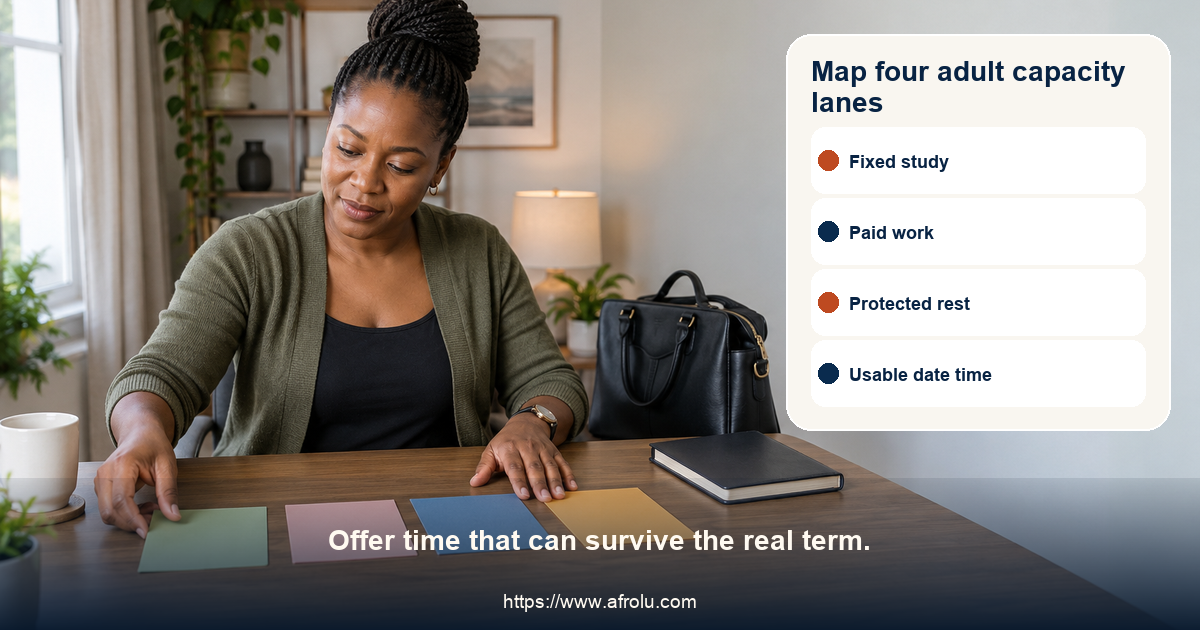
Map study, work, and rest before offering dating time
Do not offer the hours reserved for an exam, placement, shift, application, or sleep simply to demonstrate interest. A new connection can begin slowly without becoming less adult or sincere. State when term pressure will rise and which contact rhythm you can maintain during that period.
A deadline week may support one short call instead of a meeting. That adjustment works only when it is communicated, not when the other adult is expected to wait without context. Offer a specific return point such as “after Friday's submission” rather than a vague promise to be more available later.
Dating capacity should include the emotional work of planning, replying, repairing changes, and making choices. A free hour is not automatically usable if it is the only rest in a long day. Protecting recovery can make future contact more reliable than repeatedly agreeing and cancelling.
Review the map when the timetable, job, or placement changes. Do not let a rhythm created during a break become a silent obligation during term. Ask whether both adults can accept the new offer. If not, revise the structure or end rather than asking one person to absorb every transition.
accounts · records · power
Protect study, employer, and career systems
Do not share institutional passwords, one-time codes, student portals, transcripts, assessment files, placement records, work calendars, client information, or application logins. Send a public portfolio or broad course description only when you freely choose. Sensitive records can reveal identity, routine, finances, housing, and future location.
A lecturer, assessor, research lead, placement supervisor, or manager may control grades, references, pay, access, or progression. That power can make a personal invitation difficult to refuse. Check current institutional or workplace policy and use appropriate qualified channels; a dating guide cannot decide a specific conflict.
Do not ask a classmate or colleague to pass messages after someone declines. Keep study-group contact focused on the shared task. If dating ends, neither adult should alter marks, opportunities, project access, or professional reputation. Document concerning conduct and use relevant safeguarding, HR, academic, or legal routes where appropriate.
Career support should remain voluntary, transparent, and free of romantic conditions. A referral, review of a public CV, or introduction does not purchase romantic access. If help comes with secrecy, pressure, repayment through dates, or control of an application, step back and protect the independent career path.
public meeting · privacy · independent return
Plan first meetings outside protected systems
Choose a staffed venue both adults can afford, reach, and leave independently. Meet there rather than arranging pickup from a residence, library routine, workplace, or training location. Share the plan with a trusted adult if you choose, while keeping continuous live location optional and proportionate.
Keep an independent return reserve separate from tuition, rent, food, data, work travel, and other essential money. If a date only works by using protected funds or borrowing from the new match, select a lower-cost plan or postpone. Affordability is a safety and autonomy issue, not a measure of interest.
A profile, video call, public venue, or mutual contact may reduce some uncertainty but cannot guarantee conduct. Keep the meeting short enough to reassess. Do not leave drinks, belongings, devices, or account access under another person's control, and leave when the plan or behavior changes beyond your comfort.
Adult consent remains current throughout the meeting. Course help, travel, meals, gifts, or professional introductions do not create an obligation to extend the date, move somewhere private, share images, or agree to physical contact. A respectful adult accepts a pause without threatening study or career consequences.

Meet publicly, pay affordably, and keep independent returns.
deadlines · money · intrusion · repair
Read four term-time pressure points
Around deadlines, healthy conduct may include a planned quiet window and a clear return time. Pressure may look like repeated interruptions, surprise visits, accusations about slow replies, or demands that an adult skip important study to prove care. Interest does not require sabotaging a qualification.
Around money, distinguish an affordable shared activity from lending tuition, rent, data, transport, or application funds. Do not send account credentials or accept financial help tied to control. Romance-fraud and job-scam warnings are relevant when authority, urgency, or a promising opportunity is used to obtain money or banking details.
Around digital access, a match may ask for a campus email, portal, shared document, or device password under the language of support. Offer a public resource instead. Around career influence, ask whether the person can affect grades, placement, references, pay, or hiring, then check the applicable policy.
One misunderstanding can be repaired through acknowledgement and changed behavior. A repeated pattern of intrusion, financial pressure, account requests, or professional retaliation requires a firmer response. Restrict access, preserve evidence if safe, report through relevant channels, and seek current specialist support when conduct is threatening.

Notice what happens after a quiet-hour or account boundary.
conversation · money · consent
Use scripts for study time, career privacy, money, and consent
For time: “I am offline while I study and can call after Saturday's submission.” For systems: “I do not share my student or work accounts.” For career: “Please use my public email and do not contact my supervisor.” These alternatives keep support outside protected access.
For money: “I keep tuition, rent, food, data, and transport separate from dating.” For the first meeting: “I will meet you at the public venue and arrange my own return.” For consent: “The help or meal does not change what I want physically.” Each answer removes a false debt.
For power: “Because you assess or supervise my work, I will not pursue a personal connection.” If the person challenges that clear line, use the relevant institutional route rather than negotiating in private. Protect copies of messages according to current policy and personal safety needs.
For ending: “This connection is interfering with my study and career boundaries, so I am closing it.” Block or report when unwanted contact continues. You do not owe a debate about whether the course, job, application, placement, or future goal matters more than the relationship.

Name the protected system and a safe alternative.
reciprocity · goals · next term
Review whether the structure supports two adult futures
Did each adult respect quiet hours, keep accounts separate, plan affordable meetings, and avoid using professional access as leverage? Did both people make room for the other's goals? A relationship can be warm and still require a structure that neither person's term or career can support.
Continue when the present rhythm is mutual and sustainable. Revise when a clear change, such as fewer weekday messages or a different date budget, could protect both futures. Discuss serious or exclusive dating only through direct agreement; academic effort does not automatically earn or delay commitment.
Pause when the next term leaves no honest capacity, without asking the other adult to remain indefinitely available. End when one person's progress repeatedly depends on the other giving up study, work, essential money, privacy, or consent. A relationship is not career support if it requires career damage.
Close shared documents, revoke voluntarily granted access, change compromised passwords, and separate payments after an ending. If academic or workplace power was involved, use qualified institutional channels for records and retaliation concerns. The goal is two independent adult futures, whether the relationship continues or not.
Eight adult-student structure decisions
Student is mistaken for teenager
Advice or a date treats an adult learner as unable to make adult choices.
State the 25+ scope and keep autonomy explicit.A free hour is the only rest
Calendar space is offered without counting recovery or travel.
Protect rest and offer the next genuinely usable window.Slow replies become a loyalty test
Study focus is interpreted as lack of care.
Set quiet hours and a specific return point.Tutoring requires a portal login
Help is linked to access to institutional records.
Use public material and keep credentials private.A supervisor makes a personal invitation
One adult controls assessment, placement, pay, or opportunity.
Decline and check the relevant current policy.Campus pickup reveals a routine
Convenience exposes residence or study location.
Meet at a neutral public venue with separate returns.A date is funded from tuition or rent
Essential money is being traded for relationship participation.
Choose a lower-cost plan or postpone.A referral is treated as romantic debt
Professional help is used to seek dates, access, or intimacy.
Reject the condition and protect the independent career path.Fourteen signs that dating supports two futures
The page and relationship treat student as an adult learner aged 25+.
Study, work, travel, rest, and dating time are mapped separately.
Quiet hours have a clear return point rather than unexplained absence.
Course and career goals are respected without a loyalty test.
Student, work, and application credentials remain private.
A lecturer, assessor, supervisor, or manager does not exploit power.
First dates occur away from protected study and work systems.
Both adults control arrival, return, and device access.
Essential education and living money stays outside dating costs.
Gifts, tutoring, and referrals create no romantic debt.
Consent remains voluntary regardless of help or payment.
A deadline conflict receives acknowledgement and changed conduct.
The relationship supports goals belonging to both adults.
Pause or ending remains available when the term cannot support dating.
A switchboard for time, systems, money, and power
| Situation | What it may mean | What to do next |
|---|---|---|
| Term time is full | A slower or paused structure may be most accurate. | Offer the next usable window or pause clearly. |
| They expect instant replies | Contact is intruding into protected focus. | Set quiet hours and a return time. |
| They request a portal login | Support is crossing into protected system access. | Decline and offer only public material. |
| They contact a supervisor | A stated career boundary is being bypassed. | Restrict access and use relevant reporting routes. |
| They control assessment | Professional power may undermine free romantic choice. | Check policy and avoid pursuing the connection. |
| The date uses essential funds | Affordability is compromising study or living needs. | Choose a cheaper plan or postpone. |
| A referral has conditions | Career help is becoming romantic leverage. | Reject the condition and document it if appropriate. |
| Campus pickup is requested | The plan exposes a routine or residence. | Meet at a neutral public venue. |
| Deadline stress causes one conflict | Repair may be possible with a clearer plan. | Acknowledge the effect and revise the rhythm. |
| Progress requires repeated sacrifice | The structure may not support two adult futures. | Pause, revise, or end from the observed pattern. |
Twelve scripts for adult study and career boundaries
“I am an adult learner, and I make my own relationship choices.”
“I am offline while I study and can call after Saturday's submission.”
“During term I can meet every second weekend.”
“I do not share student, work, or application logins.”
“Please use my public email and do not contact my supervisor.”
“Because you assess my work, I will not pursue a personal connection.”
“I will meet you at the public cafe, not at my campus or residence.”
“I will arrange my own trip there and back.”
“I keep tuition, rent, food, data, and work travel outside dating costs.”
“Professional help does not create a personal or physical obligation.”
“The meal and support do not change what I want physically.”
“This connection is crossing my study and career boundaries, so I am ending it.”
Know the difference
Casual and serious dating share the same safety floor
Commitment may stay limited, while privacy, independent money, public meetings, and consent remain required.
Long-term direction may be clearer, while accounts, professional power, essential funds, and physical choices remain protected.
Relationship ambition changes the agreement, not the adult safety floor.

Commitment direction never removes the adult safety floor.
Casual and serious structures share a safety floor
| Type or dimension | What it describes | Best next question |
|---|---|---|
| Slow dating | A lower frequency can protect study, work, and observation. | Set a term-time rhythm and review date. |
| Casual dating | Commitment stays limited while adult safety boundaries remain. | State nonexclusivity and money limits clearly. |
| Serious dating | The adults explore future fit without sacrificing current goals. | Discuss direction and present capacity separately. |
| Exclusive dating | Both adults agree to stop other romantic dates. | Define the agreement without sharing passwords or schedules. |
| Weekend dating | Meetings fit around classes, shifts, and recovery. | Count travel and deadline preparation in the window. |
| Long-distance dating | Study or placement may separate locations. | Keep travel independent and protect records. |
| Workplace or campus dating | Professional or academic power may affect free refusal. | Check policy and assessment relationships first. |
| Career-focused dating | Both adults deliberately protect progress and opportunity. | Make referrals and networks free of romantic conditions. |
| Dating pause | A term may leave no honest capacity for connection. | Pause without asking another adult to wait indefinitely. |
A simple plan you can use today
Adult learner is the scope
Every example and image concerns adults aged 25 and above.
Capacity includes recovery
A blank calendar hour may still be protected rest.
Support needs no login
Encouragement and public resources do not require system access.
Power changes the invitation
Assessment and career control can make refusal difficult.
Essential money stays protected
Tuition, rent, food, data, and work travel are not date budgets.
Both futures should expand
A workable connection respects study and career goals on both sides.
Questions organised by purpose and depth
Choose a few prompts that fit the moment. This is a reference library, not a list to complete.
Protected week
Count adult obligations and recovery.
- Which hours are fixed?
- What rest is essential?
- Which window is genuinely open?
Systems boundary
List access that dating never needs.
- Which accounts stay private?
- Who should not be contacted?
- What public alternative can I offer?
Money floor
Protect education and living needs first.
- Which costs are essential?
- What date budget remains?
- Can both adults return independently?
Two futures
Review reciprocity during pressure.
- Were quiet hours respected?
- Did help carry conditions?
- Can both goals continue?
What deserves a closer look
Use a broad adult-education frame
UNESCO describes adult learning across formal, non-formal, continuing, vocational, and work-related contexts, supporting a wider picture than youthful campus life.
Evidence limit: It is policy guidance, not dating research; the 25+ scope is Afrolu's editorial boundary.
Fit dating beside existing life
A self-check can ask whether dating fits alongside school, work, family, and personal wellbeing before an adult offers a relationship rhythm.
Evidence limit: A checklist is not a diagnosis or research finding.
Reduce social and account exposure
Official cyber guidance supports privacy settings, digital-footprint review, strong passwords, and two-step verification for online accounts.
Evidence limit: United Kingdom guidance cannot certify a person or relationship.
Protect banking and opportunity channels
Official warnings describe scams that target students with personal job messages and requests involving money or bank information.
Evidence limit: A date asking about career goals is not therefore a scam.
Use public plans and platform controls
Online-dating safety guidance supports limiting personal details, using reporting tools, and meeting publicly with independent options.
Evidence limit: Australian guidance cannot guarantee a venue or outcome.
Look for equality, privacy, and goals
Relationship guidance can support discussion of equal voice, time apart, boundaries, and respect for each adult's goals.
Evidence limit: A checklist does not predict compatibility or safety.
Shortcuts that expose study or career systems
Treating adult students like teenagers
It obscures autonomy, work, money, and mature life context.
Offering the only rest hour
An unsustainable promise creates repeated cancellation.
Sharing a portal for tutoring
Help does not require credentials or private records.
Dating through assessment power
Grades, placement, or pay can compromise free refusal.
Funding dates from essentials
Romantic participation should not threaten study or living needs.
Calling a referral romantic proof
Career access cannot purchase attention or intimacy.
Build an adult dating plan around study and career
This guide is for adults aged 25+ and is editorial information, not institutional, employment, legal, financial, medical, safeguarding, or emergency advice.
Explore the guide library
Show more related guides
Continue with Afrolu
Show more Afrolu guides
Sources used for this guide
Afrolu reviewed these health, research, safety, or public guidance resources while editing this page. They support the behaviour and safety guidance; they do not diagnose any individual described by a reader.
Questions about adult-student dating and career goals
Is this guide for teenage students?
No. It is explicitly for adult learners aged 25 and above in higher, vocational, professional, continuing, or online education.
Which dating type fits a busy term?
Choose the structure that matches real capacity and desired commitment. Slow, weekend, serious, casual, exclusive, or paused dating may fit different terms.
Should I date during exams?
Only if you can make an honest offer without sacrificing essential study, sleep, work, or wellbeing. A clear pause is also valid.
Can a date help with coursework?
They can share public resources or encouragement. Keep accounts, assessments, records, and protected work independent.
Can I date a lecturer or supervisor?
Academic or workplace power may compromise free choice and violate policy. Check current institutional rules and qualified channels.
Where should we meet?
Use a neutral staffed public venue away from residence, study routine, and workplace, with separate arrival and return.
How should I budget for dates?
Use money left after tuition, rent, food, data, transport, and other essentials. Choose a cheaper plan or postpone when needed.
Does a referral create an obligation?
No. Professional help cannot purchase dates, secrecy, account access, physical contact, or a relationship.
How do I protect my online accounts?
Use unique passwords, two-step verification, privacy settings, and no shared codes or logins. Follow current official guidance.
When should I pause or end?
Pause when the term leaves no honest capacity; end when study, career, money, privacy, or consent boundaries are repeatedly crossed.
One thing to do now
Choose the structure that lets both futures continue
Choose a structure that survives the actual term without borrowing essential rest or money. Keep study, work, application, and professional systems closed to romantic access. Check power before contact, meet neutrally, and continue only when both adults' goals, privacy, finances, and consent remain intact under ordinary pressure.