Five lanes for connection without career capture
Choose a Dating Type Without Opening Your Career Systems
A professional dating map separating relationship type, pace and intent from work devices, clients, referrals, money and access.
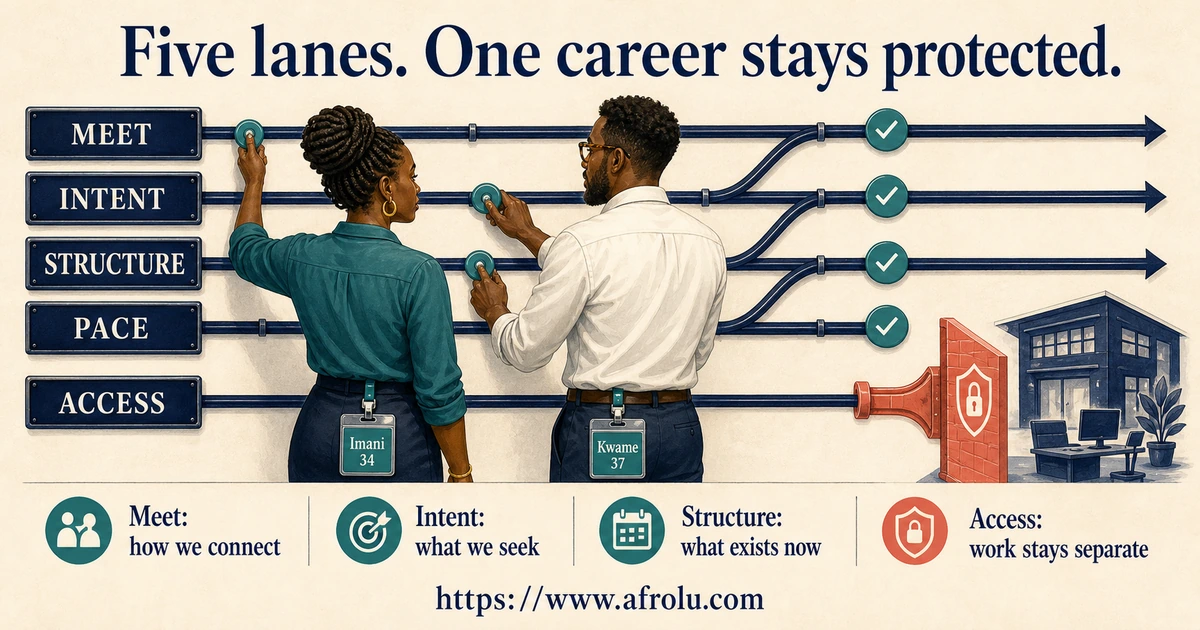
Choose the relationship lane first; grant career access only for a separate, necessary purpose.
Written and edited by Nia Kato · Profile Advice Editor
Treat professional as an audience, not a relationship type. Answer five questions separately: how you met, what direction each adult wants, what structure exists now, what pace both schedules can sustain and what career access—usually very little—is actually necessary. Move mutual interest onto personal channels. Share broad availability rather than a live calendar, and keep clients, colleagues, premises, devices, documents, credentials, referrals and financial opportunities outside romantic proof. Check current policy where workplace power or conflicts exist. Judge observable conduct rather than title, income or polish. Continue when a no stays complete and work remains untouched; resize or leave when access, money, monitoring or retaliation becomes the price of connection.
Dating basics · Professionals
Which relationship are we choosing, and which career permissions remain separate even if interest, exclusivity or seriousness grows?
Professional dating is dating shaped by work responsibilities, schedules, confidentiality, visibility or organizational power. It is an audience context rather than a commitment model. The five-lane career firewall separates meeting route, intention, present structure, pace and career access so a dating label cannot act as a master key to unrelated people, systems or influence.
Imani and Kwame are fictional professionals, 34 and 37, who meet at an industry conference. They move mutual interest onto personal contact, plan public Saturday lunch and keep the attendee directory, clients and work calendars outside the date. Their intentions differ, so they name a non-exclusive exploratory structure. Later, Imani declines a referral request. Kwame accepts the boundary without bargaining, which gives better relationship evidence than either person's title.
The professional five-lane switchboard
Let the relationship move without carrying the office inside it
Nia separates a human connection from the systems and third-party trust that make professional access consequential.
The switchboard routes meeting, intent, structure, pace and access independently, then audits whether a boundary produces respect or escalation.
Meeting route
Name whether the connection began through an app, introduction, work event or ordinary social life.
Intent and structure
Separate hoped-for direction from the exclusivity and commitments that exist today.
Pace and capacity
Build mutual notice, alternatives and review around real calendars without surveillance.
Career access
Keep people, systems, place, data, influence and money behind purpose-specific permission.
Begin with five separate answers
Stop asking one dating label to explain an entire professional life
Professional dating is not a single relationship type. The phrase usually describes an audience: adults whose work carries schedules, responsibilities, confidential information, public visibility, regulated duties, clients, employees, intellectual property or hard-won relationships. Those conditions affect how a date is planned, but they do not decide whether the relationship is casual, serious, exclusive, non-exclusive, online, long-distance or still exploratory. Start by naming the actual choice rather than turning occupation into personality.
Use five answers. Meeting route says how you connected: an app, a friend's introduction, an industry event or ordinary social life. Intention says what each person hopes might grow. Structure says what has been agreed now, including exclusivity. Pace says how quickly time, disclosure and involvement develop. Career access says whether either adult may reach colleagues, premises, devices, calendars, clients, opportunities or authority. Only the last answer governs work access, and early dating usually needs very little of it.
A demanding week is not automatically emotional unavailability. A broad job description is not deception. A lower income, different title, career break or informal occupation is not a danger signal. Compatibility asks whether two schedules, values and ambitions can coexist. Safety asks about observable conduct: impersonation, repeated workplace contact after a no, pressure for confidential material, attempts to use influence, monitoring, financial grooming, threats or retaliation. Do not replace evidence with status stereotypes.
The practical goal is not to make dating sterile. It is to keep affection personal enough to be freely chosen. Two professionals can admire each other's work, celebrate a promotion and discuss the shape of their days while client names, live location, internal documents, passwords and gate access remain closed. A connection that survives a clean professional boundary has given useful evidence. One that treats the boundary as distrust has also answered a question.
The five-lane career firewall
Route every relationship question to the lane it actually belongs in
The meeting lane records origin without assigning destiny. Meeting through work can create a conflict, a policy question or a power imbalance that needs attention, but it does not automatically make the connection committed. Meeting online may require more identity verification, yet it does not make the relationship less real once evidence accumulates. Ask what rules or asymmetries belong to the route, then move voluntary personal contact outside the professional setting where appropriate.
The intention lane holds direction: light companionship, open exploration, a committed partnership, marriage or uncertainty that is honestly named. Intention matters, but it is not a present contract. Two adults who both want marriage are not exclusive merely because their goals match. A person seeking something casual still owes truth about the current structure, relevant sexual-health information and respect for every no. Ambition in love works best when present promises remain exact.
The structure and pace lanes describe today's reality. Structure includes whether either person dates others, what relevant disclosure is expected and what counts as a change. Pace includes contact rhythm, date frequency, disclosure depth and when friends or family enter. A professional may choose fewer planned dates during a launch or audit. Slow can be mutual and visible; vague leaves one person indefinitely available. Busy becomes meaningful only when paired with honest notice, a replacement offer and reciprocal effort.
The access lane is deliberately separate. Broad role and general availability may help plan a date. A match does not need a live calendar, work email, client list, workplace pass, confidential deck, referral, procurement contact, account credential or promise of investment. If a genuine joint decision later requires professional or financial involvement, pause romance as the evidence source. Check policy, conflicts, independent advice and each person's ability to decline without relationship punishment.
Imani and Kwame leave the conference at the conference
A clean channel handoff protects both attraction and professional context
Imani and Kwame are fictional adults, 34 and 37. They meet during a regional industry conference in Nairobi. Their badges show that they work in neighbouring fields, not that either has permission to use the other person's professional network. They enjoy a short conversation between sessions. Before the next session, Kwame asks whether Imani would like to continue talking after the event. She says yes and offers a personal number rather than her work account.
That evening, Kwame suggests Saturday lunch at a staffed public venue. He does not ask for the attendee directory, add Imani to an undisclosed sales list or search for private calendar information. Imani confirms a ninety-minute plan and arranges her own return. She describes her field broadly and says client work is confidential. Kwame answers with his own broad context. The date feels less like networking because neither adult is collecting professional leverage.
They discover different relationship intentions. Imani is open to a serious relationship but wants to date slowly. Kwame is exploring after a move and cannot promise that direction yet. This is not solved by their job titles or chemistry. They agree that the present structure is non-exclusive, that neither will imply a business introduction and that they will revisit fit after several dates. The agreement may still end; its value is that each can see what is actually being offered.
A week later, Kwame asks whether Imani can introduce him to a procurement lead. She says she does not use early dating for referrals. He accepts the answer and never raises it again. That response preserves the personal connection. Had he argued that an introduction was a small proof of trust, contacted the lead anyway or appeared at her workplace, the decision would have moved from ordinary mismatch to access pressure. Boundaries reveal conduct because they create a moment in which respect can be observed.
Route requests by consequence
Distinguish conversation, compatibility and access pressure before reacting
Low-consequence conversation may include a broad field, what a satisfying workday feels like, preferred boundaries around after-hours contact or which days are realistically available. Either adult may decline detail. Compatibility information includes travel load, shift patterns, public visibility, financial priorities or a career goal that affects shared time. A mismatch can be disappointing without being unsafe. Offer one workable rhythm, then believe the answer if neither life can support it.
Access requests cross into a different category. A referral spends professional credibility. A client introduction can create duties and conflicts. A live calendar exposes patterns and location. An office visit can affect colleagues and security. A device may contain organizational and personal data. Treat each as a permission with consequences, not a cute shortcut created by closeness. The default early answer can simply be that work access is outside the relationship.
Escalation is observable. Someone uses a work directory after being given a personal channel, appears at a workplace without invitation, impersonates a colleague, demands documents, threatens a reputation, copies private material or pressures an adult to bypass policy. Preserve the useful facts rather than arguing about motives. Tell workplace security, a manager, human resources, a professional body, a platform, legal support or emergency services according to the situation and local options.
Privacy does not mean hiding a relationship to deceive another partner or evade a relevant conflict. It means sharing for a clear purpose and at an appropriate depth. If two people work in the same reporting line, handle money together, compete for a contract or owe disclosure under policy, obtain accurate current guidance from the responsible organization. This page cannot determine a workplace rule, legal duty or individual risk from a relationship label alone.

Assess the requested permission, not the charm or job title attached to it.
Permission-sized language
Offer the personal connection without donating the professional infrastructure
For channels, say: ‘I would like to continue this personally, so use this number. My work email and team chat stay for work.’ The sentence does not accuse anyone. It creates a clean route and makes later workplace contact easy to recognise. If a personal device also carries work access, follow employer policy, use strong device protections and avoid letting a date handle it. Convenience is not a reason to expose another person's information.
For availability, say: ‘I can offer Saturday afternoon. I do not share my live work calendar.’ That is enough information to make a plan. A compatible adult can accept, offer another complete time or decline. A demand to see the calendar in order to prove busyness turns scheduling into monitoring. Shared calendars may make sense in established partnerships when freely chosen, but relationship duration still does not make surveillance healthy.
For influence, say: ‘I do not make referrals or client introductions through a new dating connection. If a legitimate opportunity exists, use the normal public process.’ This protects colleagues as well as the dater. It also lets skill and fit be evaluated outside romantic pressure. Gifts, affection, exclusivity and future promises must not become unofficial payment for access. If one person controls the other's employment or evaluation, the power issue deserves especially careful independent review.
For an exit, say: ‘I asked you not to contact my workplace. You did it again, so I am ending personal contact.’ Do not meet privately to debate a repeated intrusion. Save messages, dates and relevant witness information without conducting your own surveillance. Change exposed credentials, alert appropriate workplace contacts and use local support proportionate to the risk. A direct ending is not owed in person when safety or retaliation is a concern.

Name the available personal choice and the closed professional permission in the same sentence.
Safety without status worship
Judge conduct without treating profession, income or polish as character proof
A professional biography can be independently checked when there is a legitimate reason, yet verified employment proves only that fact. It does not establish relationship status, financial honesty, sexual-health information or respect for limits. Scammers may borrow credible titles, and real professionals can still behave poorly. Keep early meetings public, control transport, limit sensitive disclosure and notice whether ordinary details stay consistent over time.
Money needs its own firewall. Do not transfer travel funds, rescue a project, join an investment, share banking access, receive unexplained funds or purchase cryptocurrency because romance creates urgency. A lucrative title does not remove the risk, and a lower income does not make an adult entitled to support. If a later joint financial decision is genuinely being considered, slow the choice, verify through independently found channels and obtain qualified advice where appropriate.
Consent also stays outside the professional hierarchy. Paying for dinner, arranging transport, mentoring someone, sharing a field or holding senior status never supplies sexual or relational consent. Ask for the specific activity in the present moment and accept a changed answer. Where workplace power exists, organizational rules and the freedom of the less powerful person require more than a private assurance that everything is fine.
Use compassion with stress. Long or inflexible hours and conflicting work-life demands can affect wellbeing, but this page cannot diagnose burnout, anxiety or any condition. A partner may offer care without becoming a clinician or manager. Agree on communication that protects sleep and essential duties. If distress is persistent or disrupts daily life, seek qualified health support; if conduct becomes coercive or threatening, use safety support rather than trying to communicate it away.
The five-minute Friday audit
Choose next week's relationship size from four pieces of evidence
First, check agreement: can both adults describe the meeting route, present intention, structure and pace in similar words? A difference can be discussed. Quietly assuming exclusivity, seriousness or unlimited availability creates avoidable harm. Ask one direct question when the answer affects a choice. Do not use online activity, colleagues or calendar clues to assemble an agreement that was never spoken.
Second, check voluntary attention: could either person decline a date, call, disclosure or introduction without punishment? Professional adults often manage scarce time, but scarcity must not become leverage. Notice whether alternatives are complete, cancellations include repair and both lives receive respect. If only one person continually rearranges work, rest and cost, name the imbalance before resentment hardens.
Third, check separation and repair: are work channels, people, documents, premises and devices still touched only for their intended purpose? When a boundary was misunderstood, did the other person acknowledge it, stop and repair the practical effect? One awkward question followed by respect differs from a repeated attempt. A polished apology without changed access behaviour is not repair.
Finally, choose the smallest accurate next action. Continue at the same size when connection and autonomy coexist. Resize by reducing contact or removing a permission when demands have outrun trust. Close when deception, coercion, repeated intrusion, financial grooming, threats or retaliation appears. No dating type needs to graduate into workplace integration. The successful result is a truthful relationship decision and a career that remains yours to conduct.

Continue from clear personal evidence; resize or exit when career access becomes the price.
Eight professional moments where the hidden question is access

A verified title is still only one fact
Mara confirms that Joel works where he says, then feels pressure to treat his polished profile as proof of serious intent.
Verify what a present decision needs, ask about intention directly and keep meetings, transport and sensitive information independently controlled.Move mutual interest onto a personal channel
Two attendees want to meet after a conference, but the delegate directory and work email are the easiest routes.
Exchange personal contact by mutual choice, leave attendee data untouched and make a complete public plan outside event duties.Replace calendar surveillance with one workable offer
Ruth has a deadline and can offer only Sunday lunch; her match asks for a screenshot of the whole week.
Share the available window, decline live-calendar access and assess whether the other adult can offer or accept a plan without monitoring.Do not spend professional trust as romantic proof
After two dates, Sami asks Leila to introduce him to a hiring manager and says support would prove she believes in him.
Keep the referral closed, direct him to the normal process and notice whether the no remains complete.Check power and policy before private optimism
Two colleagues are interested, and one has influence over the other's assignments even without being the formal supervisor.
Pause, inspect current organizational rules, name the practical power and seek independent guidance before pursuing the connection.Treat affordability as planning, not character
One adult earns more and assumes the other person's lower-cost date preference proves weak ambition.
Choose a cost both can sustain without disclosure or debt, then assess reciprocity, care and fit rather than status.Separate romance from the opportunity
A date offers access to a high-return private investment and wants a transfer before an alleged deadline.
Send nothing, refuse account or credential sharing and verify any legitimate opportunity independently with qualified help.Repeated office contact changes the category
After Njeri asks a former date to stop, he calls reception and appears near her workplace to force a conversation.
Preserve relevant evidence, alert workplace safety contacts and use platform, legal or emergency support appropriate to the risk.Evidence that connection and career separation can coexist
Both adults can name the present dating type without using profession as a substitute for intention.
Date plans contain a time, public place, cost expectation and independent way home before either person moves.
Broad role descriptions are accepted without demands for client, colleague, project or earnings detail.
Personal messages stay on a mutually chosen personal channel rather than leaking into employer systems.
A busy period includes honest notice and a realistic alternative instead of permanent last-minute access.
A referral, introduction or professional favour can be declined without affection, attention or exclusivity being withdrawn.
Neither adult uses title, income, education or public reputation as a shortcut to character or safety.
Conflicts of interest and workplace power are named early enough to seek accurate policy guidance.
Financial opportunities are evaluated outside romance, urgency and private transfer instructions.
Consent is requested for each intimate choice and never inferred from seniority, payment or mentoring.
A mistaken boundary is followed by acknowledgment, practical repair and changed behaviour.
Repeated workplace contact, impersonation, monitoring, threats or retaliation triggers documentation and appropriate support rather than another private debate.
Route the moment before granting the permission
| Situation | What it may mean | What to do next |
|---|---|---|
| A match asks what field you work in | Ordinary curiosity that needs only broad context | Share at the depth you choose; withhold employer, client and live-location detail. |
| Two intentions differ | A relationship-direction mismatch | State what is available now and decline if the directions do not fit. |
| Daily contact is mistaken for exclusivity | Frequency has been used as an unspoken structure | Ask directly and create an agreement only if both choose it. |
| A deadline removes weekday availability | A temporary capacity constraint | Offer one sustainable alternative and observe reciprocity. |
| A date requests your full calendar | Scheduling has crossed toward monitoring | Give only the available window and keep calendar access closed. |
| A match asks for a referral | A request to spend professional credibility | Use the ordinary public process; do not make romance the selection rule. |
| A colleague has influence over your work | A material power or conflict question | Pause and check current policy and independent advice before acting. |
| A first date offers an investment | A financial decision is being wrapped in connection | Transfer nothing and evaluate separately through independently found channels. |
| Someone uses work chat after being redirected | A channel boundary was ignored | Restate once if safe, preserve the record and restrict access. |
| A partner wants your device passcode | Personal reassurance would expose unrelated systems | Keep credentials private and follow employer security requirements. |
| A no is accepted and behaviour changes | A repair that can be observed | Let later trust grow from the pattern, not from immediate extra access. |
| Office visits continue after contact ends | Intrusion with possible workplace and personal safety effects | Do not arrange a private meeting; use workplace and local support proportionate to risk. |
Scripts for channels, calendars, clients, referrals, money and exits
“I am dating toward a committed relationship, and I am not exclusive until we both make that agreement.”
“I would like to keep talking personally. Use this number; my work email stays for work.”
“I can meet Saturday afternoon. I do not share my live calendar.”
“I can describe my field broadly, but client names and project details are confidential.”
“I do not make professional introductions through a new dating connection. Please use the normal process.”
“Your role affects my work, so I need to check policy and get independent guidance before we pursue this.”
“During this deadline week I cannot text through the day. I can call Wednesday evening or plan Sunday.”
“My passcodes and work device are private. We can make the plan without either one.”
“I do not invest, transfer or lend through a romantic connection. Any opportunity gets independent review.”
“My job, seniority and paying for this date do not answer physical contact. Please ask me directly.”
“I asked you not to use my workplace contact. Keep any necessary message on this personal channel.”
“You contacted my workplace again after my no, so I am ending contact and taking steps to protect access.”
Know the difference
Professional dating describes an audience; a dating type describes the actual arrangement
Dating shaped by work responsibilities, schedules, confidentiality, visibility, policy or professional power. It does not state current commitment.
Serious names a hoped-for direction; exclusive names a present mutual structure. Either can exist across many occupations and meeting routes.
Add an explicit career-access answer to either relationship: work people, systems, premises, data, influence and money do not open through implication.

Use one answer per decision and keep professional permissions outside the relationship label.
Compare audience, meeting route, relationship type and career access
| Type or dimension | What it describes | Best next question |
|---|---|---|
| Professional dating | An audience and context shaped by work, not a commitment structure | Which work boundary affects the plan? |
| Online dating | A meeting route through a digital service | What identity and meeting evidence do we need? |
| Colleague-adjacent dating | A meeting route with possible policy, conflict or power questions | Does either role affect the other's work? |
| Casual dating | A lighter present relationship scope | What is available, and are we exclusive? |
| Serious dating | A stated direction toward lasting partnership | What does serious mean in current conduct? |
| Exclusive dating | A present agreement not to date others as defined together | What exactly changed, and when? |
| Slow dating | A deliberate pace with rhythm, effort and a review point | Is the slower pace mutual and visible? |
| Long-distance dating | A relationship maintained across material geographic separation | How will contact, visits and costs work? |
| Career access | Permission involving work people, data, systems, place or influence | Is access necessary, policy-compliant and freely chosen? |
| Financial partnership | A consequential money or ownership arrangement | Can it withstand independent verification and advice? |
Build a five-lane career firewall in six moves
Write five answers
Record meeting route, intention, current structure, pace and career access. Do not let one impressive label answer all five.
Choose a personal lane
Move mutual interest from employer systems to a freely chosen personal channel while leaving directories, lists and work records untouched.
Make the date complete
Confirm time, staffed public place, cost expectation, duration and independent return before either adult moves.
Close high-consequence permissions
Keep clients, referrals, devices, calendars, premises, confidential work and accounts outside early romantic proof.
Observe one boundary
State a real limit once. Distinguish awkwardness followed by repair from bargaining, repetition or retaliation.
Run Friday's audit
Check agreement, voluntary choice, work separation and repair, then continue, resize or close from the observed pattern.
Questions organised by relationship, access, influence and review
Choose a few prompts that fit the moment. This is a reference library, not a list to complete.
Relationship lane
Name the relationship before discussing professional access.
- How did we meet?
- What direction does each person want?
- Are we exclusive now?
- What pace fits both lives?
- When will we revisit the answer?
Career boundary
List the people, places and systems that remain outside dating.
- Which channel is personal?
- What schedule detail is actually needed?
- Which work information is confidential?
- Could either role affect the other?
- Which request requires a policy check?
Money and influence
Keep financial and professional decisions independently testable.
- Is a referral being requested?
- Who else would an introduction affect?
- Is urgency replacing verification?
- Can this decision survive a romantic no?
- Which qualified advice is appropriate?
Friday audit
Use observable behaviour to choose the next relationship size.
- Can both people name the agreement?
- Can either decline without punishment?
- Did work remain separate?
- Was a correction respected?
- Do I continue, resize or close?
What law, public guidance and technical evidence can support
Purpose and minimisation are useful principles for personal sharing too
Kenya's Data Protection Act requires covered data processing to be lawful, purpose-specific and limited to what is necessary. Afrolu uses those principles as a practical reminder not to expose client, family or private information merely because a date asks.
Evidence limit: The Act governs covered processing and this page cannot determine whether a personal interaction creates a legal duty; obtain qualified advice for a specific case.
Mixed personal and work devices create real security and privacy questions
NIST's BYOD practice guide describes security and privacy risks when personal devices access organizational resources. The narrow dating lesson is to keep passcodes and managed work access private and follow the responsible organization's rules.
Evidence limit: NIST guidance is U.S. technical guidance for organizations, not a personal legal rule or endorsement of one device setup.
Harassment can occur through remote and online workplace contact
The U.S. Equal Employment Opportunity Commission explains that unlawful workplace harassment can occur in a physical or virtual work environment and advises employees to use an employer's reporting route or contact an appropriate supervisor when conduct continues. Repeated romantic intrusion into work should not be dismissed merely because it began personally.
Evidence limit: The EEOC describes U.S. federal employment protections; legal coverage, deadlines, workplace procedures and remedies vary by country and situation, so use current local and organizational guidance.
A professional profile does not replace a safer first-meeting plan
Police Scotland advises online daters to protect personal information and take care with in-person meetings, including public daytime settings. Afrolu applies the practical principle while keeping transport and local support decisions context-specific.
Evidence limit: This is UK police guidance, not a guarantee of safety or a substitute for relevant Kenyan or other local support.
Long-distance stories and professional polish can both carry money pressure
The U.S. FTC describes romance-scam patterns in which an online interest builds trust, lives or works far away and later asks for money. The durable action is to avoid transfers or gifts to an unverified online interest and contact the payment provider promptly after suspected fraud.
Evidence limit: The reporting routes and consumer remedies are U.S.-specific; use the appropriate financial provider and authorities where the transaction occurred.
Past agreement, relationship and status do not provide present consent
NHS guidance describes active consent and explains that past agreement, silence, intoxication or being in a relationship does not supply it, and consent can be withdrawn. Professional hierarchy or paying for a date cannot answer another adult's choice.
Evidence limit: The source explains UK public-health and legal context; laws and support pathways vary, and an individual incident needs qualified local help.
Six shortcuts that confuse romance with professional permission
Using profession as the dating type
An audience label hides the unanswered questions about intention, structure, pace and access.
Treating credentials as character proof
A verified role confirms employment, not consent, honesty, relationship status or safe conduct.
Making availability fully visible
A complete date needs one window, not a live map of work, movement and obligations.
Trading referrals for reassurance
Professional influence affects third parties and should never become the price of affection.
Letting convenience join systems
Shared devices, passwords and work channels can expose unrelated people and create lasting risk.
Debating repeated intrusion privately
Once workplace contact continues after a no, documentation and appropriate support matter more than another explanation.
Use a reviewed resource that matches the decision
This guide focuses on the relationship decision, so it does not rank dating apps. Check current prices, safety tools, and local availability before choosing a service.
Explore the guide library
Show more related guides
Continue with Afrolu
Show more Afrolu guides
Primary and public guidance reviewed for this career firewall
Afrolu reviewed these health, research, safety, or public guidance resources while editing this page. They support the behaviour and safety guidance; they do not diagnose any individual described by a reader.
Professional dating types and career safety questions
What type of dating works best for busy professionals?
There is no universal type. Choose intention and structure first, then design a pace that both adults can sustain. A lighter or slower rhythm can work when plans, alternatives and review are mutual. Busy does not excuse vagueness, and frequent contact does not create exclusivity. Keep career access as a separate permission regardless of the type chosen.
Is professional dating the same as serious dating?
No. Professional describes an audience or work-shaped context. Serious describes a direction toward lasting partnership. A professional may date casually, seriously, exclusively, non-exclusively, online or across distance. State the present intention and structure rather than assuming that education, career or age makes someone commitment-minded.
Should I tell a date where I work?
You can share a broad field or employer only if you want to and it fits the present purpose. Early plans rarely need a precise office, schedule, client list or access route. Public information can still be sensitive when combined. If your role has visibility or safety implications, use a depth that protects you and others while remaining truthful.
Is it safe to date someone I met at work?
The meeting route alone cannot answer. Check reporting lines, informal influence, conflicts, current organizational rules and each person's freedom to decline. Move personal interest off work systems where appropriate. If one adult controls hiring, pay, evaluation or opportunities, pause and seek independent guidance rather than relying on private agreement.
When should a partner meet my colleagues or clients?
There is no relationship-duration rule. Ask what legitimate purpose the introduction serves, whose privacy or interests are affected and whether policy permits it. Socially meeting a friend who is also a colleague differs from requesting a referral or client access. Never make a third party's professional relationship the proof of romance.
Does exclusivity mean we should share calendars or passwords?
No. Exclusivity is a relationship structure defined by mutual agreement. Calendar visibility and credentials are separate access decisions. Share only what helps a chosen purpose, preserve each adult's privacy and follow workplace security rules. A partner who needs constant visibility to tolerate exclusivity is asking for monitoring, not simply defining the structure.
How do two demanding careers make enough time to date?
Compare actual rhythms rather than ideal weeks. Each adult can name protected work, sleep and recovery time, then offer complete date windows. Use notice, replacement plans and periodic review. If only one person continually moves obligations, the problem is reciprocity. If neither schedule supports the desired relationship, that may be incompatibility rather than failure.
What if a match asks for a job referral?
You may decline without defending your feelings. Referrals spend professional credibility and can affect other people. Direct the person to a normal public process if one exists. If the request returns as a test of love, or the person contacts colleagues without permission, treat that conduct as access pressure and protect the relevant systems.
Can I invest in a project with someone I am dating?
This page cannot assess an investment. Do not act through romantic urgency, secret instructions or promised returns. Separate the decision, verify identity and claims through contact details you locate independently, protect accounts and obtain qualified financial or legal advice where appropriate. A relationship promise is not due diligence.
What should I do if a former date contacts my workplace?
If contact continues after a clear no, preserve relevant messages, dates and witness information. Tell appropriate workplace security, management or human-resources contacts, restrict exposed channels and use platform, legal, advocacy or emergency support according to the conduct and local risk. You do not owe a private in-person meeting to stop intrusion.
One thing to do now
Choose the relationship; keep every work permission deliberate
Write five answers: meeting route, intention, structure, pace and career access. Use a personal channel, make every date complete and keep high-consequence work and money permissions closed. Check policy and power independently when relevant. On Friday, ask whether the agreement is clear, attention is voluntary, career separation holds and corrections produce changed behaviour; then continue, resize or close from that pattern.