Parenting context · Nairobi · privacy-first
Types of Dating for Parents Returning to Dating in Nairobi: Safety-first
Date in Nairobi while protecting family privacy. Compare serious, casual and slow dating, plan public meetings, and decide what to share about children.
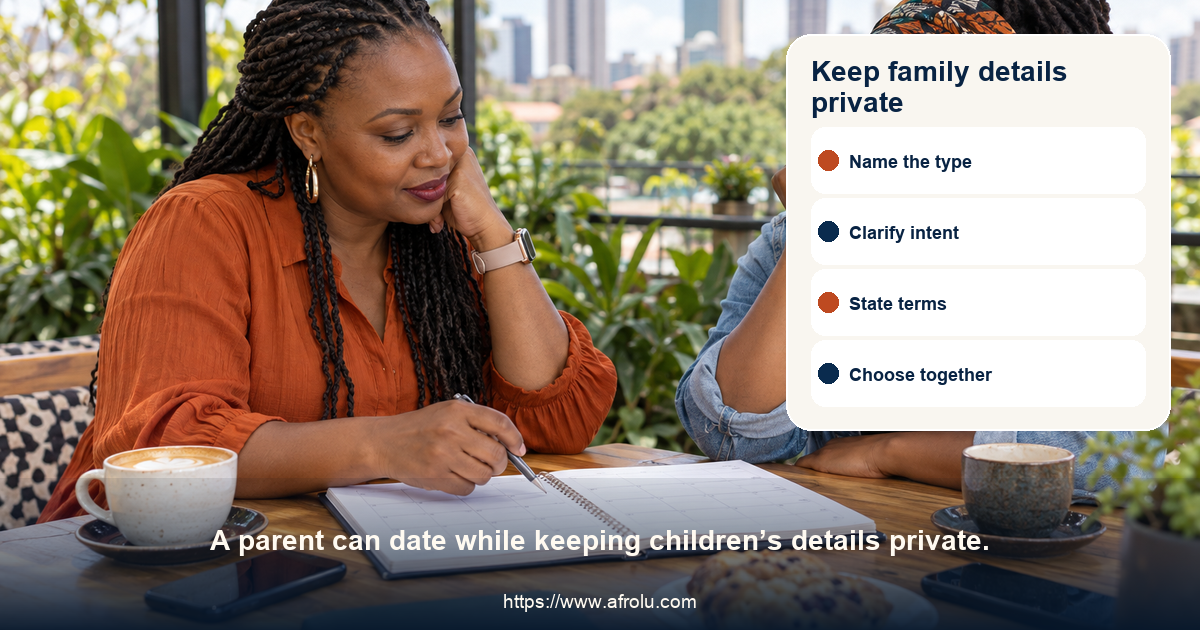
Choose adult time without sharing family identifiers.
Written and edited by Jean-Claude Mukendi · Relationship Guides Editor
State that parenting affects your time, but keep a child’s names, photos, school, home, and schedule private while a connection is new. Choose a public first meeting, arrange your own transport, and make changes without sharing private family proof. Treat meeting a child as a separate decision from serious intent, and seek qualified local advice for legal or family-specific concerns.
Dating basics · Parents Returning To Dating
How can I return to dating in Nairobi while sharing honestly about parenting and keeping my child’s identity, routines, and access deliberate?
Parent-aware dating is a relationship structure that accounts for caregiving time and family privacy while keeping adult commitment and child introductions as separate decisions.
Miriam is returning to dating and has one Saturday afternoon free twice a month. A new match wants to collect her at home and see a family photo. She explains her real availability, suggests a public cafe, and keeps names and school details private. His response helps her judge whether he can respect the family boundaries her life requires.
Family privacy · public meeting · adult choice
Make space for dating without widening access too fast
Parenting shapes availability; it does not decide which dating structure you must choose.
Protect family identifiers, plan a public outing, and review adult conduct before introductions.
What window is real?
Include childcare, travel, and return time.
Which details stay private?
Keep names, images, and routines off early dates.
Can you leave independently?
Choose a public venue and your own route.
What changes later?
Treat introductions as a distinct family choice.
identity · capacity · choice
Make room for dating without pretending parenting is a footnote
Returning to dating can bring new questions about time, privacy, and who else might eventually be affected. You do not need to present yourself as free every evening to be appealing. Share that you are a parent when the information matters to an honest decision, then decide how much detail belongs in an early conversation.
The five-part map still applies: how you met, what each person wants, what is agreed today, how quickly to move, and which life context shapes the connection. Parenting belongs in the last dimension, but it does not decide whether you date seriously, casually, slowly, online, or exclusively. Those answers remain personal and may change.
Miriam can meet every second Saturday afternoon because childcare and transport need planning. She tells a new match that her availability is limited and that child details stay private early on. He can decide whether the cadence suits him. She does not share a school, home address, custody message, or photo to prove that the responsibility is real.
Honest disclosure and privacy can coexist. Give a prospective partner enough context to understand scheduling and long-term compatibility, while keeping a child’s name, image, school, routines, and location out of new dating conversations. If family arrangements involve legal or safety concerns, seek qualified local advice instead of relying on a general editorial guide.
photos · routines · location
Keep children’s images, schedules, and location out of early dating
A photo can reveal more than a face. A uniform, street sign, school logo, sports venue, birthday caption, or recurring pickup time may identify a child or routine. Check what appears in a video-call background too. The easiest early boundary is to keep children off a new match’s screen until a considered decision says otherwise.
Do not forward school messages, custody exchanges, medical details, travel plans, or family-calendar screenshots as evidence that a date must move. A simple statement is enough: “My care plan changed, so I cannot meet tonight.” A partner may need to know that parenting affects capacity; they do not automatically need access to the private information behind it.
If a child is old enough to understand a proposed photo or introduction, take their comfort seriously and give them a way to ask questions. The adult’s dating choice should not force a child to perform happiness, keep secrets, or treat a new person as family. Introductions involve another person’s privacy, not only a parent’s enthusiasm.
UNICEF and eSafety guidance describes digital footprints, personal details, and location clues in children’s images. Those sources support a cautious sharing practice; they do not prescribe a dating timeline. No privacy setting can guarantee control after content is copied, so choose what to share based on the child’s interests and the actual audience.
venue · route · check-in
Plan a Nairobi first date around a public place and your own route
Pick a public cafe, daytime event, or familiar central place that fits the time you have. Think through traffic, parking, public transport, and the journey home before confirming. If your childcare arrangement has a firm return time, share that limit rather than disclosing who is caring for the child or where the household is.
Keep early meetings separate from school pickup, sports practice, home visits, and family errands. Do not invite someone you barely know to collect you from your address just because it saves minutes. Arrange your own ride, keep your phone charged, and tell a trusted person the broad plan if that increases your comfort.
A first date can be short and still useful. Let the other adult know when you need to leave, then leave at that time. You are not required to extend the evening because they paid, travelled, or expected more. A clear end point keeps the plan honest and helps you return to the life you already manage.
Nairobi is not one uniform travel environment; choose based on your own route, time of day, and comfort rather than a city-wide promise that a place is safe. Check current local conditions and transport options. This guide offers planning prompts, not live security information or a guarantee about a venue.

Share your broad plan without exposing a child’s routine.
adult relationship · child welfare · timing
Treat meeting a child as a separate decision from dating seriously
Serious intent can describe what an adult hopes to build; it does not guarantee that a particular match will remain. A child does not need to meet every person a parent dates. Before an introduction, consider whether the relationship is stable enough, what the purpose of the meeting is, and how the child can decline closeness without being punished.
There is no single number of dates that works for every family. Age, temperament, prior family changes, safety concerns, and existing caregiving arrangements differ. Avoid online rules that treat a fixed wait as a legal or clinical standard. If a custody order, protective measure, or family dispute affects introductions, get advice from a qualified Kenyan professional who understands the facts.
When you eventually choose an introduction, keep the first encounter brief, low-stakes, and consistent with what the child has been told. Do not ask the new partner to discipline, supervise, provide money, or act as a parent during an early meeting. That role needs more thought than one pleasant afternoon can supply.
A partner who wants to meet children immediately may be expressing a sincere preference, but you can still say no. If they turn that boundary into a test of love, threaten to leave, seek school information, or contact the child independently, stop access and get appropriate support. Family integration should never be negotiated under pressure.
privacy · pressure · money
Notice whether a match respects the limits that keep family life private
A considerate date can hear that childcare changed the plan without asking for the caregiver’s name, address, or private messages. They can accept a public venue, understand why the meeting ends on time, and avoid pressing for a child’s image. These are useful observations about respect, not proof that a person is safe in every situation.
Be alert when someone demands secrecy, sends money with strings attached, asks to meet the child before you are ready, or treats your available time as a debt. Romance-related money requests can also be wrapped in travel or emergency stories. You can refuse a transfer and keep household finances separate without investigating the other person.
Do not share passwords, one-time codes, school portals, location access, custody documents, or bank details with a new match. If a person requests such access, slow down. If they keep pushing, save relevant communication if safe, block or report through the service, and seek local help suited to the behavior.
A boundary does not require a courtroom-level explanation. Say what you are comfortable with and what you will do if it is ignored. If contact becomes threatening, stalking, or a risk to a child, prioritize immediate safety and consult local authorities or specialists. This guide cannot assess risk from a profile or replace a safety plan.

Notice whether privacy and time limits are accepted.
availability · disclosure · fairness
Explain parenting logistics without making yourself permanently on call
Choose how much of the family rhythm a new partner needs to understand: perhaps that some weekends are reserved, that plans can change, or that phone calls happen after bedtime. Keep details broad until sharing more feels appropriate. A person can decide whether this structure works without seeing a calendar that identifies a child.
Agree on how you will handle a change. If childcare falls through, let the person know when practical and offer another time only if you can keep it. A match may feel disappointed and still respond respectfully. You do not need to send private proof, reimburse a date in emotional attention, or accept guilt because a family need came first.
Parenting duties and dating interests can compete for a small amount of free time. Avoid letting the new relationship claim every open window or turn you into a constant message responder. Ask what contact rhythm is enough for both people and whether the arrangement remains enjoyable when plans are ordinary rather than exceptional.
The Kenya Children Act sets legal responsibilities and child-focused standards that are distinct from dating advice. Use that law as primary context, not as a shortcut for deciding when a particular child should meet someone. For court orders, guardianship, or parental-responsibility questions, consult an appropriately qualified local professional.
continue · adjust · pause
Review adult compatibility before changing family access
After several dates, ask whether the adult arrangement works on its own terms. Do both people follow through? Can they plan around your availability without treating it as a slight? Do they respect that a child’s schedule, images, and introductions are not theirs to control? Do you enjoy the time together without borrowing excessively from family rest?
Continue when the cadence is manageable, boundaries remain intact, and each adult wants the same current arrangement. Adjust frequency or meeting length if one clear change could help. Pause when parenting responsibilities are unusually heavy. End when pressure around a child, home, money, or private details becomes part of the connection.
A child’s reaction is information to hear without asking them to choose a parent’s relationship. Give age-appropriate explanations, accept mixed feelings, and do not promise a new partner will stay. If the child shows distress or a safety concern, pause introductions and consult a qualified child or family professional rather than asking the dating partner to explain it away.
A direct ending might be: “I have decided not to continue dating. Please do not contact my child or come to my home.” Use a message that fits the situation and your safety. If contact persists or crosses family boundaries, document what happens and seek assistance in your area.

Review adult conduct before changing child access.
Eight dating situations for parents

Childcare covers one Saturday afternoon
A short window can still support a thoughtful first meeting.
Offer the real start and end times.A match asks for the child’s full name
Identity details are not required to discuss compatibility.
Keep names and school information private.A new partner wants a family picture
A child’s image is not a relationship milestone.
Decline until a separate, considered decision.A care plan changes before a date
The other adult may need notice, not private proof.
Reschedule with only necessary detail.The match suggests collecting you at home
Convenience may reveal a family address too early.
Meet publicly and travel independently.A serious label is used to request child access
Commitment direction does not automatically grant family access.
Make introductions a separate decision.A date offers to pay a household bill
Financial help may create pressure or dependency.
Keep household finances separate.A person contacts the child directly
A stated adult boundary is being bypassed.
Stop access and seek appropriate support.Fourteen signs that privacy and respect align
The parent can describe availability without sharing a child’s schedule.
A match understands that parenting time may change a date.
Child names, photos, uniforms, and school locations stay private early on.
Both adults can meet in a public place and leave independently.
The parent can decline an early introduction without being punished.
No one asks for custody messages or school portals as proof.
Date costs remain separate from household or caregiving expenses.
A partner does not request access to the child’s location.
The child is not asked to keep secrets or perform closeness.
Family roles are not assumed from a serious relationship label.
A change in childcare receives a practical, respectful response.
The parent keeps a trusted check-in and exit option if desired.
An introduction is planned for the child’s needs, not adult reassurance.
A clear adult review occurs before wider family access is considered.
A map for time, family details, and access
| Situation | What it may mean | What to do next |
|---|---|---|
| A plan changes | Childcare or family needs may have shifted. | Give notice without exposing private messages. |
| A match asks about children | They may be checking compatibility or seeking details. | Share broad context and set a privacy line. |
| A photo is requested | The person may not understand the child’s privacy interest. | Do not share before making a separate decision. |
| The home address is requested | A new date may be seeking household access. | Choose a public venue and independent ride. |
| An early introduction is pushed | The adults may have different expectations about pace. | Decline and discuss timing without pressure. |
| Money is offered | Support can become entangled with access or obligation. | Keep essential household costs independent. |
| A child is contacted directly | The adult boundary may have been bypassed. | Stop contact and seek local guidance. |
| A date ends on time | The meeting respected the family window. | Notice the response to a clear limit. |
| A child shows discomfort | A family change may need more time or support. | Pause introductions and listen without blaming. |
| A new partner asks for authority | The relationship may be moving faster than agreed. | Clarify roles and obtain qualified advice if needed. |
Twelve scripts for parenting context and boundaries
“I can meet Saturday afternoon and need to leave by five.”
“I am a parent, and I keep child details private while dating.”
“I do not share my child’s photographs with a new match.”
“My care plan changed, so I need to reschedule.”
“Let us meet there separately and arrange our own rides.”
“I will decide about introductions when the relationship is ready.”
“Some evenings are reserved for family, and I will reply later.”
“I keep household costs separate from dating expenses.”
“Please do not take on a parenting role with my child.”
“I am pausing introductions because my child needs more time.”
“Do not contact my child directly.”
“I am ending the dating connection; do not come to my home.”
Know the difference
Adult dating access versus family access
Two adults choose dates, contact, and commitment while children’s identity and routine remain protected.
A child may become involved in meetings, photos, routines, care, or private information.
Decide adult commitment first; consider each family-access step separately.

Keep family access deliberate as a relationship develops.
Adult dating access versus family access
| Type or dimension | What it describes | Best next question |
|---|---|---|
| Casual dating | The present commitment may be limited. | Explain what contact and family privacy mean. |
| Serious dating | Adults may be exploring long-term fit. | Do not assume an introduction is automatic. |
| Weekend-first | Meetings use limited parent-free time. | Include travel and return in the window. |
| Slow dating | The adults take time before changing the arrangement. | Agree how family details stay private meanwhile. |
| Exclusive dating | Both choose to stop dating others. | Make the status discussion separate from family access. |
| Online dating | Profiles or messages begin the connection. | Keep location and child images out of the profile. |
| Public-first dating | Early meetings happen in shared places. | Plan independent transport and a trusted check-in. |
| Family-integrated dating | A child or household may join later meetings. | Consider the child’s needs and professional guidance. |
| Dating pause | Current caregiving needs may leave little capacity. | Say whether contact is paused or ended. |
A simple plan you can use today
A parent is still a dater
Family context changes logistics without cancelling adult choice.
Privacy includes the background
A photo, uniform, route, or calendar can reveal details.
An introduction is separate
No dating label creates automatic child or home access.
Schedules can change
Give notice without presenting private family proof.
Money stays independent
Household costs should not create dating debt.
There is no universal timeline
Consider the individual child and seek qualified guidance when needed.
Questions organised by purpose and depth
Choose a few prompts that fit the moment. This is a reference library, not a list to complete.
Family privacy
Choose what a new date needs to know and what remains private.
- Which facts affect compatibility?
- What identifies my child?
- What will I keep offline?
First outing
Plan a public meeting that fits the care window.
- How will I get there?
- When do I need to leave?
- Who knows my broad plan?
Introduction
Keep family access as a later adult decision.
- Is this connection stable?
- What might my child need?
- Do I need local advice?
Review
Observe how the match responds to a parenting boundary.
- Was my time respected?
- Were details requested?
- Did I feel pressured?
What deserves a closer look
Check what a photo reveals
UNICEF and eSafety resources discuss names, schools, locations, routines, and digital footprints in children’s content.
Evidence limit: The sources offer general privacy guidance, not a dating timetable.
Know the source boundary
Kenya’s Children Act is a primary legal source for child-related responsibilities and standards.
Evidence limit: This guide does not interpret an individual custody order.
Consider the child’s experience
A child may have their own feelings about a parent dating or adding a new adult to family life.
Evidence limit: No universal number of dates guarantees readiness.
Review privacy settings
Family devices and platforms can expose photos, location, or account information if configured broadly.
Evidence limit: Settings cannot guarantee a photo will not be copied.
Keep adult and child choices distinct
A parent’s interest in a relationship does not make a child responsible for closeness or secrecy.
Evidence limit: Consult a qualified child or family professional for individual concerns.
Make a practical exit
Public plans, independent transport, and a trusted contact can support adult choice at an early meeting.
Evidence limit: These steps cannot guarantee safety or replace emergency support.
Shortcuts that expose children or household access
Hiding that parenting affects time
A match cannot assess a structure described inaccurately.
Sharing a school uniform photo
Clothing and background can reveal a child’s location.
Sending a custody screenshot
Private family communications are not dating proof.
Using a child to test a match
A child should not carry an adult compatibility decision.
Treating paid bills as commitment
Financial help can create pressure or dependence.
Promising a fixed introduction date
Families and children differ; one deadline fits none.
Choose a public place and protect the family details
This guide is editorial information, not legal, child-protection, security, or emergency advice. Use qualified Kenyan support for individual family or safety concerns.
Explore the guide library
Show more related guides
Continue with Afrolu
Show more Afrolu guides
Sources used for this guide
Afrolu reviewed these health, research, safety, or public guidance resources while editing this page. They support the behaviour and safety guidance; they do not diagnose any individual described by a reader.
Questions about dating as a parent in Nairobi
Should I tell someone I am a parent before a first date?
Share enough context for an honest compatibility choice, while keeping a child’s identifying details private.
Should I share my child’s photo with a new match?
You can keep it private. A child’s image is not needed to establish your identity or interest.
When should a partner meet my child?
There is no universal timeline. Consider the child’s needs and seek qualified local advice when family or legal concerns apply.
Can I cancel a date because childcare changed?
Yes. Give notice when practical and offer another time if you want to continue.
Should a date collect me from home?
For an early meeting, a public place and independent transport preserve more choice.
Can a serious relationship label mean family access?
No. Adult commitment and child introductions are separate decisions.
What if a match offers to pay household bills?
Keep essential family expenses separate from dating so money does not create pressure.
What if a date asks for school or custody information?
You can decline to share private records and offer only the broad context needed for compatibility.
What if a partner contacts my child directly?
Treat it as a serious boundary concern, stop access, preserve relevant information if safe, and seek suitable local support.
How do I date when my schedule changes?
Explain the broad availability pattern and agree on notice and rescheduling expectations.
One thing to do now
Choose the adult connection and family pace separately
Be honest about the broad parenting context, protect identifying details, and plan public dates with an independent route home. Consider family introductions only after the adult relationship has its own evidence and the child’s needs have been considered. Pause or seek support when pressure targets a child, home, money, or private records.