Six route lines before one distance promise
Choose a Safe Long-Distance Dating Type When Starting Again
A new-journey guide to long-distance dating types, contact, privacy, money, visits, sexual health, consent and a safe, usable exit.
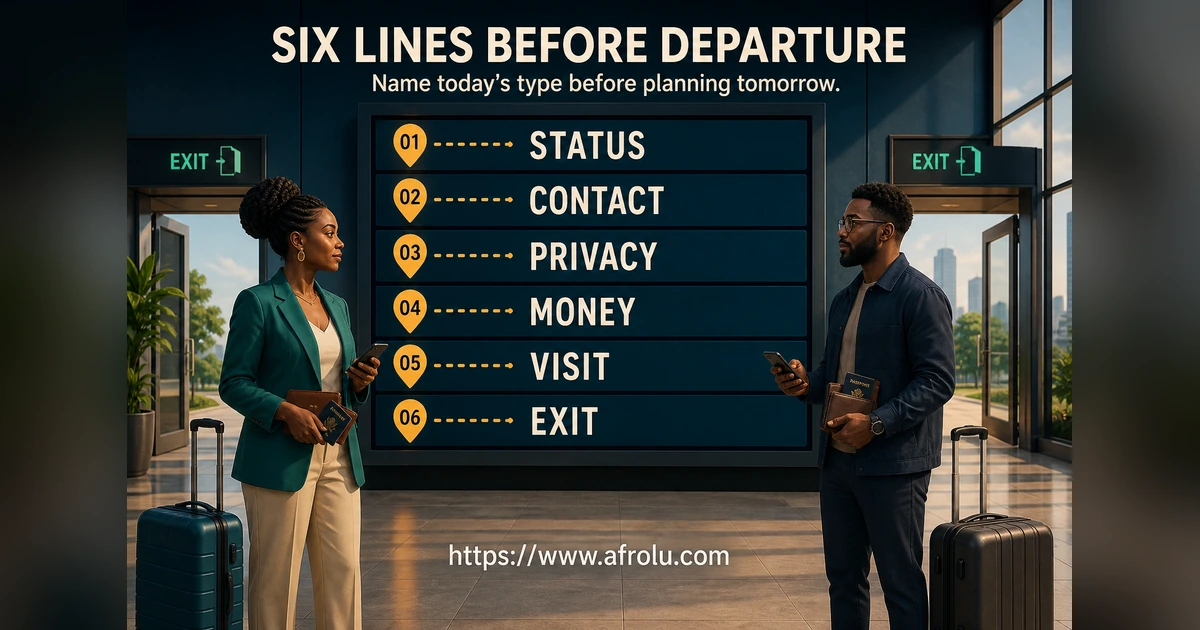
Name status, contact, privacy, money, visit and exit before calling the route safe.
Written and edited by Adwoa Boateng · Dating Safety Editor
Name today's relationship type before discussing a grand future. Agree an ordinary contact rhythm with normal delay and repair. Keep images, location, accounts, credentials and essential money separately controlled. Treat every visit as an optional plan with purpose, independent funds, movement, accommodation, health, consent and cancellation. Review conduct, burden and pressure before booking. Continue, adjust, pause or close from evidence and fit—not message volume, urgency or money already spent.
Dating basics · New Relationship Starters
Which present long-distance dating type can both adults describe, sustain and revise before money, travel or future hope makes change harder?
A safe new-journey long-distance dating type is a present-tense arrangement whose status, contact, privacy, money, visit and exit lines are explicit, purpose-limited, independently controlled and freely revisable by both adults.
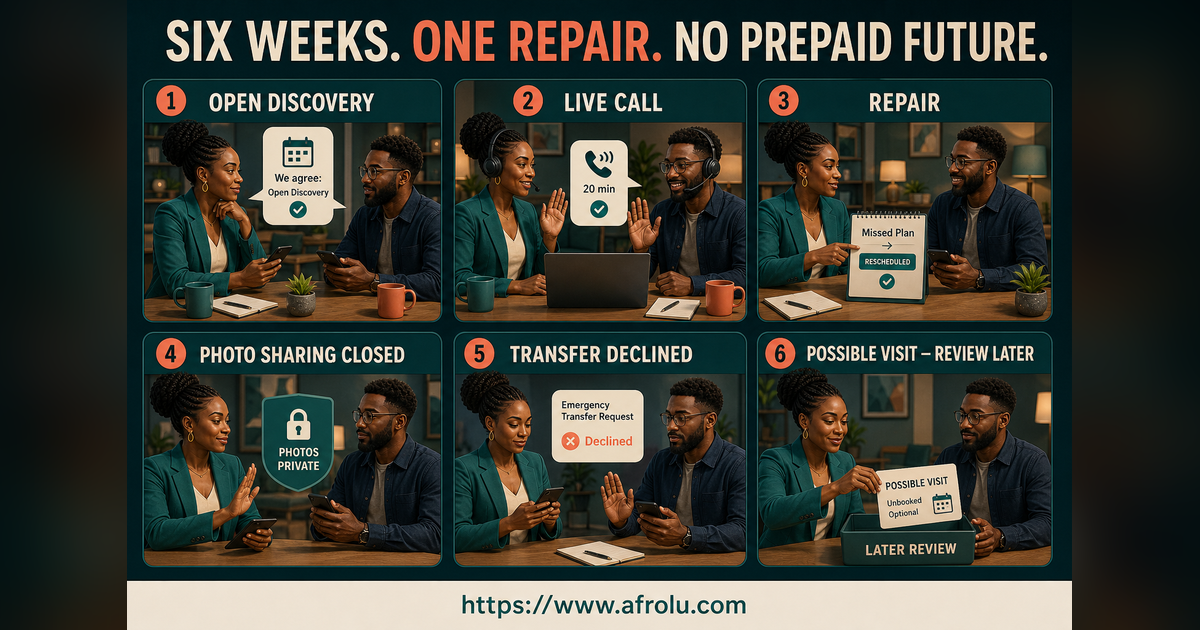
Zuri and Kelechi are fictional adults, 34 and 36. Six weeks of open discovery, one repaired call, a rejected account-based money request and a deliberately unbooked visit show how a route can grow clearer without borrowing exclusivity or future certainty.
The six-line distance departure board
Write the present route before buying the future journey
Adwoa separates relationship type from contact, privacy, money, visits and exit across one fictional six-week connection.
Six independent lines prevent intensity, checking, public visibility or a ticket from becoming a universal trust score.
Status and contact
Name today's type, ordinary rhythm, normal delay and repair.
Privacy and money
Protect images, location, accounts, credentials and essential funds.
Visit
Set purpose, budget, movement, accommodation, health and cancellation.
Exit
Keep pause, closure, blocking and suitable support practically available.
Start with a present-tense route
A new journey needs an accurate dating type before it needs a grand future
Starting a new dating journey may mean returning after a long break, changing old habits or simply entering an unfamiliar kind of connection. It does not make an adult naive, damaged or available for accelerated access. Long-distance adds selected communication and travel logistics. It does not remove the ordinary need to name what two people are doing today.
Separate personal intention from shared structure. Zuri may hope eventually for partnership while choosing open discovery now. Kelechi may focus on one connection without asking for mutual exclusivity. Those statements can coexist when spoken plainly. Neither daily contact nor future language silently changes a two-adult arrangement; a shared type changes only through a direct, mutual conversation.
Then separate relationship status from safety-critical systems. A match can appear consistent and still have no right to passwords, location history, workplace details, essential money, a funded journey or physical access. Gather only context relevant to the next bounded choice. A live call may support conversational continuity, but no isolated check proves identity, motives or future conduct.
Use a modest first route: a named status, a repeatable contact rhythm, private systems kept separate, no financial rescue and a review date. If other dating or sexual contact could affect health or consent, discuss that before the decision. New hope remains real when it is specific, conditional and able to survive an honest no.
Write six lines before departure
Status, contact, privacy, money, visit and exit should never collapse into one trust score
The status line names discovery, open dating, slow dating, one-person focus, exclusivity, partnership or closure. Define what the label includes and excludes. In particular, ask what outside dating or sexual contact would change and when disclosure is needed. Do not let relationship vocabulary become a vague badge that each adult privately interprets differently.
The contact line covers channels, planned calls, asynchronous messages, normal delay and repair. Distance can encourage idealised impressions because each adult sees selected moments. Treat meaningful digital intimacy as real without treating it as complete daily evidence. Notice how a missed plan is owned, whether replacement options are offered and whether offline responsibilities remain respected.
The privacy and money lines protect accounts, images, location, community details, credentials, investments, loans and essential funds. Kenyan data-protection principles provide useful context for purpose and necessity, while CISA guidance supports strong unique passwords, multifactor authentication, phishing awareness and updates. Neither source verifies a match; both reinforce keeping personal systems under personal control.
The visit line covers purpose, identity context, budget, accommodation, independent movement, health, consent and cancellation. The exit line states how to pause, close or block contact and recover possessions or funds safely. A ticket, sunk cost, public announcement or emotional confession cannot remove either adult's right to change the plan or end the route.
Watch one route meet ordinary friction
Zuri and Kelechi learn more from a repaired call and a declined transfer than from peak attention
Zuri, 34, lives in Nairobi and is beginning to date again after choosing a quieter year. Kelechi, 36, lives in Accra. They agreed to six weeks of open discovery, one planned video call most weekends and asynchronous messages without instant-reply expectations. They would ask before sharing images and discuss other dating before it affected health or consent.
During week three, Kelechi missed their call and replied the next morning. He acknowledged the change, offered two replacement times and did not demand that Zuri immediately accept either. Zuri named the impact without requesting location proof. They added a simple repair line: when feasible, send a short change notice; if not, own the miss and offer a realistic return.
Later, a person using Kelechi's account story appeared to request urgent help for a relative. Zuri declined to transfer money and contacted Kelechi through their established channel. The request was not his. They changed passwords, enabled stronger account protections and agreed that neither would handle emergencies, investments or verification codes through the relationship. The refusal strengthened clarity rather than weakening affection.
At day thirty, they considered a Nairobi visit but left the envelope unopened. Both retained separate travel budgets, and neither had enough ordinary evidence to book. They continued open discovery for another month with the same contact line. The result was not a dramatic promotion; it was an accurate route that had survived disruption, privacy limits and a financial no.
Read every line in three states
Continue, review and stop signals keep one attractive feature from averaging away risk
On status, continue means both repeat the same present arrangement; review means intensity is carrying an assumption; stop means exclusivity or partner privileges are claimed without agreement. On contact, continue means a usable rhythm and repair; review means temporary overload needs redesign; stop means chronic disappearance paired with demands, punishment for offline time or surveillance.
On privacy, continue means each share has a clear purpose and chosen audience. Review means a photograph, introduction or location request needs discussion. Stop means passwords, authentication codes, private messages, workplace systems or non-consensual images are demanded or exposed. Close access first; explaining more is not a prerequisite for protecting an account or reputation.
On money, continue means affordable plans and separately controlled funds. Review means one shared cost needs a cap and cancellation rule. Stop means urgent transfers, investments, debt, gift-card or crypto requests, or pressure to prove love through payment. The FTC's examples are useful warning context, but readers should use relevant banks, platforms and Kenyan or cross-border authorities.
On visits and exit, continue means independent movement, optional plans and a respected change of mind. Review means one dependency or missing fact can be redesigned. Stop means documents, lodging, movement, consent or essential funds are controlled, or contact continues through new channels after closure. Seek suitable local support when immediate safety, stalking, fraud or coercion is involved.

Decide each safety-critical line on its own evidence.
Use twelve bounded sentences
Good scripts reduce ambiguity without turning two adults into a compliance interview
For status: 'I am open to partnership later and choosing open discovery now.' For other dating: 'Before a visit or intimacy, I want us to share current facts that affect health and consent.' Those lines separate future intention from present structure and material disclosure without demanding a full personal history.
For contact: 'One planned weekend call and unhurried messages works for me.' For repair: 'If a plan changes, acknowledge it and offer a realistic return when you can.' These scripts allow work, sleep, family and offline life. If the rhythm repeatedly leaves one adult depleted or unheard, adjust it or decide that the fit is wrong.
For privacy: 'Ask before sharing my image or story, and my accounts stay separate.' For location: 'I do not use continuous tracking; I may share one journey temporarily by choice.' For money: 'I do not send emergency or investment funds through dating.' For credentials: 'I will never share a password or verification code.'
For a visit: 'We book only after purpose, budget, movement, accommodation and cancellation work for both.' For health: 'Let's discuss facts relevant to intimacy before the choice.' For consent: 'This yes applies only now and can change.' For ending: 'I am closing the dating connection; do not contact me through other accounts.'

Use one bounded question at a time and keep no available.
Review the route before the journey
Conduct, burden, pressure and missing facts matter more than the amount of hope invested
Conduct includes plans kept, changes owned, questions answered proportionately and boundaries respected. Include warmth, humour and curiosity, but test whether those qualities remain when an answer is no. One account-hardening conversation after a suspicious message can be more useful than weeks of flawless romantic performance because it reveals shared problem-solving without forced access.
Burden includes inconvenient hours, data costs, sleep, emotional labour, translation, verification effort and who continually carries uncertainty. Balance need not mean identical minutes or money. It should mean that both adults can maintain work, community, health and rest. Redesign the channel or frequency before calling exhaustion evidence of low interest or low commitment.
Pressure includes friends, family, public status, sexual expectation, gifts, tickets, urgency and time already spent. Ask what each adult would choose if nobody else expected a particular ending and no money had moved. A new journey should expand agency. If the route depends on shame, secrecy, debt or a future promise that cannot be questioned, pause or close.
Continue at the same type when all six lines remain accurate. Adjust one line and set another review when the issue is bounded. Pause when identity context, health, capacity or travel facts are missing. Close when needs differ or deception, financial manipulation, stalking, surveillance, coercion or retaliation appears. No final call, visit or explanation is owed when safety requires distance.

Review the ordinary route before paying for the exceptional journey.
Compare eight present arrangements
A safe type is descriptive, sustainable and revisable rather than impressive
Conversation is contact before a recurring dating arrangement exists. Bounded discovery adds a defined learning period and review. Open distance dating adds recurring romantic contact while both may date others. Each can be respectful when material facts arrive in time and neither adult borrows exclusivity, financial access or a journey from the label.
Slow distance dating deliberately limits frequency or escalation while retaining repair. One-person focus describes one adult's attention without claiming the other's. Those types are often confused because behaviour can look similar. The difference lives in the spoken agreement. Ask what outside dating changes, what ordinary contact is expected and what would trigger review.
Exclusive distance dating means both stop the outside dating or sexual contact they define. It still does not grant passwords, permanent location, money, travel, health files or consent. Partnership adds mutually chosen responsibilities and future coordination. A larger label requires more specific agreements, not fewer boundaries or less independent control.
Closure ends dating or contact because fit, capacity, need or safety does not support continuation. It is not a failed type. Compare every arrangement through what both adults can accurately repeat after delay, difference, a money boundary and an optional visit. If the spoken type and lived conduct diverge, shrink the label, redesign the route or leave it.
Eight new-journey distance moments where the route can silently change
Partnership language appears during open discovery
One adult hears a possible future as a current status change.
Restate today's type and the evidence needed for review.A weekend call disappears without repair
Uncertainty grows while the next romantic message ignores the miss.
Name the impact and ask for one usable return.A private image is wanted for family approval
Community reassurance would expose a new connection.
Agree purpose, audience and timing or decline.Distance becomes a reason for continuous tracking
One adult is asked to prove ordinary movement.
Keep tracking off and use bounded logistics when chosen.A familiar account sends an urgent money story
Speed and emotion are used to bypass independent checking.
Do not pay; verify through an established channel.A discounted booking creates a false deadline
Travel is proposed before purpose and exit work.
Let the price go and finish the route review.Exclusivity language replaces a direct conversation
Relevant partners, testing or prevention remain assumed.
Discuss current facts before they affect choice.Contact moves to new accounts after a clear ending
The exit line is treated as negotiable.
Block, preserve relevant evidence and seek suitable support.Signals across status, contact, privacy, money, visit and exit
Both adults can repeat the same present dating type without translating romantic intensity into status.
Contact expectations include normal delay, inconvenient-hour balance and a repair after missed plans.
Images, location, community details, messages and accounts have chosen purposes and audiences.
Strong unique passwords, multifactor authentication and independent recovery channels remain personal.
Emergency, investment, travel and living costs do not pass through a new remote relationship.
A possible visit has its own purpose, budget, movement, accommodation, health and cancellation plan.
Other dating and relevant sexual-health facts are discussed before they affect an intimate decision.
Every physical answer remains specific, current, voluntary and changeable despite tickets or time invested.
Future partnership or relocation stays conditional on evidence and two independent choices.
Continue, adjust, pause and close remain practical options for both adults at every review.
Choose the next distance step through ten bounded questions
| Situation | What it may mean | What to do next |
|---|---|---|
| Can both name today's type? | Fits: The same present arrangement is explicit. Needs review: Future language is carrying an assumption. Stop: Partner access is claimed without agreement. | Return to the smallest mutual status. |
| Does contact survive ordinary delay? | Fits: Rhythm and repair are usable. Needs review: Capacity needs redesign. Stop: Silence or monitoring controls one adult. | Adjust frequency, channel or access. |
| Is private data purpose-limited? | Fits: Use and audience are chosen. Needs review: One share needs discussion. Stop: Images, location or accounts are demanded or exposed. | Close access and protect the affected system. |
| Are accounts independently secured? | Fits: Credentials and recovery remain personal. Needs review: A reused password needs replacement. Stop: A password or code is requested. | Refuse, harden accounts and verify independently. |
| Is money outside the relationship? | Fits: Plans are affordable and funds remain separate. Needs review: A shared cost needs a cap. Stop: Urgency, investment or debt pressures payment. | Do not transfer and use relevant support. |
| Is a visit independently cancellable? | Fits: Each adult controls essentials and alternatives. Needs review: One dependency needs redesign. Stop: Documents, lodging, movement or funds are controlled. | Postpone travel or seek immediate help. |
| Are health facts timely? | Fits: Relevant information precedes choice. Needs review: A conversation or care remains incomplete. Stop: Status or affection is used to conceal material facts. | Pause intimacy and seek suitable care. |
| Can consent change safely? | Fits: Every answer is current and specific. Needs review: Expectation needs a pause. Stop: Travel, gifts or status override no. | Stop the pressured action. |
| Is the future conditional? | Fits: Options and review evidence are named. Needs review: Timelines or locations differ. Stop: Relocation or commitment is declared for one adult. | Reset the horizon or close the mismatch. |
| What does the review support? | Fits: All six lines remain accurate. Needs review: One bounded adjustment merits testing. Stop: Need, pressure or safety cannot fit. | Continue, adjust, pause or close. |
Twelve lines for type, contact, privacy, money, travel and closure
“I am open to partnership later and choosing open discovery now.”
“Before a visit or intimacy, let's share facts that affect health and consent.”
“One planned weekend call and unhurried messages works for me.”
“If a plan changes, acknowledge it and offer a realistic return when you can.”
“Ask before sharing my image or story with anyone else.”
“I do not use continuous tracking; I may share one journey temporarily by choice.”
“I do not send emergency, investment or living-cost funds through dating.”
“My passwords, codes and recovery channels stay private.”
“We book only after purpose, budget, movement, accommodation and cancellation work.”
“Before relevant intimacy, I want a direct health conversation and qualified care where needed.”
“This answer applies now and can change at any time.”
“I am closing the dating connection; do not contact me through other accounts.”
Know the difference
Present type, ordinary contact, visit access and future horizon stay separate
Names today's arrangement, protects accounts and money, tests ordinary repair and keeps visits, intimacy and future moves separately chosen.
Uses intensity, checking, urgency, public visibility or money to imply a status, journey or future that neither adult clearly agreed.
Choose the smallest type that remains accurate after delay, difference, a financial no and a freely cancelled visit.

Choose the smallest distance type both adults can describe after a difficult week.
Compare eight distance types without creating a relationship ladder
| Type or dimension | What it describes | Best next question |
|---|---|---|
| Conversation | Early contact before a recurring romantic arrangement exists. | Enough context for bounded discovery |
| Bounded discovery | A defined remote learning period with a review and no automatic exclusivity. | Ordinary conduct across time |
| Open distance dating | Recurring romance while both may date others and disclose material facts. | Comfort with the spoken open status |
| Slow distance dating | Contact or escalation is deliberately limited without removing clarity or repair. | Enough evidence at the chosen pace |
| One-person focus | One adult concentrates attention without claiming mutual exclusivity. | A direct shared-status conversation |
| Exclusive distance dating | Both stop the outside dating or sexual contact they define; other systems stay separate. | Reliable agreement and repair |
| Distance partnership | Mutual responsibilities and horizon decisions are named without blanket access. | Sustainable integration by purpose |
| Closure | Dating or contact ends when fit, capacity, need or safety requires it. | A clear boundary and suitable support |
Build a safe present-tense distance route in six moves
Name the present type
Keep future hope and today's two-adult arrangement on separate lines.
Build a repairable rhythm
Choose channels, normal delay and one return after disruption.
Secure accounts independently
Use strong unique passwords, multifactor authentication and private recovery.
Keep money outside proof
Decline emergency, investment and affection-linked transfers.
Gate every journey
Plan purpose, funds, accommodation, movement, health and cancellation.
Preserve the exit
Make pause, closure, blocking and suitable support practically available.
Questions for type, contact, visits and exit
Choose a few prompts that fit the moment. This is a reference library, not a list to complete.
Type questions
Separate present structure from future hope.
- What are we choosing now?
- May either person date others?
- What changes exclusivity?
- Which access is excluded?
- When will we review?
Contact questions
Design a rhythm that survives ordinary life.
- Which channel fits which task?
- What delay is normal?
- How do we repair a miss?
- Who carries inconvenient hours?
- When is offline time protected?
Visit questions
Keep travel bounded and cancellable.
- What is the visit for?
- Who controls essential funds?
- Where can each person stay?
- How can either leave?
- What remains undecided?
Exit questions
Make pause and closure practical.
- How will we state closure?
- Which channels close?
- What evidence should be kept?
- Which support is relevant?
- How will accounts be secured?
What Kenyan privacy, account security, distance, fraud, health and consent sources support
Data-subject rights support restraint with remote personal information
The Office of the Data Protection Commissioner summarises rights to information, access, objection, correction and deletion, alongside purpose and data-minimisation principles. That context supports limiting images, location and identity details.
Evidence limit: This is general Kenyan source context, not legal advice about a private relationship or cross-border processing.
Independent account controls reduce avoidable digital exposure
CISA's Secure Our World guidance recommends strong passwords, multifactor authentication, phishing awareness and software updates. These steps help protect accounts without asking a match to inspect them.
Evidence limit: Security practices reduce risk but cannot verify identity, intent or personal safety.
Mediated intimacy can be meaningful and selectively presented
Peer-reviewed long-distance research examined communication media, intimacy and idealisation. It supports reading remote closeness alongside ordinary conduct, disruption and in-person logistics rather than dismissing or over-certifying it.
Evidence limit: One study cannot prescribe contact frequency or predict this connection's outcome.
Remote trust-building can precede urgent financial requests
The U.S. Federal Trade Commission describes romance-scam patterns involving distance, emotional trust and requests for money. Declining transfers and checking through independent channels are proportionate actions.
Evidence limit: Examples and reporting paths are U.S.-specific; use relevant Kenyan, platform, bank and cross-border support.
Wellbeing includes respect, safety and freedom from coercion
The World Health Organization's sexual-health framework includes physical, emotional, mental and social wellbeing and a positive, respectful approach. It supports direct, non-coercive discussion before relevant intimacy.
Evidence limit: The overview is not individual diagnosis, testing advice or a substitute for qualified care.
Every physical choice remains specific and withdrawable
NSW Government guidance describes consent as free, voluntary, communicated, ongoing, specific and able to be withdrawn. A ticket, relationship label or money spent does not change those properties.
Evidence limit: Legal definitions and services vary; use appropriate local professional or emergency support.
Six ways a remote restart borrows certainty
Promoting hope into status
A possible partnership is treated as exclusivity. Repair: state the present type directly.
Auditing contact
Message frequency becomes proof of honesty. Repair: design rhythm and read repair instead.
Sharing to verify
Images or location are exposed for reassurance. Repair: limit every share by purpose and audience.
Borrowing account access
Passwords or codes are framed as intimacy. Repair: refuse and harden independent recovery.
Paying for certainty
Urgency, travel or investment opens money. Repair: do not transfer; verify outside the relationship.
Booking the answer
A visit is used to force clarity. Repair: complete the six-line review before purchase.
Use a reviewed resource that matches the decision
This guide focuses on the relationship decision, so it does not rank dating apps. Check current prices, safety tools, and local availability before choosing a service.
Explore the guide library
Show more related guides
Continue with Afrolu
Show more Afrolu guides
Official privacy, security, fraud, health and consent sources plus peer-reviewed distance research
Afrolu reviewed these health, research, safety, or public guidance resources while editing this page. They support the behaviour and safety guidance; they do not diagnose any individual described by a reader.
Safe long-distance dating-type questions for a new journey
What is a safe long-distance dating type for a new journey?
It is the smallest present arrangement both adults can describe accurately, such as bounded discovery, open dating, slow dating, one-person focus or exclusivity. It also names ordinary contact, privacy, money, visit access and exit. Safety is not guaranteed by the label; it comes from bounded choices, relevant evidence and usable boundaries.
Do frequent calls make a long-distance relationship exclusive?
No. Call frequency, disclosure and future hope do not create mutual exclusivity. Ask whether either adult dates others and what outside dating or sexual contact would stop. Until both agree, keep the spoken type. Exclusivity still does not grant passwords, tracking, money, travel or physical consent.
How much identity information should we exchange?
Seek enough consistent context for the next bounded action and no more. A short live interaction may support continuity but cannot guarantee identity or conduct. Keep sensitive documents, credentials, workplace systems and unnecessary family details private. When a claim affects money or travel, verify through independent sources you locate yourself.
Should long-distance partners share passwords or live location?
No relationship label requires account credentials or continuous tracking. Use strong unique passwords, multifactor authentication and private recovery channels. A voluntarily chosen temporary location share for one journey is different and can still be declined or stopped. Pressure, threats or contact after refusal are reasons to reduce access and seek support.
May I send money for an emergency or first visit?
Do not use payment as proof of love or identity. Urgent emergency, investment, gift-card, crypto and living-cost requests are major reasons to stop and verify independently. For travel, keep essential funds and cancellation control separate. If money has moved unexpectedly, contact the relevant bank or provider promptly and use appropriate reporting routes.
How do we plan a first in-person visit?
Agree the purpose, dates, budget, public first plan, accommodation choices, independent movement, communication, health and cancellation. Retain control of documents, belongings and essential money. Share a bounded plan with a trusted person if useful. Arrival never creates consent to extend the stay, enter a private place or accept intimacy.
When should we discuss sexual health?
Before relevant intimacy or a visit where intimacy may be considered. Discuss current partners, testing, prevention, boundaries and qualified care. Share what the decision needs without demanding unrelated records. A future promise, exclusivity or travel cannot replace a direct conversation, and each physical act still needs a current free answer.
How soon should we discuss partnership or relocation?
You may name future openness early, but keep it conditional. Discuss possible locations, career and family constraints, costs, legal advice and the evidence needed for another review. Do not use a warm month, public announcement or booked ticket as a relocation promise. Another visit, a smaller arrangement or closure must remain possible.
What if a match contacts me from new accounts after I end it?
You do not need to restart the conversation. Block new channels, preserve relevant evidence safely, tighten account privacy and tell a trusted person if useful. If there are threats, stalking, image abuse, fraud or immediate danger, seek suitable platform, Kenyan legal, financial or emergency support for the actual facts.
How do we decide whether to continue?
Review the six lines: shared status, repairable contact, purpose-limited privacy, independent money, a cancellable visit and a usable exit. Continue when all remain accurate; adjust one bounded feature; pause for missing identity, health, capacity or travel facts; close when needs differ or pressure, deception, surveillance, fraud or coercion appears.
One thing to do now
Choose the smallest route that stays truthful under pressure
Continue when both adults name the same type, repair ordinary contact, protect private systems and funds, discuss material health facts and keep travel and consent optional. Adjust one bounded line when evidence supports a test. Pause for missing identity, capacity, health or travel facts. Close when needs differ or deception, surveillance, financial manipulation, stalking, coercion or retaliation appears.