New to dating · clarity-first · distance-aware
Types of Dating for New Relationship Starters: Clarity-first and Distance-Aware Dating
Start long-distance dating with clear intent, a steady call plan and boundaries. Learn what to agree on public visits, costs, and exclusivity before travel.
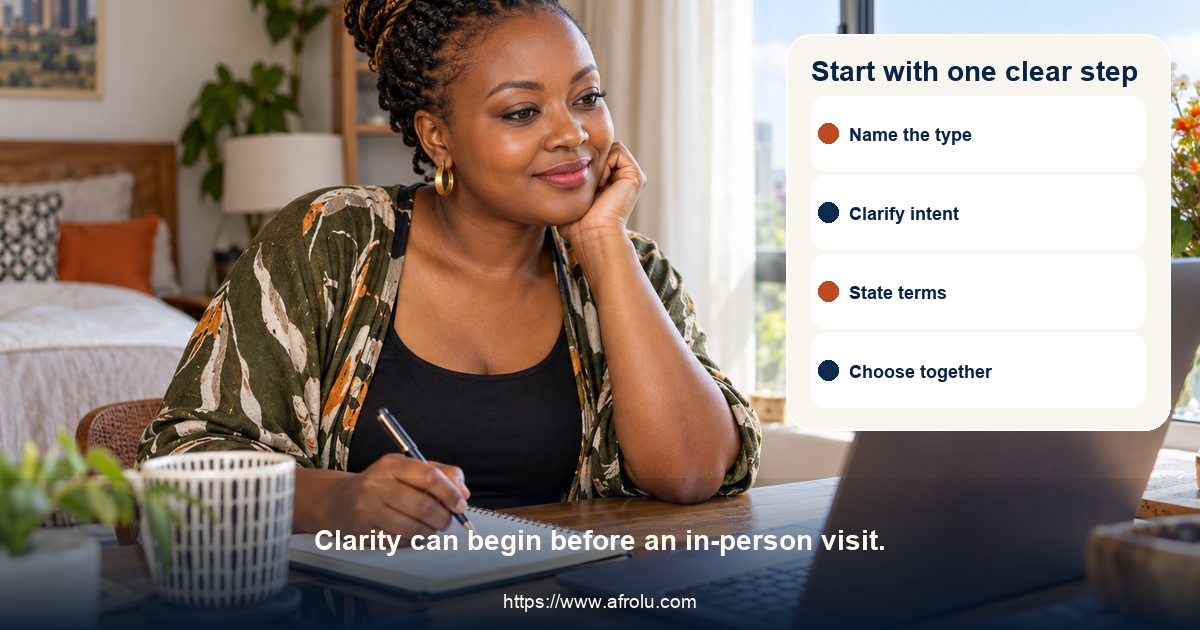
Choose the next step without promising the final outcome.
Written and edited by Tariro Ncube · Diaspora Dating Editor
Separate how you met, what each person wants, what is currently agreed, the pace, and the distance context. Choose a mutually workable call schedule, keep accounts and money separate, and make any first visit public with independent travel and lodging. Review what actually happened before planning another trip or assuming exclusivity.
Dating basics · New Relationship Starters
How can someone new to dating explore a long-distance connection with clear expectations and safe, manageable next steps?
Clarity-first long-distance dating is a staged way to explore a connection across geography while treating calls, visits, costs, intimacy, and exclusivity as separate decisions.
Njeri is new to dating and meets Paul online; he lives several hours away. She likes their conversations but has not agreed to exclusivity or travel. Instead of interpreting daily messages as a promise, she proposes two calls and asks whether either person is still meeting others. Their answers help them decide whether a public visit is worth planning.
Clarity · distance · staged decisions
Build trust through practical choices
A new dater can learn the labels without following anyone else’s timeline.
Map five dimensions, plan calls and visits, and review conduct before increasing access.
Which part is undecided?
Separate the channel from the agreement.
What time works for both?
Choose a mutual rhythm that protects routines.
Can each person leave freely?
Plan public meetings and independent travel.
What has happened so far?
Use actual behavior to choose the next step.
channel · intent · agreement
Start with a map, not a rulebook for dating beginners
If dating feels new, a list of labels can look like a test with one correct answer. Use it as a map instead. A person can meet online, want a committed relationship, remain non-exclusive, move slowly, and live in another city. The labels describe different dimensions, so you can combine them without copying a stranger’s timeline.
Write down five answers for the connection in front of you: the channel, each person’s intention, the current agreement, the desired pace, and the life context that affects contact. Leave a blank where you do not know. Saying “I am unsure about exclusivity” is clearer than letting daily messages quietly become an assumption.
Njeri is dating for the first time after focusing on work and family. She meets Paul online; he lives several hours away. She wants to explore the connection but has not agreed to exclusivity or travel. Saying that aloud helps both people decide whether a call-first arrangement suits them.
You may revise the map as you learn. One conversation is not a lifetime contract, and a first date is not proof that the relationship should continue. Keep each choice small enough to understand: a call, a public meeting, a discussion of contact, then a mutual decision about the next step.
expectations · uncertainty · pace
Use clarity to make distance manageable, not to rush certainty
Long-distance dating can begin before either person knows whether the connection is a fit. That is normal. Be clear about what has happened so far: how you met, whether you have had a live conversation, how often you are communicating, and whether either person is seeing others. Do not let frequent texts stand in for a mutual status conversation.
Ask what each person hopes will happen if early conversations go well. One adult may expect a visit within weeks; another may prefer several calls before booking anything. Both can be legitimate preferences. The useful work is finding out whether a pace fits both people, not persuading a cautious person that speed is a sign of seriousness.
A first video call can help you notice voice, responsiveness, and whether the conversation feels reciprocal, but it does not establish identity with certainty or prove future trust. Keep sensitive data private. A person can choose to continue talking, ask for another call, or stop without owing a full explanation.
Make the next step concrete and reversible. Choose a call length, an approximate day, and whether you will check in afterward. If either person is not ready to plan travel or exclusivity, say so. A clear limit gives the other adult a real choice and keeps hope from being mistaken for an agreement.

Agree on a next step that both people can reverse.
calls · time zones · privacy
Build a contact rhythm both people can keep across distance
Different cities, work patterns, caregiving, and connectivity can make simultaneous free time scarce. Pick a call window that does not depend on one person staying awake at an unreasonable hour or cancelling existing responsibilities. If time zones apply, write the agreed local times for both people and confirm before the first call.
Decide what happens when a call is missed. A short message and a proposed replacement time may be enough; an explanation is not a licence to demand someone’s live location, work rota, or private family details. Both adults should be able to keep their usual routines when the other is busy.
Use ordinary digital precautions. Keep passwords, one-time codes, financial logins, home addresses, and private documents out of the relationship while trust is new. Do not install remote-access tools or share a screen to prove you are real. CISA’s guidance on phishing, passwords, and multifactor authentication can help protect accounts independently of dating decisions.
If regular video feels uncomfortable, ask about another step you can both accept, such as a voice call or a brief public meeting when practical. Consent applies to the channel too. The goal is not to force a test; it is to choose a way of communicating that gives each person enough information to decide what they want next.

Notice comfort and responsiveness without treating a call as certification.
travel · cost · public meeting
Plan a first visit without creating financial or personal debt
Before anyone books a ticket, agree on the purpose and broad shape of the visit: who is travelling, where you will meet, how long you expect to spend together, and what each person will pay. A visit is still a date, not proof of commitment. Keep accommodation and transport independent until both people choose a different arrangement freely.
Avoid sending money to a person you have only met online, including funds for travel, emergencies, visas, medical bills, or a business opportunity. A romance story can be sincere and still leave you unable to assess a financial request. Consumer guidance warns that online romantic contacts may use urgency to seek money; you can decline without deciding the person’s motive.
For the first in-person meeting, choose a public place during a time when other people are around. Tell a trusted person your broad plan if that supports your safety. Keep your return journey under your control and do not rely on a date to take you to lodging, an ATM, or a second location you did not choose.
If one person wants the other to cover every cost, keep the conversation direct. You might choose a shorter meeting closer to the traveller, share a modest expense, or wait until both can afford a visit. No one is required to travel to prove attraction. A mismatch in money or logistics may simply mean the arrangement is not workable right now.
pattern · repair · identity
Notice steady conduct rather than intense early attention
A new connection can feel vivid when every message is novel. Keep one eye on ordinary consistency: do calls happen as planned, are changes shared promptly, does the person answer direct questions, and can each adult maintain a separate life? These observations are more useful than declarations of destiny made before the two people have met.
A missed call has many possible explanations. Look at whether the person follows up, acknowledges your time, and proposes a realistic alternative. One problem does not diagnose a character. A repeated pattern of last-minute changes, pressure, and one-sided repair can be enough reason to step back even when you cannot prove why it is happening.
Be wary when affection quickly becomes a request for money, cryptocurrency, investment help, account access, verification codes, private images, or a secret channel. Romance-scam guidance describes those tactics. Do not move funds or share credentials to preserve a connection. Save relevant messages if safe, use platform reporting, and contact your financial provider promptly if you already paid.
Keep the first visit and each later step separate from the last. A video call does not commit you to travel; a successful visit does not create exclusivity; paying for a ticket does not create consent. Ask again when the decision changes. Trust is built through repeated choices, while every adult keeps the right to revise or stop.
consent · health · exclusivity
Discuss status, consent, and sexual health before they are assumed
Long-distance partners can become emotionally close before they have shared ordinary in-person time. If you are unsure what “we are together” means, ask directly about exclusivity, future visits, public status, and whether each person is dating others. The answer may be evolving. What matters is that both people can describe the present agreement honestly.
If a visit could include intimacy, discuss boundaries and sexual health before the moment arrives. Talk about what each person is comfortable with, testing and prevention, and what should happen if either person changes their mind. Public-health resources offer conversation starters; a clinician is the right person for personal testing or treatment advice.
A person may be excited to travel and still prefer separate rooms, a shorter visit, or no physical intimacy. Planning effort does not change that. If your expectations differ, slow down and decide whether another arrangement works. Do not use the cost of a trip, the length of a call, or a relationship label to argue someone out of a boundary.
When the conversation is difficult, break it into decisions: are we exclusive; what kinds of contact are welcome; what does the visit involve; how do we manage health questions; and what is still undecided? You can return to a topic later. The important part is not hiding a material expectation until the other person is already far from home.
continue · adjust · pause
Review the connection after calls and an in-person meeting
After several calls or the first visit, compare what each adult expected with what actually happened. Was contact reciprocal? Did both people keep their separate responsibilities? Were costs and travel discussed fairly? Could either say no without punishment? Did the in-person meeting confirm enough comfort to plan another one?
Continue when the current agreement is clear and enjoyable for both. Adjust a practical term—call time, visit length, or who travels—if the connection otherwise feels mutual. Pause if you need more time before committing to another trip. End if promises repeatedly replace follow-through or pressure makes a normal choice feel unsafe.
Do not use a deadline from a dating app, a friend, or an online guide to force certainty. Different adults reach decisions at different speeds. You can still set a review date so uncertainty does not become an indefinite waiting room. Ask what information each person needs and whether that information can be gained safely.
A clear ending can be brief: “I appreciated getting to know you, but I do not want to continue long-distance dating.” If the person responds with repeated contact, threats, money demands, or attempts to locate you, keep records if safe, block or report through the service, and seek support suited to where you live.

Review calls and visits before planning another commitment.
Eight long-distance dating situations

A match proposes a late video conversation
Different schedules can make a call window hard to keep.
Choose an hour both can reasonably manage.Messages feel intimate but exclusivity was never discussed
Frequency does not automatically create a relationship agreement.
Ask directly whether either person is dating others.One adult is asked to book a visit quickly
Speed can outrun identity checks and shared planning.
Choose another call before making a commitment.A new match needs a ticket or emergency payment
A compelling story still creates a financial risk.
Do not transfer money to an online love interest.The visitor is expected to stay at the other person’s home
Lodging dependence can make it harder to leave freely.
Arrange independent accommodation and transport.One person repeatedly gives up sleep for calls
The contact rhythm may be unevenly costly.
Find a time that respects both routines.Travel effort is framed as an expectation of sex
Planning is being treated as a debt.
Restate consent and choose whether to leave.A first visit felt comfortable but status is unclear
A good date does not decide exclusivity by itself.
Discuss the next agreement before assuming it.Fourteen signs of a clear, mutual connection
Both adults can explain how they met without treating the channel as proof.
Each person states a current direction and what remains undecided.
Call times work for both routines instead of one person always losing sleep.
Missed calls are followed by honest notice and realistic alternatives.
Neither adult demands a password, one-time code, or remote access.
A live call is treated as useful information rather than identity certification.
Travel plans include public meetings and independent ways to leave.
Each person knows who will pay which expected visit costs.
No one is pressed to send money to preserve a new connection.
Private lodging and home access remain separate until freely chosen.
A visit can be shortened without punishment or financial guilt.
Sexual-health and consent questions are raised before intimacy.
Neither person treats one visit as automatic exclusivity.
A review date prevents an uncertain arrangement from becoming endless waiting.
A decision map for calls, visits, and status
| Situation | What it may mean | What to do next |
|---|---|---|
| Profile conversation only | You have limited evidence about daily conduct. | Choose a low-stakes call before travel. |
| Frequent texts | The connection may feel close without a shared status. | Ask what each person thinks is agreed. |
| A missed call | A routine disruption may have occurred. | Notice whether repair and follow-through happen. |
| Time-zone strain | One person may be carrying most of the schedule cost. | Move the call window or reduce frequency. |
| Money request | The connection may be asking for funds before in-person contact. | Do not send money or investment funds. |
| Visit invitation | Travel creates logistics but not a promise. | Plan separate transport and public first meeting. |
| Home stay request | The visitor may have less ability to leave freely. | Arrange independent lodging. |
| Sex expected after travel | Effort is being framed as entitlement. | Restate the boundary and leave if needed. |
| Exclusivity assumed | One person may have inferred more than was discussed. | Ask and answer directly. |
| Another visit is proposed | The first meeting created a new choice, not an obligation. | Review how the visit actually felt. |
Twelve scripts for distance-aware choices
“I am exploring dating and have not decided about exclusivity yet.”
“Could we speak Sunday at a time that works in both cities?”
“I cannot stay up past midnight regularly; can we find another window?”
“I would like another live conversation before planning travel.”
“Let us agree on a public meeting and arrange our own transport.”
“I do not send travel or emergency money to someone I have only met online.”
“I will arrange my own room for this visit.”
“Travel effort does not decide what I want physically.”
“Before intimacy, I want to discuss testing and prevention.”
“Are either of us dating other people right now?”
“I need more time before planning another trip.”
“I do not want to continue a long-distance connection.”
Know the difference
Distance-aware pacing versus distance-based urgency
Calls, public visits, costs, intimacy, and exclusivity become separate mutual decisions.
A short online connection is used to demand money, travel, private lodging, or a promise.
Distance calls for practical planning; it does not justify rushed access.

Choose the format that fits the evidence and both routines.
Staged pacing versus distance-based urgency
| Type or dimension | What it describes | Best next question |
|---|---|---|
| Online dating | The channel introduces two profiles or messages. | Move to a live conversation only when both choose. |
| Long-distance | Calls, travel, and cost are part of the operating plan. | Set a schedule and public visit boundaries. |
| Slow dating | Each step allows more observation. | Name the next step and when to review. |
| Serious dating | Long-term direction is discussed. | Keep current exclusivity a separate question. |
| Casual dating | Commitment may be limited today. | Say whether other dates continue. |
| Exclusive dating | Both choose to stop other romantic dates. | Agree the start and scope directly. |
| Video-first | Calls precede an in-person meeting. | Treat them as one signal, not proof. |
| Visit-based | Travel concentrates time together into a visit. | Keep lodging, money, and transport independent. |
| Dating pause | An adult may need more information or time. | Say whether contact continues while paused. |
A simple plan you can use today
Labels can combine
Channel, intention, agreement, pace, and context answer different questions.
Uncertainty is an answer
Say what is not decided instead of allowing assumptions to harden.
Calls are not certification
A conversation can inform a choice but cannot guarantee identity or trust.
Travel is a separate choice
A ticket or visit does not establish exclusivity or intimacy.
Money stays independent
Do not send funds or share financial access to protect a new connection.
Review real conduct
Use calls kept, boundaries respected, and plans repaired to choose what comes next.
Questions organised by purpose and depth
Choose a few prompts that fit the moment. This is a reference library, not a list to complete.
The map
Name each part of the connection separately.
- How did we meet?
- What do I want?
- What is agreed now?
The call plan
Choose contact around both people’s lives.
- Which hours work?
- What is a fair backup?
- How do we repair a miss?
The visit
Plan a public and independent first meeting.
- Who travels?
- Who pays?
- How can either leave?
The review
Decide what you have learned before increasing commitment.
- Were plans kept?
- Were limits respected?
- What remains uncertain?
What deserves a closer look
Pause financial urgency
FTC guidance describes romance contacts who seek money for travel, emergencies, or investments.
Evidence limit: This U.S. guidance is not a finding about a specific match.
Use basic protections
CISA materials explain phishing, strong passwords, software updates, and multifactor authentication.
Evidence limit: Security hygiene does not confirm a profile identity.
Talk before intimacy
CDC resources encourage partner conversations about testing, prevention, and clinician advice.
Evidence limit: CDC information reflects U.S. public-health resources.
Make logistics visible
A call schedule, cost plan, and independent travel arrangement can reveal whether a visit is workable.
Evidence limit: No checklist can predict relationship success.
Separate each decision
A video call, ticket, public date, lodging choice, and intimate activity require their own voluntary agreement.
Evidence limit: This guide is not legal advice.
Limit identifying details
Avoid sharing location, financial access, passwords, and personal records before trust is established.
Evidence limit: Platform and local reporting options vary.
Shortcuts that turn hope into obligation
Treating daily messages as exclusivity
Contact frequency is not a mutual status agreement.
Buying a ticket to prove interest
Travel effort does not guarantee compatibility or safety.
Sending emergency money
Online romance requests can expose finances to loss.
Sharing verification codes
A code can give someone access to an account.
Staying in a new match’s home
The visitor may lose control of transport and exit timing.
Setting intimacy as repayment
Consent is not created by a trip or its expense.
Make the next conversation mutual and easy to keep
This guide is editorial information, not legal, medical, financial, or emergency advice. Consult qualified local support for personal questions that need professional guidance.
Explore the guide library
Show more related guides
Continue with Afrolu
Show more Afrolu guides
Sources used for this guide
Afrolu reviewed these health, research, safety, or public guidance resources while editing this page. They support the behaviour and safety guidance; they do not diagnose any individual described by a reader.
Questions about starting long-distance dating
What does distance-aware dating mean?
It means planning calls, visits, costs, and contact around geography while keeping intention and agreement explicit.
Should we be exclusive after a video call?
Only if both adults discuss and choose exclusivity. A call does not create that agreement.
How many calls should happen before a visit?
There is no required number. Choose enough interaction for both people to feel comfortable deciding about travel.
Should I send money for a ticket?
Avoid sending money to a new online romantic contact. Decide travel costs independently and meet only when the plan works for both.
Is a video call proof of identity?
No. It may provide useful information but does not certify identity or predict future behavior.
Where should a first visit happen?
Use a public place, independent transport, and lodging you control if travel is involved.
What if calls keep being cancelled?
Notice communication, alternatives, and follow-through; you may end an arrangement that stays unreliable.
Do daily messages mean we are together?
No. Ask directly about the present relationship status and whether other dates continue.
When should we discuss sexual health?
Before intimacy, discuss testing, prevention, and boundaries; ask a qualified clinician for personal health advice.
How do I pause long-distance dating?
State whether you want to stop, pause contact, or revisit the connection at a specific future point.
One thing to do now
Choose one safe next step together
Choose only the next step both people understand and can reverse. Keep money, accounts, lodging, and transport independent while trust is new. Review the pattern of calls, repairs, boundaries, and in-person comfort before changing status or making another travel commitment.