Four compasses for one established life on each side
Choose a Clear Long-Distance Relationship Type Later in Life
A later-life guide to long-distance relationship types, serious intent, exclusivity, visits, family privacy, money, consent and closing-distance choices.
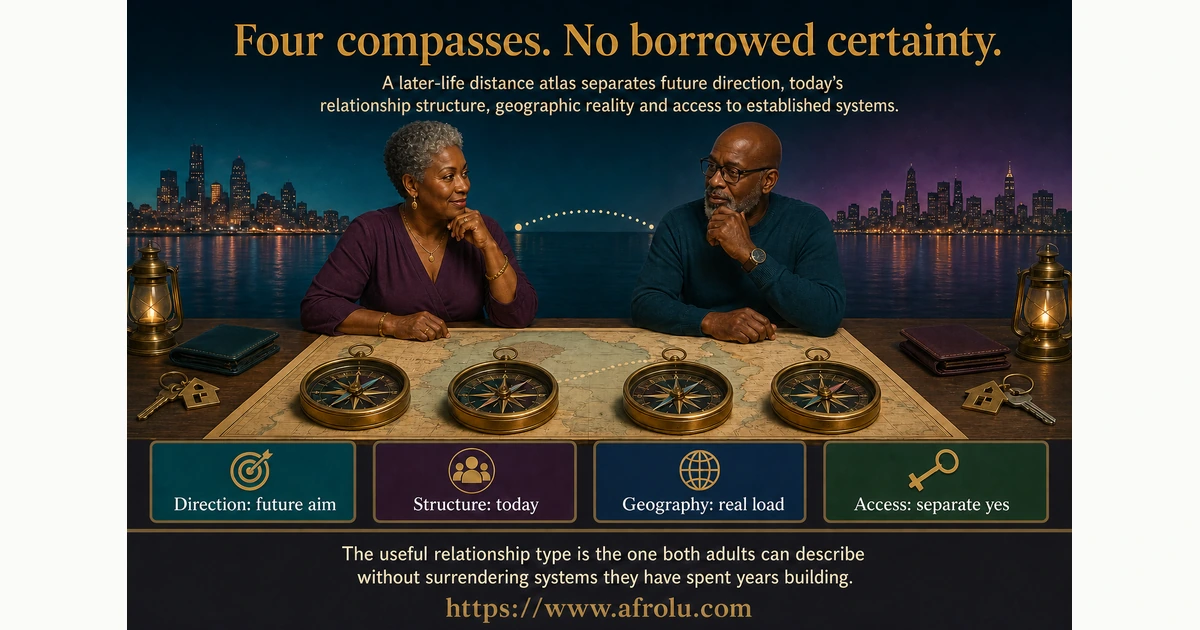
Name direction, structure, geography and access separately before changing an established life.
Written and edited by Jean-Claude Mukendi · Relationship Guides Editor
Use four separate compasses. Name future direction, today's relationship structure, the real geographic arrangement and every form of access. Serious direction does not create exclusivity; exclusivity does not promise relocation; a visit does not open a home, family network, account or body. Verify proportionately, keep travel and money independent, observe ordinary weeks as well as concentrated visits and review the type before any major life-system change.
Dating basics · Late Entrants
Which relationship type accurately describes today, and what can deepen without silently opening an established life?
A later-life long-distance relationship type is a mutually understood combination of future direction, present structure and geographic arrangement, with home, family, digital, financial and physical access governed by separate current permissions.
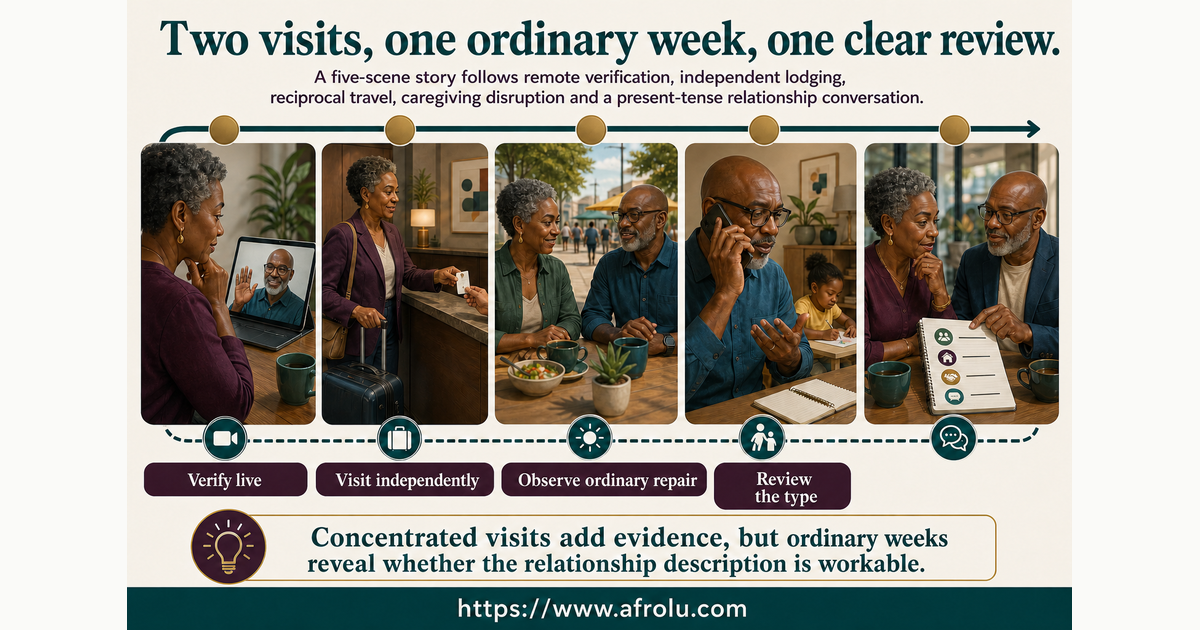
Adisa and Kojo are fictional adults, 52 and 57. They move from verified remote exploration through two independent visits and an ordinary caregiving disruption, then choose exclusivity while leaving geography, homes, family, money and documents unchanged.
The four-compass later-life distance atlas
Classify the relationship without merging the lives that are still testing it
Jean-Claude separates direction, structure, geography and access, then checks the description against ordinary conduct and five established-life systems.
The atlas follows two independent visits, one caregiving disruption and a six-ledger review with four equally valid outcomes.
Direction
Name the future you are willing to explore without assigning the role.
Structure
Describe the agreement operating today, including exclusivity.
Geography
Cost the actual time, travel and accessibility load.
Access
Open each established-life system through a separate yes.
Start with four accurate answers
Later-life experience does not make one relationship label do four jobs
Returning to dating later can create a strong wish to avoid wasted time. You may know your values, recognise familiar patterns and want a clear answer sooner than you did years ago. That knowledge is useful, but speed and clarity are different. A serious direction says which future you are willing to explore. A present structure says whether this is open exploration, exclusive dating, a defined partnership or something else. Long-distance describes geography. Access describes which parts of each established life another adult may enter. None of those answers can stand in for the other three.
The distinction matters because later-life dating often sits beside systems that already work: a home, adult or dependent family relationships, work, community duties, savings, health routines and preferred solitude. A promising match need not be treated as a threat to those systems, and those systems need not be surrendered to prove availability. The relevant question is which change the relationship actually requires now. One video call requires almost no structural change. A first visit requires public plans, travel independence and an exit. Relocation, property, caregiving and legal arrangements belong much later and may require qualified advice.
Distance can also magnify a label. Long conversations may feel unusually intimate because both adults choose focused windows and skip mundane interruptions. A weekend visit may compress affection, expense and novelty into a small space. Those experiences are real, but they do not reveal every ordinary-life behaviour. Ask how a person handles an inconvenient time zone, a declined request, a changed plan and an unglamorous week. A useful relationship type must explain the present without depending on holiday intensity or an imagined future.
Your first task is therefore descriptive, not predictive. Write four lines: the future direction you want, the relationship structure both adults have chosen, the geographic pattern that actually exists and the access currently permitted. If the other adult cannot repeat roughly the same four lines, pause escalation. The gap may be a repairable misunderstanding, a genuine incompatibility or deliberate ambiguity. Clarity means the answer can change your action; it does not mean persuading the other person to use your preferred label.
Use the four-compass distance atlas
Let each compass answer only the question it can answer
The direction compass can point toward companionship, a lasting partnership, marriage where freely desired, a lighter connection or open discovery. Direction is personal until both adults discuss it, and even a shared direction is conditional on fit. It does not guarantee that this relationship reaches the destination. Adults returning later may reasonably know that they never want to merge homes, or that partnership matters more than a legal status. State the desired future in practical terms rather than relying on a status word whose meaning may differ.
The structure compass describes what is operating today. Are both adults free to date others? Has exclusivity been chosen? Is there a defined partnership, and what commitments are actually included? Physical intimacy, frequent contact, a family introduction and a travel booking cannot silently create structure. If sexual-health decisions are affected, discuss relevant partners, testing and prevention directly with appropriate clinical support. Exclusivity is not device inspection, tracking or a right to know every movement.
The geography compass records distance, time zones, travel cost, accessibility, immigration realities and the distribution of visits. It does not measure love. A connection can be serious and remain geographically separate. Living apart together may be a durable preference for some adults; for others, distance is a temporary stage with a closing plan. Name which version is being explored and what evidence is still missing. Do not promise relocation before work, care, housing, legal and financial facts are independently understood.
The access compass covers body, home, family, digital accounts, money, documents and professional networks. Each gate needs a reason and a freely chosen yes. A visit does not grant a home key. Exclusivity does not grant passwords. Serious partnership does not grant account authority. Family approval cannot grant physical consent. When one compass is used to seize another—for example, 'if this is serious, send the fare'—return to the four lines and protect the system being pressured.
Adisa and Kojo test their description
Two visits and one disrupted week reveal what concentrated romance cannot
Adisa, 52, lived near her adult daughter and ran a small consultancy. Kojo, 57, had an established home in another country and regular responsibilities for an older relative. After several live video calls, they agreed that their direction was serious exploration, their structure was non-exclusive and their geography was remote-first. They did not exchange identity documents, bank records or home keys. Adisa's first visit used a hotel she selected, a ticket she controlled and public meetings she could end independently.
The weekend was warm, but they resisted treating warmth as a verdict. Kojo did not ask to move the date to his home when rain changed the plan. Adisa paid her own essential costs, and neither adult posted the visit for family audiences without permission. They learned how each handled walking pace, restaurant changes and quiet time. They did not learn how either person managed an ordinary workday, prolonged stress, shared domestic labour or a major financial decision, so those questions stayed open.
Before Kojo's reciprocal visit, his caregiving schedule disrupted two planned calls. The first missed call produced an apology; the second conversation produced a repair. He explained only the information he was entitled to share, proposed two new windows and stopped promising constant availability. Adisa named the effect without demanding access to his relative's private health details. The repair showed a relationship rhythm that could accommodate an established responsibility while still giving the other adult usable information.
After Kojo's visit, they reviewed the four compasses. Their direction remained serious, and they chose exclusivity. Geography remained long-distance for at least the next year. Access expanded only to a trusted-contact detail for future travel; homes, finances, documents and family introductions stayed separate. They did not call this a failure to progress. The relationship type had become more accurate precisely because the discussion protected the lives from which both adults were choosing it.
Protect five established-life systems
Closeness can grow without converting independence into a test of love
Home access includes an address, entry, keys, overnight stays and knowledge of routines. A first visit can remain public with independent lodging. Later invitations can be specific to one occasion and can change. Family access includes names, contact details, introductions, photographs and information about care responsibilities. Ask before sharing a match with adult children, relatives, faith communities or friends. A relationship is not made legitimate by turning private people into an audience.
Money access includes transfers, loans, shared bookings, investments, account details, property discussions and any role in financial decisions. Romance-scam guidance repeatedly warns that trust can be cultivated before urgent travel, medical or investment requests. A genuine person may still have a genuine need; that does not make you the appropriate funding source. Keep essential money, credentials and documents controlled. Verify claims outside the romantic channel and use qualified professional advice for consequential financial or legal decisions.
Digital access includes passwords, authentication codes, cloud folders, device inspection, live location and social-media audiences. Use personal channels with strong unique passwords and multifactor authentication. Do not make surveillance the enforcement mechanism for exclusivity. Travel access includes passport images, visas, tickets, lodging, emergency contacts and return control. Share only what the next legitimate step requires, through the appropriate service, while each adult retains documents and an independent route home.
A request becomes concerning when refusal produces repetition, shame, threatened withdrawal, spiritual or family pressure, financial urgency or attempts to bypass the boundary. Severity matters: you do not need a long pattern before responding to a threat, document demand or coerced physical situation. Reduce access, preserve relevant evidence where safe, contact financial or platform services after loss and seek local support appropriate to immediate risk. A relationship label never removes the right to protect a system.

Open only the system needed for the next proportionate step, with permission that can be changed.
Use seven present-tense sentences
Clear language respects history without letting history dictate the result
Start with direction: 'I am open to a lasting partnership, and I need to learn whether our established lives can fit without rushing a merger.' Then name structure: 'We have not agreed exclusivity; is that still how you understand today?' These sentences honour a serious goal while keeping present facts visible. Avoid implying that age creates a deadline or that previous relationships should have taught the other person your definition automatically.
For visits, say: 'I can meet publicly and keep my own lodging, ticket and return.' For family: 'I will decide when and how to involve my daughter, and I will ask before sharing anything about you.' For privacy: 'I do not exchange passwords, live location or private documents.' The other adult may have equally valid limits. Compare whether the plans can coexist rather than treating each boundary as an obstacle to overcome.
Money language should be unambiguous: 'I do not send fare, invest through a match or share account access.' A respectful response may include disappointment or a different proposal, but it does not require a detailed defence. If a person continues after a clear no, end the transaction and consider ending contact. For physical consent, use the same present tense. An earlier yes, a long journey, a paid meal or an exclusive label answers none of the acts that follow.
Finish with review: 'After the next ordinary month and one reciprocal visit plan, I want us to review direction, structure, geography and access.' The evidence may support deeper commitment, a revised rhythm, a long-term living-apart arrangement or closure. You do not owe an outcome because both adults have invested time. The value of the review is that it returns the choice to the present record.

Ask one present-tense question at a time and leave every different answer usable.
Review six ledgers
Protect time by examining the record instead of racing the clock
The direction ledger asks whether the future each adult describes is still compatible. The conduct ledger records confirmed plans, truthful corrections, response to limits and repair after disruption. The travel ledger asks whether cost, effort and inconvenience are reciprocal enough for the current stage. One adult need not mirror every trip exactly, but both should be able to explain why the distribution is fair and whether it can continue.
The capacity ledger covers work, caregiving, health, rest, community and solitude without demanding private proof beyond what the decision requires. A relationship can be emotionally valuable and practically unsustainable. The systems ledger checks whether home, family, money, digital and document access expanded through specific choices. If dependence is growing faster than evidence, close or narrow the relevant gate before deciding whether the relationship itself should continue.
Choose among four equal paths. Continue the present type when it remains accurate and workable. Revise one variable—such as call rhythm, visit distribution or exclusivity—when both adults want a specific change. Deepen commitment when ordinary conduct and practical facts support it, while keeping unrelated systems independent. Close when core direction conflicts, capacity does not fit or pressure and deception make a smaller experiment inappropriate.
If closing is the answer, use a concise message where safe and undo unnecessary access. Cancel shared bookings through legitimate channels, change exposed credentials, arrange belongings without private dependence and tell an appropriate trusted person if contact becomes persistent or threatening. Ending does not mean that later-life dating was a mistake. It means the type was reviewed against reality and no longer earned another step.

Review what works now before adding travel, access or a promise to restructure either life.
Compare eight nearby types
Long-distance relationship types are arrangements, not ranks on an age-based ladder
Open remote exploration supports conversation before either adult chooses exclusivity. Its advantage is lower commitment while learning; its risk is private expectation growing beyond the stated structure. Exclusive long-distance dating answers whether either adult dates others, but not whether homes will merge. A defined partnership adds mutual relationship status and chosen commitments while leaving passwords, property, family and physical access separate.
Living apart together can describe a committed partnership in which separate homes remain an intended structure, not merely a temporary obstacle. A first-visit stage tests in-person interaction while preserving independent travel and lodging. A reciprocal-visit stage adds evidence about effort and each location. Closing-distance planning is a practical project with employment, care, housing, legal and financial facts; it is not a romantic test that one person must pass by moving.
An online-only connection may be freely chosen, temporarily necessary or an unresolved talking stage. Name whether an in-person meeting is desired and possible. If one adult continually promises a visit but prevents verification, changes identity details or requests money, treat the facts as safety information rather than proof that more patience is required. A companionship structure may prioritise emotional connection without aiming for merged households; it still requires clear scope and consent.
Review the type whenever an assumption affects dating choices, sexual health, travel, family disclosure, money or a major life system. Ask what the current label answers, what it does not grant, what burden it creates and which observable evidence should come next. The mature choice is not always the most merged arrangement. It is the arrangement that remains mutual, accurately named and leaveable.
Eight later-life distance moments where the relationship type needs a present answer
Both adults say serious
They have not discussed exclusivity, living arrangements or whether distance is temporary.
Use the label to open four separate questions.Remote intimacy feels like partnership
Focused contact is warm, but no present structure has been chosen.
Ask what the rhythm means without treating frequency as status.Home lodging is offered as proof of trust
Accepting would expose address and exit control before in-person evidence exists.
Keep lodging and return independent.Adult children are told before permission
The connection becomes public inside a private family system.
Repair the disclosure and set an audience rule.A travel shortfall becomes urgent
Romantic direction is used to request essential money or documents.
Do not transfer; verify independently and postpone.An ordinary duty interrupts contact
The adult explains the impact and offers a workable repair without oversharing another person's privacy.
Observe whether the revised rhythm remains reliable.Both adults want a present change
Their direction aligns and ordinary conduct supports a narrower structure.
Define exclusivity and what it still does not grant.One adult is expected to move
Employment, housing, care, legal and financial facts have not been mapped.
Return to independent scenario planning before any promise.Signs that direction, structure, geography and access remain accurately separated
{'label': 'Direction', 'title': 'The future is described without assigning a role', 'detail': 'Serious hope remains conditional on mutual fit.', 'reading': 'Grounded'}
{'label': 'Structure', 'title': "Both adults can name today's agreement", 'detail': 'Contact and travel do not substitute for words.', 'reading': 'Mutual'}
{'label': 'Geography', 'title': 'Distance costs are made visible', 'detail': 'Time, money and accessibility enter the plan honestly.', 'reading': 'Practical'}
{'label': 'Access', 'title': 'Established systems open separately', 'detail': 'Home, family, money and data are never bundled.', 'reading': 'Bounded'}
{'label': 'Ordinary life', 'title': 'The bond survives unglamorous weeks', 'detail': 'Reliability is visible outside concentrated visits.', 'reading': 'Observable'}
{'label': 'Repair', 'title': 'A disruption changes the next plan', 'detail': 'Accountability is more than an affectionate apology.', 'reading': 'Responsive'}
{'label': 'Family', 'title': 'Private people are not used as an audience', 'detail': 'Introductions and disclosure follow permission.', 'reading': 'Respectful'}
{'label': 'Money', 'title': 'Travel does not create financial dependence', 'detail': 'Each adult retains essential funds and documents.', 'reading': 'Independent'}
{'label': 'Consent', 'title': 'A no remains complete after a journey', 'detail': 'Effort and expense create no physical obligation.', 'reading': 'Voluntary'}
{'label': 'Review', 'title': 'The relationship type can be revised', 'detail': 'A label is accurate only while the agreement remains true.', 'reading': 'Current'}
Choose the next step from four compasses and five protected systems
| Situation | What it may mean | What to do next |
|---|---|---|
| Can both adults name direction? | Fits: The future aim is compatible and conditional. Needs review: One definition needs translation. Stop: A future label is used as present ownership. | Write each direction in practical language. |
| Is present structure explicit? | Fits: Dating-others expectations match. Needs review: Frequent contact has created assumptions. Stop: Ambiguity protects one adult's access. | Define structure and relevant health choices. |
| Is geography honestly costed? | Fits: Time, money and accessibility are visible. Needs review: One visit burden needs rebalancing. Stop: Travel dependence removes a safe return. | Design the next trip as an independent system. |
| Does ordinary conduct support the type? | Fits: Plans and repair survive routine weeks. Needs review: Evidence exists only during visits. Stop: Warm weekends repeatedly conceal deception or absence. | Observe one ordinary-life cycle before escalating. |
| Is home access proportional? | Fits: Public plans or specific invitations preserve exit. Needs review: Convenience is opening an address early. Stop: Private lodging is demanded or departure is obstructed. | Keep accommodation and transport independent. |
| Is family access invited? | Fits: Both adults consent to the audience and scope. Needs review: A well-meant disclosure needs repair. Stop: Family pressure is used to override a choice. | Close the audience and restate permission. |
| Does money remain controlled? | Fits: Essential funds and accounts stay separate. Needs review: Shared cost could make leaving harder. Stop: Urgent transfers, investments or credentials are requested. | Stop the transaction and verify outside romance. |
| Can consent change? | Fits: Every physical and digital step gets a free answer. Needs review: Disappointment needs space. Stop: Travel, gifts or status are used as debt. | End the pressured step and prioritise safety. |
| Is closing distance evidence-based? | Fits: Several realistic paths and costs are compared. Needs review: One assumption needs qualified advice. Stop: One adult must move before facts or agreement. | Pause promises and map independent scenarios. |
| What does the review support? | Fits: Continue, revise or deepen fits the record. Needs review: One small experiment can answer a real gap. Stop: Further access would reduce agency or safety. | Choose the smallest truthful next step or close. |
Scripts for structure, visits, family, money, consent and relocation
“I want a lasting partnership, and I am still learning whether our established lives fit.”
“We have not agreed exclusivity; how are you describing us today?”
“I need a travel rhythm that both of us can fund and recover from.”
“I will keep my own lodging, ticket, documents and return plan.”
“This invitation is for today; it is not a key or permanent access.”
“Please ask before telling family or sharing my photo.”
“I do not send fare, invest through a match or share account access.”
“I am not agreeing to that, regardless of the trip or our label.”
“Let us compare staying apart, a trial period and moving before promising one path.”
“I want to review direction, structure, geography and access after this ordinary month.”
Know the difference
The later-life long-distance relationship-type atlas
Direction and structure describe what both adults are exploring and what they have mutually chosen now. They require direct words.
Distance, separate homes, family roles, finances and travel describe practical systems. They do not decide commitment automatically.
Choose an accurate agreement and a workable life arrangement separately; deepen either only through new evidence and two free answers.

Choose the type that accurately describes today, then review it when conduct or circumstances change.
Compare eight later-life long-distance relationship types
| Type or dimension | What it describes | Best next question |
|---|---|---|
| Open remote exploration | ||
| Exclusive long-distance dating | ||
| Defined long-distance partnership | ||
| Living apart together | ||
| Online-only connection | ||
| First-visit stage | ||
| Reciprocal-visit rhythm | ||
| Closing-distance planning |
Build an accurate mature distance relationship in six moves
Name direction
Define structure
Cost geography
Protect systems
Observe ordinary life
Review the type
Questions for type, established life, visits and review
Choose a few prompts that fit the moment. This is a reference library, not a list to complete.
Type questions
Describe the present before predicting the future.
- What direction do I want?
- What structure exists?
- Is distance temporary?
- Which access is agreed?
- Can both repeat the answer?
Established-life questions
Protect systems while testing fit.
- Which home detail stays private?
- Who may know?
- Which money stays protected?
- What care duty matters?
- What needs qualified advice?
Visit questions
Keep discovery independent and leaveable.
- Who controls the ticket?
- Where is separate lodging?
- What is the public plan?
- Who is the trusted contact?
- Can either cancel safely?
Review questions
Use ordinary evidence for one next choice.
- Did repair change conduct?
- Is travel reciprocal enough?
- Does capacity fit?
- Which gate stays closed?
- Continue, revise, deepen or close?
What relationship research and official guidance can support
Adults use online dating for overlapping reasons
Pew Research Center reported several stated reasons among U.S. online-dating users, including long-term relationships, casual dating and friends. Afrolu uses that finding only to support asking about intent rather than treating platform presence as one universal goal.
Evidence limit: The survey describes U.S. respondents and cannot define the motives of one person or adults in every country.
Commitment and separate households can coexist
Research on living-apart-together relationships describes committed couples who retain separate residences for varied reasons. It supports treating housing arrangement as a practical choice distinct from affection or status.
Evidence limit: Definitions and samples vary, and no study determines whether separate homes suit a particular couple.
Dedication differs from constraints that make leaving costly
Peer-reviewed commitment research distinguishes freely chosen dedication from material, felt and other constraints. Travel deposits, public announcements or entangled systems can increase cost without proving a healthier bond.
Evidence limit: Population research cannot score one relationship or decide whether an adult should stay.
Remote trust may precede urgent money requests
The U.S. Federal Trade Commission describes romance-scam patterns involving remote trust, travel or emergency narratives and requests for money. Keeping funds and credentials independent reduces one avoidable route to harm.
Evidence limit: FTC reporting routes are U.S.-specific; use appropriate local, platform and financial channels.
Strong account hygiene protects independent choice
CISA recommends strong unique passwords, multifactor authentication, software updates and phishing awareness. A relationship label is not a reason to share credentials or authentication codes.
Evidence limit: Cybersecurity practices reduce risk but cannot verify a person's identity or guarantee account safety.
Consent remains voluntary, informed and current
The Australian Department of Health explains that sexual consent is a free, voluntary and informed agreement and that a person can decide to stop at any time. Age, commitment, exclusivity, travel, gifts and a previous yes cannot decide a new physical or digital act.
Evidence limit: The service and legal context are Australia-specific; emergency, health and legal options vary by location.
Six ways distance or time pressure can blur the relationship type
Use a reviewed resource that matches the decision
This guide focuses on the relationship decision, so it does not rank dating apps. Check current prices, safety tools, and local availability before choosing a service.
Explore the guide library
Show more related guides
Continue with Afrolu
Show more Afrolu guides
Relationship research and official scam, account and consent guidance
Afrolu reviewed these health, research, safety, or public guidance resources while editing this page. They support the behaviour and safety guidance; they do not diagnose any individual described by a reader.
Later-life long-distance relationship-type questions
What type of long-distance relationship suits someone returning to dating later?
There is no age-based best type. Separate four questions: future direction, present structure, geographic arrangement and access. Open exploration, exclusivity, partnership or living apart together can each be ethical when both adults understand the scope, the travel load is workable and home, family, money, digital and physical access remain separately chosen.
Does serious later-life dating mean we should become exclusive quickly?
No universal timetable applies. Discuss exclusivity when assumptions affect feelings, dating choices or sexual health. Define what it means, when it begins and what it does not grant. Serious direction may justify asking the question early; it cannot supply the other adult's answer or prove that ordinary compatibility is already known.
Can a committed couple choose to keep separate homes?
Yes. Some adults choose a living-apart-together arrangement, temporarily or as a durable preference. Discuss what commitment includes, how visits and care work, whether either person expects a future move and what household access remains specific. Separate homes do not prove low commitment, and merged homes do not prove safety or fit.
How many visits are enough before defining the relationship?
No evidence-based visit count can decide this. Consider live verification, ordinary-week conduct, reciprocal planning, response to boundaries, repair, relevant sexual-health conversations and whether both adults can describe the same present structure. A definition can be chosen before every question is answered, but it should not claim access or certainty that the record does not support.
Should I stay with a long-distance match during a first visit?
You may choose differently as evidence grows, but independent lodging is a strong early option because it preserves address privacy, rest and exit. Keep your ticket, documents, phone, payment and return under your control. Verify current travel and venue details independently. A host's disappointment does not create an obligation to accept private lodging.
When should adult children or family meet a later-life partner?
When the adult whose family system it is freely chooses and the disclosure scope fits the evidence. Ask the partner before sharing their photograph or private story. An introduction can be specific and reversible; it does not give family authority over the relationship or give the partner access to family contact details, home routines or caregiving information.
Is it safe to help a genuine long-distance partner with travel money?
A genuine person can still make a request that is unwise for you to fund. In a new or incompletely verified connection, keep essential money and credentials separate and choose a plan each adult can finance independently. Do not invest through a match or share authentication codes. Verify any claim outside the romantic channel and use appropriate financial support after loss.
Does exclusivity include location sharing or phone access?
No. Exclusivity is an agreement about dating or sexual partners as the adults define it. Live location, passwords, device inspection, cloud files and authentication codes are separate access decisions. Monitoring does not manufacture honesty and may reduce safety. Use direct agreement and the freedom to leave rather than surveillance as enforcement.
How do we discuss closing the distance without pressure?
Compare several real paths: remaining apart, adjusting the visit rhythm, trying a bounded temporary arrangement, one person moving or deciding that no fair path exists. Map work, housing, care, legal, health and financial facts independently. A serious relationship does not require one adult to sacrifice first, and consequential decisions may need qualified local advice.
How do I end a later-life long-distance relationship cleanly?
Where safe, state that the relationship no longer fits and end the romantic contact without debating your entire history. Cancel or separate shared bookings, remove unnecessary digital and financial access, return belongings through a practical route and tell a trusted person if contact becomes threatening or persistent. Seek appropriate local support for immediate safety or financial loss.
One thing to do now
Choose the type that protects both the relationship and the lives choosing it
Read four compasses and five systems. Continue when both adults describe the same present, logistics are fair enough and a no stays usable. Revise one variable when respectful evidence supports a small experiment. Close when core direction conflicts or deception, coercion, financial urgency, surveillance or unsafe travel pressure reduces agency.