Four coordinates before one status change
Choose Faith-Led Casual Dating Without Pressure or Vagueness
A faith-aware casual dating guide separating values, intention, structure and pace while protecting privacy, money, sexual health, consent and choice.
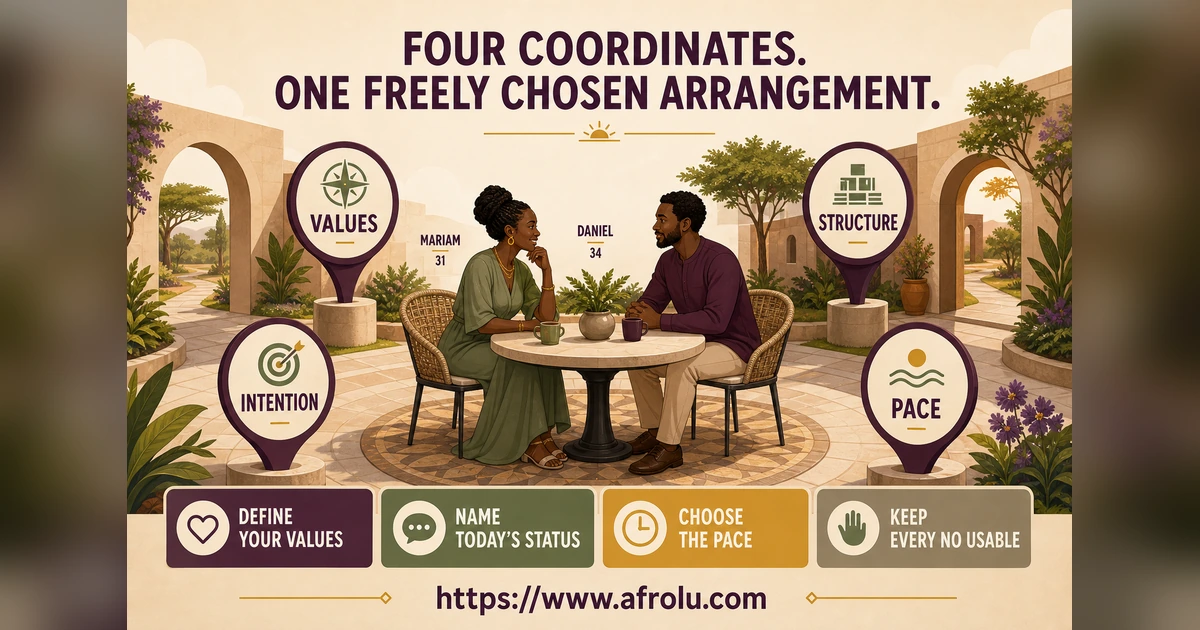
Name values, intention, structure and pace separately before choosing the next date.
Written and edited by Samira Benali · Faith and North Africa Editor
Separate four coordinates: personal values, future intention, present relationship structure and pace. State whether dating is open, focused, exclusive or partnered; discuss other dates and relevant sexual-health facts before they affect choice. Keep community information, money, accounts and movement controlled. Use a modest repeatable rhythm with a review. Continue, adjust, pause or close from observed conduct rather than identity, time invested or outside pressure.
Dating basics · Faith-Led Daters
Which faith-aware casual arrangement tells the truth today while leaving belief, access and every next choice freely held?
A faith-led low-pressure casual arrangement is a present dating agreement in which personally defined beliefs inform conduct while exclusivity, community access, money, health information and physical consent remain separately and freely chosen.
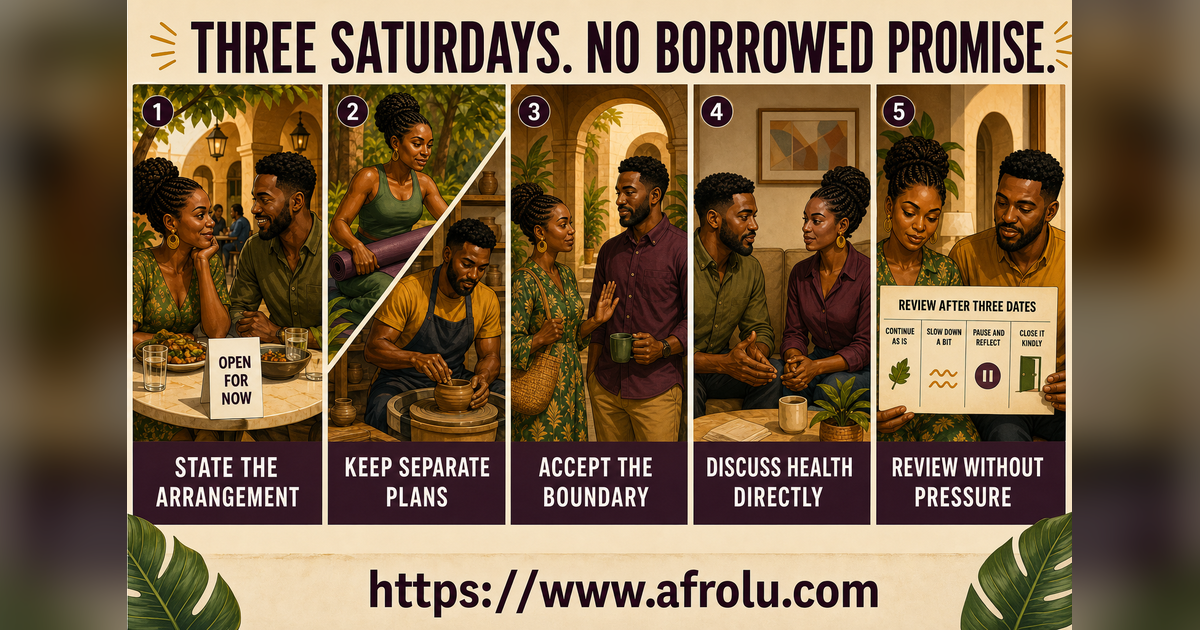
Mariam and Daniel are fictional adults, 31 and 34. Across three Saturday dates, a declined community invitation, direct health conversation and calm review show how shared interest can grow without converting an open arrangement into an unspoken promise.
The four-coordinate faith and casual courtyard
Let values inform the arrangement without deciding it alone
Samira separates belief, intention, structure and pace, then follows three ordinary dates through privacy, health and review.
The courtyard keeps every coordinate visible and every exit open so no identity, gift or public expectation can perform a status change.
Values
Explain the personal practice that actually affects dating.
Intention
Describe future openness without converting it into a promise.
Structure
Name open, focused, exclusive or partnered status today.
Pace
Choose enough contact and review without forcing escalation.
Begin with four separate coordinates
Faith-led, casual and low pressure answer different questions
Faith-led dating describes how personal belief, practice or conscience informs one adult's choices. Casual describes a present relationship structure that does not promise a long-term partnership by itself. Low pressure describes the way contact, access and escalation are managed. Those ideas can coexist, but they are not synonyms. Begin with first-person language: which practices matter to you, what future direction you are open to, what arrangement exists today and how much pace both adults can actually sustain.
Avoid using faith identity as a shortcut for character, sexual history, safety or compatibility. Two adults may use the same label while differing about community involvement, physical affection, exclusivity, alcohol, worship, privacy or marriage. Two adults with different labels may still share relevant conduct. Ask the practical question rather than grading the identity. A respectful disagreement can reveal fit; pressure to accept one person's interpretation reveals something different.
Casual does not mean careless, and it does not remove the need to discuss other dates, sexual health, consent, money or endings. It means the adults have chosen a smaller present structure. That structure may include public dates, warmth and recurring contact while leaving exclusivity and partnership unpromised. It becomes vague when one adult receives partner-level labour, secrecy, physical access or loyalty while refusing to state what they are offering in return.
Low pressure is also active rather than absent. A modest rhythm can include one planned date, a clear return after a missed plan and a review after three ordinary meetings. It should not require constant replies or early family access. It should still give both adults enough information to choose. When low pressure becomes indefinite ambiguity, repeated cancellation or a way to avoid every status conversation, reduce the arrangement or close it honestly.
Use the four-coordinate courtyard
Write values, intention, structure and pace on separate cards
On the values card, name only the practices that affect dating now. You might avoid certain settings, keep a weekly observance, want sexual boundaries, protect community privacy or prefer a particular path toward commitment. Explain the behaviour and whether it is personal or requested of both adults. Leave room for questions and difference. A broad label supplies context, not permission to inspect messages, contact a community leader or demand proof of devotion.
On the intention card, describe what future you are open to without borrowing certainty from it. You may be open to a serious partnership eventually while choosing casual dating today. You may want companionship without a shared future. Both can be honest. The important test is whether the other adult hears the same distinction. Future possibility must not be used to obtain exclusivity, money, unpaid care or physical access that the present agreement does not include.
On the structure card, state whether dating is open, focused on one person, exclusive or partnered. Clarify what happens with other dates and sexual contact before those facts affect health or consent. Do not treat a quiet period as exclusivity or a third date as an automatic upgrade. If either adult wants to change structure, they can ask. The old arrangement remains in place until both freely agree to the new one.
On the pace card, cost the actual rhythm: dates, messages, travel, recovery, community commitments and review. A low-pressure arrangement should leave work, sleep, friendships and personal practice intact. Offer enough contact to learn and enough space to think. If the only sustainable rhythm leaves one adult chronically uncertain or the other chronically overwhelmed, choose a different type rather than declaring either person's need morally superior.
Mariam and Daniel test three Saturdays
Enjoyment grows while the present arrangement stays open
Mariam, 31, and Daniel, 34, met for lunch after several measured conversations. Each described faith as personally important, but neither assumed that the phrase meant identical practice. Mariam wanted to keep family and community introductions private while learning. Daniel said he was open to a long-term relationship but was dating casually and not exclusively. They chose three public Saturday dates, no daily-message promise and a review before any change in status.
Before the second date, Daniel invited Mariam to a community event. She declined because she did not want a new connection entering that audience. Daniel did not argue that the event was harmless or that shared faith made secrecy suspicious. He offered their original public plan instead. His response protected her choice and also showed that he could experience disappointment without converting it into moral pressure.
On the third date, they discussed other dating, sexual-health expectations and physical boundaries. Mariam said she was comfortable with affection but not with a private setting. Daniel answered his current status directly and asked what health information would be relevant before any future intimacy. Neither treated faith as proof of health, experience or consent. They kept their own money and travel, and neither shared private community messages.
At the review, both said the dates had been warm and respectful. Mariam still preferred open casual dating; Daniel wanted to continue without asking for exclusivity. They kept the same rhythm for another month. That was a successful decision because it matched the evidence and both adults' present choice. If one later wants a different structure, the task will be a new conversation, not an argument that time invested has already decided it.
Read six gates rather than one identity
Belief, agreement, privacy, money, health and consent stay separately controlled
The belief gate asks whether each adult can explain personal practice without speaking for everyone who shares a label. Curiosity is welcome; interrogation and shame are not. The agreement gate asks whether both can describe the same present structure, including other dating and what would change it. Warmth does not open that gate automatically. The words should remain accurate after an ordinary week, not only during an intense conversation.
The privacy gate covers community names, messages, photographs, home, workplace and account access. A faith-aware relationship may involve public identity, but publication still needs consent. Decide what may be shared, with whom and for what purpose. The money gate stays closed to emergency transfers, investments, travel funding and proof-of-seriousness spending. A sincere story can still be false or financially unsafe, and a boundary does not require a final fraud judgment.
The health gate replaces inference with direct conversation and appropriate care. Faith identity, appearance, abstinence language or relationship intention cannot supply testing information or eliminate health needs. Discuss relevant partners, prevention, testing and boundaries before intimacy. Use qualified services for individual decisions. Neither adult must disclose unrelated medical history or provide documents to prove worthiness.
The consent gate remains current for every act. Previous affection, time, gifts, shared prayer, exclusivity or hoped-for marriage does not answer for someone now. Notice what happens after a pause or no. Respect keeps warmth available without bargaining. Sulking, shame, threats, repeated persuasion or using community reputation against someone changes the question from ordinary compatibility to pressure and possible safety support.

A shared value matters most when difference, privacy and refusal remain safe.
Use first-person clarity
Ten lines turn identity and casual status into usable choices
For belief, try: 'Faith guides these parts of my dating life; what does faith-led mean in yours?' For status: 'I am enjoying this and I am still dating openly.' For other dates: 'Before intimacy, I want us to share current partner and health information that affects the decision.' These lines separate personal meaning from the arrangement and give the other adult room to answer differently.
For pace: 'One planned date most weeks and a review after three dates works for me.' For community: 'Please ask before sharing my name, photograph or story with anyone.' For privacy: 'My accounts, messages and private practices stay mine.' Each sentence identifies a boundary without claiming that the other adult is unsafe for asking once. The response and repeated conduct provide the next evidence.
For money: 'I do not send money or invest through a new relationship; we can choose another plan.' For health: 'Before relevant intimacy, I want a direct conversation about testing, prevention and our boundaries.' For consent: 'I am comfortable with this, not that, and I may change my answer.' Specific language protects both adults from vague reassurance and makes a mismatch easier to see.
For review: 'Would we still choose this arrangement if family expectations and time invested were not deciding for us?' A review is not a demand for promotion. Continue when the type remains accurate, adjust one variable, pause when capacity is missing or close when needs differ. If pressure, deception, coercion or financial manipulation appears, prioritise safety and independent support rather than negotiating a more impressive label.

Say what a value changes for you, then ask rather than assume.
Review the ordinary pattern
Separate conduct, fit, pressure and the next free choice
The conduct folder records what repeated: plans kept, changes repaired, other dating disclosed when relevant, and boundaries accepted without punishment. Do not award points or turn ordinary uncertainty into a prosecution. The aim is to resist both idealising shared identity and dismissing a clear pattern. One respectful response matters; repeated pressure, secrecy or disappearing matters differently.
The fit folder asks whether both adults receive enough connection and enough independence. A casual arrangement can be generous and emotionally present. It can also be too small for one person's needs. Neither answer proves greater maturity or faith. Include practice, community privacy, communication, sexual-health comfort, money and how endings are handled. A mismatch deserves an accurate decision, not a campaign to change someone's values.
The pressure folder names forces that can imitate dedication: family expectation, public visibility, fear of judgment, gifts, time invested or the hope that physical intimacy must lead somewhere. Commitment research can help separate chosen dedication from constraints, but it cannot diagnose a couple. Ask what each adult would choose if leaving carried no shame or debt, then protect the answer from retaliation.
The next folder offers continue, adjust, pause and close. Continue the same type when it remains honest. Adjust one stated feature and set another review. Pause when personal capacity or safety facts are missing. Close when the arrangement cannot meet both adults' needs or when coercion, deception or unsafe financial dependence appears. Closure can honour faith and care without proving that the previous connection was meaningless.

Review conduct before changing the relationship name.
Compare present-tense types
Choose by agreement and access rather than moral rank
Discovery is conversation before a dating rhythm exists. Bounded dating adds a small number of planned meetings without exclusivity. Open casual dating names ongoing dates while both remain free to date others. Slow casual dating limits frequency or escalation so each adult can learn without partner-level expectations. Each can be faith-led when personal practice is stated and no identity claim substitutes for agreement.
One-person focus means an adult is currently concentrating attention on one connection without yet claiming mutual exclusivity. That personal choice must not be advertised as a shared status. Exclusive dating begins only when both agree to stop specified outside dating or sexual contact. It still does not automatically grant community access, account visibility, financial roles or consent to any act.
A defined partnership adds mutually chosen responsibilities and recognition. It may include faith and community practices, but those roles require detail. Closure is also a relationship type decision: one or both adults end the dating arrangement and remove access proportionately. An ending can be kind and firm. No spiritual explanation, final meeting or continued friendship is owed when safety or free choice requires distance.
Compare every type through three questions: what is agreed now, which access is included, and what evidence would justify a review. If the name is grander than the conduct, shrink it. If the conduct is caring but the need differs, decide fit. If the arrangement relies on shame, secrecy, money pressure or a no that cannot be used safely, exit the ordinary comparison and use appropriate support.
Eight faith-led casual dating moments where values and status can blur
Two adults mean different things by faith-led
One expects weekly community involvement; the other keeps practice private. Neither meaning decides the arrangement.
Describe the behaviours and decide fit without ranking sincerity.Enjoyment is mistaken for exclusivity
Both are affectionate, but neither has discussed other dating or status.
Name the current type before adding assumptions.A declined event is treated as secrecy
One adult wants more time before entering a public faith audience.
Keep the date private and read whether the boundary is respected.A quiet rhythm still keeps the plan
Messages are light, the public date is confirmed and both adults feel informed.
Judge the agreed rhythm rather than message volume.Casual status is used to demand a quick upgrade
One adult says delay proves bad character while seeking exclusivity.
Decline the pressure and keep every outcome available.Faith identity is treated as medical evidence
A health conversation is avoided because both appear value-aligned.
Discuss relevant facts directly and seek qualified care when needed.Shared purpose appears beside an urgent transfer
A new match links financial help to trust or spiritual duty.
Do not send funds; verify independently and use support channels.The values fit but the relationship need does not
One wants partnership soon and the other wants open casual dating.
Close honestly instead of asking shared identity to erase the difference.Signs that belief, structure, privacy, health and consent remain separately chosen
Each adult explains personal practice without claiming one universal faith-led rule.
Both can describe the same present relationship structure in plain language.
Other dating and relevant sexual-health facts are discussed before they affect choice.
A low-pressure rhythm still contains kept plans, useful notice and a review point.
Community names, photographs and stories stay private until sharing is agreed.
Money, accounts, travel and housing remain independently controlled.
A difference in belief or practice can be discussed without ridicule or shame.
Physical consent stays specific, current and separate from time or values.
A boundary leaves warmth possible but does not require continued dating.
Continue, adjust, pause and close remain equally real at every review.
Choose the next arrangement through ten values-and-agency questions
| Situation | What it may mean | What to do next |
|---|---|---|
| Can both adults define faith-led personally? | Fits: Practices and limits are specific. Needs review: A broad label still hides differences. Stop: One interpretation is imposed through shame. | Translate identity into conduct and decide fit. |
| Is today's relationship structure shared? | Fits: Open, focused, exclusive or partnered status is spoken. Needs review: Warmth is carrying an assumption. Stop: Access is demanded without an agreement. | Name the smallest accurate type. |
| Does low pressure still provide information? | Fits: Plans repeat and reviews happen. Needs review: Contact is too thin for one adult. Stop: The phrase excuses chronic disappearance. | Adjust the rhythm or close the mismatch. |
| Can community privacy remain controlled? | Fits: Sharing has a purpose and audience. Needs review: An introduction needs discussion. Stop: Names or images are circulated after refusal. | Stop sharing and reduce access. |
| Are other dates and health facts clear? | Fits: Relevant information is exchanged directly. Needs review: An assumption needs correction. Stop: Identity is used to conceal material facts. | Pause relevant intimacy and seek appropriate care. |
| Does money stay independent? | Fits: Plans are affordable and no transfer is required. Needs review: Spending expectations need a limit. Stop: Urgency or moral duty pressures payment. | Decline the transaction and verify outside romance. |
| Can belief differences stay safe? | Fits: Questions and disagreement remain respectful. Needs review: Defensiveness needs a slower conversation. Stop: Threats, humiliation or isolation appear. | Protect safety and use independent support. |
| Is consent current for this act? | Fits: A free specific answer is present. Needs review: Ambiguity requires a pause. Stop: Values, gifts or time override refusal. | Stop the act and prioritise safety. |
| Does the arrangement remain freely chosen? | Fits: Both would choose it without outside pressure. Needs review: Family or reputation affects the answer. Stop: Leaving is made socially or financially unsafe. | Restore independent choice before reviewing. |
| What does the twenty-one-day record support? | Fits: Conduct and fit support another chosen period. Needs review: One feature needs a bounded test. Stop: Coercion, deception or incompatible needs persist. | Continue, adjust, pause or close from evidence. |
Scripts for belief, casual status, community, money, health, consent and review
“Faith guides these parts of my dating life; what does faith-led mean in yours?”
“I like this connection and I am still dating openly.”
“Before intimacy, I want us to share current facts that affect health and consent.”
“One planned date most weeks and a review after three dates works for me.”
“Please ask before sharing my name, photograph or story with anyone.”
“My accounts, messages and private practices stay mine.”
“I do not send money or invest through a new relationship; we can choose another plan.”
“Before relevant intimacy, I want to discuss testing, prevention and our boundaries.”
“I am comfortable with this, not that, and I may change my answer.”
“Would we still choose this arrangement without family expectations or time invested?”
Know the difference
Faith meaning, casual structure and low-pressure pace remain separate coordinates
Names personal practice and today's structure, keeps privacy and money controlled, and lets boundaries or new evidence change the next choice.
Uses identity, community expectation, time or intimacy to imply status and access that both adults never directly chose.
Choose the smallest arrangement whose words match current conduct and whose every added layer remains optional.

Choose the smallest truthful arrangement and state what access it does not grant.
Compare eight faith-aware casual dating arrangements without moral rank
| Type or dimension | What it describes | Best next question |
|---|---|---|
| Discovery | Conversation before a dating rhythm exists; no exclusivity or community access is implied. | Enough interest for one bounded date |
| Bounded dating | A small number of public dates without exclusivity, private-system access or public introduction. | Conduct across two clear plans |
| Open casual dating | Recurring dates while both remain free to date others and disclose material health facts. | Comfort with the spoken open status |
| Slow casual dating | Open or bounded dating with deliberately limited frequency, disclosure or escalation. | Enough information at the chosen pace |
| One-person focus | One adult currently concentrates attention without claiming mutual exclusivity. | Direct discussion before shared status |
| Exclusive dating | Both stop agreed outside dating or sexual contact; other access remains separately chosen. | Reliable exclusivity and repair |
| Defined partnership | Mutually chosen status and responsibilities with private practice and consent still personal. | Sustainable conduct across ordinary weeks |
| Closure | The dating arrangement ends and access is reduced without requiring a moral verdict. | A clear boundary and appropriate support |
Build a clear faith-aware casual arrangement in six moves
Define personal values
Explain the practices that affect dating without speaking for every person with the label.
Name today's structure
State open, focused, exclusive or partnered status before warmth creates assumptions.
Choose enough pace
Set a modest repeatable rhythm that still produces useful information for both adults.
Gate private access
Keep community, accounts, money, health information and touch behind separate choices.
Read the boundary response
Let conduct after difference, delay or no inform the next decision.
Review without promotion pressure
Continue, adjust, pause or close while every outcome remains respectable.
Questions for meaning, structure, pace and agency
Choose a few prompts that fit the moment. This is a reference library, not a list to complete.
Meaning questions
Translate personal belief into present conduct.
- Which practice matters now?
- Is this personal or shared?
- Where may we differ?
- Who may know?
- What remains private?
Structure questions
Name what both adults are choosing today.
- Are we dating openly?
- Is either person focused on one match?
- What would exclusivity change?
- Which access is not included?
- When will we review?
Pace questions
Keep low pressure active and informative.
- How often do we meet?
- When do replies normally return?
- How are changes repaired?
- Is this enough connection?
- Can either person slow down?
Agency questions
Protect health, money, privacy and free choice.
- Which fact affects health?
- Is money staying controlled?
- Was the boundary respected?
- What pressure is external?
- Continue, adjust, pause or close?
What spiritual-intimacy, commitment, health, consent and fraud evidence supports
Religious meaning can matter without becoming a universal formula
A peer-reviewed study of married Seventh-day Adventist adults examined associations among spiritual intimacy, marital intimacy and wellbeing. It supports asking how shared meaning is experienced rather than assuming one label guarantees relationship quality.
Evidence limit: The sample was married and religiously specific, and the cross-sectional design cannot establish causality or define casual dating.
Chosen dedication differs from pressures that make leaving costly
Peer-reviewed commitment research available through PubMed Central distinguishes dedication from constraints such as investments, social pressure or practical cost. That distinction helps a casual dating review keep time and community visibility from impersonating mutual commitment.
Evidence limit: The concepts organise reflection; they do not diagnose a relationship or decide whether an adult should stay.
Respectful sexual wellbeing requires direct and informed choice
The World Health Organization describes sexual health as physical, emotional, mental and social wellbeing related to sexuality, including a respectful approach and freedom from coercion. Faith identity cannot replace relevant health conversations.
Evidence limit: The overview is not personalised medical or legal advice; local qualified care should guide individual decisions.
Relevant health facts belong before the choice they affect
U.S. Centers for Disease Control and Prevention guidance encourages conversations with partners about sexual health before sex. That supports asking about testing, prevention and current partners without demanding unrelated medical records.
Evidence limit: The service context is U.S.-specific and does not prescribe one test schedule or replace local clinical advice.
Values, affection and status never supply a current answer
NSW Government guidance presents consent as free, voluntary, communicated, ongoing, specific and withdrawable. The same standard applies in casual, exclusive and faith-led relationships.
Evidence limit: Legal definitions and services vary by location; use appropriate local professional or emergency support when needed.
Shared purpose can appear inside a financial manipulation story
The U.S. Federal Trade Commission warns that romance scammers build trust before requesting money. A reader can refuse a transfer and verify independently without resolving every personal or religious claim first.
Evidence limit: Examples and reporting routes are U.S.-specific; local platforms, providers and authorities have different processes.
Six ways faith or low pressure can blur a casual arrangement
Using faith as verification
Shared identity is treated as proof of character, health or intent. Repair: verify material facts proportionately and read conduct.
Calling vagueness low pressure
No rhythm or review exists while one adult waits. Repair: define contact, status and a decision point.
Making casual mean boundary-free
Privacy, health and consent are treated as optional. Repair: name every relevant access separately.
Publishing the connection early
Community visibility creates pressure and unintended disclosure. Repair: agree the audience before sharing.
Buying moral seriousness
Gifts or transfers are made to prove worthiness. Repair: keep plans affordable and money independent.
Treating time as an upgrade
Repeated dates become silent exclusivity or partnership. Repair: ask directly and preserve the existing type until agreement.
Use a reviewed resource that matches the decision
This guide focuses on the relationship decision, so it does not rank dating apps. Check current prices, safety tools, and local availability before choosing a service.
Explore the guide library
Show more related guides
Continue with Afrolu
Show more Afrolu guides
Primary spiritual-intimacy, commitment, sexual-health, consent and fraud sources
Afrolu reviewed these health, research, safety, or public guidance resources while editing this page. They support the behaviour and safety guidance; they do not diagnose any individual described by a reader.
Faith-led low-pressure casual dating questions
Can faith-led dating be casual?
Yes. Faith-led describes how personal belief informs conduct; casual describes the present relationship structure. State what faith changes for you, whether dating is open or exclusive, which boundaries apply and when you will review. Do not use a shared label to infer commitment, health, consent or character. A casual arrangement can be warm and responsible while remaining smaller than partnership.
What does low-pressure faith-led dating look like?
It has enough contact to learn without demanding constant access or fast escalation. Choose a repeatable date and message rhythm, keep community and private systems controlled, repair changed plans and set a review after an ordinary period. Low pressure stops being useful when it excuses chronic disappearance, avoids every structure conversation or leaves one adult indefinitely uncertain.
Do shared values mean we should date exclusively?
No. Shared values may support compatibility, but exclusivity begins only when both adults directly agree to stop specified outside dating or sexual contact. Until then, use the spoken present arrangement. Discuss other partners and relevant health facts before they affect choice. Even exclusivity does not automatically grant account access, money, community publicity or consent.
How should we discuss different faith practices?
Use first-person detail: which practice matters, what it changes, whether it is personal and where you can differ. Ask rather than test. A respectful mismatch can lead to a smaller arrangement or closure. Ridicule, shame, threats, forced participation or using community reputation to make leaving unsafe are not ordinary disagreement and may require independent support.
When should family or a faith community know?
Only when both adults understand and accept the purpose and audience. Early casual dating rarely requires names, images, messages or private history to circulate. One adult can seek confidential support without publishing the other. If an introduction is proposed, discuss what status it implies, what will be shared and whether either adult can decline without punishment.
How do faith-led casual daters discuss sexual health?
Directly and before relevant intimacy. Discuss current partners, testing, prevention, boundaries and where qualified care is needed. Do not infer health information from faith identity, appearance or serious language. Share what the decision requires without demanding unrelated records. Each act still needs a free, specific and current answer, and either adult may pause.
Does casual dating make consent less clear?
It should make the need for clarity more visible, not less. Ask about the specific act and accept a no, pause or changed answer without bargaining. Gifts, dates, travel, time, shared practice, open status or exclusivity do not create physical entitlement. If refusal leads to shame, threats, repeated persuasion or an unsafe exit, stop and prioritise support.
What if a faith-led match asks for money?
Do not treat shared values as verification. Keep essential funds, payment accounts and investments controlled. Decline transfers and verify consequential claims through sources you locate independently. Urgency, secrecy or moral pressure is a reason to stop. If money has moved, contact the relevant financial provider quickly and use appropriate platform and local reporting channels.
Can low-pressure dating become serious later?
Yes, if both adults freely choose a new structure after enough evidence. Review whether plans repeat, boundaries remain safe, health conversations are possible, money stays independent and needs are compatible. Then ask directly about exclusivity or partnership. Time and affection alone do not perform the upgrade, and either adult may prefer to keep the current type or close.
How do I know whether to continue the arrangement?
Separate conduct, fit and pressure. Continue when the present type is honest and sufficient. Adjust one named feature when the mismatch is manageable. Pause when capacity or important facts are missing. Close when needs differ or when coercion, deception, financial manipulation or unsafe community pressure appears. A clear ending can respect both faith and the connection that existed.
One thing to do now
Choose the arrangement whose values leave both adults free
Advance when values are personally defined, today's structure is shared, the rhythm produces enough evidence, private systems remain controlled and every no stays usable. Adjust one bounded feature when the mismatch is manageable. Pause for missing facts or capacity. Close when needs differ or identity, reputation, money, intimacy or time is used to coerce access.