Five city checkpoints before one access change
Choose a Safe Diaspora Dating Arrangement in Nairobi
A diaspora Nairobi guide to dating types, verification, public meetings, transport, privacy, money, consent, family sharing and post-date review.
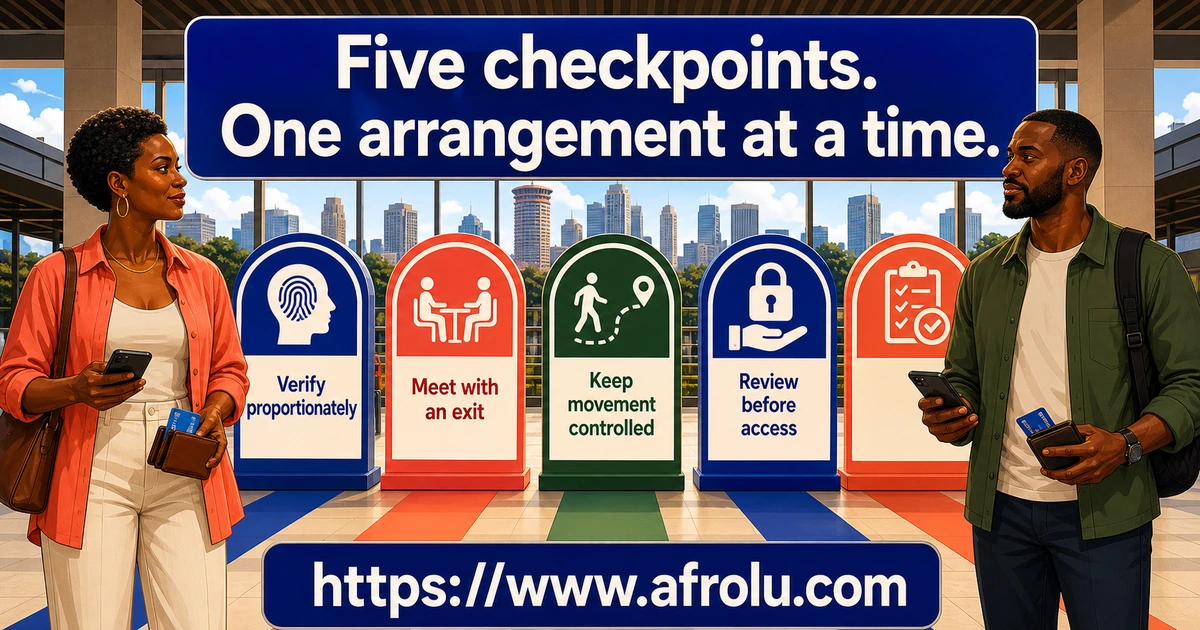
Choose the relationship arrangement and each safety permission separately.
Written and edited by Nadine El-Sayed · Verification Editor
Separate the relationship arrangement from five safety checkpoints: identity, meeting, movement, access and review. Diaspora background, Nairobi familiarity, hospitality, travel expense and a successful date do not prove intent or create exclusivity. Verify only the claim relevant to the next step, confirm public plans independently, control phone, payment and departure, keep addresses, accounts, money, images, family and touch behind separate permissions, then repeat, revise, pause or close from observed conduct.
Dating basics · Diaspora Daters
Which dating arrangement accurately describes today, and which city or access decision can be made without asking familiarity to substitute for evidence?
A diaspora Nairobi dating arrangement is the present relationship agreement between adults whose city access, travel rhythm or home ties cross locations, with identity evidence, movement and private-system access chosen independently of the label.
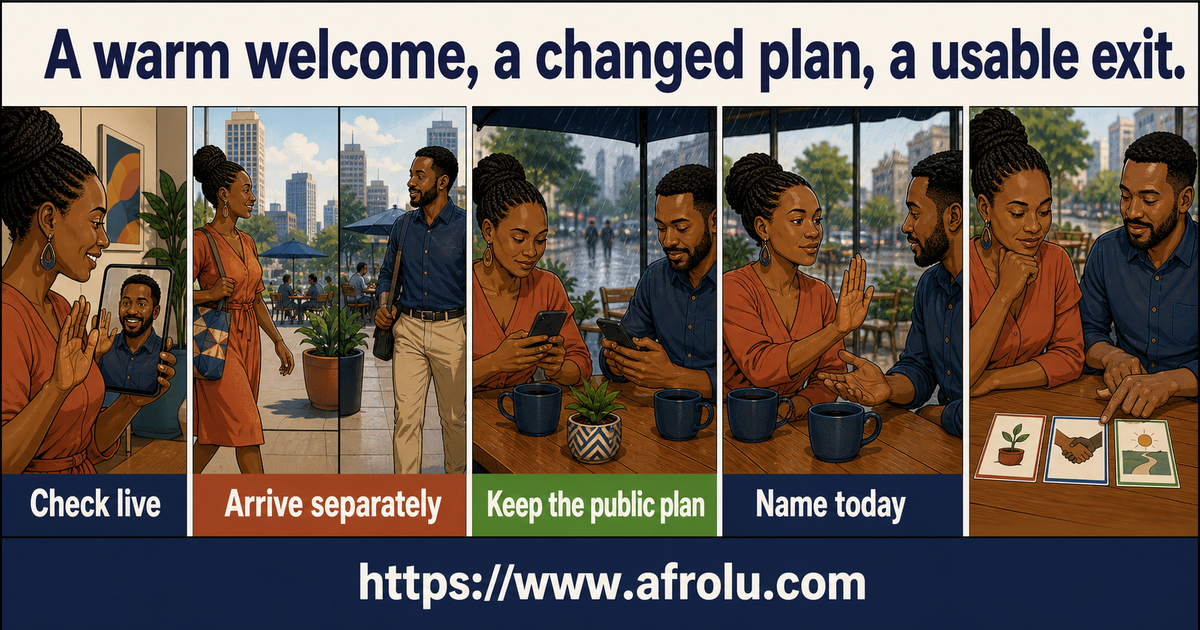
Zuri and Malik are fictional adults, 38 and 41. During Zuri's short Nairobi stay they move from verified remote exploration to two public dates, and a rain-related location change tests whether hospitality leaves her boundary and departure intact.
The five-checkpoint diaspora city terminal
Choose the relationship type without handing city familiarity the keys
Nadine separates identity, meeting, movement, access and review, then lets a changed Nairobi plan test whether the arrangement remains leaveable.
The terminal follows two public dates, one declined private switch and a six-part after-date review with four equal outcomes.
Identity
Confirm only the fact required for the next bounded action.
Meeting
Choose a current public plan without treating public as a guarantee.
Movement
Keep arrival, essentials and the route home under personal control.
Access
Open address, accounts, money, images, family and touch separately.
Review
Let facts and boundary response choose one next action.
Separate connection from city access
A Nairobi plan does not tell you what kind of relationship you have
A diaspora connection can arrive with several stories already attached. One adult may be visiting Nairobi, returning after years away, working between cities or planning a longer stay. The other may know the city well, have recently moved there or also live across borders. Those facts shape transport, time, privacy and expectations, but they do not tell either adult whether the connection is open exploration, exclusive dating, partnership or a relocation project. Begin with a present-tense sentence about the relationship, then build the city plan that fits it.
Safety also needs separate sentences. Verification asks whether a relevant claim has enough independent support for the next step. A meeting plan asks where, when, how each person arrives and how each can leave. Access asks who may know an address, see a document, receive an image, contact family or handle money. Consent asks about one current physical or digital act. A person can pass one checkpoint without receiving a general certificate of trust. Every later permission remains available to grant, refuse or change.
Avoid treating local familiarity as either proof or danger. Someone who knows Nairobi can suggest a practical public place, but you should still confirm current opening, location and transport information through authoritative channels. A visitor can be organised or careless. A returnee can know family networks and still be unfamiliar with a changed area. Make the plan from current facts and personal capacity rather than from assumptions about who is worldly, wealthy, vulnerable or owed hospitality.
The useful question is not 'Can I trust diaspora dating?' It is 'What arrangement are we choosing, which fact matters for the next action, and can either person leave that action without punishment?' That question allows warmth and caution to coexist. It also prevents safety advice from becoming surveillance. You do not need passwords, constant location access or a private dossier to date thoughtfully. You need proportionate checks, controlled essentials, direct language and attention to behaviour when a limit is heard.
Walk the five-checkpoint terminal
Identity, meeting, movement, access and review answer different questions
At the identity checkpoint, confirm only what the next decision requires. Live contact can show that a person can appear and respond in real time, but it does not prove every biography detail. Consistent names, timelines and ordinary conversation add context. When a claim affects travel, work, money or legal decisions, verify it outside the romantic channel through the appropriate official or professional source. Do not exchange full identity records merely to demonstrate good faith; copies can expose information unrelated to dating.
At the meeting checkpoint, choose a public setting that is currently open, accessible and suitable for both adults. Tell a trusted person the broad plan if that supports you. Keep the first encounter bounded enough that leaving is simple. Public does not mean universally safe, and a crowded venue does not replace awareness. It means the plan gives both adults more options than an unfamiliar private address. Confirm details close to the date because city conditions, hours and transport routes change.
Movement covers arrival, departure, phone charge, payment and an alternative route. Each adult should know how to leave without the other person's vehicle, fare, device or permission. If plans change, make the new choice rather than drifting into a private location because weather, traffic or convenience has created pressure. A considerate date can help solve a problem while still respecting independent control. If refusal creates anger, repeated bargaining or an attempt to strand someone, the response is the safety information.
Access and review complete the circuit. Keep home addresses, workplace routines, family contacts, live location, passwords, intimate images, money and documents behind separate permissions. Afterward, write what was confirmed, what remained uncertain, which boundaries were respected and what the current relationship description still means. Attraction may support another date. It does not need to produce exclusivity, home access or a financial gesture. Review makes a modest next step possible without pretending certainty.
Zuri and Malik test the arrangement
One declined location change gives them better evidence than a perfect welcome
Zuri, 38, was spending three weeks in Nairobi while visiting relatives and exploring a possible work move. Malik, 41, lived in the city and had matched with her before the trip. They used live video, kept the first conversations on the platform and agreed that they were in open exploration. Zuri did not send her itinerary, passport page or relative's address. Malik suggested three public daytime options; she confirmed one independently and arranged her own arrival and return.
The meeting felt easy. They discussed work, family and why Zuri might move, but Malik did not treat her possible relocation as a promise to continue dating. He asked before taking a photograph and accepted when she preferred not to post anything. Zuri paid her share as planned. Neither used spending as a test. Their connection was warmer after two hours, yet the arrangement remained public city dating rather than an exclusive relationship or a local-host dependency.
Rain disrupted the second plan. Malik offered his apartment as the simplest alternative. Zuri said she was not meeting at a home yet and proposed a covered public venue she had checked. Malik briefly explained that the change would add travel time, then agreed or offered to reschedule; he did not call the boundary distrust, invoke the effort he had made or ask for her family address instead. The repaired plan showed that convenience could bend without requiring Zuri's safety rule to bend.
After two dates, they reviewed the present. Both wanted another meeting and remained free to see others. Malik knew only the neighbourhood of Zuri's accommodation, not the address. Zuri knew how he described his job but had not verified details irrelevant to a casual date. They agreed that if exclusivity became relevant, they would discuss it directly rather than infer it from the length of her stay. The result was modest: another public date, clearer language and no expanded money, home, device or family access.
Protect five forms of access
The relationship can progress while identity, movement, data and money stay proportionate
Identity information sits on a spectrum. A first name, live conversation and consistent public profile may be enough for early screening. A travel booking, employment claim or consequential financial proposal needs different evidence. Never let a match turn a request for your documents into the price of verifying theirs. Share through legitimate services only what that service actually requires. Where impersonation, account compromise or cyber fraud is suspected, preserve relevant evidence safely and use appropriate platform, financial or national incident channels.
Movement information includes current location, home and workplace addresses, routines, vehicle details and travel documents. Share the meeting location and a useful arrival window without granting continuous tracking. A chosen trusted contact can know the broad plan without becoming a chaperone who controls the date. If you are visiting, keep lodging and the return route under your control. If you live locally, hospitality remains optional. Neither person owes a pickup, home tour or family-host role because one knows the city better.
Digital access can expand quietly when a conversation moves from an app to personal messaging. A phone number may expose social profiles, contacts or account-recovery pathways. Use strong unique passwords, multifactor authentication and current software; never share login or verification codes. Ask before forwarding messages or posting images. Intimate media deserves especially careful consent because copying and distribution can outlast the relationship. A threatened release or demand for more material is a reason to stop engagement and seek specialised support.
Money access includes fare, emergencies, gifts, investments, mobile transfers, account details and business opportunities. Romance-scam guidance describes relationships cultivated before an urgent request, but you do not need to decide whether the entire identity is false before refusing payment. Keep essential funds independent, verify claims beyond the romantic channel and contact the relevant provider promptly after loss. A genuine adult can respect that a new match is not the right source of finance. Pressure, secrecy or urgency reduces the case for another step.

Open only the gate needed for the next bounded step.
Use eight departure-board sentences
A good boundary includes the plan you are available for
For a meeting, try: 'I can meet at the public place we both confirm and stay until seven.' For transport: 'I will arrive and leave on my own plan.' These lines are specific without accusing the other person. If they prefer another time or venue, compare options. If they insist on collecting you, need your address or dismiss the public plan as insulting, repeat the boundary once and postpone or close. Safety does not improve through an argument about whether you are trusting enough.
For privacy, say: 'I am not sharing my lodging or workplace address.' For images: 'Please ask before taking or posting a photograph of me.' For family: 'My relatives are not part of this connection yet, and I will decide what I share.' Diaspora dating can make family networks feel close to the first conversation, especially when mutual contacts or home communities overlap. Familiarity may support context, but it does not make another person's family, story or location available for circulation.
For money, use a complete line: 'I do not send money, handle investments or share account access with a match.' You can add a practical consequence: 'If the plan cannot happen independently, we will postpone it.' For physical contact: 'I want to keep this meeting nonsexual,' or 'I am comfortable with this and not that.' Consent remains specific and current. A flight, meal, gift, exclusive label or family introduction cannot answer on behalf of either body.
For review, say: 'I enjoyed today, and I want to decide tomorrow whether another public date fits.' You may also say that you do not want another meeting. If contact becomes persistent, threatening or manipulative, choose the safest available channel rather than pursuing a perfect closure conversation. Block or report where appropriate, tell a trusted person, protect accounts and seek local emergency or specialist support for immediate risk. The relationship type should always leave room for an adult to end it.

State the boundary and the workable plan in the same sentence.
Run the six-part after-date review
Read what happened before letting the city or diaspora narrative explain it
Begin with facts you personally observed: the person appeared, the timeline was consistent or changed, the agreed venue was used and the date ended when planned. Mark what remains a claim rather than turning uncertainty into accusation or belief. Then record feeling as information about your experience. Ease, attraction, tension or confusion matter, but none verifies a biography. A calm body does not prove safety, and nerves do not prove danger. Specific conduct should lead the next decision.
Review every stated limit. Was the public venue accepted? Did photo, transport, money and touch choices remain voluntary? A respectful person can ask once, hear the answer and adjust without punishment. Mild disappointment is not automatically coercion, but repeated bargaining, shame, threats, sudden anger or attempts to remove the exit are stronger signals. Severity can justify closing after one event; you do not owe a pattern when a single act creates meaningful risk.
Examine logistics without romantic interpretation. Was the timing realistic? Did each adult control essential spending and transport? Did city knowledge support the plan or become a source of authority? A mismatch may be solvable through a different duration, location or notice period. It may also show that the arrangement is too costly, inaccessible or disruptive. Practical incompatibility is enough reason to stop; neither adult has to prove bad character.
Choose among repeat, revise, pause and close. Repeat when the same bounded format still provides useful evidence. Revise one variable when the first plan exposed a manageable problem. Pause when facts, capacity or travel timing need independent clarification. Close when interest is absent, the arrangement does not fit or deception, financial pressure, digital abuse, coercion or unsafe movement makes another experiment inappropriate. The next choice should be smaller than your remaining uncertainty, not larger than your hope.

Review facts, conduct and access before adding another city step.
Compare eight city-and-distance arrangements
Geography changes the load, while agreement chooses the relationship type
Remote exploration allows two adults to learn before a Nairobi meeting. Public city dating begins in person without implying exclusivity. A short diaspora return visit compresses time and may need deliberately modest expectations. A commuter arrangement repeats travel between locations and should expose who carries cost and inconvenience. Each can be ethically open or exclusive when the adults say so; the physical pattern alone does not select the structure.
Exclusive dating answers whether either adult dates or has sexual contact with others as they define it. A partnership adds chosen mutual commitments. Neither status grants passwords, location tracking, money, home entry, family contact or physical access. Living apart can be temporary or intended. Name the role of Nairobi: current home, meeting city, periodic base or possible future location. A city label is too vague to carry work, housing, care and legal decisions.
Relocation exploration is a research stage, not proof of devotion. Compare employment, housing, immigration, health, community and financial facts through appropriate sources before promising a move. The person considering relocation should retain independent advice and choice. A relationship can remain valuable even if no fair route exists; it can also end without either adult being fraudulent. Serious direction does not guarantee geographic compatibility.
For every arrangement, ask four questions. What have both adults agreed today? Which movement burden is real? What access has been specifically chosen? Which fact or behaviour should be observed next? If the answers differ, do not use more intimacy, spending or public announcement to force alignment. Return to a smaller arrangement or close. The most useful type is the one that accurately describes the present and keeps both adults able to revise it.
Eight diaspora Nairobi moments where arrangement and access can become blurred
Diaspora is treated as a complete identity
A location and background label are carrying unverified assumptions about money, intent and mobility.
Ask only for the fact relevant to the next date.One live call feels like full verification
Real-time contact supports one identity check but cannot prove every biography claim.
Match each consequential claim to its own source.A familiar place has changed
Old city knowledge conflicts with current opening or access details.
Confirm present information independently and choose again.Hospitality requires an address
A convenient ride would remove privacy and independent departure.
Meet there or arrange separate transport.The welcome becomes public content
A date image is about to reach family or social audiences without a clear yes.
Ask before capturing, sending or posting.A genuine problem becomes your payment
Urgency is used to make a new match responsible for transport or an emergency.
Do not fund; postpone and verify outside romance.Travel is treated as physical consent
Time, distance or spending is invoked after one adult declines contact.
End the act or meeting and protect the exit.A good date is mistaken for exclusivity
Warmth has changed expectations without changing the spoken agreement.
Name the present structure before another date.Signs that identity, movement, privacy, money and consent remain proportionate
{'label': 'Identity', 'title': 'Claims stay consistent under ordinary questions', 'detail': 'Verification remains proportionate to the next choice.', 'reading': 'Grounded'}
{'label': 'Meeting', 'title': 'A public plan needs no trust performance', 'detail': 'Either adult may choose the safer format without shame.', 'reading': 'Respectful'}
{'label': 'Movement', 'title': 'Arrival and departure remain independent', 'detail': 'Convenience never removes the route home.', 'reading': 'Leaveable'}
{'label': 'Privacy', 'title': 'An address can remain undisclosed', 'detail': 'Local knowledge does not become entitlement.', 'reading': 'Bounded'}
{'label': 'Digital', 'title': 'Account access stays personal', 'detail': 'No password, code or tracking is used to prove loyalty.', 'reading': 'Secure'}
{'label': 'Money', 'title': 'Each adult controls essential costs', 'detail': 'Romantic interest does not create a funding role.', 'reading': 'Independent'}
{'label': 'Images', 'title': 'Audience changes require permission', 'detail': 'Diaspora and family networks do not own the story.', 'reading': 'Private'}
{'label': 'Consent', 'title': 'Every no remains effective', 'detail': 'Travel, gifts and attraction create no physical debt.', 'reading': 'Voluntary'}
{'label': 'Repair', 'title': 'A changed plan keeps both choices intact', 'detail': 'Problems are solved without consuming a boundary.', 'reading': 'Responsive'}
{'label': 'Type', 'title': 'Both adults can describe today', 'detail': 'City presence and relationship status remain distinct.', 'reading': 'Clear'}
Choose the next city step through five independent checkpoints
| Situation | What it may mean | What to do next |
|---|---|---|
| Is the relationship type explicit? | Fits: Both describe the same present agreement. Needs review: Warm contact has created an assumption. Stop: Ambiguity is used to demand access. | Name open, exclusive or partnered status directly. |
| Is identity evidence proportionate? | Fits: Relevant facts are checked through suitable channels. Needs review: One consequential claim remains unclear. Stop: Documents or codes are demanded as proof of trust. | Verify the claim without exposing unrelated data. |
| Is the meeting plan current? | Fits: Both confirmed a public accessible option. Needs review: Hours or transport need rechecking. Stop: Only an unfamiliar private location is accepted. | Choose a current plan with an independent exit. |
| Can each adult leave independently? | Fits: Phone, payment and route stay controlled. Needs review: One convenience creates avoidable reliance. Stop: Departure is obstructed or threatened. | Restore control or end the meeting safely. |
| Is address privacy respected? | Fits: A broad area is enough for the plan. Needs review: Pickup pressure is framed as hospitality. Stop: A home or family address is pursued after refusal. | Meet there and withhold the address. |
| Are digital boundaries intact? | Fits: Images and channels change through permission. Needs review: Personal contact reveals more than expected. Stop: Passwords, codes, tracking or intimate media are coerced. | Reduce access, secure accounts and preserve evidence. |
| Is money outside the trust test? | Fits: Each adult funds a sustainable plan. Needs review: A cost imbalance needs discussion. Stop: Urgency, secrecy or investment claims seek a transfer. | Do not pay; verify and use proper support channels. |
| Can family remain private? | Fits: Introductions follow the relevant adult's choice. Needs review: Mutual contacts are sharing assumptions. Stop: Family is contacted or exposed without permission. | Narrow the audience and repair the disclosure. |
| Is physical consent current? | Fits: Each act receives a free and specific yes. Needs review: Expectation needs a direct reset. Stop: Travel, gifts or status are used to override a no. | Stop the act and prioritise safety. |
| What did the last plan reveal? | Fits: Conduct supports another bounded step. Needs review: One fact or fit question needs review. Stop: Deception, coercion or unsafe movement reduces agency. | Repeat, revise, pause or close from the record. |
Scripts for public meetings, transport, addresses, money, images and review
“”
“”
“”
“”
“”
“”
“”
“”
“”
“”
Know the difference
City presence and relationship structure are separate coordinates
Names the present structure, costs the actual Nairobi rhythm, keeps essential systems controlled and identifies one observable next step.
Uses diaspora identity, travel effort, family familiarity or city hospitality to imply exclusivity, safety, payment or private access.
Choose the smallest arrangement that accurately describes today and preserves both adults' ability to revise or leave it.

Compare what each arrangement includes, excludes and needs next.
Compare eight diaspora Nairobi dating arrangements
| Type or dimension | What it describes | Best next question |
|---|---|---|
| Remote exploration | Live contact and consistent facts | |
| Public city dating | Response to one clear limit | |
| Short return visit | Conduct after the visit | |
| Commuter dating | Sustainable travel distribution | |
| Exclusive city-distance dating | Ordinary reliability | |
| Defined partnership | Repair and capacity | |
| Living apart | Long-term practicality | |
| Relocation exploration | A fair feasible path |
Build a clear and leaveable Nairobi dating plan in six moves
Name the arrangement
Verify one claim
Build the exit
Gate access
Read the response
Review the type
Questions for arrangement, meeting, access and review
Choose a few prompts that fit the moment. This is a reference library, not a list to complete.
Arrangement prompts
Describe today without using place as status.
- Are we dating others?
- What does Nairobi mean here?
- Is this visit bounded?
- What remains unverified?
- What would change the type?
Meeting prompts
Design a current and leaveable plan.
- Is the venue confirmed?
- How do I arrive?
- How do I leave?
- Who knows the broad plan?
- What is the alternative?
Access prompts
Open only what the step requires.
- Which address stays private?
- Who may see a photo?
- Which account stays separate?
- Is money involved?
- Can touch change?
Review prompts
Let conduct choose one next action.
- What was confirmed?
- What did I feel?
- Was a no respected?
- Did logistics fit?
- Repeat, revise, pause or close?
What official safety, cyber, consent and sexual-health guidance can support
False profiles and rushed channel changes justify a slower check
UK Government Stop! Think Fraud guidance recommends limiting social-media information, checking whether a profile image appears elsewhere and considering staying on the dating platform until identity confidence improves. It also warns against time-critical pressure to send money or information.
Evidence limit: The reporting route is UK-specific; local, Kenyan, platform and provider channels differ.
Kenya has a national cyber incident channel
National KE-CIRT/CC, established through the Communications Authority of Kenya, provides an incident-reporting route and national cyber-security information. It can be relevant when dating-related conduct includes account compromise or cyber fraud.
Evidence limit: The service does not verify a date or replace emergency, financial, platform or legal support.
Trust-building can precede urgent requests
The U.S. Federal Trade Commission describes scammers who build remote romantic trust before requesting money. A reader can refuse a transfer without first proving whether every part of a story is false.
Evidence limit: FTC examples and reporting are U.S.-specific; use appropriate local and provider channels.
Independent accounts preserve options
CISA recommends strong unique passwords, multifactor authentication, software updates and phishing awareness. Those practices reduce avoidable exposure when a conversation moves beyond a dating platform.
Evidence limit: Good account hygiene cannot establish identity or prevent every form of abuse.
Consent remains free, specific, communicated and changeable
NSW Government guidance emphasises consent that is voluntary, ongoing, specific and withdrawable. A journey, payment, exclusive label or previous yes cannot supply a current answer.
Evidence limit: Legal definitions and services vary by location; seek appropriate local help when needed.
Partner conversation supports informed choices
CDC public-health guidance encourages direct conversation about testing, prevention and sexual health. A serious intention or assumed exclusivity cannot replace current information and qualified care.
Evidence limit: The guidance is general and U.S.-based; clinical recommendations and services vary.
Six ways hospitality, familiarity or travel can open access too quickly
Use a reviewed resource that matches the decision
This guide focuses on the relationship decision, so it does not rank dating apps. Check current prices, safety tools, and local availability before choosing a service.
Explore the guide library
Show more related guides
Continue with Afrolu
Show more Afrolu guides
Official online-safety, Kenya cyber, scam, account, consent and health sources
Afrolu reviewed these health, research, safety, or public guidance resources while editing this page. They support the behaviour and safety guidance; they do not diagnose any individual described by a reader.
Diaspora dating safety and relationship-type questions for Nairobi
What is the safest type of diaspora dating in Nairobi?
No label guarantees safety. Start with the smallest accurate arrangement—such as remote exploration or bounded public city dating—and separate identity, meeting, movement, access and review. Confirm current venue and transport facts independently, control essentials, keep money and accounts personal and let respect for a clear boundary determine whether another step is appropriate.
Does a mutual Nairobi or home-country connection verify someone?
It can add context but cannot prove every identity, relationship or financial claim. Ask the mutual contact only what they are entitled to share and avoid exposing the match without permission. Verify consequential claims through the relevant independent source. Never send your own identity document, code or account access merely because a social connection feels familiar.
Should a diaspora visitor share where they are staying?
Not by default. A public meeting needs a venue and timing, not a lodging or family address. You can share a broad area if useful while arranging independent arrival and departure. If a later practical need justifies more detail, decide then. Repeated pursuit of an address after a no is meaningful safety information.
Is it rude to refuse a Nairobi pickup or home invitation?
No. Hospitality can be generous and still optional. Say that you will meet at the venue or prefer a public plan. A respectful adult may discuss timing or offer alternatives without making trust, culture or attraction depend on accepting. If convenience would remove your exit or expose an address, use the independent option or postpone.
When should we move from the app to private messaging?
Move when the additional convenience is worth the privacy change, not as a loyalty test. A phone number or social account may reveal wider networks and recovery information. Review settings, use strong unique passwords and multifactor authentication, and never share codes. You may remain on the platform or use a separate contact channel while learning.
Can I send travel money if the person seems genuine?
A genuine person can still make a request that is inappropriate for a new match to fund. Choose dates and travel each adult can sustain independently. Do not send emergency money, invest through a match or share account credentials. Verify claims outside the romantic channel and use the relevant provider promptly if money has already been lost.
Does a diaspora return visit make exclusivity more likely?
It may make the question timely because meetings are concentrated, but geography cannot choose the answer. Ask whether either person is dating others, what exclusivity would include and when it would begin. A short visit may provide useful in-person evidence while leaving structure open. Do not infer status from travel expense, family welcome or number of dates.
How do I involve family without losing privacy?
Decide what purpose the introduction serves and ask the match before sharing their name, image, messages or personal history. A trusted relative may know your broad meeting plan without receiving the entire relationship. Family familiarity cannot provide consent or authorize home, digital, financial or physical access.
What should I do after a boundary is ignored?
Prioritise immediate safety, end the act or meeting where possible and use the safest route away. Reduce digital access, preserve relevant evidence safely and tell a trusted person. Use appropriate platform, financial, cyber-incident, specialist or emergency channels for the conduct involved. You do not need another date to confirm a severe event.
How do I decide whether to date again after a good first meeting?
Separate confirmed facts from attraction, then review boundary response, logistics, ordinary conduct and remaining uncertainty. Repeat the same bounded format if it can answer another useful question. Revise one variable if a manageable fit problem appeared. Pause for independent facts or capacity, and close if interest, safety or practical compatibility is not present.
One thing to do now
Choose the arrangement that keeps both the welcome and the exit real
Advance when both adults name the same arrangement, material facts are proportionately checked, the city plan is current and each no remains usable. Revise one variable when logistics or expectations need repair. Pause for independent facts or capacity. Close when deception, financial urgency, digital abuse, coercion or unsafe movement reduces agency.