After the first date · study and distance
Text after a first date when classes and distance shape the pace
Students dating across distance can follow up without daily-text pressure. Offer one realistic call, protect study time and check costs before a visit.
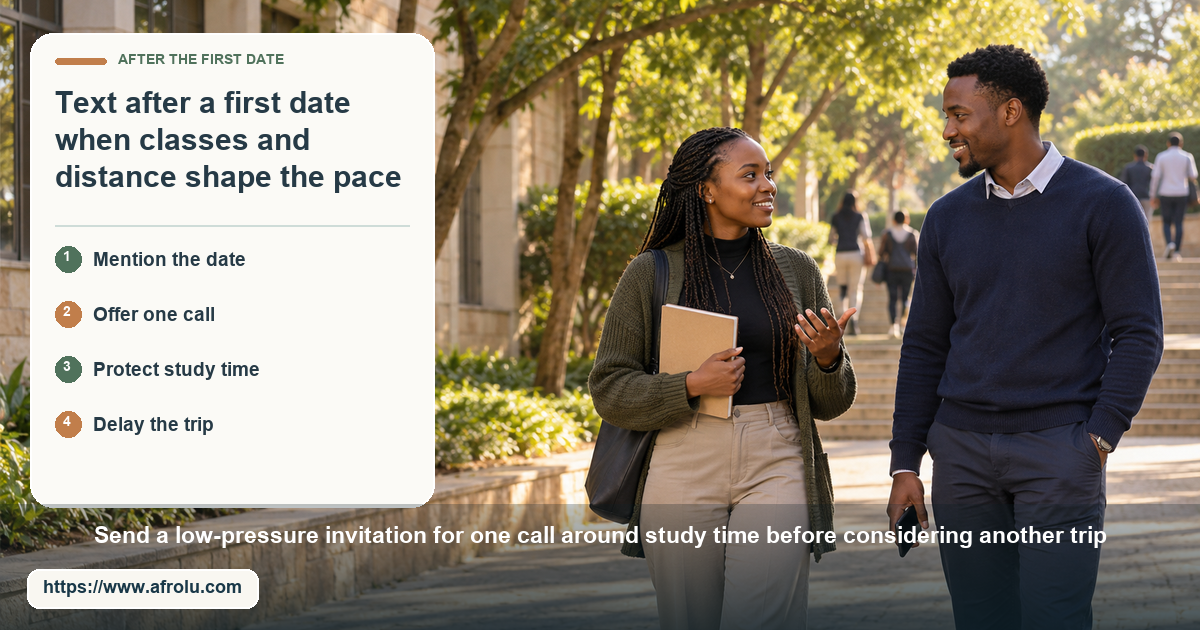
Offer contact that fits the real term calendar and keep travel separate.
Written and edited by Nala Okafor · Africa Dating Platforms Editor
Thank the person for a specific moment, then offer a short call at a time that fits your class and revision schedule if you want another conversation. You can explain that daily messaging is beyond your capacity this term. A different city makes travel a separate budget and transport choice. Share broad availability rather than a full timetable, residence address or student account details.
First dates · Students
What can I text after a first date if I want to stay in touch without sacrificing study time or paying for a trip?
A low-pressure student follow-up names interest while leaving study, money and rest intact. It offers one contact option that can be accepted, changed or declined without treating message frequency as a measure of commitment.
Illustrative scenario: Two adults meet during a weekend visit between university cities. They enjoy an exhibition, but exams are near and travel costs more than either wants to spend now. One sends a message about the exhibition and asks whether a short call after classes next Thursday would work. They do not book another trip or promise daily chats.
Study · time · budget
Let the term timetable set a realistic pace
A good date does not create extra hours in a week or money for a second journey.
Choose one short call window, describe the contact rhythm you can sustain and discuss travel only after checking the real cost.
Where is a free slot?
Use a broad window outside class and revision.
How long can you talk?
A 20-minute call can have a clear end.
Can a visit wait?
Leave fares unspent until a trip fits the budget.
What can repeat?
Say whether occasional contact works during exams.
Make one clear invitation
The next step can be smaller than another journey
After a first date across campuses or cities, you may want to keep talking without knowing whether another visit is possible. Name a detail from the date that mattered to you, such as a shared conversation or activity. Then ask about a specific, manageable call if you would genuinely enjoy one. A kind thank-you alone need not imply a second date.
Choose a call time around actual class, study and rest needs. A 20-minute conversation can be enough to learn whether both adults want more contact. Do not schedule a call during revision just to prove interest, and do not assume the other adult should interrupt their work. A suggested time is useful because it can be accepted or changed.
There is no universal response-time rule. Someone may be in class, working, offline or simply unsure. A timestamp cannot establish which explanation applies. After you send a direct invitation, continue with your own day. If the answer arrives later, you can decide whether it still fits, without turning the delay into a test.
Respect the term
Low pressure needs an honest contact rhythm
Low pressure should have a practical meaning. You might be able to exchange occasional messages or speak on some weekends, but not keep up a daily conversation during exams. Say that in your own words before someone has to infer it from silence. Ask whether the other adult would be comfortable with that amount of contact.
A different preference is possible. They may want frequent contact and decide that an occasional call is not enough. You may want less contact than they do. Neither difference needs an accusation of clinginess or disinterest. Discuss the actual rhythm each adult can offer and decide whether there is a workable overlap.
A missed call can be rescheduled if both still want it. If one adult repeatedly offers times they cannot keep, notice the pattern as a practical problem, not a diagnosis of character. You can say you would prefer to arrange a call when the schedule settles or that the current arrangement does not suit you.

A workable rhythm matters more than a fast reply during exams.
Keep the trip optional
A good first date does not create a travel debt
A second in-person date may cost transport, accommodation, mobile data and time away from paid work or study. Make those costs visible before discussing a date as if it is already planned. You can say that a trip is outside your budget this month. If that means the connection cannot continue, it is better to learn that than to spend money you cannot spare.
The Federal Trade Commission documents urgent travel-money stories in online romance scams. Its categorical warning about sending money is directed at people who have not met in person, while the adults in this example have met. The pattern cannot determine anyone's intent. You can still decline a transfer because a first date does not create a financial obligation.
If you eventually choose to meet, agree on the time, public meeting point and transport each adult prefers. Do not offer your residence address or full timetable to make a plan feel real. A second date requires both adults' agreement, not proof that one person can travel whenever the other asks.

Name a realistic call time and allow a different answer.
Share what the plan needs
Your course schedule and residence can stay private
Your class timetable, residence location, student identification and account details reveal more than the other adult needs to know to arrange a call. Share a window such as Thursday evening instead. Australia's eSafety Commissioner advises caution with personal details disclosed through dating services. That guidance is Australian and cannot guarantee a particular platform protects information after it is sent.
If a match asks to move to another service, decide whether that makes sense for you. You can remain on the original platform or decline to send more personal details. A video call can be helpful, but it does not verify every claim about identity, university enrollment or future plans. Avoid asking the other adult for sensitive proof too.
Boundaries can include time as well as data. It is reasonable to say you will reply after revision or that a call needs an end time. If the other adult keeps pressing for your location, documents or immediate access after you decline, you can pause contact. Protecting your study routine and privacy does not require a lengthy defense.
Decide after more context
Interest can fit a limited term, or it may not
After the next exchange, ask what has actually been offered. Is there a call time both adults want? Is the proposed rhythm compatible with study and rest? Are travel costs being treated honestly? These are practical questions, not a scoring method. One call or delayed message cannot predict the whole relationship.
If you both enjoy the conversation and want another meeting, wait until a trip fits the calendar and budget before confirming it. If the term remains crowded, a slower pace may be right. Another adult may decide they want more contact than that; their preference is as real as yours, and you can accept the difference.
If you no longer want to date, say so briefly rather than using exams as a permanent placeholder for a plan you do not intend to make. The goal of a clear post-date text is to help both adults choose with accurate information. It does not require either person to put studies, money or rest on hold.

Keep revision, money and travel independent of a new connection.
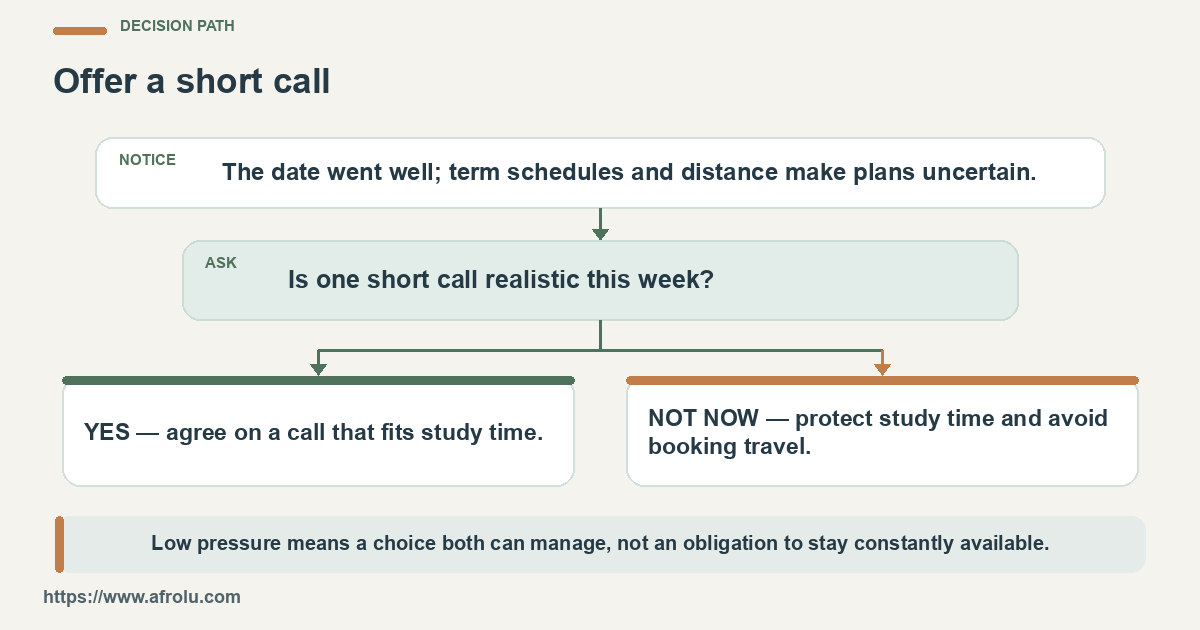
When coursework and distance shape the answer
Exam week begins
One adult has little spare time.
Offer a later call only if wanted; do not treat study as rejection.A late reply appears
The message arrives after your study session.
Answer when you choose, without a response-time test.A call is suggested
There is one free half-hour across both schedules.
Agree on a time and an optional end point.A visit sounds exciting
Travel between cities would cost more than planned.
Check the budget before making a booking.A timetable is requested
Someone asks for exact classes or residence details.
Share a broad free window instead.Daily texting is expected
One adult wants frequent contact.
Say what you can manage and ask whether it suits.The call falls through
Classes or transport delay one person.
Reschedule once if both want to, or leave it.The pace differs
One wants more time than the other can offer.
Name the mismatch without fault.What a workable term-time rhythm looks like
The message mentions a real moment from the first date.
A call window avoids classes, revision or needed rest.
The invitation allows a no or another time without penalty.
Neither adult demands daily replies during exams.
The cost of data, transport or a visit is acknowledged if it matters.
A suggested in-person date remains tentative until both confirm it.
No one asks for a student ID, timetable or residence address as proof.
A delayed reply is not read as evidence of another person's motive.
A cancelled call is rescheduled only if both still want one.
Each adult can maintain friendships, study and other commitments.
A video chat is treated as one interaction, not complete verification.
The adults can choose an end time for a call.
If one person cannot afford travel, that limit is accepted.
Interest is judged by explicit communication and feasible plans over time.
Choose the contact your term can hold
| Situation | What it may mean | What to do next |
|---|---|---|
| The week before exams | You liked the date but revision time is already allocated. | Offer a short call after a study block instead of daily contact. |
| A call during class | The proposed time is unavailable even if the person matters to you. | Give one alternative window outside classes. |
| A request for daily good-morning texts | The other adult wants a rhythm you may not be able to sustain. | Describe your real term-time contact capacity and ask if it fits. |
| A late-night message | The timing may be convenient for them and tiring for you. | Reply when rested and suggest a daytime exchange if you prefer. |
| An unanswered call invite | No call has been agreed, regardless of the reason for silence. | Keep studying and decide later whether one follow-up is worthwhile. |
| A train fare exceeds your limit | The second meeting is currently unaffordable. | Say that travel must wait; offer contact you can manage if you want it. |
| A request for your room number | A call or public meeting does not require residence details. | Share a broad availability window or public point only when useful. |
| One adult misses a planned call | A missed slot may be a scheduling problem rather than an explanation of motive. | Ask whether a new time still works; stop offering slots if the pattern continues. |
| Your course load grows | A plan that fitted last week may no longer fit. | Explain the changed capacity and offer a slower rhythm or pause. |
| The term ends | More free time may make a visit possible but does not obligate one. | Recheck interest, budget and transport before naming a date. |
Words for a short call and honest limits
“I enjoyed talking with you after the exhibition.”
“Would a 20-minute call on Thursday evening suit you?”
“If this week is full, we can leave it until after exams.”
“I can text sometimes, but I cannot keep up a daily chat this term.”
“Would you prefer a call or an occasional message?”
“I need to finish revision tonight, so I will reply later.”
“A trip is more than I can spend this month.”
“Let us choose a public place; I am keeping my residence private.”
“Thursday at seven works for me; does that still fit you?”
“My class ran late. I can call Sunday if you still want to.”
“I understand you want more contact than I can offer right now.”
“I appreciated meeting you, but I do not want to continue dating.”
Know the difference
A manageable call is not daily availability
Two adults choose one short conversation around classes and revise it if term work changes.
One person treats daily replies, missed study hours or a costly trip as proof of interest.
Low pressure means a choice both can manage, not an obligation to stay constantly available.

Agree on the contact rhythm and leave travel for a separate budget choice.
An enjoyable date and a daily rhythm differ
| Type or dimension | What it describes | Best next question |
|---|---|---|
| Nice date | Enjoyment says nothing definite about a term-long contact schedule. | Ask what amount of contact each person wants. |
| Twenty-minute call | A bounded conversation can fit between ordinary commitments. | Offer a start and end time. |
| Daily chat | A repeating commitment uses attention during class and revision weeks. | Agree to it only if you can keep it. |
| Exam boundary | Limited contact can describe workload without hiding your preference. | State when you expect to be free again. |
| Missed slot | One missed call differs from repeatedly unkept arrangements. | Offer one reset, then notice follow-through. |
| Travel wish | Wanting to meet again differs from being able to afford a trip. | Check total cost before proposing dates. |
| Booked travel | A fare creates a consequence beyond a casual suggestion. | Confirm both adults' meeting plans first. |
| Residence detail | An address reveals more than a call or public date needs. | Use a public meeting point when relevant. |
| Changed term | A new class or work load can change feasible contact. | Renegotiate the rhythm openly. |
Six ways to protect a workable pace
Small invitations are easier to keep
A 20-minute call after classes is more informative than a promise to be available all evening.
The calendar is not a character test
A full revision week explains a constraint you can name; it does not establish either adult's hidden intentions.
Count the whole trip
Transport, meals, data and missed work can matter as much as the headline fare.
Location can stay approximate
A broad window and public meeting point do the planning work without exposing a residence or full timetable.
A mismatch can be ordinary
Someone who wants daily contact may simply need an arrangement you cannot offer this term.
A pause has a shape
If exams leave no useful contact time, name when you could revisit the conversation instead of indefinitely postponing it.
Questions for an exam-week follow-up
Choose a few prompts that fit the moment. This is a reference library, not a list to complete.
Choose a call slot
Work with the calendar you actually have.
- Where is a clear 20-minute opening?
- What end time protects revision or sleep?
- Can I offer a second option if Thursday fails?
Define low pressure
Replace a vague pace label with a repeatable practice.
- How many messages can I enjoy in an exam week?
- Would an occasional call suit the other adult?
- How will I explain a temporary pause?
Check a visit
Treat travel as a separate budget decision.
- What is the total transport and accommodation cost?
- Will the trip displace study or paid work?
- Can I choose my own arrival and return?
Review term-time contact
Observe the arrangement rather than a reply timestamp.
- Did each person get the rhythm they agreed to?
- Was a missed slot repaired respectfully?
- Would I choose this pace again next week?
What research and guidance can—and cannot—tell you
Boundaries
love is respect explains that personal boundaries can include time, communication and digital contact.
Evidence limit: The guidance is U.S.-based and does not prescribe a student schedule.
Digital privacy
eSafety describes privacy risks when online dating profiles reveal personal details.
Evidence limit: Its Australian guidance does not determine what a particular university or service does.
Consent
RAINN describes consent as voluntary and specific.
Evidence limit: The material is general U.S. education, not local law.
Safer meetings
RAINN suggests practical planning for online and in-person dates.
Evidence limit: No checklist guarantees safety and its support pathways are U.S.-based.
Romance fraud
The FTC describes urgent requests for travel or other money from online romantic contacts.
Evidence limit: This consumer warning does not explain ordinary delayed replies.
Money requests
The FTC warns about online romantic contacts who ask for travel or emergency money.
Evidence limit: Its categorical do-not-send advice concerns someone never met in person; this student pair has met, so use the pattern cautiously.
Study and travel promises that strain the plan
Promising daily replies
A term calendar may make constant contact unrealistic.
Using study time as proof
Missing revision to take a call is not a measure of interest.
Travel beyond the budget
A good date does not justify unaffordable fares or borrowing.
Sending a full timetable
A broad call window works without a residence or class schedule.
Diagnosing a late reply
Class, work, rest or a changed preference can all affect timing.
Treating a missed call as a verdict
Ask once about a new time if you want, then choose your limit.
Offer contact that fits the study week
These information links are clearly labelled, non-commercial and do not promise a relationship outcome.
Explore the guide library
Show more related guides
Continue with Afrolu
Show more Afrolu guides
Research and practical guidance used for this guide
Afrolu reviewed these health, research, safety, or public guidance resources while editing this page. They support the behaviour and safety guidance; they do not diagnose any individual described by a reader.
Questions about texts, exams and travel
When should students text after a first date?
There is no universal clock. Send a sincere message when you have space to write it.
Is it rude to suggest a call after exams?
No. Explain the current constraint and offer a time only if you want to follow through.
How can I sound interested without promising daily texts?
Say you enjoyed the meeting, give one realistic contact option, and invite their preference.
What if we attend universities in different cities?
Discuss whether a call fits first; time, cost and transport for a visit are separate decisions.
Should I share my class schedule?
You can share a broad free window without sending your full timetable or residence details.
Does a missed call mean they are not interested?
Not by itself. Ask about a new time if you want, then decide whether the available rhythm suits you.
What if travel costs are too high?
Keep the trip unbooked and say the cost is beyond your budget.
Can I set a call end time?
Yes. A bounded call can fit study and rest better than an open-ended promise.
Do they owe me a reply because I paid for the first date?
No. Payment and a pleasant date do not create an obligation to continue.
What if I change my mind during term?
Say your current preference has changed. Either adult can pause or stop.
One thing to do now
Choose a call your week can actually hold
Suggest a small, feasible contact window; let coursework, rest and travel remain independent choices.