After the first date · Nairobi student life
Separate a safe-arrival text from your next Nairobi date
Adult students dating in Nairobi can send a clear first-date follow-up, choose an affordable public second meeting and keep campus and travel details private.
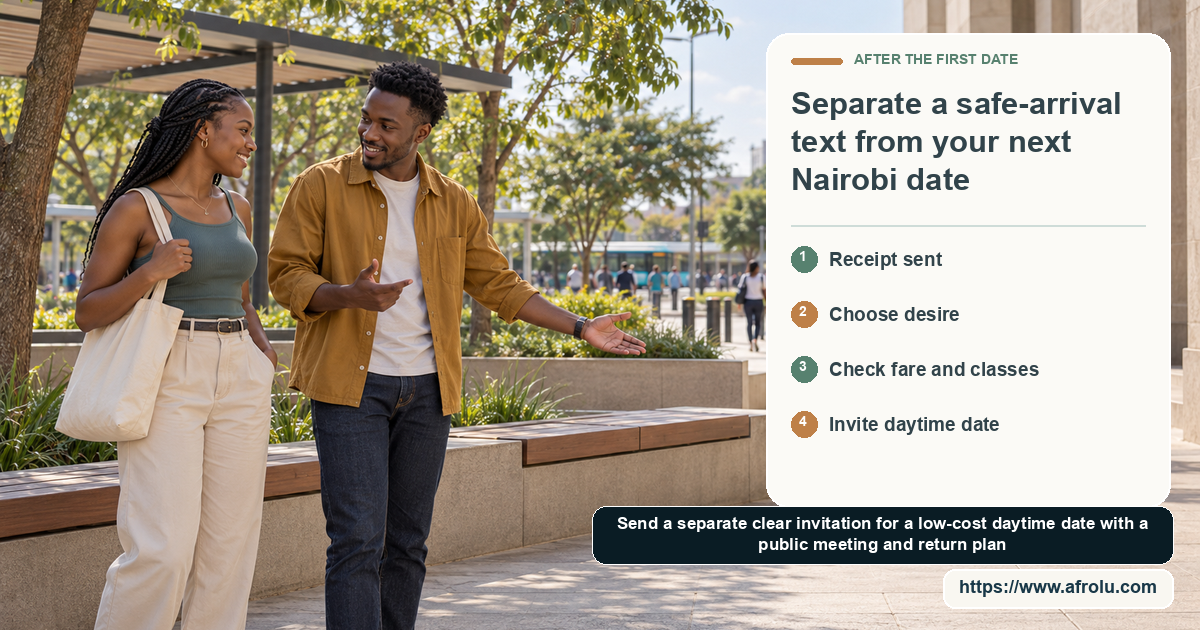
If you want another date, ask directly and make its cost, time and return workable.
Written and edited by Liya Bekele · Horn of Africa Editor
A safe-arrival message can close the practical loop without promising another date. If you want to meet again, say so directly in the same message or a later one: mention a real moment and offer an affordable public activity at a time that fits both adults' classes and return plans. You can share a meeting point without giving a residence, full timetable or live route. If they prefer a late or costly plan, suggest an option you would choose or decline.
First dates · Students
Does my safe-arrival text count as interest, and how do I suggest another Nairobi date that fits classes, cost and my own travel choices?
A clear Nairobi student follow-up distinguishes arrival information from a romantic invitation, then makes any second meeting specific enough to answer. The plan should fit adult class schedules, transport cost, public location and each person's independent choice about how to get home.
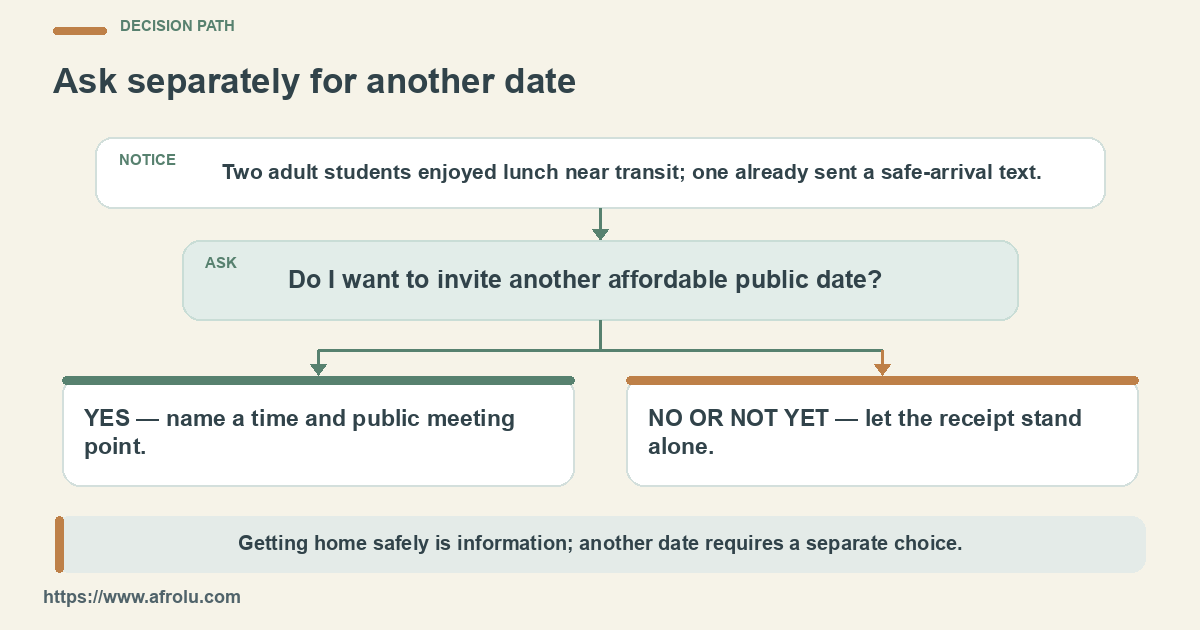
Illustrative scenario: Two adult students share a modest lunch near a public transit plaza on Saturday afternoon. One texts that they reached home safely, then realizes they would like another date. The next day they mention their conversation over lunch and suggest a daytime walk and coffee near the plaza after classes next week. They agree on a public meeting point while keeping their residences and exact class routes private.
Receipt · invitation · local plan
Make the next message do one clear job
A local date may be easier to imagine than a long-distance visit, but classes, money and a return trip still matter.
Decide whether you are confirming arrival or inviting another meeting, then choose a public plan both adults can reach and leave on their own terms.
What is settled?
A receipt can simply say you got home.
Do you want another date?
Ask directly if the answer is yes.
Can both afford it?
Suggest an ordinary, modest activity.
How will each leave?
Keep travel and residence details personal.
Separate two messages
Getting home safely is useful information, not a second-date contract
After a first date in Nairobi, a note that you reached home safely can close a practical loop. It does not automatically say that you want another date, and a person who receives it should not have to treat it as one. If you do want to continue, add a separate sentence about a real part of the date and ask a question they can answer.
You can send both parts together or send the invitation after you have considered your week. There is no universal number of hours that proves interest. A clear message is more helpful than waiting for a timing rule or sending repeated safe-arrival updates in the hope that the other adult will infer a romantic plan.
If you are unsure, do not offer a second meeting to avoid an awkward silence. Thank them for lunch or the conversation and take the time you need. If you know you do not want another date, a respectful closing is clearer than a vague promise to catch up sometime. Each message should reflect a choice you actually hold.
Choose an affordable second date
The next activity should fit more than a flattering text
A second meeting does not need to repeat the cost of the first. You could suggest a daytime café, a free public event or another activity both adults would enjoy. State the place and approximate time, then ask whether it fits. The recipient can accept, propose an alternative or decline without a story about why your idea was good enough.
Think about the whole expense: admission if any, a drink, transport to the meeting and a way home. A low ticket price may still mean a difficult return fare. If the other adult proposes something outside your budget, say that plainly and offer a cheaper option if you want to meet. Borrowing or skipping essentials is not a requirement of a promising first date.
RAINN's U.S. safer-dating guidance suggests public early meetings and control over transport. Those are general options, not a guarantee about a Nairobi venue or trip. Use your knowledge of your own routes, time and comfort. A public meeting point can be agreed without sharing a residence or allowing the other adult to decide your return.

A public meeting point need not reveal a residence.
Fit classes and travel
A local distance still uses time on both sides
Being in the same city does not mean two students can meet at any hour. Classes, paid work, revision and travel between neighborhoods all take time. Check when you could arrive without rushing and leave without sacrificing a commitment. Ask about the other adult's available window rather than assuming they share your campus routine.
A specific invitation need not include a full class timetable. 'After classes on Wednesday' or 'Saturday afternoon' usually gives enough information for a first answer. If the time changes, send an update before the other adult travels. If no window overlaps this week, decide whether a later meeting or brief conversation appeals to you both.
Be careful about turning a delayed reply into a theory about their feelings. They may be in class, travelling, resting or choosing a different plan; you cannot tell which from a timestamp. What you can decide is whether a proposed date is confirmed and whether the communication you actually receive fits your own preferences.

The other adult can suggest another time or decline.
Choose what to share
A meeting point does not require a residence or live route
A public venue and time are useful for planning. A room number, student identification, exact class route and live location are different kinds of information. Australia's eSafety Commissioner advises caution about location and profile details in online dating. That Australian guidance cannot promise that any message remains private after it is sent, so choose what you want to reveal.
If someone offers to pick you up, you may appreciate the thought and still make your own way. If they ask to move the plan to a private room or an unfamiliar location, the change deserves a new decision. A previous yes to daytime coffee does not settle another venue, later hour or different transport arrangement.
Do not ask the other adult for a residence address or class schedule as proof of sincerity either. A chosen public meeting can be confirmed without either person's private routine. If someone repeatedly presses after a clear limit, you can revise the plan or stop contact based on what happened without needing to diagnose their motive.
Use the real answer
A second date is chosen, changed or declined by two adults
If the other adult accepts, confirm the public place, time and general activity. You can each arrange your own journey and decide how long to stay. If they suggest a more expensive or late-night plan, say whether it suits you and offer another option only if you want one. A different preference is information, not a challenge to win.
If they do not answer a clear invitation, decide whether one follow-up would feel right and then continue with your life. Repeated prompts cannot create an agreed date. If they say no, respect it; the first date can still have been a good experience. You are free to choose a connection whose timing, budget and communication fit you better.
After another meeting, review what was actually agreed and how the plan felt. Did the activity and cost fit both people? Did each keep control of private information and travel? Do you want another step? These questions support your own judgment. They do not turn one Nairobi date into a prediction about either person's character or a future relationship.

A clear no is a complete answer.
When a safe-arrival text becomes confusing
The arrival receipt
One student confirms they reached home after Saturday lunch.
Take it as journey information, not an invitation.The next-day decision
The sender decides they would like another date.
Ask separately for one modest public outing.The emoji answer
The recipient sends a friendly reaction without addressing the invitation.
Leave the plan unconfirmed; ask once if clarity is needed.An exam week
Study and classes fill the proposed afternoon.
Offer another real time or pause the plan.A costly activity
One adult suggests an outing beyond the other's budget.
Choose a cheaper option or decline without shame.A residence request
The other adult asks where to pick the student up.
Choose a public meeting point instead.A changed route
Transport home is less convenient at the proposed hour.
Move the meeting earlier or choose a different place.A clear decline
One student enjoyed lunch but does not want another date.
Respect the answer without treating the receipt as a promise.Look for an explicit, affordable plan
The safe-arrival message only confirms the journey home.
A later note names the lunch conversation the sender enjoyed.
A second date is asked for explicitly rather than inferred.
The proposed activity fits both students' budgets.
A daytime time window works around classes and study.
A public plaza or café is named without sharing a residence.
Each checks the fare and route home before agreeing.
The recipient can propose a different time or activity.
A friendly emoji is not treated as acceptance of a date.
A delayed reply during lessons is not called disinterest.
Neither asks for a live location or exact class timetable.
A changed class schedule leads to a direct update.
One adult may prefer not to date again and can say so.
The final plan names time, place and each person's return choice.
Turn interest into a separate invitation
| Situation | What it may mean | What to do next |
|---|---|---|
| After the ride home | A receipt closes the travel question, not the dating question. | Send a short arrival note and let it stand. |
| The next day | You may now know you want another date. | Write a separate invitation rather than reinterpreting the receipt. |
| When choosing an activity | A costly plan may burden fare and food budgets. | Suggest a modest coffee or walk in daylight. |
| Before naming a time | Classes, study and the return journey all use time. | Offer a window that fits an ordinary week. |
| When choosing a place | A public plaza can work without a private address. | Name a clear public meeting point. |
| When an emoji arrives | A reaction can show friendliness without accepting a date. | Ask once whether the proposal suits them. |
| When a residence is requested | The date can be planned without a hostel or home location. | Offer the public meeting point instead. |
| When fare is tight | Wanting a date need not require unaffordable travel. | Choose a nearer plan or decline without shame. |
| When class changes | The original afternoon may no longer be feasible. | Update and offer another checked window. |
| When they decline | A safe-arrival text never created a second-date debt. | Accept the answer and close kindly. |
Words for lunch, coffee and an independent return
“I got back safely, thank you for lunch.”
“I enjoyed our conversation over lunch.”
“Would a daytime coffee near the plaza after classes next week suit you?”
“Could we keep it simple and affordable this time?”
“I finish classes at three on Thursday; would a short meeting work?”
“Let us meet at the café entrance near the plaza.”
“I will arrange my trip home after the date.”
“I liked our chat, but I was only confirming that I reached home.”
“Would that coffee plan interest you, or shall we leave it?”
“My class changed; Friday afternoon is free if that works for you.”
“Thank you for lunch. I do not want to plan another date.”
“Thanks for letting me know; I enjoyed meeting you.”
Know the difference
An arrival receipt is not a second-date agreement
Both accept a public, low-cost meeting with class and return times considered.
A safety update or a friendly reply is assumed to commit someone to another outing.
Getting home safely is information; another date requires a separate choice.

Friendliness alone sets no time, place or budget.
A receipt and a date answer different questions
| Type or dimension | What it describes | Best next question |
|---|---|---|
| Arrival receipt | Information that the journey ended. | Do not treat it as a date agreement. |
| Warm reaction | A friendly response without a plan. | Ask a direct question if needed. |
| Second-date invitation | An explicit optional proposal. | Name activity, time and public place. |
| An accepted date | A shared choice with settled details. | Confirm before travelling. |
| A campus route | Private routine information. | Keep it outside the invitation. |
| Public plaza | A shared landmark for meeting. | Use a precise public point. |
| Low-cost activity | A plan that protects student budgets. | Check fare and food costs. |
| Daytime window | Time to meet and return around classes. | Leave sufficient travel margin. |
| A clear no | An answer that ends this plan. | Respect it without bargaining. |
Six checks for a modest Nairobi date
A receipt has one job
Getting home safely can be acknowledged without creating a date agreement.
Interest needs its own question
A separate invitation lets the other adult answer what they actually want.
Local travel still costs
Even a short Nairobi journey uses fare, time and return planning.
Public is practical
A café or plaza meeting point can be clear without exposing a residence.
An emoji is incomplete
Friendliness does not settle time, budget or a yes to another date.
Decline completes the choice
A no after a good lunch does not undo the value of the first meeting.
Questions for class time, fare and privacy
Choose a few prompts that fit the moment. This is a reference library, not a list to complete.
After the receipt
Decide whether there is a separate dating wish.
- Do I want another meeting?
- Am I only relieved to be home?
- Would I ask directly?
Before proposing
Build a workable low-cost date.
- What can each afford?
- Which day fits classes?
- Where is a public meeting point?
Before travelling
Set details without exposing private routes.
- Is the time confirmed?
- How will each return?
- Can we meet without a residence address?
After their answer
Respond to the choice given.
- Did they accept or counteroffer?
- Am I inferring from a reaction?
- Can I respect a no?
What the guidance supports and where it stops
Dating expectations
love is respect encourages discussing expectations rather than assuming that two adults mean the same thing.
Evidence limit: U.S.-based education does not define what a safe-arrival text means in Nairobi.
Digital terms
love is respect recommends talking about texting expectations.
Evidence limit: It does not make a reply time a test of romantic interest.
Dating privacy
Australia's eSafety Commissioner advises limiting identifiable location details in dating services.
Evidence limit: Australian online guidance cannot assess this specific in-person date.
Safer dates
RAINN suggests public meeting places and independent transport for early dates.
Evidence limit: U.S. advice does not guarantee that a public place is safe.
Guesswork that makes an invitation harder
Reading the receipt as a yes
Travel information is not agreement to another outing.
Using an emoji as a booking
A date needs an explicit choice and workable details.
Suggesting an expensive venue
A flattering plan can be impractical for student budgets.
Ignoring the return
A daytime date still requires time and fare to get home.
Requesting a residence
A public meeting point is enough for this plan.
Diagnosing a class-time reply
A lesson or study period can explain a message gap.
Ask for a modest daytime date clearly
Plan a public, affordable Nairobi date only after a separate invitation is accepted.
Explore the guide library
Show more related guides
Continue with Afrolu
Show more Afrolu guides
Sources and their scope
Afrolu reviewed these health, research, safety, or public guidance resources while editing this page. They support the behaviour and safety guidance; they do not diagnose any individual described by a reader.
Questions about student follow-up in Nairobi
Does 'I got home safely' mean I want another date?
No. It confirms a journey. Send a separate invitation if you want to meet again.
Can I ask the next day?
Yes, if you know what you want to offer. Give the other adult space to answer.
Do I need an expensive second date?
No. Suggest an affordable public activity that fits both adults' budgets.
What if the other student only reacts with an emoji?
An emoji is not a confirmed date. Ask a clear question once if you want an answer.
Should I share my hostel or residence?
A public meeting point is enough to plan a date; a private address is optional and unnecessary here.
What if class times change?
Update the other adult and offer another real window if you still want to meet.
Is a late reply after lessons a bad sign?
A timestamp cannot explain the reason. Look for whether a plan is accepted, changed or declined.
How do I keep the return trip manageable?
Check fare, daylight and the route you prefer before agreeing; each adult chooses their own return.
Can we meet near campus?
Yes, if both freely choose a public place that works without sharing residence or live routes.
What if they do not want a second date?
Thank them for the honest answer and let the first meeting remain a complete experience.
One thing to do now
Ask for a date only if both can choose its details
Say whether you want another date; make its time, cost, public meeting point and return workable for both adults.