After the first date · work and safety
Plan a second date without sharing your workplace or route
Follow up after a first date during a busy career season. Offer a public second-date plan, keep workplace details private and choose your own transport.
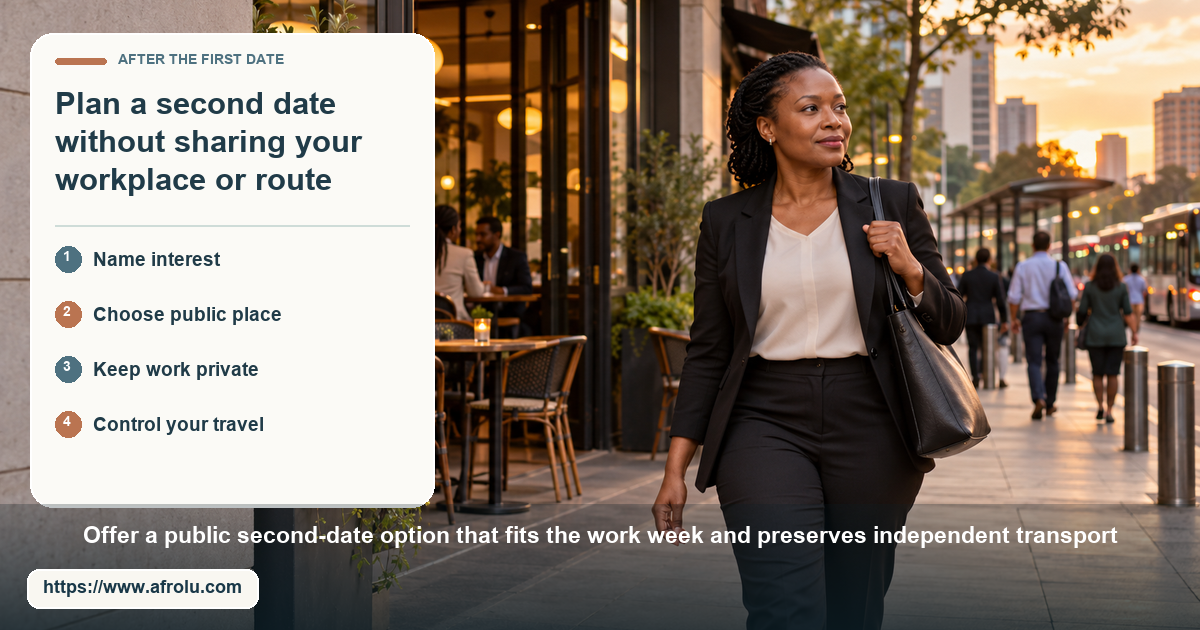
Make the next date concrete and keep work access and transport under your control.
Written and edited by Ruth Akinyi · Local Dating Editor
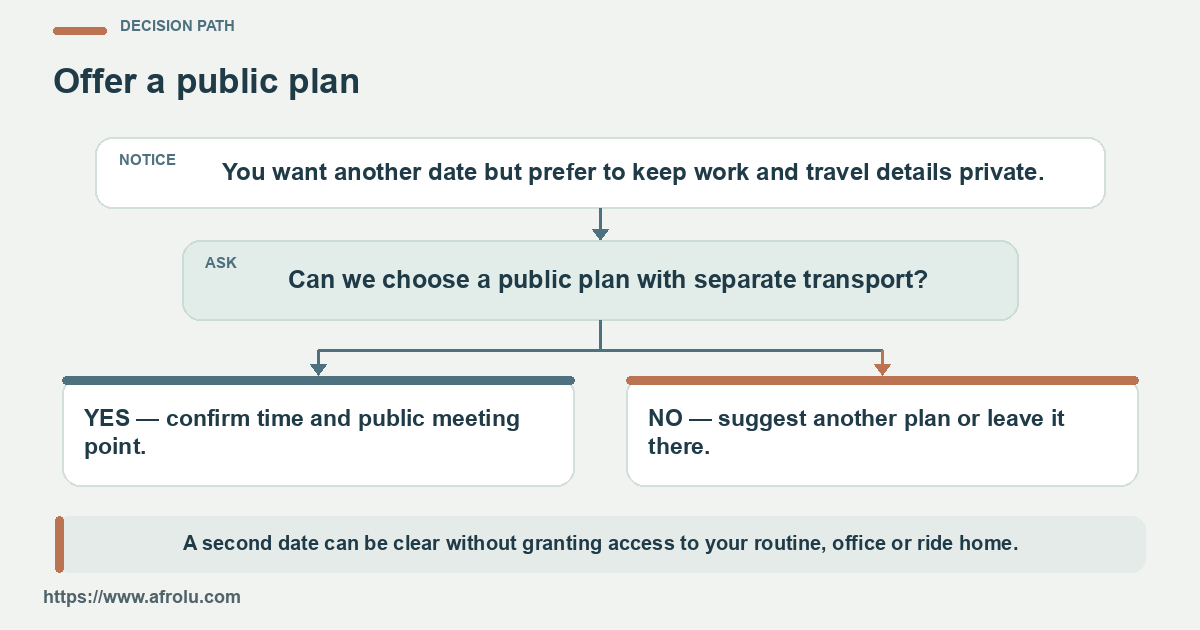
Thank the person for the date, offer one public meeting option at a time you can keep, and say you will arrange your own travel if that is your preference. You do not need to share your employer, office location, exact commute or live route. Confirm the time and place before changing plans. If the venue or transport arrangement changes, decide again; a yes to the original plan is not agreement to every revision.
First dates · Professionals
How do I suggest another date without giving a new match my workplace, commute details or a lift-home expectation?
A work-aware, safety-conscious follow-up expresses interest and offers a concrete next date while treating workplace access, location details and transport as separate choices. Public settings and independent travel can support comfort, though no checklist guarantees another person's behavior.
Illustrative scenario: After a pleasant weekday first date, a professional sends a note about the conversation and proposes a Saturday afternoon café. The other adult offers to collect them from work on Friday instead. They decline the pickup, keep the public Saturday plan, and arrange their own way home. The invitation stays warm without exposing an office or commute.
Work · place · transport
Make the second-date invitation answerable
A realistic public plan can show interest without disclosing an employer, commute or private address.
Offer a time you can keep, confirm the meeting point and retain a separate choice over travel or a changed venue.
When are you free?
Suggest a time outside work and rest commitments.
Where will you meet?
Name a public venue rather than an office entrance.
How will you arrive?
Arrange your own trip if you prefer.
Did the venue change?
Ask again before accepting a new location.
Make the invitation concrete
A thoughtful note can include one realistic meeting option
A first-date follow-up can be both warm and practical. Mention one conversation or activity you enjoyed, then say whether you would like to meet again. If you want a second date, suggest a public place and a window you can keep around work and rest. The other adult can accept, suggest an alternative or decline.
Avoid offering constant availability to compensate for a full work week. An honest Saturday option is more useful than a promise to reply every hour or meet tomorrow when you know you cannot. A delayed workday response does not explain anyone's intentions on its own. Look at the plans both adults choose and how changes are communicated.
A clear invitation is not a confirmed plan until both have agreed on its details. Ask whether the proposed place and time suit the other adult, and keep your calendar until you have an answer. If your own schedule changes, say so promptly and offer another option only if you genuinely want one.
Choose the meeting place
Interest does not grant access to your office or home
You can suggest a café, gallery or other public setting that is convenient for you without naming your employer or office building. RAINN's U.S. safer-dating guidance recommends public meeting places for early dates. That is a practical option, not a guarantee that a particular setting or person is safe. Choose the level of openness that fits your circumstances.
If the other adult asks to meet outside your office, you can decline and keep the original public plan. If they suggest a private place after you have agreed to a café, pause before accepting. The new venue may change how you travel, how easily you can leave and what personal information you disclose. Your earlier yes does not settle the revision.
State the new choice plainly: “The café works for me; I do not want to meet at an office or home.” You may suggest a different public place or decide not to meet. Notice whether a boundary is accepted. Repeated pressure is observable behavior you can act on without trying to explain the other person's inner motive.

Look at the agreed meeting details rather than treating work delays as motive.
Keep travel yours
A lift is an offer you may accept or decline
Someone may offer a pickup out of convenience or courtesy. You can appreciate the offer and still choose your own transport. RAINN also recommends keeping control over travel for early meetings. These are general U.S. suggestions, not a Nairobi transport instruction or a safety guarantee. Your practical plan should fit local routes, timing and budget.
Share only the meeting point and time needed to meet. You do not need to send your live route, home address, vehicle details or exact office exit to show interest. Australia's eSafety Commissioner discusses risks of disclosing personal and location information on dating services. Once a detail is shared, platform settings may not prevent it being copied or passed on.
Consider a time you can leave comfortably. You may set an end point for a second date and arrange your return independently. If the other adult suggests extending the meeting or changing transport, decide whether that new option suits you. A plan remains voluntary after it begins, and saying no to a lift does not require a personal explanation.

Share the venue and time without offering an office address or live route.
Separate work from dating
A job context can be broad without exposing a routine
A broad statement such as “This week is full, but Saturday works” gives useful scheduling information. It need not include the employer's name, a client assignment, a floor number or your hours at a specific address. A person who wants to date you can answer the invitation without access to your workplace. Keep professional obligations and dating choices distinct.
Kenya's Office of the Data Protection Commissioner explains data-subject rights concerning information processed by organizations. Those rights do not promise that a private romantic contact will handle your details well. Treat personal disclosure as your own choice. If a platform offers privacy controls, use them as tools, not as assurance that any shared message is fully private.
Privacy should be mutual. Do not ask for the other adult's work badge, exact shift or location to assess whether their interest is real. A call or ordinary conversation may add context, but it cannot authenticate every claim. Discuss only the practical details that help both adults decide whether and where to meet again.
Confirm and choose again
Respectful planning matters more than reply speed
Before the meeting, confirm what both adults actually chose: a venue, time and general plan. If a detail changes, ask whether you still want the new arrangement. One good first date cannot guarantee a second one will feel comfortable. Keep an option to leave and make decisions as the situation develops rather than treating an earlier agreement as permanent.
Pay attention to how the other adult responds when you decline a pickup or keep the office private. A respectful answer may make planning easier; repeated attempts to change the boundary are information about this interaction. You do not need to label the person or persuade them before choosing a different plan or ending contact.
If the second date goes well, you can decide what to share later and at what pace. If it does not fit, you can say you do not want another meeting. Clear, bounded communication protects both people's ability to choose while keeping work, rest and travel under the control of the person whose life they affect.

A changed place or lift is a new proposal that each adult can decline.
When the meeting plan reaches work or travel
The workday runs late
A planned meeting time no longer works.
Offer a real alternative or decline.An office visit is suggested
They ask to pick you up at work.
Keep the office private and choose your own meeting point.A public café is proposed
Both like the idea but no time is agreed.
Confirm time and place before changing plans.The venue changes
A public venue is replaced with a private address.
Pause and decide again; a previous yes is not automatic consent.A lift is offered
They offer to drive you home.
Accept only if you want; arrange your own travel otherwise.A commute detail is requested
They ask for your route or live location.
Share only information needed for the chosen plan.An end time shifts
The date runs longer than you planned.
State your end time and leave when you choose.Pressure follows a no
Your meeting or transport boundary is repeatedly challenged.
Stop negotiating and choose a different plan or no date.Notice how the public plan is handled
The message mentions a real moment from the date.
A second meeting is proposed in a public place both can identify.
The time fits the sender's actual work and rest schedule.
Each adult can arrange transport without being pressured to accept a lift.
No one asks for office access as proof of interest.
A job title or company detail is shared only if the adult chooses.
A changed meeting point is explicitly checked with both people.
A changed end time can be declined without explanation.
A polite no to a home pickup is accepted.
The location is not described with a live route or real-time tracking request.
A delayed workday reply is not treated as a motive test.
A public place is chosen for convenience and comfort, not as a guarantee.
The plan is confirmed before either adult changes other commitments.
A pattern of ignored boundaries is noticed as behavior, not diagnosed as a personality trait.
Keep each venue and transport choice yours
| Situation | What it may mean | What to do next |
|---|---|---|
| An open Saturday | You have one realistic window outside work. | Suggest a public café at that time rather than promising constant availability. |
| A request to meet at your office | The invitation would reveal workplace access you did not offer. | Keep the meeting at the public venue and decline the office pickup. |
| They offer a lift | Transport can be a kind offer but remains your choice. | Thank them and say you will arrange your own arrival or return. |
| The café becomes a private flat | The venue change materially changes the agreement. | Reassess the plan and decline or propose another public place. |
| A request for live location | The meeting point can be confirmed without sharing a real-time route. | Give the venue and agreed time; keep your movement private. |
| A meeting slips past your end time | You may have work, rest or travel commitments afterward. | State when you will leave and arrange your own return. |
| A client call delays you | Your availability changed, not necessarily your interest. | Send a brief update and offer another time only if you want to meet. |
| They ask about confidential work | Professional details are unrelated to a second-date choice. | Keep the description broad and redirect to the meeting plan. |
| A boundary is repeatedly challenged | Repeated requests are observable even if motive is unknown. | Choose a different plan or end contact without arguing about intent. |
| The date is confirmed | Both agreed to one time and place, while travel remains separate. | Check the venue details and retain a way to leave that suits you. |
Words for a public plan and private work life
“I enjoyed our conversation about music.”
“Would a café near the centre on Saturday afternoon work?”
“This week is full, but Saturday is realistic for me.”
“I prefer to keep my workplace separate from dating.”
“I will arrange my own way there and home.”
“Thank you, but I do not want a pickup.”
“Are we agreed on the café at two?”
“That new place does not work for me; I would rather keep the public café.”
“I can stay until four, then I need to leave.”
“I can meet at the venue without sharing my live route.”
“I am no longer comfortable with that arrangement, so I will not go ahead.”
“I appreciated meeting you, but I do not want another date.”
Know the difference
A public plan does not grant private access
Both adults agree on a meeting point and each manages private work and transport details.
A warm reply is treated as permission to visit a workplace, collect an address or arrange a lift.
A second date can be clear without granting access to your routine, office or ride home.

Confirm place, time and travel separately while keeping work details private.
A public invitation differs from workplace access
| Type or dimension | What it describes | Best next question |
|---|---|---|
| Public invitation | A café proposal identifies a meeting without offering private access. | Confirm its name and time together. |
| Work availability | A free window tells someone when you can meet. | Share the window without an employer or shift schedule. |
| Office pickup | Collection from work would expose a routine and change transport. | Decide separately whether you want it. |
| Independent trip | Each adult can choose their own arrival and return. | Arrange the route you prefer. |
| Changed venue | A new place is a new proposal, even after saying yes earlier. | Ask whether it still fits your comfort and exit options. |
| Live route | Real-time location offers more information than a meeting point. | Keep it private unless you freely choose otherwise. |
| Time extension | Staying longer than planned requires a fresh choice. | State your end time and leave when you want. |
| Work detail | A broad career topic differs from client, badge or building access. | Keep confidential and identifying details out of early dating. |
| Public setting | A public place may support comfort but cannot guarantee behavior. | Keep evaluating the actual situation and your choices. |
Six ways to keep planning clear
An answerable invitation has three parts
A named public place, feasible time and direct question let the other adult respond without guessing your availability.
Convenience is not consent
A lift or office pickup may be convenient for someone else while changing what you would need to share.
Venue changes reset the choice
An earlier yes to a café does not carry over to a private or unfamiliar location.
Privacy is reciprocal
You can keep your work details private without asking the other adult for a badge or exact shift.
Work delays need simple repair
A brief update and workable alternative are more useful than a story about why a timestamp looks late.
Plan your exit before meeting
An end time and travel option make the date easier to leave when you choose.
Questions for a second-date plan
Choose a few prompts that fit the moment. This is a reference library, not a list to complete.
Build the invitation
Use an actual public plan rather than vague availability.
- Which day fits work and rest?
- Which public venue can both identify?
- What direct question makes the invitation easy to answer?
Choose transport
Keep travel as a separate decision.
- How will I get there and back?
- Would a pickup expose my office or home?
- What end time gives me room to leave?
Handle a venue change
Reassess the full plan when one part moves.
- Is the new location still public and convenient?
- Can I reach and leave it on my own terms?
- Would I rather keep the original venue or decline?
Review the exchange
Focus on what happened in planning.
- Were the time and place actually confirmed?
- How did the other adult respond to a travel limit?
- Do I still want this second date?
What research and guidance can—and cannot—tell you
Safer dating
RAINN recommends public meeting places and control of transport for early dates.
Evidence limit: These are options, not a guarantee; its support contacts are U.S.-based.
Digital privacy
Australia's eSafety Commissioner advises care with location and personal details on dating services.
Evidence limit: Its platform guidance is Australian and cannot secure a private message after sharing.
Kenyan data rights
Kenya's Office of the Data Protection Commissioner explains rights over data processed by organizations.
Evidence limit: This does not govern every private interpersonal disclosure.
Boundaries
love is respect explains naming and respecting personal boundaries.
Evidence limit: It is U.S.-based relationship education, not legal advice.
Consent
RAINN describes voluntary and specific consent.
Evidence limit: General U.S. education cannot replace Kenyan law or individualized support.
Physical boundaries
love is respect discusses the right to describe and revise physical comfort.
Evidence limit: Its examples are U.S.-based and do not determine any individual dating decision.
Meeting shortcuts that expose private details
Sharing an office address
A public second-date invitation does not require employer access.
Accepting a lift by pressure
Transport is a separate choice and can be declined.
Following an unchosen venue change
A new location deserves a new decision from both adults.
Sending a live commute
The meeting point is enough; a real-time route is optional.
Treating work delay as motive
A reply after work cannot explain the whole connection.
Assuming public means safe
A public venue can support comfort but cannot guarantee conduct.
Choose a public plan and your own travel
These information links are clearly labelled, non-commercial and do not promise a relationship outcome.
Explore the guide library
Show more related guides
Continue with Afrolu
Show more Afrolu guides
Research and practical guidance used for this guide
Afrolu reviewed these health, research, safety, or public guidance resources while editing this page. They support the behaviour and safety guidance; they do not diagnose any individual described by a reader.
Questions about venues, work and lifts
What can I text after a first date if work is busy?
Mention the date and offer one time you can actually keep. You need not promise constant messaging.
Should I tell them where I work?
Only if you choose. A public meeting plan does not require your employer or office address.
Is it rude to decline a lift?
No. You can say you will arrange your own travel.
Where should a second date be?
Choose a setting both adults want. A public, easy-to-leave place can help with comfort, but no place guarantees safety.
What if the meeting point changes?
Treat it as a new choice: ask for the new place and decide whether it still suits you.
Should I share my live location?
It is not required to show interest. Decide independently what information you want to share and with whom.
Does a slow reply during work mean disinterest?
Not by itself. Use direct plans and observed follow-through rather than a timestamp.
What if they want to visit my office?
You can decline and suggest a public meeting elsewhere if you still want a date.
Can I set an end time?
Yes. A clear end time can help you plan rest and transport.
What if a boundary is ignored?
You can pause or leave the plan and seek support that fits the situation. You do not need to prove motive.
One thing to do now
Confirm the public plan on your terms
Offer a realistic public plan; keep work, exact location and travel details under your own control.