After the first date · weekend-first professionals
Make a second-date plan when weekends are your main free time
After a promising weekend first date, offer one second-date window that fits both adults. Discuss weekday contact and rest without reserving every weekend.

Invite one public outing, then ask what weekend time suits the other adult.
Written and edited by Nala Okafor · Africa Dating Platforms Editor
Mention what you enjoyed and offer one weekend activity or time you can genuinely keep. Ask whether the other adult is free or prefers another option; their weekends may follow a different work or family rhythm. Explain your ordinary weekday contact capacity rather than disappearing until Friday or promising constant messages. Confirm only the chosen date, leave other weekends open, and reassess if your schedules rarely overlap.
First dates · Professionals
What should I text after a weekend first date if weekdays are crowded and I do not know whether our weekends will overlap?
A weekend-aware follow-up is a specific second-date invitation shaped by two adults' actual calendars. It does not turn a pleasant Saturday into a standing claim on future weekends or treat slower weekday replies as evidence of indifference.
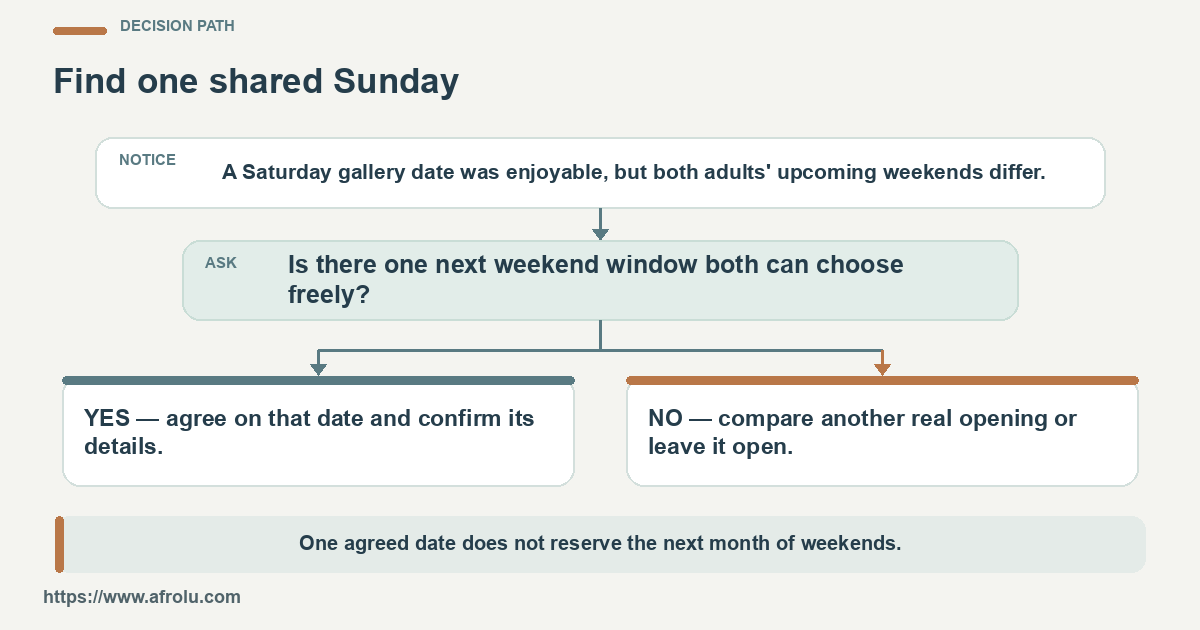
Illustrative scenario: Two adults enjoy a Saturday afternoon gallery visit. On Sunday, one professional writes about the exhibit and suggests another public outing the following weekend. The other adult works that day but is free on a different Sunday. They compare two real windows and agree on one, without expecting nightly workweek chats or reserving all future Saturdays.
One weekend · two calendars · ordinary weekdays
A free day is an invitation, not a standing reservation
A workweek can make the next weekend feel like the only chance to date, but both adults have their own rest and commitments.
Suggest one meeting you would enjoy, leave space for another time and agree on what contact between weekends actually fits.
What did you enjoy?
Refer to the Saturday activity.
Which slot is real?
Offer one feasible weekend time.
When are they free?
Ask rather than assuming their day off.
How will you talk?
Describe contact you can sustain after work.
Use the Sunday window
The follow-up can be simple without claiming next weekend
The day after a pleasant weekend date is often a natural time to follow up, but there is no clock that makes a message sincere. Mention one detail from the activity or conversation rather than saying only that the day was fun. If you would like to meet again, suggest a real time or activity and ask whether it works for the other adult.
A weekend invitation should use the singular. 'Next Sunday afternoon' is a proposal; 'we should do every Saturday' asks for a recurring commitment that has not been discussed. Keep the first message small enough for a yes, no or alternative. If you are unsure whether you want another date, a warm thank-you does not need to masquerade as a plan.
Do not reserve your entire next weekend while waiting for an answer. You can keep ordinary commitments and decide what remains available when the other adult replies. A date is confirmed only after both people choose its time and place; a kind response to your message does not automatically do that work.
Compare two calendars
Your free Sunday may be someone else's workday
Professionals do not all work Monday to Friday. The other adult may have weekend shifts, family care, religious commitments or a different rest day. If your first proposal fails, ask what window they actually have instead of deciding that the connection lacks interest. One alternative that suits both adults is more useful than a string of hopeful dates that no one can keep.
Check your own capacity as carefully as theirs. A busy week may leave you needing one quiet afternoon, and dating should not silently consume it. An hour at a gallery or a daytime meal can be a complete second date. You can state an end time without making the meeting sound like a work appointment.
If weekends rarely overlap, explore whether a short weekday call or another form of contact would be enjoyable. That is an option, not a debt created by the first date. If neither adult has room for a meeting or conversation they actually want, name the scheduling mismatch rather than interpreting an unavailable Sunday as rejection.

One good Saturday does not reserve the next month.
Discuss the workweek
Contact between dates needs its own rhythm
Some people enjoy a short message after work; others prefer to speak when a date is being planned. Neither preference can be inferred from how quickly a text arrives on Monday. If communication matters to you, say what you would enjoy and ask what feels comfortable to the other adult. A weekend-first meeting pattern does not decide weekday access by itself.
love is respect discusses digital boundaries, including expectations for texting and social media. That U.S.-based resource does not prescribe a frequency for Kenyan professionals or anyone else. Its useful point here is that people should describe their own contact preferences rather than treating a phone as an automatic sign of availability.
If you know you cannot chat during work, say so in ordinary language. You do not need to disclose clients, meetings or office details to explain that evenings are easier. The other adult may be comfortable with that rhythm or may want more between-date contact. Both answers are information about the arrangement, not a diagnosis of commitment.

A separate discussion can set the workweek contact rhythm.
Handle a moved weekend
A changed shift or family plan deserves a fresh invitation
A Saturday that looked free can be taken by work, a family obligation or needed rest. If a confirmed date must move, tell the other adult when you know rather than leaving them to discover the change at the last minute. Offer one replacement day that you have checked. They may be unavailable or decide not to reschedule, and that is their choice.
Notice the difference between a rare change and a calendar that never settles. If you keep naming weekends that later disappear, stop asking someone to reserve them. You can explain that your schedule cannot support a second date right now. An honest pause is more respectful than keeping a series of unconfirmed possibilities alive.
If the other adult changes the plan, hear the actual reason they choose to share and decide what works for you. You do not need to investigate their motives. The practical questions are whether a feasible alternative exists, whether the proposed contact rhythm suits both adults and whether either person still wants another meeting.
Review the real fit
One good Saturday cannot answer whether the rhythm lasts
After arranging a second meeting, consider whether the pattern could fit an ordinary month. Do you each have weekends to yourself as well as time together? Can you discuss plans without assuming that every free hour should be offered to dating? Is a weekday conversation pleasant or burdensome? These questions help each adult choose; they are not a checklist that predicts a relationship.
If weekend-first dating works for both, confirm the specific date you want and let future weekends remain open. If one adult needs frequent spontaneous visits and the other can only offer occasional planned time, discuss that difference early. Neither person should be asked to give up rest or a job to demonstrate interest after a single date.
You can also decide not to continue. A considerate message can acknowledge the enjoyable first meeting while saying that the available schedule does not fit what you want. Clarity is useful even when the answer is no: it prevents a calendar mismatch from becoming a long exchange of vague promises and disappointed expectations.

Revisit future weekends only when both want to.
When two weekend calendars do not match
A Sunday invitation
One adult offers the following Sunday after a good Saturday date.
Ask whether that window works before treating it as booked.A Sunday shift
The recipient works the suggested day.
Hear a different availability without reading motive into the shift.A short opening
Only ninety minutes overlap before another commitment.
Choose a shorter public meeting if both want it.Weekend rest
One adult needs a quiet day after a full workweek.
Respect rest and ask about another real window.Unclear confirmation
The place is suggested but no time is agreed.
Set a confirmation point before either travels.Weekday quiet
Messages slow during work hours after a date is chosen.
Discuss contact separately from the meeting.Changed shift
A roster change removes the agreed Sunday.
Update promptly and offer one feasible alternative.Different rhythm
One wants most weekends together; the other cannot offer that.
Name the mismatch before making another standing plan.Notice a chosen time or useful counteroffer
The note recalls a specific part of Saturday's gallery visit.
The invitation names one Sunday afternoon rather than an entire weekend.
The other adult has room to propose a different day.
A shift or care commitment is taken as calendar information.
Travel to and from a public venue is counted on both sides.
Neither adult treats one free Saturday as a standing reservation.
A tentative plan has an agreed confirmation point.
A counteroffer is considered on its practical merits.
Weekday message expectations are discussed separately from a date.
A quiet workday is not made into a motive diagnosis.
A changed weekend is reported as soon as known.
One real replacement is offered if the sender still wants a date.
The venue and time are confirmed by both adults.
Each can decline a recurring weekend rhythm that does not fit.
Make a Sunday plan that both can keep
| Situation | What it may mean | What to do next |
|---|---|---|
| The Sunday follow-up | Saturday's gallery date gives a real detail for an invitation. | Recall the exhibit and offer one Sunday afternoon. |
| Before offering the slot | A free weekend may contain work, family or needed rest. | Check the whole window including travel. |
| When they work Sunday | A roster is an availability fact, not a romantic verdict. | Ask for one different opening. |
| When only an hour overlaps | A short meeting may be easier than a full afternoon. | Offer the shorter public outing if both want it. |
| When they counteroffer | Another day is evidence of a proposed choice, not a lesser yes. | Check whether the alternative fits your calendar. |
| When a date stays vague | A place without a time can make both adults hold their weekend. | Agree on a confirmation point before travel. |
| During the workweek | Nightly chat is a different decision from next Sunday's date. | Discuss between-date contact explicitly. |
| When a shift changes | One adult's change affects the other's arrangements. | Tell them early and offer one verified alternative. |
| After a second weekend | A recurring rhythm may or may not suit both adults. | Ask about future weekends rather than assuming access. |
| When weekends never align | Interest alone cannot create shared time. | Choose a weekday, a call or a considerate close. |
Words for one weekend, with room to decline
“I enjoyed the gallery yesterday, especially our talk about the exhibit.”
“Would next Sunday afternoon suit you for another visit?”
“If weekends are difficult, tell me what works for you.”
“I understand you work next Sunday; is another afternoon easier?”
“We could meet for an hour if that fits us better.”
“I need Saturday to rest, but Sunday afternoon is free.”
“I usually message after work; what rhythm suits you?”
“Shall we confirm the public meeting point on Friday?”
“My shift moved, so I cannot make Sunday. I wanted to tell you now.”
“The following Wednesday evening is free for me if you would like to try that.”
“I enjoy seeing you, but I cannot reserve every weekend.”
“I appreciated Saturday, but our available rhythms do not seem to fit.”
Know the difference
One chosen Sunday does not reserve future weekends
A specific outing is agreed after both check shifts, rest and other plans.
A good Saturday is treated as access to every future weekend or nightly chat.
One agreed date does not reserve the next month of weekends.

A recurring rhythm needs a later conversation.
A chosen outing versus assumed weekend access
| Type or dimension | What it describes | Best next question |
|---|---|---|
| One Sunday | A specific date to be accepted or declined. | Confirm time and place together. |
| Every Sunday | A recurring expectation not set by one date. | Discuss separately if it emerges. |
| A work shift | A real commitment in the other calendar. | Consider a counteroffer. |
| Weekend rest | Time a person may need for themselves. | Respect it as part of capacity. |
| A short outing | A limited but genuine next date. | Use if two calendars overlap briefly. |
| An unconfirmed plan | An idea without settled details. | Set a decision deadline. |
| Weekday texting | Contact between meetings. | Agree on a sustainable rhythm. |
| A changed roster | A practical cancellation reason. | Repair with notice and a checked alternative. |
| A rhythm mismatch | Different preferred meeting frequency. | Name it rather than silently reserving time. |
Six facts to check before holding Sunday
The gallery supplies context
A specific shared moment makes a Sunday invitation warm without expanding its scope.
Both weekends count
One person's free time is only half of the scheduling problem.
A counteroffer can be useful
A different time is an actual plan to evaluate, not a coded rejection.
Rest is not an excuse
Needed recovery may make a technically free day unavailable.
Confirmation matters
A chosen venue and time prevent unnecessary travel or held weekends.
Future access is unearned
Another date does not give either adult a standing claim to weekends.
Questions for shifts, rest and contact
Choose a few prompts that fit the moment. This is a reference library, not a list to complete.
Before Sunday text
Offer a real opening.
- Is this afternoon truly free?
- Which gallery detail can I mention?
- Does the outing include travel time?
When they answer
Compare calendars without motive-reading.
- Did they propose another day?
- Can a shorter outing work?
- Do I need to hold the date tentatively?
During the week
Define contact independently.
- What messages feel natural?
- When can we confirm details?
- Are either of us expecting nightly calls?
After another date
Review the actual rhythm.
- Did both have enough rest?
- Were plans kept or repaired?
- Do we want another weekend?
What the guidance supports and where it stops
Expectations
love is respect distinguishes negotiated expectations from assumptions about a relationship.
Evidence limit: U.S.-based education does not prescribe a number of weekend dates.
Digital rhythm
love is respect encourages a conversation about texting expectations.
Evidence limit: It does not make weekday reply speed a test of interest.
Time boundaries
love is respect describes personal time and independence as valid boundaries.
Evidence limit: It cannot decide which Sunday these adults should choose.
Safer meeting
RAINN recommends considering public early meeting places and independent transport.
Evidence limit: General U.S. guidance cannot guarantee a particular outing is safe.
Weekend assumptions that create pressure
Claiming the next weekend
The other adult may be working or resting on your free Sunday.
Treating shifts as disinterest
A roster tells you availability, not private motive.
Leaving details floating
A tentative plan should not hold two calendars indefinitely.
Expecting nightly chat
A second date does not establish an after-work messaging rule.
Moving the date silently
A change needs notice before the other adult travels or rearranges plans.
Assuming a standing rhythm
One enjoyable weekend does not book future weekends.
Find one shared weekend window
Compare weekend availability and a second-date answer without guessing from weekday texts.
Explore the guide library
Show more related guides
Continue with Afrolu
Show more Afrolu guides
Sources and their scope
Afrolu reviewed these health, research, safety, or public guidance resources while editing this page. They support the behaviour and safety guidance; they do not diagnose any individual described by a reader.
Questions about another weekend date
Is a Sunday text too soon after a Saturday date?
A simple, specific note is fine if you want another meeting. Let the other adult choose whether and when to answer.
Should I hold every coming weekend free?
No. Keep one agreed plan, then decide future dates separately.
What if they work the Sunday I suggested?
Ask whether another real window works; a work shift is not itself a rejection.
Does a weekday silence cancel a weekend plan?
Not automatically. Agree on a confirmation point and talk about the contact rhythm you each prefer.
Can I offer a short date rather than a whole afternoon?
Yes. A shorter meeting may fit work and rest better if both want it.
What if I need weekend rest?
Count rest as a real commitment before offering time. You can suggest a different window.
Should I expect nightly calls after a good first date?
Only if both adults want that rhythm. A second-date invitation does not set a daily contact agreement.
How do we handle a shift change?
Tell the other adult promptly and offer a checked replacement if you still want to meet.
What if neither of our weekends align?
A short call or a respectful pause may be more realistic than repeatedly holding tentative dates.
When do we decide whether weekend dating fits?
After comparing actual calendars and trying a plan, ask whether the rhythm works for both.
One thing to do now
Confirm one outing, then choose again later
Offer one weekend slot, ask about the other adult's calendar and agree on a contact rhythm that ordinary weekdays can support.